 by Tom Gurney
Tom Gurney BSc (Hons) is an art history expert with over 20 years experience
Published on June 19, 2020 / Page Updated on November 5, 2026
Email: tomgurney1@gmail.com / Phone: +44 7429 011000
Introduction
John Constable's Weymouth Bay with Approaching Storm is the Dorset coast made darker, larger and more deliberate. The subject began in the intimate circumstances of the artist's 1816 honeymoon near Osmington, but this painting is not a small private beach memory. It is the storm version: a worked-up canvas in which sea, cliff, beach and sky are pulled into a single weather system.
The painting is held by the Louvre, where the current collection record gives the French title La baie de Weymouth à l'approche de l'orage. It is RF 39, oil on canvas, dated 1818/1819, and measures 0.88 by 1.12 metres.[1] The Louvre records it as currently displayed in the Denon wing, Room 713, within the Great Britain and United States section.[1] That institutional identity matters because this is not simply another view of Bowleaze Cove. It is the larger, more highly finished storm culmination of Constable's Weymouth sequence.
The National Gallery's account of the related Weymouth Bay: Bowleaze Cove and Jordon Hill explains the sequence clearly. Constable produced three oil versions of the view: a small stormy sketch now in the Victoria and Albert Museum, the National Gallery canvas of 1816-17, and the larger Louvre painting, developed from both.[2] JC028 should therefore be read as the ambitious storm painting in the group, not as a duplicate of the National Gallery work.
At a Glance
- ArtistJohn Constable (1776–1837)
- English titleWeymouth Bay with Approaching Storm [1]
- Louvre titleLa baie de Weymouth à l'approche de l'orage [1]
- Date1818 / 1819 [1]
- CollectionMusée du Louvre, Département des Peintures [1]
- InventoryRF 39 [1]
- MediumOil on canvas [1]
- Dimensions0.88 × 1.12 m in its enlarged state [1]
- AcquisitionDonated by John Waterloo Wilson in 1873 [1]
- RevisionEnlarged at the top and left before David Lucas's 1830 engraving; the current dimensions are not the 1819 exhibition dimensions [1]
Contents
- Introduction
- Object Identity
- From Osmington to the Louvre Canvas
- Shore, Cliff and Small Figures
- The Storm as Structure
- Enlargement and Revision
- The Three Weymouth Paintings
- Lucas and Tonal Weather
- Why the Storm Version Matters
Object identity
The Louvre title, La baie de Weymouth à l'approche de l'orage, translates the painting's identity directly: Weymouth Bay at the approach of storm.[1] The date range, 1818/1819, places it after the first Osmington honeymoon studies and after the National Gallery canvas.[1][2] The title's weather language is not incidental. Storm is the organising fact of the composition.
The Louvre gives the dimensions as 0.88 metres high and 1.12 metres wide.[1] This is a major increase in scale from the small V&A sketch and the National Gallery canvas. The greater size allows the sky to become more than a background. It becomes the painting's main pressure, bearing down over the shore and spreading across the wide sea horizon.
The acquisition history also gives the work a French afterlife. The Louvre record states that John Waterloo Wilson donated the painting in 1873.[1] That matters within Constable's wider reputation because his art found important admirers in France, even when his position in Britain remained uneven for much of his life. The Louvre painting became one of the great public carriers of Constable's storm landscape outside Britain.
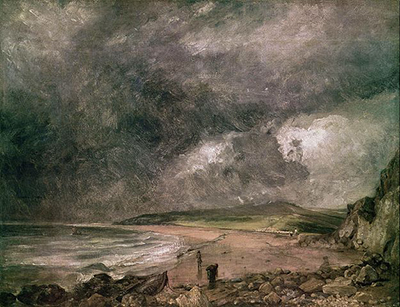
The local image matches the Louvre work: a broad beach, dark sea at the left, a cliff on the right, small figures near the foreground and middle distance, and a huge broken mass of cloud dominating the sky. The viewer is not asked to admire a clear coastal prospect. The eye is made to feel weather arriving.
The V&A's wider introduction to Constable helps place this ambition within his larger practice. It stresses how sketches, drawings, watercolours and earlier paintings fed his major compositions, rather than remaining isolated fragments of observation.[5] The Louvre canvas is exactly that kind of transformation. It preserves the remembered pressure of the Dorset shore while enlarging the subject into a more public and dramatic landscape statement.
From Osmington to the Louvre canvas
The Weymouth subject began with Constable's 1816 stay at Osmington during his honeymoon with Maria Bicknell. The National Gallery records that John Fisher, Constable's friend, married the couple and invited them to stay at his vicarage near Weymouth.[2] From there, paths led down to the beach, Osmington Mills and the coves of Weymouth Bay.[2] Constable made many oil sketches and around twenty drawings and watercolours of the area.[2]
Those facts are the starting point, not the whole explanation. Weymouth Bay with Approaching Storm is a later act of return. The Louvre gives its date as 1818/1819 and says it was painted around those years, then reworked and enlarged toward the end of the 1820s.[1] The painting therefore gathers memory, earlier studies, studio revision and exhibition ambition into one canvas.
This matters because the work's emotional register differs from a honeymoon sketch. The scene is not domestic, playful or nostalgic. Constable turns the Dorset coast into a test of weather drama. If the National Gallery canvas balances beach clarity with restless cloud, the Louvre version pushes harder toward storm, scale and darkness.
Yet the place remains specific. The view still belongs to Bowleaze Cove and the Osmington coast. The beach, cliff and sloping hill are not invented theatre. Constable's storm needs topography. Its drama is convincing because it grips a recognisable stretch of Dorset shore.
Reynolds's later catalogue context is useful precisely because the Louvre painting sits in a complicated chronology: conceived from 1816 material, painted around 1818-19, then physically altered later.[6] It is neither an untouched honeymoon study nor a wholly new late invention. It is a painting with a long memory, shaped across more than one phase of Constable's working life.
Shore, cliff and small figures
The composition holds the viewer low on the beach. Rocks occupy the foreground, while the cliff at the right rises as a rough vertical edge. This closeness to stone and sand gives the painting bodily weight. The storm is not being watched from a safe panoramic distance; it is felt from the exposed shore.
Small figures appear along the beach, dwarfed by the weather. Their presence is important but deliberately minor. They do not turn the painting into a coastal anecdote. Instead, they mark human scale against the vastness of cloud and sea. Constable gives them enough visibility to make the shore inhabited, but not enough to disturb the storm's authority.
The sea occupies the left side with dark, low movement. It is not a smooth marine plane. The surf breaks in pale streaks, and the water feels pulled into the same tonal system as the sky. The storm is not merely above the coast; it is reflected, repeated and answered by the sea.
Jordon Hill and the land beyond catch intermittent light. This is one of the painting's subtler effects. Constable does not make the whole scene uniformly black. Instead, he lets patches of land glow under or beside the cloud mass. Those lights intensify the approaching darkness because they show what the storm is about to overtake.
The cliff on the right gives the composition a hard boundary. It pushes the eye back toward the open bay and the tumultuous sky. Without that cliff, the painting might dissolve into a general storm view. With it, the viewer remains anchored in Bowleaze Cove, under chalk, rock and weather.
The storm as structure
The storm cloud is the painting's great subject. It does not sit politely above the land. It swells, darkens, breaks and rolls across the upper field, changing the meaning of everything beneath it. Constable had always treated sky as active, but here the sky becomes almost architectural. It shapes the whole space.
The National Gallery's related discussion notes that in the Louvre picture the sky is stormy and there are a few more figures than in the National Gallery painting.[2] That understated comparison points to a major transformation. The larger canvas has moved from coastal observation toward atmospheric command. The cloud is not an episode; it is the framework within which beach, hill, cliff and figures exist.
Light still matters. The bright openings within the sky and across the land keep the storm from becoming a flat dark mass. Constable's drama depends on contrast: grey against white, black cloud against lit hill, dark sea against pale surf. The approaching storm is powerful because it is unstable.
This instability is central to Constable's weather art. He was not interested in sky as decorative mood alone. The V&A's account of his sketches stresses his ability to capture transient effects of light and weather, using oil sketching as a way of recording changing conditions.[3] Weymouth Bay with Approaching Storm takes that sketching intelligence into a larger, reworked format.
The painting therefore keeps two qualities in tension. It has the immediacy of weather seen and remembered, but also the deliberation of a canvas revised over time. That tension is not a weakness. It is what makes the work feel both spontaneous and monumental.
Enlargement and revision
The Louvre record contains a crucial technical-history note: the painting was enlarged by Constable himself at the top and left before David Lucas's 1830 engraving reproduced it in its current proportions.[1] The object history adds that it was reworked and enlarged toward the end of the 1820s, after having been exhibited at the British Institution in 1819 in smaller dimensions.[1]
This is not a dry catalogue detail. It changes how the painting should be seen. Constable expanded the canvas where it mattered most: above and to the left, increasing the field of sky and sea. The storm quite literally grew. What may have begun as a more compact exhibition work became a larger atmospheric statement.
The enlargement also shows how long the Weymouth subject remained alive for him. Constable did not simply paint the view around 1818-19 and leave it fixed. He returned to it as his thinking about weather, scale and print translation developed. By the late 1820s, he was working closely with David Lucas on mezzotints, and the Weymouth storm became part of that larger effort to translate landscape into tonal drama.
The expanded canvas therefore belongs to both painting and print history. It is a painted object with its own visible power, but its present proportions were also tied to the version Lucas would reproduce. Constable was not passively handing a finished image to an engraver; he was shaping the image that would carry Weymouth Bay into another medium.
This process distinguishes the Louvre painting from the National Gallery canvas. The National Gallery work is a middle-scale painting rooted close to the Osmington experience. The Louvre picture is a later, darker, enlarged statement, shaped by exhibition history and the print project. The two works speak to each other, but they should not be collapsed into one.
The top-left enlargement is especially telling. Adding height and width in those directions gives more room to the two most volatile parts of the composition: cloud and sea. Constable could have clarified foreground incident or strengthened the cliff instead. By expanding sky and water, he increased the painting's weather-bearing capacity. The storm became not simply an effect within the view, but the scale against which the whole view is judged.
The three Weymouth paintings
The three-painting sequence gives the subject unusual depth. The small V&A sketch is the most immediate storm impression, associated with outdoor painting from nature.[2] The National Gallery canvas is larger, less engulfed by storm, and may have been painted back at the vicarage near the beach.[2] The Louvre canvas is the final, larger and more highly finished version, developed from both earlier works.[2]
That movement from small storm sketch to middle canvas to enlarged Louvre painting is a miniature history of Constable's method. He did not treat studies as disposable preliminaries. He used them as living material. A quick beach impression could become a more ordered canvas, and that canvas relationship could then feed a major storm painting and a mezzotint.
The National Gallery links the Louvre canvas with the British Institution showing of 1819 under the title Osmington Shore, near Weymouth.[2] The Louvre record also places the work in that 1819 exhibition, while specifying that it then appeared before the later additions changed its size.[1] This means the painting's public life began before its final physical form was fixed.
The title history is revealing too. In the later Lucas context, Constable considered alternatives such as “Tempestuous Afternoon” or “Tempestuous Evening”.[2] Those titles pull attention away from topography and toward time, weather and mood. The work could be understood as Weymouth Bay, but also as an hour of storm.
This is why version separation is more than pedantry. Each Weymouth painting answers a different question. The V&A sketch asks how quickly storm can be seized. The National Gallery canvas asks how coastal observation can be organised. The Louvre painting asks how storm can become the commanding architecture of a larger landscape.
That sequence also shows Constable's unusual patience with his own material. He did not merely choose the best sketch and abandon the rest. He let the same coastline produce several related but distinct solutions. In the Louvre painting, the balance shifts decisively from describing a cove to staging a meteorological event. The place remains Bowleaze, but the governing subject is weather.
Lucas and tonal weather
David Lucas's mezzotint after the Weymouth subject belongs to Constable's English Landscape Scenery project. The National Gallery says Lucas made the 1830 print mainly from the Louvre version.[2] The National Gallery of Art in Washington identifies its Weymouth Bay as David Lucas after John Constable, dated 1830.[4]
The print afterlife matters because mezzotint was especially suited to storm. Its velvety darks and capacity for subtle tonal transitions could translate the pressure of cloud, sea and shadow without depending on line alone. The Washington record describes a coast dominated by the upper air, with forceful cloud, active waves and tiny human presence on the shore.[4] Those are precisely the elements that make the Louvre painting so forceful.
Lucas's print also clarifies Constable's interest in the “chiaroscuro of nature”, the play of dark and light that gives weather its structure. In the Louvre painting, the storm is not simply dark. It is made from relationships: cloud against opening, sea against surf, cliff against sky, figures against expanse. Mezzotint could carry those relationships into black-and-white drama.
The print should not replace the painting in interpretation, but it reveals what Constable valued in the subject by 1830. Weymouth Bay had become a lesson in tonal weather. The coast was no longer merely a honeymoon place; it had become a demonstration of how landscape could be constructed from moving darkness and light.
Why the storm version matters
Weymouth Bay with Approaching Storm matters because it shows Constable enlarging weather both physically and imaginatively. The canvas grew at the top and left, and with that growth the storm gained more authority. The painting's present form is therefore inseparable from revision. It is a landscape that became more itself through reworking.
It also matters because it bridges two sides of Constable's art. One side is empirical and local: Osmington, Bowleaze Cove, beach, cliff, hill, sea. The other is atmospheric and ambitious: storm, darkness, enlargement, exhibition and print. The Louvre painting holds both together. It never becomes an invented sublime scene detached from place, but it also refuses to remain a modest coastal record.
Within the wider Constable sequence, the painting shows that his concern with sky and weather did not belong only to Hampstead cloud studies or late expressive works. It was already present in the Weymouth material, pressed into the specific conditions of a Dorset shore. The storm is observed, remembered, revised and amplified.
The result is one of Constable's most compelling coastal statements. Small figures stand beneath a sky that seems to move faster than human time. The sea darkens, surf breaks, land catches brief light, and the cliff fixes the viewer at the edge of the weather. The painting does not merely show an approaching storm. It shows Constable discovering how storm itself could organise a landscape.
Frequently Asked Questions
Discussion
Where does this painting's coastal force lie most strongly: in the storm mass, surf, cliff edge, small figures, or history of enlargement?
Reader Insights
How do the waves and cloud strokes turn the whole coast into one moving system?
How does the added canvas at the top and left intensify the storm's control of the composition?
What changes when RF 39 is seen beside the small V&A sketch and National Gallery NG2652?
Join the Conversation
Share your reading below.
References
- Louvre, La baie de Weymouth à l'approche de l'orage, https://collections.louvre.fr/ark:/53355/cl010063041
- National Gallery, Weymouth Bay: Bowleaze Cove and Jordon Hill, https://www.nationalgallery.org.uk/paintings/john-constable-weymouth-bay-bowleaze-cove-and-jordon-hill
- Victoria and Albert Museum, “John Constable's sketches,” https://www.vam.ac.uk/articles/john-constables-sketches/
- National Gallery of Art, Washington, David Lucas after John Constable, Weymouth Bay, https://www.nga.gov/artworks/55387-weymouth-bay
- Victoria and Albert Museum, “John Constable – an introduction,” https://www.vam.ac.uk/articles/john-constable-an-introduction
- Graham Reynolds, The Later Paintings and Drawings of John Constable, Paul Mellon Centre for Studies in British Art, Yale University Press.