 by Tom Gurney
Tom Gurney BSc (Hons) is an art history expert with over 20 years experience
Published on June 19, 2020 / Page Updated on November 5, 2026
Email: tomgurney1@gmail.com / Phone: +44 7429 011000
Introduction
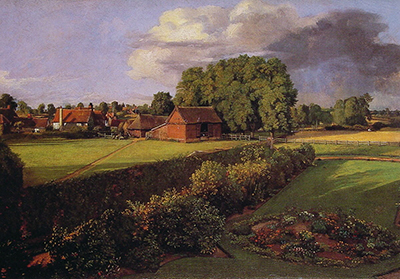
John Constable's Golding Constable's Flower Garden is one of his most intimate views of East Bergholt. It looks out from the family home across a garden, a hedge, farm buildings, village houses, trees and fields, with a large evening sky gathering over the scene. The painting is small, but it opens like a memory: domestic ground in the foreground, working and village life beyond, and the Suffolk air binding them together.
Art Fund identifies the work as Golding Constable's Flower Garden, by John Constable, dated 1815, oil on canvas, measuring 33.1 by 50.7 centimetres and held at Christchurch Mansion, Ipswich.[1] Ipswich Borough Council's Constable collection highlights specify August 1815 and record that the painting was acquired through the Ernest E Cook Bequest via the National Art Collections Fund.[2] Wikimedia/Art UK image metadata gives the closely matching dimensions of 33 by 50.8 centimetres and the accession number R.1955-96.1 for Ipswich Borough Council Museums and Galleries.[3]
The subject is not a famous river bend or a public landmark. It is the garden of Constable's father, Golding Constable, at East Bergholt House, the family home where the artist had grown up. Yet the painting is more than a private view. It shows how Constable could make a familiar domestic landscape carry weight, structure and feeling without forcing it into drama.
At a Glance
- ArtistJohn Constable (1776–1837)
- TitleGolding Constable's Flower Garden [1]
- Date1815; Ipswich specifies August 1815 [2]
- MediumOil on canvas [1][2]
- DimensionsApproximately 33.1 × 50.7 cm [1][3]
- CollectionChristchurch Mansion, Ipswich [1][2]
- AccessionR.1955-96.1 [3][4]
- AcquisitionErnest E Cook Bequest via the National Art Collections Fund, 1955 [1][2]
- ViewpointAn upper window or the roof of the Constable family home [1]
- Paired workGolding Constable's Kitchen Garden; a related but separate object [5]
Contents
- Introduction
- Object Identity
- The View from East Bergholt House
- Flower Garden and Kitchen Garden
- August 1815 and Family Feeling
- Foreground Flowers and Distant Village
- Sky, Shadow and Viewpoint
- Early Constable and the Meaning of Home
- Why the Painting Matters
Object identity
The secure object is the Ipswich painting Golding Constable's Flower Garden, dated 1815 and more specifically August 1815 in the local collection listing.[2] Its medium, dimensions and 1955 acquisition history are confirmed by Art Fund and by the Art UK-linked image metadata on Wikimedia Commons.[1][3][4] The work belongs with the important group of Constable holdings at Christchurch Mansion, which Ipswich describes as one of the world's major collections of his work and the only place in his own region where his paintings can now be seen.[2]
The local image corresponds to this object. The foreground is filled by a dark garden edge and beds of flowers, with a path or lawn cutting across the right. Beyond the hedge are red-brick buildings, village roofs, trees and open fields. The sky is broad and animated, with light cloud and darker weather massing above the garden.
The title needs careful handling because another closely related painting, usually called Golding Constable's Kitchen Garden, belongs to the same pair.[5] The two garden paintings were conceived as a panorama, but they are not interchangeable. The Flower Garden concentrates on the decorative and domestic part of the grounds, while the Kitchen Garden extends the sequence toward vegetables, labour and harvest. The second picture deserves its own treatment; here the focus stays on the flower garden and its place within the paired view.
The view from East Bergholt House
Art Fund states that the painting shows the view from Constable's parental house in Suffolk and was painted from an upper window or from the roof.[1] That high viewpoint is one of the picture's most distinctive features. We do not stand in the garden looking across it at eye level. We look down and out, as though from within the house itself.
This matters because the painting is not only about what is seen, but about where seeing begins. The family house is absent from the image because the viewer occupies its position. The garden lies below, the village stretches beyond, and the sky opens above. The whole painting depends on the house as an unseen point of origin.
East Bergholt House was central to Constable's early life. The East Bergholt Society describes it as the Constable family home, later sold after Golding Constable's death and pulled down around 1840, with parts of the stable, coach and laundry range surviving.[8] That later loss gives the garden paintings a special documentary charge. They preserve views from a house that no longer stands.
The composition also explains why Constable kept returning to this ground. The view gathers private garden, working farm, village, fields and weather into one continuous landscape. Nothing has to be invented. The painter already has a world below his window, dense with family, labour, affection and memory.
The absent house also creates an unusual intimacy. In many landscape paintings, a building appears as an object to be admired from outside. Here the most important building is behind the viewer. Constable lets the house organise the view without showing its façade. The painting therefore feels less like a portrait of property than a view from within family life, where garden and village are seen from a habitual domestic position.
That position gives the work a different character from the later Stour paintings. At Flatford, Constable often looks across or along working river scenery, with barges, locks and mills giving the landscape public movement. In the Flower Garden, the movement is quieter. The eye passes from planted beds to hedge, meadow, buildings and sky, as though following the daily geography of a household rather than the traffic of a river.
Flower garden and kitchen garden
The Flower Garden was made as one half of a panoramic pair. Art Fund explains that it was conceived with the Kitchen Garden, moving from the village at the left of the Flower Garden to the refectory and houses at the right of the Kitchen Garden.[1] The paired Kitchen Garden, also at Christchurch Mansion, is dated c.1815 by Art Fund and listed by Ipswich as July 1815.[2][5] Together they build a sweep across the grounds behind Golding Constable's house.
The distinction between the two gardens is more than horticultural. The flower garden carries associations of ornament, domestic order and family feeling. The kitchen garden carries stronger associations of work, provision and the household economy. Constable places them in relation, not opposition. Beauty and use belong to the same family landscape.
The National Gallery of Australia archive, discussing a related drawing of the kitchen garden at Golding Constable's house, makes this relationship especially clear. It describes a view drawn from a first-floor window at the back of the house, with the flower garden associated with Constable's mother and the kitchen garden associated with his father.[6] It also notes the rectory connected with Maria Bicknell and the mill where Constable had once worked on the horizon.[6] The garden scene therefore joins family, courtship and work in a single field of vision.
In the Flower Garden painting, those meanings are quieter but still present. The foreground flowers are not mere decoration. They mark the cultivated domestic zone closest to the house, while the buildings and fields beyond point toward the family's wider life in the village and its agricultural economy.
The two paintings also reveal how precisely Constable could divide a continuous view into related emotional zones. The Flower Garden has more shade, ornament and enclosure; the Kitchen Garden, according to Art Fund, includes the productive ground, workers and harvest beyond.[5] One turns inward toward the family's planted domestic space, while the other opens more fully toward provision and work. Together they make the family estate feel both cherished and useful.
This pairing is one reason the Flower Garden should not be isolated as a pretty fragment. It is a finished painting in its own right, but it gains depth from the adjacent view. Constable was not selecting a picturesque corner and ignoring the rest. He was working across a remembered and inhabited terrain, separating flower garden and kitchen garden while allowing each to complete the other.
August 1815 and family feeling
The 1815 date gives the painting particular emotional force. The Guardian's account of the 2015 Christchurch Mansion exhibition links the two garden paintings with a difficult year for Constable's family: his mother, Ann Constable, died in March 1815, and his father Golding was in declining health before his death the following year.[7] The Garden Museum gives the same broad context, describing the summer of 1815 as unsettled by Ann's death and Golding's failing condition.[8]
This context should be used with care. The painting is not a melodrama about grief, and it does not need to be reduced to biography. Its power comes from the way feeling is held inside the view. The garden is ordered, the fields are sunlit, and the sky is beautiful, yet the long shadows and dark cloud give the scene a muted gravity.
The timing also explains why the painting feels retrospective even though it was made from immediate observation. Constable was looking at a familiar garden at a moment when the family world around it was changing. Ann was gone; Golding would die in 1816; the house would later leave the family and eventually disappear. The view was still present, but already vulnerable.
That vulnerability gives the picture much of its tenderness. Constable does not sentimentalise the garden. He does not fill it with figures or anecdote. Instead, he records the structure of the place: the flower beds, the hedge, the buildings, the village and the weather above them. The feeling comes through exactness.
There is a quiet discipline in that restraint. A less controlled picture might have advertised grief through obvious symbolism or darkened the garden into an emblem. Constable does something subtler. He allows ordinary forms to remain ordinary: flowers, walls, roofs, trees, fields, cloud. Their poignancy comes from the knowledge that they belong to a family world under pressure, not from any theatrical device laid over them.
Foreground flowers and distant village
Art Fund singles out the small strokes of colour used for the flowers and foliage in the foreground, as well as the luminosity of the fields and sky.[1] Those details are essential to the painting's effect. The foreground is dark and busy, full of small accents that make the garden feel planted, tended and alive.
The flower beds are not shown as a neat botanical display. They are dense, slightly shadowed and partly absorbed into the lower edge of the picture. That gives them immediacy. The viewer feels the garden close below the window, almost too near to take in fully. It is a known place seen from above rather than an idealised flower piece.
Beyond the garden, the buildings bring the painting into a wider social world. Red-brick walls and roofs catch the light, while the village stretches across the left and centre. These structures prevent the view from becoming purely pastoral. Constable is painting a lived village landscape, not a secluded garden fantasy.
The fields beyond the buildings add another register. They connect the domestic grounds with agriculture, harvest and the economy that had shaped the Constable family. Golding Constable was not simply the owner of a garden; he was a prosperous miller and corn merchant whose life was tied to land, grain and transport. The painting lets that world remain visible without turning it into a business portrait.
This balance between affection and structure is central to the picture. The flowers provide colour and closeness, but the village buildings prevent the scene from closing into private nostalgia. The fields bring scale, while the sky supplies movement and time. Constable's achievement is to keep all these registers active at once. The garden remains a garden, but it also becomes an introduction to the larger East Bergholt world.
Sky, shadow and viewpoint
The sky occupies a large part of the picture and changes the mood of the garden. It is not the storm drama of later Constable works, but neither is it a blank summer background. Pale blue, warm cloud and darker masses gather over the fields, making the garden feel caught in a particular hour.
The foreground shadows are just as important. They darken the flowers and hedge, so that the brightest passages often lie beyond the immediate garden. This creates a gentle emotional tension. The domestic foreground is close and cherished, but the light seems to move outward across fields and village, away from the viewer's position.
The high viewpoint intensifies that tension. Looking down from an upstairs position, Constable can join near and far more tightly than a ground-level view would allow. The garden, buildings and fields appear as interlocking planes. The result is almost map-like, but not dry. The view is structured, yet it breathes.
This angle also shows Constable's observational confidence in 1815. He does not need a conventional path leading the viewer into depth. Instead, he builds depth through overlapping zones: flower garden, hedge, meadow, farm buildings, village, trees, fields and sky. The painting feels clear because each band of the landscape has its own weight.
Early Constable and the meaning of home
Golding Constable's Flower Garden belongs to the same year as Boat-Building near Flatford Mill and close to the Suffolk works in which Constable was beginning to turn personal knowledge into serious landscape painting. The V&A's account of Constable's early life notes that he was born at East Bergholt, worked in the family business from 1792, and first developed as an artist through local instruction and exposure to older painting.[9] The garden view stands at the meeting point of those experiences.
It is local, but not provincial. Constable is using the material closest to him to solve large artistic questions: how a landscape can be both observed and composed; how a familiar place can carry emotional meaning; how ordinary fields, buildings and gardens can be made pictorially serious. The answer is not spectacle. It is concentration.
The painting also differs from later images of Constable Country because it has not yet been turned into public myth. East Bergholt, Flatford and Dedham would become famous partly because Constable painted them. In 1815, this garden was still primarily a family place. Its later fame depends on the care with which he saw it before it became famous.
That makes the picture one of the quiet keys to Constable's art. The artist's mature landscapes often look outward to river work, weather, mills, cathedrals and larger public ambitions. Here he looks from home itself. The whole scene begins with a domestic threshold, and the world expands from there.
Why the painting matters
Golding Constable's Flower Garden matters because it shows Constable making a major emotional subject out of a private view. The painting is not large, and its subject is not grand. Yet it brings together family, garden design, village life, agriculture, memory and weather with remarkable compression.
It also matters as half of a carefully related pair. The Flower Garden and Kitchen Garden together form a panoramic memory of the grounds behind East Bergholt House, but each has its own emphasis. The Flower Garden is the more intimate and shadowed of the two, the one in which colour, ornament and family feeling press closest to the unseen house.
The picture should not be mistaken for a simple charming garden scene. Its charm is real, but it is crossed by time. The family home would be sold and demolished, Ann and Golding Constable would soon belong to memory, and the view itself would become a record of a vanished domestic world. Constable's achievement was to preserve that world without embalming it. Flowers, buildings, fields and clouds still seem alive.
That liveliness is the deepest reason the painting endures. Constable does not ask the garden to become grander than it is. He looks at it long enough, and from the right place, for its seriousness to emerge. The result is one of his most personal Suffolk landscapes: a family garden, seen from above, becoming a whole world.
Frequently Asked Questions
Discussion
What gives Golding Constable's Flower Garden its strongest sense of home: the high viewpoint, close flowers, village buildings, distant fields, shifting sky, or the relationship between them?
Reader Insights
How does the unseen family house shape the way the garden and village are experienced?
What changes when this intimate half of the panorama is considered beside the separate productive garden?
How do ordinary flowers, roofs, fields and clouds carry the family pressures of 1815?
Join the Conversation
Share your reading below.
References
- Art Fund, Golding Constable's Flower Garden, https://www.artfund.org/our-purpose/art-funded-by-you/golding-constables-flower-garden
- Ipswich Borough Council, “The Constable collection,” https://www.ipswich.gov.uk/leisure/arts-and-entertainment/museums-and-galleries/christchurch-mansion/constable-collection
- Wikimedia Commons, John Constable Golding Constable's Flower Garden.jpg, https://commons.wikimedia.org/wiki/File%3AJohn_Constable_Golding_Constable%27s_Flower_Garden.jpg
- Wikimedia Commons, Constable - Golding Constable's Flower Garden,1815, R.1955-96.1.jpg, https://commons.wikimedia.org/wiki/File%3AConstable_-_Golding_Constable%27s_Flower_Garden%2C1815%2C_R.1955-96.1.jpg
- Art Fund, Golding Constable's Kitchen Garden, https://www.artfund.org/our-purpose/art-funded-by-you/golding-constables-kitchen-garden
- National Gallery of Australia archive, Kitchen garden at Golding Constable's house, https://digital.nga.gov.au/archive/exhibition/constable/detail.cfm%3Firn%3D145049%26bioartistirn%3D18283%26mystartrow%3D13%26realstartrow%3D13%26mnuid%3D2.html
- Maev Kennedy, “Garden state: Constable's paintings of home reveal his emotional side,” The Guardian, 16 June 2015, https://www.theguardian.com/artanddesign/2015/jun/16/constables-gardens-review-john-constable-paintings-christchurch-mansion-ipswich
- Garden Museum, “The Garden in Art History: Constable's Garden,” https://www.gardenmuseum.org.uk/film/the-garden-in-art-history-constables-garden/
- Victoria and Albert Museum, “John Constable – an introduction,” https://www.vam.ac.uk/articles/john-constable-an-introduction