 by Tom Gurney
Tom Gurney BSc (Hons) is an art history expert with over 20 years experience
Published on June 19, 2020 / Page Updated on November 5, 2026
Email: tomgurney1@gmail.com / Phone: +44 7429 011000
Introduction
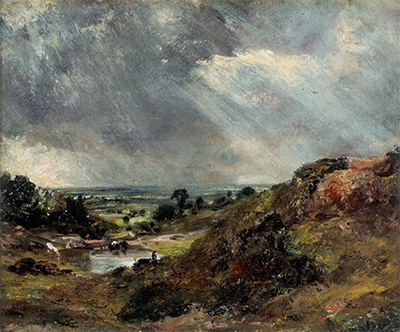
John Constable's Branch Hill Pond, Hampstead is one of the first paintings to show what Hampstead could offer him. It is small, rough, swift and charged with weather. A pond sits low in the landscape, the ground rises steeply at the right, a distant view opens beyond the heath, and the sky presses down in dark, rain-heavy masses. Nothing in the painting is grand in the usual sense. Its force comes from the way a modest place becomes a testing ground for air, light, distance and feeling.
The Victoria and Albert Museum identifies the work as Branch Hill Pond, Hampstead, an oil painting by John Constable, painted in 1819 and now in the V&A's Prints, Drawings & Paintings Collection.[1] The museum number is 122-1888, and the work was given by Isabel Constable in 1888.[1] The V&A also records an inscription on the stretcher dating it to the end of October 1819.[1] That date matters. Constable had moved to Hampstead for the first time only a short while earlier, and Branch Hill Pond quickly became one of the motifs through which he learned the place.
This is not the later Tate picture made for Jack Bannister, nor the 1828 exhibition painting now in the V&A, nor the Cleveland Museum of Art's larger 1828 version. It is the earlier study: a compact oil on canvas, about 254 by 300 millimetres, from which Constable developed a whole family of Branch Hill compositions.[1][4][5][6] It should be seen as a beginning rather than as a simplified version of a later work.
At a Glance
- ArtistJohn Constable (1776–1837)
- TitleBranch Hill Pond, Hampstead [1]
- Date1819 [1]
- InscriptionEnd of Octr. 1819 on the stretcher [1]
- MediumOil on canvas [1]
- DimensionsEstimated 254 × 300 mm [1]
- CollectionVictoria and Albert Museum, Prints, Drawings & Paintings Collection [1]
- Museum number122-1888 [1]
- CreditGiven by Isabel Constable, 1888 [1]
- RoleBasis for several later Branch Hill paintings [1]
Contents
- Introduction
- Object Identity
- Hampstead in 1819
- Pond, Bank and Distance
- Weather as Structure
- Oil Sketch and Later Painting
- The Branch Hill Sequence
- Apart from the Cloud Studies
- Why the Painting Matters
Object identity
The V&A record gives the painting its secure identity. It is an 1819 oil on canvas, museum no. 122-1888, with estimated dimensions of 254 by 300 millimetres.[1] Its title is recorded as Branch Hill Pond, Hampstead, and the object history connects it with Isabel Constable's 1888 gift.[1] The physical description is spare, but the essentials are enough: a small oil painting, made at Hampstead, dated by an inscription to late October 1819.
The V&A also states that Constable moved to Hampstead in the summer of 1819 and that Branch Hill Pond became one of his favourite subjects.[1] It adds that he based several larger paintings on this sketch.[1] That is the key relationship. The work is not merely one more Hampstead view. It is a seed image, a small painted observation that later became a standard composition in his Hampstead practice.
The visible structure matches that role. The pond lies at the lower left, dark and reflective but not picturesque in a polished way. The bank at the right rises roughly, carrying brushwork that is thicker, darker and more bodily than the distant landscape. The middle distance opens toward fields, trees and low settlement. Above all of this, the sky shifts between gloom and brightness, making the whole painting feel caught in unsettled weather.
The painting's smallness should not be mistaken for slightness. Constable often used small oil studies to work through visual problems that later became larger compositions. In this case, the problem was Hampstead itself: how to paint a landscape close to London that still felt open, wild and atmospheric, without turning it into either city view or pastoral nostalgia.
Hampstead in 1819
Hampstead entered Constable's life at a decisive moment. The V&A's historical context for the 1819 painting notes that he exhibited A Scene on the River Stour, now better known as The White Horse, at the Royal Academy that year; that his second child, Maria Louisa, was born in July; that he first took a house at Hampstead toward the end of summer; and that he was elected Associate of the Royal Academy on 1 November.[1] Branch Hill Pond, Hampstead belongs to that compressed year of family, ambition, recognition and new looking.
The V&A's broader introduction explains why Hampstead mattered. Constable needed London for his career, but central London did not suit him, and the family eventually settled in Hampstead from 1827 onward.[2] Even before that permanent move, Hampstead offered him a retreat at the edge of the city: close enough to London for professional life, open enough to give him sky, heath, ponds, lanes and long views.
That in-between condition is central to the painting. Branch Hill Pond is not Suffolk, and Constable does not pretend that it is. The view lacks the deeply personal river economy of Flatford and Dedham. There are no Stour barges, mills or locks to bind the landscape to family trade. Instead, Hampstead gives him a different kind of subject: rough urban edge, high ground, sudden weather and a view westward or north-westward over open country.
The painting therefore marks an expansion rather than a replacement. Constable did not stop being the painter of the Stour Valley when he came to Hampstead. He found another landscape in which observation could become personal. The pond, bank and sky gave him a new local language, less rooted in childhood but intensely available to daily looking.
Pond, bank and distance
The composition is simple but very carefully weighted. The pond occupies the lower left, catching darkness and light in a compact patch of water. It is not a broad reflective lake, nor a decorative foreground pool. It is a small, practical piece of ground-water, tucked into the heath and partly absorbed by the surrounding earth. Its modest scale is part of the painting's honesty.
The right bank is the painting's strongest physical form. It rises steeply, almost abruptly, and its dark surface pushes against the sky. Constable uses it to make the view feel bodily. The viewer is not floating above Hampstead in a clean panorama; the eye is placed beside uneven ground, scrub, rough vegetation and sloping earth. The bank gives the scene resistance.
Beyond the pond and bank, the landscape opens outward. The distant fields and low horizon pull the eye away from the immediate foreground and into space. This outward opening is one of the reasons Branch Hill became so useful to Constable. The motif allowed him to join near roughness with far distance, weather with topography, and a local pond with a broad view beyond the heath.
The middle distance is painted with enough abbreviation to keep the eye moving. Trees, fields and buildings appear as tonal notes rather than finished description. That looseness keeps the painting alive. Constable is less interested in counting details than in holding together the experience of being there: wet ground, a rising bank, a clearing horizon and sky in motion.
The result is a landscape built from contrasts. Low water and high bank, dark cloud and pale opening, near texture and far view, compact canvas and spacious weather all work against one another. In that friction, Hampstead becomes more than a local subject. It becomes a place where Constable can test how much atmosphere a small painting can carry.
Weather as structure
The sky is not an accessory in Branch Hill Pond, Hampstead. It is the force that organises the whole scene. Dark cloud comes across the upper left and centre, while paler cloud and light open toward the right. The land below seems to wait under that shifting pressure. The painting does not need a dramatic storm narrative; its drama lies in changing conditions.
The V&A introduction places Hampstead at the centre of Constable's early-1820s work on clouds and atmospheric effects.[2] That context should not swallow the 1819 painting into the later cloud-study campaign, but it helps explain why this subject mattered. Hampstead gave Constable wide skies close to home, and Branch Hill Pond gave those skies a landscape structure beneath them.
The Cleveland Museum of Art's 1828 Branch Hill Pond, Hampstead later describes Constable as an amateur meteorologist and stresses his close attention to cloud formation, weather and natural light.[6] That later painting is not the 1819 V&A sketch, but the relationship is useful. The Branch Hill composition remained tied to weather. Even as Constable enlarged and varied it, the sky continued to carry the emotional weight.
In the 1819 painting, the weather is still compact and immediate. The brushwork has the quickness of direct response. Dark blue-grey and smoky cloud are dragged across the upper field; pale passages break through them; the distant land catches intermittent light. The pond, small as it is, helps register the atmosphere by holding a dark reflection below the sky.
This is where Constable's Hampstead practice becomes distinct from simple topography. The painting is a record of place, but it is also a record of conditions. Branch Hill Pond is not just where the view is. It is where the weather is being understood.
Oil sketch and later painting
The V&A's account of Constable's oil sketches explains that he often used small works to capture changing light and movement quickly and freely, later drawing on them when planning larger compositions.[3] The museum says plainly that the 1819 Branch Hill Pond, Hampstead became the basis for several larger paintings.[1] That gives the work a double identity: it is a finished observation in itself and also a point of departure.
Its scale encourages that reading. At roughly 254 by 300 millimetres, it is small enough to feel close to the act of looking.[1] The brushwork is not polished into exhibition smoothness. Forms are compressed, edges remain open, and colour does much of the work that detail might do in a larger painting. The study is serious precisely because it leaves the experience fresh.
Constable's oil-sketch method also helps explain the painting's roughness. The V&A notes that in his smaller works one can often see rapid handling, colours blended directly on the sketch and a concern with immediate mood and effect.[3] Branch Hill Pond, Hampstead fits that understanding even though it is oil on canvas rather than one of the paper/card examples discussed elsewhere. The important point is not the support alone, but the way the work preserves speed, pressure and atmospheric decision.
The later versions show that Constable did not treat this view as a passing accident. The National Gallery of Australia archive records that he first painted the Branch Hill view in October 1819 and that it became one of his standard Hampstead compositions, repeated with variations in later works, including versions around 1825, two in 1828 and a final Hampstead/rainbow picture in 1836.[5] The 1819 work is therefore the beginning of a long pictorial conversation.
That sequence matters because it corrects a common misunderstanding. A small early oil is not necessarily an inferior preliminary. In Constable's hands, it could be the core from which a family of paintings grew. The freshness of the 1819 study was not discarded; it was returned to, rethought and enlarged.
The Branch Hill sequence
The later Branch Hill paintings clarify what Constable found in the motif. The 1828 V&A painting, Hampstead Heath, Branch Hill Pond, is a larger oil on canvas showing the heath, the pond, a horse and buggy and figures in the foreground.[4] The V&A record says it is based on an oil sketch and connects it with one of the two paintings called Landscape that Constable exhibited at the Royal Academy in 1828.[4] It may also be the work praised for rich colour and the effect of light after a shower.[4]
The Cleveland Museum of Art owns another 1828 Branch Hill Pond, Hampstead, a larger canvas measuring 60.6 by 78.1 centimetres.[6] Cleveland's description emphasises dark rain clouds, weather effects and natural light, while noting that the figures and labourers remain subordinate to the atmosphere.[6] That later treatment makes explicit something already present in the 1819 study: human or local incident matters less than the sky's command over the whole view.
The Tate-related variant discussed by the National Gallery of Australia archive adds another thread. It records a c.1825-28 Branch Hill Pond, Hampstead Heath, with a boy sitting on a bank, associated with the actor Jack Bannister, who wanted a landscape in which he could feel the wind on his face.[5] That material is fascinating, but it should not be attached to the 1819 V&A painting as if it were the same object. It belongs to the later life of the composition.
Taken together, the versions show how flexible the Branch Hill design became. Sometimes the emphasis falls on a boy, sometimes on a cart and labourers, sometimes on a larger post-shower landscape, sometimes on the sky. The constant is the relation between pond, slope, distance and air. Constable found a structure that could accept variation without losing identity.
This is why the 1819 painting deserves attention in its own right. It is the earliest fixed point in a chain of later decisions. The rough bank, small pond and turbulent sky are not minor ingredients waiting to be improved. They are the original terms of the problem.
Apart from the cloud studies
Because Hampstead is so closely associated with Constable's cloud studies, Branch Hill Pond, Hampstead can easily be misread as simply another step toward sky painting. That would be too narrow. The sky is central, but the painting is not a pure cloud study. It is a landscape in which sky, water, ground and distance depend on one another.
The difference is important. In a cloud study, the land may be almost absent or reduced to a small anchoring strip. Here, the land has weight. The bank at the right is as necessary as the cloud above it. The pond is small, but it gives the weather somewhere to fall and reflect. The distant view gives the sky scale. The painting is meteorological and topographical at once.
Mark Evans's Constable's Skies remains relevant because Hampstead weather is part of the subject, and Constable's attention to sky was never merely decorative.[7] But this article's centre is the Branch Hill composition, not the cloud-study campaign as a whole. The question is how a particular Hampstead place taught Constable to combine rough ground and changing sky.
That combination explains the painting's staying power. It feels spontaneous, but not shapeless. It feels local, but not narrow. It belongs to Hampstead, yet it opens toward the broader weather language that would matter increasingly in Constable's later work.
Why the painting matters
Branch Hill Pond, Hampstead matters because it catches Constable at the moment when Hampstead begins to become his second great landscape territory. Suffolk remained the deepest ground of memory and affection, but Hampstead offered something different: a place near London where the sky could be studied daily and where small views could become laboratories of weather.
The painting also matters because it shows how modest subjects could generate ambitious thinking. A pond, a slope and a distant view might seem too ordinary for sustained attention. Constable proves the opposite. He finds in them a structure for light, air and movement. The ordinary place becomes durable because it is precisely observed.
Its later repetition confirms its importance. The Branch Hill motif did not disappear after one small oil study. Constable returned to it across the 1820s and into his late Hampstead work, varying figures, weather, scale and finish. The 1819 painting is the compact origin of that sequence.
Most of all, the work matters for its balance of intimacy and weather. It is small enough to feel close to the hand, but large enough in feeling to open into distance and sky. Hampstead is not idealised into rural dream. It is rough, damp, uneven and alive. In that small field of pond, bank and cloud, Constable found a new way to make landscape breathe.
Frequently Asked Questions
Discussion
What gives this small Hampstead study its greatest force: the low pond, steep bank, distant view, rain-heavy sky, or the balance between them?
Reader Insights
How does the rough bank make the far landscape feel more open and atmospheric?
How do dark cloud, brighter sky and the pond's reflection organise the scene?
What can the small 1819 study preserve that changes in the larger Branch Hill versions?
Join the Conversation
Share your reading below.
References
- Victoria and Albert Museum, Branch Hill Pond, Hampstead, https://collections.vam.ac.uk/item/O84528/branch-hill-pond-hampstead-oil-painting-constable-john-ra/
- Victoria and Albert Museum, “John Constable – an introduction,” https://www.vam.ac.uk/articles/john-constable-an-introduction
- Victoria and Albert Museum, “Constable's oil sketches,” https://www.vam.ac.uk/articles/constables-oil-sketches
- Victoria and Albert Museum, Hampstead Heath, Branch Hill Pond, https://collections.vam.ac.uk/item/O69872/hampstead-heath-branch-hill-pond-oil-painting-constable-john-ra/
- National Gallery of Australia archive, Branch Hill Pond, Hampstead Heath, with a boy sitting on a bank, https://digital.nga.gov.au/archive/exhibition/constable/detail.cfm%3Firn%3D143363%26bioartistirn%3D18283%26mystartrow%3D73%26realstartrow%3D73%26mnuid%3Dsrch.html
- Cleveland Museum of Art, Branch Hill Pond, Hampstead, https://www.clevelandart.org/art/1972.48
- Mark Evans, Constable's Skies: Paintings and Sketches by John Constable, V&A / Thames & Hudson.