 by Tom Gurney
Tom Gurney BSc (Hons) is an art history expert with over 20 years experience
Published on June 19, 2020 / Page Updated on November 5, 2026
Email: tomgurney1@gmail.com / Phone: +44 7429 011000
Introduction
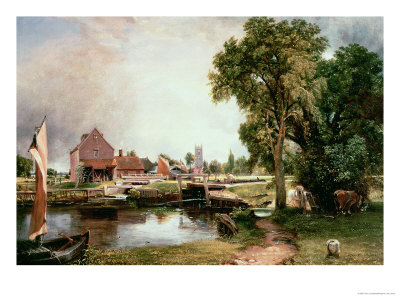
John Constable's Dedham Lock and Mill belongs to the Stour landscape that formed him as an artist, but it is not simply another variation on Flatford. The painting turns toward Dedham, with its mill, lock, church tower, water traffic and river labour. The local image connected with the work shows a broad horizontal scene: a boat and sail at the left edge, the mill and waterwheel left of centre, Dedham church tower in the distance, the lock and river across the middle ground, and horses resting under trees on the right. Everything seems calm, yet the calm depends on work.
The main public identity of the subject is the V&A's Dedham Lock and Mill, dated 1820 and recorded under museum number FA.34[O].[1] The painting needs careful handling because Constable made several related Dedham compositions. There is an 1817 Tate variant, an 1816 V&A oil sketch, a Currier Museum finished version of 1820, and other studies linked to the same motif.[2][3][4][5] This article treats the 1820 finished Dedham subject as the centre, while using the related works to explain Constable's process.
At a Glance
- ArtistJohn Constable (1776–1837)
- TitleDedham Lock and Mill
- Date1820 [1]
- CollectionVictoria and Albert Museum [1]
- Museum numberFA.34[O] [1]
- MediumOil on canvas [1]
- Dimensions53.7 × 76.2 cm [1]
- SubjectDedham Mill, sluice and lock gate on the River Stour [1]
- Topographical markerTower of Dedham church [1]
- Version contextThird and last version of the composition [1]
Contents
- Introduction
- A Dedham Subject within Constable Country
- The Composition
- Mill, Lock and River Work
- Golding Constable's World
- Related Versions and Studies
- Open-Air Freshness and Studio Order
- Sky, Water and Reflection
- Dedham and the Stour Sequence
- Why Dedham Lock and Mill Matters
A Dedham subject within Constable country
Dedham was one of the names that mattered deeply in Constable's early imaginative geography. East Bergholt, Flatford, Dedham, Stratford St Mary and the River Stour were not remote picturesque discoveries. They were the places through which his family business, childhood memory and artistic training intersected. The V&A's account of Constable's Suffolk settings describes the Stour running through East Bergholt and Dedham Vale, and places Golding Constable's Flatford and Dedham mills within a wider network of stores, warehouses, barges and river trade.[6]
That background is essential for Dedham Lock and Mill. The picture does not ask us to look at a mill as a decorative relic. It shows a place where water power, navigation, agriculture and local movement meet. Dedham Mill was part of the same family economy that supported Constable before his art could support him. The result is a landscape both intimate and practical. The painter knew the visual pleasures of the river, but he also knew why the river was being managed.
The subject also has a slightly different emotional temperature from the Flatford works. Flatford often feels close to the family centre: mill, house, lock, dry dock, barge and childhood ground. Dedham opens the view a little. The church tower gives the village a recognisable centre beyond the mill, while the river connects the scene to the larger Stour system. Constable is still painting known country, but he is arranging it with a broader sense of place.
That breadth is important. Dedham gives Constable a composition in which local industry, village identity and open weather can be held in a single glance. The scene is domestic in scale, but not narrow in feeling. It lets the Stour become both a remembered river and a passage through a settled community.
The composition
The composition is built from a strong horizontal spread. At the left, a boat and sail give the scene a vertical accent at the water's edge. Behind and slightly inward, Dedham Mill forms the main architectural mass. The waterwheel is visible under its small roof, making the building's function explicit rather than merely picturesque. Near the centre, the tower of Dedham church rises beyond the mill structures, small but decisive, a topographical marker that fixes the view in the local village world.
Across the foreground and middle distance lies the Stour, its surface carrying reflections of sky, brick, trees and bank. The lock and boats make clear that this is not idle water. The Currier Museum's description of its finished version notes the mill, wheel, church tower, boat sails, clump of trees, tow horses, tow rope and a figure in red working at the lock.[3] These details matter because they keep the painting tied to use. Constable's beauty is made from handled materials: timber, rope, water, brick, animal strength and changing light.
The right side of the painting is anchored by trees and resting horses. They are not grand staffage figures imported from a classical formula. They belong to the working river. Their presence softens the mechanical character of the lock and mill, but it also reinforces the economy of towing and transport. Constable sets them under foliage as living weight, balancing the buildings on the opposite bank and giving the eye a place to rest after travelling across the water.
Mill, lock and river work
The most misleading reading of Dedham Lock and Mill would be to call it merely idyllic. It is peaceful, but it is peaceful in the way a working river can be peaceful between actions. The mill turns grain into flour; boats pass along the Stour; horses rest until they are needed; the lock regulates movement through water levels. The scene is not a retreat from labour. It is labour folded into landscape.
The National Trust's history of the Stour landscape around Flatford is useful here because it explains the importance of locks, lighters and river management within the same family and commercial world.[7] Although Dedham and Flatford are distinct places, the Stour connected them. Golding Constable's business depended on milling and transport, and the river was both a natural feature and a commercial channel. In Dedham Lock and Mill, that dual identity is visible everywhere.
Constable's handling of the subject refuses both crude industry and rural fantasy. The mill is not smoking with modern force, yet neither is it decorative. It sits in the scene as a necessary structure. The lock is not a picturesque accessory, but the device that explains why boats, horses and water are arranged as they are. The church tower beyond adds village identity, but it should not be forced into unsupported symbolism. It is enough to see it as a stable point within a working and inhabited valley.
Golding Constable's world
Golding Constable's role in the painting is not simply biographical colour. The V&A Suffolk account stresses that he owned Flatford and Dedham water mills, as well as associated stores, warehouses and barges, with flour moving along the Stour toward Mistley and then onward toward London.[6] That information changes the visual logic of Dedham Lock and Mill. The elements in the picture are linked by a system of ownership, labour and movement that Constable understood personally.
This does not mean that the painting is a commercial document. Constable was not making a business inventory for his father. He was turning known forms into art. Yet the business world gave those forms weight. A mill beside a river could be painted by anyone as charming scenery; for Constable, Dedham Mill belonged to a network of remembered tasks, expectations and family pressures. His decision to become a painter rather than continue in the family firm sits quietly behind such subjects.
That personal tension helps explain the painting's tenderness. Constable did not reject the Stour world by painting it. He refused one future within it, then returned to it through art. Dedham Lock and Mill is therefore both a landscape of belonging and a landscape of distance. The painter looks at the family world with affection, but from the position of someone who has remade that world into his own vocation.
Related versions and studies
The subject survives through a web of related works. The V&A finished painting of 1820 is the principal anchor for the local image, while the Currier Museum holds another finished version of the same year.[1][3] Sotheby's describes a c.1820 Study for Dedham Lock and Mill as closely related to the signed V&A and Currier paintings, while also noting differences in the boat, horses and roof over the wheel.[4] Such variations are not minor trivia. They show Constable adjusting the mechanics of the picture.
There is also the V&A's 1816 oil sketch, identified in V&A technical material as Dedham Lock and Mill, museum number 145-1888.[5] The Tate variant, dated 1817 and catalogued as N02661, belongs to the same larger Dedham problem but should not be treated as the same physical painting.[2] These related works suggest that Constable returned to the subject across several years, testing viewpoint, detail, degree of finish and the balance between observed immediacy and studio construction.
This version network matters because Dedham Lock and Mill can otherwise seem too serene, too settled. Behind the finished image lies repeated trial. Constable had to decide how far the boat should enter from the left, how clearly to show the waterwheel, how to balance the horses against the mill, how much atmosphere to give the sky, and how to place the church tower so that it reads as part of the village rather than a detached emblem. The finished painting is calm because the problems have been resolved.
Open-air freshness and studio order
The V&A's discussion of Constable's oil sketches explains that he usually painted such studies outdoors in order to capture changing light and movement, then used them later while planning larger compositions.[5] Dedham is a good example of that relationship between direct looking and later order. The 1816 oil sketch preserves the quickness of observation; the finished versions carry that observation into a more composed form.
Sotheby's notes that Constable's c.1820 study relates to a group of full-scale sketches and that these could be used to map a design at the size of the intended finished canvas.[4] That process is important for understanding Constable's art after 1817, when he spent less time in Suffolk and increasingly worked up Stour subjects from London. The finished Dedham paintings are not simple outdoor transcriptions. They are studio landscapes nourished by outdoor memory and earlier studies.
This is one of the reasons Constable's Stour paintings can feel both immediate and deliberate. The reflections, sky and foliage keep the air alive, while the arrangement of mill, lock, boat and horses gives the scene a strong pictorial architecture. He does not choose between freshness and structure. He lets the two correct one another.
Sky, water and reflection
The sky in Dedham Lock and Mill gives the painting more than weather. It spreads light across the water, breaks up the mass of the trees, and prevents the mill from dominating too heavily. The Currier Museum's account of its finished version stresses the varied light created by the sky, the reflections in the millpond and the range of greens across trees and grass.[3] Those observations apply to the subject's central achievement: the working landscape is softened and animated by atmosphere.
Water is equally active. It reflects the sky, but it also explains the lock and mill. Constable makes the Stour beautiful without detaching it from use. The surface can shimmer and mirror brickwork, yet it remains a managed channel through which boats and goods move. This double role gives the painting much of its depth. The water is at once optical, economic and emotional.
The reflections also help hold the composition together. Brick, sail, foliage and cloud are repeated in altered form on the river surface. Nothing appears mechanically symmetrical, but the water creates a second, shifting register of the scene. That register is crucial to Constable's art: the world is observed through forms that are always changing, even when the buildings and banks remain fixed.
Dedham and the Stour sequence
Within Constable's broader Stour sequence, Dedham Lock and Mill sits between early local study and the larger exhibition ambitions of the six-footers. It is not itself one of the great six-foot canvases, but it belongs to the same intellectual world. Mills, locks, barges, horses, church towers, willows and river bends recur across Constable's art because they gave him the vocabulary from which he built serious landscape painting.
Graham Reynolds's study of Constable's early paintings and drawings remains important here because it shows how deeply the artist's mature Stour works depended on the repeated study of East Bergholt, Dedham, Flatford and nearby places before 1816.[8] Dedham was not an isolated subject discovered in 1820. It was part of a long accumulation of local knowledge. Constable's confidence in the finished painting depends on years of looking, drawing and remembering.
The work also helps clarify why the Stour could bear so much artistic weight. The river was narrow in geographical terms, but wide in meaning. It carried family business, childhood experience, courtship memories, village identity, weather, agriculture and transport. In Dedham Lock and Mill, Constable gathers those meanings into a compact scene that feels open rather than crowded.
Boundaries with other Stour paintings
Because Constable returned so often to mills and locks, the distinctions between works matter. The Lock is the later vertical six-footer centred on the operation of Flatford Lock. Flatford Mill from a Lock on the Stour is an earlier lock-view subject tied to Flatford. The Tate painting usually titled Flatford Mill (Scene on a Navigable River) belongs to a different 1816-17 Stour subject. Boat-Building near Flatford Mill concerns the dry dock and barge construction. Dedham Lock and Mill belongs to Dedham and has its own relationship between mill, church tower, lock, boats and horses.
Keeping those boundaries clear strengthens the picture. The painting should not be valued merely because it resembles more famous Stour works. Its distinctiveness lies in the combination of Dedham's village centre and the practical river setting. The church tower is not incidental; the mill is not generic; the lock is not borrowed from Flatford. Constable is painting another node in the same river world.
That distinction also helps us see the range of his local art. Constable did not repeat the Stour because he lacked imagination. He repeated it because each position along the river produced a different problem. Dedham asked for a wider village-and-mill balance than Flatford; Flatford offered family immediacy; Stratford brought another kind of mill landscape; the later lock paintings increased drama and scale. The unity of the sequence depends on such differences.
Why Dedham Lock and Mill matters
Dedham Lock and Mill matters because it shows Constable making a serious landscape from a place that was both familiar and functional. The painting is beautiful, but its beauty is grounded in use. Mill, lock, river, boats and horses belong together. The church tower and trees give the scene a sense of settlement and shade, while the sky and reflections keep it alive.
It also matters because it reveals the depth of Constable's method. The finished calm rests on years of local study and on a network of related versions. The Tate work, the V&A sketch, the Currier version and the c.1820 study all show that Dedham was not a single passing subject. It was a motif Constable tested until he found the right relation between observation, memory and pictorial order.
Most of all, the painting matters because it resists the softest version of Constable. It is tempting to see him only as the painter of English rural peace. Dedham Lock and Mill offers something richer: a river landscape shaped by work, family history, local knowledge and artistic discipline. Its quietness is not emptiness. It is the quiet of a working place seen by an artist who understood both its labour and its light.
Frequently Asked Questions
Discussion
What best explains the calm force of Dedham Lock and Mill: its working-river detail, family history, resolved composition or changing light and reflections?
Reader Insights
Where do mill, lock, boats, horses and controlled water keep labour present beneath the scene's quietness?
Which compositional choices make the V&A painting feel settled after Constable's repeated studies and variants?
How do the church tower and wider village setting give this Stour subject its own identity?
Join the Conversation
Share your reading below.
References
- V&A Explore the Collections, Dedham Lock and Mill, https://collections.vam.ac.uk/item/O17381/dedham-lock-and-mill-oil-painting-constable-john-ra/
- Tate, Dedham Lock and Mill, https://www.tate.org.uk/art/artworks/constable-dedham-lock-and-mill-n02661
- Currier Museum of Art, Dedham Lock and Mill, https://collections.currier.org/objects-1/info?page=3&query=keywordPath+%3D+%22DUNE%22+and+Disp_Obj_Type+%3D+%22Painting%22&sort=0
- Sotheby's, John Constable, Study for Dedham Lock and Mill, https://www.sothebys.com/en/buy/auction/2019/old-masters-day-sale/john-constable-r-a-study-for-dedham-lock-and-mill
- V&A, “Constable's oil sketches,” https://www.vam.ac.uk/articles/constables-oil-sketches
- V&A Blog, “Constable's Country: Inspired by Suffolk Settings,” https://www.vam.ac.uk/blog/constable-the-making-of-a-master/constables-country-inspired-by-suffolk-settings
- National Trust, “History of Flatford,” https://www.nationaltrust.org.uk/visit/suffolk/flatford/history-of-flatford
- Graham Reynolds, The Early Paintings and Drawings of John Constable, Paul Mellon Centre / Yale University Press, 1996, https://www.paul-mellon-centre.ac.uk/publications/browse/9780300063370