 by Tom Gurney
Tom Gurney BSc (Hons) is an art history expert with over 20 years experience
Published on June 19, 2020 / Page Updated on November 5, 2026
Email: tomgurney1@gmail.com / Phone: +44 7429 011000
Introduction
John Constable's The Hay Wain is one of the most familiar paintings in British art, but familiarity can make it harder to see. The picture has been reproduced so often that it can look, at first glance, like a settled emblem of rural England: cottage, river, trees, wagon, horses, meadow and summer cloud. Yet the painting is far more complicated than a pastoral souvenir. It is a work of memory, labour, experiment, ambition and afterlife, made by an artist who knew the place intimately but composed the final canvas in London through years of study and revision.
The National Gallery identifies the painting as NG1207, an oil on canvas made in 1821, measuring 130.2 by 185.4 centimetres and presented by Henry Vaughan in 1886.[1] Those facts already place it in two worlds. It belongs to a precise institutional record, with dimensions, date, medium, provenance and display history. It also belongs to a larger imaginative geography: Flatford, the River Stour, Willy Lott's house, the Constable family business and the wider region that later came to be called Constable country.
Its fame rests partly on the ease with which the image seems to welcome the viewer. The wagon pauses in shallow water. The house leans toward the millpond. Small figures work beyond the river. Trees and sky make the day feel spacious. But the painting's calm is not simple. The final image was built from studies, memories and technical decisions. Its serenity hides, or rather transforms, a demanding process of making.
At a Glance
- ArtistJohn Constable
- Date1821 [1]
- Original titleLandscape: Noon [1]
- MediumOil on canvas [1]
- Dimensions130.2 × 185.4 cm [1]
- SettingFlatford millpond on the River Stour [1]
- Central actionAn empty wain crossing toward haymakers [1]
- Working methodOutdoor studies and a full-scale preparatory oil sketch [1][5]
- Paris receptionSalon success and a gold medal in 1824 [1][2]
- CollectionNational Gallery, NG1207; presented by Henry Vaughan in 1886 [1]
Contents
- Introduction
- A Painting Built from Memory and Place
- What the Picture Shows
- Flatford, Work and Rural Change
- The Title and the Royal Academy
- From Outdoor Study to London Studio
- The Full-Scale Study
- Composition and Balance
- Sky, Light and Weather
- The Six-Foot Sequence
A painting built from memory and place
The scene is the millpond at Flatford on the River Stour. The National Gallery explains that Flatford Mill was a watermill for grinding corn, operated by the Constable family for nearly a hundred years, and that it survives about a mile from East Bergholt, where Constable was born.[1] The house on the left also survives; in Constable's time it was occupied by the tenant farmer Willy Lott.[1] The picture is therefore not an invented rustic dream. It begins from a place bound to Constable's family, childhood and local knowledge.
That local knowledge matters. Constable was not merely visiting a picturesque rural corner. His father, Golding Constable, was involved in milling, agricultural land and the commercial life of the Stour. The National Trust's Flatford material describes Golding as an entrepreneur who inherited Flatford Mill and its flour-milling business, also operating Dedham Mill and owning agricultural land around East Bergholt.[6] The landscape of The Hay Wain is therefore not just scenery. It is a working river landscape, shaped by milling, farming, transport and tenancy.
The National Trust's history of Flatford adds useful specificity to the buildings within this world. Willy Lott's House was originally part of Gibbeon's Gate Farm, and Willy Lott was a tenant farmer who worked the surrounding land.[7] Flatford Mill, meanwhile, belonged to the network of buildings and activities through which the Stour landscape functioned as an economy, not simply as a view. This helps keep the painting honest. Constable's art may be tender, but the setting is not weightless.
The hiddenness of the mill is one of the painting's most subtle decisions. The family business stands just outside full view, represented only by a small red edge. That restraint turns the millpond into the real subject. The painting is not about ownership displayed proudly, nor about industry announced directly. It is about the relations that ownership and labour created: water level, crossing, house, bank, meadow, transport and habit.
This makes the painting's affection more interesting. Constable loved the Stour Valley, but he knew it as an economy as well as a view. The river carried goods, the mill served production, the meadows supported labour, and the cottage belonged to a tenant farmer rather than to a fantasy of rural leisure. The painting turns that world into art without erasing its practical structure.
Graham Reynolds's work on the early paintings and drawings helps explain why this place could become so visually deep for Constable.[9] The Paul Mellon Centre describes Reynolds's catalogue as covering the works from 1790 to 1816, including numerous sketches of the homeland around East Bergholt and Dedham on which later masterpieces were based.[9] The Hay Wain depends on that long preparation. It is not the sudden discovery of a famous view; it is the mature return of a painter to forms he had stored in eye, hand and memory.
What the picture shows
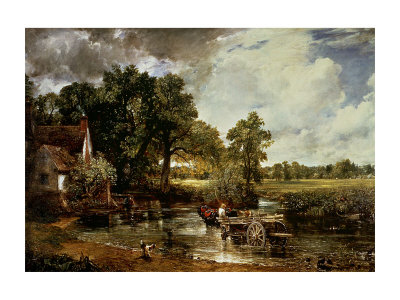
The painting shows an empty wooden wagon, or wain, crossing shallow water near the millpond. The National Gallery explains that the wagon is moving toward a ford across the stream, while haymakers work in the meadow beyond.[1] The title refers to the wagon used for transporting cut and dried meadow grass, which would serve as winter feed.[1] This central vehicle gives the painting its later name, but it also gives the composition a slow forward motion.
The wagon is empty, which matters. A fully laden hay cart would have made a different picture: heavier, more declarative, perhaps more clearly about the harvest itself. Constable chooses the crossing before collection, the moment of going rather than return. The action remains modest. It is a practical transition across water, not a triumphant procession. That modesty is one reason the painting can sustain such fame without becoming theatrical.
The wagon is not rushing. It seems suspended in the water, held between the house at left, the shaded trees, the bright meadow and the open sky. The horses stand partly immersed, the men guide them, and the front wheel turns toward the ford. The sense of movement is small but essential. Without it, the painting might become a static view of cottage and river. With it, the whole scene becomes an interval in work.
Willy Lott's house anchors the left side of the picture. It is not grand architecture. Its white walls, red roofs, chimneys and brick supports make it particular, memorable and irregular. A woman stoops near the water with a pitcher. The house belongs to daily use: doors, windows, steps, water, washing, shade. It gives the picture domestic intimacy, but it also balances the activity of the wagon and meadow.
The woman by the water is small, but she is not incidental. She makes the house active. The building is not an empty emblem of rural charm; it is inhabited, used and connected to the river. Her stooping movement rhymes quietly with the labour in the distant field and the movement of the wagon in the centre. Constable gives the painting several scales of work: domestic, agricultural and transport.
The right side is quieter and more secretive. Reeds, thicket and a small boat partly close the composition. The edge of Flatford Mill appears only indirectly, in a glimpse of red brick at the far right.[1] This is a remarkable decision. The family mill is historically important, yet the painting does not put it at the centre. Constable makes the millpond and its relationships central: house, water, cart, trees, meadow, sky.
Flatford, work and rural change
The painting is often treated as timeless, but it belongs to a specific historical moment. The National Gallery notes that Constable's determination to paint the rural Suffolk landscape of his boyhood in monumental form may have been connected with a sense that this way of life was changing under rapid industrialisation.[1] That does not mean the painting is an illustrated political argument. It does mean that its calm should not be mistaken for historical emptiness.
The painting contains labour, even though it does not dramatise hardship. Haymakers are visible in the distance. The wain exists because hay must be carried. The horses are working animals. The millpond is part of a productive environment. The beauty of the painting is inseparable from this activity. Constable does not present work as heroic struggle, but neither does he remove it.
This restraint is part of the painting's historical intelligence. Constable does not fill the canvas with social explanation, but he gives enough evidence for the viewer to understand that beauty and labour occupy the same field. The far meadow glows, yet the glow falls on people cutting, lifting and stacking hay. The picture is peaceful because of its composition and light, not because nothing is being done.
That balance is easy to miss because the modern image of The Hay Wain has often softened the painting into an emblem of rural peace. The National Gallery's audio description rightly cautions that the scene projects tranquillity at odds with the lived experience of many agricultural workers in the period.[1] The picture does not show riot, poverty or industrial conflict. Its power lies in another register: the transformation of a working local landscape into an image of continuity at the moment when continuity itself was under pressure.
Flatford's survival has also shaped the painting's afterlife. The National Trust describes the hamlet as a place where visitors can still see Flatford Mill, Willy Lott's House, the Granary, Bridge Cottage and the River Stour landscape associated with Constable.[8] This survival gives the painting an unusual relation to place. Viewers can travel to the setting, but the painting is not simply a postcard of what remains. It is a composed memory of a working world that has changed, been preserved, restored and reimagined.
The survival can be both helpful and misleading. It helps because it confirms the specificity of Constable's attachment. It misleads if it encourages the painting to be treated as a transparent view of a conserved heritage landscape. The modern visitor sees a place shaped by later preservation, restoration, tourism and national affection. Constable's painting belongs to a different moment: a family landscape still tied to productive work and personal memory.
The title and the Royal Academy
Constable did not exhibit the painting as The Hay Wain. The National Gallery records that it was sent to the Royal Academy in 1821 under the title Landscape: Noon and that the now-famous title was a nickname given by his friend Archdeacon John Fisher.[1] The catalogue entry expands this point, noting Fisher's use of the phrase when asking about the picture's progress.[2] This title history matters because it shows how a practical motif overtook the original, more general exhibition title.
Landscape: Noon points to time, light and genre. It places the painting within landscape art and asks the viewer to feel a moment in the day. The Hay Wain points instead to the vehicle. It makes the wagon the key to memory. The later title is more concrete and more memorable; it gives the painting an object around which affection can gather.
The 1821 Royal Academy context also matters. The painting was large, ambitious and public. It was not made as a modest private keepsake. The National Gallery places it third in Constable's 1819-1825 Royal Academy run of monumental River Stour subjects.[1] In other words, The Hay Wain was part of a sustained campaign to make the local river landscape bear the scale and seriousness of major art.
The 1821 title also changes the way one thinks about the light. Noon is not a dramatic hour. It is broad, working daylight, a time when labour continues and shadows are shortened rather than theatrical. Constable's noon is not blank glare. It is a changing summer brightness moderated by tree shade and cloud. The title asks us to see the painting as a study of time as well as place.
Seen that way, the later title does not replace the original so much as narrow the point of entry. The Hay Wain gives the viewer a memorable object; Landscape: Noon gives the painter's larger ambition. The best reading holds both together. The wagon makes the picture famous, but the landscape and the hour make the wagon meaningful.
It was greeted favourably but did not sell at the Royal Academy.[1] That fact is central to the painting's early story. The work that later became a national icon did not immediately secure the English success one might expect in retrospect. Constable's career was full of this kind of mismatch: deep conviction, visible achievement and slow institutional reward.
The Royal Academy setting also clarifies why the painting could not remain merely private. Constable had to make a local scene legible to viewers who did not share his memories. The picture had to introduce Flatford as a place with pictorial authority, not simply as a beloved corner of family life. That is why the title, scale and composition all matter so much. They convert local intimacy into exhibition form.
From outdoor study to London studio
One of the most important facts about The Hay Wain is that it was not simply painted on the spot. The National Gallery states clearly that although the picture evokes a Suffolk scene, it was created in Constable's London studio from outdoor studies accumulated across years, followed by a full-scale preparatory oil study.[1] This should change how the painting is understood.
The work feels immediate because Constable knew how to preserve the freshness of observation. But the final canvas is a constructed composition. The house, wagon, boat, water, figures, trees and sky had to be arranged at exhibition scale. Constable had to make a painting that would carry local truth, pictorial balance and public ambition at once.
This is not a contradiction. A painting can be truthful without recording a single uninterrupted moment. In Constable's case, truth often came from returning, comparing and combining. The finished image is a memory structure built from observed parts. Its apparent naturalness is a result of decisions so well integrated that the viewer no longer feels them as separate.
The V&A's account of Constable's sketches explains the broader method. His sketches included studies from nature, effects of light, shade and weather, and studio studies for compositions; the V&A also stresses that he was distinctive in making full-size studio sketches for exhibition paintings.[3] That distinction is crucial. Outdoor study gave Constable visual evidence and vitality. Studio work gave the painting form.
In The Hay Wain, this process is unusually well documented. The National Gallery records that Constable had made many drawings and oil sketches of Willy Lott's farmhouse, with early studies going back to around 1802 and particular reliance on three small oil sketches of the house from 1811.[1] The wagon itself was studied separately around 1820, in a small preliminary oil sketch now at the Yale Center for British Art.[1] The final painting gathered these studies into a single, persuasive whole.
The time span matters. If the earliest related oil study of the house probably dates from around 1802, the final painting is drawing on nearly two decades of attention.[1] That makes the familiar cottage more than a motif. It is a form repeatedly returned to, adjusted and understood. By 1821, Constable was not inventing the scene from memory alone; he was reactivating a long visual relationship.
This accumulated process gives the painting its density. It feels like one scene, but it contains years of looking. The image is not false because it is assembled. It is powerful because the assembly allows long familiarity to appear as a single moment.
The full-scale study
The full-scale oil study is central to the making of The Hay Wain. The National Gallery records that Constable made a full-scale oil sketch to develop the composition before painting the final picture, and that he painted it quickly with large areas of the brown ground left bare.[1] The V&A identifies the full-scale preparatory sketch for The Hay Wain as one of the highlights of its Constable collection.[5]
This large study was not a mere enlargement. It was a working field in which Constable could test the entire composition at scale. The V&A introduction explains that for the large River Stour scenes he adopted the painstaking process of making full-size preparatory oil sketches, using them to organise motifs, adjust colour relations, resolve light and shade, and preserve some of the life of smaller studies.[4] The phrase painstaking is important. The study may look free, but the process was demanding.
The full-scale study also helps reveal what Constable changed. The National Gallery notes that a horse and rider visible in the foreground of the oil sketch were kept in the final picture but painted out at a late stage.[1] The catalogue entry supports this through technical discussion, showing that the final canvas continued to be revised as Constable judged its balance.[2] Such evidence prevents any sentimental idea that the painting simply arrived as a perfect memory. It was argued into shape.
That painted-out rider is especially valuable because it shows restraint. Constable could have accepted a more crowded foreground. Instead, he removed an element that may have interfered with the slower crossing of the wain and the broad curve of the riverbank. The deletion makes the foreground more open and gives the viewer room to enter the scene imaginatively. Absence becomes a compositional gain.
The existence of the full-scale study also alters the relation between roughness and finish. Constable's broad handling was not a failure to complete. It was a way of keeping the large design alive during composition. The final painting needed enough finish to stand at the Royal Academy, but it also needed to retain the pulse of observation. The full-scale study allowed Constable to rehearse that balance.
The V&A's collection context reinforces this point. Its overview stresses that Constable's surviving drawings, oil sketches, watercolours and sketchbooks provide exceptional insight into his process, with the full-scale preparatory sketch for The Hay Wain singled out among the highlights.[5] The finished National Gallery painting is therefore best understood alongside the survival of its working culture. The public image is inseparable from the private labour that prepared it.
The full-scale study also changes how one sees the final surface. The National Gallery painting is more resolved, but it is not inert. It still carries the memory of sketching: white flickers, varied greens, worked cloud, lively water and small accents of colour. Constable did not simply polish the study into convention. He translated its energy into a form that could withstand public exhibition.
Composition and balance
The composition of The Hay Wain is deceptively calm. The left side is weighted by Willy Lott's house and the bank of trees; the middle holds the wagon and horses; the right is closed by thicket, reeds, a small boat and the partial presence of the mill. Above, the sky expands the whole scene. The design gives the viewer a feeling of openness while keeping every important element in relation.
The wagon is central but not isolated. It forms a hinge between domestic space and meadow labour. It faces away from the viewer, so the movement is not theatrical. We are not invited to watch a dramatic arrival. We see a practical crossing, an everyday action made monumental by scale and arrangement.
The curve of the riverbank gives the foreground a soft sweep. The shallow water catches light, darkens under trees and opens toward the ford. The house leans visually into the picture, while the wagon moves away from it. These opposing directions keep the scene from becoming flat. The painting breathes because its parts pull gently against one another.
The centre of the painting is also carefully unsettled. The wain sits in the middle, but it does not dominate by force. The eye moves around it: to the woman's platform, to the horses' heads, to the light meadow, to the dark trees, to the little boat. This circulation makes the composition feel natural, yet it is highly managed. Constable gives the viewer many small reasons to linger.
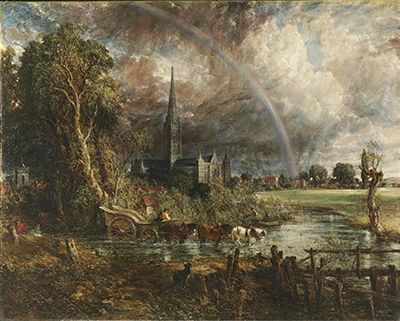
The small boat on the right is especially revealing. The National Gallery notes that it is based on a study Constable made in 1809, used earlier in The White Horse and later in Salisbury Cathedral from the Meadows.[1] It is a small element, but it balances the house and wagon.[1] This is Constable's compositional intelligence at work. A detail that might seem incidental is doing structural labour.
The boat also expands the river's meaning. The wain crosses the water, the woman uses it, the mill depends on it, and the boat rests beside it. The river is not just reflective scenery. It is the common medium of work, movement and visual connection. It gathers the whole painting into relation.
The distribution of figures is equally subtle. The men with the horses are close enough to identify as workers, but not individualised into portraits. The haymakers are distant enough to become part of the field's rhythm, but not so distant that labour disappears. The woman by the house belongs to a domestic scale. These different figure scales keep the painting from becoming a single anecdote. It is a whole rural system observed through a few carefully placed actions.
Wagon, boat and artistic tradition
The wagon itself is more complicated than the title suggests. The National Gallery notes that it does not conform neatly to the usual design of hay wagons or carts of Constable's period; its sides are too low for carting hay and it seems more suited to carrying timber.[1] This should not be treated as an error. It reminds us that the painting is not an agricultural diagram. Constable chose and adapted motifs to serve composition, memory and visual effect.
The National Gallery also connects the wagon with older Flemish and Dutch traditions, especially scenes of carts passing through fords and Constable's admiration for Rubens.[1] The catalogue entry handles this with care, suggesting that Rubens may have acted as a liberating force rather than a model copied directly.[2] That is the right balance. Constable learned from earlier landscape art, but he made the subject his own through local observation.
This matters because Constable's originality did not require ignorance of tradition. He knew that landscape painting had an inheritance, and he studied earlier painters seriously. The difference lies in how he used that inheritance. The older motif of a cart crossing water gave him a pictorial problem worth revisiting; Flatford gave him the emotional and observational ground on which to solve it.
The Dutch and Flemish context helps explain why an unheroic rural event could become a major painting. A cart crossing water is not a noble myth, battle or classical ruin. It is ordinary. But the older landscape tradition had already shown that ordinary movement through land could sustain pictorial seriousness. Constable inherited that possibility and translated it into the Stour Valley.
At the same time, The Hay Wain is not a disguised old-master exercise. Constable's local details matter too much. Willy Lott's house, Flatford millpond, the Stour, the remembered boat, the particular weather and the structure of the meadow all keep the painting grounded. Tradition gives him scale; place gives him necessity.
The Rubens connection is therefore best understood as permission rather than dependence. Constable could admire breadth, movement and compositional largeness in Rubens while refusing to surrender his Suffolk specificity. The wagon may carry echoes of older art, but it crosses Flatford water. The composition may have an inherited nobility, but the details are stubbornly local.
Sky, light and weather
The sky in The Hay Wain is not background. It is one of the painting's active structures. Clouds occupy a large upper field, darkening and opening in ways that control the light below. The meadow glows because the sky permits it; the river feels shaded because cloud and foliage modulate the light; the house gains warmth against surrounding greens and greys.
Mark Evans's Constable's Skies is useful here because it treats the sky as essential to Constable's landscapes rather than as a decorative addition.[10] The book's description emphasises Constable's fascination with English weather and the role of skies across famous works, including The Hay Wain.[10] For this painting, that means the sky is part of the composition's emotional grammar.
The V&A introduction records Constable's belief that the sky was a material aid to landscape composition.[4] In The Hay Wain, that belief is visible. The clouds give scale, time and mood. They prevent the painting from becoming merely a charming arrangement of cottage and cart. The atmosphere makes the scene feel passing and alive.
The sky also regulates the painting's emotional temperature. Too clear a sky would have made the scene merely sunny. Too stormy a sky would have turned it into drama. Constable chooses something more delicate: a breathable, changeable sky that suggests English weather without overwhelming the rural action. The result is a mood of provisional calm.
Constable's weather is restrained here compared with his more dramatic later works. There is no overwhelming storm, no ruined castle under pressure, no cathedral beneath symbolic turbulence. The sky is changeable but not violent. That moderation is part of the painting's character. The scene seems peaceful, but the sky keeps peace from hardening into stillness.
The clouds also prevent the landscape from becoming a set of isolated objects. They connect house, river, meadow and distance through a common atmosphere. Light falls unevenly, and that unevenness lets the scene feel lived rather than staged. The painting's weather is therefore a form of unity.
This is where The Hay Wain quietly prepares the ground for Constable's more concentrated sky work. It is not a cloud study, and it should not be treated as though the upper part alone carries the picture. Yet the painting already shows his belief that the sky is structurally decisive. Without the sky's movement, the millpond would feel too enclosed and the meadow too decorative. The air opens the scene.
The six-foot sequence
The Hay Wain belongs to Constable's group of large Stour paintings, often called the six-footers. The V&A introduction describes this River Stour group as a sequence that includes The Hay Wain and The Leaping Horse, made with the aid of full-size preparatory oil sketches.[4] The National Gallery of Art's exhibition record for Constable's Great Landscapes likewise identifies the six-foot landscape paintings and their full-size oil sketches as the centre of a major modern reassessment.[11]
The six-foot scale changed the meaning of the subject. A smaller view of Flatford might have been understood as topography or private affection. At this size, the Stour becomes a public claim. Constable was asking viewers at the Royal Academy to take his local river landscape seriously as major art.
That claim was both aesthetic and social. A large canvas asks for attention in a crowded exhibition room. It competes with portraits, history subjects and grander forms of landscape. Constable used that scale for a river crossing, a cottage, work horses and a hay meadow. The decision itself argues that ordinary rural life could carry pictorial grandeur.
This ambition is easy to underplay because The Hay Wain now feels beloved and accessible. But in 1821, placing this kind of rural subject on such a scale was not a timid decision. Constable was not merely preserving childhood memories. He was making an argument about what landscape painting could do.
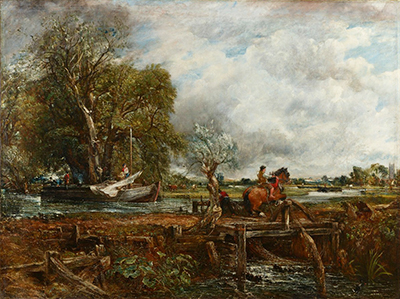
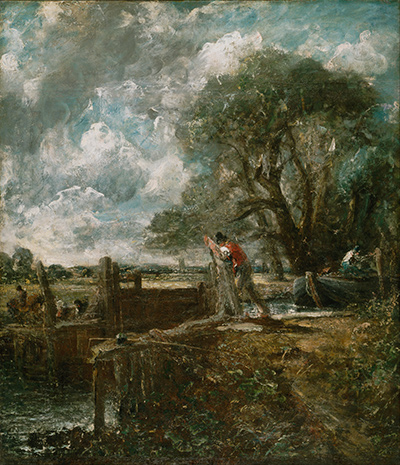
The sequence also shows persistence. The White Horse, Stratford Mill, The Hay Wain, View on the Stour near Dedham, The Lock and The Leaping Horse together form a sustained exploration of Stour motifs, movement, labour, water and atmosphere. The Hay Wain is the most famous member of the group, but it gains depth when seen as one part of this wider campaign.
Modern exhibitions have helped restore that context. The National Gallery of Art records that Constable's Great Landscapes focused on the six-foot canvases and their related full-size sketches, bringing together the finished works and preparatory studies as a central interpretive project.[11] Such a framing is useful because it rescues The Hay Wain from isolation. It becomes not just the famous picture, but one stage in an unusually ambitious method.
Seeing the painting within the sequence also helps correct the assumption that Constable repeated himself sentimentally. The Stour subjects are related, but each poses a different problem of movement, scale and emphasis. The Hay Wain is distinctive because it makes crossing the dominant action while setting the mill almost outside the visible field. Its grandeur is not based on spectacle, but on balance.
London reception and English difficulty
The initial English response to The Hay Wain was not the triumphant story one might expect. The National Gallery records that it was greeted favourably by reviewers at the Royal Academy, but did not sell.[1] The catalogue notes the mismatch between English hesitation and later French admiration.[2] This early uncertainty is important because it keeps the painting's fame from seeming inevitable.
Constable's English career was often marked by slow recognition. His art did not fit neatly into the smooth expectations of much academic landscape painting. His broken handling, local subjects and insistence on direct observation could be admired and resisted at the same time. The Hay Wain sits exactly at that point: praised, noticed, unsold.
The unsold status also changes the emotional tone of the work's history. Today it is difficult to imagine The Hay Wain without prestige. In 1821, Constable had to live with uncertainty. The painting may have represented exactly the kind of landscape he most believed in, but belief did not guarantee a buyer. This gap between artistic conviction and market response runs through much of his career.
The title Landscape: Noon may also have contributed to its original framing. It announced a landscape and a time of day, not an icon. Only later did the wain become the unforgettable centre of identity. The painting's early life reminds us that masterpieces often become famous through a sequence of re-readings, not through instant consensus.
Even the favourable reviews need careful interpretation. Admiration for the painting's natural look did not automatically translate into purchase or institutional reward. Constable's desire for serious recognition in England remained only partly satisfied. The painting's later place in national memory can obscure how precarious that recognition first was.
That precariousness is part of the painting's human story. Constable was a mature artist with family responsibilities, not a young prodigy awaiting inevitable fame. The painting's unsold status meant that one of his deepest artistic claims had not yet been fully answered by the market or institution he most needed. Its later fame is therefore not just a reversal of taste; it is a reminder that artistic value and immediate success often move at different speeds.
Paris, Delacroix and the gold medal
The Paris story is one of the most remarkable parts of The Hay Wain's early history. In 1824, Constable agreed to sell The Hay Wain, View on the Stour near Dedham and a small Yarmouth Jetty to the Anglo-French dealer John Arrowsmith for £250.[1] Arrowsmith sent the works to the Paris Salon, where they caused a sensation.[1]
The National Gallery catalogue describes the Salon response in detail, noting that Delacroix went more than once to see the paintings and returned to his own studio with renewed colouristic energy.[2] This has often been treated as a dramatic moment in the history of modern landscape painting. It should not be exaggerated into a single-cause origin story, but it is plainly significant. Constable's Suffolk painting could appear in Paris as something urgent and liberating.
The painting also won official recognition. The National Gallery records that Constable was awarded a gold medal by Charles X, chiefly for The Hay Wain, and that the medal is now in the National Gallery Archives.[1] This foreign success was gratifying but also bittersweet. Constable wanted English institutional recognition, and he would not become a full Royal Academician until 1829.
The irony is sharp. A painting rooted in a small Suffolk working landscape achieved a kind of breakthrough abroad before it gained the English institutional recognition Constable most desired. Paris saw vitality where the English market had hesitated. That does not mean French viewers understood the painting in the same local terms that Constable did, but it does show that the work's pictorial energy could cross national and cultural boundaries.
Paris changed the painting's reputation. A work that failed to sell in London entered a broader European conversation about nature, colour and modern landscape. Its subject remained Suffolk, but its effect travelled. The local became international without ceasing to be local.
The Paris episode also helped define what was radical about the picture. French viewers did not need Constable's childhood memories of Flatford in order to feel the painting's force. They could respond to the handling, colour, weather and living structure of the landscape. This separation between local meaning and international effect is one of the reasons The Hay Wain has endured. It is intensely specific, yet not provincial.
Provenance and the National Gallery
The National Gallery's provenance record gives the painting a complex nineteenth-century journey. It was purchased from Constable and taken to Paris in 1824 by Arrowsmith, later passing through French sale and ownership, then into the collection of Edmund Higginson, through dealers and George Young, before Henry Vaughan presented it to the National Gallery in 1886.[1] This long movement matters because the painting's national-icon status was not fixed from the start.
Its return into a British public collection was part of its later transformation. Once in the National Gallery, The Hay Wain could become a shared image rather than a privately circulating painting. Reproduction, education, tourism and national memory all did the rest. The picture's modern familiarity depends not only on what Constable painted but on where the painting eventually came to reside.
The National Gallery currently records the painting as on loan to Christchurch Mansion, Ipswich, for Constable 250.[1] This current loan has a pleasing historical symmetry. A painting of the Stour Valley, long central to the National Gallery's collection, returns temporarily to Suffolk in the anniversary year of Constable's birth. It is not a permanent relocation, but it reminds viewers that the painting's institutional life and local life remain connected.
The V&A's Constable holdings add another layer. The full-scale preparatory sketch and the large body of drawings, oil sketches, watercolours and sketchbooks associated with Isabel Constable's gift make the making of The Hay Wain visible beyond the finished canvas.[5] The finished painting at the National Gallery and the preparatory material at the V&A together shape modern understanding of Constable's achievement.
The painting's provenance also shows how national icons are made over time. They do not become public symbols simply because an artist completes them. They pass through dealers, collectors, institutions, exhibitions, reproductions and changing historical needs. The Hay Wain became available to collective memory because it entered a major collection and because later viewers found in it an image they wanted to keep returning to.
Henry Vaughan's gift in 1886 was therefore decisive for the painting's public afterlife.[1] Once the work belonged to the National Gallery, it could be encountered as part of a national collection rather than as a private possession. That institutional setting did not create the painting's quality, but it amplified its cultural role.
Icon without nostalgia
The danger with The Hay Wain is that it can become too comfortable. Its fame can flatten it into a nostalgic picture of England before industry, conflict and modernity. That reading is understandable, but it is not enough. The painting is affectionate, but not simple. It is calm, but not empty. It is local, but not naive.
The National Gallery's own interpretation notes the absence of the factories, steam power and locomotives visible in the works of some contemporaries.[1] That absence is meaningful. Constable is not painting industrial modernity directly. He is painting a rural world with such intensity that its vulnerability can be felt indirectly. The picture does not shout about change; it answers change with remembered form.
Nor should the painting be reduced to escapism. The labourers, the wagon, the millpond and the family business all tie the image to work. The tranquillity is pictorial, not documentary proof of rural ease. Constable's art transforms work into beauty, but that transformation should not make the work disappear.
The painting's beauty is therefore double-edged. It preserves the look of continuity while depending on a world of change. It makes rural work appear harmonious, but its very act of memorialising suggests that this harmony was fragile. The result is not propaganda and not reportage. It is a painting that converts local knowledge into a persuasive, emotionally durable form.
The painting's icon status also depends on its technical originality. The white touches, the broken handling, the active sky and the accumulated studies all make it more than a charming subject. Its appeal lies in the way known things are made newly vivid: a house, a wagon, a ford, a boat, a field, a cloud. The ordinary is made inexhaustible.
That is why the painting can survive overuse. Reproduction may flatten it, but the original remains resistant. Its details continue to work against cliché: the barely visible mill, the deleted rider, the borrowed boat motif, the odd wagon design, the unsold English debut, the Paris breakthrough. Each detail complicates the simple image of rural contentment. The more closely one looks, the less postcard-like it becomes.
Its national familiarity should therefore be treated as a final layer, not the starting point. The painting became beloved partly because it could be made to stand for continuity, locality and English weather, but those meanings arrived after a much more exact artistic act. Constable did not set out to paint an abstract symbol of a nation. He painted a place he knew, through methods he had refined, at a scale intended to challenge the status of landscape art.
That distinction protects the painting from sentimental reduction. If The Hay Wain is only an image of rural England, it risks becoming vague. If it is seen as a worked painting of Flatford millpond, composed from long study and sharpened by exhibition ambition, its power becomes more durable. The national image depends on the local truth; without the local truth, the icon would be hollow.
How to look at The Hay Wain
A good way to look at The Hay Wain is to begin away from its fame. Notice first the structure. The house, wagon and boat form a carefully balanced triangle of attention. The trees darken and shelter the left side. The meadow opens beyond the crossing. The sky occupies enough space to make the scene feel governed by weather rather than by objects alone.
Then follow the movement. The wagon is not at rest, even though it seems slow. It is crossing toward work. The front wheel turns. The men guide the horses. The distant haymakers continue their labour. The river, too, has movement, even when it seems still. Constable's genius lies in making these small movements enough.
Next, compare the scales of attention. The broad sky sets the atmosphere, the middle distance holds the meadow, the foreground carries the crossing, and the small details reward close looking. Constable does not force all these scales into equal clarity. Some things are precise, some suggestive, some almost lost. That variety helps the painting feel like experience rather than diagram.
Look also at what is barely shown. Flatford Mill is reduced to an edge. The far labourers are tiny. The boat is modest. The dog, birds and water details reward close attention without turning the painting into a catalogue of objects. Constable gives enough for the eye to believe the world continues beyond the frame.
Finally, look at the surface. The painting's naturalness is made, not given. The final canvas depends on drawing, oil sketches, the full-scale study, studio revision and compositional judgement. Its ease is a high achievement. The more one understands the making, the less passive the painting becomes.
It is also worth looking at the painting in stages rather than all at once. First take in the broad balance of house, wain, meadow and sky. Then move slowly through the details: the woman, the horses' collars, the reeds, the small boat, the distant workers, the edge of the mill. Finally return to the whole. Constable's achievement is that the parts remain particular while the total image feels inevitable.
The most rewarding viewing may come from letting the painting alternate between image and process. One moment it is a scene of summer work; the next it is a record of choices. The wagon sits where it does because Constable placed it there. The riverbank opens because an earlier foreground element was suppressed. The cottage feels intimate because it had been studied for years. The sky feels natural because weather had become one of the painter's central compositional tools. The painting lives in that alternation.
Why it still matters
The Hay Wain remains powerful because it joins several kinds of truth. It is true to a place Constable knew. It is true to the process by which memory becomes art. It is true to weather, light and rural work without pretending to be a single untouched moment. It is also true to the strange afterlife of paintings: how an unsold Royal Academy exhibit can become a national image, a European influence and a returning Suffolk presence.
The painting's greatness does not lie in a simple claim that England was once like this. It lies in the way Constable made a particular world carry feeling, observation and ambition. He gave monumental seriousness to a small corner of Suffolk, but he did so through craft rather than sentiment alone.
To see The Hay Wain well is to see a painting working against its own overfamiliarity. The river is not just charming; it is structural. The wagon is not just picturesque; it is labour in motion. The house is not just cosy; it is a lived and remembered form. The sky is not just blue and clouded; it is the engine of light. The whole painting is not a window opened onto the past, but a composition in which place, time, work and weather are held in a single, unforgettable balance.
That balance is why the painting can still bear close attention after so many reproductions. It offers immediate pleasure, but it does not exhaust itself in that pleasure. It keeps returning the viewer to the relation between art and remembered place: how a painter can love a familiar world without merely copying it, how labour can become beautiful without vanishing, and how an ordinary crossing at a ford can become one of the central images of nineteenth-century landscape painting.
Frequently Asked Questions
Discussion
Which detail most effectively breaks through the painting's familiar postcard image?
Reader Insights
Where does close knowledge of Flatford make the scene feel more exact than nostalgic?
How do the wagon, haymakers and domestic activity complicate the apparent calm?
Which relationship feels most deliberately constructed once the preparatory process is known?
Join the Conversation
Share your reading below.
References
- National Gallery, “John Constable, The Hay Wain,” https://www.nationalgallery.org.uk/paintings/the-hay-wain
- Judy Egerton, “The Hay Wain,” National Gallery Catalogues: The British Paintings, https://www.nationalgallery.org.uk/paintings/catalogues/egerton-2000/the-hay-wain
- Victoria and Albert Museum, “John Constable's sketches,” https://www.vam.ac.uk/articles/john-constables-sketches/
- Victoria and Albert Museum, “John Constable – an introduction,” https://www.vam.ac.uk/articles/john-constable-an-introduction
- Victoria and Albert Museum, “John Constable,” collection overview, https://www.vam.ac.uk/collections/john-constable
- National Trust, “John Constable at Flatford,” https://www.nationaltrust.org.uk/visit/suffolk/flatford/john-constable-at-flatford
- National Trust, “History of Flatford,” https://www.nationaltrust.org.uk/visit/suffolk/flatford/history-of-flatford
- National Trust, “Flatford,” https://www.nationaltrust.org.uk/visit/suffolk/flatford
- Graham Reynolds, The Early Paintings and Drawings of John Constable, Paul Mellon Centre / Yale University Press, 1996, https://www.paul-mellon-centre.ac.uk/publications/browse/9780300063370
- Mark Evans, Constable's Skies: Paintings and Sketches by John Constable, V&A / Thames & Hudson, 2018, https://www.thamesandhudson.com/products/constables-skies-victoria-and-albert-museum
- National Gallery of Art, Washington, “Constable's Great Landscapes,” https://www.nga.gov/exhibitions/constables-great-landscapes