 by Tom Gurney
Tom Gurney BSc (Hons) is an art history expert with over 20 years experience
Published on June 19, 2020 / Page Updated on November 5, 2026
Email: tomgurney1@gmail.com / Phone: +44 7429 011000
Introduction
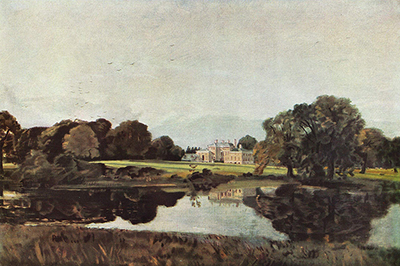
John Constable's Malvern Hall is one of his calmest early country-house landscapes. The house sits in the middle distance, seen across a broad sheet of water whose reflections soften the building and trees into the foreground. The view is orderly, but it is not stiff. A pale sky, drifting birds, masses of foliage and the long horizontal spread of the lake make the estate feel less like an architectural possession than a living landscape.
The painting is usually identified more fully as Malvern Hall, Warwickshire. Tate-linked image metadata records it as a work by John Constable, dated 1809, bequeathed by George Salting in 1910 and associated with the accession number N02653.[1] The Web Gallery of Art gives the same date, medium and Tate location, and describes the work as oil on canvas measuring about 51 by 77 centimetres.[3] That modest scale matters. Constable was not making a grand aristocratic panorama. He was compressing a patron's house, park, water and atmosphere into a measured, observant landscape.
Malvern Hall also takes Constable beyond the Suffolk subjects with which he is most closely associated. The house stood at Solihull in historic Warwickshire, and it belonged to Henry Greswold Lewis, one of Constable's important early patrons.[4][7] The picture therefore belongs to the network of commissions, friendships and country-house visits that helped sustain the young artist before the great Stour paintings made his public identity more secure.
At a Glance
- ArtistJohn Constable (1776–1837)
- TitleMalvern Hall, Warwickshire [1]
- Date1809 [1]
- MediumOil on canvas [1]
- DimensionsApproximately 51.4 × 76.8 cm [2][3]
- CollectionTate / Tate Britain [1]
- AccessionN02653 [1]
- CreditBequeathed by George Salting, 1910 [1]
- PlaceMalvern Hall, Solihull, historic Warwickshire [7]
- Patron contextHenry Greswold Lewis; Constable first stayed at Malvern Hall in 1809 [4][5]
Contents
- Introduction
- Object Identity
- Henry Greswold Lewis and the 1809 Visit
- Solihull and the Estate Setting
- A Country House Seen as Landscape
- Water, Reflection and Distance
- Constable before the Stour Six-Footers
- The Later Malvern Hall Views
- Why the Painting Matters
Object identity
The secure object is the Tate painting Malvern Hall, Warwickshire, dated 1809 and connected with the accession number N02653.[1] Older collection summaries and secondary records give the dimensions as roughly 51.4 by 76.8 centimetres, confirming the horizontal format seen in the image.[2][3] The work is oil on canvas, and its Salting bequest places it within the group of Constable works that entered a public collection in the early twentieth century.[1]
The local image corresponds to this Tate-linked object. The composition is a broad landscape view: water fills much of the lower half, the hall lies beyond it, and trees close the scene on both sides. The building is present, even central, but it does not dominate. It is absorbed into its park, its reflection and the surrounding air.
This distinction is important because the Malvern Hall subject exists in several forms. Constable painted and drew the house more than once, and later views from around 1820 show different sides of the building.[5][6] The 1809 Tate picture should be kept apart from those later works. Its subject is not simply "Malvern Hall" as a repeatable label, but this particular lake-side view of the estate at an early moment in Constable's career.
The title can sound plain, yet the painting is subtle in its handling of status. A country house is usually an image of ownership, lineage and land. Constable gives us all of that, but he also quietly changes the emphasis. The hall is not announced like a monument. It appears through distance, water, light and foliage, as if the estate's authority has been translated into weather and reflection.
Henry Greswold Lewis and the 1809 visit
Malvern Hall was the home of Henry Greswold Lewis, a wealthy widower and one of Constable's earliest patrons.[5] Christie’s describes Lewis as an early and eccentric supporter of the artist, and records that Constable first met him in 1807 through the Dysart family connection.[4] Lewis and Constable remained associated for more than twenty years, during which Lewis commissioned portraits, views of Malvern Hall and several unusual works.[4]
The 1809 visit is especially important. The National Gallery of Australia archive states that Constable was first a guest at Malvern Hall in that year, when he painted portraits of Lewis and Lewis's ward, Mary Freer.[5] A Christie’s entry for Constable's drawing Solihull Church from the grounds in front of Malvern Hall connects the visit with a related sheet inscribed with the artist's departure for Malvern on 15 July 1809.[6] The same account says that the purpose of the visit was the portrait of Mary Freer, but that Constable also made landscape drawings and three oil paintings of the house.[6]
That combination is revealing. Constable came as a portrait painter within a patronage network, yet the visit produced landscape work that seems to have mattered to him in its own right. The house, grounds and water offered him a different kind of subject from the Stour valley: not family mills, boats and working riverbanks, but a gentry estate shaped by architecture, lawn, trees and planned water.
Lewis should not be allowed to swallow the painting, though. His patronage explains why Constable was there, but the picture does not behave like a portrait of Henry Lewis by other means. There are no prominent figures performing ownership. The estate is seen through an atmospheric structure, and the viewer's attention settles as much on water and sky as on the house itself.
Solihull and the estate setting
The place itself helps explain the painting's difference from Constable's Suffolk work. DiCamillo identifies Malvern Hall, also known as Malvern Farm, with Solihull in the West Midlands, within historic Warwickshire.[7] The house was altered in the period before and around Constable's visits, including work associated with John Soane, and later changes reduced the building in the late nineteenth century.[7] The painting therefore preserves not just a rural view, but an estate appearance that has its own architectural history.
Constable's view does not advertise those architectural facts directly. He does not make the house a lesson in design, nor does he isolate a façade for close study. Instead, he places the building far enough away for the park to become the true mediator between house and viewer. Lawn, water, trees and sky carry the image. The hall is visible because the whole setting has been organised around visibility.
This is one reason the water matters so much. In a country estate, water could be a sign of improvement, taste and possession. In the painting, it is also an optical instrument. It broadens the foreground, reflects the trees and hall, and gives the eye a gentle obstacle before it reaches the building. The result is a view that acknowledges estate design while turning it into a painterly problem.
Solihull also gives Constable a subject away from the intensely personal geography of East Bergholt. At Flatford and Dedham, his knowledge of paths, mills and river work had the weight of childhood and family business. At Malvern Hall, his knowledge came through hospitality, commission and temporary residence. That change of relation affects the picture. The scene is affectionate and attentive, but it has a more formal social distance than many of the Suffolk works.
Yet distance does not mean indifference. Constable's treatment of the house across water suggests careful looking during a period of real opportunity. He was inside Lewis's circle as a commissioned artist, but he was also outside the permanent life of the estate. The picture holds that double position beautifully: close enough to know the place, far enough to see it as an image.
A country house seen as landscape
The painting belongs to the long British tradition of country-house portraiture, in which a house is shown with its land, water, avenues or gardens. Yet Constable bends that tradition toward landscape painting. The hall is the named subject, but the composition gives nearly equal force to lake, bank, trees and sky. The house becomes a feature within a wider order rather than the single reason for the view.
This is why Malvern Hall feels quieter than many formal estate images. Constable does not push the architecture forward. The house is set back, its pale façade broken by shadows and softened by distance. The water in front of it doubles the structure without making it more assertive. Reflection, which could have been a device of grandeur, becomes a means of dissolution.
The trees also change the tone. They frame the building but do not simply serve it. At the left, dark foliage creates a strong vertical mass; at the right, the trees are more open and varied. Their unevenness prevents the scene from becoming a balanced architectural diagram. Nature is not decoration around the hall. It is the condition through which the hall is seen.
The sky is similarly active, even though it is not dramatic. Birds cross above the treetops, and soft cloud breaks the open upper space. This light, airy top half keeps the painting from feeling heavy. Constable gives the house dignity by placing it in a calm, breathable atmosphere rather than by enlarging it.
Water, reflection and distance
The water is the painting's emotional centre. It occupies the foreground, delays the approach to the house and turns the view into something contemplative. The viewer cannot simply walk into the scene. The lake creates a pause, and that pause is where much of the painting's feeling gathers.
Reflection is not treated with hard precision. The house and trees are recognisable in the water, but they are softened by movement and tonal blur. This makes the reflected image less a duplicate than a second register of the scene. Constable lets the estate appear twice: once as architecture and once as light held on water.
The foreground bank gives a low, dark base to the picture. Above it, the water opens horizontally, spreading the viewer's attention before the eye reaches the hall. This structure produces a deliberately slow experience. The painting is not arranged around a sudden incident. It is arranged around looking, waiting and comparing solid forms with their softer reflections.
The distant handling of the house also keeps the work from becoming too proprietary. A patron's house can easily become an emblem of command. Here it feels remote, almost modest. The viewer recognises it as a country seat, but also as one element in a larger play of surfaces. The hall is important because the whole setting has been made important.
Constable before the Stour six-footers
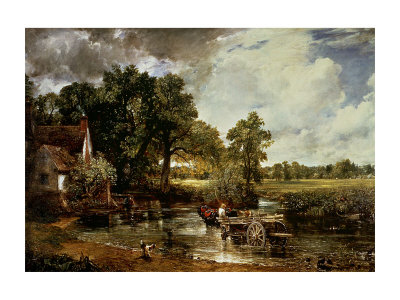
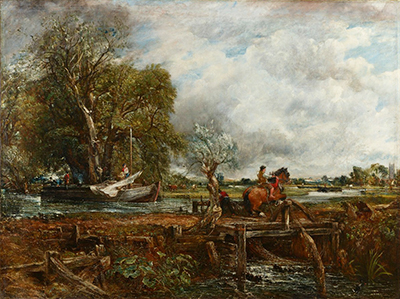
In 1809 Constable was still more than a decade away from The Hay Wain, Stratford Mill, The Leaping Horse and the other large Stour landscapes that would define his mature public ambition. Reynolds's catalogue of the early paintings and drawings is useful here because it places the Malvern Hall material within the broader phase of portraits, local studies and landscape experiments before the mature Stour sequence.[8] The picture shows a painter learning how to adapt different kinds of commission and subject to his own instincts.
The picture is more restrained than the later six-footers. There is no heavy wagon, working lock, tow horse, mill race or unsettled storm. The brushwork is disciplined, the view is still, and the tonal range is cool. Yet some mature Constable qualities are already visible. He is alert to the way light passes across foliage, how water alters architecture, and how a named place can become more persuasive when it is not over-explained.
This restraint should not be mistaken for weakness. The painting has a delicacy of judgment that suits its subject. Constable does not try to turn Malvern Hall into Suffolk. He accepts the estate's different social and visual character, then finds a way to make it part of his own landscape language.
The result is a useful reminder that Constable's art did not develop only from beloved home territory. Patronage, travel and country-house access also mattered. Malvern Hall gave him an opportunity to think about landscape as social space: land shaped by ownership, taste, architecture and memory, but still open to weather, growth and reflection.
Seen in this early-career light, the painting is also an exercise in tact. Constable had to respect a patron's house without reducing himself to a recorder of property. His answer was to make the hall legible but not emphatic. He allowed the setting to carry the grandeur, so that social rank enters the work quietly, through distance, calm and cultivated land.
The later Malvern Hall views
Constable returned to the subject of Malvern Hall in later works, and those later pictures help clarify the 1809 painting by contrast. The National Gallery of Australia archive describes a c.1820 work, Malvern Hall: The entrance front, now associated with the Yale Center for British Art, as a view of the entrance or garden front from the east.[5] That archive also explains that the Dowager Countess of Dysart asked Constable in 1820 to paint views of the house from both sides.[5]
Those later works are more directly tied to a country-house commission. They look at the building from other positions and belong to a renewed act of family and estate representation. The 1809 Tate painting, by contrast, comes out of the earlier visit connected with portrait work and landscape studies. Its viewpoint across water makes the house recede into a broader park image.
The differences are not merely cataloguing details. They affect interpretation. A view of the entrance front foregrounds the house as architecture and arrival. A view from across water makes the hall a distant presence, approached visually rather than physically. In the Tate painting, we do not stand at the door or on the drive. We look from the far side of a reflective boundary.
Constable's repeated interest in Malvern Hall also shows the usefulness of the place to him. It offered architecture, water, trees, long views, family patronage and a social setting distinct from East Bergholt or Flatford. The subject could be adjusted from personal study to estate commission without losing its landscape possibilities.
Why the painting matters
Malvern Hall matters because it shows Constable negotiating two identities at once. He is the young painter dependent on patrons, moving within the social circuits that brought him portrait work and access to country houses. He is also the landscape painter who cannot treat a house simply as a house. He turns it into a relationship between architecture, water, trees and atmosphere.
The painting is also a valuable counterweight to the familiar Suffolk-centred account of Constable. His deepest imaginative roots were in East Bergholt, Dedham and the Stour, but his early career was wider than that. Malvern Hall shows him responding to Warwickshire, to a patron's estate, and to a visual tradition with its own rules.
Its quietness is part of its importance. Nothing spectacular happens. The birds are small, the house is distant, the water is still and the light is restrained. Yet the picture has a precise mood: one of evening calm, reflective distance and social order softened by nature. Constable does not challenge the country-house tradition with drama. He transforms it by attention.
That is why the painting stays with the viewer. The hall remains recognisable, but it is not the only subject. The real subject is the experience of seeing it from across water, as a building held in landscape and doubled by light. In that sense, Malvern Hall is an early statement of a very Constable idea: a place becomes meaningful not by being made grand, but by being looked at with complete seriousness.
Frequently Asked Questions
Discussion
What gives Malvern Hall its greatest force: the distant house, broad water, softened reflection, framing trees, pale sky, or the balance between them?
Reader Insights
How does Constable make the patron's house legible without letting it dominate the landscape?
How do the lake and softened reflection slow the approach to the hall?
What does this restrained 1809 estate view reveal that the later Stour six-footers do not?
Join the Conversation
Share your reading below.
References
- Wikimedia Commons, Constable - Malvern Hall, Warwickshire, 1809, N02653, https://commons.wikimedia.org/wiki/File%3AConstable_-_Malvern_Hall%2C_Warwickshire%2C_1809%2C_N02653.jpg
- Wikimedia Commons, Constable MalvernHall, https://commons.wikimedia.org/wiki/File%3AConstable_MalvernHall.jpg
- Web Gallery of Art, Malvern Hall in Warwickshire, https://www.wga.hu/html_m/c/constabl/malvern.html
- Christie’s, Portrait of Henry Greswold Lewis, https://www.christies.com/lot/lot-6594226
- National Gallery of Australia archive, Malvern Hall: The entrance front, https://digital.nga.gov.au/archive/exhibition/constable/detail.cfm%3Firn%3D143487.html
- Christie’s, Solihull Church from the grounds in front of Malvern Hall, https://www.christies.com/en/lot/lot-1472259
- DiCamillo, Malvern Hall (Malvern Farm), https://www.thedicamillo.com/house/malvern-hall/
- Graham Reynolds, The Early Paintings and Drawings of John Constable, Paul Mellon Centre for Studies in British Art.