 by Tom Gurney
Tom Gurney BSc (Hons) is an art history expert with over 20 years experience
Published on June 19, 2020 / Page Updated on November 5, 2026
Email: tomgurney1@gmail.com / Phone: +44 7429 011000
Introduction
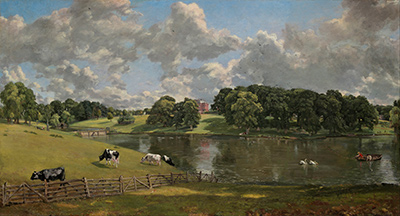
John Constable's Wivenhoe Park looks, at first, like one of the most serene landscapes in his early career: cattle grazing in a sunlit field, a broad sheet of water, swans, a small boat, a distant house, full trees and a sky piled with summer cloud. Yet the painting is not simply a free rural view. Its full museum title is Wivenhoe Park, Essex, and the National Gallery of Art in Washington identifies it as an 1816 oil on canvas, 56.1 by 101.2 centimetres, in the Widener Collection under accession number 1942.9.10.[1]
The painting therefore belongs to a different branch of Constable's art from the Flatford and Dedham mill subjects. It is not a family-business river scene, not a lock picture, and not a dry-dock subject. It is a commissioned estate landscape. Major-General Francis Slater-Rebow, owner of Wivenhoe Park and a close friend of Constable's father, commissioned the picture.[1] That fact matters because Wivenhoe Park has to satisfy two demands at once: it must persuade as a natural landscape and also serve as a portrait of a particular property.
At a Glance
- ArtistJohn Constable (1776–1837)
- Full titleWivenhoe Park, Essex [1]
- Date1816 [1]
- CollectionNational Gallery of Art, Washington [1]
- Accession number1942.9.10 [1]
- Credit lineWidener Collection [1]
- MediumOil on canvas [1]
- Dimensions56.1 × 101.2 cm [1]
- CommissionMajor-General Francis Slater-Rebow [1]
- ExhibitedRoyal Academy, 1817, no. 85 [1]
Contents
- Introduction
- The View across the Park
- House, Water, Cattle and Sky
- A Rebow Commission
- Estate Portrait and Natural Landscape
- The Made Naturalness of the Painting
- Wivenhoe as Place
- Constable in 1816
- Light, Shade and Reflection
- Why Wivenhoe Park Matters
The view across the park
The National Gallery of Art describes a horizontal composition in which low grassy hills occupy the left, water lies across the middle and the brick house appears in the centre distance beneath a large clouded sky.[1] This is exactly the balance that gives the painting its special calm. Constable spreads the view laterally, asking the eye to move across pasture, fence, lake, trees and sky rather than to follow a single dramatic incident.
The foreground fence is more important than it first appears. It begins at the lower left and runs inward toward the water, giving the scene a low, practical structure. Beyond it, black-and-white cattle graze on the sloping grass. Their scale is modest, but their crisp placement keeps the scene from dissolving into general greenness. They also remind us that Wivenhoe is managed parkland, not untouched countryside.
The water carries the middle of the composition. It is lake-like rather than the working Stour of the mill subjects, yet it remains active. Swans, reflections, shadows and the boat at the right animate its surface. At the far side of the water, trees gather into a dense horizon, broken by the house. The building is not monumental in the manner of a grand architectural portrait. It is held within the landscape, visible through the trees rather than imposed upon them.
House, water, cattle and sky
The painting's pleasures depend on small adjustments of emphasis. The house is the reason for the commission, but Constable does not let it dominate. The cattle in the foreground are not mere decoration, because they anchor the estate's pastoral identity. The swans and boat are tiny, but they open the water to movement. The clouds are large, but they do not overwhelm the ground. Everything has been given just enough weight.
The National Gallery of Art's visual description points to the donkey cart at the left distance, crossing near a bridge, and to two men in a boat pulling in nets at the right.[1] These details give the painting a social and recreational life. Wivenhoe Park is not shown as empty land. It is a place where children ride, animals graze, men work or fish, and waterfowl move across the lake. The estate is alive without becoming busy.
The sky is one of the painting's great achievements. It fills a large share of the canvas, but its role is structural rather than ornamental. Clouds cast shadows across the sunlit scene, creating the alternation of brightness and cool shade that gives the park depth. The sky also connects Wivenhoe to the broader Constable practice of studying weather, light and atmosphere. Even in a commissioned estate view, the weather is not a backdrop. It is the condition under which the landscape becomes visible.
A Rebow commission
The patronage context is unusually important. The National Gallery of Art records that the commission came from Major-General Francis Slater-Rebow, the owner of Wivenhoe Park, and notes that he had been a close friend of Constable's father.[1] This was not an impersonal transaction with an unknown collector. It belonged to a network of family acquaintance, local connection and early professional opportunity.
The painting was also not Constable's first work for the Rebow family. The National Gallery of Art notes that in 1812 he had painted a full-length portrait of Mary Rebow, then aged seven, and that she appears in Wivenhoe Park riding in the donkey cart at the left.[1] This detail transforms the painting. It is not only a view of land and water. It also includes a small dynastic and domestic note, placing the patron's daughter within the estate that her family wished to see represented.
The National Gallery of Australia archive, in its account of Constable's The Quarters behind Alresford Hall, confirms the wider Rebow commission context. It records that Slater-Rebow commissioned that cabinet picture and the larger Wivenhoe Park, Essex during Constable's 1816 visit, and that Constable returned in late August and September to work on them.[2] This places Wivenhoe Park within a short, focused campaign of paintings for the family, not as an isolated pastoral invention.
The companion commission also helps explain why Wivenhoe Park feels so carefully tuned to family life. The Quarters behind Alresford Hall concerns a more intimate leisure setting associated with fishing and informal retreat, while Wivenhoe Park opens outward to the estate as a whole.[2] Together, they suggest a patron interested not just in topographical record but in a lived family landscape. Constable had to represent property, pleasure, water, land and people as parts of one social world.
Estate portrait and natural landscape
Because Wivenhoe Park is a commission, it needs to be read as an estate portrait. This does not make it less Constable. It makes the painting more interesting. Constable had to show a recognisable property, include things the family wanted, and still make the view feel fresh, coherent and alive. The painting is a negotiation between patronage and perception.
That negotiation explains the evenness of the composition. The house must be present, but the landscape must breathe around it. The park must look cared for, but not stiff. Human and animal details must mark ownership and use, but not turn the scene into a crowded anecdote. Constable's success lies in making these obligations feel natural. The viewer experiences harmony, but the harmony has been constructed.
The National Gallery of Art's interpretation describes the painting as a creative synthesis of the actual place, with brilliant sunshine, cool shade, a rambling fence, and a balance of trees, meadow and water.[1] The word synthesis is important. Constable is not simply copying what stood before him at a single instant. He is assembling a version of Wivenhoe that feels truthful while fulfilling the logic of a commissioned image.
The made naturalness of the painting
The National Gallery of Art audio transcript makes the point even more strongly. It explains that Constable went to considerable lengths to satisfy his patrons and that he added canvas at the sides after realising the original format did not contain everything required.[3] On the left, the added area included another cow; on the right, it allowed for the small boat with two men setting a net.[3] These details are wonderful because they expose the artifice behind the painting's natural ease.
The result does not feel patched or compromised. Instead, the additions help the composition. The cow at the left enriches the foreground rhythm; the boat at the right gives the water a point of action and balances the donkey cart on the opposite side. A practical patronage problem becomes a pictorial solution. Constable's naturalism is not the absence of construction. It is construction hidden inside the sensation of naturalness.
The same transcript notes that the scene cannot be understood as a simple photographic position. Trees, shadows and reflections have been adjusted so that the painting feels real even though it is not a literal one-point record.[3] This is central to Constable's achievement. He wanted natural truth, but he did not mistake truth for mechanical transcription. Wivenhoe Park is convincing because it is shaped.
Wivenhoe as place
Historic England's registered park and garden entry helps clarify the physical setting behind the painting. Wivenhoe Park lies north of Wivenhoe, near Colchester, and covers about thirty-four hectares. The entry describes relatively flat parkland divided by a valley, with three lakes crossing the ground, and places Wivenhoe House toward the eastern boundary overlooking the valley and lakes.[4] This supports the painting's basic topography: house, water, parkland and tree masses belong to a real designed estate.
The Historic England account also reminds us that Wivenhoe was a shaped landscape before Constable painted it. The park had design history, approaches, lodges, a house and water features. Constable's picture therefore represents not wild nature but cultivated nature: land ordered for residence, pleasure, display and use. The fence, cattle, lake and house all belong to this managed environment.
This is why the painting should not be folded too quickly into the Stour tradition. Wivenhoe is near Constable's larger home region, but it is not the same kind of subject as Flatford or Dedham. The Stour pictures often arise from family labour and river infrastructure. Wivenhoe Park arises from estate ownership and patronage. Both are local landscapes, but their social meanings differ.
Constable in 1816
The year 1816 gives the painting additional importance. Constable was not yet the painter of The Hay Wain, The Leaping Horse or The Lock. He was still building the professional footing that would allow his mature landscape career to unfold. Wivenhoe Park shows him handling a substantial commission with confidence, scale and unusual clarity.
It also belongs to the year of his marriage to Maria Bicknell. The painting should not be reduced to that biographical fact, and unsupported claims about exact payment should be avoided. Still, the timing matters. In 1816 Constable was moving from prolonged uncertainty into a more settled adult and professional life. The Rebow commission sits within that moment of transition: local connection becomes professional opportunity; estate patronage becomes landscape experiment.
Graham Reynolds's work on Constable's early paintings and drawings is useful for understanding this threshold. The early years before the great Stour exhibition pictures were not a prelude to be skipped. They were the period in which Constable learned how to turn local knowledge, outdoor study and patron requirements into sustained compositions.[5] Wivenhoe Park is one of the clearest demonstrations of that ability before the six-footers.
Detail and clarity
One reason Wivenhoe Park remains so memorable is the precision of its details. The cattle are small but individually placed. The fence has a particular, rambling irregularity. The swans are tiny touches of white against the water. The figures in the boat are almost miniature, yet they give the lake a human scale. Mary Rebow's donkey cart is distant, but once noticed it changes the painting's meaning.
The National Gallery of Art notes the precision of Constable's brushwork in animals, birds and people, and says that this precision gives importance to smaller details.[1] That is exactly how the painting works. Constable does not reserve importance for the house or the sky. He distributes significance through the whole surface. The eye can settle on a cow, a boat, a cloud, a reflection or a fence rail, and each contributes to the larger order.
This clarity differs from the more forceful handling of later oil sketches and weather studies. Wivenhoe Park is finished, legible and patron-ready. But it is not dull. Its clarity allows the viewer to enter the scene slowly, discovering how many quiet actions are happening inside its apparent stillness.
Light, shade and reflection
The painting's most subtle drama is the movement of light. Large clouds pass across the sky and cast shifting patches of brightness and shade. The lake reflects some of that movement, while the fields and trees absorb it differently. This means that the landscape is never merely laid out; it is being activated by weather.
Constable had not yet made the Hampstead cloud studies that would later become central to his reputation, but Wivenhoe Park already shows the sky as a governing force. The cloud masses do more than fill space. They regulate the light across the whole estate. They create depth, mood and variety without disturbing the painting's calm.
Water intensifies the effect. It widens the middle ground and gives the sky a second life in reflection. It also separates the foreground pasture from the house and trees beyond, allowing Constable to build the scene in measured zones. The viewer looks over the fence, across the animals, over the water, toward the house, then upward into the sky. The painting feels spacious because each zone is distinct yet connected.
Boundaries with the Stour works
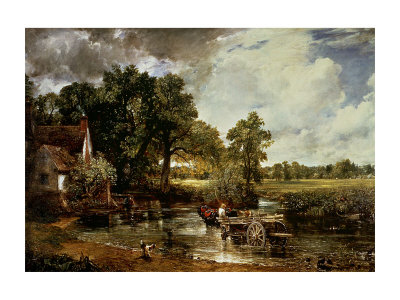
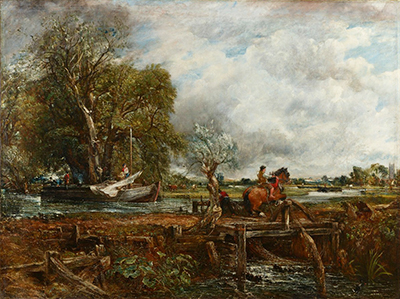
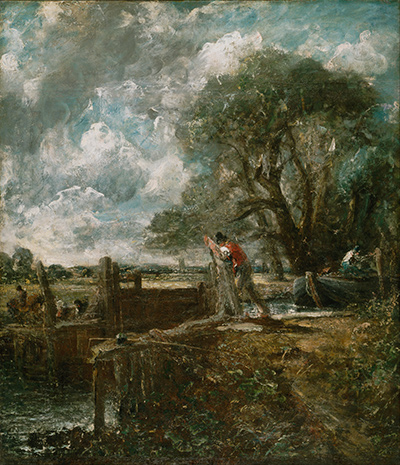
It is useful to keep Wivenhoe Park apart from the Stour mill and lock paintings already discussed in the Constable sequence. Boat-Building near Flatford Mill is about work at the dry dock. Flatford Mill from a Lock on the Stour and Dedham Lock and Mill are river and mill subjects tied to the family business world. The Lock is a later six-footer built around the physical drama of passing a boat through water levels. Wivenhoe Park has a different centre of gravity.
Here, the water is part of an estate landscape rather than a commercial river artery. The animals are part of parkland rhythm rather than towage or mill labour. The house, though modestly placed, is the social anchor. The patron's child is included. The painting's constructed naturalness serves the presentation of property and family as much as the observation of nature.
This distinction does not diminish the work. It expands Constable's range. He could paint the Stour as working memory, Flatford as family ground, Dedham as river-village industry, and Wivenhoe as commissioned estate harmony. Seeing those differences keeps the Constable cluster from becoming a blur of trees, water and cows.
Exhibition and later ownership
The National Gallery of Art records that Wivenhoe Park, Essex was exhibited at the Royal Academy in 1817, no. 85.[1] That matters because the painting was not only a private estate possession. It also entered the public exhibition world where Constable was trying to build a reputation. In that setting, the work needed to stand as a polished landscape, not merely as a pleasing reminder of Wivenhoe for the Rebow family.
The Royal Academy showing also helps explain the painting's unusually finished clarity. This is not the rougher immediacy of an oil sketch, nor the experimental force of a full-scale study. Constable presents the estate with a degree of polish suitable for both patron and exhibition. The tiny figures, birds, animals and reflections are carefully resolved because they carry the painting's claim to precision. Public viewers did not need to know Wivenhoe personally in order to read the picture as a convincing rural world.
That public legibility is one of the painting's quiet strengths. Constable offers enough specificity for the Rebow family to recognise their estate, but enough pictorial coherence for strangers to understand the scene without private knowledge. The house, cart, cattle, water and sky become a grammar of rural possession and ease. The painting speaks locally and publicly at the same time, which is exactly what a successful exhibited estate landscape needed to do. Its quietness is therefore social as well as visual, and historically legible.
The later history of the painting reinforces its status as a major object rather than a minor commission. The National Gallery of Art traces the picture from Francis Slater-Rebow through family inheritance, then through later ownership before its acquisition by Peter A. B. Widener in 1906 and eventual gift to the National Gallery of Art in 1942.[1] That provenance carried the painting from an English estate context into one of the major American museum collections. Its current setting in Washington changes its audience, but not its original logic: it remains a picture of English parkland shaped for a particular family at a particular moment.
This later movement is worth noting because Constable's art often travelled differently from his subjects. The places remained local, but the paintings became international. Wivenhoe Park now functions both as a record of an Essex estate and as an example of British landscape painting for viewers far removed from Wivenhoe itself. That double life is part of the painting's modern importance.
Why Wivenhoe Park matters
Wivenhoe Park matters because it shows Constable mastering a complicated commission without losing the freshness of landscape. The painting had to please a patron, include a property, represent family identity and still feel like a living outdoor scene. Its beauty lies in that balance. It is ordered but not frozen; descriptive but not dry; commissioned but not merely compliant.
It also matters because it reveals how constructed Constable's naturalism could be. The added canvas, adjusted details and carefully balanced zones do not betray the painting's truth. They create it. Constable understood that a painted landscape could feel more convincing when it was intelligently arranged than when it simply copied a view.
The painting also matters because it catches Constable at a point where portraiture, patronage and landscape were still closely intertwined. His later fame depends above all on landscape, but Wivenhoe Park shows that landscape could itself behave like portraiture. The sitter is not only the house, nor only Mary Rebow in the donkey cart. The sitter is the estate as a social organism: land, water, buildings, animals, leisure and ownership held together under weather.
Finally, the painting matters because it captures a moment before the famous Stour six-footers, when Constable's art was already remarkably assured. Wivenhoe Park is not an apprenticeship exercise waiting to be surpassed. It is a major early achievement: a sunlit estate portrait in which water, sky, land, family and patronage become a single lucid landscape.
Frequently Asked Questions
Discussion
What best explains Wivenhoe Park's persuasive calm: the estate commission, its distributed detail, the reshaped canvas or the movement of light across water and land?
Reader Insights
Where do property, patronage and family presence remain visible even though the house is kept modest?
How do the added canvas, balanced cattle and boat reveal construction beneath the scene's ease?
Which shifts of cloud, light, shade and reflection make the park feel alive rather than fixed?
Join the Conversation
Share your reading below.
References
- National Gallery of Art, Washington, Wivenhoe Park, Essex, https://www.nga.gov/artworks/1147-wivenhoe-park-essex
- National Gallery of Australia archived exhibition, John Constable, The Quarters behind Alresford Hall, https://digital.nga.gov.au/archive/exhibition/constable/detail.cfm%3Firn%3D145016%26bioartistirn%3D18283%26audio%3D32k%26viewid%3D1%26mnuid%3D2.html
- National Gallery of Art, Washington, audio tour transcript for Wivenhoe Park, Essex, https://www.nga.gov/visit/tours-guides/audio-tours/west-building-tour-featured-selections-stop-701
- Historic England, “Wivenhoe Park,” https://historicengland.org.uk/listing/the-list/list-entry/1000371
- Graham Reynolds, The Early Paintings and Drawings of John Constable, Paul Mellon Centre / Yale University Press, 1996, https://www.paul-mellon-centre.ac.uk/publications/browse/9780300063370