Jackson Pollock.jpg)
 by Tom Gurney
Tom Gurney BSc (Hons) is an art history expert with over 20 years experience
Published on June 19, 2020 / Updated on October 30, 2026
Email: tomgurney1@gmail.com / Phone: +44 7429 011000
Untitled, c.1938–41: Introduction
Two hooded figures give Jackson Pollock’s Untitled, c.1938–41 a human focus within its closely interlocking forms. The drawing belongs to the Museum of Modern Art in New York, which records pencil and coloured pencil on paper, measuring 35.6 × 27.9 centimetres. Lee Krasner gave it in 1983 in Pollock’s memory; its museum number is 665.1983. These particulars identify a small, intimate work whose complicated relationships deserve attention alongside his paintings. [1]
MoMA’s label for its 2015–16 collection survey describes one figure with a bowed head and another raising hands above the face, suggesting sorrow or horror. Its account connects their sinuous, interlocking forms with José Clemente Orozco. The gestures offer a way into the composition: attend to the relationship between the bodies and to the space that holds them together. The emotions belong to the museum’s reading of represented postures. They cannot, by themselves, tell us what Pollock was feeling while drawing. [1]
At a Glance
This work across Jackson Pollock’s career
The Flame
c.1934–38The She-Wolf
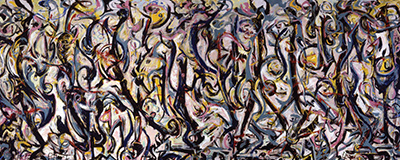
1943Mural
1943Alchemy
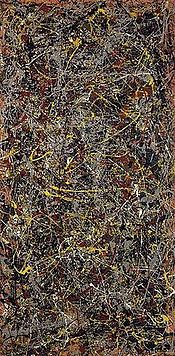
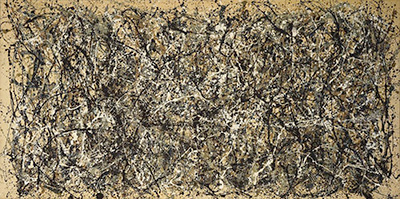
1947Number 1A, 1948
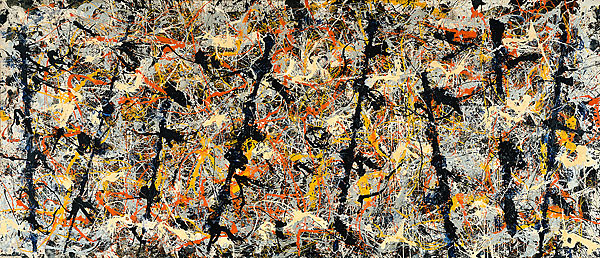
1948Blue Poles
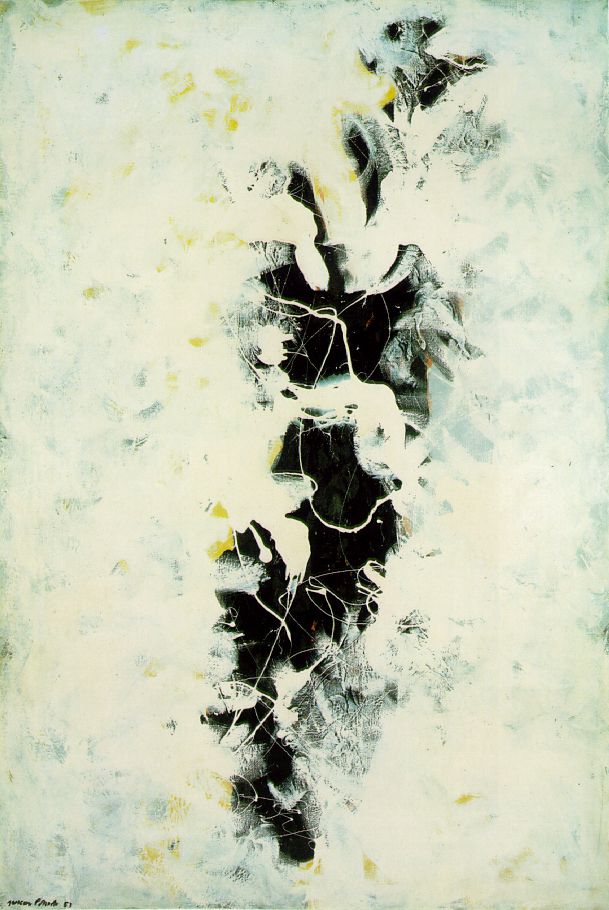
1952The Deep
1953White Light
1954Contents
- Finding the particular drawing
- Line as an artistic problem
- Orozco and the expressive figure
- A drawing brought into public view
Finding the particular drawing
Pollock left many works without descriptive titles, so a date alone can be a poor guide. The 1998 MoMA retrospective catalogue placed this drawing beside another Untitled, c.1938–41, owned by the Metropolitan Museum of Art. Both captions describe pencil and colour pencil, but they identify different sheets: the Met’s is OT 470r, whereas MoMA’s is OT 486. The latter caption gives the same 35.6 × 27.9 centimetre dimensions and Krasner memorial credit used for this drawing. Those catalogue numbers help a reader follow the work through changing publications. They also prevent a discussion of one untitled composition from silently becoming an account of its neighbour. Here, the persistent identity is OT 486, rather than every early drawing that happens to share the approximate date. [2]
Rose’s 1980 checklist calls CR 486 Untitled, approximately 1938, and lists pencil, coloured pencil and coloured crayon. It gives 34.2 × 24.1 centimetres as a “sight” measurement: measured through glass. That smaller figure records a different measurement basis; it supplies no evidence that the paper subsequently shrank or was cut down. The checklist explains that dates in parentheses were absent from the works themselves, marking the year as an estimate. [3]
Line as an artistic problem
Rose’s broader argument helps explain the interest of early Pollock drawings. She considered line’s competing roles in describing figures and organising a picture’s whole field. She traced interwoven lines and outward-driving movement to his sketchbook studies after Michelangelo, El Greco and Rubens. She understood many early sheets as records of ideas or independent achievements, giving drawing a purpose beyond preparation for a canvas. This is a useful framework for approaching CR 486, although her general discussion does not establish it as a copy after any particular Old Master. [3]
The difficulty of making line feel alive had occupied Pollock well before this sheet’s estimated date. In a January 1930 letter to his brother Charles, reproduced by Francis V. O’Connor, he criticised his drawing for lacking freedom and rhythm. That self-assessment makes drawing sound like a demanding, learned activity, with movement something to work towards. O’Connor also reproduced a draft associated with Pollock’s later My Painting statement, in which the artist distinguished drawings related to his painting from drawings made as preliminary studies for it. The two passages illuminate different stages of a continuing concern. The youthful letter records dissatisfaction; the later draft articulates a relationship between media. Neither provides a record of how CR 486 was made. Together they encourage attention to the drawing’s own organisation, without requiring a missing finished painting to explain why it exists. A sheet can sustain a problem in line even when no corresponding canvas has been identified. [4]
Pollock’s published comments also leave room for both invention and artistic judgment. In his 1944 questionnaire for Arts and Architecture, he expressed interest in the unconscious as a source of art and recalled Benton’s introduction to Renaissance art. In My Painting, published in Possibilities in winter 1947–48, he described involvement in the act of painting followed by a period of recognising what he had done, with changes remaining possible. These are later statements about his practice, rather than testimony about this early drawing. They help explain why the word spontaneous need not imply an absence of reflection. For this sheet, a proposed sequence in which Pollock first completed the people and then added surrounding lines would require evidence of its own. His general comments cannot supply that order, and the distinction matters when thinking about bodies and linear movement developing together within a composition. [5]
Watch: Jackson Pollock
Choose a film about Pollock’s paintings and ways of working.
Orozco and the expressive figure
Orozco’s relevance extends beyond a loose resemblance between expressive figures. In her Hood Museum essay, Sarah G. Powers describes Pollock’s 1936 journey to Dartmouth to study The Epic of American Civilization. She places that encounter within an existing interest: he had already seen Prometheus at Pomona College in 1930 and studied reproductions. Her discussion of early Pollock paintings follows recurring imagery of sacrifice, skeletons, serpents and fire, connecting particular works with particular passages in Orozco’s murals. That history gives substance to the connection MoMA makes for the hooded figures. It suggests an artist building a vocabulary through repeated looking and selective transformation. Powers’s essay centres on works including The Flame and Circle; its comparisons help establish the wider setting for the drawing, without assigning its two figures a named episode from the Dartmouth cycle or a single symbolic identity. [6]
A comparison with Naked Man with Knife makes the need for specificity clearer. Robert Storr, writing in Jackson Pollock: New Approaches, relates that painting, several sketchbook drawings and a gouache to Orozco’s Barricade. The gouache he identifies belongs to the Metropolitan Museum of Art and measures 57.8 × 45.1 centimetres. It is a separate object from MoMA’s pencil drawing. Storr’s comparison shows how the Orozco relationship can be pursued through a particular composition and group of works. It does not establish Barricade as the direct model for CR 486. Reading these early works together is most rewarding when their identities remain clear: a connection proposed for one drawing can sharpen a question about another, but it cannot automatically answer it. This preserves the value of comparison while allowing the hooded figures to retain their own unresolved situation. [7]
A drawing brought into public view
The sheet had a documented exhibition life before entering MoMA’s collection. It appears as the first work on paper in the final checklist for Jackson Pollock: Drawing into Painting, held from 4 February to 16 March 1980, with Lee Krasner Pollock named as its owner. The museum announced an exhibition of eighty-five drawings and five paintings, directed by Rose. Its arrangement of media addressed the connection between Pollock’s drawing and painting across his career, giving an early pencil sheet a place in that larger enquiry. The press release also distinguished the New York selection from a somewhat different version that had toured Europe. The checklist anchors this drawing in the New York exhibition; it should not be treated as a list of everything shown at each earlier venue. Its presence there records an occasion for studying it publicly, decades after its making and before the memorial gift. [8]
Pollock artworks directory
Explore the distinct works discussed in these guides. This selection is not a complete catalogue. Green Silver and Untitled, 1949 are two guides to the same painting.
Discussion
Look again at the images and ideas explored in Untitled, c.1938–41. These editorial prompts invite your observations.
Reader Insights
Which detail in “Finding the particular drawing” changes how you understand this work?
What comparison comes to mind after “Line as an artistic problem”?
What would you like to discuss about “Orozco and the expressive figure”?
Join the Conversation
Share a detail, comparison or question about Untitled, c.1938–41 below.
References
- The Museum of Modern Art, “Jackson Pollock. Untitled. (c.1938–41)”, object 665.1983; collection record and gallery label for Jackson Pollock: A Collection Survey, 1934–1954, 2015–16. Accessed 26 October 2026. View source.
- Kirk Varnedoe, with Pepe Karmel, Jackson Pollock (New York: MoMA, 1998), p.150, plates 20–21; PDF p.155. View source.
- Bernice Rose, Jackson Pollock: Drawing into Painting (New York: MoMA, 1980), pp.8–10, 94, CR 486; PDF pp.11–13, 97. View source.
- Jackson Pollock, January 1930 letter and 1947 statement draft, reproduced in Francis V. O’Connor, Jackson Pollock (New York: MoMA, 1967), pp.15, 40; PDF pp.20, 45. View source.
- Jackson Pollock, “A Questionnaire,” Arts and Architecture 61, no.2 (February 1944), and “My Painting,” Possibilities 1 (winter 1947–48), reprinted in Pepe Karmel, ed., Jackson Pollock: Interviews, Articles, and Reviews (MoMA, 1999), pp.15–18; PDF pp.18–21. View source.
- Sarah G. Powers, “Men of Fire: José Clemente Orozco and Jackson Pollock”, Hood Quarterly 33 (spring 2012), pp.4–5. Hood Museum of Art, Dartmouth College. View source.
- Robert Storr, “A Piece of the Action,” in Kirk Varnedoe and Pepe Karmel, eds., Jackson Pollock: New Approaches (New York: MoMA, 1999), p.50; PDF p.52. View source.
- The Museum of Modern Art, “Pollock’s Works on Paper and Paintings to Be Shown at Museum of Modern Art”, 1980 press release and final checklist, PDF pp.1–2, 5, work 1, CR 486. View source.