 by Tom Gurney
Tom Gurney BSc (Hons) is an art history expert with over 20 years experience
Published on June 19, 2020 / Updated on October 30, 2026
Email: tomgurney1@gmail.com / Phone: +44 7429 011000
Number 23, 1948: Introduction
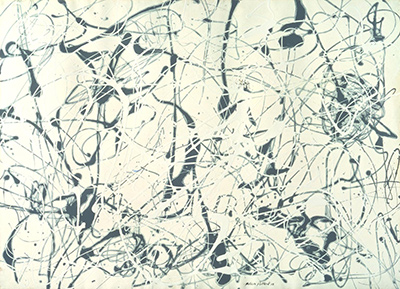
Jackson Pollock’s Number 23 brings the possibilities of liquid paint to a sheet of prepared paper. Tate’s collection dataset identifies the work as enamel on gesso on paper, dated 1948, with a support measuring 57.5 × 78.4 centimetres. Those materials are a useful starting point: the paper carries a preparation, and the enamel meets that prepared surface. Thinking of the work only as a drawing can obscure the importance of this meeting between paint and ground. Its scale also deserves attention. At under eighty centimetres wide, the sheet invites a different encounter from an enveloping mural. Tate recorded it under accession T00384, presented in 1960 by the Friends of the Tate Gallery, with purchase funds provided by Mr and Mrs H. J. Heinz II and H. J. Heinz Co. Ltd. [1]
At a Glance
This work across Jackson Pollock’s career
The Flame
c.1934–38The She-Wolf
1943Mural
1943Alchemy
1947Number 1A, 1948
1948Blue Poles
1952The Deep
1953White Light
1954Contents
Black, white and grey
Tate’s gallery label gives a precise account of the interplay of paints in Number 23. It describes streams of black and white enamel poured onto the surface, with the black spreading into the white background and producing grey. Thicker white paint was then woven over that base. This gives the restricted palette a material history: grey emerges through the meeting of paints, while the later white establishes another kind of line above it. The label identifies an expansive arc in the black and characterises the result through the coexistence of energy, delicacy and control. Following that account, the work becomes easier to read as a succession of related actions. An earlier application supplies conditions to which another responds. The difference between a spreading dark mark and a thicker white trail matters as much as their contrasting colours. Tate’s description makes improvisation specific to this sheet, through the behaviour of its paints and the deliberate continuation above them. [2]
James Coddington’s study of Number 14: Gray, also made in 1948, supplies a useful technical comparison. He describes a long black pour, probably made directly from a can, whose solvent acted on the white beneath and softened the line. This helps explain why a receiving surface matters alongside the movement delivering paint. Coddington’s account distinguishes the properties of a material from the behaviour it can produce in combination with another layer. A softened edge can carry evidence of an interaction, alongside the trace of a gesture. His solvent explanation and probable tool concern Number 14 specifically. They offer a comparison for the Tate sheet without establishing the same chemistry or application procedure for it. [3]
Drawing and choice
Bernice Rose’s Drawing into Painting places such exchanges within Pollock’s sustained interest in drawing through paint. Her study describes line carrying the physical presence of paint while organising a surface; figure and ground can exchange roles, and spatial effects depend partly on the chosen support and light. This framework makes room for a sheet to be both graphic and painterly. Applied here, it encourages attention to the changing relationship between line and field, without making paper synonymous with a preliminary study or requiring a hidden figure as the painting’s subject. [4]
Pollock’s own statements explain how freedom could coexist with judgment. In “My Painting,” published in the winter of 1947–48, he described seeking a hard surface’s resistance, using unconventional tools and becoming acquainted with what had emerged before making changes. Later, in his interview with William Wright, he described considerable control of liquid paint’s flow acquired through experience. These are general accounts, rather than testimony about making Number 23. They explain the coexistence of improvisation and reflection in his practice, while leaving the sequence of work on an individual sheet to its particular evidence. The broader account appears in Pollock’s technique. [5]
Scale affected those decisions. Kirk Varnedoe stresses the adjustments needed to sustain Pollock’s poured vocabulary across different dimensions: wrist movements, extended arm sweeps and changes in paint consistency could yield related effects through different procedures. He also describes late brushwork and intervals between applications. His account helps keep the compact Number 23 within a varied practice, in which the boundaries of each support called for choices about the reach and density of a gesture. [6]
Watch: Jackson Pollock
Choose a film about Pollock’s paintings and ways of working.
From New York to Tate
The work’s early exhibition history puts paper near the centre of Pollock’s activity. Francis V. O’Connor’s museum chronology lists Number 23 among the works on paper in Pollock’s Betty Parsons Gallery exhibition of 24 January–12 February 1949. The show brought together twenty-six works dated 1948, dividing its roster between canvas and paper. A visitor could therefore encounter these supports within the same presentation of recent work. There is a practical complication in that roster: it also lists a Number 23 on canvas. The number alone cannot identify the object. O’Connor further explains that Pollock’s numbers seldom provide an exact sequence of execution and sometimes repeat within a year. The Tate sheet’s title consequently gives us a way of naming it without supplying a story, a subject, or a reliable position in a chronological queue. Its year and support do essential work alongside the number. [7]
The sheet later became Tate’s first acquisition of a Pollock. Alex J. Taylor’s research for the museum places its announced acquisition in November 1960, after years in which Pollock remained a priority for the collection. Rising prices and Tate’s limited resources made external support consequential. Taylor traces the purchase funds to Henry J. Heinz II and the H.J. Heinz Company through the American Friends of the Tate. The work also became a public sign of the museum’s changing American holdings: John Hay Whitney hoped that its acquisition would encourage further gifts and help establish a representative room of American art. This history gives the modestly sized sheet a substantial institutional role. It entered a debate about what a British museum should collect and how international patronage might make that possible. Its arrival helped bring Pollock into Tate’s collection through a concrete act of support. [8]
Drawing with light
Tate gave Number 23 a further context in its 2018 Shape of Light exhibition guide. The introduction traces exchanges between photography and abstraction across several media; room 6, “Drawing with Light,” includes the painting’s caption within a discussion of gestural mark making. The guide connects experiments in automatism with painters’ movements and with photographers moving cameras or light sources. Its example of a sparkler’s trace makes the connection readily imaginable: motion can leave a graphic record through different materials. This is a curatorial conversation across media, rather than evidence that a particular photographer inspired Pollock’s sheet. The enamel painting retains its own material identity within that comparison. The guide broadens the questions we can bring to it: how does a gesture persist after movement has ended, and how does a surface hold that persistence? Those questions join its life as a painting on paper to a wider history of artists finding ways to make motion legible. [9]
Pollock artworks directory
Explore the distinct works discussed in these guides. This selection is not a complete catalogue. Green Silver and Untitled, 1949 are two guides to the same painting.
Discussion
Look again at the images and ideas explored in Number 23, 1948. These editorial prompts invite your observations.
Reader Insights
Which detail in “Black, white and grey” changes how you understand this work?
What comparison comes to mind after “Drawing and choice”?
What would you like to discuss about “From New York to Tate”?
Join the Conversation
Share a detail, comparison or question about Number 23, 1948 below.
References
- Tate. Collection dataset, October 2014 snapshot, artwork_data.csv, accession T00384: title, date, medium, support dimensions and credit line. View source.
- Tate. Discover Painting, “Number 23,” complete gallery label dated July 2008. View source.
- James Coddington. “No Chaos Damn It,” in Kirk Varnedoe and Pepe Karmel, eds., Jackson Pollock: New Approaches. New York: The Museum of Modern Art, 1999, p. 102. View source.
- Bernice Rose. Jackson Pollock: Drawing into Painting. New York: The Museum of Modern Art, 1980, pp. 8–9, 17–18. View source.
- Jackson Pollock. “My Painting,” Possibilities 1 (winter 1947–48), and interview with William Wright, recorded 1950; reprinted in Pepe Karmel, ed., Jackson Pollock: Interviews, Articles, and Reviews. New York: The Museum of Modern Art, 1999, pp. 17–18, 20–23. View source.
- Kirk Varnedoe. “Jackson Pollock,” in Jackson Pollock, with Pepe Karmel. New York: The Museum of Modern Art, 1998, pp. 50–51. View source.
- Francis V. O’Connor. Jackson Pollock. New York: The Museum of Modern Art, 1967, p. 45; PDF p. 50. View source.
- Alex J. Taylor. “American Art under John Rothenstein, 1938–64”, Modern American Art at Tate 1945–1980. Tate Research Publication, 2019, November 1960 acquisition discussion and notes 127–128. View source.
- Tate. Exhibition Guide: Shape of Light, 2018, introduction and room 6, “Drawing with Light.” View source.