 by Tom Gurney
Tom Gurney BSc (Hons) is an art history expert with over 20 years experience
Published on June 19, 2020 / Updated on October 30, 2026
Email: tomgurney1@gmail.com / Phone: +44 7429 011000
The Deep by Jackson Pollock: Introduction
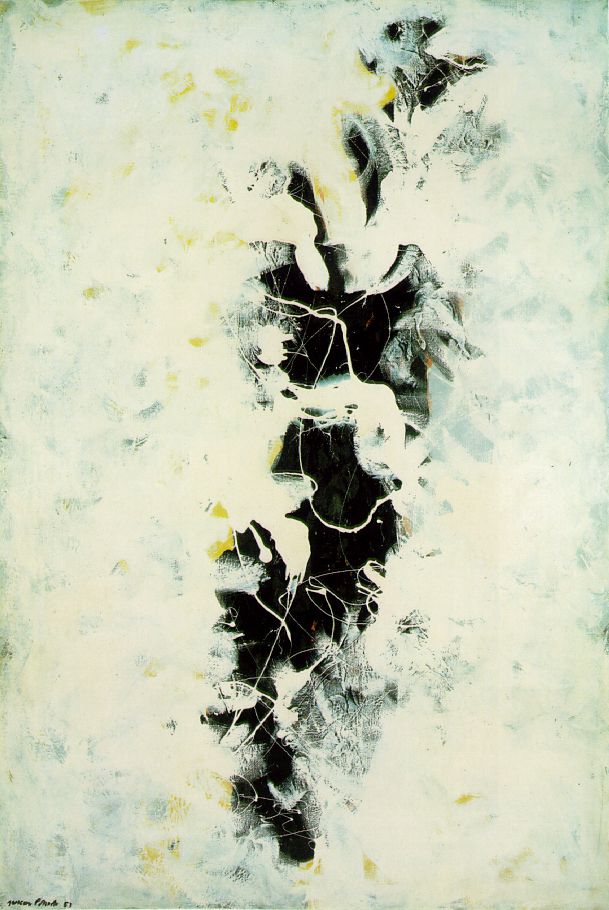
A dark opening draws the eye into The Deep, Jackson Pollock’s painting of 1953. Olivier Michelon describes a cream, milky field of brushed and poured paint surrounding matte black touched with red. The sense of an opening belongs to painted space: light paint brings a darker layer into view. [1]
The painting’s reworking changed its orientation, preserving earlier paint within the final image. [2]
At a Glance
This work across Jackson Pollock’s career
The Flame
c.1934–38The She-Wolf
1943Mural
1943Alchemy
1947Number 1A, 1948
1948Blue Poles
1952White Light
1954Contents
- A painting transformed
- Different ways forward
- The first audience
- Looking into the interval
- Beyond The Deep
- Collection and exhibition life
A painting transformed
Conservator Carol C. Mancusi-Ungaro’s 1999 study reports that an infrared-sensitive camera confirmed an earlier, colourful horizontal composition beneath The Deep. Pollock had begun by brushing forms onto a white, preprimed canvas held upright. He changed the composition to a vertical format, partly covered earlier forms with grey, brushed in black, then laid the canvas flat to pour more black. Upright again, he brushed white around the opening. Broken brush hairs remained in this paint. Finally, with the canvas flat, he poured liquid white across it. [2]
Mancusi-Ungaro connects this transformation with Pollock’s letter to Sidney Janis about breaking up a red, blue and yellow painting that had left him stuck. He allowed that its image might return if it belonged to him. The letter places revision within his working thought, alongside the material evidence of repeated applications. [2]
Different ways forward
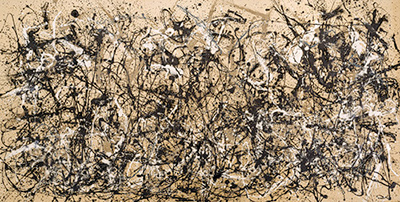
An illuminating comparison is Echo: Number 25, 1951. MoMA describes its economy and its suggestions of figuration, contrasting them with the multidirectional energy of One: Number 31, 1950. In its accompanying letter excerpt, Pollock discusses drawing on canvas in black and the reappearance of early imagery. The museum’s account helps explain why changes after the celebrated poured paintings deserve attention in their own right. [3]
In Echo, MoMA locates the interest in a composition poised between abstraction and recognisable forms. For a reader approaching The Deep, this provides a useful question: what makes a shape feel separate from its surroundings? Following that question keeps attention on relationships within a painting, even when no definite object emerges. Recognition can remain tentative; a viewer need not settle on an identifiable subject before attending to the way a composition holds together. [3]
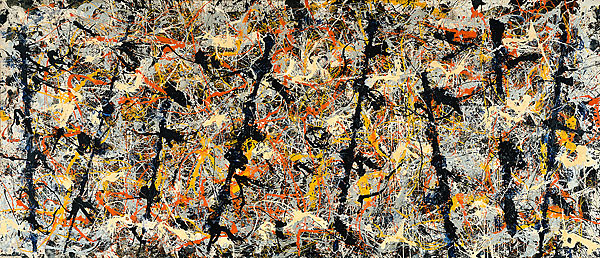
Blue Poles offers another direction. Sarina Noordhuis-Fairfax’s account for the National Gallery of Australia describes the 1952 painting’s successive colours, combinations of wet and dried layers, and eight dark poles added late in the process. Those poles were made by pressing the painted edge of wood against the canvas, with further flung lines laid over them. Its construction brought direct contact and airborne application into the same work. [4]
The comparison makes a single story of abandoning pouring difficult to sustain. In Blue Poles, a strong late addition interrupts a network while becoming entangled with subsequent lines. It invites attention to the order in which marks were made, and to how a later action can reorganise what is already there. Comparing the two paintings is especially useful when considering revision: an added mark can change an existing composition’s emphasis without removing its earlier material. [4]
The first audience
The Deep appeared among ten paintings from 1953 at Sidney Janis Gallery, New York, from 1 to 27 February 1954. Emily Genauer’s review of 7 February singled it out alongside Easter and the Totem. Although she remained hostile to the earlier drip paintings, she admired these works’ compositional control, texture, luminosity and communication of mood. Her enthusiasm depended partly on seeing a promising change in Pollock’s direction. [5]
Other responses to the exhibition were broader. Robert M. Coates acknowledged weaknesses while finding Pollock’s strengths predominant and his new directions encouraging. James Fitzsimmons valued the expanded resources of the new work, particularly Ocean Greyness and Sleeping Effort. These were responses to the exhibition as a whole, with different paintings carrying different arguments. Together they show how readily the new work prompted discussion of development, reassessment and possibility, even among critics who disagreed about the value of Pollock’s earlier achievement. [5]
Watch: Jackson Pollock
Choose a film about Pollock’s paintings and ways of working.
Looking into the interval
Later judgments remained divided. In his 1998 essay, Kirk Varnedoe compared The Deep with Barnett Newman’s vertical divisions and Clyfford Still’s jagged forms. He found Pollock’s treatment too emphatic and its brushing and pouring less compelling than the spatial uncertainty of the earlier drip paintings. This was an adverse formal judgment, with the particular organisation of the painting at its centre. [6]
Michelon’s 2007 catalogue entry takes a more receptive view, relating the painting to the atmospheric sensations of contemporary colour-field painting and treating its spatial experiment as a singular direction within Pollock’s work. [1]
Varnedoe’s comparison offers a practical way to look. Ask where the foreground seems to gather and how the dark interval affects the space around it. Does the image hold an uncertain depth, or does the contrast make that depth too explicit? Those questions allow his reservations to become something a viewer can consider, rather than a verdict to inherit. A painted opening can be compelling for one viewer precisely where another finds the effect insistent. [6]
Beyond The Deep
The Deep was not Pollock’s last painting. Varnedoe discusses White Light, dated 1954, and Untitled (Scent), dated about 1953–55, after it. [6] MoMA’s account of White Light describes paint squeezed directly from tubes and wet passages manipulated with a brush. The resulting surface combines raised strands with marbling. These are concrete examples of continuing choices about how paint could be placed and altered. [7]
Placed beside The Deep, White Light also makes the distinction between a technique and a finished effect easier to grasp. The museum describes both direct application and subsequent editing: squeezing paint establishes a material presence, while moving wet paint changes its relationships. A reader can follow those actions without treating any one tool as the definition of Pollock’s art. The later painting rewards attention to the worked surface, and gives the late career a further point of comparison rather than a single final image. [7]
Collection and exhibition life
The Centre Pompidou records The Deep (La Profondeur) as paint on canvas, 220.4 × 150.2 cm, accession AM 1976-1230. Its height exceeds two metres, giving the central interval a bodily scale. The current credit records a 1976 gift in memory of Jean de Menil by his children and the Menil Foundation. [1] The 1999 catalogue instead captions it as oil and enamel and dates the donation to 1975. [2]
On 25 October 2026, the Pompidou listed the work on loan to the Metropolitan Museum of Art. [1] Krasner and Pollock: Past Continuous, running from 4 October 2026 to 31 January 2027, considers the two artists’ distinct, connected careers. The Met’s announcement names The Deep among its principal works. This is a temporary exhibition context; the holding collection remains the Centre Pompidou. [8]
The Met’s approach places individual works within changing practices and exchanges, giving equal attention to Krasner’s independent achievement. Seeing The Deep within that broader setting invites comparison across a career rather than allowing one striking late image to stand for its ending. The exhibition’s emphasis on shifts of scale, material and form provides a useful route back to the painting’s own construction. [8]
Pollock artworks directory
Explore the distinct works discussed in these guides. This selection is not a complete catalogue. Green Silver and Untitled, 1949 are two guides to the same painting.
Discussion
Look again at the images and ideas explored in The Deep by Jackson Pollock. These editorial prompts invite your observations.
Reader Insights
Which detail in “A painting transformed” changes how you understand this work?
What comparison comes to mind after “Different ways forward”?
What would you like to discuss about “The first audience”?
Join the Conversation
Share a detail, comparison or question about The Deep by Jackson Pollock below.
References
- Centre Pompidou, The Deep (La Profondeur), AM 1976-1230. Collection record and Olivier Michelon’s 2007 catalogue entry; consulted 25 October 2026. View source.
- Carol C. Mancusi-Ungaro, “Jackson Pollock: Response as Dialogue,” in Jackson Pollock: New Approaches, ed. Kirk Varnedoe and Pepe Karmel (MoMA, 1999), pp. 149–151; caption p. 139. View source.
- Museum of Modern Art, Echo: Number 25, 1951, 241.1969; collection record and 2010–11 gallery label. View source.
- Sarina Noordhuis-Fairfax, “Blue Poles: The Work of Art”, National Gallery of Australia. View source.
- Francis V. O’Connor, Jackson Pollock (MoMA, 1967), pp. 69–70: exhibition dates and excerpts from Genauer, New York Herald-Tribune, 7 February; Coates, New Yorker, 20 February; Fitzsimmons, Arts & Architecture, March 1954. View source.
- Kirk Varnedoe, “Comet: Jackson Pollock’s Life and Work,” in Jackson Pollock, with Pepe Karmel (MoMA, 1998), p. 66. View source.
- Museum of Modern Art, White Light, 337.1967; collection record and 2015–16 gallery label. View source.
- Metropolitan Museum of Art, “The Met to Present a Major Exhibition Dedicated to the Careers of Lee Krasner and Jackson Pollock”, 24 February 2026. View source.