 by Tom Gurney
Tom Gurney BSc (Hons) is an art history expert with over 20 years experience
Published on June 19, 2020 / Updated on October 30, 2026
Email: tomgurney1@gmail.com / Phone: +44 7429 011000
Mural on Indian Red Ground: Introduction
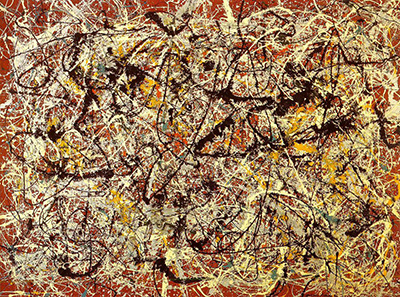
Jackson Pollock’s Mural on Indian Red Ground is a substantial painting on an unusual support. The National Museum of Modern Art, Tokyo’s 2012 retrospective checklist dates it to 1950 and records oil, enamel and aluminium paint on canvas mounted on wood, measuring 183 × 243.5 cm. Its roughly four-to-three rectangle is an important starting point: this is a painting with a firm physical support. The checklist names the Tehran Museum of Contemporary Art as lender. [1]
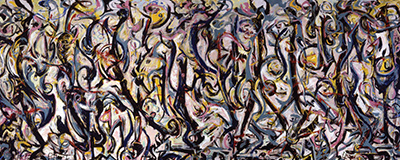
The title can cause confusion with Mural, the much earlier commission from Peggy Guggenheim. Getty’s account identifies that work as a 1943 painting in oil and casein on canvas, belonging to the University of Iowa. Its research found strong evidence that Pollock painted the stretched canvas upright, leaning against a wall. The two commissions therefore deserve separate histories, including separate accounts of materials and making. Getty’s work on the earlier canvas also shows how consequential the edges of a mural can be: a new, slightly curved stretcher followed its painted boundaries and returned unpainted canvas to the sides. A painting’s apparent limits depend partly on how its support presents it. That issue takes a particularly tangible form in the later domestic commission. [2]
At a Glance
This work across Jackson Pollock’s career
The Flame
c.1934–38The She-Wolf
1943Mural
1943Alchemy
1947Number 1A, 1948
1948Blue Poles
1952The Deep
1953White Light
1954Contents
- From a model museum to a house
- A painting with a front and a back
- Red ground, mobile lines
- Completion, installation and everyday life
- Tehran, Tokyo and the Berlin proposal
From a model museum to a house
Architect Peter Blake helped install Pollock’s 1949 exhibition at the Betty Parsons Gallery. As Helen A. Harrison explains, he included a model for an ideal museum, drawing on Mies van der Rohe’s 1942 Museum for a Small City. Paintings could themselves define walls, while mirrors suggested that their fields continued beyond their actual edges. It was an architectural proposal made through reproductions: Blake changed the scale and orientation of paintings to suit the imagined building. The model proposed a way of inhabiting Pollock’s imagery rather than a faithful miniature exhibition. [3]
Harrison traces a practical result: Blake brought Marcel Breuer to the show, leading to the commission for Bertram and Phyllis Geller’s house in Lawrence, Long Island. The original model later fell apart. A replica authorised in 1994 used updated materials, including acrylic and Plexiglas. Its survival should be distinguished from the survival of the original proposal’s components. The Geller painting was a more durable, realised answer to the model’s architectural ambition. [3]
Emily Warner’s reconstruction places the canvas, wrapped around plywood, on the back of Breuer’s birch bookcase, fabricated by Irving and Casson, between the living and dining rooms, raised on stone feet. The Gellers requested its dimensions and rust-red ground, relating the painting to the interior’s wood and stone. It furnished a room while helping divide it. [4]
A painting with a front and a back
Megan R. Luke draws out the consequences of that arrangement. Someone could walk around the partition, but the bookcase concealed the painting’s reverse. Physical movement around the object did not produce a second painted view. Its two sides served different purposes, and the picture continued to address viewers from one direction. Luke’s argument makes the distinction between a picture that stands within a room and one that can be experienced equally from every side especially clear. A freestanding support could change circulation without abolishing the painting’s front. [5]
Luke sets this installation beside Blake’s 1952 Pinwheel House proposal, in which large Pollock paintings would form sliding exterior walls. Opened out, those walls would extend into the landscape; closed, they would surround the interior. That scheme remained unrealised: Luke’s note records that the house was built without the paintings in 1954. The comparison locates the Geller mural between an ordinary hung picture and an entire environment made from painted walls. [5]
Red ground, mobile lines
Warner describes a central rectangle of painterly activity surrounded by a three-to-nine-inch red margin. Some pours cross that margin to the edge. She reads the result as both bounded and open, its concentrated activity set apart without losing the suggestion of continuation. [4]
William Rubin offers another useful way into its colour. In his revised essay on Pollock and the modern tradition, he singles out the saturated yellows, greens and reds of Mural on Indian Red Ground. Yet he observes that their quantities remain limited in relation to black, white and aluminium, with the coloured units dispersed across the surface. A bright palette can thus participate in an overall tonal structure. For Rubin, the amount and distribution of colour matter as much as the presence of an intense hue. [6]
His comparison with Easter and the Totem sharpens the point. There, larger panels of colour establish a different organisation from the dispersed colour of the poured painting. The comparison invites attention to each coloured passage’s size and relationship to neighbouring marks. It also explains why a title naming a red ground does not exhaust the later mural’s colour relationships: the ground and the marks play different structural roles. These are Rubin’s critical distinctions, rather than findings from a materials analysis. [6]
Bernice Rose’s broader account of Pollock connects this problem of colour to the space around a painting. She describes optical effects generated through ground, contrasting colours, reflected light and the intervals in a linear network. In her reading, the surface can suggest expansion both before and behind its physical plane. Applied as a framework here, that distinction helps separate the physical object’s definite place in a room from the painted field’s apparent reach. Rose’s account concerns Pollock’s practice more generally; it offers a way to think about the eye’s movement through a composition. [7]
Watch: Jackson Pollock
Choose a film about Pollock’s paintings and ways of working.
Completion, installation and everyday life
Warner cites a letter of about March 1950 reporting completion and prolonged drying. July installation involved Giorgio Cavallon; Pollock’s participation remains disputed. Her reconstruction is conditional, without known in-situ photographs or her own inspection of the painting. [4]
The chronology by Elizabeth Levine and Anna Indych in MoMA’s 1998 catalogue instead places the beginning of work on the Geller mural in March. The difference leaves the exact schedule open. Their account also situates the commission amid other attempts to bring Pollock’s work into architecture: during the summer, Pollock, Tony Smith and Alfonso Ossorio began discussing a church on Long Island. That project continued in discussion through 1952 but was never built. Against such unrealised possibilities, the Geller commission has particular interest as an architectural setting that actually received a painting. [8]
Warner reports Bertram’s admiration and Phyllis’s dislike, followed by a second Breuer house commissioned in 1955 and the mural’s resale a few years later. Their differing responses belong to its domestic history. [4]
By 1967, Francis V. O’Connor’s MoMA catalogue listed the painting as Mural, dated 1950, in William Rubin’s collection in New York. It described canvas mounted on wood, with dimensions of six by eight feet. This dated entry supplies a useful point in its subsequent history and preserves the support as part of the work’s identity. The shorter title also explains why an older reference to a 1950 Mural may concern the Geller painting. Date and support help distinguish it from Guggenheim’s commission. [9]
Tehran, Tokyo and the Berlin proposal
The Tokyo retrospective offers a later, precise exhibition record. Mural on Indian Red Ground appears in its bilingual checklist for Jackson Pollock: A Centennial Retrospective, held from 10 February to 6 May 2012. Its placement among the works of 1947–1950 lets the domestic commission enter a broader account of Pollock’s mature experiments. The lender credit documents the Tehran connection in a Japanese museum context, giving the painting a public history beyond the house for which it was made. [1]
In October 2015, the Stiftung Preußischer Kulturbesitz explicitly named the 1950 mural among Tehran’s important holdings when announcing a planned exhibition in Berlin. Its release placed the museum, opened in 1977, within the collecting undertaken under the patronage of Farah Pahlavi. The proposed exhibition would bring Western works from Tehran together with an equal number of works by Iranian artists. Pollock’s painting thus belonged to a collection whose significance extended beyond the history of American abstraction. The proposed encounter offered a different setting again: a comparison across artistic traditions, supported by cooperation between museums. [10]
That exhibition was cancelled. In a March 2017 interview with Achim Klapp, co-curator Gabriel Montua explained that export permissions for the artworks were missing. The accompanying conference went ahead, addressing the development of the museum’s Iranian and Western collections and the wider history of modern art in Iran. Montua stressed the value of understanding Iranian art within a global history while attending to its particular contexts. The conference continued that discussion even though the intended loans did not reach Berlin. This episode gives the mural’s international history a clear distinction between a documented Tokyo loan and a Berlin exhibition that remained a proposal. [11]
Pollock artworks directory
Explore the distinct works discussed in these guides. This selection is not a complete catalogue. Green Silver and Untitled, 1949 are two guides to the same painting.
Discussion
Look again at the images and ideas explored in Mural on Indian Red Ground. These editorial prompts invite your observations.
Reader Insights
Which detail in “From a model museum to a house” changes how you understand this work?
What comparison comes to mind after “A painting with a front and a back”?
What would you like to discuss about “Red ground, mobile lines”?
Join the Conversation
Share a detail, comparison or question about Mural on Indian Red Ground below.
References
- National Museum of Modern Art, Tokyo. Jackson Pollock: A Centennial Retrospective, exhibition checklist. 2012, pp. 1, 3, entry 42. View source.
- Getty. “Jackson Pollock’s Mural.” Project summary, outcomes and researching technique sections. View source.
- Helen A. Harrison. “Jackson Pollock: Blake’s 1949 Museum Design.” Art & Architecture Quarterly, 18 October 2012. View source.
- Emily S. Warner. Abstraction Unframed: Abstract Murals in New York, 1935–1960. PhD dissertation, University of Pennsylvania, 2017, pp. 164–173. View source.
- Megan R. Luke. “Painting in the Round.” Getty Research Journal 9, supplement 1 (2017): 149–182, especially pp. 163–165 and note 56. doi:10.1086/695873. View source.
- William Rubin. “Jackson Pollock and the Modern Tradition,” revised 1999, in Pepe Karmel, ed., Jackson Pollock: Interviews, Articles, and Reviews. New York: MoMA, 1999, p. 143. First published Artforum, February–May 1967. View source.
- Bernice Rose. Jackson Pollock: Drawing into Painting. New York: MoMA, 1980, pp. 17–19. View source.
- Elizabeth Levine and Anna Indych. Chronology, in Kirk Varnedoe with Pepe Karmel, Jackson Pollock. New York: MoMA, 1998, p. 324. View source.
- Francis V. O’Connor. Jackson Pollock. New York: MoMA, 1967, p. 133, entry 55. View source.
- Stiftung Preußischer Kulturbesitz. “Modern art comes from Tehran to Berlin.” Press release, 21 October 2015, pp. 1–2. View source.
- Gabriel Montua, interviewed by Achim Klapp. “Das Ende der Nabelschau.” Stiftung Preußischer Kulturbesitz, 16 March 2017. View source.