 by Tom Gurney
Tom Gurney BSc (Hons) is an art history expert with over 20 years experience
Published on June 19, 2020 / Updated on October 30, 2026
Email: tomgurney1@gmail.com / Phone: +44 7429 011000
The Key by Jackson Pollock: Introduction
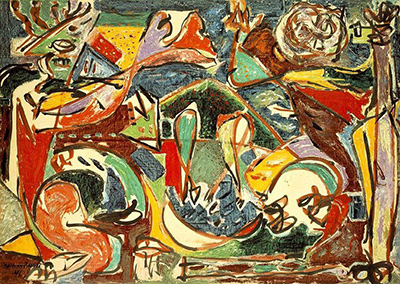
Jackson Pollock painted The Key in 1946 on the floor of an upstairs bedroom. The Art Institute of Chicago identifies it as part of the Accabonac Creek series, named after a stream near the East Hampton property he and the painter Lee Krasner bought in late 1945. Its oil paint rests on linen, and the museum records a width of 208.3 centimetres. That substantial surface was worked from all four sides: the familiar relationship between an upright painter and a picture facing him had already begun to change. [1]
At a Glance
This work across Jackson Pollock’s career
The Flame
c.1934–38The She-Wolf
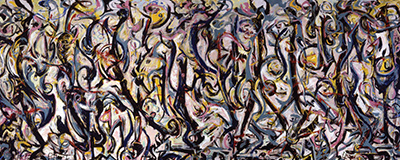
1943Mural
1943Alchemy
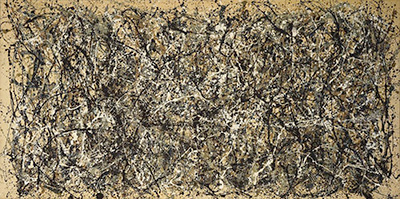
1947Number 1A, 1948
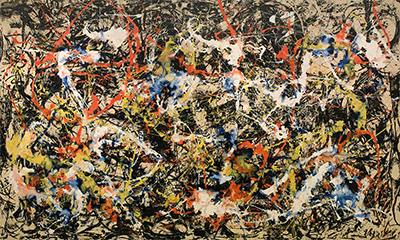
1948Blue Poles
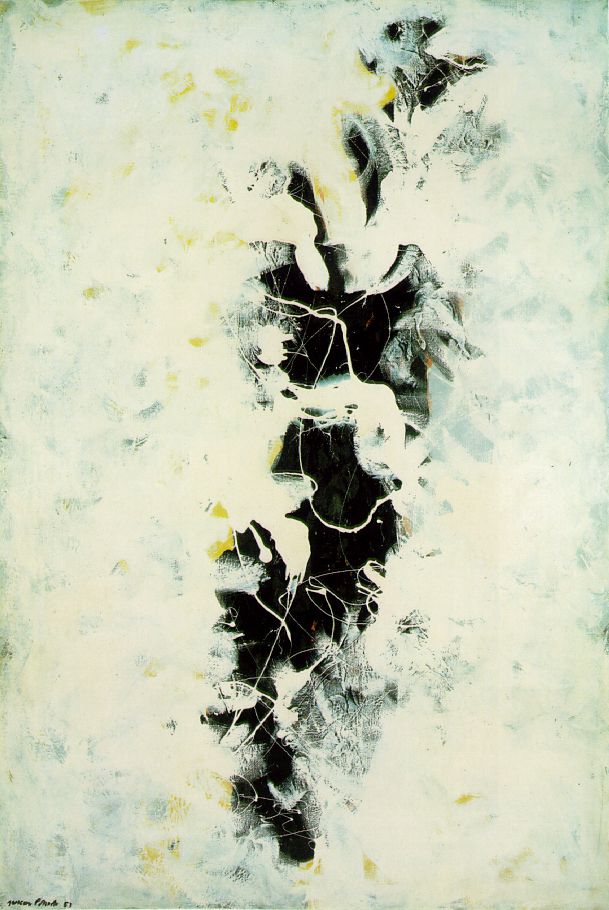
1952The Deep
1953White Light
1954Contents
A painting against the floor
Recalling the bedroom in her interview with Barbara Rose, Krasner remembered The Key occupying almost all its floor, with little space to walk around it. Yet she resisted explaining Pollock's larger gestures through studio size alone, recalling the earlier Mural. Her testimony makes the room tangible while leaving the invention more complicated than a change of premises. [2]
Pepe Karmel's account gives the floor a precise material role. He describes dark, looping outlines made with a brush, with colour placed between their curves. Pollock spread that colour with a knife, pressing against the boards beneath the fabric. Pressure deposited paint and scraped it away; fabric dipping into gaps between boards escaped the knife and retained thicker horizontal bands. Elsewhere the weave remained exposed. The supporting floor thus helped determine the painted surface. Karmel argues that colour occupies the same plane as the drawing, sometimes seeming to come forward. His proposed figures—one at the right, another apparently holding a palette at the left—recall the studio composition of Stenographic Figure. Alternating colours interrupt their coherence. A possible body is divided among coloured areas, while the network of lines continues to organise the whole. He connects its interlace, reaching to the edges, with Pollock's engravings, suggesting that rotating a printing plate offered experience of working from different sides. [3]
The contact between fabric, knife and floor also matters to the larger story of Pollock's technique. Kirk Varnedoe points to the floorboard impressions in The Key when discussing the transition to working horizontally. He also places Pollock's famous statement My Painting within a publication history that reaches back before the later poured pictures. Published in Possibilities in winter 1947–48, it accompanied earlier work, with no examples of the new drip paintings reproduced. Its discussion of resistant supports, unusual tools and heavy paint therefore belongs partly to experiments already accomplished. The Key helps give that language a physical meaning: the floor could resist the artist's pressure, becoming an active condition of making. The relation between artist and support was changing before the best-known photographs of paint travelling through the air. Working horizontally opened several possibilities, including this emphatically tactile one. [4]
Colour before the public
The Key reached Art of This Century in New York in Pollock's exhibition of 14 January–1 February 1947. Francis V. O'Connor's chronology lists it with The Water Bull, Yellow Triangle and The Tea Cup in the Accabonac Creek group. The exhibition also presented the Sounds in the Grass series, including Eyes in the Heat, and Guggenheim's Mural. Its setting was therefore an encounter among different approaches to painting, with a large earlier commission beside the recent groups. Later that year, The Key appeared in Chicago's fifty-eighth annual exhibition, held from 6 November 1947 to 11 January 1948. It returned to a retrospective context at Bennington and Williams colleges in 1952. These successive settings gave the painting different historical company: first fellow recent experiments, then a wider survey of American art, and finally a selection spanning Pollock's developing career. Its public history extends beyond its later position as a precursor to pouring. [5]
The anonymous Art News reviewer in February 1947 singled out The Key as broader and more colourful, making Pollock's energy easier to follow. Later, William Rubin identified a hand holding a key at the upper right, while warning that titles provide uncertain guides. His proposed detail leaves the remaining imagery unresolved. [2]
Watch: Jackson Pollock
Choose a film about Pollock’s paintings and ways of working.
The Key becomes architecture
The painting acquired another kind of public life through Peter Blake's projected museum for Pollock. Eileen Costello's catalogue caption identifies a mirrored reproduction of The Key in the original 1949 model at Betty Parsons Gallery. Her account explains that the model combined miniature paintings with small plaster-dipped wire sculptures made by Pollock. The reproduction moved The Key into a three-dimensional arrangement, where an image could be repeated by reflection and encountered alongside sculptural forms. [6]
Emily S. Warner places The Key at the centre of Blake's model and explains how reproductions taken from catalogues and magazines were attached to standing supports. Her interpretation connects the project to Blake's enthusiasm for the surrounding landscape: transparent architecture, reflected pictures and the outdoor setting could bring paintings and their environment into a continuous experience. The Key had a central role within that architectural reading. Blake's proposal imagined a setting in which the landscape remained visible around the art, extending the architectural reading beyond the boundaries of any single image. This tells us how an architect could understand and reposition Pollock's painting. It offers a history of interpretation rather than proof of a particular creek represented in its coloured forms. [7]
Helen A. Harrison adds an essential qualification about scale. Blake's original model used reproductions without preserving the proportions of the paintings. Small works could become apparent murals; a long painting might appear no wider than a much smaller one. As Harrison explains, the model demonstrated an architectural idea, sacrificing fidelity to individual objects. That freedom changes how we understand The Key in this setting: its reproduced image served a new spatial arrangement, with scale and reflection controlled by the design. The model eventually fell apart, and Blake authorised a replica in 1994. The replica carries forward an ambitious way of imagining the display of Pollock's art. The history of the model demonstrates how freely an image's surroundings could be redesigned along with its apparent size. [8]
The Key itself passed from Pollock to Krasner and then, through her bequest, to the Pollock-Krasner Foundation. It was sold through Jason McCoy to the Art Institute of Chicago on 26 June 1987. The museum credits its acquisition through the prior gift of Mr. and Mrs. Edward Morris. Its present collection history joins the domestic circumstances of its making to its long exhibition life. [1]
Pollock artworks directory
Explore the distinct works discussed in these guides. This selection is not a complete catalogue. Green Silver and Untitled, 1949 are two guides to the same painting.
Discussion
Look again at the images and ideas explored in The Key by Jackson Pollock. These editorial prompts invite your observations.
Reader Insights
Which detail in “A painting against the floor” changes how you understand this work?
What comparison comes to mind after “Colour before the public”?
What would you like to discuss about “The Key becomes architecture”?
Join the Conversation
Share a detail, comparison or question about The Key by Jackson Pollock below.
References
- Art Institute of Chicago, The Key, 1946, accession 1987.261, current object description, medium, measurements and provenance. View source.
- Lee Krasner, interview by Barbara Rose, “Jackson Pollock at Work,” Partisan Review 47, no. 1 (1980); anonymous, “Reviews & Previews: Jackson Pollock,” Art News 45, no. 12 (February 1947); William Rubin, “Pollock as Jungian Illustrator: The Limits of Psychological Criticism” (1979), reprinted in Pepe Karmel, ed., Jackson Pollock: Interviews, Articles, and Reviews (MoMA, 1999), pp. 40–41, 56, 240 respectively. View source.
- Pepe Karmel, “A Sum of Destructions,” in Kirk Varnedoe and Pepe Karmel, eds., Jackson Pollock: New Approaches (MoMA, 1999), pp. 81–83. View source.
- Kirk Varnedoe, “Comet: Jackson Pollock's Life and Work,” in Jackson Pollock, with Pepe Karmel (MoMA, 1998), pp. 47–48. View source.
- Francis V. O'Connor, Jackson Pollock (MoMA, 1967), chronology, pp. 40, 42, 68. View source.
- Eileen Costello, “Jackson Pollock & Tony Smith: Speculations in Form,” Jackson Pollock & Tony Smith: Sculpture (Matthew Marks Gallery, 2012), pp. 24–25, fig. 17. View source.
- Emily S. Warner, Abstraction Unframed: Abstract Murals in New York, 1935–1960, PhD dissertation, University of Pennsylvania, 2017, pp. 176–179. View source.
- Helen A. Harrison, “Jackson Pollock: Blake's 1949 Museum Design”, Art & Architecture Quarterly, 18 October 2012, particularly the discussion of reproductions and the 1994 replica. View source.