 by Tom Gurney
Tom Gurney BSc (Hons) is an art history expert with over 20 years experience
Published on June 19, 2020 / Updated on October 30, 2026
Email: tomgurney1@gmail.com / Phone: +44 7429 011000
Out of the Web: Number 7, 1949 by Jackson Pollock: Introduction
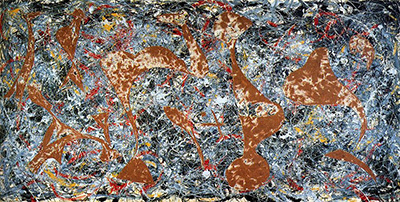
Out of the Web brings figures into a surface already woven from poured paint. Jackson Pollock made the painting in 1949 on Masonite, a rigid fibreboard, using oil and enamel or lacquer paint. Fondation Beyeler’s 2008 exhibition text records it as approximately 122 × 244 cm and in the Staatsgalerie Stuttgart collection. Its long format matters: there is room for the shaped areas to spread across the painted field. In Action Painting, Beyeler singled out both the balance of the chosen format and the removal of figure shapes. The museum presented this work as a particularly clear demonstration that figuration and abstraction could coexist. [1]
The surprising part is how those shapes arrived. In his 1998 account, Kirk Varnedoe describes Pollock reconsidering a painting that was already mounted, removing areas and then partly painting into the forms he had created. He compares the resulting organic shapes to those of Joan Miró, describing their rhythmic interaction with the dense poured network. This is a sequence of decisions: a painted field was established, altered through removal, and adjusted again through paint. The shapes therefore belong to a revision of the whole composition. Varnedoe places the experiment among several ways Pollock explored bounded forms in 1948 and 1949, including the filled areas of Summertime: Number 9A, 1948. His account helps explain why identifying the work as a drip painting tells only part of its material history. The initial method remained available for reconsideration after the surface had acquired its elaborate structure. [2]
At a Glance
This work across Jackson Pollock’s career
The Flame
c.1934–38The She-Wolf
1943Mural
1943Alchemy
1947Number 1A, 1948
1948Blue Poles
1952The Deep
1953White Light
1954Contents
Cutting into the painting
Robert Storr gives a more exact sense of the removal. Pollock scraped and chiselled into the fibreboard until an intermediate layer of the board itself became visible as colour. Scored remnants of the original paint remained inside the outlines, giving the recessed areas variations resembling modelling or shading. The figure shapes thus contain both exposed support and traces of the painted surface from which they were excavated. [3]
This physical alteration has a larger place in Pollock’s treatment of space. Bernice Rose identifies Out of the Web as one of his experiments with bringing figures into an allover painting during the poured-paint period. Her account follows an ongoing exchange between figures and landscape: the figure can give an image its frontal presence, while landscape suggests breadth and extension. These possibilities overlap across his work. For Rose, the movement towards abstraction involved changing relations between line, figure and surrounding space, with several structural alternatives explored together. Seen within that argument, the shaped areas in this painting are part of a continuing inquiry into how an image occupies a field. A figure need not become an isolated person standing before a conventional background. The surrounding activity can remain essential to its existence. Rose’s reading gives the painting a place within the development of Pollock’s abstraction while preserving its particular experiment with the figure. [4]
Fondation Beyeler’s later presentation also asks the viewer to attend to compositional choice. Its discussion couples the figure shapes with the carefully selected horizontal format. The painting’s balance becomes evidence of reflection within a method commonly associated with movement and chance. The museum’s interpretation keeps the large field and the shaped interruptions in view together: both contribute to the painting’s organisation. [1]
A number and a descriptive title
The two parts of the title lead into the painting’s exhibition history. Francis V. O’Connor’s catalogue lists Number 7, identified in brackets as Out of the Web, in Pollock’s exhibition at the Betty Parsons Gallery, New York, from 21 November to 10 December 1949. The show contained thirty-four works dated that year. O’Connor later lists Out of the Web [Number 7, 1949] in 15 Years of Jackson Pollock at the Sidney Janis Gallery, from 28 November to 31 December 1955. The descriptive title was therefore in use by that later exhibition. The record does not establish the moment it was invented or who proposed it. The two names do different work for a reader: the number belongs to an annual sequence, while the descriptive phrase directs attention to the shapes’ relationship with the painted network. Keeping the year alongside the number also preserves the identity of this particular painting when discussing Pollock’s repeated use of numerical titles. [5]
Watch: Jackson Pollock
Choose a film about Pollock’s paintings and ways of working.
Figures that remain in the field
The painting became especially important to Michael Fried’s interpretation of Pollock in 1965. Fried asked how line could again describe figures within the allover style. Comparing Out of the Web with the related Cut-Out, he argued that the latter concentrated attention too strongly on its central removed figure. Here, by contrast, the shapes dispersed through the field, approaching the point of disappearance within it. He understood their presence through the experience of looking: an interruption could register as a gap in vision while continuing to participate in the painting’s larger continuity. This was a critical account of perception, rather than a description of scraping tools. Fried’s high estimate of the painting rested on its reconciliation of two demands: forms sufficiently bounded to register as figures and a field sufficiently continuous to resist a single commanding focus. His argument makes the uncertainty of seeing the shapes central to their effect. [6]
A later museum comparison follows the question into the black paintings. Discussing Number 8, 1951, “Black Flowing”, the National Museum of Western Art in Tokyo explicitly points back to Out of the Web and Cut Out. Its interpretation treats the more apparent figuration of the black works as an extension of questions already active within the poured paintings. That connection makes a useful distinction between increased visibility and a wholly new interest. The museum also cautions against assuming that suggestive forms in Black Flowing can be decoded as specific objects. Applied as a comparison, this encourages patience with the earlier painting: acknowledging a figure does not oblige the viewer to attach a fixed identity or narrative to it. The connection lies in the problem of making a form emerge within the method of painting. It leaves room for differences between the gouged, partly repainted board and the later work’s black enamel on cotton canvas. [7]
The painting also entered discussions of Helen Frankenthaler’s response to Pollock. Anne M. Wagner reports a 1952 snapshot showing Frankenthaler, Lee Krasner and Clement Greenberg outdoors beneath Out of the Web. Wagner uses the encounter to emphasise the painting’s physical availability for discussion, challenging a simple progression from Pollock through Frankenthaler to Morris Louis. For her, depth, material presence and figuration remained active questions in that exchange. [3]
Pollock artworks directory
Explore the distinct works discussed in these guides. This selection is not a complete catalogue. Green Silver and Untitled, 1949 are two guides to the same painting.
Discussion
Look again at the images and ideas explored in Out of the Web: Number 7, 1949 by Jackson Pollock. These editorial prompts invite your observations.
Reader Insights
Which detail in “Cutting into the painting” changes how you understand this work?
What comparison comes to mind after “A number and a descriptive title”?
What would you like to discuss about “Figures that remain in the field”?
Join the Conversation
Share a detail, comparison or question about Out of the Web: Number 7, 1949 by Jackson Pollock below.
References
- Fondation Beyeler. Action Painting, Jackson Pollock section. 2008. German exhibition text and Out of the Web caption. View source.
- Kirk Varnedoe, with Pepe Karmel. Jackson Pollock. New York: The Museum of Modern Art, 1998, p. 51. View source.
- Robert Storr, “A Piece of the Action,” p. 59; Anne M. Wagner, “Pollock’s Nature, Frankenthaler’s Culture,” pp. 186–187. In Kirk Varnedoe and Pepe Karmel, eds., Jackson Pollock: New Approaches. New York: The Museum of Modern Art, 1999. View source.
- Bernice Rose. Jackson Pollock: Drawing into Painting. New York: The Museum of Modern Art, 1980, p. 16. View source.
- Francis V. O’Connor. Jackson Pollock. New York: The Museum of Modern Art, 1967, pp. 48, 72. View source.
- Michael Fried. “Jackson Pollock.” Artforum 4, no. 1 (September 1965), pp. 14–17. Reprinted in Pepe Karmel, ed., Jackson Pollock: Interviews, Articles, and Reviews. New York: The Museum of Modern Art, 1999, pp. 101–102. View source.
- National Museum of Western Art, Tokyo. Number 8, 1951, “Black Flowing”, collection P.1965-0008. Commentary from Masterpieces of the National Museum of Western Art, Tokyo (2009), cat. 122. View source.