 by Tom Gurney
Tom Gurney BSc (Hons) is an art history expert with over 20 years experience
Published on June 19, 2020 / Updated on October 30, 2026
Email: tomgurney1@gmail.com / Phone: +44 7429 011000
Unformed Figure: Introduction
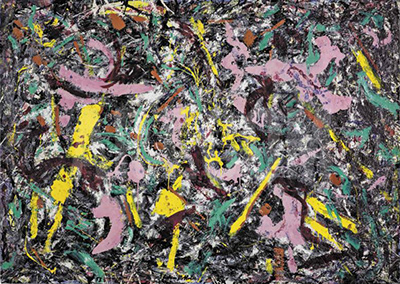
Jackson Pollock’s Unformed Figure of 1953 is an oil and enamel painting on canvas, measuring 130 × 195.5 cm in Museum Ludwig’s record. Its title holds together a suggestion of recognisable imagery and the uncertainty of a shape still escaping definition. [1]
A contemporary response supplies a useful starting point. Reviewing Pollock in February 1954, Robert M. Coates specifically included Unformed Figure among paintings that retained his poured technique. He understood these marks as serving composition or background within the newer work. The question becomes what a familiar way of moving paint could now contribute to a different pictorial problem. [2]
At a Glance
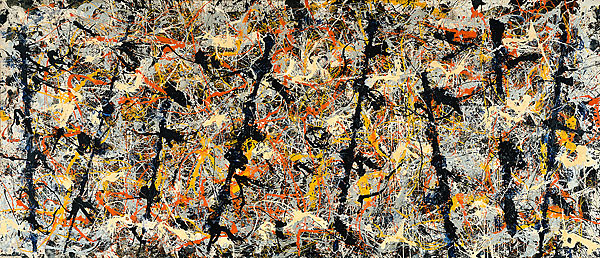
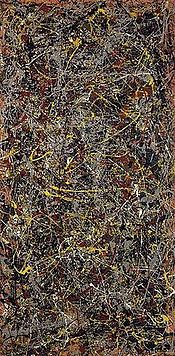
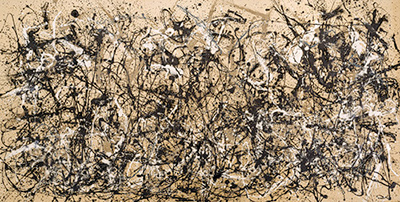
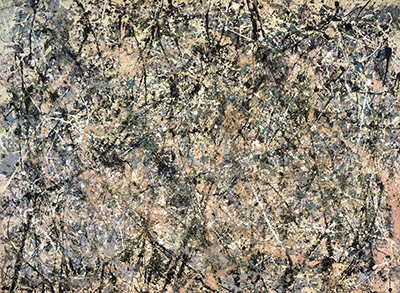
This work across Jackson Pollock’s career
The Flame
c.1934–38The She-Wolf
1943Mural
1943Alchemy
1947Number 1A, 1948
1948Blue Poles
1952The Deep
1953White Light
1954Contents
- What does “unformed” suggest?
- A varied exhibition in 1954
- A British collector’s choice
- Figure and space in a later setting
What does “unformed” suggest?
Bernice Rose’s account of Pollock helps make the title productive without turning it into a puzzle with one correct answer. She describes an exchange between figure and surrounding space in his earlier painting: areas between figures could become active shapes, while lines could loosen their attachment to the things they outlined. In that account, figure and ground are positions that can change. Read through this broader argument, Unformed Figure is an invitation to attend to the uncertain boundary between a shape and its surroundings. The name can direct attention towards the process of recognising a figure, including the moment when recognition remains incomplete. Rose also sees 1953 as a renewed investigation of oil paint and substantial painted surfaces, incorporating images developed in the preceding years. Her account places the painting’s date within continuing experiments in how images and paint could belong together. [3]
Museum Ludwig’s record also reports No. 2, Pollock’s name and the year 1953 inscribed on the reverse stretcher. The numbered identity and descriptive title coexist. The year identifies which numbered work is meant, while Unformed Figure opens a question about its imagery. [1]
Pollock and Lee Krasner had already discussed that difference in a 1950 interview with Berton Roueche. Krasner explained that numbers allowed people to encounter a painting without the prompting of a conventional title. Pollock added that he wanted to reduce the confusion around abstraction. Their remarks explain how numbering could direct attention towards the painting itself. Unformed Figure makes the distinction especially useful: its number identifies, while its name encourages a particular kind of attention. Pollock’s earlier “My Painting” statement also described recognising what had developed during work and freely changing or destroying an image. He described a period of becoming acquainted with the painting, making discovery part of the practical work of deciding what to retain. Those remarks allow emergence and revision to enter the discussion of his technique. They provide a general account of his practice, without supplying a step-by-step reconstruction of this canvas. [4]
A varied exhibition in 1954
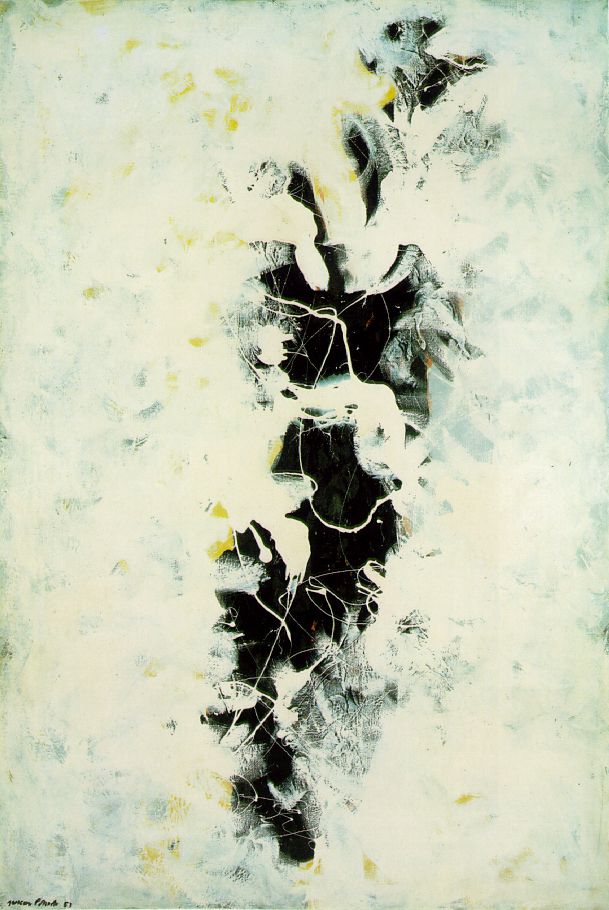
Unformed Figure appeared at Sidney Janis Gallery in New York from 1 to 27 February 1954, in a show of ten paintings made during 1953. Francis V. O’Connor’s exhibition chronology lists it beside Ocean Greyness, The Deep, Easter and the Totem and Greyed Rainbow. The reviews he reproduces register substantial disagreement. Emily Genauer remained hostile to the poured paintings while welcoming certain newer approaches. James Fitzsimmons praised the exhibition’s experimentation and singled out Ocean Greyness and Sleeping Effort as exceptional successes. Thomas B. Hess understood a synthesis of earlier ideas with a changing conception of space. These responses give Unformed Figure a lively early exhibition context: reviewers were debating how the paintings’ different methods and degrees of figuration fitted together. Their judgments also retain useful distinctions. Fitzsimmons’s strongest endorsement concerns two named companions; it cannot automatically become praise of every canvas in the room. [5]
The variety matters when placing this painting within Pollock’s later work. Kirk Varnedoe cautioned against making stylistic change follow the events of the artist’s life in a fixed sequence. He pointed instead to differences between paintings made close together and affinities between works separated by years. His comparison of the contrasting 1953 paintings Ritual and Easter and the Totem gives a particularly useful example. The date groups them historically while leaving their artistic problems distinct. That approach gives Unformed Figure room to be understood through its own title, continuing poured marks and relationship between image and surrounding paint. “Late Pollock” identifies a period; closer comparisons explain what remained open within it. The works gathered at Janis can therefore be explored as several active possibilities, each testing a different balance between the image, the material and the overall field. [6]
Watch: Jackson Pollock
Choose a film about Pollock’s paintings and ways of working.
A British collector’s choice
The painting’s subsequent history takes it into the early British collecting of American abstraction. Catherine Dossin reports that Ted Power became interested in American art after seeing Modern Art in the USA in London in 1956. With help from dealers Peter Cochrane and David Gibbs, he began building holdings that extended his existing interest in European painters such as Nicolas de Staël and Jean Dubuffet. In January 1958 he acquired two further Pollocks, including Unformed Figure. Dossin’s account gives the purchase a setting among acquisitions of Still, Kline and other American artists. It was part of an expanding engagement with several painters, through dealers and exhibitions. She also records a presentation of Power’s collection at London’s Institute of Contemporary Arts in March 1958. That collection exhibition shows how private purchases could create opportunities for a wider audience, although the account alone does not establish that Unformed Figure itself hung there. [7]
Museum Ludwig’s documentation traces a later institutional chapter: the painting was on loan from the Ludwig collection to Berlin’s Nationalgalerie between 1980 and 1985, followed by a loan to Museum Ludwig in Cologne in 1985. Its provenance also names the Janis, Castelli and Parsons galleries. The same record lists Düsseldorf in 1999 and Venice in 2002 among its exhibitions. It carefully distinguishes those appearances from reproduction in the 1998–99 Pollock catalogue, for which it explicitly records that the painting was absent from the exhibition. [1]
Figure and space in a later setting
The Museo Nacional Thyssen-Bornemisza featured Unformed Figure in its presentation of Warhol, Pollock and other American spaces, held from 21 October 2025 to 25 January 2026. Its caption identifies the painting as a permanent loan from the Peter und Irene Ludwig Stiftung, dating from 1985, at Museum Ludwig. The exhibition’s explanation centred on artists rethinking pictorial space through layering, concealment and changing relationships between figure and background. This offers another useful setting for the painting’s unresolved title. A figure can be something made visible through the handling of space, while surrounding paint participates in what becomes recognisable. The exhibition brought that question into a wider conversation about how paintings disclose and withhold images. [8]
Pollock artworks directory
Explore the distinct works discussed in these guides. This selection is not a complete catalogue. Green Silver and Untitled, 1949 are two guides to the same painting.
Discussion
Look again at the images and ideas explored in Unformed Figure. These editorial prompts invite your observations.
Reader Insights
Which detail in “What does “unformed” suggest?” changes how you understand this work?
What comparison comes to mind after “A varied exhibition in 1954”?
What would you like to discuss about “A British collector’s choice”?
Join the Conversation
Share a detail, comparison or question about Unformed Figure below.
References
- Museum Ludwig, Unformed Figure, ML 01444, institutional object record in Bildindex; inscriptions, provenance, exhibitions and bibliography. View source.
- Robert M. Coates, “American and International”, The New Yorker, print issue, 20 February 1954, Pollock review. View source.
- Bernice Rose, Jackson Pollock: Drawing into Painting (New York: Museum of Modern Art, 1980), pp. 8–9, 23. View source.
- Berton Roueche, “Unframed Space,” The New Yorker, 5 August 1950; Jackson Pollock, “My Painting,” Possibilities, winter 1947–48; reprinted in Pepe Karmel, ed., Jackson Pollock: Interviews, Articles, and Reviews (New York: Museum of Modern Art, 1999), pp. 17–19. View source.
- Francis V. O’Connor, Jackson Pollock (New York: Museum of Modern Art, 1967), pp. 69–71, exhibition chronology and excerpts from Genauer, Fitzsimmons and Hess. View source.
- Kirk Varnedoe, “Open-Ended Conclusions about Jackson Pollock,” in Kirk Varnedoe and Pepe Karmel, eds., Jackson Pollock: New Approaches (New York: Museum of Modern Art, 1999), p. 237. View source.
- Catherine Dossin, “To Drip or to Pop? The European Triumph of American Art”, ARTL@S Bulletin 3, no. 1 (spring 2014), pp. 90–91, note 48. View source.
- Museo Nacional Thyssen-Bornemisza, Warhol, Pollock and other American spaces, exhibition statement, 2025–26; Unformed Figure caption. View source 1. View source 2.