 by Tom Gurney
Tom Gurney BSc (Hons) is an art history expert with over 20 years experience
Published on June 19, 2020 / Updated on October 30, 2026
Email: tomgurney1@gmail.com / Phone: +44 7429 011000
Number 14, 1951 by Jackson Pollock: Introduction
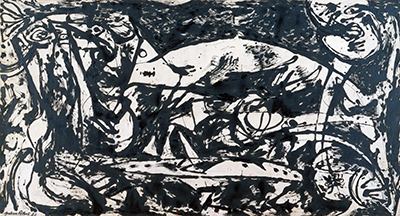
Jackson Pollock’s Number 14, 1951 belongs to Tate: an oil painting on canvas measuring 146.5 × 269.5 cm, acquired in 1988 with assistance from the American Fellows of the Tate Gallery Foundation. Its accession number is T03978. The broad horizontal support matters to an encounter with the painting: at nearly 2.7 metres across, it gives the relationship between mark and interval a substantial physical presence. Tate’s collection record distinguishes these canvas dimensions from the larger measurements of its frame. The numbered title can sound anonymous, but the combination of date, support and scale identifies a particular object, with a particular material history. [1]
Tate singles out Number 14 when describing Pollock’s change towards monochrome and more explicit figuration in 1951. The museum’s account contrasts the dense accumulations of the preceding drip paintings with a closer relationship between black paint and exposed canvas. That shift gives a useful starting point for this painting: attend to how the marks and their surrounding spaces act together. A reduced palette can make the relation between an edge and an opening carry much of the picture’s activity. The interest moves towards the possibility that a line may describe something, while continuing to work as a free painted mark. [2]
At a Glance
This work across Jackson Pollock’s career
The Flame
c.1934–38The She-Wolf
1943Mural
1943Alchemy
1947Number 1A, 1948
1948Blue Poles
1952The Deep
1953White Light
1954Contents
Drawing large
Pollock himself recognised that imagery was coming into his new work. Writing to Alfonso Ossorio on 7 June 1951, he described a period of drawing in black on canvas and the reappearance of earlier images. He anticipated that this would disturb both committed advocates of nonobjective painting and people who thought his paintings were easy to imitate. The letter, reproduced in the MoMA chronology by Elizabeth Levine and Anna Indych, makes this change a problem Pollock was actively considering. For Number 14, that makes the possibility of a recognisable image part of an exploration Pollock acknowledged at the time. Familiarity with the poured paintings had become an expectation he could complicate. Black drawing on canvas offered a way to make that expectation newly uncertain, with recognisable possibilities entering the same practice of fluid paint. [3]
Lee Krasner’s account of the black paintings makes their production unusually tangible. Interviewed by B. H. Friedman in 1969, she described unprimed cotton duck, rolls of commercially supplied fabric, thinned paint, sticks, worn brushes and basting syringes. She emphasised Pollock’s control over flow as well as gesture. She also recalled decisions made through cutting and editing: where one work ended, which edge became its bottom and whether adjacent passages should remain together. These are recollections of the group’s working methods, rather than a complete record of Number 14 being made. They nevertheless give its horizontal extent a practical context. A painting’s boundaries could emerge through decisions taken after the marks existed. “Unprimed” also needs care: Krasner described glue sizing applied before painting or, in some cases, afterwards, so exposed cloth does not necessarily mean entirely untreated cloth. [4]
Bernice Rose’s Drawing into Painting offers a way to think about the resulting imagery. Discussing the 1951 canvases, she describes black sometimes serving as contour, sometimes as a positive shape, and sometimes leaving the blank ground to supply an edge. A thickening mark can therefore change its role as the eye follows it. Her argument connects figure and ground with the physical character of flowing paint: a line remains a material deposit even while suggesting a form. Applied as a reading approach to Number 14, this means allowing the pale intervals to become active. Follow an opening as carefully as a black passage, then consider whether the apparent figure changes. Recognition can arise within a larger arrangement of marks and spaces without becoming the painting’s only subject. Rose’s account keeps that ambiguity connected to drawing, scale and the behaviour of the medium. [5]
Watch: Jackson Pollock
Choose a film about Pollock’s paintings and ways of working.
The surface between black and canvas
A less obvious part of Number 14 is its finishing coat. Conservator James Coddington reports that analysis identified the final clear coating as polyvinyl acetate. Under reflected light, gloss in the exposed canvas reduces its difference from the shiny black paint, making the space read flatter. This gives the unpainted-looking intervals an altered surface of their own: the optical relationship depends on more than where black was deposited. Coddington proposes an aesthetic purpose for such coating, while allowing a practical explanation. Pollock’s letter of 14 April 1952 to Dorothy Miller asked about applying glue sizing to Number 7 to reduce wrinkles; it describes another painting. For Number 14, the chemical identification and reported gloss effect are firmer evidence than any claim about Pollock’s precise intention. Krasner’s remembered trade name, Rivit, supplies historical context rather than laboratory identification of a brand. [6]
The painting entered a public discussion already concerned with these shifting relationships. Francis V. O’Connor’s exhibition chronology lists a canvas Number 14 in Pollock’s Betty Parsons Gallery show of 26 November–15 December 1951, alongside a separate work on paper with the same number. His reprinted extracts show several approaches to the exhibition. Alfonso Ossorio’s introduction linked unfamiliar materials and methods to the ideas requiring them. Howard Devree welcomed a stronger sense of organisation and the suggestion of heads and figures. Fairfield Porter described a reversibility through which either light spaces or dark marks could become the subject. These are responses to the show as a whole. They place Number 14 within a contemporary debate about how to read the new work, while leaving its individual meanings open. Material decisions and the emergence of images were being discussed together from the outset. [7]
A painting Frankenthaler remembered
Helen Frankenthaler gave Number 14 a particularly memorable afterlife. In her 1968 interview with Barbara Rose, she explained that she generally found numerical titles difficult to remember, yet this painting had made its number unforgettable. She recalled seeing something like a fox or another animal in a wood at its centre. The association brought back a childhood game of finding concealed creatures in pictures; she also mentioned Rorschach experience as a personal association. Her account describes her own response, and she explicitly allowed that someone else could see the painting as completely abstract. This is valuable testimony about the room the work leaves for recognition. The animal belongs to a painter’s remembered encounter, rather than supplying an authoritative subject for Pollock’s canvas. Her recollection also mingles works from different years, so it is strongest as an account of looking and remembering, rather than an exact exhibition calendar. [8]
Tate’s account follows this monochrome experiment into the renewed colour of 1952, including Yellow Islands. That continuation makes Number 14 one stage in an evolving investigation: the tension between abstraction and representation continued as the palette changed. Its black line opened possibilities that colour could subsequently carry forward. [2]
Pollock artworks directory
Explore the distinct works discussed in these guides. This selection is not a complete catalogue. Green Silver and Untitled, 1949 are two guides to the same painting.
Discussion
Look again at the images and ideas explored in Number 14, 1951 by Jackson Pollock. These editorial prompts invite your observations.
Reader Insights
Which detail in “Drawing large” changes how you understand this work?
What comparison comes to mind after “The surface between black and canvas”?
What would you like to discuss about “A painting Frankenthaler remembered”?
Join the Conversation
Share a detail, comparison or question about Number 14, 1951 by Jackson Pollock below.
References
- Tate. Collection dataset, October 2014 snapshot, Number 14, 1951, T03978: medium, support and frame dimensions, acquisition credit. View source.
- Tate. “Jackson Pollock Black Paintings (portfolio)”, curatorial description, paragraphs on the 1951 black paintings and 1952 colour works. Accessed 25 October 2026. View source.
- Elizabeth Levine and Anna Indych. Chronology, p. 326, in Kirk Varnedoe with Pepe Karmel, Jackson Pollock. New York: Museum of Modern Art, 1998. Pollock’s letter to Alfonso Ossorio, 7 June 1951. View source.
- Lee Krasner, interviewed by B. H. Friedman. “An Interview with Lee Krasner Pollock,” 1969; reprinted in Pepe Karmel, ed., Jackson Pollock: Interviews, Articles, and Reviews. New York: Museum of Modern Art, 1999, pp. 37–38. View source.
- Bernice Rose. Jackson Pollock: Drawing into Painting. New York: Museum of Modern Art, 1980, pp. 19–21, especially p. 20. View source.
- James Coddington. “No Chaos Damn It,” p. 111 and p. 115, notes 22, 25–27, in Kirk Varnedoe and Pepe Karmel, eds., Jackson Pollock: New Approaches. New York: Museum of Modern Art, 1999. View source.
- Francis V. O’Connor. Jackson Pollock. New York: Museum of Modern Art, 1967, pp. 61–62: 1951 Parsons exhibition roster and extracts from Ossorio, Devree and Porter. View source.
- Helen Frankenthaler, interviewed by Barbara Rose. Oral history interview with Helen Frankenthaler, 1968. Archives of American Art, Smithsonian Institution. Transcript conversation on Pollock’s Number 14, numerical titles and perceived imagery. View source.