 by Tom Gurney
Tom Gurney BSc (Hons) is an art history expert with over 20 years experience
Published on June 19, 2020 / Updated on October 30, 2026
Email: tomgurney1@gmail.com / Phone: +44 7429 011000
Watery Paths (Undulating Paths): Introduction
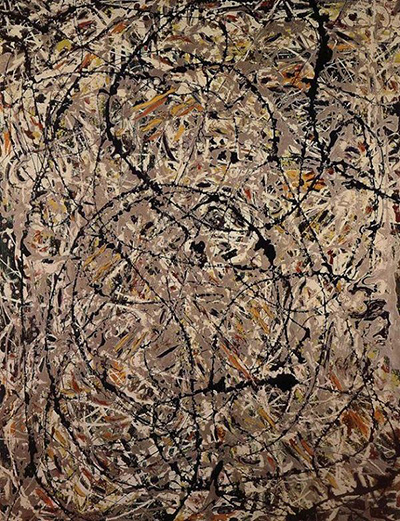
Jackson Pollock’s Watery Paths, also known as Sentieri ondulati and Undulating Paths, is a 1947 painting in Rome’s Galleria Nazionale d’Arte Moderna e Contemporanea. Its intertwined colour makes movement the subject of looking. [1]
The oil painting measures 114 × 86 cm and is inventory number 4554 in Rome, a 1950 gift from Peggy Guggenheim. Its support is inconsistently recorded: the English 2016 Palazzo Strozzi caption lists canvas, while the Italian version lists Masonite. That discrepancy remains unresolved. [2]
At a Glance
This work across Jackson Pollock’s career
The Flame
c.1934–38The She-Wolf
1943Mural
1943Alchemy
1947Number 1A, 1948
1948Blue Poles
1952The Deep
1953White Light
1954Contents
- Colour in motion
- A space made by colour
- Movement and decision
- A painting among new paintings
- Peggy Guggenheim’s gift to Rome
- Protecting access
- Returning to Guggenheim’s story
Colour in motion
The Galleria Nazionale describes whorls and tangles that coil back upon themselves. Some passages resolve into spots and stripes; elsewhere, flowing paint spreads into broader areas. Overlapping tones produce a partially grey background. In the museum’s account, circular movements made in the air remain registered in the colour. This gives a useful way into the painting: follow a turning line, then attend to the wider patch beside it and the background between marks. Different widths make different kinds of movement available to the eye. The museum also records that its archives preserve extensive correspondence about Guggenheim’s donation, connecting the active surface to a carefully documented public history. [1]
A space made by colour
Bernice Rose’s study of Pollock offers a broader explanation of how such paintings can suggest atmosphere without depicting a recognisable landscape. She argues that colour works both as a distinct hue and as a tone within the whole, while linear networks leave intervals through which space seems to continue. The viewer’s changing response helps activate that space. [3]
Rose’s account encourages attention to relations: a line acquires force from the surrounding field, and a quieter passage can alter the apparent position of an insistent mark. Applied as a way of looking at Watery Paths, this makes the background worth sustained attention. It participates in the experience of depth and movement. Rose’s discussion concerns Pollock’s larger practice, so it supplies questions to bring to this painting: how do light and dark hold together, and how does the eye move between separate colours and their combined effect? [3]
Movement and decision
Pollock’s own account places physical movement beside acts of judgment. In “My Painting,” published in Possibilities in winter 1947–48, he explained his preference for an unstretched canvas secured to a hard wall or the floor. Floor working let him move around the painting and approach it from four sides. He described becoming acquainted with what he had made and a willingness to revise it: “I have no fears about making changes.” [4]
That sequence allows for an immediate action followed by recognition, alteration and renewed work. It helps explain why an energetic painted trace need not be understood as an unconsidered one. Read alongside Watery Paths, the statement invites attention to the relationship between movement and the developing whole. It is an account of his practice at the time, rather than a record of every tool, ingredient or working session used for this particular painting. [4]
Kirk Varnedoe places these words within a transition whose exact beginnings resist a single dramatic story. His account of the new methods stresses decisions made through working with materials. He also points out that the illustrations accompanying “My Painting” showed earlier work, rather than the poured paintings. Readers first encountered the statement without those new canvases beside it. For Watery Paths, this distinction helps separate the history of making from the history of being seen. A painting could embody a developing method before an exhibition made that method a public issue. Varnedoe’s discussion follows how the unusual process subsequently became a powerful part of the work’s reception. [5]
Watch: Jackson Pollock
Choose a film about Pollock’s paintings and ways of working.
A painting among new paintings
Watery Paths appeared in Pollock’s first solo exhibition at the Betty Parsons Gallery in New York, held from 5 to 23 January 1948. Francis V. O’Connor’s exhibition chronology lists seventeen paintings, including Enchanted Forest, Cathedral, Lucifer, Full Fathom Five and Alchemy. That company places the Rome painting within an important exhibition. [6]
The responses reprinted by O’Connor show how unsettled judgment remained. Robert M. Coates, writing in The New Yorker on 17 January, welcomed some paintings while finding others uncommunicative; his favourable examples included Full Fathom Five and Enchanted Forest. Clement Greenberg’s response in The Nation on 24 January stressed the originality of the new work and the difficulty of assessing it. These are responses to the exhibition and its other named paintings, rather than a recorded verdict on Watery Paths itself. They restore something valuable to its history: the painting entered public view among works whose energy and organisation were being actively debated, before their place in museums could seem inevitable. [6]
Peggy Guggenheim’s gift to Rome
Mario Ursino’s archival research gives the gift a more precise story. In his February 2019 account, Guggenheim offered the Pollock and Renato Birolli’s Still Life of 1947 to the Galleria Nazionale in 1949 through Vittorio Corrain. Ursino cites a letter dated 26 January 1950 in which director Palma Bucarelli thanked Guggenheim, confirming that the two paintings had been received and displayed with her name. The offer and the acknowledgment mark different stages in bringing the work into public ownership. [7]
This was one part of a much wider distribution of Guggenheim’s collection. Ursino also recalls the 1987–88 exhibition devoted to her gifts, which gathered fifty-six works from twenty-one museums and included the Pollock from Rome. Seen through that history, Watery Paths belongs both to a particular Italian collection and to Guggenheim’s wider network of donations. Its museum home carries the history of a collector making works available beyond her own collection. [7]
Protecting access
On 26 January 1999, Watery Paths was marked with a grey felt-tip pen inside the Rome museum. Reporting the following day in l’Unità, Vichi De Marchi described an immediate alarm, visitors raising the alert and the intervention of custodians. According to her report, the marks were removed in the museum’s laboratories within hours and the painting was rehung. This is the contemporary published account of the response, rather than a technical treatment report. [8]
The incident also prompted a revealing discussion about how paintings should meet their public. Museum representative Elena Di Maio warned that stronger protection could reduce access to the works and that glass affected their visual impact. Critic Maurizio Calvesi proposed antireflective glass alongside attentive supervision. Their differing emphases bring the question close to the experience of looking: the surface that makes a painting compelling is also the surface a museum must safeguard. [8]
Returning to Guggenheim’s story
A later exhibition returned Watery Paths to a wider account of collecting. Palazzo Strozzi included it in From Kandinsky to Pollock: The Art of the Guggenheim Collections, held in Florence from 19 March to 24 July 2016. The Pollock section also brought together The Moon Woman, The Water Bull, Enchanted Forest, Untitled (Green Silver) and Number 18. That selection let the Rome painting take its place among works of different dates, supports and approaches. [2]
Pollock artworks directory
Explore the distinct works discussed in these guides. This selection is not a complete catalogue. Green Silver and Untitled, 1949 are two guides to the same painting.
Discussion
Look again at the images and ideas explored in Watery Paths (Undulating Paths). These editorial prompts invite your observations.
Reader Insights
Which detail in “Colour in motion” changes how you understand this work?
What comparison comes to mind after “A space made by colour”?
What would you like to discuss about “Movement and decision”?
Join the Conversation
Share a detail, comparison or question about Watery Paths (Undulating Paths) below.
References
- La Galleria Nazionale d’Arte Moderna e Contemporanea, “Watery Paths (Sentieri ondulati) di Jackson Pollock”, Google Arts & Culture, complete Italian narrative. View source.
- Fondazione Palazzo Strozzi, From Kandinsky to Pollock: The Art of the Guggenheim Collections, exhibition press kit, 2016, English PDF pp. 2, 7–8; Italian version, PDF p. 8; entry 3.09 in both. View source 1. View source 2.
- Bernice Rose, Jackson Pollock: Drawing into Painting (New York: The Museum of Modern Art, 1980), pp. 17–18 (PDF pp. 20–21). View source.
- Jackson Pollock, “My Painting,” Possibilities 1 (winter 1947–48), pp. 78–83, reprinted in Pepe Karmel, ed., Jackson Pollock: Interviews, Articles, and Reviews (New York: The Museum of Modern Art, 1999), pp. 17–18 (PDF pp. 21, 20). View source.
- Kirk Varnedoe, Jackson Pollock, with Pepe Karmel (New York: The Museum of Modern Art, 1998), pp. 47–48 (PDF pp. 52–53). View source.
- Francis V. O’Connor, Jackson Pollock (New York: The Museum of Modern Art, 1967), pp. 42–43 (PDF pp. 47–48), exhibition roster and reprinted Coates and Greenberg reviews. View source.
- Mario Ursino, “40 anni fa scompariva Peggy Guggenheim, indimenticabile protagonista di una stagione artistica indimenticabile”, About Art On Line, signed Rome, February 2019, “Le donazioni di Peggy Guggenheim” and its complete asterisked archival note. View source.
- Vichi De Marchi, “Sfregio a Pollock nella Galleria d’arte moderna”, l’Unità, 27 January 1999, p. 22, main report and adjacent sidebar. View source.