 by Tom Gurney
Tom Gurney BSc (Hons) is an art history expert with over 20 years experience
Published on June 19, 2020 / Updated on October 30, 2026
Email: tomgurney1@gmail.com / Phone: +44 7429 011000
Ocean Greyness: Introduction
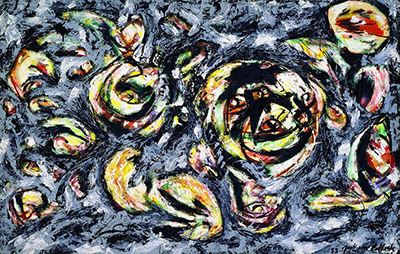
In Ocean Greyness, coloured fragments and detached, eye-like forms interrupt a churning grey field. The title invites an association with moving water, but the forms also suggest the beginnings of a face. The Guggenheim’s account places this uncertainty at the centre of the painting: representation and abstraction remain in active tension. An eye can be recognisable without making everything around it resolve into a body, a setting or a story. Those partial recognitions give the surface a peculiar intimacy within its restless movement. [1]
Jackson Pollock painted the work in 1953. It belongs to the Solomon R. Guggenheim Museum in New York, where its accession number is 54.1408. The museum identifies the medium as oil on canvas; its published dimensions are 146.7 × 229 centimetres. [1] [2]
At a Glance
This work across Jackson Pollock’s career
The Flame
c.1934–38The She-Wolf
1943Mural
1943Alchemy
1947Number 1A, 1948
1948Blue Poles
1952The Deep
1953White Light
1954Contents
- How the grey surface was made
- A painting could change as it developed
- Texture across the years
- Its first critical audience
- A new direction, and a museum acquisition
How the grey surface was made
Conservator Carol C. Mancusi-Ungaro reconstructs an intricate sequence. Thin, fluid, vibrant colour first soaked the canvas. Pollock then seems to have covered it with Rivit glue: that intermediate layer remains a qualified identification. He used traditional oil paint and a brush to build raised ridges, selectively covered these with black enamel, then added grey thickened with particulate matter and further squeezes of oil colour from tubes. Opposing directions of enamel drips indicate changes in the canvas’s orientation. The grey recalls a material tactic in The She-Wolf. James Coddington likewise identifies premixing for the heavy impasto. [3]
Crucially, Mancusi-Ungaro identifies one eye in the upper left as a gap exposing the first painted layer. An early stage survives inside the finished design. Here, earlier colour remains an active participant in the completed painting. Kirk Varnedoe connects Ocean Greyness with territory Pollock had explored in Eyes in the Heat in 1946. Familiar possibilities could be reopened through a new combination of materials. [3]
A painting could change as it developed
Pollock’s own writing gives a useful context for such revisiting. In “My Painting,” published in the winter of 1947–48, he described a period of becoming acquainted with what he had made. Awareness could follow activity; recognition could then lead to substantial alteration. He explicitly allowed for changing or destroying an image during the work. His account makes recognition itself part of the work. The text describes an exchange between an artist and a developing painting, with the result remaining open during its making. It also names both fluid paint and heavy impasto among his materials. Written several years before Ocean Greyness, it supplies a vocabulary for responsiveness and revision, rather than a dated record of this canvas’s sessions. Its practical emphasis lets us approach the painting through decisions and adjustments without having to invent a predetermined subject. [4]
Texture across the years
Writing for MoMA’s 1956 retrospective, Sam Hunter located Ocean Greyness within a longer history of Pollock’s interest in the substance of paint. He connected its thick, pitted surface to the rich pigment of Shimmering Substance, a work of 1946. He also brought Lavender Mist into this account of increasingly elaborate painted surfaces. The comparison directs attention to texture across works made with different handling: paint can retain a forceful material presence even when the arrangement and character of its marks change. Hunter contrasted this strand with the thinner, more linear manner of The Blue Unconscious. Read as a comparison, his account helps locate Ocean Greyness among Pollock’s recurring alternatives. Thickness and thinness, built surfaces and linear movement offered different possibilities over several years. Hunter’s retrospective perspective makes the 1953 painting part of that continuing engagement with paint, giving its density a history beyond the immediate suggestion of grey water. [5]
Watch: Jackson Pollock
Choose a film about Pollock’s paintings and ways of working.
Its first critical audience
Ocean Greyness appeared at Sidney Janis Gallery in New York from 1 to 27 February 1954, in a solo exhibition of ten paintings made in 1953. They included The Deep, Easter and the Totem, Greyed Rainbow and Unformed Figure. The responses preserved by Francis V. O’Connor show critics weighing these new paintings individually. James Fitzsimmons, writing in Arts & Architecture that March, singled out Ocean Greyness and Sleeping Effort as matching Pollock’s finest achievements, while acknowledging uneven results elsewhere in the show. Emily Genauer preferred The Deep and Easter and the Totem. Her praise of a new direction therefore cannot be treated as a particular endorsement of Ocean Greyness. Thomas B. Hess described the exhibition more broadly as a synthesis of earlier possibilities with a changing conception of active space. Together these responses show that the late work invited argument about renewal, invention and quality while Pollock was still alive. [6]
Robert M. Coates’s review offers an impression. He admired the sweep and fluidity of colour in Ocean Greyness, comparing its vigour to Soutine. His favourable response sat within a qualified assessment of the exhibition’s experiments. Elsewhere in the show, he observed that dripping continued to serve compositional purposes, including in Unformed Figure. The comparison records what a contemporary critic found compelling in this canvas; it does not establish a source Pollock deliberately followed. [7]
A new direction, and a museum acquisition
Bernice Rose returned to the painting in her 1980 study Jackson Pollock: Drawing into Painting. She understood 1953 as a renewed investigation of colour, oil paint and the material possibilities of raised paint surfaces, bringing imagery into that inquiry. Ocean Greyness and The Deep were her examples of a promising new direction. This later assessment gives another way to understand the painting’s place in the career. A change of handling can open a fresh problem even when it draws on existing resources. Rose’s emphasis is on the possibilities being investigated, and on the limited number of paintings through which they were explored. Her reading leaves Ocean Greyness with an experimental quality: its significance lies partly in the questions about colour, imagery and paint that it keeps in play. The materials and the imagery belong to the same unfolding inquiry. [8]
The Guggenheim’s acquisition soon gave it a different public setting. Younger American Painters: A Selection, organised under director James Johnson Sweeney, opened on 12 May 1954. The museum acquired fourteen works from the exhibition across its participating artists. Ocean Greyness brought Pollock into the collection, alongside first acquisitions of paintings by Jimmy Ernst and Franz Kline. Sweeney’s programme welcomed artists who challenged existing taste. There was also an earlier connection: he had contributed the introduction to Pollock’s first solo exhibition at Peggy Guggenheim’s Art of This Century in 1943. Peggy’s gallery and the Solomon R. Guggenheim Museum were distinct institutions within that history. The 1954 acquisition linked their separate acts of support through this particular late painting. [2]
Pollock artworks directory
Explore the distinct works discussed in these guides. This selection is not a complete catalogue. Green Silver and Untitled, 1949 are two guides to the same painting.
Discussion
Look again at the images and ideas explored in Ocean Greyness. These editorial prompts invite your observations.
Reader Insights
Which detail in “How the grey surface was made” changes how you understand this work?
What comparison comes to mind after “A painting could change as it developed”?
What would you like to discuss about “Texture across the years”?
Join the Conversation
Share a detail, comparison or question about Ocean Greyness below.
References
- Solomon R. Guggenheim Museum, Pollock digital wall texts, 2020, “Ocean Greyness,” PDF p. 5. View source.
- Solomon R. Guggenheim Museum, Art of Another Kind, 2012, “Younger American Painters at the Guggenheim in 1954” and Ocean Greyness caption. View source.
- James Coddington, Carol C. Mancusi-Ungaro and Kirk Varnedoe, in Jackson Pollock: New Approaches, edited by Varnedoe and Pepe Karmel (MoMA, 1999), pp. 111, 151, 238. View source.
- Jackson Pollock, “My Painting,” Possibilities 1 (winter 1947–48), pp. 78–83; reprinted in Pepe Karmel, ed., Jackson Pollock: Interviews, Articles, and Reviews (MoMA, 1999), pp. 17–18. View source.
- Sam Hunter, Jackson Pollock, The Museum of Modern Art Bulletin 24, no. 2 (1956–57), p. 11. View source.
- Francis V. O’Connor, Jackson Pollock (MoMA, 1967), pp. 69–71: February 1954 exhibition and extracts from Genauer, Fitzsimmons and Hess. View source.
- Robert M. Coates, “American and International”, The New Yorker, print issue 20 February 1954, Pollock review. View source.
- Bernice Rose, Jackson Pollock: Drawing into Painting (MoMA, 1980), p. 23. View source.