 by Tom Gurney
Tom Gurney BSc (Hons) is an art history expert with over 20 years experience
Published on June 19, 2020 / Updated on October 30, 2026
Email: tomgurney1@gmail.com / Phone: +44 7429 011000
No. 5, 1948 by Jackson Pollock: Introduction
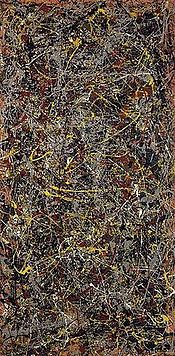
Number 5, 1948 brings the physical life of paint into the foreground. The Museum of Modern Art’s 1998 catalogue identifies it as oil, enamel and aluminium paint on fiberboard, measuring 243.8 × 121.9 centimetres, and assigns it the catalogue number OT 188. Its tall format and the later accounts of its reworking make it a particularly revealing painting through which to consider Pollock’s decisions about a surface. [1]
At a Glance
This work across Jackson Pollock’s career
The Flame
c.1934–38The She-Wolf
1943Mural
1943Alchemy
1947Number 1A, 1948
1948Blue Poles
1952The Deep
1953White Light
1954Contents
- Eight feet high
- A purchase before a friendship
- What did Pollock change?
- A number, and an allover field
- Three different material situations
- Looking and knowing
Eight feet high
Francis V. O’Connor’s 1967 MoMA catalogue describes the support as composition board and gives its measurements as eight by four feet. Read in the usual height–width order, this means a vertical rectangle, twice as high as it is wide. That proportion matters when imagining the original: its height exceeds a standing person’s, while its narrower width contains the field laterally. A small reproduction can make the whole painting available in a glance and disguise that encounter with scale. [2]
The same caption places the painting in the collection of Alfonso A. Ossorio and Edward F. Dragon in East Hampton. This is a record of ownership in 1967. [2] The 1998 catalogue names David Geffen’s collection in Los Angeles. These dated entries describe stages in the painting’s history; they do not establish its present owner or location. [1]
A board is also a useful reminder to think about the object carrying the paint. Describing every Pollock as a canvas can make his pictures seem more materially interchangeable than they were. The support, the applied paint and the dimensions belong together in our understanding of this particular work.
A purchase before a friendship
Number 5 appeared in Pollock’s second exhibition at the Betty Parsons Gallery, held from 24 January to 12 February 1949. Elizabeth Levine and Anna Indych’s chronology identifies it among twenty-six works painted in 1948. Kirk Varnedoe’s accompanying essay records that Ossorio bought it before meeting Pollock. [1]
Gail Levin’s study of Ossorio’s patronage supplies the next events. In April 1949 Parsons brought Pollock and Lee Krasner to inspect the damaged painting at Ossorio’s Greenwich Village home. Pollock offered to repair it at his studio. The following month Ossorio and his companion Ted Dragon took it to Springs and stayed with the Pollocks; friendship developed through the visit. [3]
Levin also publishes Grace Hartigan’s recollection, recorded in 1979. Hartigan remembered a detached lump of paint, an initial patch and a subsequent reworking of the whole painting after Ossorio noticed something wrong at its centre. In her telling, Ossorio recognised the changes and preferred the result. This is a later participant’s story, with the emphasis and remembered dialogue of oral history. [3]
The purchase brought a collector’s attention into the painting’s making. The person who owned it could notice, question and respond to what the artist had done, helping to open a friendship.
What did Pollock change?
Carol C. Mancusi-Ungaro gives a related account in her 1999 essay “Jackson Pollock: Response as Dialogue,” drawing on Ossorio’s 1978 Yale lecture. He described a six-by-nine-inch paint skin, taken from an opened paint can, which had shifted on the painting. When he saw the work again three weeks later, he recognised extensive, subtle overpainting. He felt that the first conception survived, enriched by the new work. [4]
The two recollections place different weight on the revision. Hartigan’s story stresses repainting the whole work; Ossorio stresses continuity within the change. Neither account provides a mapped technical reconstruction of the surviving layers. Together they invite us to understand a built surface in which earlier paint could remain active while later marks altered its relationships. Mancusi-Ungaro situates this example within Pollock’s wider practice of responding to paint already present. [4]
Repair can mean restoring a former condition. These accounts describe an artist producing a changed result, while leaving open how much of the earlier appearance survived.
A number, and an allover field
The title offers no named landscape, character or episode to organise a first response. In Berton Roueche’s 1950 article “Unframed Space,” Krasner explained the numbered titles with the phrase “Numbers are neutral.” Her point concerned attention to painting itself. It supplies useful context for Number 5, without turning its numeral into a chronological position or a mathematical key. [5]
Pollock’s own “My Painting,” published in winter 1947–48, combines absorption in working with a subsequent period of recognising what he has made. He also describes a willingness to change or destroy an image. Awareness, response and revision belong within that account of his method. The repair memories therefore have a wider artistic context, though the statement gives no instructions for reconstructing this specific painting. [5]
“Allover” raises questions about attention. Where does a passage lead the eye, and what brings it back? How does one mark affect another? These questions allow differences of emphasis within a field, including changes made by introducing new marks among older ones.
Three different material situations
Full Fathom Five, made in 1947, offers an instructive earlier comparison. MoMA records oil on canvas with embedded objects including nails, buttons, coins and a key, and dimensions of 129.2 × 76.5 centimetres. Its institutional account describes a brush-and-palette-knife underlayer followed by poured paint; work begun on an easel was completed on the floor. The museum connects its marks across the surface with allover composition. [6]
That example helps distinguish a painted field from a single pouring event. Different applications and physical inclusions can coexist within one work. Its smaller, upright canvas also gives a useful point of reference for imagining a tall painted surface at another scale. The comparison encourages attention to specific material histories, while leaving the precise sequence of Number 5’s applications open. [6]
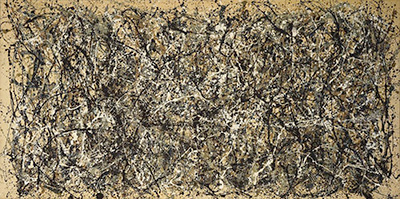
Two years after Number 5, One: Number 31, 1950 takes the comparison into a broad horizontal format. MoMA lists oil and enamel on canvas and dimensions of 269.5 × 530.8 centimetres. Its height is comparable to that of Number 5, but its width creates a substantially different relation to the viewer. The museum describes a dense network whose overall order coexists with small, delicate incidents. [7]
The contrast makes format part of the interpretation. A viewer might scan a wide painting from side to side, then move closer to follow a local passage. Looking at a tall, narrower work raises a different relation between upward reach and lateral limits. These are ways of approaching the paintings, rather than claims about a compulsory route through either composition. A shared interest in distributed marks can accommodate very different kinds of encounter. [7]
Looking and knowing
One later philosophical response helps explain why an abstract painting can sustain disagreement. In the abstract of his 2016 article on Number 5, Kim Su Rasmussen rejects a simple opposition between abstraction and figuration. He proposes two competing readings: an encounter with sensation before conceptual explanation, and an encounter already shaped by inherited history. His argument concerns the tension between these possibilities. It is a philosophical interpretation, rather than evidence of Pollock’s intention. [8]
That tension offers a useful question for readers who know this painting through catalogues and reproductions: how does learning its history affect the next encounter with it? A description of reworking may sharpen curiosity about the surface; a dimension may change the imagined distance between the painting and the body. Knowledge can give looking fresh questions while leaving room for an immediate response.
Pollock artworks directory
Explore the distinct works discussed in these guides. This selection is not a complete catalogue. Green Silver and Untitled, 1949 are two guides to the same painting.
Discussion
Look again at the images and ideas explored in No. 5, 1948 by Jackson Pollock. These editorial prompts invite your observations.
Reader Insights
Which detail in “Eight feet high” changes how you understand this work?
What comparison comes to mind after “A purchase before a friendship”?
What would you like to discuss about “What did Pollock change?”?
Join the Conversation
Share a detail, comparison or question about No. 5, 1948 by Jackson Pollock below.
References
- Kirk Varnedoe, with Pepe Karmel, Jackson Pollock (MoMA, 1998), p. 58; Elizabeth Levine and Anna Indych, chronology, p. 323; plates 142–143 caption, PDF p. 258. View source.
- Francis V. O’Connor, Jackson Pollock (MoMA, 1967), Number 5 caption, PDF p. 102. View source.
- Gail Levin, “The Extraordinary Interventions of Alfonso Ossorio, Patron and Collector of Jackson Pollock and Lee Krasner”, Archives of American Art Journal 50, nos. 1–2 (2011), pp. 8–9; Hartigan’s 10 May 1979 recollection quoted on p. 9. View source.
- Carol C. Mancusi-Ungaro, “Jackson Pollock: Response as Dialogue,” in Jackson Pollock: New Approaches, edited by Kirk Varnedoe and Pepe Karmel (MoMA, 1999), pp. 120, 145; Ossorio’s 1978 Yale lecture quoted there. View source.
- Jackson Pollock, “My Painting,” Possibilities 1 (winter 1947–48), reprinted pp. 17–18; Berton Roueche, “Unframed Space,” The New Yorker, 5 August 1950, reprinted pp. 18–19, in Jackson Pollock: Interviews, Articles, and Reviews, edited by Pepe Karmel (MoMA, 1999). View source.
- The Museum of Modern Art, Full Fathom Five, 1947, object 186.1952; object record, 2010–11 gallery label and 2017 course text. View source.
- The Museum of Modern Art, One: Number 31, 1950, object 7.1968; object record and MoMA Highlights (2019) excerpt. View source.
- Kim Su Rasmussen, “Antinomy of Abstraction: On Pollock’s ‘Number 5’ (1948)”, 범한철학 82, no. 3 (2016), pp. 215–244. English and Korean abstract and bibliographic record consulted. View source.