 by Tom Gurney
Tom Gurney BSc (Hons) is an art history expert with over 20 years experience
Published on June 19, 2020 / Updated on October 30, 2026
Email: tomgurney1@gmail.com / Phone: +44 7429 011000
Male and Female by Jackson Pollock: Introduction
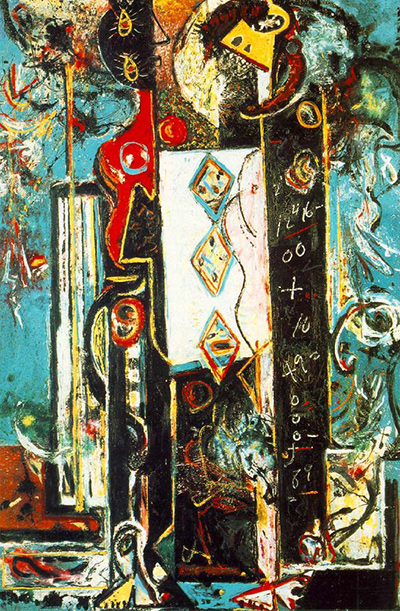
Two upright bodies and a panel of numbers make Male and Female a direct encounter with the problem of recognising figures in Pollock’s early painting. The Philadelphia Museum of Art dates the oil on canvas to 1942–43. Its account identifies the black column on the right as male and the curving figure on the left, with catlike eyelashes, as female. Both stand on small triangular feet amid splashed and smeared paint. The museum’s pairing gives the viewer an initial route into a picture alive with contrasting kinds of marks. [1]
The museum records the canvas at 186.1 × 124.3 cm and its frame separately at 194.3 × 132.1 cm. It entered the collection as the gift of Mr. and Mrs. H. Gates Lloyd in 1974, accession 1974-232-1. At more than six feet high, the painted support gives the standing forms a scale that matters to their confrontation with the viewer. The smaller feet, emphasised in the museum’s description, make an arresting counterpoint to the vertical bodies above them. [1]
At a Glance
This work across Jackson Pollock’s career
The Flame
c.1934–38The She-Wolf
1943Mural
1943Alchemy
1947Number 1A, 1948
1948Blue Poles
1952The Deep
1953White Light
1954Contents
Bodies assembled in paint
The figures have bodily presence without the continuous modelling of a conventional double portrait. The Musée national Picasso-Paris’s exhibition dossier describes a heterogeneous central block whose combined elements produce the effect of collage. Around it, drops, runs and quick strokes give the painter’s gesture greater freedom. Here, “collage” describes an effect within oil painting; it does not establish pasted papers on this canvas. [2]
That distinction clarifies the composition’s competing energies. The central grouping concentrates forms, while surrounding marks carry gestures beyond its boundaries. The dossier connects this composite treatment with Picasso’s experiments in assembling and fragmenting figures. A body can remain recognisable when its parts cease to join anatomically. The comparison directs attention to how Pollock builds a figure, without making every painted shape a borrowed motif. [2]
Which figure is which?
The title names a relationship, but it leaves the viewer to assign its terms. In 1979 Elizabeth Langhorne reversed the pairing now given by the Philadelphia museum: she identified the left figure as male and the right as female, connecting red and yellow, selected numbers and alchemical imagery to a union of opposites. She also related the work to Pollock’s developing relationship with Lee Krasner. This is an interpretation, not evidence that the painting portrays the couple. [3]
William Rubin challenged her decoding in the same year. He questioned the selection of particular colours and the numbers 2, 4 and 6 from a much larger array of marks. He also doubted that the title required two figures with unambiguously separate sexes. His alternative of a blackboard covered with mathematical notation restores the panel’s everyday pictorial associations. The disagreement leaves the painting’s gender identities open; it supplies no settled numerical message. [3]
The numbers also interrupt the familiar distinction between a body and the space around it. Omri Moses, writing in 2004, makes this the centre of a different reading. The figure becomes a blackboard on which “figuring” can mean calculation as well as representation. Yet the surrounding marks resist becoming an orderly explanation of that figure. Moses draws attention to eyes emerging near the right edge and at the base of the female form, where looking appears to occur outside the main encounter. [4]
His argument asks us to consider what happens when an inscription shares a surface with a depicted being. Do the marks belong to the character, explain it, or begin to act independently? The peripheral eyes complicate the answer by allowing attention to gather away from the principal bodies. This is Moses’s philosophical account of the painting’s activity, rather than a statement of Pollock’s intentions or proof that he designed an illustration of a particular theory. It makes the scattered marks consequential without converting them into a code. [4]
Watch: Jackson Pollock
Choose a film about Pollock’s paintings and ways of working.
Recognition keeps changing
A useful companion is Stenographic Figure, where the uncertainty begins even before deciding who the characters might be. MoMA offers two possible configurations: a reclining female extending across the canvas, or two upright figures. Its description identifies a final layer of scratchy calligraphic lines. Those alternatives show how a viewer’s recognition can shift while the painted marks stay the same. A line that helps establish the body in one reading can participate in a different arrangement in another. [5]
The comparison gives Male and Female a more particular interest. Its title invites the reader to look for a pair, whereas Stenographic Figure can sustain uncertainty over whether there is one figure or two. Reading the works together encourages a pause between recognising a human presence and deciding its precise configuration. MoMA’s account does not resolve its own alternatives into a preferred answer; that openness provides a useful model for approaching the disputed identities here. A convincing initial recognition can remain available even when another reading becomes possible. [5]
The Moon Woman offers a related route into these early figures. The Peggy Guggenheim Collection dates it to 1942 and connects its palette and composition with Picasso. The museum places its mythic subject within Pollock’s broader interest in ideographic signs and the Surrealists’ idea of the unconscious as a source of art. This establishes a shared artistic setting for the works while leaving room for their very different organisations. A single named figure and a named pair can both inhabit a language in which marks hover between bodily description and independent sign. [6]
The French dossier gives the comparison a concrete focus: in The Moon Woman, black draws the body in a few lines, while the face’s profile recalls Picasso. It is a concise reminder of how little descriptive information can carry recognition. [2]
An early public life
Male and Female belonged to Pollock’s first solo exhibition at Peggy Guggenheim’s Art of This Century, held from 9 to 27 November 1943. Elizabeth Levine and Anna Indych’s chronology lists it alongside The Moon Woman, Stenographic Figure, The She-Wolf and Guardians of the Secret. Seen within that company, the painting formed part of an already varied public presentation, joining figurative subjects to experiments with signs and paint. [7]
Kirk Varnedoe situates the exhibition’s figures of uncertain gender and apparently unreadable markings within a wartime search for consequential abstract subject matter. He argues that their effect could depend on seeming meaningful while withholding a fully knowable meaning. This critical position helps explain why the desire to decode the numbers is so persistent: the painting encourages the sense that there is something to understand. It also suggests a way to remain attentive when a proposed explanation fails to account for everything on the surface. [7]
The exhibition drew mixed responses. Francis V. O’Connor’s documentary catalogue reprints Clement Greenberg’s November 1943 review, which specifically coupled Male and Female with Guardians of the Secret in questioning their balance between easel painting and mural scale. Robert Coates’s response to the show was more broadly welcoming, although he also found some works overworked. These were different assessments of an emerging practice, rather than a unanimous verdict on this canvas. [8]
Its exhibition history continued: O’Connor records Male and Female in the Pinacotheca group show in New York, 9–27 May 1944, and in Pollock’s Arts Club of Chicago exhibition, 5–31 March 1945. The Chicago checklist again brought it together with The Moon Woman and Stenographic Figure, as well as Pasiphaë. Those appearances give the painting a public history extending beyond its first unveiling. The figures and their inscriptions were already confronting audiences while critics were still arguing about what Pollock’s combinations of abstraction and representation could achieve. [8]
Pollock artworks directory
Explore the distinct works discussed in these guides. This selection is not a complete catalogue. Green Silver and Untitled, 1949 are two guides to the same painting.
Discussion
Look again at the images and ideas explored in Male and Female by Jackson Pollock. These editorial prompts invite your observations.
Reader Insights
Which detail in “Bodies assembled in paint” changes how you understand this work?
What comparison comes to mind after “Which figure is which?”?
What would you like to discuss about “Recognition keeps changing”?
Join the Conversation
Share a detail, comparison or question about Male and Female by Jackson Pollock below.
References
- Philadelphia Museum of Art, Male and Female, accession 1974-232-1; object fields and interpretive text, accessed 25 October 2026. View source.
- Musée national Picasso-Paris, Jackson Pollock: les premières années (1934–1947), Dossier documentaire, 2024, pp. 29–31. French. View source.
- Elizabeth L. Langhorne, “Jackson Pollock’s ‘The Moon Woman Cuts the Circle’” (1979), pp. 208–210; William Rubin, “Pollock as Jungian Illustrator: The Limits of Psychological Criticism” (1979), pp. 245–248, in Pepe Karmel, ed., Jackson Pollock: Interviews, Articles, and Reviews (MoMA, 1999). View source.
- Omri Moses, “Jackson Pollock’s Address to the Nonhuman”, Oxford Art Journal 27, no. 1 (2004), pp. 7–8; DOI 10.1093/oaj/27.1.1. View source.
- The Museum of Modern Art, Stenographic Figure, 2015 exhibition label, accessed 25 October 2026. View source.
- Peggy Guggenheim Collection, The Moon Woman, object record and commentary, accessed 25 October 2026. View source.
- Kirk Varnedoe, with Pepe Karmel, Jackson Pollock (MoMA, 1998), pp. 37–38; Elizabeth Levine and Anna Indych, chronology, p. 320. View source.
- Francis V. O’Connor, Jackson Pollock (MoMA, 1967), pp. 29–31, 34, 36; reprinted reviews and exhibition records. View source.