by Tom Gurney
Tom Gurney BSc (Hons) is an art history expert with over 20 years experience
Published on June 19, 2020 / Updated on October 30, 2026
Email: tomgurney1@gmail.com / Phone: +44 7429 011000
Summertime: Number 9A: Introduction
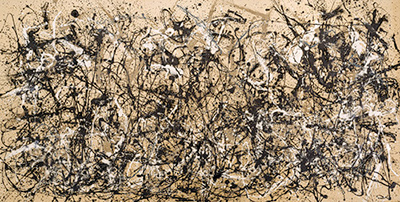
Jackson Pollock’s Summertime: Number 9A stretches across more than five and a half metres of canvas while remaining less than a metre high. Tate’s collection dataset, preserved as an October 2014 snapshot, records it as a painting of 1948, measuring 84.8 × 555 cm, made with oil paint, enamel paint and commercial paint. It identifies the work as T03977 and records its purchase in 1988. Those proportions give the painting an unusually sustained horizontal reach: its width is more than six times its height. For a reader approaching Pollock through his large, encompassing canvases, the dimensions offer a useful first distinction. Here a relatively shallow band carries an extended encounter, inviting attention along its length as well as to the relationships within each part. [1]
At a Glance
This work across Jackson Pollock’s career
The Flame
c.1934–38The She-Wolf
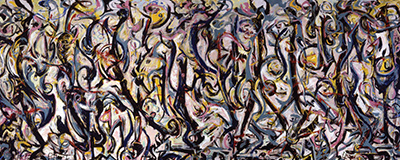
1943Mural
1943Alchemy
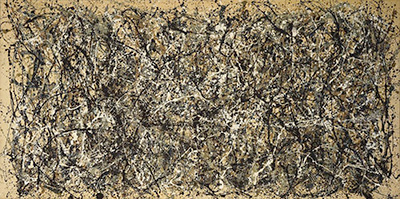
1947Number 1A, 1948
1948Blue Poles
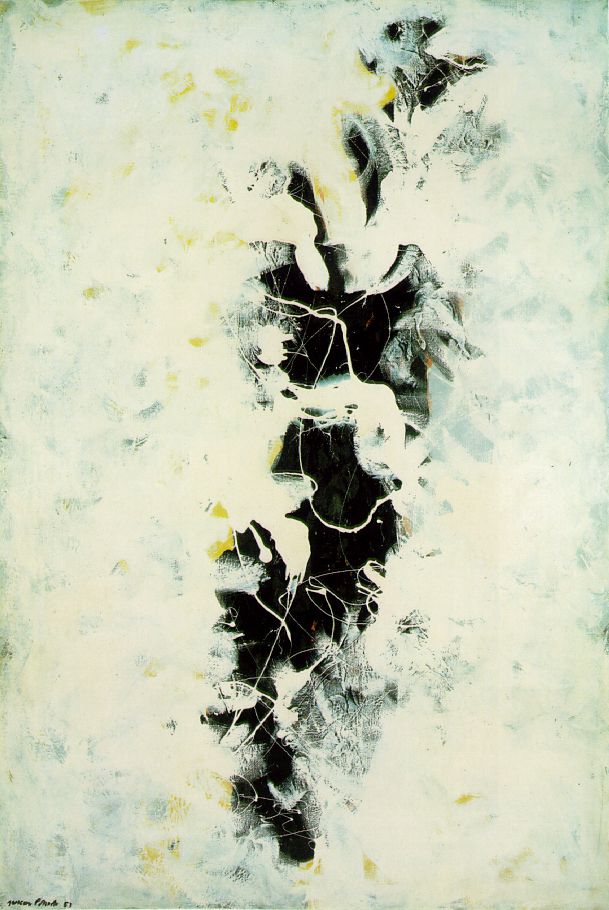
1952The Deep
1953White Light
1954Contents
Different kinds of paint mark
Olga Fuesers and Stefan Zumbühl’s 2008 account distinguishes black and silver-grey paint, described as alkyd, from coloured dabs of artists’ oils. They describe the former as poured, dripped and sprayed from a brush handle onto the horizontal canvas, producing smooth, glossy areas; the coloured dabs retain visible brush movement. Application and appearance remain connected: fluid marks and placed touches contribute different kinds of incident. Their painting-specific information cites Tom Learner’s 2006 Tate Modern Paint Podcast. Their experiments concern modern paint strips, so the paper supplies a published description of Summertime, rather than a new chemical examination of its canvas. [2]
The commercial paint has a less settled published history than that description alone suggests. Harriet Standeven’s 2007 chapter in Modern Paints Uncovered identifies an oleoresinous house paint in Summertime. Her note traces the information to a February 2003 personal communication from Learner at Tate, mentioning pyrolysis gas chromatography/mass spectrometry and infrared spectroscopy. The particular finding reaches us through her chapter; the underlying analytical report is not supplied there. This matters because “house paint” names a use, while oleoresinous and alkyd describe different binder formulations. The broad commercial category can accommodate differences that become consequential in a technical account. [3]
A 2020 technical survey by Francesca Rosi and colleagues includes Summertime in its comparative table of paints and applications. The entry cites Fuesers and Zumbühl’s paper, carrying its account forward without supplying an independent investigation of this work. The survey also explains why sampling and single-point measurements offer limited representations of complex paintings. Its methodological discussion makes a useful distinction between identifying a material at particular points and describing a whole painted surface. The scope and provenance of a finding matter as much as its appearance in a later publication. [4]
The 2007 oleoresinous identification and the 2008 alkyd description remain unreconciled. Both are mediated accounts of Learner’s work. Their publication dates alone cannot establish that one supersedes the other, or yield a single formula for the painting. [2] [3]
Watch: Jackson Pollock
Choose a film about Pollock’s paintings and ways of working.
Shapes within the field
Kirk Varnedoe places Summertime beside White Cockatoo in a discussion of Pollock’s experiments with bounded, filled shapes. Such areas reintroduce the possibility of figures within a poured field. It raises a question: when does a line continue across a painting, and when does it begin to describe something with an inside and an outside? Varnedoe treats these paintings within a larger range of deliberate adjustments and varied methods. His comparison with Out of the Web also marks a material distinction: the excision of forms belongs to that other work. The bounded shapes in Summertime do not establish that Pollock cut this canvas. [5]
Michael Fried made the same painting important to a particular critical argument in 1965. For Fried, Pollock’s all-over style had liberated line from its customary task of enclosing figures. Summertime, White Cockatoo and The Wooden Horse brought that task back into play by adding forms to the field. He saw a demanding contradiction: how could a painting preserve the continuous optical activity of the all-over approach while allowing line to regain its power to describe a shape? His account helps explain why a filled area can matter so much. It changes how the adjoining line is read, giving it a boundary-making role. Fried’s argument directs attention to the relationships among marks and their effect on the viewer. It is also a critic’s interpretation of Pollock’s formal ambitions. His subsequent discussion of physically removed shapes in Cut-Out and Out of the Web describes a different solution to the problem. [6]
Bernice Rose’s study of drawing offers a complementary way to approach that question. She describes Pollock’s work through exchanges between linear drawing and the material presence of paint: a line can define an image, become a colour accent, or participate in an interwoven surface. Her broader argument about shifting figure and ground is useful here because it makes looking an active process. An enclosed area can briefly hold attention as a separate form; the surrounding lines can then draw attention back into the larger field. Read through this framework, the significant question is how those readings coexist, rather than which single object a shape represents. Rose also connects colour and tonal relationships with the spatial effects experienced by the viewer. Her framework keeps surface, line and perception in conversation without supplying a chemical explanation for the particular paints in Summertime. It offers a reason to return to the work’s relationships after following an individual contour. [7]
Number, title and public life
The painting’s exhibition history helps place these experiments among Pollock’s contemporary work. Francis V. O’Connor’s 1967 chronology lists Number 9 [Summertime] in Pollock’s Betty Parsons Gallery exhibition of 24 January–12 February 1949. The show contained twenty-six works, all dated 1948, on canvas and paper. The older listing is a historical title form for the painting now identified as Summertime: Number 9A. O’Connor cautions that Pollock’s numbers seldom indicate an exact order of production and that numbers recur within some years. “9” consequently cannot establish that this was his ninth painting of 1948, or locate it precisely before and after other numbered canvases. The descriptive name and the number provide different ways of approaching the same work: one suggests an association, while the other places it within a body of paintings whose chronology needs documentary evidence. For related questions about numbered titles, see Number 1A. [8]
The A suffix belongs to Parsons’s distinction between unsold 1948 works and new 1949 paintings, as the later MoMA chronology explains. [5]
MoMA’s catalogue also identifies Arnold Newman’s published Life portrait of Pollock with Summertime, dated 8 August 1949, and another photograph made for that article but unused. [5]
Pollock artworks directory
Explore the distinct works discussed in these guides. This selection is not a complete catalogue. Green Silver and Untitled, 1949 are two guides to the same painting.
Discussion
Look again at the images and ideas explored in Summertime: Number 9A. These editorial prompts invite your observations.
Reader Insights
Which detail in “Different kinds of paint mark” changes how you understand this work?
What comparison comes to mind after “Shapes within the field”?
What would you like to discuss about “Number, title and public life”?
Join the Conversation
Share a detail, comparison or question about Summertime: Number 9A below.
References
- Tate, Collection Metadata, October 2014 snapshot, record T03977, “Summertime: Number 9A”; support measurements and acquisition credit. Official dataset. View source.
- Olga Fuesers and Stefan Zumbühl, “The Influence of Organic Solvents on the Mechanical Properties of Alkyd and Oil Paint,” 9th International Conference on NDT of Art, Jerusalem, 2008, pp. 2–3 and reference 12, p. 13. Paper. View source.
- Harriet Standeven, “‘Cover the Earth’: A History of the Manufacture of Household Gloss Paints in Britain and the United States from the 1920s to the 1950s,” in Modern Paints Uncovered, edited by Thomas J. S. Learner, Patricia Smithen, Jay W. Krueger and Michael R. Schilling (Getty Conservation Institute, 2007), pp. 79, 82, note 10. Volume. View source.
- Francesca Rosi, Costanza Miliani, John Delaney, Kathryn Dooley, Lena Stringari, Grazina Subelyte and Luciano Pensabene Buemi, “Jackson Pollock’s Drip Paintings: Tracing the Introduction of Alkyds Through Non-invasive Analysis of Mid-1940s Paintings,” in Science and Art: The Contemporary Painted Surface, edited by Antonio Sgamellotti, Brunetto Giovanni Brunetti and Costanza Miliani (Royal Society of Chemistry, 2020), pp. 8, 16–17, table 1.1 and reference 22. Chapter preview. View source.
- Kirk Varnedoe, with Pepe Karmel, Jackson Pollock (The Museum of Modern Art, 1998), p. 51 and p. 59, captions to figures 28–29; Elizabeth Levine and Anna Indych, chronology, pp. 323, 329, note 32. Catalogue. View source.
- Michael Fried, “Jackson Pollock,” Artforum 4, no. 1 (September 1965), pp. 14–17; reprinted in Pepe Karmel, ed., Jackson Pollock: Interviews, Articles, and Reviews (The Museum of Modern Art, 1999), pp. 97–102, especially 100–101. Reprint. View source.
- Bernice Rose, Jackson Pollock: Drawing into Painting (The Museum of Modern Art, 1980), pp. 8–9, 17–18. Catalogue. View source.
- Francis V. O’Connor, Jackson Pollock (The Museum of Modern Art, 1967), p. 45, chronology and January–February 1949 exhibition listing. Catalogue. View source.