 by Tom Gurney
Tom Gurney BSc (Hons) is an art history expert with over 20 years experience
Published on June 19, 2020 / Updated on October 30, 2026
Email: tomgurney1@gmail.com / Phone: +44 7429 011000
Pasiphaë: Introduction
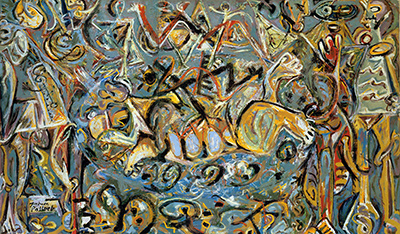
Jackson Pollock’s Pasiphaë, dated about 1943 by the Metropolitan Museum of Art, holds figures and restless lines in an uneasy balance. The museum describes angular and swirling marks crowding the front of the picture, with two sentinel forms flanking a prone central figure. Its oil-painted canvas measures 142.6 × 243.8 cm: a broad field in which a possible scene struggles to emerge. [1]
At a Glance
This work across Jackson Pollock’s career
The Flame
c.1934–38The She-Wolf
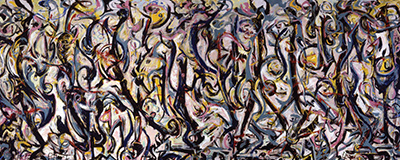
1943Mural
1943Alchemy
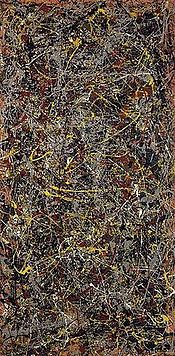
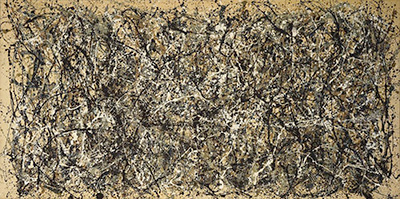
1947Number 1A, 1948
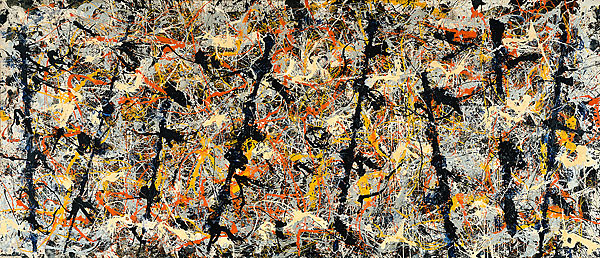
1948Blue Poles
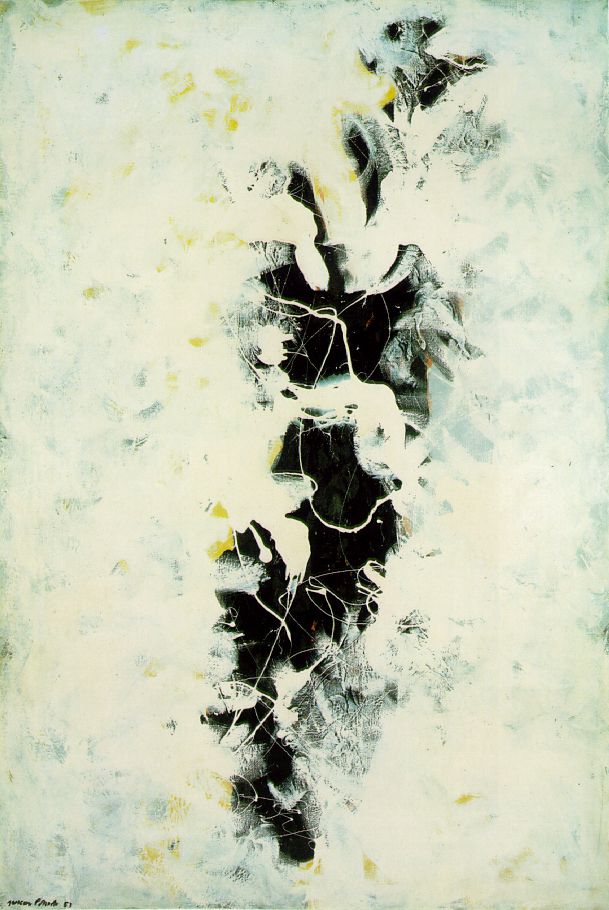
1952The Deep
1953White Light
1954Contents
- A title discovered afterwards
- Figures within the field
- Upright painting and deliberate revision
- From the studio to an audience
A title discovered afterwards
The name came after the image. In his 1979 essay, William Rubin recounts a studio visit by Peggy Guggenheim and James Johnson Sweeney: Guggenheim disliked its original title, Moby Dick, and Sweeney suggested Pasiphaë. Rubin attributes Pollock’s initial unfamiliarity with the myth to Lee Krasner’s recollection. The tale concerned the mother of the Minotaur, the creature combining human and bull. According to Rubin, the name changed without any alteration to the painting. He presents the episode as a warning about reading titles too literally: his own earlier interpretation, developed in Meyer Schapiro’s graduate seminar, had treated the canvas as an illustration of the legend. Yet he also resists dismissing the new title as arbitrary. His distinction is between a name that feels metaphorically appropriate and a story that determined the image in advance. A suggestive connection can matter without supplying a key to each figure. [2]
That original name can cause a practical confusion. Blue—Moby Dick, in the Ohara Museum of Art, is a separate work. Art Platform Japan records it as gouache and ink on fiberboard, about 1943, measuring 48 × 60.5 cm. Its support, materials and much smaller dimensions distinguish it from the Met canvas. The shared literary association belongs to the history of two objects; it does not establish that one is a study for the other. [3]
Figures within the field
The Met connects Pasiphaë with dozens of coloured drawings through which Pollock developed his version of Surrealist automatism, a method of drawing upon unconscious associations. Its description keeps the figures barely discernible. That qualification matters: the sentinels give a loose organisation to the field while the broken forms resist a stable account of what is happening. The museum also relates the surface-wide concentration of marks to the later drip paintings. The connection concerns pictorial organisation; the two kinds of painting have distinct material histories. [1]
A useful companion is Guardians of the Secret. SFMOMA’s description of that 1943 painting identifies tall figures at either side and a wide central area carrying signs. It proposes a tapestry, scroll or shroud for this middle field, leaving the identification open. The museum’s accompanying narration also observes that Pollock never explained its secret. Beside Pasiphaë, this gives a way to think about flanking figures as a compositional device: they establish sides, direct attention inward and make the centre seem consequential. The resemblance invites comparison before it invites storytelling. An arrangement can imply that something is being guarded or witnessed while leaving its content unresolved. Keeping SFMOMA’s alternatives in view also helps preserve the distinction between recognising an organised space and identifying a particular object within it. Neither painting needs to be made into a diagram of the other. [4]
Upright painting and deliberate revision
Carol C. Mancusi-Ungaro’s technical account brings that uncertain imagery back to concrete decisions. She identifies drips in Pasiphaë’s lower-right area as evidence of upright working, and brush-hair marks as evidence of viscous tube oil paint. She also describes grey paint covering parts of the imagery, apparently using oil here. Her comparison with shinier, more fluid masking paint in Guardians of the Secret and The She-Wolf is specific to those works; it does not establish industrial paint in Pasiphaë. Covering the space around a form can clarify its contour even while obscuring earlier marks. Revision therefore participates in making the image readable. These observations allow automatism and deliberation to coexist: an emerging form can prompt a response, and a later application can change its relationship to everything nearby. The surviving drips and brush traces offer evidence of making, rather than a chemical identification of every passage or a complete sequence of gestures. [5]
Watch: Jackson Pollock
Choose a film about Pollock’s paintings and ways of working.
From the studio to an audience
The painting belongs to the period when Peggy Guggenheim’s support gave Pollock greater professional opportunity. The Peggy Guggenheim Collection’s biography records his first solo exhibition at her New York museum-gallery, Art of This Century, in 1943, and a contract that enabled him to concentrate on painting. Its account places Picasso and Surrealism among the important contexts for his work before the middle of the decade. This was a New York setting in which European modernism and emerging American artists could meet through exhibitions and patronage. Later international circulation should also be understood through those networks: Guggenheim arranged Pollock’s first European solo exhibition in Venice in 1950, while Pollock himself never travelled outside the United States. The movement of his paintings and his own movements have different histories. [6]
For Pasiphaë itself, the documented early appearances are more precise. Francis V. O’Connor’s chronology lists it in Art of This Century’s group exhibition First Exhibition in America, held from 11 April to 6 May 1944. He also includes it in Pollock’s Arts Club of Chicago solo exhibition of 5–31 March 1945. The Chicago response included sharp resistance. In a review published on 6 March, Eleanor Jewett invoked Picasso’s Guernica while disparaging Pasiphaë and the exhibition’s restless, forceful character. Her comparison records a hostile response, rather than demonstrating that Pollock intended a parallel narrative. It is useful precisely because it shows how the density that later viewers might value could strike an early critic as disorder. These exhibition dates document public encounters with the work; they do not replace the Met’s approximate date of its making. [7]
Elizabeth Levine and Anna Indych’s later chronology corroborates the Chicago exhibition and places Pasiphaë among seventeen paintings shown with eight drawings. The roster included Guardians of the Secret, Male and Female and The Moon Woman, allowing audiences to encounter several related approaches to figures, symbols and abstraction together. Their account also records that a selection from the Chicago show travelled to the San Francisco Museum of Art later that year. The wording matters: a selected exhibition travelled, which by itself does not prove that every Chicago canvas went with it. This history locates Pasiphaë within an expanding public presentation of Pollock’s work, with the individual painting taking its place among other experiments. It also makes the exhibition a useful comparison point for readers exploring Pollock’s paintings: shared circumstances need not imply identical pictorial solutions. [8]
The Met purchased Pasiphaë in 1982 through the Rogers, Fletcher, and Harris Brisbane Dick Funds and Joseph Pulitzer Bequest. Its accession number is 1982.20, anchoring the painting’s present collection identity. [1]
That institutional familiarity could still be disturbed by a new encounter. Reviewing Surrealism: Desire Unbound at the Met in 2002, Peter Schjeldahl found Pasiphaë startling after the preceding galleries. His response emphasised the painting’s accumulated energy and the urgency of its marks. This was one critic’s experience of an exhibition, giving the painting a fresh reception history rather than settling its meaning. [9]
Pollock artworks directory
Explore the distinct works discussed in these guides. This selection is not a complete catalogue. Green Silver and Untitled, 1949 are two guides to the same painting.
Discussion
Look again at the images and ideas explored in Pasiphaë. These editorial prompts invite your observations.
Reader Insights
Which detail in “A title discovered afterwards” changes how you understand this work?
What comparison comes to mind after “Figures within the field”?
What would you like to discuss about “Upright painting and deliberate revision”?
Join the Conversation
Share a detail, comparison or question about Pasiphaë below.
References
- The Metropolitan Museum of Art, “Pasiphaë”, object 1982.20, collection description and artwork details. View source.
- William Rubin, “Pollock as Jungian Illustrator: The Limits of Psychological Criticism,” Art in America, November–December 1979; reprinted in Pepe Karmel, ed., Jackson Pollock: Interviews, Articles, and Reviews (MoMA, 1999), pp. 241–242. View source.
- Art Platform Japan, “Blue—Moby Dick”, W1051556, Ohara Museum of Art, object 1110; citing the museum’s 2011 collection catalogue, p. 78. View source.
- SFMOMA, “Guardians of the Secret, 1943”, object 45.1308, audio-description and narration transcripts. View source.
- Carol C. Mancusi-Ungaro, “Jackson Pollock: Response as Dialogue,” in Kirk Varnedoe and Pepe Karmel, eds., Jackson Pollock: New Approaches (MoMA, 1999), p. 119. View source.
- Peggy Guggenheim Collection, “Jackson Pollock”, artist biography. View source.
- Francis V. O’Connor, Jackson Pollock (MoMA, 1967), pp. 34, 36; including Eleanor Jewett, Chicago Daily Tribune, 6 March 1945, review excerpt. View source.
- Elizabeth Levine and Anna Indych, “Chronology,” in Kirk Varnedoe, with Pepe Karmel, Jackson Pollock (MoMA, 1998), pp. 320–321. View source.
- Peter Schjeldahl, “Surrealism Revisited”, The New Yorker, 11 February 2002; print issue 18 & 25 February 2002, final three paragraphs. View source.