 by Tom Gurney
Tom Gurney BSc (Hons) is an art history expert with over 20 years experience
Published on June 19, 2020 / Updated on October 30, 2026
Email: tomgurney1@gmail.com / Phone: +44 7429 011000
Jackson Pollock Quotes: Introduction
Jackson Pollock’s words become more interesting when they are brought back to the paintings. A remark about freedom can raise questions about practice; a refusal to explain a picture can invite a more patient look. The short quotations below offer starting points for those encounters. They also come with a distinction worth keeping: an artist describing his work, an interviewer shaping a conversation and a historian interpreting the result each give us a different kind of evidence.
Read a quotation once, then try looking at a painting without repeating it to yourself. Afterwards, ask whether the words helped you notice something particular. The most useful remark may be the one that leaves you with a better question.
At a Glance
- FocusPublished statements and interviews
- Reading approachSpeaker, date and context
- Related guideTechnique and materials
Contents
- Where Pollock’s words survive
- “Craftsmanship is essential”
- Working with a painting as it changes
- “I deny the accident”
- Looking without demanding a fixed story
- Painting and self-discovery
- Keeping the speaker in view
Where Pollock’s words survive
Sources include the 1944 questionnaire, 1947 application, My Painting (1947–48) and Wright interview. [1]
The Smithsonian’s Archives of American Art catalogues the recording as circa 1949; its finding aid also uses 1949. [2] Karmel’s edition instead gives late 1950 and a 1951 broadcast. [1] Those accounts remain unresolved. A cautious citation can identify the interviewer and the edition used without turning the broadcast history into a certainty.
These differences matter when a sentence travels on its own. Publication in an anthology supplies a reliable place to find the text, but the anthology’s publication year is not the date Pollock spoke. Similarly, a statement written for a grant application has a practical audience and purpose. Its confidence about future work should be read with that occasion in mind.
“Craftsmanship is essential”
In 1944, Pollock cites Picasso, Miró, the unconscious and Indigenous art. [1]
Bernice Rose’s Drawing into Painting offers a useful way to understand the emphasis on craftsmanship. She argues that Pollock’s achievement developed through sustained exchanges between drawing and painting: line could describe a figure, become a movement across a surface, or help organise the whole work. In her account, the material itself could prompt further invention. She connects his early experiments to the Siqueiros workshop and describes the poured line as a solution to problems he had already been exploring. This is Rose’s interpretation of an evolving practice, giving the short statement a longer artistic setting. [3]
Try taking craftsmanship as a question about decisions. Where does one kind of mark meet another? What happens when a line thickens or disappears? How does a passage of exposed canvas affect the marks around it? Such questions give the eye something to do without requiring a hidden subject to be found first. They also make freedom more demanding: a wider range of possible marks creates more choices for a painter to judge.
Working with a painting as it changes
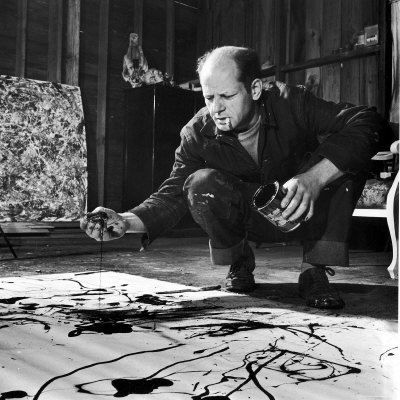
My Painting describes leaving the easel, working on the floor from four sides, sticks, knives, fluid paint, recognition and revision; the 1947 application proposes movable pictures between easel and mural. [1]
The distinction between making a mark and deciding to retain it is especially helpful here. A painting can develop through responses to what has already happened. Recognition may arrive after an action, while still affecting the next one. When reading an artist’s description of absorption in his work, allow room for that sequence: action, attention and another decision. The words need not supply a timetable for every moment in the studio.
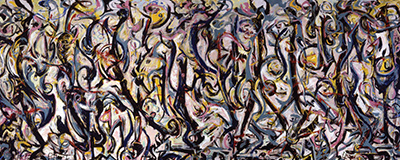
Modern examination of Mural gives this idea a concrete setting. Getty researchers found an initial composition in four diluted colours applied wet into wet. Tom Learner allowed that this early stage could have developed rapidly, perhaps within one night. Many subsequent applications, however, lie over dried paint, indicating intervals of days or weeks. The researchers also identified a late use of white house paint to recover areas of open space. These findings concern that particular painting; they give material substance to a history of returning, adjusting and building. [4]
“I deny the accident”
With Wright, Pollock links experienced flow control, a “general notion,” directness resembling drawing, and contemporary needs driving new techniques. [1]
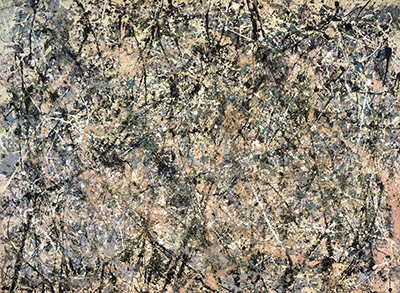
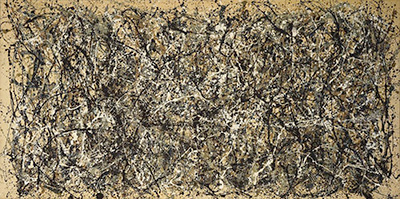
MoMA conservators James Coddington and Jennifer Hickey provide an instructive comparison in their account of One: Number 31, 1950. They distinguish late, similarly shaped rust-brown drips from scattered pink spots that they consider more likely to be studio accidents. The brown marks strongly suggest final work with the canvas upright. Their examination also describes industrial paints, occasional yellow artist’s oil and varying degrees of dilution. Here, decisions at a small scale remain consequential within a large painting. The conservators’ qualified conclusions add evidence about sequence and handling; they do not give access to every intention behind a mark. [5]
The phrase about accident can therefore remain a challenging declaration without becoming a claim that nothing unforeseen ever happened. Ask what the painter could select, redirect or incorporate, and what evidence a particular surface preserves. An unexpected event and an accepted artistic result are different stages of a process. The useful comparison is between the statement and the work, leaving each its own degree of certainty.
For a fuller account of the different tools, supports and paints involved, see Pollock’s technique and materials.
Watch: Jackson Pollock
Choose a film about Pollock’s paintings and ways of working.
Looking without demanding a fixed story
Wright distinguishes inner expression from copying appearances and encourages open looking. [1]
An earlier painting offers a memorable example of Pollock’s reluctance to close interpretation. MoMA reproduces his explanation that The She-Wolf existed because he needed to paint it, followed by the warning that verbal explanation “could only destroy it.” The museum dates the painting to 1943 and tentatively connects its subject to the wolf who nursed Romulus and Remus. Its language preserves that association as a possibility. The subject has a recognisable cultural setting, while Pollock’s statement resists a definitive explanation supplied by the artist. The museum’s discussion and his refusal can be held together: a possible source need not determine everything a painting does. [6]
This offers a practical approach to The She-Wolf. Begin with what draws your attention, then consider what the suggested myth adds. You might find that identifying a possible subject changes your response without exhausting it. Keep some distinction between recognising an association and explaining the entire picture. There is room for historical knowledge, sensory response and uncertainty within the same encounter.
Painting and self-discovery
“Painting is self-discovery” is another compact phrase with a complicated documentary setting. Francis V. O’Connor’s 1967 catalogue attributes the passage to a June 1956 conversation with Selden Rodman, subsequently published in Conversations with Artists in 1957. The passage also concerns representation and the emergence of figures from the unconscious. This is O’Connor’s account of its source; it does not establish that every version circulating today reproduces the same document. [7]
Rose presents a closely related passage as a handwritten note in Pollock’s files, possibly answering an unidentified questionnaire. These are different accounts of its origin, which remains uncertain. [3]
Read the phrase as an invitation to consider discovery within making. It can prompt attention to what becomes apparent through work, through looking again, or through allowing one decision to alter another. It supplies no secure diagnosis of the painter, and it cannot identify the private meaning of an individual shape. Readers interested in the documented circumstances of his life can follow the biography, while allowing each painting time to make its own impression.
Keeping the speaker in view
Krasner explains numbered titles in Roueché’s 1950 account. [1] That small attribution is worth retaining whenever a remembered conversation becomes a collection of sayings.
Kirk Varnedoe’s opening essay in the 1998 MoMA catalogue provides a broader caution. He treats Pollock’s art and the public stories surrounding it as connected, while resisting an explanation that reduces the paintings to those stories. He also describes a continuing disagreement about why the work matters. For the reader, that distinction makes room for an encounter that a familiar quotation has not already settled. A famous sentence can focus attention, yet the picture may give a different emphasis to the same question each time one returns. [8]
When copying a quotation, retain the speaker, occasion and source. When looking at a painting, let those details support your attention. The words are most useful when they send you back to the work with more to notice.
Pollock artworks directory
Explore the distinct works discussed in these guides. This selection is not a complete catalogue. Green Silver and Untitled, 1949 are two guides to the same painting.
Discussion
Look again at the images and ideas explored in Jackson Pollock Quotes. These editorial prompts invite your observations.
Reader Insights
Which detail in “Where Pollock’s words survive” changes how you understand this work?
What comparison comes to mind after ““Craftsmanship is essential””?
What would you like to discuss about “Working with a painting as it changes”?
Join the Conversation
Share a detail, comparison or question about Jackson Pollock Quotes below.
References
- Jackson Pollock, questionnaire, Arts and Architecture 61, no. 2 (February 1944), p. 14; fellowship application (1947); My Painting, Possibilities 1 (winter 1947–48), pp. 78–83; William Wright interview; Berton Roueché, Unframed Space, The New Yorker (5 August 1950), p. 16. Reprinted in Pepe Karmel, ed., Jackson Pollock: Interviews, Articles, and Reviews (MoMA, 1999), respectively pp. 15–16, 17, 17–18, 20–23, 18–19. View source.
- Archives of American Art, Smithsonian Institution, Interview with Jackson Pollock conducted by William Wright, item 15615, circa 1949. Compare the finding aid, section 1.1, box 1, folders 7–11. View source 1. View source 2.
- Bernice Rose, Jackson Pollock: Drawing into Painting (New York: MoMA, 1980), pp. 8–11, 21. View source.
- J. Paul Getty Trust, Getty Completes Conservation of Milestone Painting by Jackson Pollock, 21 January 2014, findings on initial composition, dried layers and white house paint. View source.
- James Coddington and Jennifer Hickey, MoMA’s Jackson Pollock Conservation Project: Insight into the Artist’s Process, 17 April 2013, discussion of One. View source.
- The Museum of Modern Art, The She-Wolf, 1943, object 82.1944; 2025 gallery label and MoMA Highlights excerpt (revised 2004; originally 1999). View source.
- Francis V. O’Connor, Jackson Pollock (New York: MoMA, 1967), p. 73, recording Rodman’s June 1956 interview and 1957 publication. View source.
- Kirk Varnedoe, “Comet: Jackson Pollock’s Life and Work,” in Jackson Pollock, with Pepe Karmel (New York: MoMA, 1998), pp. 17–19. View source.