 by Tom Gurney
Tom Gurney BSc (Hons) is an art history expert with over 20 years experience
Published on June 19, 2020 / Updated on October 30, 2026
Email: tomgurney1@gmail.com / Phone: +44 7429 011000
Number 17A, 1948 by Jackson Pollock: Introduction
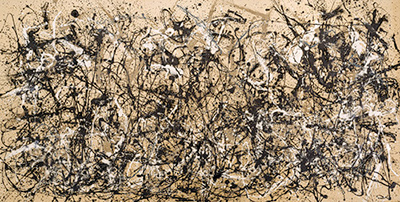
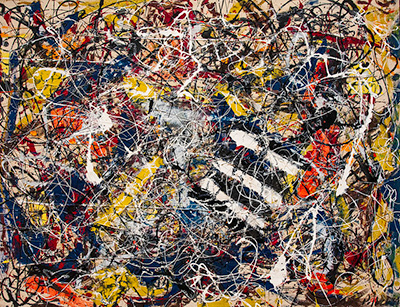
Jackson Pollock’s Number 17A dates from 1948, when his poured paintings were opening new possibilities for drawing with paint. [1]
At a Glance
This work across Jackson Pollock’s career
The Flame
c.1934–38The She-Wolf
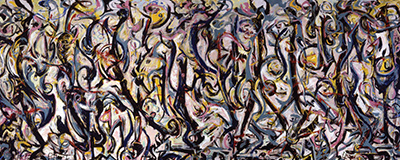
1943Mural
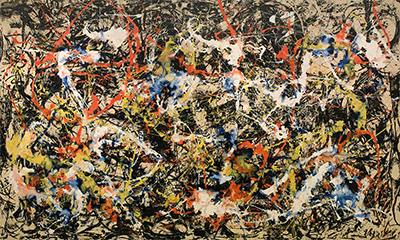
1943Alchemy
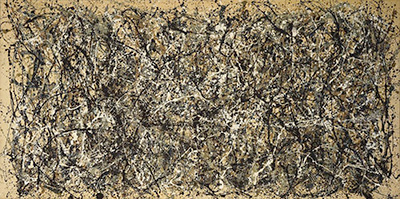
1947Number 1A, 1948
1948Blue Poles
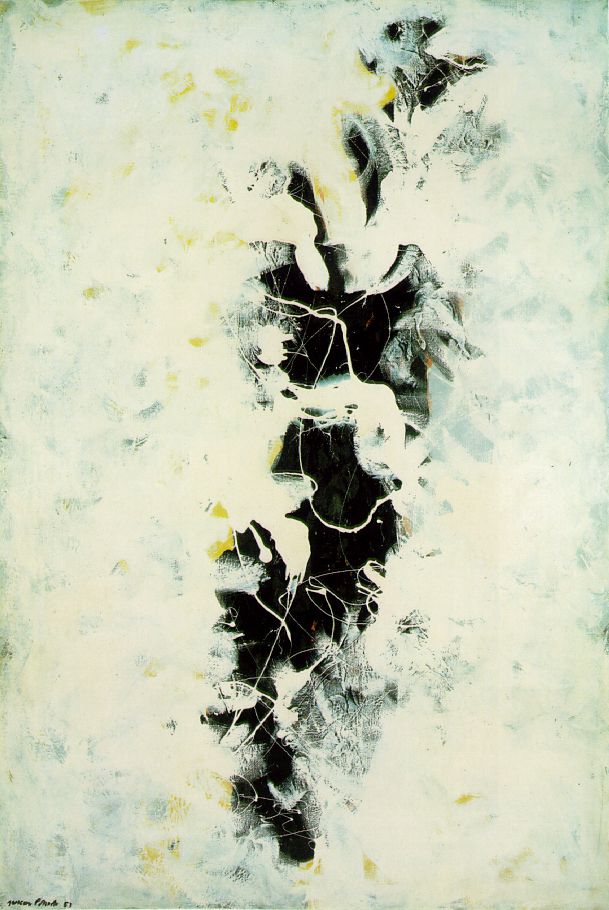
1952The Deep
1953White Light
1954Contents
- A field of small marks and rapid lines
- Making decisions with flowing paint
- Entering public view
- Imagining a room for Pollock
- Private collecting and museum encounters
A field of small marks and rapid lines
The interaction between a dense field and fast, travelling lines gives the painting a particular place in T. J. Clark’s account of Pollock. Clark includes Number 17A among works in which a final tracery brings a continuum of smaller marks together. The sweeping lines remain affected by everything beneath them; their apparent speed prevents them from settling into separate, neatly bounded forms. Following his reading, a viewer can attend to two scales: the small incidents distributed through the field and the longer movements that connect them. The painting’s coherence arises from their interaction. Clark’s account explains an optical relationship, rather than establishing an exact sequence of paint applications through material testing. It also gives a useful way to slow down the experience of a work whose lines seem so quick: look at how a line belongs to the surrounding activity as well as following where it goes. [2]
A broader account of this freedom appears in Museo Picasso Málaga’s 2016 exhibition guide. The guide treats Pollock’s all-over compositions as a formal problem to which pouring offered a solution. Line could spread through a painting without continually defining the edge of a depicted object or plane. This interpretation shifts attention from the novelty of the equipment to the changing work performed by a painted line. A line need not enclose something before it can organise a picture. Its passage, its relation to other marks and its participation in the whole become sufficient subjects for attention. Applied as a general context for Number 17A, the museum’s argument helps explain why a poured painting can retain the activity of drawing even when it supplies no clearly outlined object. [3]
Making decisions with flowing paint
Pollock’s own statements allow this apparent freedom to coexist with decisions and revision. In My Painting, published in the winter of 1947–48, he described working close to a painting and recognising what it had become after a period of engagement. He also acknowledged changing or destroying an image. In the William Wright interview, dated to 1950 in its MoMA reprint, he explained that experience allowed substantial control over flowing paint, and connected new techniques with new expressive needs. These accounts of his practice make responsiveness central to his method. The emerging painting could suggest the next decision. For readers exploring Pollock’s technique, this exchange between action and judgement is essential to understanding how an unfamiliar method could produce a considered result. [4]
There are several ways of explaining what that result achieved. In his 1998 essay, Kirk Varnedoe questioned historical schemes that made Pollock fulfil a predetermined destiny for modern painting. His discussion also complicates the familiar division between an art of formal discipline and an art of expressive action. A painting such as Number 17A invites attention to the relationships among its marks without requiring the viewer to deny the activity that produced them. Both questions can remain open during the same encounter. [1]
Watch: Jackson Pollock
Choose a film about Pollock’s paintings and ways of working.
Entering public view
Number 17A helped bring poured painting to readers far beyond the gallery. Alexandra Stevenson’s 2016 report identifies it as one of three paintings featured in Life magazine’s famous 1949 article asking whether Pollock was America’s greatest living painter. That question made artistic judgement itself part of the publicity: readers encountered a challenge about the painter’s standing alongside the paintings. [5]
The gallery history of these years was uneven and increasingly successful. Susan Davidson’s account of Betty Parsons’s work records a difficult first Pollock exhibition in 1948, followed by stronger sales in both 1949 shows. More than half the works in the November exhibition sold. Small works on paper contributed substantially to that success. This history matters because it gives the paintings an audience of specific purchasers alongside the much larger audience created by magazines. Interest could take the practical form of choosing a work and living with it. The growth of Pollock’s reputation involved the dealer’s continuing efforts, returning collectors and new buyers. Davidson’s account supplies the surrounding market context; it does not identify a sale of Number 17A at either exhibition. The related Number 1A, 1948 offers another route into the group of paintings gaining recognition during these years. [6]
Imagining a room for Pollock
Architecture offered another way to imagine an audience. Helen A. Harrison describes Peter Blake’s proposal for a Pollock museum, shown as a model at the Betty Parsons Gallery in 1949. Transparent and mirrored walls suggested an environment in which paintings could interact with the surrounding space. The model used reproductions whose scale and proportions could be altered to serve the design. Harrison’s captions identify Number 17A in the later, 1994–95 reconstruction, alongside The Key. Such a setting asks what happens when the apparent expansiveness of a painting meets the literal space around it: reflection and transparency make the room an active participant in the experience. The later reconstruction gives that architectural proposal a renewed physical presence. [7]
The reconstruction also carries a revealing uncertainty. Megan R. Luke explains that the inclusion of Number 17A and Number 1A involved educated approximations: surviving photographs of the original model do not clearly reveal the relevant walls. The later model therefore preserves an interpretation of Blake’s project while leaving the original selection partly unresolved. A visitor can learn from its proposed relationship between painting and architecture without assuming that every miniature occupies a securely documented historical position. For Number 17A, inclusion in the original 1949 model remains unproved. [8]
Private collecting and museum encounters
Stevenson reported in February 2016 that Kenneth Griffin had bought Number 17A and Willem de Kooning’s Interchanged from David Geffen for a combined $500 million. The figure covered both paintings. Her report also documented their loan to the Art Institute of Chicago. Museum president James Rondeau emphasised the opportunity for thousands of visitors to encounter the works. Private collecting had brought these paintings into another public setting. [5]
A further museum encounter is documented in Katya Kazakina’s report of 7 October 2026. Visiting the Metropolitan Museum of Art’s Krasner and Pollock: Past Continuous, she described Number 17A on loan from Griffin and dated his acquisition to 2015. The exhibition followed the artistic paths of both Pollock and Lee Krasner, placing their work within a history of exchange and independent development. This dated loan gives the painting a more particular public life than a price alone can convey. An exhibition lets viewers meet a privately held work among other paintings, with relationships proposed by the selection and installation. In this setting, Number 17A participated in a renewed account of two artists whose careers developed together. The loan documents an opportunity to see it at the Met in 2026; it is an episode in its exhibition history, rather than a permanent location for the work. [9]
Pollock artworks directory
Explore the distinct works discussed in these guides. This selection is not a complete catalogue. Green Silver and Untitled, 1949 are two guides to the same painting.
Discussion
Look again at the images and ideas explored in Number 17A, 1948 by Jackson Pollock. These editorial prompts invite your observations.
Reader Insights
Which detail in “A field of small marks and rapid lines” changes how you understand this work?
What comparison comes to mind after “Making decisions with flowing paint”?
What would you like to discuss about “Entering public view”?
Join the Conversation
Share a detail, comparison or question about Number 17A, 1948 by Jackson Pollock below.
References
- Kirk Varnedoe, with Pepe Karmel, Jackson Pollock (New York: Museum of Modern Art, 1998), pp. 43–46; plate 141, p. 245 (PDF p. 256). View source.
- T. J. Clark, “Pollock’s Smallness,” in Jackson Pollock: New Approaches, ed. Kirk Varnedoe and Pepe Karmel (New York: Museum of Modern Art, 1999), p. 26 (PDF p. 28). View source.
- Museo Picasso Málaga, Mural. Jackson Pollock: Energy Made Visible / La energía hecha visible, exhibition guide, 2016, section 8, “Formal Innovations,” PDF p. 10. View source.
- Jackson Pollock, “My Painting,” Possibilities 1 (winter 1947–48), and interview with William Wright (1950, as dated in reprint), in Jackson Pollock: Interviews, Articles, and Reviews, ed. Pepe Karmel (New York: Museum of Modern Art, 1999), pp. 17–18, 20–23. Recording and broadcast chronology varies between accounts. View source.
- Alexandra Stevenson, “Kenneth Griffin Joins Elite Rank of Hedge Fund Art Patrons With $500 Million Deal”, New York Times, clipping dated 18 February 2016, p. 1; original article URL dated 19 February 2016. View source.
- Susan Davidson, “Feminismoa gehienbat maskulinoa zen giroan: nola bi emakumek arte-merkatu bat abian jarri zuten”, in Espresionismo Abstraktua (Bilbao: Guggenheim Bilbao Museoa, 2017), Basque translation, paragraphs on Pollock’s 1948–49 Parsons exhibitions. View source.
- Helen A. Harrison, “Jackson Pollock: Blake’s 1949 Museum Design”, Art & Architecture Quarterly, 18 October 2012; and model captions, 7 November 2012, identifying Number 17A in the 1994–95 model. View source 1. View source 2.
- Megan R. Luke, “Painting in the Round”, Getty Research Journal 9, supplement 1 (2017), pp. 149–182, note 49, pp. 179–180. DOI: 10.1086/695873. Author-uploaded text. View source.
- Katya Kazakina, “The Met’s Krasner-Pollock Blockbuster ‘Was a Herculean Effort.’ Here’s How It Came Together”, Artnet News, 7 October 2026, section “Mobbed Galleries,” Number 17A loan report. View source.