 by Tom Gurney
Tom Gurney BSc (Hons) is an art history expert with over 20 years experience
Email: tomgurney1@gmail.com / Phone: +44 7429 011000
Western Motel: Introduction
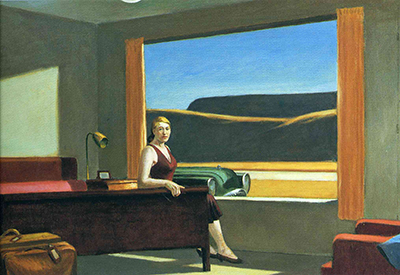
A woman sits beside a bed with her face turned towards the room. Behind her, a large window opens onto dry hills, blue sky and the front of a green car. Two cases occupy the lower left, while a garment lies over a chair at the right. Edward Hopper's Western Motel makes a temporary bedroom feel suspended between the objects of staying and the means of moving on.
The Yale University Art Gallery records the work as an oil on canvas of 1957, measuring 77.8 × 128.3 cm, accession 1961.18.32, bequest of Stephen Carlton Clark, B.A. 1903. [1] The landscape supplies an expansive western setting, but the title gives no particular town, motel or destination.
At a Glance
- ArtistEdward Hopper [1]
- Date1957 [1]
- Mediumoil on canvas [1]
- Collection / recordYale University Art Gallery [1]
- Accession1961.18.32 [1]
This work across Edward Hopper’s career
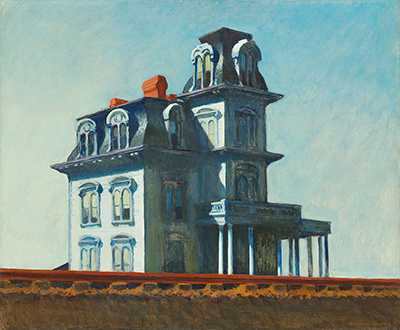
American Village
1912Soir Bleu
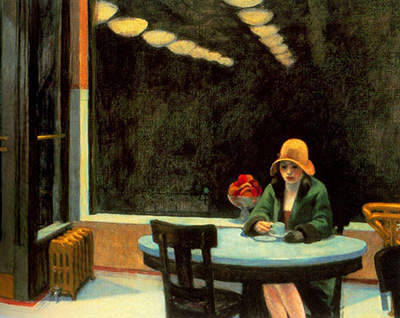
1914Automat
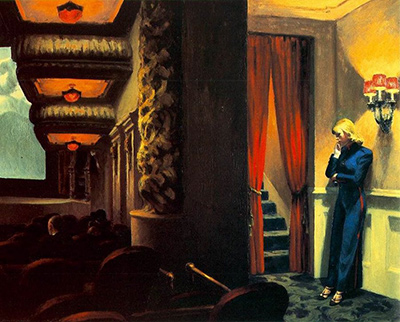
1927New York Movie
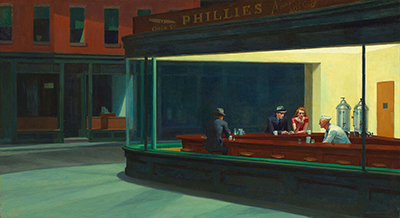
1939Nighthawks
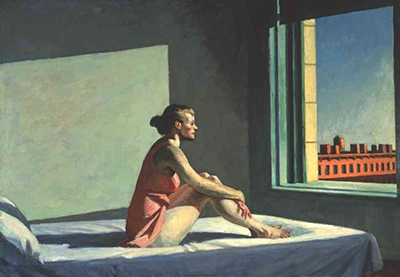
1942Morning Sun
1952Two Comedians
1966Contents
- The bed across the foreground
- A figure facing into the room
- The car just beyond the glass
- A broad landscape in a narrow frame
- Green walls and concentrated light
- A lobby before it became a bedroom
- Belongings and an unfinished itinerary
- Looking at the painting from a museum
- A room announced for visitors
- Other pauses while travelling
The bed across the foreground
The dark wooden bed is one of the first obstacles between the spectator and the woman. Its broad end extends across the lower part of the room, giving the foreground a weight that contrasts with the openness of the window beyond.
The pink covering remains visible farther left. It brings a warmer, softer area into a setting dominated by firmer architectural divisions and large green planes. The woman sits near the bed's side rather than reclining across it.
Her hand rests close to the wood, linking the body to the substantial piece of furniture before her. The legs and pale feet extend towards the floor. These points of contact make the seated posture specific without identifying what she intends to do next.
The bed also changes our approach to the room. We cannot move visually towards the figure without accounting for its height and length. Hopper gives the spectator a place inside the interior while putting a large furnishing in the way.
A figure facing into the room
The woman's dark red dress separates her from the cooler surroundings. Pale arms, face and lower legs establish a more continuous body within that strong garment shape. Her upright torso contrasts with the bed's horizontal mass.
Her face is oriented more towards the spectator than the outward-looking figures in several of Hopper's other interiors. That orientation does not automatically establish an exchanged glance. We can see her frontally without knowing whether she acknowledges an imagined person occupying our position.
Yale's collection interpretation emphasises the uncertainty of her stare and posture, reading them as signs of a pause before an event. [1] The visible body gives that interpretation a starting point, but no event arrives to confirm it within the picture.
The setting contains several possible reasons for waiting. A car is nearby and luggage is present, yet neither tells us who has made an arrangement, whether someone else is expected, or how soon the room will be vacated.
The car just beyond the glass
The green vehicle enters the view close to the window. We see only a portion of it, with the windshield and front bodywork interrupting the lower edge of the landscape. Yale identifies it as a Buick. [2]
Its proximity gives the outside world two different distances. The car is immediately beside the accommodation, while the hills extend much farther away. A traveller could pass from the room towards a vehicle without first crossing a depicted city street or station concourse.
The partial view also keeps the car from becoming the painting's sole subject. It is enough to establish motor travel, but the woman and the architecture remain larger presences. The room is connected to movement without becoming a scene of driving.
The packed cases give that connection an interior counterpart. They belong to a traveller's practical equipment, whereas the bed and chair appear to be part of the accommodation. Things carried from place to place sit beside things intended for successive occupants.
A broad landscape in a narrow frame
The picture window takes up much of the back wall. Its horizontal span brings the dry terrain into the room as a large area of colour, almost parallel with the bed's dark wood below.
The hills are simplified into broad profiles. Light catches warmer ridges against darker slopes, while the clear blue above provides a contrasting band. The view gives the setting an expansive character without supplying a named landmark.
Orange curtains and the pale lower sill frame this landscape. Their vertical edges make the opening feel like a selected view rather than an unlimited continuation of the room. The apparent freedom of the distant terrain is held within the motel's construction.
The woman sits before that view without turning to share it with us. Her body and the landscape therefore ask for different kinds of attention. We look at her from inside the room and look past her towards a setting that remains outside it.
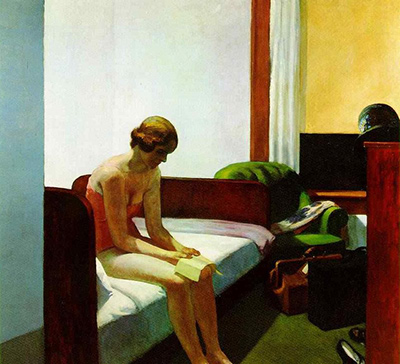
Compare: Hotel Room, 1931.
Green walls and concentrated light
The room's green surfaces give it a cooler character than the dry land beyond. Sunlit passages and shadows divide those surfaces into larger shapes, making the interior feel sharply constructed even where there is little decoration.
The left wall receives a broad area of brightness. Its pale plane contrasts with the darker ceiling and the wooden bed, giving light a substantial position in the room rather than allowing it to remain a general atmosphere.
At the right, the chair and garment introduce another small group of colours and textures. The red upholstery and blue fabric differ from both the green room and the pink bedding. The objects make a furnished interior from a limited number of elements.
The strong window frame keeps the outside brightness distinct. Hopper does not dissolve the wall into landscape. He lets colour and light join the two spaces while preserving the boundary through which we see.
A lobby before it became a bedroom
Yale's account of a preparatory drawing acquired in 2009 describes an earlier conception with three seated figures in what appears to be a motel lobby. The final painting reduces the group to one woman and changes the shared lobby into a bedroom. [2]
The published reproduction shows the change's architectural basis. Two figures occupy the left-hand seating area and another sits at the far right; large windows give a broad outlook across the landscape. A sign on a tall post and the front of a car provide further indications of roadside accommodation. [3]
The drawing's repeated lines make the ceiling, windows and furniture visibly exploratory. The room is assembled around a view and several occupants before the final painting concentrates attention on a single body and bed.
The reduction changes the social character of the scene. A lobby can bring unrelated people together within a shared space; a bedroom places the remaining woman in a more private enclosure. The window and car connect both conceptions with travel, but the kind of stay becomes different.
This comparison prevents the finished canvas from seeming like an unaltered record of one motel room. An arrangement of travellers, furnishings and openings was revised until it became the particular interior we see.
Watch: Edward Hopper’s Life and Art
Explore Hopper’s paintings and the places behind them in these museum films. Choose a film below.
Belongings and an unfinished itinerary
Yale's discussion links the cases and garment with the possibilities of arrival or departure. [2] Both readings fit the objects, and the painting does not settle the sequence by showing unpacking, a door being opened or someone entering the car.
The traveller's possessions are unusually economical clues. They suggest a stay that has a beginning and end, without providing an itinerary or a personal history. A bed can be made ready for another occupant; the cases can be carried elsewhere.
The landscape reinforces that provisional state. It offers distance, but no road leads visibly from the room towards a named place. The means of movement is close at hand while the journey itself remains beyond the canvas.
This makes the room's solidity more interesting. The furniture and wall planes are firmly presented, yet the occupant's relation to them appears temporary. Hopper gives a place of passing through the visual weight of a settled composition.
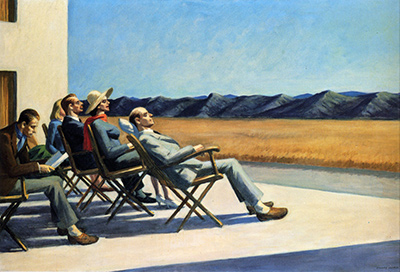
Compare: People in the Sun, 1960.
Looking at the painting from a museum
The painting entered Yale through Clark's bequest in 1961. [1] The bequest established the canvas in a public collection.
The gallery's 2009 acquisition of the composition drawing made the change from a multi-person lobby easier to study beside the oil. [2] The pair offers a particularly clear example of why a preparatory sheet can alter our reading of a finished picture.
Instead of treating every detail as a direct transcription, we can see alternatives that were retained or discarded. The car and landscape survive across the developing idea; the number of occupants and the character of their room change. The final stillness contains a history of revision.
A room announced for visitors
For its 2019 exhibition Edward Hopper and the American Hotel, the Virginia Museum of Fine Arts announced overnight stays in a room inspired by Western Motel. [4] The proposal translated an image of temporary accommodation into a temporary museum experience.
That shift makes the spectator's position tangible. In front of the canvas, we cannot walk around the bed, open a case or see the landscape from another angle. A reconstructed room invites physical occupation, while the painting preserves one carefully selected relationship among body, furniture and view.
The same setting makes possible different kinds of experience. An actual stay involves actions and a passage of time. The painted room remains fixed before a departure or arrival can become certain.
Other pauses while travelling
Hotel Room gives a lone woman a timetable and luggage beside a bed. Her attention contracts towards the paper, while the woman in Western Motel presents a more outward-facing posture before a much broader view.
Hotel Window keeps its occupant in a public seating area beside a dark urban outlook. Here the bedroom, nearby car and open terrain provide a different relation between enclosure and distance.
In People in the Sun, a group occupies the light outside. Western Motel holds its figure behind the window, with the sun and landscape entering as carefully framed parts of an interior.
Look from the cases towards the green car, then back to the dark bed across the room. The objects make movement possible while the furniture holds the figure within a place. Hopper gives those two conditions a shared, unresolved moment.
Artworks and studies directory
This researched directory includes finished works and separately identified studies. It is not a complete catalogue raisonné. Linked titles open the articles; unlinked studies are identified by their collection accessions. Watercolours retain their recorded media, and original prints remain distinct from reproductions.
| Name | Date | Medium |
|---|---|---|
| (Bridge and Embankment) (70.1298) | 1906 | Oil on wood |
| (Jo Sketching at Good Harbor Beach) (70.1129) | 1923–1924 | Watercolor and fabricated chalk on paper |
| (Manhattan Bridge) (70.1098) | 1925–1926 | Watercolor and graphite pencil on paper |
| (Rooftops) (70.1114) | 1926 | Watercolor and graphite pencil on paper |
| (Seated Male Model, Bent Over) (70.1277) | c. 1902–1903 | Oil on canvas |
| (Self-Portrait) (70.1254) | 1903–1906 | Oil on canvas |
| (Solitary Figure in a Theater) (70.1418) | c. 1902–1904 | Oil on board |
| 5 A.M. | 1937 | oil on canvas |
| Adam's House | 1928 | watercolour and charcoal on paper |
| American Village | 1912 | Oil on canvas |
| Apartment Houses | 1923 | oil on canvas |
| Approaching a City | 1946 | oil on canvas |
| August in the City | 1945 | oil on canvas |
| Automat | 1927 | oil on canvas |
| Barber Shop | 1931 | oil on canvas |
| Blackwell's Island | 1928 | oil on canvas |
| Bridge on the Seine | 1909 | Oil on canvas |
| Bridle Path | 1939 | oil on canvas |
| Burly Cobb's House South Truro | 1930–1933 | oil on canvas |
| Cape Cod Evening | 1939 | oil on canvas |
| Cape Cod Morning | 1950 | oil on canvas |
| Chair Car | 1965 | oil on canvas |
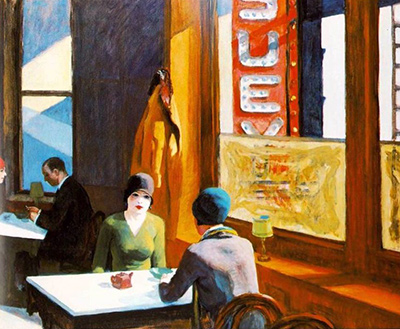
| Chop Suey | 1929 | oil on canvas |
| City Roofs | 1932 | Oil on canvas |
| Coast Guard Station | 1929 | oil on canvas |
| Compartment C, Car 293 | 1938 | oil on canvas |
| Conference at Night | 1949 | oil on canvas |
| Corn Hill | 1930 | oil on canvas |
| Dawn in Pennsylvania | 1942 | oil on canvas |
| Drug Store | 1927 | oil on canvas |
| Early Sunday Morning | 1930 | Oil on canvas |
| East Side Interior (70.1020) | 1922 | Etching |
| East Wind Over Weehawken | 1934 | oil on canvas |
| El Palacio | 1946 | Watercolor and graphite pencil on paper |
| Eleven A.M. | 1926 | oil on canvas |
| Evening Wind | 1921 | etching |
| Excursion into Philosophy | 1959 | oil on canvas |
| First Row Orchestra | 1951 | oil on canvas |
| Freight Car at Truro | 1931 | watercolour over graphite on paper |
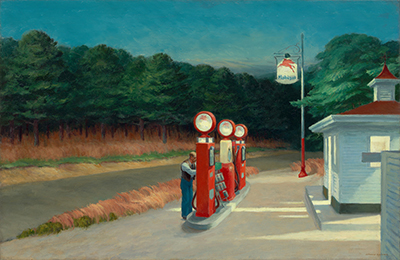
| Gas | 1940 | oil on canvas |
| Girl at a Sewing Machine | c. 1921 | oil on canvas |
| Gloucester Harbor | 1912 | Oil on canvas |
| Ground Swell | 1939 | oil on canvas |
| Haskell's House | 1924 | watercolour over graphite on paperboard |
| High Noon | 1949 | oil on canvas |
| Hill and Houses Cape Elizabeth Maine | 1927 | watercolour over graphite pencil |
| Hills South Truro | 1930 | oil on canvas |
| Hotel by a Railroad | 1952 | oil on canvas |
| Hotel Lobby | 1943 | oil on canvas |
| Hotel Room | 1931 | oil on canvas |
| Hotel Window | 1955 | oil on canvas |
| House by the Railroad | 1925 | oil on canvas |
| House by the Squam River | 1926 | watercolour over graphite on paper |
| Le Bistro or The Wine Shop | 1909 | Oil on canvas |
| Le Pont des Arts | 1907 | Oil on canvas |
| Le Pont Royal | 1909 | Oil on canvas |
| Le Quai des Grands Augustins | 1909 | Oil on canvas |
| Lighthouse and Buildings Portland Head | 1927 | watercolour over graphite pencil on paper |
| Lighthouse Hill | 1927 | oil painting |
| Manhattan Bridge Loop | 1928 | oil on canvas |
| Model Sitting | c. 1902 | oil painting; support not asserted |
| Morning Sun | 1952 | oil on canvas |
| New York Movie | 1939 | oil on canvas |
| New York New Haven and Hartford | 1931 | oil on canvas |
| New York Office | 1962 | oil on canvas |
| New York Pavements | 1924–1925 | oil on canvas |
| New York Restaurant | c. 1922 | oil on canvas |
| Night Windows | 1928 | oil on canvas |
| Nighthawks | 1942 | oil on canvas |
| October on Cape Cod | 1946 | oil on canvas |
| Office at Night | 1940 | oil on canvas |
| Office in a Small City | 1953 | oil on canvas |
| Pennsylvania Coal Town | 1947 | oil on canvas |
| People in the Sun | 1960 | oil on canvas |
| Portrait of Orleans | 1950 | oil on canvas |
| Queensborough Bridge | 1913 | Oil on canvas |
| Railroad Sunset | 1929 | Oil on canvas |
| Railroad Train | 1908 | oil on canvas |
| Road in Maine | 1914 | oil on canvas |
| Room in Brooklyn | 1932 | oil on canvas |
| Room in New York | 1932 | oil on canvas |
| Rooms by the Sea | 1951 | oil on canvas |
| Rooms for Tourists | 1945 | oil on canvas |
| Route 6 Eastham | 1941 | oil on canvas |
| Second Story Sunlight | 1960 | Oil on canvas |
| Self-Portrait | 1925–1930 | Oil on canvas |
| Self-Portrait with Hat (70.1903) | c. 1918, posthumous print | Drypoint |
| Seven A.M. | 1948 | Oil on canvas |
| Soir Bleu | 1914 | oil on canvas |
| South Carolina Morning | 1955 | Oil on canvas |
| Stairway at 48 Rue de Lille Paris | 1906 | Oil on wood |
| Study for 5 A.M. (70.153) | 1937 | Fabricated chalk on paper |
| Study for 5 A.M. (70.429) | 1937 | Fabricated chalk and graphite pencil on paper |
| Study for Approaching a City (70.869) | 1946 | Fabricated chalk and charcoal on paper |
| Study for August in the City (70.158a-b) | 1945 | Fabricated chalk on paper |
| Study for August in the City (70.159) | 1945 | Fabricated chalk on paper |
| Study for Bridle Path (70.220) | 1939 | Fabricated chalk on paper |
| Study for Bridle Path (70.235) | 1939 | Fabricated chalk on paper |
| Study for Compartment C, Car 293 (70.430) | 1938 | Fabricated chalk on paper |
| Study for Compartment C, Car 293 (70.431a-b) | 1938 | Fabricated chalk and charcoal on paper |
| Study for Conference at Night (70.170) | 1949 | Fabricated chalk on paper (recto); Typewriter ink on paper (verso) |
| Study for Conference at Night (70.174) | 1949 | Fabricated chalk on paper ( recto); Typewriter ink on paper (verso) |
| Study for East Wind over Weehawken (70.249) | 1934 | Graphite pencil on paper |
| Study for East Wind over Weehawken (70.252) | 1934 | Fabricated chalk and charcoal on paper |
| Study for Evening Wind (70.343a-b) | 1921 | Fabricated chalk on paper |
| Study for First Row Orchestra (70.841) | 1951 | Fabricated chalk and charcoal on paper |
| Study for Gas (70.263) | 1940 | Fabricated chalk on paper |
| Study for Ground Swell (70.339) | 1939 | Fabricated chalk, charcoal and graphite pencil on paper |
| Study for Hotel by a Railroad (70.199) | 1952 | Fabricated chalk on paper |
| Study for Hotel by a Railroad (70.427) | 1952 | Fabricated chalk on paper |
| Study for Hotel by a Railroad (70.428) | 1952 | Fabricated chalk on paper |
| Study for Hotel Lobby (70.117) | 1942 | Fabricated chalk and graphite pencil on paper |
| Study for Hotel Lobby (70.839) | 1942 | Fabricated chalk and charcoal on paper |
| Study for Hotel Window (70.161) | 1955 | Fabricated chalk, graphite pencil and colored pencil on paper |
| Study for Morning Sun (70.243) | 1952 | Fabricated chalk on paper |
| Study for Morning Sun (70.244) | 1952 | Fabricated chalk on paper |
| Study for Morning Sun (70.290) | 1952 | Fabricated chalk on paper |
| Study for Morning Sun (70.291) | 1952 | Fabricated chalk and graphite pencil on paper |
| Study for New York Movie (70.273) | 1939 | Fabricated chalk on paper |
| Study for New York Movie (70.274a-b) | 1938 or 1939 | Fabricated chalk and charcoal on paper (recto); Fabricated chalk on paper (verso) |
| Study for New York Movie (70.455) | 1939 | Fabricated chalk and charcoal on paper |
| Study for New York Office (70.822) | 1962 | Fabricated chalk on paper |
| Study for Nighthawks (70.192) | 1941 or 1942 | Fabricated chalk on paper |
| Study for Nighthawks (70.193) | 1941 or 1942 | Fabricated chalk on paper |
| Study for Office at Night (70.340) | 1940 | Fabricated chalk and charcoal on paper |
| Study for Office at Night (70.341) | 1940 | Fabricated chalk and graphite pencil on paper |
| Study for Pennsylvania Coal Town (70.198) | 1947 | Fabricated chalk on paper |
| Study for Pennsylvania Coal Town (70.229) | 1947 | Fabricated chalk and charcoal on paper |
| Study for Rooms for Tourists (70.438) | 1945 | Fabricated chalk and charcoal on paper |
| Study for Rooms for Tourists (70.848) | 1945 | Fabricated chalk and charcoal on paper |
| Study for Route 6, Eastham (70.369) | 1941 | Fabricated chalk and graphite pencil on paper |
| Study for Route 6, Eastham (70.854) | 1941 | Fabricated chalk and graphite pencil on paper |
| Study for South Carolina Morning (70.162a-b) | 1955 | Fabricated chalk on paper (recto and verso) |
| Study for The Sheridan Theatre (70.969) | 1937 | Graphite pencil on paper |
| Study for Two on the Aisle (70.128) | 1927 | Fabricated chalk on paper |
| Study for Two on the Aisle (70.129) | 1927 | Fabricated chalk on paper |
| Study for Yawl Riding a Swell (70.439) | 1935 | Fabricated chalk and graphite pencil on paper |
| Summer Evening | 1947 | oil on canvas |
| Summer Interior | 1909 | Oil on canvas |
| Sun in an Empty Room | 1963 | oil on canvas |
| Sunlight in a Cafeteria | 1958 | oil on canvas |
| Sunlight on Brownstones | 1956 | oil on canvas |
| Tables for Ladies | 1930 | oil on canvas |
| The Bootleggers | 1925 | oil on canvas |
| The Camel's Hump | 1931 | oil on canvas |
| The Circle Theatre | 1936 | oil on canvas |
| The City | 1927 | oil on canvas |
| The Lighthouse at Two Lights | 1929 | oil on canvas |
| The Long Leg | 1935 | oil on canvas |
| The Mansard Roof | 1923 | watercolour over graphite on paper |
| The Sheridan Theatre | 1937 | oil on canvas |
| Tramp Steamer | 1908 | oil on canvas |
| Two Comedians | 1966 | oil on canvas |
| Two on the Aisle | 1927 | oil on canvas |
| Valley of the Seine | 1909 | Oil on canvas |
| Western Motel | 1957 | oil on canvas |
Frequently Asked Questions
Edward Hopper made Western Motel in 1957. [1]
The recorded medium is oil on canvas. [1]
A woman sits beside a bed with her face turned towards the room. Behind her, a large window opens onto dry hills, blue sky and the front of a green car. Two cases occupy the lower left, while a garment lies over a chair at the right. Edward Hopper's Western Motel makes a temporary bedroom feel suspended between the objects of staying and the means of moving on.
Discussion
Look again at the images and ideas explored in Western Motel. These editorial prompts invite your observations.
Reader Insights
Which boundary, gesture or change of light first holds your attention in Western Motel?
Compare Hotel Room with Western Motel. Which visual difference matters most to your reading?
Which detail would you look at again after reading “The car just beyond the glass”?
Join the Conversation
Share a detail, comparison or question about Western Motel below.
References
- Yale University Art Gallery, Western Motel, 1957, accession 1961.18.32; collection metadata, interpretation and provenance. View source.
- Yale News, “Newly Acquired Edward Hopper Sketches Illuminate the Artist's Creative Process”, 17 July 2009, gallery account of the composition drawing and final painting. View source.
- “Yale Acquires Important Edward Hopper Drawings”, Antiques and the Arts Weekly, 16 June 2009; published reproduction of the 1957 charcoal-and-graphite study, credited to Yale University Art Gallery, Everett V. Meeks Fund. View source.
- Virginia Museum of Fine Arts, “Edward Hopper and the American Hotel to Debut at VMFA”, 12 August 2019, announcement of the exhibition and proposed overnight motel-room experience. View source.
- Collection or catalogue record, American Village, 1912; medium and identity as discussed in the linked article. View source.
- Collection or catalogue record, Soir Bleu, 1914; medium and identity as discussed in the linked article. View source.
- Collection or catalogue record, House by the Railroad, 1925; medium and identity as discussed in the linked article. View source.
- Collection or catalogue record, Automat, 1927; medium and identity as discussed in the linked article. View source.
- Collection or catalogue record, Early Sunday Morning, 1930; medium and identity as discussed in the linked article. View source.
- Collection or catalogue record, New York Movie, 1939; medium and identity as discussed in the linked article. View source.
- Collection or catalogue record, Nighthawks, 1942; medium and identity as discussed in the linked article. View source.
- Collection or catalogue record, Morning Sun, 1952; medium and identity as discussed in the linked article. View source.
- Collection or catalogue record, Second Story Sunlight, 1960; medium and identity as discussed in the linked article. View source.
- Collection or catalogue record, Two Comedians, 1966; medium and identity as discussed in the linked article. View source.
- Whitney Museum of American Art, Study for Route 6, Eastham, 1941, accession 70.854; exact object record. View source.
- Whitney Museum of American Art, Study for Conference at Night, 1949, accession 70.170; exact object record. View source.
- Whitney Museum of American Art, Study for First Row Orchestra, 1951, accession 70.841; exact object record. View source.
- Whitney Museum of American Art, (Bridge and Embankment), 1906, accession 70.1298; exact object record. View source.
- Whitney Museum of American Art, (Seated Male Model, Bent Over), c. 1902–1903, accession 70.1277; exact object record. View source.
- Whitney Museum of American Art, Study for Morning Sun, 1952, accession 70.244; exact object record. View source.
- Whitney Museum of American Art, Study for Morning Sun, 1952, accession 70.243; exact object record. View source.
- Whitney Museum of American Art, Study for Two on the Aisle, 1927, accession 70.128; exact object record. View source.
- Whitney Museum of American Art, Study for New York Office, 1962, accession 70.822; exact object record. View source.
- Whitney Museum of American Art, Study for Two on the Aisle, 1927, accession 70.129; exact object record. View source.
- Whitney Museum of American Art, Study for Pennsylvania Coal Town, 1947, accession 70.229; exact object record. View source.
- Whitney Museum of American Art, (Rooftops), 1926, accession 70.1114; exact object record. View source.
- Whitney Museum of American Art, Study for South Carolina Morning, 1955, accession 70.162a-b; exact object record. View source.
- Whitney Museum of American Art, (Self-Portrait), 1903–1906, accession 70.1254; exact object record. View source.
- Whitney Museum of American Art, (Manhattan Bridge), 1925–1926, accession 70.1098; exact object record. View source.
- Whitney Museum of American Art, (Solitary Figure in a Theater), c. 1902–1904, accession 70.1418; exact object record. View source.
- Whitney Museum of American Art, Study for Approaching a City, 1946, accession 70.869; exact object record. View source.
- Whitney Museum of American Art, Study for August in the City, 1945, accession 70.159; exact object record. View source.
- Whitney Museum of American Art, Study for Compartment C, Car 293, 1938, accession 70.430; exact object record. View source.
- Whitney Museum of American Art, Study for Compartment C, Car 293, 1938, accession 70.431a-b; exact object record. View source.
- Whitney Museum of American Art, Study for East Wind over Weehawken, 1934, accession 70.252; exact object record. View source.
- Whitney Museum of American Art, Study for East Wind over Weehawken, 1934, accession 70.249; exact object record. View source.
- Whitney Museum of American Art, Study for Evening Wind, 1921, accession 70.343a-b; exact object record. View source.
- Whitney Museum of American Art, Study for The Sheridan Theatre, 1937, accession 70.969; exact object record. View source.
- Whitney Museum of American Art, Study for New York Movie, 1939, accession 70.455; exact object record. View source.
- Whitney Museum of American Art, Study for New York Movie, 1939, accession 70.273; exact object record. View source.
- Whitney Museum of American Art, Study for New York Movie, 1938 or 1939, accession 70.274a-b; exact object record. View source.
- Whitney Museum of American Art, Study for 5 A.M., 1937, accession 70.153; exact object record. View source.
- Whitney Museum of American Art, Study for 5 A.M., 1937, accession 70.429; exact object record. View source.
- Whitney Museum of American Art, (Jo Sketching at Good Harbor Beach), 1923–1924, accession 70.1129; exact object record. View source.
- Whitney Museum of American Art, Study for August in the City, 1945, accession 70.158a-b; exact object record. View source.
- Whitney Museum of American Art, Study for Morning Sun, 1952, accession 70.291; exact object record. View source.
- Whitney Museum of American Art, Study for Morning Sun, 1952, accession 70.290; exact object record. View source.
- Whitney Museum of American Art, Study for Office at Night, 1940, accession 70.340; exact object record. View source.
- Whitney Museum of American Art, Study for Office at Night, 1940, accession 70.341; exact object record. View source.
- Whitney Museum of American Art, Study for Hotel by a Railroad, 1952, accession 70.427; exact object record. View source.
- Whitney Museum of American Art, Study for Hotel by a Railroad, 1952, accession 70.199; exact object record. View source.
- Whitney Museum of American Art, Study for Hotel by a Railroad, 1952, accession 70.428; exact object record. View source.
- Whitney Museum of American Art, Study for Hotel Lobby, 1942, accession 70.117; exact object record. View source.
- Whitney Museum of American Art, Study for Hotel Lobby, 1942, accession 70.839; exact object record. View source.
- Whitney Museum of American Art, Study for Conference at Night, 1949, accession 70.174; exact object record. View source.
- Whitney Museum of American Art, Study for Hotel Window, 1955, accession 70.161; exact object record. View source.
- Whitney Museum of American Art, Study for Pennsylvania Coal Town, 1947, accession 70.198; exact object record. View source.
- Whitney Museum of American Art, Study for Route 6, Eastham, 1941, accession 70.369; exact object record. View source.
- Whitney Museum of American Art, Study for Bridle Path, 1939, accession 70.220; exact object record. View source.
- Whitney Museum of American Art, Study for Bridle Path, 1939, accession 70.235; exact object record. View source.
- Whitney Museum of American Art, Study for Ground Swell, 1939, accession 70.339; exact object record. View source.
- Whitney Museum of American Art, Study for Yawl Riding a Swell, 1935, accession 70.439; exact object record. View source.
- Whitney Museum of American Art, Study for Rooms for Tourists, 1945, accession 70.848; exact object record. View source.
- Whitney Museum of American Art, Study for Rooms for Tourists, 1945, accession 70.438; exact object record. View source.
- Whitney Museum of American Art, Study for Nighthawks, 1941 or 1942, accession 70.193; exact object record. View source.
- Whitney Museum of American Art, Study for Nighthawks, 1941 or 1942, accession 70.192; exact object record. View source.
- Whitney Museum of American Art, Study for Gas, 1940, accession 70.263; exact object record. View source.
- Whitney Museum of American Art, Self-Portrait with Hat, c. 1918, posthumous print, accession 70.1903; exact object record. View source.
- Whitney Museum of American Art, East Side Interior, 1922, accession 70.1020; exact object record. View source.
- Art Institute of Chicago, Selected Chronology for Edward Hopper; training, travels, exhibitions, New York and Truro chronology. View source.
- Emily C. Burns, Spectral figures: Edward Hopper’s empty Paris, chapter 5 in Empty Spaces: Confronting Emptiness in National, Cultural and Urban Histories, 2019; complete chapter and notes consulted. View source.
- Charles Brock, Regionalism and Folk Art, National Gallery of Art; complete essay and two notes consulted. View source.