 by Tom Gurney
Tom Gurney BSc (Hons) is an art history expert with over 20 years experience
Email: tomgurney1@gmail.com / Phone: +44 7429 011000
Morning Sun: Introduction
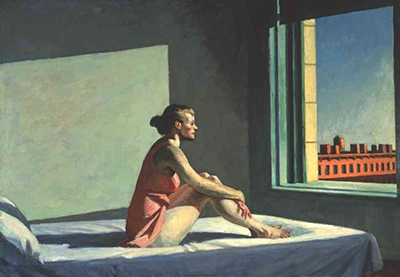
A woman sits on a bed with her knees drawn up, looking towards a large window. Sunlight strikes her face and bare limbs, then spreads across a pale wall behind her. Beyond the glass, a red-brick building rises under a blue sky. Edward Hopper's Morning Sun connects a closely observed body with the geometry of a room and a fragment of the city outside.
The 1952 oil on canvas belongs to the Columbus Museum of Art, Howald Fund Purchase. The Whitney's exhibition checklist records 71.4 × 101.9 cm. [1] Its furnishings are sparse enough for the relation between woman, bed, wall and window to carry the picture, while the light makes each of those elements behave differently.
At a Glance
- ArtistEdward Hopper [1]
- Date1952 [1]
- Mediumoil on canvas [1]
- Collection / recordColumbus Museum of Art [1]
This work across Edward Hopper’s career
American Village
1912Soir Bleu
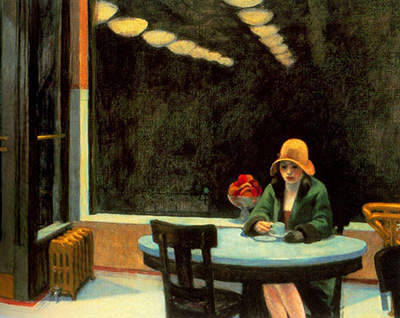
1914Automat
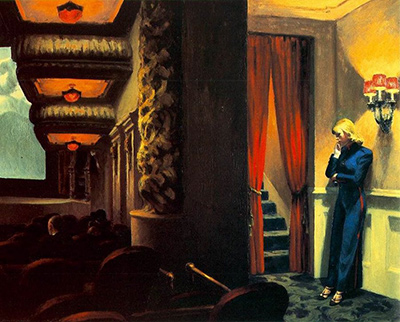
1927New York Movie
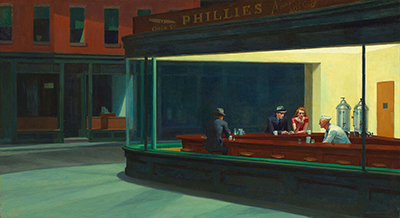
1939Nighthawks
1942Two Comedians
1966Contents
- Sitting within a large room
- A bed, a viewpoint and an unequal intimacy
- The outline of the body
- The pale shape on the wall
- A window opening onto more windows
- Light on a wall and light on skin
- A familiar interior transformed
- A figure study with colour notes
- What the handwritten observations record
- Testing the room around the figure
Sitting within a large room
The woman occupies the lower central portion of the scene. Her torso is upright, but her legs fold towards her body and her arms rest across them. The pose gathers the figure into a compact group of connected angles.
The bed extends further towards the left and foreground. Pale sheets spread around the seated body, with folds and shaded passages distinguishing the surface beneath her. Much of the bed remains unoccupied, giving her posture a setting larger than the space it immediately requires.
The close view does not explain the room completely. We do not see a doorway, a full floor plan or a collection of possessions that would identify the occupant's life. The picture concentrates on a place where a body can sit within the morning light.
A bed, a viewpoint and an unequal intimacy
The bed brings us close to a private space, yet the painting does not place us directly opposite the woman. We approach her from an angle, seeing the side of her body while her attention continues towards the right. This oblique relationship is different from the encounter offered by a seated portrait facing its spectator.
The expanse of sheet matters to that position. It occupies much of the lower picture, giving the eye a surface to cross before reaching the figure. Folds change direction around her weight and the raised legs. Their smaller shifts in light make the bed a physical support, while its larger pale area connects it to the brightness on the wall.
No second person appears at the edge to explain our presence. The scene permits a close view without providing the social exchange that would usually accompany it. We can inspect a shoulder, a bent knee and the profile, while the woman continues to occupy a direction of looking separate from ours.
This helps explain the particular intimacy of the image. Familiar furniture and the uncovered limbs make the situation bodily specific, but the profile keeps it from becoming a direct confession. The spectator is near the figure in represented space and at a distance from her experience.
The painted room also gives that distance a measurable form. A broad wall stands behind her, while the window's heavy upright establishes a limit ahead. She occupies a place between those architectural surfaces rather than floating against an indefinite background. The body has room around it, and that room remains available for our attention.
The outline of the body
The pose creates several linked contours. A shoulder leads towards an arm, the arm meets the raised legs, and the lower legs continue across the sheet. These connections give the figure a contained shape without making it rigidly symmetrical.
Her pink-orange garment adds a warmer mass beside the pale skin. Its edge and folds help separate torso, thigh and bed, while its colour remains distinct from the cooler surrounding walls. Clothing gives the body another set of divisions within its overall silhouette.
The profile directs attention towards the window. We can follow the orientation of forehead, nose and chin, but the woman does not meet the spectator's gaze. The painting invites us to observe her without supplying a reciprocal look.
Light models the body unevenly. The shoulder and face contain firmer divisions, while smaller changes of tone describe the limbs. Some contours are sharply separated from their surroundings; others become quieter where similar pale colours meet.
This variation keeps the figure from becoming a simple cut-out shape. Her position remains clearly bounded, yet the way light falls across it gives different parts a different visual weight.
The pale shape on the wall
A large illuminated area rises behind the woman. Its angled upper edge crosses the wall, while a more upright boundary appears nearer the window side. The light makes an emphatic shape out of a relatively plain domestic surface.
That area is not entirely uniform. Cooler and warmer passages vary across it, and the surface has more life than a blank rectangle would possess. Hopper allows the wall to remain a wall while giving it a substantial pictorial role.
The relation to the figure is especially important. The woman's head and shoulders appear against a lighter field, making the profile legible. Her body interrupts the illumination without becoming its only purpose.
The darker strip above supplies another boundary. It makes the bright wall seem more concentrated and holds the room around it. A scene that could be described simply as a woman in sunlight becomes a carefully weighted arrangement of illuminated and shaded areas.
The wall also gives looking a second destination. We can follow the woman's gaze towards the window, or turn back to the light behind her. The picture distributes attention between an implied outward view and a substantial effect within the room.
A window opening onto more windows
The window is large relative to the figure. Its thick greenish frame creates a strong upright at the right, with a lower sill that joins the room's horizontal divisions. It is an architectural object as well as a source of light.
Beyond it, the brick building introduces a different colour and scale. Warm red and orange surfaces carry a series of smaller openings, with rooftop shapes interrupting the sky. The outside world is urban rather than an uninterrupted natural panorama.
The repeated distant windows complicate the woman's position. She looks from one interior towards a building that contains the possibility of other interiors. Their occupants remain unseen, and the view offers no particular exchange across the intervening space.
Columbus curator David Stark draws attention to that relationship in his museum account. He suggests that the neighbouring windows invite us to imagine other solitary people, while leaving the painting open to contrasting responses of peace or isolation. [1]
The window therefore provides more than an escape from the room. It brings another built surface into view, allowing the city to answer the interior with a different series of rectangles and openings.
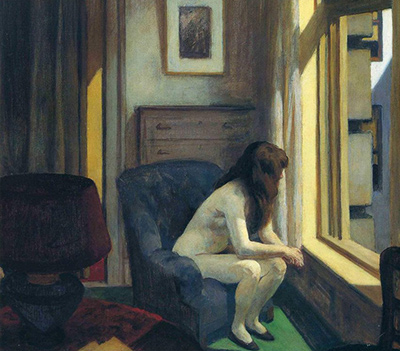
Compare: Eleven A.M., 1926.
Light on a wall and light on skin
The large wall passage and the illuminated body offer two quite different accounts of the same daylight. A wall is comparatively planar: an angled boundary can pass across it with remarkable clarity. A shoulder, forearm or knee turns through space, requiring changes within the light as well as a boundary around it.
Hopper allows those kinds of description to coexist. The wall establishes a strong large shape behind the figure; smaller transitions make the limbs rounded. The viewer can recognize the picture quickly through its broad geometry, then spend longer following the individual forms that geometry contains.
The window adds a third account. Its surround has thickness, so the opening is defined by narrow planes that face different directions. The sill, upright and shaded edges establish depth through a few concentrated changes. Their relatively hard construction contrasts with both the wall's expanse and the body's curved surfaces.
The red building beyond the glass then provides a more distant illuminated mass. Its scale is smaller in the image, but its colour has enough force to answer the woman's warmer garment. The eye can connect two separated areas without assuming a personal link between their occupants.
This is a useful way to approach Hopper's economy. The room contains few kinds of objects, but each makes a different demand on painting. Architecture, fabric, skin and a distant exterior allow light to be examined through distinct shapes and surfaces. Simplicity of furnishing has made those differences more apparent.
A familiar interior transformed
In the Whitney's interpretation, writer Kirsty Bell identifies Morning Sun with the Hoppers' own interior, distinguishing it from many of the artist's more extensively invented rooms. She also emphasizes Jo Hopper's longstanding role as a model and her experience of performance. [2]
The association makes the painting's construction more interesting. A familiar room could supply practical information about window, light and bed, while a posed figure could be adjusted within it. Direct observation did not remove the need to decide what the finished picture would show.
Nor does a known model settle the painted character's identity. Jo's body and appearance supplied material for the work, but the woman on the bed need not be read as a literal record of Jo's age, thoughts or domestic circumstances.
The preparatory drawings make that distinction unusually visible. They preserve close attention to an individual sitter alongside decisions about a more generalized figure and a complete room.
A figure study with colour notes
The Whitney holds a 1952 study in fabricated chalk and graphite, accession 70.291, showing the seated woman with notes distributed around her body. [3] Lines connect particular passages with observations about colour, light and shadow.
The sheet gives the pose considerable specificity. The sitter's profile, hair, shoulder and folded limbs are carefully considered, while the handwritten annotations extend the drawing beyond an account of outline alone. Hopper was recording relationships he would have to make through paint.
Another figure study, accession 70.290, gives the body a more continuous tonal description without the same dense field of notes. [3] Light catches the face and limbs, while darker passages gather around the torso and the contact with the bed.
The repeated pose lets Hopper examine how an arm crosses a leg and how the body meets the supporting surface. The handwritten notes add a record of colour relationships that chalk alone could not specify.
What the handwritten observations record
The annotations on study 70.291 are unusually revealing because many describe relationships rather than isolated colour names. One compares the temperature of the legs with that of the arms. Others attend to warmth in a shadow, a cooler half-tone and light reflected from the sheet. The notes turn small differences within the seated body into practical questions for the painter. [3]
A dark mark in chalk can establish where a shadow falls, but it cannot by itself specify whether that shadow should tend towards blue, pink, green or a warmer brown. Words supply another kind of record alongside the drawing. The sheet preserves both the location of a passage and something about its intended colour relation.
That distinction is especially useful around the folded limbs. The raised legs, resting forearm and garment come close together, so that similar pale surfaces have to remain distinguishable. A small change in temperature can help separate them without requiring an exaggerated dark outline.
The reference to reflected light from the bed also brings the surroundings into the figure study. The body is being examined as part of a luminous environment, even where the larger room is scarcely drawn. Light received from nearby surfaces can affect a shaded area as well as the parts directly exposed to the window.
These notes are evidence of close observation, not a list of pigments or a laboratory account of the finished canvas. A comparative instruction can be carried out through more than one paint mixture. What survives most clearly is Hopper's attention to differences: one passage cooler than another, one shadow warmer, one edge lighter against its setting.
The working sheet consequently complicates the familiar idea of Hopper as a painter of stark oppositions. The completed composition has large contrasts, but the preparatory record is also full of qualified judgements between neighbouring tones. The quiet figure depends on that smaller scale of discrimination.
Watch: Edward Hopper’s Life and Art
Explore Hopper’s paintings and the places behind them in these museum films. Choose a film below.
Testing the room around the figure
A separate sheet, accession 70.243, contains two small framed compositions. [3] Both bring the bed, window and seated woman together, but their relative positions and surrounding dark areas differ.
The drawn frames are significant. They allow Hopper to test the whole picture as a bounded arrangement, rather than treating the figure as an isolated subject. Moving a window edge or changing the visible length of the bed alters how the body occupies the room.
The alternatives are quickly worked, with repeated lines and diagonal shading. They establish relationships without resolving every surface. A person, a patch of wall and an opening can be reconsidered in a compact space.
The more developed compositional study, accession 70.244, makes the room's large light area and dark upper wall clearer. [3] The figure sits between the bed's expanse and the large window, and the outside building is sufficiently present to make the interior–exterior relationship legible.
The drawings do not need to be forced into a precise chronological sequence to show the range of decisions. Some concentrate on the body, another tests two complete arrangements, and another develops the room's major tonal structure.
The two framed designs on 70.243 extend this investigation into the room. In the upper arrangement the sitter gathers more tightly near the window, with emphatic dark passages around her. The lower design gives the body a longer diagonal extension across the bed, while the window and its outside building become a different balance of openings and marks. These are observable alternatives on one sheet, rather than consecutive frames of an action. [3]
The drawn borders make each alternative a separate test. A small change in the figure's inclination affects how much pale bed lies before her and how the profile relates to the window upright. The pose is therefore more than an anatomical problem solved before the room is added. It participates in the room's entire arrangement.
Comparing the designs with the colour-note sheet reveals two scales of work. A mark near an elbow can address a local temperature or reflected light; a few heavy lines around a window can address the balance of the whole image. The final canvas brings those scales together without displaying the amount of trial visible on paper.
Jo's features and the finished character
Whitney curator Carter Foster reads the related studies as a movement from recognizable features of Jo towards a less individualized character. In his account, Hopper progressively simplified the face as he considered how the woman should appear within the room and its light. [3]
This is a useful distinction between studying a model and making a portrait. The artist could observe Jo closely, including the shape of her profile and the light across her skin, then alter that information for a figure whose identity remained open.
The finished face retains a clear direction but relatively little expression that can be named securely. Its profile participates in the arrangement of light and dark as well as in the suggestion of someone thinking or looking.
That restraint gives the viewer work to do. We can notice the body's gathering posture and the outward gaze, but we cannot translate them into a diary entry. The preparation provides evidence of construction rather than a warrant to assign the woman a particular private sorrow.
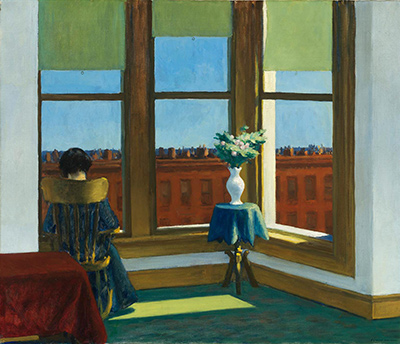
Compare: Room in Brooklyn, 1932.
Calm, isolation and an attentive gaze
The painting can feel quiet without feeling emotionally simple. The room is orderly, the sunlight is substantial and the seated pose is stable. At the same time, the woman's compact body and lack of visible company can encourage a sense of separation.
Stark's museum discussion deliberately allows both calm and loneliness as responses. [1] The alternatives are useful because neither requires us to discover an unseen event that caused the scene.
The architecture helps sustain that openness. The window connects the room with a larger city while remaining a firm boundary. The bed offers a place to rest, yet the woman sits upright rather than lying down. Light makes the surroundings visible without explaining the occupant's thoughts.
The picture's title is similarly economical. It names the time and illumination that organize the scene, leaving the woman's circumstances unspecified. A concrete effect can carry an extensive range of responses.
Contemplation as an activity
Italian scholar Tiziana Migliore offers a further reading in her 2004 study of waiting and attention in Hopper. She treats the woman's direction towards the window as an active, contemplative relation to the outside, emphasizing the organization of body, bed, illumination and opening. Her account makes looking itself an activity, rather than assuming that a motionless figure has simply withdrawn from experience. [4]
The interpretation usefully changes the question a spectator brings to the pose. Sitting without a visible task can be considered an attentive occupation of time. The woman may be receiving light, looking at a building or simply maintaining a position whose duration matters to her. The image does not have to disclose a practical purpose for that interval to be substantial.
At the same time, the profile does not reveal a precise object of thought. The account remains strongest as a way of recognizing bodily orientation. We can see that the torso is raised and the face turned towards the window; the exact experience of that relation stays with the painted person.
The distinction enriches the contrast between calm and loneliness rather than resolving it. Absorption can be chosen, sustaining or difficult. A shared outward setting need not produce the same inward state in every viewer who imagines occupying the bed.
A continuing point of departure
The painting has remained available for deliberate reinterpretation. In 2025, Edward Hopper House Museum & Study Center presented Tomokazu Matsuyama: Morning Sun, centred on Matsuyama's new Morning Sun Dance. In the museum's statement, the artist identifies Hopper's treatment of light, solitude and constructed space as a continuing influence on his own work. [5]
The response is valuable as a named contemporary artist's engagement rather than a general claim that Hopper influenced everything after him. Matsuyama takes the 1952 picture as a point of departure for a different domestic and cultural setting, showing how its arrangement can remain recognizable while inviting new concerns.
How Morning Sun Dance changes the encounter
Matsuyama's Morning Sun Dance makes the act of response concrete through its departures. The museum's account identifies a richly furnished domestic environment and clothing bringing together Japanese and Western references. It also describes a reversal of attention: the new figure turns towards her domestic surroundings rather than Hopper's outside city view. [5]
Looking at the published painting, the change in posture is immediate. Matsuyama's woman sits on patterned upholstery with her lower legs extending towards the floor. Her hands gather near her lap, and her head turns to one side. The body is more open through its length than the tightly folded figure on Hopper's bed.
The room has also acquired a profusion of competing surfaces. Stripes, animal patterns, swirling wall decoration and images within the image occupy areas that Hopper leaves relatively plain. Dogs appear in the room, while pictures and printed matter provide further signs of attention and possession. Domestic space has become dense with choices and references.
The support itself refuses the simple rectangular limit of Hopper's canvas. Projecting edges follow parts of walls, ceiling and floor, so the room seems to extend in several directions against the surrounding wall. This changes the viewer's encounter before the figure is examined: the boundary of the painting is already involved in representing architecture.
The comparison need not turn the later painting into a judgment on the earlier one. Hopper's restraint and Matsuyama's density make different relations available. A spare room can give one patch of light exceptional force; an abundant room can make a person's inward-looking pause persist among numerous visual invitations.
What carries across is a demanding pictorial problem: how to give a seated figure a distinct presence within an environment that has a life of its own. The 2025 response demonstrates how much that problem can change through posture, pattern, furnishings and the edge of the painted support.
Other women beside windows
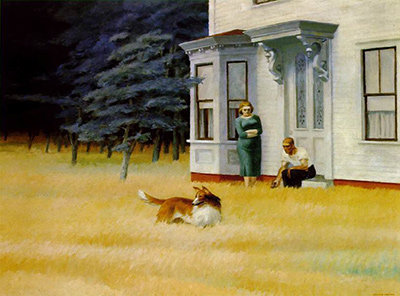
Cape Cod Morning presents the figure from outside the house, leaning forward within a projecting window. Morning Sun places us inside with a seated woman, giving the bed and illuminated wall a much greater role.
Girl at a Sewing Machine connects its figure to a more explicit task. The earlier picture makes work central to the relation between person, room and daylight; the woman here has no comparably visible activity beyond sitting and looking.
Room in Brooklyn gives a seated figure a different relationship to multiple windows and the city beyond. Together, the works show how a recurring subject can change through viewpoint, posture and the amount of surrounding space.
Follow the large light shape from the wall towards the woman's profile, then out to the distant brick building. The route connects three different scales: a broad domestic surface, an observed body and a fragment of city. Morning Sun gives each enough independence to remain worth looking at after its familiar first impression.
Artworks and studies directory
This researched directory includes finished works and separately identified studies. It is not a complete catalogue raisonné. Linked titles open the articles; unlinked studies are identified by their collection accessions. Watercolours retain their recorded media, and original prints remain distinct from reproductions.
| Name | Date | Medium |
|---|---|---|
| (Bridge and Embankment) (70.1298) | 1906 | Oil on wood |
| (Jo Sketching at Good Harbor Beach) (70.1129) | 1923–1924 | Watercolor and fabricated chalk on paper |
| (Manhattan Bridge) (70.1098) | 1925–1926 | Watercolor and graphite pencil on paper |
| (Rooftops) (70.1114) | 1926 | Watercolor and graphite pencil on paper |
| (Seated Male Model, Bent Over) (70.1277) | c. 1902–1903 | Oil on canvas |
| (Self-Portrait) (70.1254) | 1903–1906 | Oil on canvas |
| (Solitary Figure in a Theater) (70.1418) | c. 1902–1904 | Oil on board |
| 5 A.M. | 1937 | oil on canvas |
| Adam's House | 1928 | watercolour and charcoal on paper |
| American Village | 1912 | Oil on canvas |
| Apartment Houses | 1923 | oil on canvas |
| Approaching a City | 1946 | oil on canvas |
| August in the City | 1945 | oil on canvas |
| Automat | 1927 | oil on canvas |
| Barber Shop | 1931 | oil on canvas |
| Blackwell's Island | 1928 | oil on canvas |
| Bridge on the Seine | 1909 | Oil on canvas |
| Bridle Path | 1939 | oil on canvas |
| Burly Cobb's House South Truro | 1930–1933 | oil on canvas |
| Cape Cod Evening | 1939 | oil on canvas |
| Cape Cod Morning | 1950 | oil on canvas |
| Chair Car | 1965 | oil on canvas |
| Chop Suey | 1929 | oil on canvas |
| City Roofs | 1932 | Oil on canvas |
| Coast Guard Station | 1929 | oil on canvas |
| Compartment C, Car 293 | 1938 | oil on canvas |
| Conference at Night | 1949 | oil on canvas |
| Corn Hill | 1930 | oil on canvas |
| Dawn in Pennsylvania | 1942 | oil on canvas |
| Drug Store | 1927 | oil on canvas |
| Early Sunday Morning | 1930 | Oil on canvas |
| East Side Interior (70.1020) | 1922 | Etching |
| East Wind Over Weehawken | 1934 | oil on canvas |
| El Palacio | 1946 | Watercolor and graphite pencil on paper |
| Eleven A.M. | 1926 | oil on canvas |
| Evening Wind | 1921 | etching |
| Excursion into Philosophy | 1959 | oil on canvas |
| First Row Orchestra | 1951 | oil on canvas |
| Freight Car at Truro | 1931 | watercolour over graphite on paper |
| Gas | 1940 | oil on canvas |
| Girl at a Sewing Machine | c. 1921 | oil on canvas |
| Gloucester Harbor | 1912 | Oil on canvas |
| Ground Swell | 1939 | oil on canvas |
| Haskell's House | 1924 | watercolour over graphite on paperboard |
| High Noon | 1949 | oil on canvas |
| Hill and Houses Cape Elizabeth Maine | 1927 | watercolour over graphite pencil |
| Hills South Truro | 1930 | oil on canvas |
| Hotel by a Railroad | 1952 | oil on canvas |
| Hotel Lobby | 1943 | oil on canvas |
| Hotel Room | 1931 | oil on canvas |
| Hotel Window | 1955 | oil on canvas |
| House by the Railroad | 1925 | oil on canvas |
| House by the Squam River | 1926 | watercolour over graphite on paper |
| Le Bistro or The Wine Shop | 1909 | Oil on canvas |
| Le Pont des Arts | 1907 | Oil on canvas |
| Le Pont Royal | 1909 | Oil on canvas |
| Le Quai des Grands Augustins | 1909 | Oil on canvas |
| Lighthouse and Buildings Portland Head | 1927 | watercolour over graphite pencil on paper |
| Lighthouse Hill | 1927 | oil painting |
| Manhattan Bridge Loop | 1928 | oil on canvas |
| Model Sitting | c. 1902 | oil painting; support not asserted |
| Morning Sun | 1952 | oil on canvas |
| New York Movie | 1939 | oil on canvas |
| New York New Haven and Hartford | 1931 | oil on canvas |
| New York Office | 1962 | oil on canvas |
| New York Pavements | 1924–1925 | oil on canvas |
| New York Restaurant | c. 1922 | oil on canvas |
| Night Windows | 1928 | oil on canvas |
| Nighthawks | 1942 | oil on canvas |
| October on Cape Cod | 1946 | oil on canvas |
| Office at Night | 1940 | oil on canvas |
| Office in a Small City | 1953 | oil on canvas |
| Pennsylvania Coal Town | 1947 | oil on canvas |
| People in the Sun | 1960 | oil on canvas |
| Portrait of Orleans | 1950 | oil on canvas |
| Queensborough Bridge | 1913 | Oil on canvas |
| Railroad Sunset | 1929 | Oil on canvas |
| Railroad Train | 1908 | oil on canvas |
| Road in Maine | 1914 | oil on canvas |
| Room in Brooklyn | 1932 | oil on canvas |
| Room in New York | 1932 | oil on canvas |
| Rooms by the Sea | 1951 | oil on canvas |
| Rooms for Tourists | 1945 | oil on canvas |
| Route 6 Eastham | 1941 | oil on canvas |
| Second Story Sunlight | 1960 | Oil on canvas |
| Self-Portrait | 1925–1930 | Oil on canvas |
| Self-Portrait with Hat (70.1903) | c. 1918, posthumous print | Drypoint |
| Seven A.M. | 1948 | Oil on canvas |
| Soir Bleu | 1914 | oil on canvas |
| South Carolina Morning | 1955 | Oil on canvas |
| Stairway at 48 Rue de Lille Paris | 1906 | Oil on wood |
| Study for 5 A.M. (70.153) | 1937 | Fabricated chalk on paper |
| Study for 5 A.M. (70.429) | 1937 | Fabricated chalk and graphite pencil on paper |
| Study for Approaching a City (70.869) | 1946 | Fabricated chalk and charcoal on paper |
| Study for August in the City (70.158a-b) | 1945 | Fabricated chalk on paper |
| Study for August in the City (70.159) | 1945 | Fabricated chalk on paper |
| Study for Bridle Path (70.220) | 1939 | Fabricated chalk on paper |
| Study for Bridle Path (70.235) | 1939 | Fabricated chalk on paper |
| Study for Compartment C, Car 293 (70.430) | 1938 | Fabricated chalk on paper |
| Study for Compartment C, Car 293 (70.431a-b) | 1938 | Fabricated chalk and charcoal on paper |
| Study for Conference at Night (70.170) | 1949 | Fabricated chalk on paper (recto); Typewriter ink on paper (verso) |
| Study for Conference at Night (70.174) | 1949 | Fabricated chalk on paper ( recto); Typewriter ink on paper (verso) |
| Study for East Wind over Weehawken (70.249) | 1934 | Graphite pencil on paper |
| Study for East Wind over Weehawken (70.252) | 1934 | Fabricated chalk and charcoal on paper |
| Study for Evening Wind (70.343a-b) | 1921 | Fabricated chalk on paper |
| Study for First Row Orchestra (70.841) | 1951 | Fabricated chalk and charcoal on paper |
| Study for Gas (70.263) | 1940 | Fabricated chalk on paper |
| Study for Ground Swell (70.339) | 1939 | Fabricated chalk, charcoal and graphite pencil on paper |
| Study for Hotel by a Railroad (70.199) | 1952 | Fabricated chalk on paper |
| Study for Hotel by a Railroad (70.427) | 1952 | Fabricated chalk on paper |
| Study for Hotel by a Railroad (70.428) | 1952 | Fabricated chalk on paper |
| Study for Hotel Lobby (70.117) | 1942 | Fabricated chalk and graphite pencil on paper |
| Study for Hotel Lobby (70.839) | 1942 | Fabricated chalk and charcoal on paper |
| Study for Hotel Window (70.161) | 1955 | Fabricated chalk, graphite pencil and colored pencil on paper |
| Study for Morning Sun (70.243) | 1952 | Fabricated chalk on paper |
| Study for Morning Sun (70.244) | 1952 | Fabricated chalk on paper |
| Study for Morning Sun (70.290) | 1952 | Fabricated chalk on paper |
| Study for Morning Sun (70.291) | 1952 | Fabricated chalk and graphite pencil on paper |
| Study for New York Movie (70.273) | 1939 | Fabricated chalk on paper |
| Study for New York Movie (70.274a-b) | 1938 or 1939 | Fabricated chalk and charcoal on paper (recto); Fabricated chalk on paper (verso) |
| Study for New York Movie (70.455) | 1939 | Fabricated chalk and charcoal on paper |
| Study for New York Office (70.822) | 1962 | Fabricated chalk on paper |
| Study for Nighthawks (70.192) | 1941 or 1942 | Fabricated chalk on paper |
| Study for Nighthawks (70.193) | 1941 or 1942 | Fabricated chalk on paper |
| Study for Office at Night (70.340) | 1940 | Fabricated chalk and charcoal on paper |
| Study for Office at Night (70.341) | 1940 | Fabricated chalk and graphite pencil on paper |
| Study for Pennsylvania Coal Town (70.198) | 1947 | Fabricated chalk on paper |
| Study for Pennsylvania Coal Town (70.229) | 1947 | Fabricated chalk and charcoal on paper |
| Study for Rooms for Tourists (70.438) | 1945 | Fabricated chalk and charcoal on paper |
| Study for Rooms for Tourists (70.848) | 1945 | Fabricated chalk and charcoal on paper |
| Study for Route 6, Eastham (70.369) | 1941 | Fabricated chalk and graphite pencil on paper |
| Study for Route 6, Eastham (70.854) | 1941 | Fabricated chalk and graphite pencil on paper |
| Study for South Carolina Morning (70.162a-b) | 1955 | Fabricated chalk on paper (recto and verso) |
| Study for The Sheridan Theatre (70.969) | 1937 | Graphite pencil on paper |
| Study for Two on the Aisle (70.128) | 1927 | Fabricated chalk on paper |
| Study for Two on the Aisle (70.129) | 1927 | Fabricated chalk on paper |
| Study for Yawl Riding a Swell (70.439) | 1935 | Fabricated chalk and graphite pencil on paper |
| Summer Evening | 1947 | oil on canvas |
| Summer Interior | 1909 | Oil on canvas |
| Sun in an Empty Room | 1963 | oil on canvas |
| Sunlight in a Cafeteria | 1958 | oil on canvas |
| Sunlight on Brownstones | 1956 | oil on canvas |
| Tables for Ladies | 1930 | oil on canvas |
| The Bootleggers | 1925 | oil on canvas |
| The Camel's Hump | 1931 | oil on canvas |
| The Circle Theatre | 1936 | oil on canvas |
| The City | 1927 | oil on canvas |
| The Lighthouse at Two Lights | 1929 | oil on canvas |
| The Long Leg | 1935 | oil on canvas |
| The Mansard Roof | 1923 | watercolour over graphite on paper |
| The Sheridan Theatre | 1937 | oil on canvas |
| Tramp Steamer | 1908 | oil on canvas |
| Two Comedians | 1966 | oil on canvas |
| Two on the Aisle | 1927 | oil on canvas |
| Valley of the Seine | 1909 | Oil on canvas |
| Western Motel | 1957 | oil on canvas |
Frequently Asked Questions
Edward Hopper made Morning Sun in 1952. [1]
The recorded medium is oil on canvas. [1]
A woman sits on a bed with her knees drawn up, looking towards a large window. Sunlight strikes her face and bare limbs, then spreads across a pale wall behind her. Beyond the glass, a red-brick building rises under a blue sky. Edward Hopper's Morning Sun connects a closely observed body with the geometry of a room and a fragment of the city outside.
Discussion
Look again at the images and ideas explored in Morning Sun. These editorial prompts invite your observations.
Reader Insights
Which boundary, gesture or change of light first holds your attention in Morning Sun?
Compare Eleven A.M. with Morning Sun. Which visual difference matters most to your reading?
Which detail would you look at again after reading “The pale shape on the wall”?
Join the Conversation
Share a detail, comparison or question about Morning Sun below.
References
- David Stark, “Pocketguide to CMA: Edward Hopper's Morning Sun”, Columbus Museum of Art, 12 May 2020; 1952 oil, Howald Fund Purchase and alternative interpretations. Dimensions from Whitney Museum of American Art, Edward Hopper's New York, final checklist, 2022, p.30. View source 1. View source 2.
- Kirsty Bell, Morning Sun, interpretation transcript, Edward Hopper's New York, Whitney Museum of American Art, 2022; the Hoppers' interior, Jo as model and her performance background. View source.
- Whitney Museum of American Art, Morning Sun studies: 70.291, fabricated chalk and graphite on paper; 70.290, 70.243 and 70.244, fabricated chalk on paper; all 1952, Josephine N. Hopper Bequest. Current records and complete images, with Carter Foster's interpretation transcript on the related drawings. View source 1. View source 2. View source 3. View source 4.
- Tiziana Migliore, “Edward Hopper: le passioni dell'intervallo”, Ocula, no.5, September 2004, section 2.0, pp.5–8 (Italian); attributed interpretation of contemplation, the outward gaze and the relations among body, bed, light and window. View source.
- Edward Hopper House Museum & Study Center, Tomokazu Matsuyama: Morning Sun, 20 June–5 October 2025; exhibition introduction and Matsuyama's statement about Hopper's influence on Morning Sun Dance. View source.
- Collection or catalogue record, American Village, 1912; medium and identity as discussed in the linked article. View source.
- Collection or catalogue record, Soir Bleu, 1914; medium and identity as discussed in the linked article. View source.
- Collection or catalogue record, House by the Railroad, 1925; medium and identity as discussed in the linked article. View source.
- Collection or catalogue record, Automat, 1927; medium and identity as discussed in the linked article. View source.
- Collection or catalogue record, Early Sunday Morning, 1930; medium and identity as discussed in the linked article. View source.
- Collection or catalogue record, New York Movie, 1939; medium and identity as discussed in the linked article. View source.
- Collection or catalogue record, Nighthawks, 1942; medium and identity as discussed in the linked article. View source.
- Collection or catalogue record, Morning Sun, 1952; medium and identity as discussed in the linked article. View source.
- Collection or catalogue record, Second Story Sunlight, 1960; medium and identity as discussed in the linked article. View source.
- Collection or catalogue record, Two Comedians, 1966; medium and identity as discussed in the linked article. View source.
- Whitney Museum of American Art, Study for Route 6, Eastham, 1941, accession 70.854; exact object record. View source.
- Whitney Museum of American Art, Study for Conference at Night, 1949, accession 70.170; exact object record. View source.
- Whitney Museum of American Art, Study for First Row Orchestra, 1951, accession 70.841; exact object record. View source.
- Whitney Museum of American Art, (Bridge and Embankment), 1906, accession 70.1298; exact object record. View source.
- Whitney Museum of American Art, (Seated Male Model, Bent Over), c. 1902–1903, accession 70.1277; exact object record. View source.
- Whitney Museum of American Art, Study for Morning Sun, 1952, accession 70.244; exact object record. View source.
- Whitney Museum of American Art, Study for Morning Sun, 1952, accession 70.243; exact object record. View source.
- Whitney Museum of American Art, Study for Two on the Aisle, 1927, accession 70.128; exact object record. View source.
- Whitney Museum of American Art, Study for New York Office, 1962, accession 70.822; exact object record. View source.
- Whitney Museum of American Art, Study for Two on the Aisle, 1927, accession 70.129; exact object record. View source.
- Whitney Museum of American Art, Study for Pennsylvania Coal Town, 1947, accession 70.229; exact object record. View source.
- Whitney Museum of American Art, (Rooftops), 1926, accession 70.1114; exact object record. View source.
- Whitney Museum of American Art, Study for South Carolina Morning, 1955, accession 70.162a-b; exact object record. View source.
- Whitney Museum of American Art, (Self-Portrait), 1903–1906, accession 70.1254; exact object record. View source.
- Whitney Museum of American Art, (Manhattan Bridge), 1925–1926, accession 70.1098; exact object record. View source.
- Whitney Museum of American Art, (Solitary Figure in a Theater), c. 1902–1904, accession 70.1418; exact object record. View source.
- Whitney Museum of American Art, Study for Approaching a City, 1946, accession 70.869; exact object record. View source.
- Whitney Museum of American Art, Study for August in the City, 1945, accession 70.159; exact object record. View source.
- Whitney Museum of American Art, Study for Compartment C, Car 293, 1938, accession 70.430; exact object record. View source.
- Whitney Museum of American Art, Study for Compartment C, Car 293, 1938, accession 70.431a-b; exact object record. View source.
- Whitney Museum of American Art, Study for East Wind over Weehawken, 1934, accession 70.252; exact object record. View source.
- Whitney Museum of American Art, Study for East Wind over Weehawken, 1934, accession 70.249; exact object record. View source.
- Whitney Museum of American Art, Study for Evening Wind, 1921, accession 70.343a-b; exact object record. View source.
- Whitney Museum of American Art, Study for The Sheridan Theatre, 1937, accession 70.969; exact object record. View source.
- Whitney Museum of American Art, Study for New York Movie, 1939, accession 70.455; exact object record. View source.
- Whitney Museum of American Art, Study for New York Movie, 1939, accession 70.273; exact object record. View source.
- Whitney Museum of American Art, Study for New York Movie, 1938 or 1939, accession 70.274a-b; exact object record. View source.
- Whitney Museum of American Art, Study for 5 A.M., 1937, accession 70.153; exact object record. View source.
- Whitney Museum of American Art, Study for 5 A.M., 1937, accession 70.429; exact object record. View source.
- Whitney Museum of American Art, (Jo Sketching at Good Harbor Beach), 1923–1924, accession 70.1129; exact object record. View source.
- Whitney Museum of American Art, Study for August in the City, 1945, accession 70.158a-b; exact object record. View source.
- Whitney Museum of American Art, Study for Morning Sun, 1952, accession 70.291; exact object record. View source.
- Whitney Museum of American Art, Study for Morning Sun, 1952, accession 70.290; exact object record. View source.
- Whitney Museum of American Art, Study for Office at Night, 1940, accession 70.340; exact object record. View source.
- Whitney Museum of American Art, Study for Office at Night, 1940, accession 70.341; exact object record. View source.
- Whitney Museum of American Art, Study for Hotel by a Railroad, 1952, accession 70.427; exact object record. View source.
- Whitney Museum of American Art, Study for Hotel by a Railroad, 1952, accession 70.199; exact object record. View source.
- Whitney Museum of American Art, Study for Hotel by a Railroad, 1952, accession 70.428; exact object record. View source.
- Whitney Museum of American Art, Study for Hotel Lobby, 1942, accession 70.117; exact object record. View source.
- Whitney Museum of American Art, Study for Hotel Lobby, 1942, accession 70.839; exact object record. View source.
- Whitney Museum of American Art, Study for Conference at Night, 1949, accession 70.174; exact object record. View source.
- Whitney Museum of American Art, Study for Hotel Window, 1955, accession 70.161; exact object record. View source.
- Whitney Museum of American Art, Study for Pennsylvania Coal Town, 1947, accession 70.198; exact object record. View source.
- Whitney Museum of American Art, Study for Route 6, Eastham, 1941, accession 70.369; exact object record. View source.
- Whitney Museum of American Art, Study for Bridle Path, 1939, accession 70.220; exact object record. View source.
- Whitney Museum of American Art, Study for Bridle Path, 1939, accession 70.235; exact object record. View source.
- Whitney Museum of American Art, Study for Ground Swell, 1939, accession 70.339; exact object record. View source.
- Whitney Museum of American Art, Study for Yawl Riding a Swell, 1935, accession 70.439; exact object record. View source.
- Whitney Museum of American Art, Study for Rooms for Tourists, 1945, accession 70.848; exact object record. View source.
- Whitney Museum of American Art, Study for Rooms for Tourists, 1945, accession 70.438; exact object record. View source.
- Whitney Museum of American Art, Study for Nighthawks, 1941 or 1942, accession 70.193; exact object record. View source.
- Whitney Museum of American Art, Study for Nighthawks, 1941 or 1942, accession 70.192; exact object record. View source.
- Whitney Museum of American Art, Study for Gas, 1940, accession 70.263; exact object record. View source.
- Whitney Museum of American Art, Self-Portrait with Hat, c. 1918, posthumous print, accession 70.1903; exact object record. View source.
- Whitney Museum of American Art, East Side Interior, 1922, accession 70.1020; exact object record. View source.
- Art Institute of Chicago, Selected Chronology for Edward Hopper; training, travels, exhibitions, New York and Truro chronology. View source.
- Emily C. Burns, Spectral figures: Edward Hopper’s empty Paris, chapter 5 in Empty Spaces: Confronting Emptiness in National, Cultural and Urban Histories, 2019; complete chapter and notes consulted. View source.
- Charles Brock, Regionalism and Folk Art, National Gallery of Art; complete essay and two notes consulted. View source.