 by Tom Gurney
Tom Gurney BSc (Hons) is an art history expert with over 20 years experience
Email: tomgurney1@gmail.com / Phone: +44 7429 011000
Excursion into Philosophy: Introduction
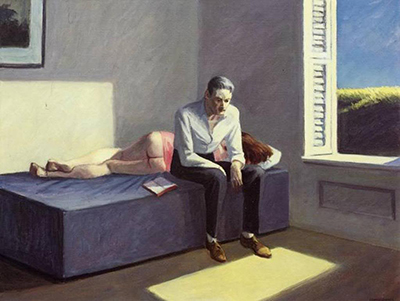
A man sits at the edge of a couch, his head lowered and his hands close to his knees. Behind him, a woman lies with her back towards us. An open book rests nearby, while sunlight makes a conspicuous shape on the floor. Edward Hopper's Excursion into Philosophy offers several possible starting points for a story without allowing any one of them to explain the others completely.
The painting dates from 1959 and is an oil on canvas measuring 30 by 40 inches. [1] Its title encourages us to think about the man's thoughts, but the most accessible evidence is physical: where the bodies lie, how the furniture is placed and which parts of the room receive light.
At a Glance
This work across Edward Hopper’s career
American Village
1912Soir Bleu
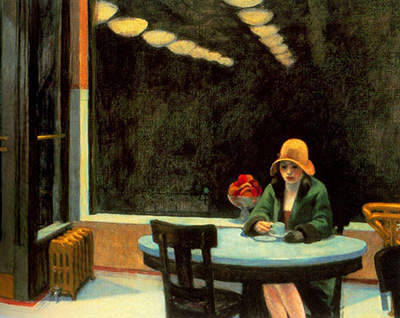
1914Automat
1927New York Movie
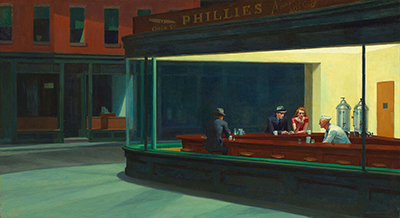
1939Nighthawks
1942Morning Sun
1952Two Comedians
1966Contents
- A man at the edge
- The shirt and the weight of the seated pose
- A second body behind him
- The book and the title
- An excursion as a temporary journey
- Two ways of bringing Plato into the room
- A window with very little landscape
- The shutter beside the open pages
- Sunlight as a separate event
- Sunlight reaches more than one surface
A man at the edge
The seated figure faces towards the foreground, with his upper body inclined slightly forwards. His pale shirt separates him from the darker furniture and trousers. His knees and feet establish a position that feels firmly held rather than momentarily passing through the room.
His lowered head is central to the picture's effect. We see enough of the face to recognise its direction, yet not enough to recover a precise thought. The pose can suggest absorption, fatigue or difficulty, but it does not identify a particular problem.
The hands reinforce the downward movement. They do not hold the book or reach towards the woman. Their placement keeps the figure's action close to his own body, leaving the other elements nearby without an active connection between them.
The couch's front edge gives him a clear location within the room. He occupies its boundary rather than reclining across its depth. That placement distinguishes him from the woman and brings him closer to the space in which the viewer seems to stand.
The shirt and the weight of the seated pose
The man's shirt is one of the brightest objects associated with either figure. Its collar opens beneath the lowered head, and the sleeves carry light down towards the forearms. Those passages give the upper body a structure that remains clear against the more muted wall.
The light fabric also makes the bend at the waist consequential. It gathers across a torso that is neither upright in a chair nor fully relaxed on the couch. The forearms descend towards the knees, bringing the head, hands and feet into a sequence of downward directions.
The trousers continue that sequence in darker tones. Their legs form two substantial vertical shapes near the front of the furniture, with brown shoes meeting the floor. The pose has weight because the body is visibly supported at the couch's edge and grounded through the feet.
The woman is arranged along a different axis. Her pale legs extend across the furniture, and the warmer pink garment gathers near the bend of her upper body. The contrast between clothed vertical and partly exposed horizontal forms can be followed before the title brings philosophy into the room.
This distinction gives the scene a bodily difficulty that is more specific than a generic mood of sadness. The man sits beside a surface on which another person lies, while his own hands and head remain drawn towards his immediate position. The painting allows that arrangement to be examined without requiring a precise account of its cause.
A second body behind him
The woman lies across the couch, her legs extending towards the left. A pink top covers her upper body, while the turned back and partly exposed lower body create a very different arrangement from the man's clothed, upright posture.
She faces away from the spectator. Her head is near the right-hand end of the couch, but the face does not become available as another source of explanation. We cannot inspect a shared look or expression that would tell us how the two people relate.
Their bodies occupy the same piece of furniture while following different directions. His posture descends towards the floor; hers extends across the couch. That formal difference can be read as emotional distance, but it exists first as a visible arrangement of limbs, clothing and orientation.
Nor does a reclining pose alone prove that she is asleep. Her awareness of the man beside her is not visible. The uncertainty is productive: we must consider the two figures together while accepting that their states of mind are not equally accessible.
The book and the title
The open book is small enough to be overlooked at first, but the title gives it considerable importance. Pale pages contrast with a warmer cover and the blue-grey upholstery. It lies near the seated figure without being in his hands.
Jo Hopper identified the book as Plato in her description of the painting, according to the transcription from Gail Levin's biography reproduced by the George Deem estate. Her description also associated the reading with a sense of belatedness. [2] That evidence supports a philosophical connection; it does not establish a named dialogue or a specific passage that we can read from the painted pages.
The distinction is useful because the book is not legible as a text within the image. We recognise an open volume, its position and its relation to a person who is no longer visibly reading. A title and an associated written account add information that sight alone cannot supply.
Even with that information, the picture resists becoming an illustration of a doctrine. The man may be reflecting on what he has read, but we cannot reconstruct an argument from his posture. Philosophy enters the room as an activity and a possible source of difficulty, rather than as a solved lesson.
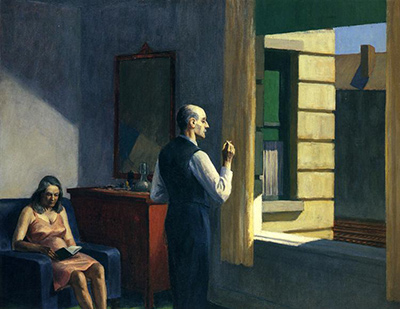
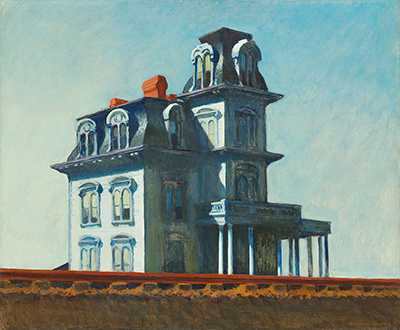
Compare: Hotel by a Railroad, 1952.
An excursion as a temporary journey
The word excursion makes philosophy sound like a movement into another area of experience. It gives the title a different emphasis from simply naming the seated figure a philosopher. The painting identifies a possible activity of thought while leaving the man's wider life unspecified.
The book's position makes that distinction tangible. It lies open beside him, available to be picked up again. The hands have moved away from its pages, but the volume remains within reach. Reading and thinking can be different stages of an encounter with a text, and the picture gives them separate physical locations.
The title can therefore place a reflective interval within a room occupied by another person. It does not require the setting to become a scholar's study filled with books or the man to wear the costume of a professional thinker. Philosophy enters through one ordinary volume and a change in bodily attention.
Its relation to the woman remains unresolved. We can see that her recumbent body and his seated one take different directions, while the title encourages an association between those directions and his thoughts. The association is strong enough to sustain interpretation without supplying the words of his reflection.
Two ways of bringing Plato into the room
The identification of Plato has encouraged different philosophical readings. In his 2011 Bristol dissertation, Louis Shadwick discusses the cave interpretation associated with Sheena Wagstaff and proposes a different connection with the Phaedo. He relates the seated man's turning away from the reclining body to that dialogue's distinction between bodily experience and the philosopher's search for truth. [3] The proposal concerns what the painting may suggest, rather than a passage deciphered from its pages.
The Phaedo provides a particular context for that reading. Socrates asks Simmias whether the philosopher should be governed by bodily pleasures, then questions the senses' reliability in acquiring knowledge. [4] A clothed man and a partly undressed woman can invite such a comparison, especially when an open philosophical book lies near them.
Yet that comparison has limits. The woman in the painting is a person occupying the same furniture, not merely a diagram of bodily appetite. Her back-turned position leaves her own attention unavailable. Reducing her to an obstacle in the man's intellectual life would lose the unequal access Hopper gives us to the two figures.
The cave allegory in the Republic approaches light differently. Its prisoners initially take shadows for reality; release and a difficult ascent allow a changed relation to what they can see. [5] This provides one reason light, enclosure and the possibility of knowledge can become connected in readings of Hopper's room.
Hopper keeps the man seated within the room, looking down near the floor light. Plato’s prisoner has a different trajectory, rising and being led towards an exit. The comparison concerns what light might mean for knowledge, while the physical situations remain distinct.
The two readings therefore open different questions. One concerns the relation of mind and body; the other concerns vision, appearance and understanding. Neither becomes the securely identified contents of the painted book. Jo's recorded identification supplies Plato, while the dialogue and the particular argument remain matters of interpretation.
A window with very little landscape
The window at the right supplies a narrow view of blue sky and a lit strip of ground above a dark bank. It gives the interior a relation to an outside world without opening onto a detailed panorama.
A shutter's repeated horizontal divisions run beside the opening. They introduce a regular pattern against the broader planes of wall and sky. The room's architecture remains visually active even where no person touches it.
The window is close to the seated man, but his head turns downwards rather than towards the view. That difference of orientation helps separate the availability of light from the act of looking outside. The exterior exists in the painting without becoming his obvious destination.
The couch and window also create a compact setting. The people are not separated by an immense room; they are close to one another and to the opening. Any sense of distance arises within physical proximity, through their poses and the lack of an unmistakable exchange.
The shutter beside the open pages
The shutter's small repeated divisions have a different rhythm from the large areas of wall and upholstery. They gather beside the window as a narrow, articulated upright, marking an edge through which light and outside space become visible.
The book introduces another small arrangement of divisions. Its open pages form pale planes above a warmer cover, with a central break where the volume bends. The object is legible as something made to be held and read, even though its text is unavailable.
Their different scales connect the room's practical equipment with its intellectual suggestion. The shutter belongs to the handling of an opening; the book belongs to the handling of information. Both are situated close to the man, but neither receives an active gesture from him at the moment shown.
That lack of handling changes how the objects contribute. A person opening a shutter or turning a page would give the picture a more definite action. Here the furnishings and document remain in place while the body appears occupied with thought, fatigue or another inward condition we cannot specify.
The exterior makes this uncertainty sharper rather than resolving it. Blue sky, a narrow lit strip and darkness below offer a compressed view beyond the window. There is enough outside to establish depth and illumination, while almost all the detailed human situation remains inside the room.
Watch: Edward Hopper’s Life and Art
Explore Hopper’s paintings and the places behind them in these museum films. Choose a film below.
Sunlight as a separate event
The large patch on the floor is among the painting's most assertive forms. Its slanting edges cut across the lower composition, giving the foreground a brightness that differs from the quieter tones of the people.
A second illuminated area appears on the wall behind the couch. Together, these patches make the incoming light visible through distinct surfaces. They describe the room while also forming shapes that can be followed almost independently of its occupants.
The man's shoes sit near the edge of the brighter floor area. That proximity makes the relation between body and light particularly tangible. He shares the room with the sunlight, yet the two do not become a simple statement of comfort or renewal.
Light can be physically clear without making a situation emotionally clear. Here it sharpens the boundaries of the floor, couch and wall, while the relationship between the people remains difficult to define. The picture's uncertainty does not arise from a lack of visible detail.
Sunlight reaches more than one surface
The two main patches of light are separated by the couch and its occupants. The wall's pale area rises behind the reclining legs, while the floor receives a more oblique shape near the man's shoes. The eye has to pass between different planes to connect them.
This distribution prevents light from operating as a single backdrop behind a protagonist. It gives the room a geometry of its own. The man sits near one bright boundary and the woman lies beside another, so each body is located differently in relation to the incoming illumination.
The wall patch is especially effective because it meets a quieter field of colour above. Its upper edge has a firmness that can be compared with the couch's horizontal divisions. Architecture and upholstery receive different kinds of boundary, one made by light and another by the construction of furniture.
The floor patch extends the scene towards the spectator. Its sloping edges make the foreground active even though it contains no third figure. We look at a bright surface from a position in which both the people and the room's arrangement are available at once.
The precision can support philosophical interpretation, but it also gives a concrete visual reason to remain with the canvas. The bright shapes are not simply illustrations attached to a title. They make separate surfaces visible and organise the interval between the bodies and the place from which we look.
A drawing with the woman seated
A charcoal study reproduced in Jill Newhouse Gallery's 2025 drawing catalogue preserves a different arrangement. The woman sits upright in the foreground with her back towards us, while the man is positioned farther across the furniture and faces towards the window. The sheet is dated 1959. [6]
This changes the distribution of attention. The woman's back becomes a substantial foreground form, and the man's profile connects him more directly with the opening. The window, shutter and broad shaded planes already help structure the room.
In the oil, the woman is recumbent and the man turns more towards the foreground. The alteration makes his downward pose easier to see, while her extended body takes attention across the furniture. The final painting therefore changes how the two figures occupy a common space, rather than simply refining their outlines.
The drawing is evidence of a compositional alternative. It need not depict an earlier moment in an unfolding domestic story. Treating it as a preceding episode would confuse the order in which an artist considers arrangements with the chronology of imaginary people.
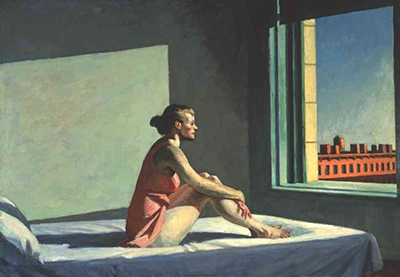
Compare: Morning Sun, 1952.
Studying the man separately
A different sheet, catalogued by Freeman's as a study for the painting, concentrates on the seated man. The auction record dates it to about 1959 and describes conté crayon on brown paper. [7] The woman does not appear in this drawing.
The figure's bowed head, forearms held across his lap and long, bent legs receive their own attention. Lines describing the couch, window and floor remain around him, so his position is considered in relation to the room rather than entirely in isolation.
Compared with the finished painting, the sheet makes the act of construction easier to follow. Repeated contours adjust the furniture and body, while shading near the window establishes a strong vertical boundary. The pose can be studied before the completed picture's book and second figure invite more elaborate stories.
Together, the two drawings reveal different kinds of decision. One tests the relationship between two people; the other studies a figure within the architectural setting. Neither provides a written explanation of what the painted man is thinking.
A room that remains when people are absent
Sun in an Empty Room offers a later comparison for these relationships between wall, floor and incoming light. Its right-hand window and sharp changes of illumination give an unoccupied interior a force that does not depend on visible human gesture.
The comparison makes the furniture in Excursion into Philosophy particularly important. Couch, book and bodies fill a room whose light already has a strong structure. The people bring directions and bodily weights into an arrangement that can also be followed through its larger surfaces.
That does not mean the earlier painting would be unchanged if its figures were removed. Their presence determines the scale of the couch and the significance of the open volume. The floor light is encountered near a man's shoes; the wall light appears beside the recumbent woman's legs. Those contacts turn general illumination into a particular occupied setting.
The later empty room demonstrates a different possibility, not a concealed solution to the earlier scene. Hopper could give sharply bounded sunlight a major role with or without people. Looking between the canvases helps distinguish that recurring pictorial concern from the stories prompted by two bodies on the same piece of furniture.
George Deem returns the Hoppers to the room
The artist George Deem made a documented later response in 1995. In his version, he replaced Hopper's original figures with Edward and Jo seated side by side, taking their poses from a 1955 photograph by Sidney Waintrob. His accompanying note explicitly describes the substitution. He also explained that the larger canvas allowed a one-inch margin around the borrowed image, marking his work as a separate painting. [2]
The retained room makes the change immediately recognisable. A setting that held one seated and one reclining figure now accommodates a couple presented together. Deem makes biography visible through an intervention rather than discovering two literal portraits already hidden in Hopper's canvas.
This response demonstrates how strongly the original arrangement invites reinterpretation. Its furniture, light and window can remain recognisable while new figures alter the relationship we perceive. Deem's painting belongs to the work's later reception; it does not settle the identities or intentions of Hopper's original people.
The difference is also a useful safeguard when considering the title. We can learn about the painting's references and subsequent meanings without closing down its visible uncertainty. The book contributes philosophy, the studies reveal choices, and the later response introduces named people. The original canvas continues to hold a more elusive encounter: two bodies close together, a bright room, and a thought whose content is withheld.
Artworks and studies directory
This researched directory includes finished works and separately identified studies. It is not a complete catalogue raisonné. Linked titles open the articles; unlinked studies are identified by their collection accessions. Watercolours retain their recorded media, and original prints remain distinct from reproductions.
| Name | Date | Medium |
|---|---|---|
| (Bridge and Embankment) (70.1298) | 1906 | Oil on wood |
| (Jo Sketching at Good Harbor Beach) (70.1129) | 1923–1924 | Watercolor and fabricated chalk on paper |
| (Manhattan Bridge) (70.1098) | 1925–1926 | Watercolor and graphite pencil on paper |
| (Rooftops) (70.1114) | 1926 | Watercolor and graphite pencil on paper |
| (Seated Male Model, Bent Over) (70.1277) | c. 1902–1903 | Oil on canvas |
| (Self-Portrait) (70.1254) | 1903–1906 | Oil on canvas |
| (Solitary Figure in a Theater) (70.1418) | c. 1902–1904 | Oil on board |
| 5 A.M. | 1937 | oil on canvas |
| Adam's House | 1928 | watercolour and charcoal on paper |
| American Village | 1912 | Oil on canvas |
| Apartment Houses | 1923 | oil on canvas |
| Approaching a City | 1946 | oil on canvas |
| August in the City | 1945 | oil on canvas |
| Automat | 1927 | oil on canvas |
| Barber Shop | 1931 | oil on canvas |
| Blackwell's Island | 1928 | oil on canvas |
| Bridge on the Seine | 1909 | Oil on canvas |
| Bridle Path | 1939 | oil on canvas |
| Burly Cobb's House South Truro | 1930–1933 | oil on canvas |
| Cape Cod Evening | 1939 | oil on canvas |
| Cape Cod Morning | 1950 | oil on canvas |
| Chair Car | 1965 | oil on canvas |
| Chop Suey | 1929 | oil on canvas |
| City Roofs | 1932 | Oil on canvas |
| Coast Guard Station | 1929 | oil on canvas |
| Compartment C, Car 293 | 1938 | oil on canvas |
| Conference at Night | 1949 | oil on canvas |
| Corn Hill | 1930 | oil on canvas |
| Dawn in Pennsylvania | 1942 | oil on canvas |
| Drug Store | 1927 | oil on canvas |
| Early Sunday Morning | 1930 | Oil on canvas |
| East Side Interior (70.1020) | 1922 | Etching |
| East Wind Over Weehawken | 1934 | oil on canvas |
| El Palacio | 1946 | Watercolor and graphite pencil on paper |
| Eleven A.M. | 1926 | oil on canvas |
| Evening Wind | 1921 | etching |
| Excursion into Philosophy | 1959 | oil on canvas |
| First Row Orchestra | 1951 | oil on canvas |
| Freight Car at Truro | 1931 | watercolour over graphite on paper |
| Gas | 1940 | oil on canvas |
| Girl at a Sewing Machine | c. 1921 | oil on canvas |
| Gloucester Harbor | 1912 | Oil on canvas |
| Ground Swell | 1939 | oil on canvas |
| Haskell's House | 1924 | watercolour over graphite on paperboard |
| High Noon | 1949 | oil on canvas |
| Hill and Houses Cape Elizabeth Maine | 1927 | watercolour over graphite pencil |
| Hills South Truro | 1930 | oil on canvas |
| Hotel by a Railroad | 1952 | oil on canvas |
| Hotel Lobby | 1943 | oil on canvas |
| Hotel Room | 1931 | oil on canvas |
| Hotel Window | 1955 | oil on canvas |
| House by the Railroad | 1925 | oil on canvas |
| House by the Squam River | 1926 | watercolour over graphite on paper |
| Le Bistro or The Wine Shop | 1909 | Oil on canvas |
| Le Pont des Arts | 1907 | Oil on canvas |
| Le Pont Royal | 1909 | Oil on canvas |
| Le Quai des Grands Augustins | 1909 | Oil on canvas |
| Lighthouse and Buildings Portland Head | 1927 | watercolour over graphite pencil on paper |
| Lighthouse Hill | 1927 | oil painting |
| Manhattan Bridge Loop | 1928 | oil on canvas |
| Model Sitting | c. 1902 | oil painting; support not asserted |
| Morning Sun | 1952 | oil on canvas |
| New York Movie | 1939 | oil on canvas |
| New York New Haven and Hartford | 1931 | oil on canvas |
| New York Office | 1962 | oil on canvas |
| New York Pavements | 1924–1925 | oil on canvas |
| New York Restaurant | c. 1922 | oil on canvas |
| Night Windows | 1928 | oil on canvas |
| Nighthawks | 1942 | oil on canvas |
| October on Cape Cod | 1946 | oil on canvas |
| Office at Night | 1940 | oil on canvas |
| Office in a Small City | 1953 | oil on canvas |
| Pennsylvania Coal Town | 1947 | oil on canvas |
| People in the Sun | 1960 | oil on canvas |
| Portrait of Orleans | 1950 | oil on canvas |
| Queensborough Bridge | 1913 | Oil on canvas |
| Railroad Sunset | 1929 | Oil on canvas |
| Railroad Train | 1908 | oil on canvas |
| Road in Maine | 1914 | oil on canvas |
| Room in Brooklyn | 1932 | oil on canvas |
| Room in New York | 1932 | oil on canvas |
| Rooms by the Sea | 1951 | oil on canvas |
| Rooms for Tourists | 1945 | oil on canvas |
| Route 6 Eastham | 1941 | oil on canvas |
| Second Story Sunlight | 1960 | Oil on canvas |
| Self-Portrait | 1925–1930 | Oil on canvas |
| Self-Portrait with Hat (70.1903) | c. 1918, posthumous print | Drypoint |
| Seven A.M. | 1948 | Oil on canvas |
| Soir Bleu | 1914 | oil on canvas |
| South Carolina Morning | 1955 | Oil on canvas |
| Stairway at 48 Rue de Lille Paris | 1906 | Oil on wood |
| Study for 5 A.M. (70.153) | 1937 | Fabricated chalk on paper |
| Study for 5 A.M. (70.429) | 1937 | Fabricated chalk and graphite pencil on paper |
| Study for Approaching a City (70.869) | 1946 | Fabricated chalk and charcoal on paper |
| Study for August in the City (70.158a-b) | 1945 | Fabricated chalk on paper |
| Study for August in the City (70.159) | 1945 | Fabricated chalk on paper |
| Study for Bridle Path (70.220) | 1939 | Fabricated chalk on paper |
| Study for Bridle Path (70.235) | 1939 | Fabricated chalk on paper |
| Study for Compartment C, Car 293 (70.430) | 1938 | Fabricated chalk on paper |
| Study for Compartment C, Car 293 (70.431a-b) | 1938 | Fabricated chalk and charcoal on paper |
| Study for Conference at Night (70.170) | 1949 | Fabricated chalk on paper (recto); Typewriter ink on paper (verso) |
| Study for Conference at Night (70.174) | 1949 | Fabricated chalk on paper ( recto); Typewriter ink on paper (verso) |
| Study for East Wind over Weehawken (70.249) | 1934 | Graphite pencil on paper |
| Study for East Wind over Weehawken (70.252) | 1934 | Fabricated chalk and charcoal on paper |
| Study for Evening Wind (70.343a-b) | 1921 | Fabricated chalk on paper |
| Study for First Row Orchestra (70.841) | 1951 | Fabricated chalk and charcoal on paper |
| Study for Gas (70.263) | 1940 | Fabricated chalk on paper |
| Study for Ground Swell (70.339) | 1939 | Fabricated chalk, charcoal and graphite pencil on paper |
| Study for Hotel by a Railroad (70.199) | 1952 | Fabricated chalk on paper |
| Study for Hotel by a Railroad (70.427) | 1952 | Fabricated chalk on paper |
| Study for Hotel by a Railroad (70.428) | 1952 | Fabricated chalk on paper |
| Study for Hotel Lobby (70.117) | 1942 | Fabricated chalk and graphite pencil on paper |
| Study for Hotel Lobby (70.839) | 1942 | Fabricated chalk and charcoal on paper |
| Study for Hotel Window (70.161) | 1955 | Fabricated chalk, graphite pencil and colored pencil on paper |
| Study for Morning Sun (70.243) | 1952 | Fabricated chalk on paper |
| Study for Morning Sun (70.244) | 1952 | Fabricated chalk on paper |
| Study for Morning Sun (70.290) | 1952 | Fabricated chalk on paper |
| Study for Morning Sun (70.291) | 1952 | Fabricated chalk and graphite pencil on paper |
| Study for New York Movie (70.273) | 1939 | Fabricated chalk on paper |
| Study for New York Movie (70.274a-b) | 1938 or 1939 | Fabricated chalk and charcoal on paper (recto); Fabricated chalk on paper (verso) |
| Study for New York Movie (70.455) | 1939 | Fabricated chalk and charcoal on paper |
| Study for New York Office (70.822) | 1962 | Fabricated chalk on paper |
| Study for Nighthawks (70.192) | 1941 or 1942 | Fabricated chalk on paper |
| Study for Nighthawks (70.193) | 1941 or 1942 | Fabricated chalk on paper |
| Study for Office at Night (70.340) | 1940 | Fabricated chalk and charcoal on paper |
| Study for Office at Night (70.341) | 1940 | Fabricated chalk and graphite pencil on paper |
| Study for Pennsylvania Coal Town (70.198) | 1947 | Fabricated chalk on paper |
| Study for Pennsylvania Coal Town (70.229) | 1947 | Fabricated chalk and charcoal on paper |
| Study for Rooms for Tourists (70.438) | 1945 | Fabricated chalk and charcoal on paper |
| Study for Rooms for Tourists (70.848) | 1945 | Fabricated chalk and charcoal on paper |
| Study for Route 6, Eastham (70.369) | 1941 | Fabricated chalk and graphite pencil on paper |
| Study for Route 6, Eastham (70.854) | 1941 | Fabricated chalk and graphite pencil on paper |
| Study for South Carolina Morning (70.162a-b) | 1955 | Fabricated chalk on paper (recto and verso) |
| Study for The Sheridan Theatre (70.969) | 1937 | Graphite pencil on paper |
| Study for Two on the Aisle (70.128) | 1927 | Fabricated chalk on paper |
| Study for Two on the Aisle (70.129) | 1927 | Fabricated chalk on paper |
| Study for Yawl Riding a Swell (70.439) | 1935 | Fabricated chalk and graphite pencil on paper |
| Summer Evening | 1947 | oil on canvas |
| Summer Interior | 1909 | Oil on canvas |
| Sun in an Empty Room | 1963 | oil on canvas |
| Sunlight in a Cafeteria | 1958 | oil on canvas |
| Sunlight on Brownstones | 1956 | oil on canvas |
| Tables for Ladies | 1930 | oil on canvas |
| The Bootleggers | 1925 | oil on canvas |
| The Camel's Hump | 1931 | oil on canvas |
| The Circle Theatre | 1936 | oil on canvas |
| The City | 1927 | oil on canvas |
| The Lighthouse at Two Lights | 1929 | oil on canvas |
| The Long Leg | 1935 | oil on canvas |
| The Mansard Roof | 1923 | watercolour over graphite on paper |
| The Sheridan Theatre | 1937 | oil on canvas |
| Tramp Steamer | 1908 | oil on canvas |
| Two Comedians | 1966 | oil on canvas |
| Two on the Aisle | 1927 | oil on canvas |
| Valley of the Seine | 1909 | Oil on canvas |
| Western Motel | 1957 | oil on canvas |
Frequently Asked Questions
Edward Hopper made Excursion into Philosophy in 1959. [1]
The recorded medium is oil on canvas. [1]
A man sits at the edge of a couch, his head lowered and his hands close to his knees. Behind him, a woman lies with her back towards us. An open book rests nearby, while sunlight makes a conspicuous shape on the floor. Edward Hopper's Excursion into Philosophy offers several possible starting points for a story without allowing any one of them to explain the others completely.
Discussion
Look again at the images and ideas explored in Excursion into Philosophy. These editorial prompts invite your observations.
Reader Insights
Which boundary, gesture or change of light first holds your attention in Excursion into Philosophy?
Compare Hotel by a Railroad with Excursion into Philosophy. Which visual difference matters most to your reading?
Which detail would you look at again after reading “The book and the title”?
Join the Conversation
Share a detail, comparison or question about Excursion into Philosophy below.
References
- Gail Levin, Symbol and Reality in Edward Hopper's Room in New York, Arts Magazine, January 1982, pages 148–153; Excursion into Philosophy reproduced as figure 11, page 153. View source.
- George Deem estate, Edward and Jo Hopper: Excursion into Philosophy, 1995, image notes reproducing Jo Hopper's description through Gail Levin's 1995 biography, and Deem's artist note dated 19 February 1996. View source.
- Louis Shadwick, “The Window and the Void” in the Work of Edward Hopper, BA Honours dissertation, University of Bristol, 2011, printed pp. 53, 57, 60–62; proposed Phaedo reading and discussion of other interpretations. This is the author’s early dissertation, distinct from his later biography. View source.
- Plato, Phaedo, translated by Benjamin Jowett, Internet Classics Archive, passage corresponding to 64c–65d: Socrates and Simmias on bodily pleasures, sense experience and knowledge. View source.
- Plato, Republic, Book VII, translated by Benjamin Jowett, Internet Classics Archive, opening cave allegory and ascent towards the light, especially 514a–517a. The passage supplies philosophical context, not a confirmed identification of the text in Hopper’s painting. View source.
- Jill Newhouse Gallery, Edward Hopper: Drawings of New York and Cape Cod, 5–30 May 2025, entry 9, pages 26–29. View source.
- Freeman's, Study for Excursion into Philosophy, about 1959, sale 6352, lot 55, object description and reproduced drawing. View source.
- Collection or catalogue record, American Village, 1912; medium and identity as discussed in the linked article. View source.
- Collection or catalogue record, Soir Bleu, 1914; medium and identity as discussed in the linked article. View source.
- Collection or catalogue record, House by the Railroad, 1925; medium and identity as discussed in the linked article. View source.
- Collection or catalogue record, Automat, 1927; medium and identity as discussed in the linked article. View source.
- Collection or catalogue record, Early Sunday Morning, 1930; medium and identity as discussed in the linked article. View source.
- Collection or catalogue record, New York Movie, 1939; medium and identity as discussed in the linked article. View source.
- Collection or catalogue record, Nighthawks, 1942; medium and identity as discussed in the linked article. View source.
- Collection or catalogue record, Morning Sun, 1952; medium and identity as discussed in the linked article. View source.
- Collection or catalogue record, Second Story Sunlight, 1960; medium and identity as discussed in the linked article. View source.
- Collection or catalogue record, Two Comedians, 1966; medium and identity as discussed in the linked article. View source.
- Whitney Museum of American Art, Study for Route 6, Eastham, 1941, accession 70.854; exact object record. View source.
- Whitney Museum of American Art, Study for Conference at Night, 1949, accession 70.170; exact object record. View source.
- Whitney Museum of American Art, Study for First Row Orchestra, 1951, accession 70.841; exact object record. View source.
- Whitney Museum of American Art, (Bridge and Embankment), 1906, accession 70.1298; exact object record. View source.
- Whitney Museum of American Art, (Seated Male Model, Bent Over), c. 1902–1903, accession 70.1277; exact object record. View source.
- Whitney Museum of American Art, Study for Morning Sun, 1952, accession 70.244; exact object record. View source.
- Whitney Museum of American Art, Study for Morning Sun, 1952, accession 70.243; exact object record. View source.
- Whitney Museum of American Art, Study for Two on the Aisle, 1927, accession 70.128; exact object record. View source.
- Whitney Museum of American Art, Study for New York Office, 1962, accession 70.822; exact object record. View source.
- Whitney Museum of American Art, Study for Two on the Aisle, 1927, accession 70.129; exact object record. View source.
- Whitney Museum of American Art, Study for Pennsylvania Coal Town, 1947, accession 70.229; exact object record. View source.
- Whitney Museum of American Art, (Rooftops), 1926, accession 70.1114; exact object record. View source.
- Whitney Museum of American Art, Study for South Carolina Morning, 1955, accession 70.162a-b; exact object record. View source.
- Whitney Museum of American Art, (Self-Portrait), 1903–1906, accession 70.1254; exact object record. View source.
- Whitney Museum of American Art, (Manhattan Bridge), 1925–1926, accession 70.1098; exact object record. View source.
- Whitney Museum of American Art, (Solitary Figure in a Theater), c. 1902–1904, accession 70.1418; exact object record. View source.
- Whitney Museum of American Art, Study for Approaching a City, 1946, accession 70.869; exact object record. View source.
- Whitney Museum of American Art, Study for August in the City, 1945, accession 70.159; exact object record. View source.
- Whitney Museum of American Art, Study for Compartment C, Car 293, 1938, accession 70.430; exact object record. View source.
- Whitney Museum of American Art, Study for Compartment C, Car 293, 1938, accession 70.431a-b; exact object record. View source.
- Whitney Museum of American Art, Study for East Wind over Weehawken, 1934, accession 70.252; exact object record. View source.
- Whitney Museum of American Art, Study for East Wind over Weehawken, 1934, accession 70.249; exact object record. View source.
- Whitney Museum of American Art, Study for Evening Wind, 1921, accession 70.343a-b; exact object record. View source.
- Whitney Museum of American Art, Study for The Sheridan Theatre, 1937, accession 70.969; exact object record. View source.
- Whitney Museum of American Art, Study for New York Movie, 1939, accession 70.455; exact object record. View source.
- Whitney Museum of American Art, Study for New York Movie, 1939, accession 70.273; exact object record. View source.
- Whitney Museum of American Art, Study for New York Movie, 1938 or 1939, accession 70.274a-b; exact object record. View source.
- Whitney Museum of American Art, Study for 5 A.M., 1937, accession 70.153; exact object record. View source.
- Whitney Museum of American Art, Study for 5 A.M., 1937, accession 70.429; exact object record. View source.
- Whitney Museum of American Art, (Jo Sketching at Good Harbor Beach), 1923–1924, accession 70.1129; exact object record. View source.
- Whitney Museum of American Art, Study for August in the City, 1945, accession 70.158a-b; exact object record. View source.
- Whitney Museum of American Art, Study for Morning Sun, 1952, accession 70.291; exact object record. View source.
- Whitney Museum of American Art, Study for Morning Sun, 1952, accession 70.290; exact object record. View source.
- Whitney Museum of American Art, Study for Office at Night, 1940, accession 70.340; exact object record. View source.
- Whitney Museum of American Art, Study for Office at Night, 1940, accession 70.341; exact object record. View source.
- Whitney Museum of American Art, Study for Hotel by a Railroad, 1952, accession 70.427; exact object record. View source.
- Whitney Museum of American Art, Study for Hotel by a Railroad, 1952, accession 70.199; exact object record. View source.
- Whitney Museum of American Art, Study for Hotel by a Railroad, 1952, accession 70.428; exact object record. View source.
- Whitney Museum of American Art, Study for Hotel Lobby, 1942, accession 70.117; exact object record. View source.
- Whitney Museum of American Art, Study for Hotel Lobby, 1942, accession 70.839; exact object record. View source.
- Whitney Museum of American Art, Study for Conference at Night, 1949, accession 70.174; exact object record. View source.
- Whitney Museum of American Art, Study for Hotel Window, 1955, accession 70.161; exact object record. View source.
- Whitney Museum of American Art, Study for Pennsylvania Coal Town, 1947, accession 70.198; exact object record. View source.
- Whitney Museum of American Art, Study for Route 6, Eastham, 1941, accession 70.369; exact object record. View source.
- Whitney Museum of American Art, Study for Bridle Path, 1939, accession 70.220; exact object record. View source.
- Whitney Museum of American Art, Study for Bridle Path, 1939, accession 70.235; exact object record. View source.
- Whitney Museum of American Art, Study for Ground Swell, 1939, accession 70.339; exact object record. View source.
- Whitney Museum of American Art, Study for Yawl Riding a Swell, 1935, accession 70.439; exact object record. View source.
- Whitney Museum of American Art, Study for Rooms for Tourists, 1945, accession 70.848; exact object record. View source.
- Whitney Museum of American Art, Study for Rooms for Tourists, 1945, accession 70.438; exact object record. View source.
- Whitney Museum of American Art, Study for Nighthawks, 1941 or 1942, accession 70.193; exact object record. View source.
- Whitney Museum of American Art, Study for Nighthawks, 1941 or 1942, accession 70.192; exact object record. View source.
- Whitney Museum of American Art, Study for Gas, 1940, accession 70.263; exact object record. View source.
- Whitney Museum of American Art, Self-Portrait with Hat, c. 1918, posthumous print, accession 70.1903; exact object record. View source.
- Whitney Museum of American Art, East Side Interior, 1922, accession 70.1020; exact object record. View source.
- Art Institute of Chicago, Selected Chronology for Edward Hopper; training, travels, exhibitions, New York and Truro chronology. View source.
- Emily C. Burns, Spectral figures: Edward Hopper’s empty Paris, chapter 5 in Empty Spaces: Confronting Emptiness in National, Cultural and Urban Histories, 2019; complete chapter and notes consulted. View source.
- Charles Brock, Regionalism and Folk Art, National Gallery of Art; complete essay and two notes consulted. View source.