



 by Tom Gurney
Tom Gurney BSc (Hons) is an art history expert with over 20 years experience
Email: tomgurney1@gmail.com / Phone: +44 7429 011000
The Mansard Roof: Introduction
Cream-coloured awnings swell out above a porch. Behind them, dormer windows rise through a dark roof, their pale trim catching the light. Trees crowd the building at either side, and green shadows spread across its lower walls. Edward Hopper's The Mansard Roof is a picture of architecture made unusually animated by fabric, foliage and the movement of watercolour.
Painted in 1923, it belongs to the Brooklyn Museum, accession 23.100, purchased through the Museum Collection Fund. The official checklist for the 2007 Hopper retrospective identifies the medium as watercolour over graphite on paper. [1]
The house is in Rocky Neck, Gloucester, Massachusetts. Local researcher Catherine Ryan identifies it at the junction of Clarendon and Wonson Streets, relating the painted view to the surviving building and historical photographs. Her account locates a specific architectural subject behind a title that initially names only its roof. [2]
At a Glance
- ArtistEdward Hopper [1]
- Date1923 [1]
- Mediumwatercolour over graphite on paper [1]
- Collection / recordBrooklyn Museum [1]
- Accession23.100 [1]
This work across Edward Hopper’s career
American Village
1912Soir Bleu
1914Automat
1927New York Movie
1939Nighthawks
1942Morning Sun
1952Two Comedians
1966Contents
- A roof full of interruptions
- The awnings bring the house forward
- Trees at the edges
- The dark space below the porch
- Drawing with washes and accents
- Jo Nivison and the Brooklyn exhibition
- What attracted Hopper to the building?
A roof full of interruptions
A mansard roof has a steep lower slope, allowing windows to project from it. Hopper makes that lower slope prominent, but we encounter it mainly through the dormers, shutters, cornices and patches of darkness that break its surface. The roof is an accumulation of parts rather than a single continuous plane.
The dormers create a rhythm across the upper half. Pale surrounds frame dark or shuttered windows; small gables interrupt the skyline; projecting cornices cast short shadows. The individual forms are related, yet their changing angles prevent them from becoming mechanically identical.
Some windows face us more directly than others. The building turns, and its openings turn with it. We can read the side and front through the way these repeated features change shape and overlap. The roof's complexity becomes a means of understanding the house as a volume.
The green shutters are particularly active. They provide dark upright accents beside paler window surrounds, sometimes opening away from the wall. Their small changes of direction make the upper architecture more intricate than a simple row of black rectangles would be.
Two warm brick chimneys rise beyond the pale trim. Their colour is distinct from the cooler roof and greenery, and their blunt vertical shapes interrupt the many pointed gables. They also help hold the upper part of the picture together: warm accents appear at separate points across an otherwise predominantly green, grey and white arrangement.
There is considerable darkness in this roof, but the impression is not heavy. Bright edges repeatedly interrupt it. Hopper lets us follow a cornice or the side of a dormer before attention moves into the next dark opening. Looking across the upper half becomes a sequence of quick discoveries.
The awnings bring the house forward
The largest awning projects towards us over the porch. Its light colour makes it conspicuous against the roof and darker spaces behind. Instead of behaving like a rigid architectural plane, its edge rises and dips, suggesting fabric pulled into a changing shape.
The underside is especially important. A deep curved shadow below the pale cloth gives the canopy a hollow, projecting form. It is one of the boldest dark shapes in the middle of the painting, quite different from the narrow accents of shutters and window frames above.
A second stretch of awning extends along the side. Together, these coverings describe the porch as an outdoor space wrapped around the building. They also conceal portions of the walls and openings, so that the house has to be understood through partial views.
Below them, a white balustrade supplies a steadier rhythm. Its closely spaced uprights are smaller and more regular than the shapes of the cloth. Fabric and wood consequently behave differently in the same passage: one appears mobile and billowing, the other constructed and fixed.
The relationship makes the porch feel inhabited even without a visible figure. The coverings have a practical use, giving shade to a place where people might sit. Hopper leaves that possibility in the architecture rather than providing an occupant to act it out.
Trees at the edges
The vegetation does not remain politely behind the house. At the left, a dense tree overlaps the view, introducing dark green and small warm touches. At the right, lighter branches and leaves enter across the pale wall and sky. The building is seen through these interruptions.
This framing has a different character on each side. The left tree feels fuller and heavier, while the right-hand forms are more dispersed. The asymmetry prevents the house from looking formally presented between a matched pair of trees.
The marks of vegetation also answer the fabric. Both interrupt the harder edges of the building, though in different ways. Awnings form broad, continuous light shapes; leaves and branches break into smaller, irregular accents. Their combination gives the whole view an impression of air moving around a substantial structure.
The house remains firmly present beneath this activity. Its columns, walls, porch rail and roof establish a framework that the looser forms can cross. The effect depends on that agreement between stability and movement. If the building were equally loose everywhere, the fabric and foliage would lose much of their expressive contrast.

Compare: Adam's House, 1928.
The dark space below the porch
The lower half deserves attention after the roof. Beneath the porch, dark areas open between supporting elements. These passages make the house seem raised above its immediate surroundings, with light walls continuing below the brighter railing.
The shadows are varied. Some are broad and relatively continuous; others are broken by columns, diagonal marks or patches of vegetation. The lower building is neither a uniform dark base nor an exhaustively described foundation. Its parts remain partially concealed.
This area balances the dark roof above. Between the two, the awning and balustrade form a conspicuous light band. We can read the painting as a layered arrangement of dark and light, while still recognizing the practical parts of the house.
The viewpoint increases the importance of the upper structure. We look towards a building rising above us, with the roof and dormers given a substantial share of the field. The foreground does not provide a long avenue or a garden laid out for inspection. The house arrives close to the spectator, crowded by foliage and cropped space.
Watch: Edward Hopper’s Life and Art
Explore Hopper’s paintings and the places behind them in these museum films. Choose a film below.
Drawing with washes and accents
Watercolour allows Hopper to keep broad passages open while concentrating detail around selected edges. Light walls contain changes of colour and tone, and the sky remains comparatively spare. Against those areas, shutters, cornices and the porch's deepest shadow become more emphatic.
The marks are readily visible at the scale of the reproduction. They do not attempt to turn every leaf or slat into a separately finished object. A few related strokes can suggest a branch, while a dark interval and a pale edge can establish an architectural projection.
The graphite recorded in the museum catalogue belongs to the work's material structure. The finished image nevertheless does more than fill drawn compartments with colour. Shapes overlap, washes vary and the foliage disrupts the building's clearer outlines. The encounter between those different edges gives the watercolour much of its energy. [1]
The Mansard Roof has a different character from the broad, sharply bounded forms of some later oils. Its numerous architectural accents remain legible because the pale awnings and broad wall surfaces give them a larger framework.
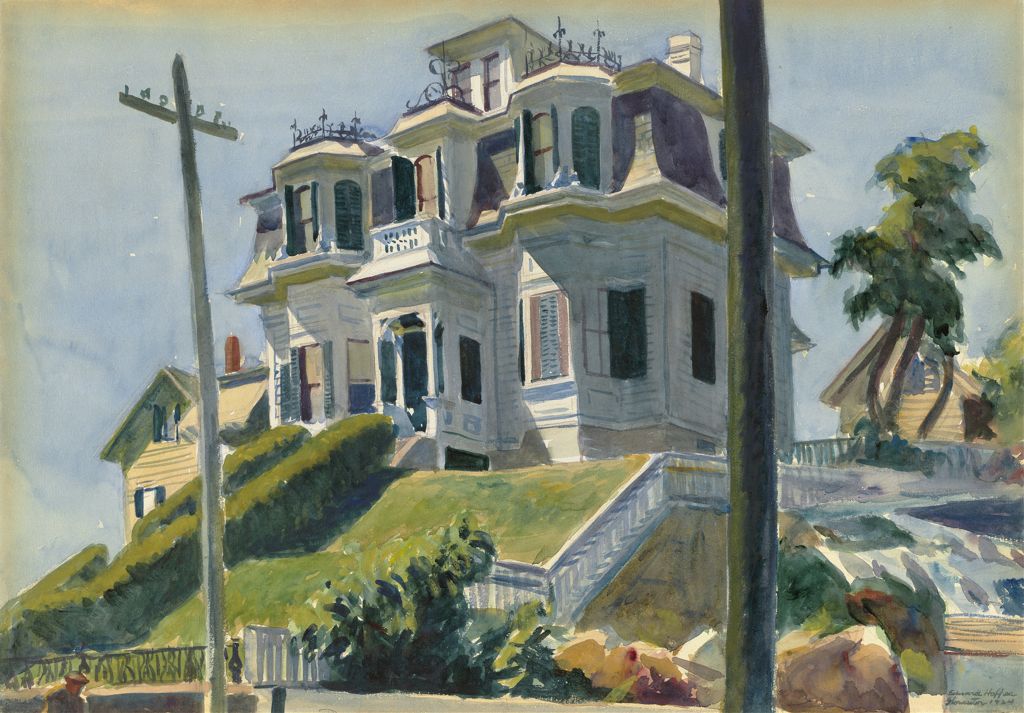
Compare: Haskell's House, 1924.
Jo Nivison and the Brooklyn exhibition
The picture's exhibition history involves another painter. In her 1980 study of Josephine Verstille Nivison Hopper, Gail Levin records that Jo encouraged Edward's watercolour work during their 1923 Gloucester summer. When Jo was invited to exhibit at the Brooklyn Museum that autumn, she advocated the inclusion of his work as well. Each artist showed six watercolours. [3]
Levin's account draws in part on a joint interview recorded in 1966. It preserves Jo's recollection of an intervention made more than forty years earlier, rather than offering a newly witnessed account of the 1923 selection. The museum bought The Mansard Roof for $100; Jo sold no work from the exhibition. Levin connects the different outcomes with the later imbalance in the artists' professional recognition. [3]
That history makes it important to see Jo as an exhibiting artist with her own work and contacts. Her role in this moment went beyond posing for Edward or keeping his later records. The watercolour's path into a public collection depended in part on an artistic relationship and an act of advocacy.
The purchase also belongs to a longer development. Hopper had already sold a painting at the 1913 Armory Show and had a solo exhibition at the Whitney Studio Club in 1920. His watercolour success in 1923 and the following year expanded his opportunities after a prolonged period of paid illustration and uneven recognition. [4]
What attracted Hopper to the building?
WNYC's archive entry for Ruth Bowman's interview with Hopper identifies The Mansard Roof as one of the works discussed. Its account emphasizes his interest in roofs, windows, turrets, structure, colour and light. That summary directs attention to the variety of visible forms rather than supplying a narrative about an unseen resident. [5]
The roof itself demonstrates the attraction. Each dormer presents a different problem of angle, shadow and overlap. The awning introduces a broad curve beneath those smaller angular forms. The trees cut across the result, and the lower porch gives the building a dark, open base.
A comparison with Haskell's House, painted in Gloucester the following year, makes the range of Hopper's architectural looking clear. The later watercolour gives greater emphasis to the house's bays, steep ground and nearby utility poles. In The Mansard Roof, fabric and foliage are more prominent agents of movement.
Adam's House opens the scene towards a street corner and distant roofs. The Brooklyn picture stays closer to the elaborate building. Its interruptions are largely internal or immediately adjacent: dormer against roof, cloth against porch, branch against wall.
Look once more at the curved darkness beneath the largest awning, then follow the bright railing underneath it. That small journey moves from soft, swelling fabric to regular woodwork. Above them, the dormers resume their varied rhythm. Hopper has made one house a remarkably rich encounter between constructed form and passing light.
Artworks and studies directory
This researched directory includes finished works and separately identified studies. It is not a complete catalogue raisonné. Linked titles open the articles; unlinked studies are identified by their collection accessions. Watercolours retain their recorded media, and original prints remain distinct from reproductions.
| Name | Date | Medium |
|---|---|---|
| (Bridge and Embankment) (70.1298) | 1906 | Oil on wood |
| (Jo Sketching at Good Harbor Beach) (70.1129) | 1923–1924 | Watercolor and fabricated chalk on paper |
| (Manhattan Bridge) (70.1098) | 1925–1926 | Watercolor and graphite pencil on paper |
| (Rooftops) (70.1114) | 1926 | Watercolor and graphite pencil on paper |
| (Seated Male Model, Bent Over) (70.1277) | c. 1902–1903 | Oil on canvas |
| (Self-Portrait) (70.1254) | 1903–1906 | Oil on canvas |
| (Solitary Figure in a Theater) (70.1418) | c. 1902–1904 | Oil on board |
| 5 A.M. | 1937 | oil on canvas |
| Adam's House | 1928 | watercolour and charcoal on paper |
| American Village | 1912 | Oil on canvas |
| Apartment Houses | 1923 | oil on canvas |
| Approaching a City | 1946 | oil on canvas |
| August in the City | 1945 | oil on canvas |
| Automat | 1927 | oil on canvas |
| Barber Shop | 1931 | oil on canvas |
| Blackwell's Island | 1928 | oil on canvas |
| Bridge on the Seine | 1909 | Oil on canvas |
| Bridle Path | 1939 | oil on canvas |
| Burly Cobb's House South Truro | 1930–1933 | oil on canvas |
| Cape Cod Evening | 1939 | oil on canvas |
| Cape Cod Morning | 1950 | oil on canvas |
| Chair Car | 1965 | oil on canvas |
| Chop Suey | 1929 | oil on canvas |
| City Roofs | 1932 | Oil on canvas |
| Coast Guard Station | 1929 | oil on canvas |
| Compartment C, Car 293 | 1938 | oil on canvas |
| Conference at Night | 1949 | oil on canvas |
| Corn Hill | 1930 | oil on canvas |
| Dawn in Pennsylvania | 1942 | oil on canvas |
| Drug Store | 1927 | oil on canvas |
| Early Sunday Morning | 1930 | Oil on canvas |
| East Side Interior (70.1020) | 1922 | Etching |
| East Wind Over Weehawken | 1934 | oil on canvas |
| El Palacio | 1946 | Watercolor and graphite pencil on paper |
| Eleven A.M. | 1926 | oil on canvas |
| Evening Wind | 1921 | etching |
| Excursion into Philosophy | 1959 | oil on canvas |
| First Row Orchestra | 1951 | oil on canvas |
| Freight Car at Truro | 1931 | watercolour over graphite on paper |
| Gas | 1940 | oil on canvas |
| Girl at a Sewing Machine | c. 1921 | oil on canvas |
| Gloucester Harbor | 1912 | Oil on canvas |
| Ground Swell | 1939 | oil on canvas |
| Haskell's House | 1924 | watercolour over graphite on paperboard |
| High Noon | 1949 | oil on canvas |
| Hill and Houses Cape Elizabeth Maine | 1927 | watercolour over graphite pencil |
| Hills South Truro | 1930 | oil on canvas |
| Hotel by a Railroad | 1952 | oil on canvas |
| Hotel Lobby | 1943 | oil on canvas |
| Hotel Room | 1931 | oil on canvas |
| Hotel Window | 1955 | oil on canvas |
| House by the Railroad | 1925 | oil on canvas |
| House by the Squam River | 1926 | watercolour over graphite on paper |
| Le Bistro or The Wine Shop | 1909 | Oil on canvas |
| Le Pont des Arts | 1907 | Oil on canvas |
| Le Pont Royal | 1909 | Oil on canvas |
| Le Quai des Grands Augustins | 1909 | Oil on canvas |
| Lighthouse and Buildings Portland Head | 1927 | watercolour over graphite pencil on paper |
| Lighthouse Hill | 1927 | oil painting |
| Manhattan Bridge Loop | 1928 | oil on canvas |
| Model Sitting | c. 1902 | oil painting; support not asserted |
| Morning Sun | 1952 | oil on canvas |
| New York Movie | 1939 | oil on canvas |
| New York New Haven and Hartford | 1931 | oil on canvas |
| New York Office | 1962 | oil on canvas |
| New York Pavements | 1924–1925 | oil on canvas |
| New York Restaurant | c. 1922 | oil on canvas |
| Night Windows | 1928 | oil on canvas |
| Nighthawks | 1942 | oil on canvas |
| October on Cape Cod | 1946 | oil on canvas |
| Office at Night | 1940 | oil on canvas |
| Office in a Small City | 1953 | oil on canvas |
| Pennsylvania Coal Town | 1947 | oil on canvas |
| People in the Sun | 1960 | oil on canvas |
| Portrait of Orleans | 1950 | oil on canvas |
| Queensborough Bridge | 1913 | Oil on canvas |
| Railroad Sunset | 1929 | Oil on canvas |
| Railroad Train | 1908 | oil on canvas |
| Road in Maine | 1914 | oil on canvas |
| Room in Brooklyn | 1932 | oil on canvas |
| Room in New York | 1932 | oil on canvas |
| Rooms by the Sea | 1951 | oil on canvas |
| Rooms for Tourists | 1945 | oil on canvas |
| Route 6 Eastham | 1941 | oil on canvas |
| Second Story Sunlight | 1960 | Oil on canvas |
| Self-Portrait | 1925–1930 | Oil on canvas |
| Self-Portrait with Hat (70.1903) | c. 1918, posthumous print | Drypoint |
| Seven A.M. | 1948 | Oil on canvas |
| Soir Bleu | 1914 | oil on canvas |
| South Carolina Morning | 1955 | Oil on canvas |
| Stairway at 48 Rue de Lille Paris | 1906 | Oil on wood |
| Study for 5 A.M. (70.153) | 1937 | Fabricated chalk on paper |
| Study for 5 A.M. (70.429) | 1937 | Fabricated chalk and graphite pencil on paper |
| Study for Approaching a City (70.869) | 1946 | Fabricated chalk and charcoal on paper |
| Study for August in the City (70.158a-b) | 1945 | Fabricated chalk on paper |
| Study for August in the City (70.159) | 1945 | Fabricated chalk on paper |
| Study for Bridle Path (70.220) | 1939 | Fabricated chalk on paper |
| Study for Bridle Path (70.235) | 1939 | Fabricated chalk on paper |
| Study for Compartment C, Car 293 (70.430) | 1938 | Fabricated chalk on paper |
| Study for Compartment C, Car 293 (70.431a-b) | 1938 | Fabricated chalk and charcoal on paper |
| Study for Conference at Night (70.170) | 1949 | Fabricated chalk on paper (recto); Typewriter ink on paper (verso) |
| Study for Conference at Night (70.174) | 1949 | Fabricated chalk on paper ( recto); Typewriter ink on paper (verso) |
| Study for East Wind over Weehawken (70.249) | 1934 | Graphite pencil on paper |
| Study for East Wind over Weehawken (70.252) | 1934 | Fabricated chalk and charcoal on paper |
| Study for Evening Wind (70.343a-b) | 1921 | Fabricated chalk on paper |
| Study for First Row Orchestra (70.841) | 1951 | Fabricated chalk and charcoal on paper |
| Study for Gas (70.263) | 1940 | Fabricated chalk on paper |
| Study for Ground Swell (70.339) | 1939 | Fabricated chalk, charcoal and graphite pencil on paper |
| Study for Hotel by a Railroad (70.199) | 1952 | Fabricated chalk on paper |
| Study for Hotel by a Railroad (70.427) | 1952 | Fabricated chalk on paper |
| Study for Hotel by a Railroad (70.428) | 1952 | Fabricated chalk on paper |
| Study for Hotel Lobby (70.117) | 1942 | Fabricated chalk and graphite pencil on paper |
| Study for Hotel Lobby (70.839) | 1942 | Fabricated chalk and charcoal on paper |
| Study for Hotel Window (70.161) | 1955 | Fabricated chalk, graphite pencil and colored pencil on paper |
| Study for Morning Sun (70.243) | 1952 | Fabricated chalk on paper |
| Study for Morning Sun (70.244) | 1952 | Fabricated chalk on paper |
| Study for Morning Sun (70.290) | 1952 | Fabricated chalk on paper |
| Study for Morning Sun (70.291) | 1952 | Fabricated chalk and graphite pencil on paper |
| Study for New York Movie (70.273) | 1939 | Fabricated chalk on paper |
| Study for New York Movie (70.274a-b) | 1938 or 1939 | Fabricated chalk and charcoal on paper (recto); Fabricated chalk on paper (verso) |
| Study for New York Movie (70.455) | 1939 | Fabricated chalk and charcoal on paper |
| Study for New York Office (70.822) | 1962 | Fabricated chalk on paper |
| Study for Nighthawks (70.192) | 1941 or 1942 | Fabricated chalk on paper |
| Study for Nighthawks (70.193) | 1941 or 1942 | Fabricated chalk on paper |
| Study for Office at Night (70.340) | 1940 | Fabricated chalk and charcoal on paper |
| Study for Office at Night (70.341) | 1940 | Fabricated chalk and graphite pencil on paper |
| Study for Pennsylvania Coal Town (70.198) | 1947 | Fabricated chalk on paper |
| Study for Pennsylvania Coal Town (70.229) | 1947 | Fabricated chalk and charcoal on paper |
| Study for Rooms for Tourists (70.438) | 1945 | Fabricated chalk and charcoal on paper |
| Study for Rooms for Tourists (70.848) | 1945 | Fabricated chalk and charcoal on paper |
| Study for Route 6, Eastham (70.369) | 1941 | Fabricated chalk and graphite pencil on paper |
| Study for Route 6, Eastham (70.854) | 1941 | Fabricated chalk and graphite pencil on paper |
| Study for South Carolina Morning (70.162a-b) | 1955 | Fabricated chalk on paper (recto and verso) |
| Study for The Sheridan Theatre (70.969) | 1937 | Graphite pencil on paper |
| Study for Two on the Aisle (70.128) | 1927 | Fabricated chalk on paper |
| Study for Two on the Aisle (70.129) | 1927 | Fabricated chalk on paper |
| Study for Yawl Riding a Swell (70.439) | 1935 | Fabricated chalk and graphite pencil on paper |
| Summer Evening | 1947 | oil on canvas |
| Summer Interior | 1909 | Oil on canvas |
| Sun in an Empty Room | 1963 | oil on canvas |
| Sunlight in a Cafeteria | 1958 | oil on canvas |
| Sunlight on Brownstones | 1956 | oil on canvas |
| Tables for Ladies | 1930 | oil on canvas |
| The Bootleggers | 1925 | oil on canvas |
| The Camel's Hump | 1931 | oil on canvas |
| The Circle Theatre | 1936 | oil on canvas |
| The City | 1927 | oil on canvas |
| The Lighthouse at Two Lights | 1929 | oil on canvas |
| The Long Leg | 1935 | oil on canvas |
| The Mansard Roof | 1923 | watercolour over graphite on paper |
| The Sheridan Theatre | 1937 | oil on canvas |
| Tramp Steamer | 1908 | oil on canvas |
| Two Comedians | 1966 | oil on canvas |
| Two on the Aisle | 1927 | oil on canvas |
| Valley of the Seine | 1909 | Oil on canvas |
| Western Motel | 1957 | oil on canvas |
Frequently Asked Questions
Edward Hopper made The Mansard Roof in 1923. [1]
The recorded medium is watercolour over graphite on paper. [1]
Cream-coloured awnings swell out above a porch. Behind them, dormer windows rise through a dark roof, their pale trim catching the light. Trees crowd the building at either side, and green shadows spread across its lower walls. Edward Hopper's The Mansard Roof is a picture of architecture made unusually animated by fabric, foliage and the movement of watercolour.
Discussion
Look again at the images and ideas explored in The Mansard Roof. These editorial prompts invite your observations.
Reader Insights
Which boundary, gesture or change of light first holds your attention in The Mansard Roof?
Compare Adam's House with The Mansard Roof. Which visual difference matters most to your reading?
Which detail would you look at again after reading “Trees at the edges”?
Join the Conversation
Share a detail, comparison or question about The Mansard Roof below.
References
- National Gallery of Art, Edward Hopper exhibition checklist, updated 6 September 2007, cat. 22; Brooklyn Museum, accession 23.100, medium and Museum Collection Fund credit. View source.
- Catherine Ryan, Edward Hopper All Around Gloucester, entry 68, The Mansard Roof, identifying the Rocky Neck building. Ryan's further conjectures about optical devices and photographic sources are not adopted here. View source.
- Gail Levin, “Josephine Verstille Nivison Hopper”, Woman's Art Journal 1, no. 1 (Spring–Summer 1980), pp. 28–32, especially p. 29 and notes 13–16. The 1966 Arlene Jacobowitz interview is cited through Levin. View source.
- Art Institute of Chicago, Edward Hopper: Selected Chronology, entries for 1913, 1920, 1923 and 1924. View source.
- WNYC, “The Early Works of Edward Hopper”, NYPR Archive Collections entry, 1 January 2000, describing archival interview clips with Ruth Bowman; archive id 8796. The date is that of the archive entry. View source.
- Collection or catalogue record, American Village, 1912; medium and identity as discussed in the linked article. View source.
- Collection or catalogue record, Soir Bleu, 1914; medium and identity as discussed in the linked article. View source.
- Collection or catalogue record, House by the Railroad, 1925; medium and identity as discussed in the linked article. View source.
- Collection or catalogue record, Automat, 1927; medium and identity as discussed in the linked article. View source.
- Collection or catalogue record, Early Sunday Morning, 1930; medium and identity as discussed in the linked article. View source.
- Collection or catalogue record, New York Movie, 1939; medium and identity as discussed in the linked article. View source.
- Collection or catalogue record, Nighthawks, 1942; medium and identity as discussed in the linked article. View source.
- Collection or catalogue record, Morning Sun, 1952; medium and identity as discussed in the linked article. View source.
- Collection or catalogue record, Second Story Sunlight, 1960; medium and identity as discussed in the linked article. View source.
- Collection or catalogue record, Two Comedians, 1966; medium and identity as discussed in the linked article. View source.
- Whitney Museum of American Art, Study for Route 6, Eastham, 1941, accession 70.854; exact object record. View source.
- Whitney Museum of American Art, Study for Conference at Night, 1949, accession 70.170; exact object record. View source.
- Whitney Museum of American Art, Study for First Row Orchestra, 1951, accession 70.841; exact object record. View source.
- Whitney Museum of American Art, (Bridge and Embankment), 1906, accession 70.1298; exact object record. View source.
- Whitney Museum of American Art, (Seated Male Model, Bent Over), c. 1902–1903, accession 70.1277; exact object record. View source.
- Whitney Museum of American Art, Study for Morning Sun, 1952, accession 70.244; exact object record. View source.
- Whitney Museum of American Art, Study for Morning Sun, 1952, accession 70.243; exact object record. View source.
- Whitney Museum of American Art, Study for Two on the Aisle, 1927, accession 70.128; exact object record. View source.
- Whitney Museum of American Art, Study for New York Office, 1962, accession 70.822; exact object record. View source.
- Whitney Museum of American Art, Study for Two on the Aisle, 1927, accession 70.129; exact object record. View source.
- Whitney Museum of American Art, Study for Pennsylvania Coal Town, 1947, accession 70.229; exact object record. View source.
- Whitney Museum of American Art, (Rooftops), 1926, accession 70.1114; exact object record. View source.
- Whitney Museum of American Art, Study for South Carolina Morning, 1955, accession 70.162a-b; exact object record. View source.
- Whitney Museum of American Art, (Self-Portrait), 1903–1906, accession 70.1254; exact object record. View source.
- Whitney Museum of American Art, (Manhattan Bridge), 1925–1926, accession 70.1098; exact object record. View source.
- Whitney Museum of American Art, (Solitary Figure in a Theater), c. 1902–1904, accession 70.1418; exact object record. View source.
- Whitney Museum of American Art, Study for Approaching a City, 1946, accession 70.869; exact object record. View source.
- Whitney Museum of American Art, Study for August in the City, 1945, accession 70.159; exact object record. View source.
- Whitney Museum of American Art, Study for Compartment C, Car 293, 1938, accession 70.430; exact object record. View source.
- Whitney Museum of American Art, Study for Compartment C, Car 293, 1938, accession 70.431a-b; exact object record. View source.
- Whitney Museum of American Art, Study for East Wind over Weehawken, 1934, accession 70.252; exact object record. View source.
- Whitney Museum of American Art, Study for East Wind over Weehawken, 1934, accession 70.249; exact object record. View source.
- Whitney Museum of American Art, Study for Evening Wind, 1921, accession 70.343a-b; exact object record. View source.
- Whitney Museum of American Art, Study for The Sheridan Theatre, 1937, accession 70.969; exact object record. View source.
- Whitney Museum of American Art, Study for New York Movie, 1939, accession 70.455; exact object record. View source.
- Whitney Museum of American Art, Study for New York Movie, 1939, accession 70.273; exact object record. View source.
- Whitney Museum of American Art, Study for New York Movie, 1938 or 1939, accession 70.274a-b; exact object record. View source.
- Whitney Museum of American Art, Study for 5 A.M., 1937, accession 70.153; exact object record. View source.
- Whitney Museum of American Art, Study for 5 A.M., 1937, accession 70.429; exact object record. View source.
- Whitney Museum of American Art, (Jo Sketching at Good Harbor Beach), 1923–1924, accession 70.1129; exact object record. View source.
- Whitney Museum of American Art, Study for August in the City, 1945, accession 70.158a-b; exact object record. View source.
- Whitney Museum of American Art, Study for Morning Sun, 1952, accession 70.291; exact object record. View source.
- Whitney Museum of American Art, Study for Morning Sun, 1952, accession 70.290; exact object record. View source.
- Whitney Museum of American Art, Study for Office at Night, 1940, accession 70.340; exact object record. View source.
- Whitney Museum of American Art, Study for Office at Night, 1940, accession 70.341; exact object record. View source.
- Whitney Museum of American Art, Study for Hotel by a Railroad, 1952, accession 70.427; exact object record. View source.
- Whitney Museum of American Art, Study for Hotel by a Railroad, 1952, accession 70.199; exact object record. View source.
- Whitney Museum of American Art, Study for Hotel by a Railroad, 1952, accession 70.428; exact object record. View source.
- Whitney Museum of American Art, Study for Hotel Lobby, 1942, accession 70.117; exact object record. View source.
- Whitney Museum of American Art, Study for Hotel Lobby, 1942, accession 70.839; exact object record. View source.
- Whitney Museum of American Art, Study for Conference at Night, 1949, accession 70.174; exact object record. View source.
- Whitney Museum of American Art, Study for Hotel Window, 1955, accession 70.161; exact object record. View source.
- Whitney Museum of American Art, Study for Pennsylvania Coal Town, 1947, accession 70.198; exact object record. View source.
- Whitney Museum of American Art, Study for Route 6, Eastham, 1941, accession 70.369; exact object record. View source.
- Whitney Museum of American Art, Study for Bridle Path, 1939, accession 70.220; exact object record. View source.
- Whitney Museum of American Art, Study for Bridle Path, 1939, accession 70.235; exact object record. View source.
- Whitney Museum of American Art, Study for Ground Swell, 1939, accession 70.339; exact object record. View source.
- Whitney Museum of American Art, Study for Yawl Riding a Swell, 1935, accession 70.439; exact object record. View source.
- Whitney Museum of American Art, Study for Rooms for Tourists, 1945, accession 70.848; exact object record. View source.
- Whitney Museum of American Art, Study for Rooms for Tourists, 1945, accession 70.438; exact object record. View source.
- Whitney Museum of American Art, Study for Nighthawks, 1941 or 1942, accession 70.193; exact object record. View source.
- Whitney Museum of American Art, Study for Nighthawks, 1941 or 1942, accession 70.192; exact object record. View source.
- Whitney Museum of American Art, Study for Gas, 1940, accession 70.263; exact object record. View source.
- Whitney Museum of American Art, Self-Portrait with Hat, c. 1918, posthumous print, accession 70.1903; exact object record. View source.
- Whitney Museum of American Art, East Side Interior, 1922, accession 70.1020; exact object record. View source.
- Art Institute of Chicago, Selected Chronology for Edward Hopper; training, travels, exhibitions, New York and Truro chronology. View source.
- Emily C. Burns, Spectral figures: Edward Hopper’s empty Paris, chapter 5 in Empty Spaces: Confronting Emptiness in National, Cultural and Urban Histories, 2019; complete chapter and notes consulted. View source.
- Charles Brock, Regionalism and Folk Art, National Gallery of Art; complete essay and two notes consulted. View source.


