 by Tom Gurney
Tom Gurney BSc (Hons) is an art history expert with over 20 years experience
Email: tomgurney1@gmail.com / Phone: +44 7429 011000
Early Sunday Morning: Introduction
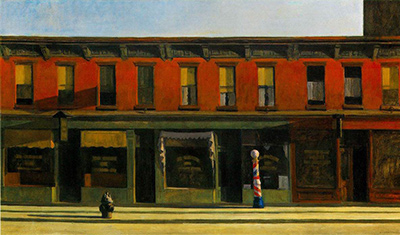
A row of low buildings stretches across the canvas. Sunlight warms the red upper walls, while the shops below remain darker and greener. A fire hydrant and striped barber pole stand on the empty pavement, each casting a long shadow. Edward Hopper's Early Sunday Morning turns a New York street into an extended sequence of windows, doors, colour and light.
The Whitney Museum of American Art dates the oil on canvas to 1930 and records 89.4 × 153 cm, accession 31.426, purchased with funds from Gertrude Vanderbilt Whitney. [1] Its broad format allows the eye to travel along the building line rather than rise towards the towers more commonly associated with the modern city.
At a Glance
- ArtistEdward Hopper [1]
- Date1930 [1]
- MediumOil on canvas [1]
- Collection / recordWhitney Museum of American Art [1]
- Accession31.426 [1]
This work across Edward Hopper’s career
American Village
1912Soir Bleu
1914Automat
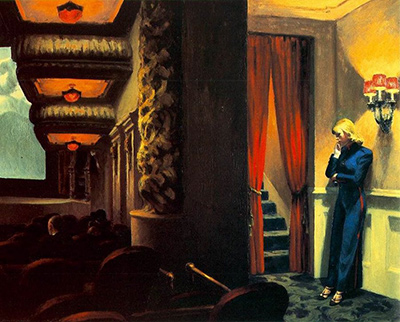
1927New York Movie
1939Nighthawks
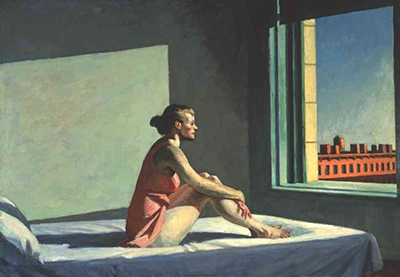
1942Morning Sun
1952Two Comedians
1966Contents
- A city extending sideways
- Looking from across the road
- The windows are not identical
- Shops with less legible names
- Reading marks that will not become words
- Two objects on the pavement
- Light that reorganizes a street
- Masonry, glass and painted wood
- A facade changed during preparation
- A larger city at the edge
A city extending sideways
The buildings occupy most of the picture's width. A narrow strip of sky appears above them, and the pavement, curb and street make similarly long bands below. The architecture is held between these horizontal limits.
The upper wall has a strong, relatively continuous red colour. Windows interrupt it at regular intervals, while the dark roof edge gives the row a firm upper boundary. The repeated openings make the wall readable as a succession of occupied spaces rather than a single uninterrupted block.
The shop level is less regular. Doorways, display windows, awnings and painted surrounds establish different widths and depths. The quieter upper rhythm therefore sits above a more complicated public frontage.
There is no long street perspective drawing us towards a vanishing point at the centre. We look across towards the buildings, moving visually from one bay to the next. The street's extent is registered through repetition and cropping rather than through a dramatic avenue receding into the distance.
The format has a human scale despite the absence of people. Each doorway and shop window suggests a familiar size, while the whole row remains low enough for its parts to be inspected together. Hopper lets ordinary architecture provide the measure of the city.
Looking from across the road
The position from which we look is unusually steady. There is no nearby passer-by to obscure a shop and no vehicle between us and the pavement. Nor is there a foreground window frame identifying the place from which the street is observed. The spectator receives a clear frontage without being given a particular character's view of it.
That clarity should not be confused with a flat architectural elevation. Recesses darken the entrances, the rolled awnings project, and the curb has a visible upper surface. These small indications are enough to give the building substance. Hopper keeps its depth subordinate to its width, so that the eye continues along the row instead of entering one especially inviting opening.
The canvas also withholds the street's ends. We cannot turn a visible corner or locate the nearest junction. Buildings leave the frame at both sides, and the lower horizontal bands continue beyond our view. The painted row therefore feels selected from a longer, functioning street rather than set apart as an isolated monument.
This combination makes the spectator's looking unusually consequential. A walk along a real frontage would produce changing angles, reflections and obstructions. Here the angle remains stable while attention moves. The experience of passing successive premises has been condensed into a surface we can inspect without moving our feet.
The broad format supports that inspection without becoming a panorama of the whole city. At roughly one and seven-tenths times as wide as it is high, the canvas gives the row room to develop, but its upper and lower limits stay close to the building. The restriction directs attention to the scale at which shops and apartments meet the pavement.
The windows are not identical
The upstairs windows initially appear almost uniform. Their similar proportions and repeated spacing give the facade a clear rhythm. Closer attention reveals differences in the coverings and the darkness behind the glass.
Some pale shades descend further than others. Certain openings have lighter curtains, while others read as deeper dark rectangles. These small changes prevent the upper floor from becoming a purely mechanical pattern.
They also suggest use without presenting an occupant. A lowered shade implies an interior boundary; a different curtain hints at a separately arranged room. The differences belong to the visible fittings of domestic life, leaving the people themselves outside the painted scene.
The sunlight helps make those variations legible. Pale coverings remain distinct against red masonry and darker openings. A window can be understood through a small arrangement of light and dark, without a detailed view of furniture beyond it.
The upper floor consequently carries an unusual amount of implied human presence. We can distinguish separate interiors through their outward signs, but none becomes the setting for a fully visible story.
Shops with less legible names
The lower frontage addresses the street more directly. Large display areas, doorways and projecting awnings provide the architectural vocabulary of shops. Yet the lettering does not offer the same clear information as the words in Drug Store.
The broad green areas unify several of these premises. They differ from the warmer red shop at the right, giving the ground floor its own changes of colour across the row. Individual businesses can be distinguished through their framing even where their names remain uncertain.
Rolled awnings create dark horizontal accents above the windows. Their cylindrical forms and small projections add another scale of structure beneath the broader upper wall. They are practical fittings that also interrupt the facade's flatter planes.
Recessed doorways contrast with the shallower display areas, giving the frontage several degrees of depth.
The shops remain quiet, but quietness does not establish their economic condition. The title invites an early Sunday setting; the image supplies no transaction, closure notice or named occupant from which to infer a particular business history.
Reading marks that will not become words
The uncertain lettering gives the shop windows a special status. A shop sign usually addresses someone outside, offering a name, a service or an invitation to enter. Hopper retains the appearance of that address while reducing the information it conveys. We recognize an environment of businesses without becoming customers of a named establishment.
The marks still matter as paint. Small light strokes interrupt dark glass, while the larger areas of green join the lower bays. Attempting to read them brings the eye close to the surface, where a supposed word breaks into separate touches. Looking then returns to the larger window and the frontage around it.
The barber pole works differently. Its trade can be recognized through a striped object rather than an inscription. That legibility makes the pole a useful point of orientation among the less informative windows. A single business type becomes apparent without giving the entire street an inventory of names.
Upstairs, the coverings communicate through another visual language. A shade's height or a curtain's edge records an adjustment made within a room. Those signs are quieter than commercial lettering and seem directed primarily towards the occupants' needs. The facade joins two forms of communication: premises designed to attract outside attention, and living spaces whose outward appearance follows private arrangements.
Neither level becomes transparent. The shops are difficult to identify, while the apartments cannot be inspected beyond their coverings. The building presents itself with exceptional clarity as a physical structure, yet access to the lives and transactions it supports remains partial. This is one reason that prolonged looking continues to find distinctions without arriving at a completed story.
Two objects on the pavement
The fire hydrant stands towards the left, low against the shopfronts. Its compact dark form and small projecting details give it a weight distinct from the long bands around it. It is a familiar piece of street equipment, yet its isolation makes it conspicuous.
The barber pole is taller and brighter. Its spiralling red, white and blue bands create a small concentration of colour near the centre-right. The pole interrupts the frontage's muted greens and reds with a different kind of repeated pattern.
The two objects establish scale. Their practical sizes help us judge the height of the shops and the distance across the pavement. With no pedestrian to provide that measure, these modest fixtures take on a larger compositional role.
Their positions are also unequal. The hydrant sits lower and further left, while the pole rises against a different portion of the frontage. Hopper avoids a matched pair, allowing the eye to move between objects with different shapes and weights.
A narrow strip of pavement separates them from the buildings. Their shadows extend across that space, connecting isolated uprights with the larger arrangement of ground and facade.
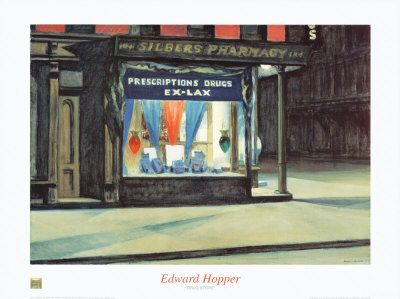
Compare: Drug Store, 1927.
Light that reorganizes a street
The sunlight comes from the right side of the picture. It makes the upper brickwork bright and sends long shadows leftwards from the pavement objects. The low angle allows each small upright to project a surprisingly extensive shape.
Those shadows give the foreground a direction of its own. The building extends across the canvas, while dark diagonals pass through the lighter ground. A relatively shallow strip becomes an active part of the composition.
Light makes the building's two uses visibly different: deeper entrances and larger dark panes below, more continuous illuminated masonry above.
The Whitney points out that the shadow arrangement would not occur in this way along north–south Seventh Avenue, despite Hopper's description of the work as close to a literal translation of that street. [1] The observation is a useful limit on treating the canvas as a precisely mapped view.
The light belongs to the painting's organization. It clarifies the low facade, gives the small street fixtures long extensions and makes the unoccupied foreground worth examining. Recognizable architecture and adjusted illumination work together.
Masonry, glass and painted wood
The red upper storey and green shopfronts can first appear to be two large colour blocks. Their handling becomes more varied when we compare the edges. Window surrounds, sill lines and the horizontal division above the shops establish small changes in relief, while the broad wall holds them together.
Hopper does not give every brick a separate outline. The upper frontage retains the impression of masonry through its colour, texture and relation to the openings. This economy prevents a repeated brick pattern from competing with the larger sequence of windows. The wall can read simultaneously as a built surface and a substantial field of red paint.
The glass is even less demonstrative. Reflections do not spread a second, bustling street across the shopfronts. Darker panes and pale marks give the windows enough presence to be understood without filling them with a detailed reflected world. Their restraint helps keep the pavement objects separate and visible.
Small projections become important in this reduced setting. An awning roll carries a highlight and a dark underside; a sill changes the relation between opening and wall. Such passages give a shallow building front enough tactile variety to resist becoming a diagram. Their effect depends on how selectively they appear.
The same light thus does several kinds of work. It describes the frontage's materials, establishes the time suggested by the title and strengthens a broad red-and-green arrangement. None of these functions has to cancel the others. The painting's recognizable street is made persuasive through decisions about colour and emphasis, as well as through the objects it includes.
Watch: Edward Hopper’s Life and Art
Explore Hopper’s paintings and the places behind them in these museum films. Choose a film below.
A facade changed during preparation
Curator Carter Foster describes identifying a source building through old photographs. In his Whitney interpretation, Hopper added an upper window bay and another shop opening below, extending the row while compressing the widths of its lower divisions. [1]
Those alterations explain how a familiar street could become such a concentrated arrangement. A painter can retain enough of a building's character to make it recognizable while changing the relationships that govern its appearance on canvas.
The upper and lower storeys do not simply duplicate one another. Their different rhythms make the eye adjust as it moves between them. Repeated upstairs windows offer continuity, while the shops present more varied divisions beneath.
The barber pole becomes especially effective within that structure. Its bright, compact form can interrupt a long architectural sequence without introducing a figure. Its presence is both practical and pictorial: it identifies a trade while making the frontage less uniform.
A larger city at the edge
At the upper right, a dark block rises beyond the low row. It is easy to overlook because much of it is cropped, but its height differs markedly from the buildings receiving our main attention.
The interruption changes the setting. Without it, the facade might seem to belong to a self-contained low street. The dark mass suggests a city continuing beyond that scale, with larger structures close by.
In the Whitney's commentary, preservationist Andrew Berman reads this detail in relation to the pressure of a changing, increasingly vertical New York. [1] His interpretation gives the edge of the canvas a historical significance without making the painting a prediction of a particular demolition.
Kim Conaty likewise places the picture within Hopper's interest in the city's lateral extent. In her interview with David Ebony, she contrasts this attention to a more familiar emphasis on tall new buildings. [2] The wide facade is a deliberate way of imagining New York, with ordinary premises rather than a skyline carrying the principal visual weight.
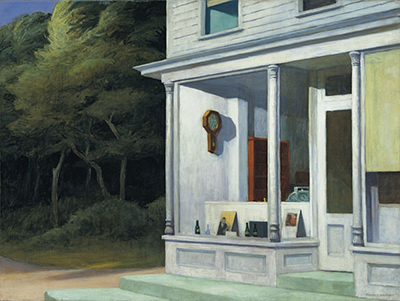
Compare: Seven A.M., 1948.
Seventh Avenue and the memory of a smaller town
The Edward Hopper House Museum's Nyack walking tour proposes a comparison with the low commercial buildings on South Broadway. Its account connects those shopfronts and apartments with the streets Hopper knew while growing up, while retaining his own identification of Seventh Avenue as the painting's starting point. The Nyack comparison is suggestive context, rather than documentation that the canvas depicts a Broadway address. [3]
That distinction lets two scales of experience coexist. The scene can come from New York and still recall a form of building familiar beyond Manhattan: a business below, a residence above, a modest roofline and a pavement occupied by practical fixtures. Recognition need not depend on knowing the precise site.
The dark taller mass at the right prevents the smaller scale from becoming the whole account. Its presence makes the low row part of a larger built environment. The painting can sustain a sense of familiarity while allowing something more imposing to enter at its edge.
It is therefore worth resisting a simple choice between a specific city and a generalized American town. Hopper's decisions make the frontage particular enough to study, while removing much of the information that would fix a viewer's experience to one intersection. The subject's reach grows from that balance.
A painting acquired early
The Art Institute of Chicago's chronology records the Whitney's purchase in May 1930. [4] The acquisition belongs to the year in which Hopper painted the work, even though its museum accession number begins with 31.
The purchase made the street part of a public collection early in its history. The current credit preserves Gertrude Vanderbilt Whitney's funding, connecting one of Hopper's best-known urban scenes with the institution that would later hold so much of his work. [1]
A comic strip before its action
Cartoonist Art Spiegelman offers an illuminating later response in the Whitney's recorded interpretation. He relates Hopper's subdivided rectangles to the boxes of comics and imagines this street as a strip awaiting its inhabitants and activity. He also treats the hydrant and barber pole as unexpectedly lively presences. These are a practising cartoonist's associations with the painting, rather than evidence that Hopper designed it as a comic. [1]
The comparison draws attention to a real difference between repetition and sequence. The upstairs windows are next to one another in space, but they do not show successive moments in one person's day. A spectator who moves from left to right is comparing neighbouring interiors rather than following a completed action from panel to panel.
The ground floor further interrupts any perfectly regular reading. Its divisions do not match the upstairs openings one for one. The eye has to shift pace between the levels, sometimes grouping several windows above one broader frontage. The building supplies a rhythm, but it does not prescribe a single route through its parts.
The suggestion of a stage offers another comparison. The clear pavement and frontal building could seem prepared for someone to enter. Yet the setting is not waiting to become meaningful only when a person arrives. Light has already established an event across its surfaces, and the small uprights already alter the distribution of colour and shadow.
These comparisons help explain why the scene can seem suspended without becoming inert. A street, a stage and a comic strip each imply different possibilities for what might happen next. Hopper gives us enough structure to imagine those possibilities while keeping attention on a present arrangement that is complete in paint.
The title contributes an expectation of time passing. Morning implies a day ahead, and Sunday can suggest a change in the weekly pattern of work. Neither requires the viewer to invent a specific opening hour or a scheduled arrival. The extended interval is available to be felt through the street's quiet appearance itself.
Street, stage and inhabited space
The empty pavement gives the scene a degree of openness. There is room for a person to enter, but no arrival becomes the picture's event. The fixtures and facade retain attention while that possibility remains unused.
This is a different experience from Night Windows, where a partly concealed woman and a moving curtain are glimpsed through a dark exterior. Early Sunday Morning lets the spectator look across a whole frontage, finding signs of habitation in coverings and fittings rather than a visible body.
In Seven A.M., one pale shopfront stands beside dense trees. The clock and sparse display become individual problems of interpretation. Here, the longer row creates a collective rhythm, and no single window explains the whole street.
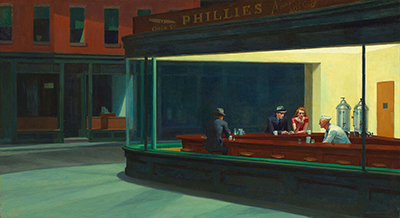
Nighthawks gives an illuminated interior a stronger human focus at night, with a diner occupying a corner opposite darker buildings. The wide facade in Early Sunday Morning supplies another way to understand Hopper's interest in the passage from one part of a city to another, and from one condition of light to the next.
Look again at the barber pole's narrow shadow, then move upwards to the varied curtains. The pavement is empty, but the painting is full of small distinctions. Hopper gives a quiet row of buildings enough variation to sustain the eye across its entire width.
Artworks and studies directory
This researched directory includes finished works and separately identified studies. It is not a complete catalogue raisonné. Linked titles open the articles; unlinked studies are identified by their collection accessions. Watercolours retain their recorded media, and original prints remain distinct from reproductions.
| Name | Date | Medium |
|---|---|---|
| (Bridge and Embankment) (70.1298) | 1906 | Oil on wood |
| (Jo Sketching at Good Harbor Beach) (70.1129) | 1923–1924 | Watercolor and fabricated chalk on paper |
| (Manhattan Bridge) (70.1098) | 1925–1926 | Watercolor and graphite pencil on paper |
| (Rooftops) (70.1114) | 1926 | Watercolor and graphite pencil on paper |
| (Seated Male Model, Bent Over) (70.1277) | c. 1902–1903 | Oil on canvas |
| (Self-Portrait) (70.1254) | 1903–1906 | Oil on canvas |
| (Solitary Figure in a Theater) (70.1418) | c. 1902–1904 | Oil on board |
| 5 A.M. | 1937 | oil on canvas |
| Adam's House | 1928 | watercolour and charcoal on paper |
| American Village | 1912 | Oil on canvas |
| Apartment Houses | 1923 | oil on canvas |
| Approaching a City | 1946 | oil on canvas |
| August in the City | 1945 | oil on canvas |
| Automat | 1927 | oil on canvas |
| Barber Shop | 1931 | oil on canvas |
| Blackwell's Island | 1928 | oil on canvas |
| Bridge on the Seine | 1909 | Oil on canvas |
| Bridle Path | 1939 | oil on canvas |
| Burly Cobb's House South Truro | 1930–1933 | oil on canvas |
| Cape Cod Evening | 1939 | oil on canvas |
| Cape Cod Morning | 1950 | oil on canvas |
| Chair Car | 1965 | oil on canvas |
| Chop Suey | 1929 | oil on canvas |
| City Roofs | 1932 | Oil on canvas |
| Coast Guard Station | 1929 | oil on canvas |
| Compartment C, Car 293 | 1938 | oil on canvas |
| Conference at Night | 1949 | oil on canvas |
| Corn Hill | 1930 | oil on canvas |
| Dawn in Pennsylvania | 1942 | oil on canvas |
| Drug Store | 1927 | oil on canvas |
| Early Sunday Morning | 1930 | Oil on canvas |
| East Side Interior (70.1020) | 1922 | Etching |
| East Wind Over Weehawken | 1934 | oil on canvas |
| El Palacio | 1946 | Watercolor and graphite pencil on paper |
| Eleven A.M. | 1926 | oil on canvas |
| Evening Wind | 1921 | etching |
| Excursion into Philosophy | 1959 | oil on canvas |
| First Row Orchestra | 1951 | oil on canvas |
| Freight Car at Truro | 1931 | watercolour over graphite on paper |
| Gas | 1940 | oil on canvas |
| Girl at a Sewing Machine | c. 1921 | oil on canvas |
| Gloucester Harbor | 1912 | Oil on canvas |
| Ground Swell | 1939 | oil on canvas |
| Haskell's House | 1924 | watercolour over graphite on paperboard |
| High Noon | 1949 | oil on canvas |
| Hill and Houses Cape Elizabeth Maine | 1927 | watercolour over graphite pencil |
| Hills South Truro | 1930 | oil on canvas |
| Hotel by a Railroad | 1952 | oil on canvas |
| Hotel Lobby | 1943 | oil on canvas |
| Hotel Room | 1931 | oil on canvas |
| Hotel Window | 1955 | oil on canvas |
| House by the Railroad | 1925 | oil on canvas |
| House by the Squam River | 1926 | watercolour over graphite on paper |
| Le Bistro or The Wine Shop | 1909 | Oil on canvas |
| Le Pont des Arts | 1907 | Oil on canvas |
| Le Pont Royal | 1909 | Oil on canvas |
| Le Quai des Grands Augustins | 1909 | Oil on canvas |
| Lighthouse and Buildings Portland Head | 1927 | watercolour over graphite pencil on paper |
| Lighthouse Hill | 1927 | oil painting |
| Manhattan Bridge Loop | 1928 | oil on canvas |
| Model Sitting | c. 1902 | oil painting; support not asserted |
| Morning Sun | 1952 | oil on canvas |
| New York Movie | 1939 | oil on canvas |
| New York New Haven and Hartford | 1931 | oil on canvas |
| New York Office | 1962 | oil on canvas |
| New York Pavements | 1924–1925 | oil on canvas |
| New York Restaurant | c. 1922 | oil on canvas |
| Night Windows | 1928 | oil on canvas |
| Nighthawks | 1942 | oil on canvas |
| October on Cape Cod | 1946 | oil on canvas |
| Office at Night | 1940 | oil on canvas |
| Office in a Small City | 1953 | oil on canvas |
| Pennsylvania Coal Town | 1947 | oil on canvas |
| People in the Sun | 1960 | oil on canvas |
| Portrait of Orleans | 1950 | oil on canvas |
| Queensborough Bridge | 1913 | Oil on canvas |
| Railroad Sunset | 1929 | Oil on canvas |
| Railroad Train | 1908 | oil on canvas |
| Road in Maine | 1914 | oil on canvas |
| Room in Brooklyn | 1932 | oil on canvas |
| Room in New York | 1932 | oil on canvas |
| Rooms by the Sea | 1951 | oil on canvas |
| Rooms for Tourists | 1945 | oil on canvas |
| Route 6 Eastham | 1941 | oil on canvas |
| Second Story Sunlight | 1960 | Oil on canvas |
| Self-Portrait | 1925–1930 | Oil on canvas |
| Self-Portrait with Hat (70.1903) | c. 1918, posthumous print | Drypoint |
| Seven A.M. | 1948 | Oil on canvas |
| Soir Bleu | 1914 | oil on canvas |
| South Carolina Morning | 1955 | Oil on canvas |
| Stairway at 48 Rue de Lille Paris | 1906 | Oil on wood |
| Study for 5 A.M. (70.153) | 1937 | Fabricated chalk on paper |
| Study for 5 A.M. (70.429) | 1937 | Fabricated chalk and graphite pencil on paper |
| Study for Approaching a City (70.869) | 1946 | Fabricated chalk and charcoal on paper |
| Study for August in the City (70.158a-b) | 1945 | Fabricated chalk on paper |
| Study for August in the City (70.159) | 1945 | Fabricated chalk on paper |
| Study for Bridle Path (70.220) | 1939 | Fabricated chalk on paper |
| Study for Bridle Path (70.235) | 1939 | Fabricated chalk on paper |
| Study for Compartment C, Car 293 (70.430) | 1938 | Fabricated chalk on paper |
| Study for Compartment C, Car 293 (70.431a-b) | 1938 | Fabricated chalk and charcoal on paper |
| Study for Conference at Night (70.170) | 1949 | Fabricated chalk on paper (recto); Typewriter ink on paper (verso) |
| Study for Conference at Night (70.174) | 1949 | Fabricated chalk on paper ( recto); Typewriter ink on paper (verso) |
| Study for East Wind over Weehawken (70.249) | 1934 | Graphite pencil on paper |
| Study for East Wind over Weehawken (70.252) | 1934 | Fabricated chalk and charcoal on paper |
| Study for Evening Wind (70.343a-b) | 1921 | Fabricated chalk on paper |
| Study for First Row Orchestra (70.841) | 1951 | Fabricated chalk and charcoal on paper |
| Study for Gas (70.263) | 1940 | Fabricated chalk on paper |
| Study for Ground Swell (70.339) | 1939 | Fabricated chalk, charcoal and graphite pencil on paper |
| Study for Hotel by a Railroad (70.199) | 1952 | Fabricated chalk on paper |
| Study for Hotel by a Railroad (70.427) | 1952 | Fabricated chalk on paper |
| Study for Hotel by a Railroad (70.428) | 1952 | Fabricated chalk on paper |
| Study for Hotel Lobby (70.117) | 1942 | Fabricated chalk and graphite pencil on paper |
| Study for Hotel Lobby (70.839) | 1942 | Fabricated chalk and charcoal on paper |
| Study for Hotel Window (70.161) | 1955 | Fabricated chalk, graphite pencil and colored pencil on paper |
| Study for Morning Sun (70.243) | 1952 | Fabricated chalk on paper |
| Study for Morning Sun (70.244) | 1952 | Fabricated chalk on paper |
| Study for Morning Sun (70.290) | 1952 | Fabricated chalk on paper |
| Study for Morning Sun (70.291) | 1952 | Fabricated chalk and graphite pencil on paper |
| Study for New York Movie (70.273) | 1939 | Fabricated chalk on paper |
| Study for New York Movie (70.274a-b) | 1938 or 1939 | Fabricated chalk and charcoal on paper (recto); Fabricated chalk on paper (verso) |
| Study for New York Movie (70.455) | 1939 | Fabricated chalk and charcoal on paper |
| Study for New York Office (70.822) | 1962 | Fabricated chalk on paper |
| Study for Nighthawks (70.192) | 1941 or 1942 | Fabricated chalk on paper |
| Study for Nighthawks (70.193) | 1941 or 1942 | Fabricated chalk on paper |
| Study for Office at Night (70.340) | 1940 | Fabricated chalk and charcoal on paper |
| Study for Office at Night (70.341) | 1940 | Fabricated chalk and graphite pencil on paper |
| Study for Pennsylvania Coal Town (70.198) | 1947 | Fabricated chalk on paper |
| Study for Pennsylvania Coal Town (70.229) | 1947 | Fabricated chalk and charcoal on paper |
| Study for Rooms for Tourists (70.438) | 1945 | Fabricated chalk and charcoal on paper |
| Study for Rooms for Tourists (70.848) | 1945 | Fabricated chalk and charcoal on paper |
| Study for Route 6, Eastham (70.369) | 1941 | Fabricated chalk and graphite pencil on paper |
| Study for Route 6, Eastham (70.854) | 1941 | Fabricated chalk and graphite pencil on paper |
| Study for South Carolina Morning (70.162a-b) | 1955 | Fabricated chalk on paper (recto and verso) |
| Study for The Sheridan Theatre (70.969) | 1937 | Graphite pencil on paper |
| Study for Two on the Aisle (70.128) | 1927 | Fabricated chalk on paper |
| Study for Two on the Aisle (70.129) | 1927 | Fabricated chalk on paper |
| Study for Yawl Riding a Swell (70.439) | 1935 | Fabricated chalk and graphite pencil on paper |
| Summer Evening | 1947 | oil on canvas |
| Summer Interior | 1909 | Oil on canvas |
| Sun in an Empty Room | 1963 | oil on canvas |
| Sunlight in a Cafeteria | 1958 | oil on canvas |
| Sunlight on Brownstones | 1956 | oil on canvas |
| Tables for Ladies | 1930 | oil on canvas |
| The Bootleggers | 1925 | oil on canvas |
| The Camel's Hump | 1931 | oil on canvas |
| The Circle Theatre | 1936 | oil on canvas |
| The City | 1927 | oil on canvas |
| The Lighthouse at Two Lights | 1929 | oil on canvas |
| The Long Leg | 1935 | oil on canvas |
| The Mansard Roof | 1923 | watercolour over graphite on paper |
| The Sheridan Theatre | 1937 | oil on canvas |
| Tramp Steamer | 1908 | oil on canvas |
| Two Comedians | 1966 | oil on canvas |
| Two on the Aisle | 1927 | oil on canvas |
| Valley of the Seine | 1909 | Oil on canvas |
| Western Motel | 1957 | oil on canvas |
Frequently Asked Questions
Edward Hopper made Early Sunday Morning in 1930. [1]
The recorded medium is Oil on canvas. [1]
A row of low buildings stretches across the canvas. Sunlight warms the red upper walls, while the shops below remain darker and greener. A fire hydrant and striped barber pole stand on the empty pavement, each casting a long shadow. Edward Hopper's Early Sunday Morning turns a New York street into an extended sequence of windows, doors, colour and light.
Discussion
Look again at the images and ideas explored in Early Sunday Morning. These editorial prompts invite your observations.
Reader Insights
Which boundary, gesture or change of light first holds your attention in Early Sunday Morning?
Compare Drug Store with Early Sunday Morning. Which visual difference matters most to your reading?
Which detail would you look at again after reading “Shops with less legible names”?
Join the Conversation
Share a detail, comparison or question about Early Sunday Morning below.
References
- Whitney Museum of American Art, Early Sunday Morning, 1930, oil on canvas, accession 31.426; current dimensions and credit, museum essay on the Seventh Avenue comparison and shadows, and English interpretation transcripts by Carter Foster and Andrew Berman. The quoted artist recollection is transmitted by the museum. View source.
- David Ebony, “Edward Hopper's Public and Private New York”, interview with Kim Conaty, Yale University Press, 17 November 2022; lateral extent, canvas format and human scale. View source.
- Edward Hopper House Museum & Study Center, “Early Sunday Morning,” Walking Tour of Hopper's Nyack, selected South Broadway entry; the museum's proposed comparison with Nyack commercial streets, distinguished here from the documented Seventh Avenue starting point. View source.
- Art Institute of Chicago, Edward Hopper: Selected Chronology, May 1930 entry recording the Whitney purchase. View source.
- Collection or catalogue record, American Village, 1912; medium and identity as discussed in the linked article. View source.
- Collection or catalogue record, Soir Bleu, 1914; medium and identity as discussed in the linked article. View source.
- Collection or catalogue record, House by the Railroad, 1925; medium and identity as discussed in the linked article. View source.
- Collection or catalogue record, Automat, 1927; medium and identity as discussed in the linked article. View source.
- Collection or catalogue record, Early Sunday Morning, 1930; medium and identity as discussed in the linked article. View source.
- Collection or catalogue record, New York Movie, 1939; medium and identity as discussed in the linked article. View source.
- Collection or catalogue record, Nighthawks, 1942; medium and identity as discussed in the linked article. View source.
- Collection or catalogue record, Morning Sun, 1952; medium and identity as discussed in the linked article. View source.
- Collection or catalogue record, Second Story Sunlight, 1960; medium and identity as discussed in the linked article. View source.
- Collection or catalogue record, Two Comedians, 1966; medium and identity as discussed in the linked article. View source.
- Whitney Museum of American Art, Study for Route 6, Eastham, 1941, accession 70.854; exact object record. View source.
- Whitney Museum of American Art, Study for Conference at Night, 1949, accession 70.170; exact object record. View source.
- Whitney Museum of American Art, Study for First Row Orchestra, 1951, accession 70.841; exact object record. View source.
- Whitney Museum of American Art, (Bridge and Embankment), 1906, accession 70.1298; exact object record. View source.
- Whitney Museum of American Art, (Seated Male Model, Bent Over), c. 1902–1903, accession 70.1277; exact object record. View source.
- Whitney Museum of American Art, Study for Morning Sun, 1952, accession 70.244; exact object record. View source.
- Whitney Museum of American Art, Study for Morning Sun, 1952, accession 70.243; exact object record. View source.
- Whitney Museum of American Art, Study for Two on the Aisle, 1927, accession 70.128; exact object record. View source.
- Whitney Museum of American Art, Study for New York Office, 1962, accession 70.822; exact object record. View source.
- Whitney Museum of American Art, Study for Two on the Aisle, 1927, accession 70.129; exact object record. View source.
- Whitney Museum of American Art, Study for Pennsylvania Coal Town, 1947, accession 70.229; exact object record. View source.
- Whitney Museum of American Art, (Rooftops), 1926, accession 70.1114; exact object record. View source.
- Whitney Museum of American Art, Study for South Carolina Morning, 1955, accession 70.162a-b; exact object record. View source.
- Whitney Museum of American Art, (Self-Portrait), 1903–1906, accession 70.1254; exact object record. View source.
- Whitney Museum of American Art, (Manhattan Bridge), 1925–1926, accession 70.1098; exact object record. View source.
- Whitney Museum of American Art, (Solitary Figure in a Theater), c. 1902–1904, accession 70.1418; exact object record. View source.
- Whitney Museum of American Art, Study for Approaching a City, 1946, accession 70.869; exact object record. View source.
- Whitney Museum of American Art, Study for August in the City, 1945, accession 70.159; exact object record. View source.
- Whitney Museum of American Art, Study for Compartment C, Car 293, 1938, accession 70.430; exact object record. View source.
- Whitney Museum of American Art, Study for Compartment C, Car 293, 1938, accession 70.431a-b; exact object record. View source.
- Whitney Museum of American Art, Study for East Wind over Weehawken, 1934, accession 70.252; exact object record. View source.
- Whitney Museum of American Art, Study for East Wind over Weehawken, 1934, accession 70.249; exact object record. View source.
- Whitney Museum of American Art, Study for Evening Wind, 1921, accession 70.343a-b; exact object record. View source.
- Whitney Museum of American Art, Study for The Sheridan Theatre, 1937, accession 70.969; exact object record. View source.
- Whitney Museum of American Art, Study for New York Movie, 1939, accession 70.455; exact object record. View source.
- Whitney Museum of American Art, Study for New York Movie, 1939, accession 70.273; exact object record. View source.
- Whitney Museum of American Art, Study for New York Movie, 1938 or 1939, accession 70.274a-b; exact object record. View source.
- Whitney Museum of American Art, Study for 5 A.M., 1937, accession 70.153; exact object record. View source.
- Whitney Museum of American Art, Study for 5 A.M., 1937, accession 70.429; exact object record. View source.
- Whitney Museum of American Art, (Jo Sketching at Good Harbor Beach), 1923–1924, accession 70.1129; exact object record. View source.
- Whitney Museum of American Art, Study for August in the City, 1945, accession 70.158a-b; exact object record. View source.
- Whitney Museum of American Art, Study for Morning Sun, 1952, accession 70.291; exact object record. View source.
- Whitney Museum of American Art, Study for Morning Sun, 1952, accession 70.290; exact object record. View source.
- Whitney Museum of American Art, Study for Office at Night, 1940, accession 70.340; exact object record. View source.
- Whitney Museum of American Art, Study for Office at Night, 1940, accession 70.341; exact object record. View source.
- Whitney Museum of American Art, Study for Hotel by a Railroad, 1952, accession 70.427; exact object record. View source.
- Whitney Museum of American Art, Study for Hotel by a Railroad, 1952, accession 70.199; exact object record. View source.
- Whitney Museum of American Art, Study for Hotel by a Railroad, 1952, accession 70.428; exact object record. View source.
- Whitney Museum of American Art, Study for Hotel Lobby, 1942, accession 70.117; exact object record. View source.
- Whitney Museum of American Art, Study for Hotel Lobby, 1942, accession 70.839; exact object record. View source.
- Whitney Museum of American Art, Study for Conference at Night, 1949, accession 70.174; exact object record. View source.
- Whitney Museum of American Art, Study for Hotel Window, 1955, accession 70.161; exact object record. View source.
- Whitney Museum of American Art, Study for Pennsylvania Coal Town, 1947, accession 70.198; exact object record. View source.
- Whitney Museum of American Art, Study for Route 6, Eastham, 1941, accession 70.369; exact object record. View source.
- Whitney Museum of American Art, Study for Bridle Path, 1939, accession 70.220; exact object record. View source.
- Whitney Museum of American Art, Study for Bridle Path, 1939, accession 70.235; exact object record. View source.
- Whitney Museum of American Art, Study for Ground Swell, 1939, accession 70.339; exact object record. View source.
- Whitney Museum of American Art, Study for Yawl Riding a Swell, 1935, accession 70.439; exact object record. View source.
- Whitney Museum of American Art, Study for Rooms for Tourists, 1945, accession 70.848; exact object record. View source.
- Whitney Museum of American Art, Study for Rooms for Tourists, 1945, accession 70.438; exact object record. View source.
- Whitney Museum of American Art, Study for Nighthawks, 1941 or 1942, accession 70.193; exact object record. View source.
- Whitney Museum of American Art, Study for Nighthawks, 1941 or 1942, accession 70.192; exact object record. View source.
- Whitney Museum of American Art, Study for Gas, 1940, accession 70.263; exact object record. View source.
- Whitney Museum of American Art, Self-Portrait with Hat, c. 1918, posthumous print, accession 70.1903; exact object record. View source.
- Whitney Museum of American Art, East Side Interior, 1922, accession 70.1020; exact object record. View source.
- Art Institute of Chicago, Selected Chronology for Edward Hopper; training, travels, exhibitions, New York and Truro chronology. View source.
- Emily C. Burns, Spectral figures: Edward Hopper’s empty Paris, chapter 5 in Empty Spaces: Confronting Emptiness in National, Cultural and Urban Histories, 2019; complete chapter and notes consulted. View source.
- Charles Brock, Regionalism and Folk Art, National Gallery of Art; complete essay and two notes consulted. View source.