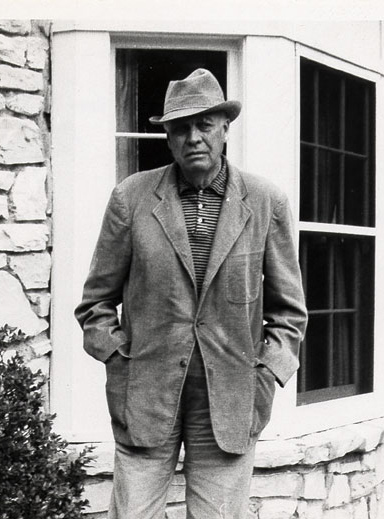
 by Tom Gurney
Tom Gurney BSc (Hons) is an art history expert with over 20 years experience
Email: tomgurney1@gmail.com / Phone: +44 7429 011000
Edward Hopper Quotes and Statements: Introduction
Edward Hopper's words are most revealing when their circumstances remain attached. A statement for an exhibition catalogue has a different purpose from a reply in conversation. A letter about one painting may address a technical question that disappears when a single sentence is lifted from it.
The passages below connect his words with particular dates, pictures and questions. They show an artist concerned with personal experience, the difficulty of painting and the relationship between a recognisable world and an individual imagination. They also reveal a civic voice less familiar than the reserved figure often associated with his work.
These statements can sharpen looking without settling every interpretation. A painting may make visible relations that its maker did not discuss. A phrase can identify an aim while leaving the viewer to consider how the actual picture succeeds, changes or complicates it.
At a Glance
Contents
- Personal impressions in the 1933 statement
- Inner life and a public argument about art
- If a painting could be said in words
- Geometry described as partly unintentional
- An interviewer's question helps shape an answer
- Pleasure did not remove the work
- Twenty-six years, corrected by Jo
- Office at Night and the absence of an obvious anecdote
- A composite scene in Cape Cod Evening
- A direct voice on Washington Square
Personal impressions in the 1933 statement
Hopper began his Notes on Painting, published in the Museum of Modern Art's 1933 retrospective catalogue, with this sentence. [1]
My aim in painting has always been the most exact transcription possible of my most intimate impressions of nature.
The relationship between exactness and intimacy is crucial. The statement does not make the painter disappear behind a neutral record. It places his impressions at the centre of what he wants to realise.
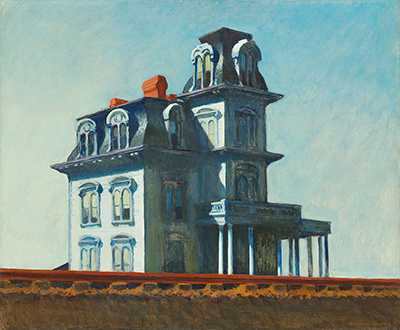
That distinction is useful in House by the Railroad. The building is convincing, but the railway conceals its lower part and changes the viewer's access. The arrangement can be exact in its intended effect without providing a complete architectural survey.
Hopper's longer statement also discusses the difficulty of maintaining an initial vision as painting proceeds. [1] The quoted aim is therefore part of an account of work and limitation. Its ambition should not be mistaken for a claim that every canvas transparently records a scene already complete in front of him.
Inner life and a public argument about art
The next passage opens a statement published in Reality in 1953. Hopper reread it during John Morse's interview on 17 June 1959; that transcript supplies the wording here. [2]
Great art is the outward expression of an inner life in the artist
The clause continues in the original. It belongs to an argument for imagination and against reducing painting to formal invention. Its setting is an artistic debate, rather than an invitation to diagnose the people in his canvases.
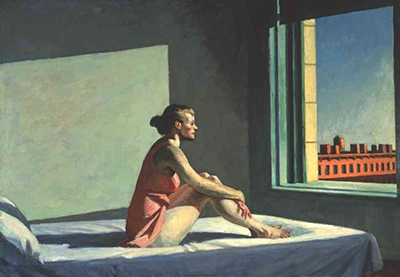
In Morning Sun, a body, a bed and a field of light can suggest a state of attention. We need not assign the woman a particular private history to recognise how those forms organise the encounter. The painter's response and the character's apparent experience are related questions, but they are not identical.
The phrase is also more expansive than a requirement that art confess a personal incident. An inner life can involve memory, imagination, judgement and sustained looking. The painting provides a form in which those activities become available to another person.
If a painting could be said in words
One of Hopper's most frequently repeated remarks appeared in Time magazine’s cover profile of 24 December 1956. The article reports the following sentence. [3]
If you could say it in words, there'd be no reason to paint.
The line is concise, but the article surrounding it is expansive. Its writer builds a portrait of a reserved artist and places him within a national history of realism. Hopper's reported sentence should remain distinct from that editorial argument and from the anecdotes through which the magazine presents his personality.
The remark also does not abolish his own writing. By 1956 he had supplied statements, correspondence and explanations of individual pictures. Read beside those documents, it makes most sense as a distinction between media: a verbal account cannot do everything the painted arrangement does.
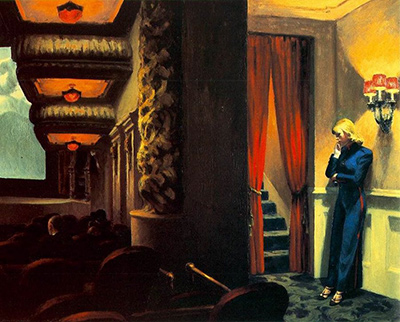
New York Movie offers a practical example. We can name the usher, audience, column and staircase. We can describe their relative positions. The painting also lets the eye experience those relations at once, then move among them at a pace no single sentence fixes.
A verbal interpretation necessarily selects a route. It may begin with the standing worker, the fragment of screen or the division between light and darkness. Another viewer can begin elsewhere without looking at another painting. The quoted remark leaves room for that difference between an image and the order in which words explain it.
Its continuing popularity can obscure its particular history. It is a reported line in a 1956 magazine profile, rather than an inscription Hopper placed beneath every canvas. Keeping that date and publication attached makes the quotation more useful, because we can see what kind of public encounter first carried it.
Geometry described as partly unintentional
Morse asked Hopper about the solid geometric forms in Approaching a City. In his reply, Hopper used this qualification. [2]
more or less unintentionally
The small phrase keeps the answer open. It does not say that the picture was unplanned, or that the buildings' shapes are unimportant. It limits a claim about how consciously those forms were pursued.
Looking at Approaching a City, a viewer can follow the retaining wall, the blocks of architecture and the tunnel's dark opening. Their organisation is a real part of the experience whether or not Hopper began by naming it as a geometric programme.
The distinction prevents an account of style from becoming a recipe. An artist can care about a remembered sensation, work carefully towards a composition and later describe some of its effects as less than fully deliberate. The resulting forms remain available for close analysis.
An interviewer's question helps shape an answer
The 1959 interview is not a continuous lecture by Hopper. Morse’s praise of the geometry in Approaching a City supplies the immediate subject to which Hopper responds. [2]
This is different from finding a private note in which the painter spontaneously announces his governing method. A conversation is made by more than one person. Agreement can be real while remaining narrower than a later quotation suggests.
The distinction does not make the exchange unreliable. It tells us what it records. Morse notices formal organisation; Hopper connects the picture with sensations of entering a city by train. Together they make several aspects of the work discussable without reducing them to one initial formula.
The transcript also preserves hesitation and interruption. Those features can disappear when a polished sentence circulates alone. They are useful reminders that an artist may be testing the extent of an explanation while speaking.
Pleasure did not remove the work
When Morse asked whether painting Cape Cod Morning had been a pleasure, Hopper qualified his answer with these words. [2]
they’re all hard work to me
The line concerns the effort of painting. It does not cancel the preceding admission of pleasure or establish that he disliked every completed canvas.
The woman in Cape Cod Morning leans towards a window, with the architecture holding her apart from the exterior. The image can be grasped quickly, yet the relation between body, frame and light is exacting. A small shift could alter the balance of the whole scene.
This is one reason the phrase is worth retaining beside the picture. Apparent stillness can be the product of repeated difficult judgements. The ease with which a viewer recognises a pose is different from the effort required to find its place on canvas.
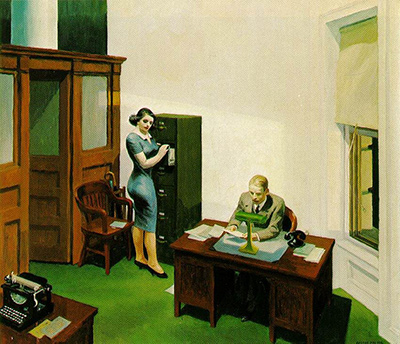
Compare: Office at Night, 1940.
Twenty-six years, corrected by Jo
After Hopper rereads the 1933 statement, Morse initially calculates that it was written thirty-six years earlier. Jo intervenes to correct the interval to twenty-six. The small exchange places three people in the room and makes the relation between the original statement and its later reading unusually clear. [2]
The correction matters for more than arithmetic. Hopper is being asked in 1959 to reconsider words written for a 1933 exhibition. A response about what he would now change belongs to that later occasion. It should not be silently folded back into the original statement.
Jo's intervention also gives a concrete example of her presence in the surviving record. She is neither an anonymous background voice nor automatically the author of Edward's answers. The transcript names her contributions, allowing her particular words to retain their speaker.
This is a useful scale at which to consider the partnership: a date checked, a reply interrupted, a record made more exact. The action is modest, but it changes what an attentive reader knows about the interview.
Office at Night and the absence of an obvious anecdote
In his 25 August 1948 letter to Walker Art Center curator Norman Geske, Hopper discussed the light and furniture in Office at Night. The passage reproduced by the Walker ends with these words. [4]
I hope it will not tell any obvious anecdote, for none is intended.
The context matters. He had been explaining a room's illumination and the challenge of balancing bright areas around the figure. The statement directs the reader back towards the painted arrangement after providing some practical information about its making.
It need not forbid all interpretation. The woman, man, filing cabinet and desk in Office at Night still invite questions about attention and power. What the sentence withholds is a ready-made incident that would convert those relations into a single, obvious plot.
A viewer can respond to tension while distinguishing that response from a documented intention. The letter and the canvas have different explanatory powers: one states what Hopper chose to say, while the other continues to present an encounter whose implications exceed the furniture's practical uses.
A composite scene in Cape Cod Evening
The National Gallery's scholarly account of Cape Cod Evening transmits a statement published in Grace Pagano's 1945 collection catalogue. Hopper describes the scene this way. [5]
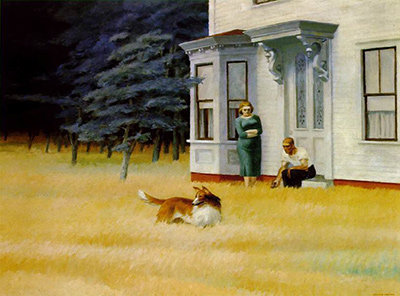
It is no transcription of a place, but pieced together from sketches and mental impressions of things in the vicinity.
The statement provides a useful companion to the 1933 aim. The earlier words concerned an exact rendering of personal impressions; these explain how different observations could be assembled. There is no requirement that a meaningful painting preserve the boundaries of a single view.
The particular parts remain important. A doorway, trees and grass have recognisable qualities, but they meet on the canvas through choices about scale and position. The people and dog create further directions of attention within that constructed setting.
Looking at Cape Cod Evening, the most productive question is how those ingredients have been made to relate. The statement explains the method's breadth without turning every tree or gesture into a fixed symbol.
A direct voice on Washington Square
Hopper wrote to Nathaniel M. Elias of the Washington Square Committee on 17 March 1950. In the complete surviving letter reproduced by the Whitney, he opposed further damaging development around the square and made this demand. [6]
No more tall buildings should be built here.
The word at the end is specific. He was addressing a named place, including the buildings on the north side of Washington Square. The line is not a universal declaration that every tall building is artistically or socially unacceptable.
Its force is nevertheless striking. The speaker is a resident making an argument about the future of a neighbourhood. The letter's directness broadens the range of voices associated with a painter whose pictures often leave human intentions unstated.
Placed beside the city paintings, it invites comparison between advocacy and art. A letter can call for a particular action. A painted street can preserve a complicated response to buildings without giving the viewer an instruction. Both can emerge from sustained attention to a place.
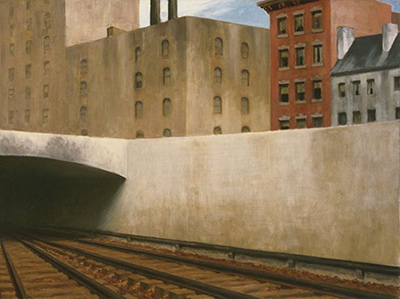
Compare: Approaching a City, 1946.
A technical recollection has a date and a limit
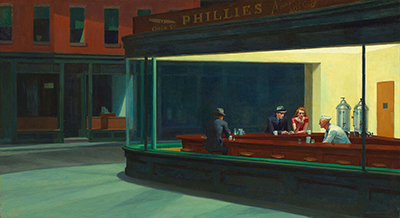
Morse also asks about the materials in Hopper's paintings. Hopper recalls trouble with zinc white in an area of Nighthawks and describes his preferences at the time of the interview. He qualifies the account through memory, and does not claim to be supplying a complete scientific examination of the painting. [2]
Such a statement is valuable historical evidence. It records what the painter remembered using and what he thought had happened. A conservator's later investigation asks further questions through the actual object. The two forms of evidence can support or complicate one another.
The same distinction applies to his discussion of prepared canvas. He names a preferred supplier while acknowledging uncertainty about the exact ground. The answer is unusually informative precisely because it contains a limit. Extracting only the supplier's name would make the practice appear more exhaustively specified than it was.
His remarks on varnish also describe a personal practice in 1959. They should be read as part of the history of his working method, rather than instructions for treating a painting now. What an artist says he did and what a particular surface currently needs are different questions.
This kind of reading brings the statements closer to the material paintings. Light on a wall was made through paint on a support, and the painter's memory preserves one part of that history.
Words an artist admires have another author
Authorship requires care even where a passage is securely associated with an artist. Robert Hobbs's account describes Hopper endorsing a statement by Goethe during the 1961 interview with Brian O'Doherty. [7] That association does not make Goethe's words an original Hopper aphorism.
The distinction can enrich the connection. An admired passage may identify an idea an artist found congenial, providing a way to discuss his interests in literature and the relation between the external world and personal form. It supplies evidence of reading and agreement.
Removing the original author's name changes the nature of that evidence. A borrowed statement becomes an invented act of composition. Preserving the credit allows both the literary source and Hopper's response to retain their places.
The same care applies to a critic quoting a letter or a museum reproducing an earlier catalogue. The original date and the date of its later reproduction can answer different questions.
Looking in and out of Apartment Houses
Near the end of the interview, Morse turns to Apartment Houses, painted in 1923. He proposes that it crystallised a style that would continue through Hopper's later work. Hopper agrees, recalls making it in his Washington Square studio, and assents to the importance of a city continuing beyond the selected segment. [2]
The exchange is useful because it concerns a particular early painting rather than a general mood. Its glimpsed interior belongs to a larger built environment, and the composition makes looking inward and outward possible at the same time. The artist's reply helps identify that spatial sensation as something he recognised in the work.
It remains a retrospective account. The date of the painting and the date of the interview are separated by decades. Agreement in 1959 does not establish that Hopper wrote down the same judgement when he completed the canvas in 1923.
Returning to the picture, we can follow the broad pale architectural divisions and the small area occupied by the figure. The remark directs us towards those relations without explaining the woman's thoughts. A statement about pictorial space can be quite precise while leaving a human situation unresolved.
The records contain more than Edward's voice
The ledgers bring another distinction into view. The Whitney credits Artist's Ledger—Book III jointly to Edward and Josephine Nivison Hopper. Edward supplied miniature records of completed works; Jo added descriptions and practical information. [8]
Their entries can include imaginative character names as well as dates and transactions. A lively description may show how the couple talked about a figure without identifying an actual person depicted in the painting.
Jo's contribution should also keep its authorship. A sentence she wrote is not automatically Edward's explanation because it appears beside his composition. Her phrasing belongs to an independent writer and artist participating in a shared record.
Reading with that distinction makes the material more interesting. A painting can have a documented date, a business history and an invented studio character, each answering a different question. Their presence together should encourage a richer account, not a flattening of all three into one voice.
A statement can change its meaning as it travels
A sentence may move from an artist's letter into a catalogue, from the catalogue into a museum label, and from that label into a short quotation. Each stage can preserve the wording while reducing the surrounding information. The visible sentence becomes easier to remember and harder to place.
The passages here offer practical ways to restore that setting. A title can identify the painting under discussion. A date can distinguish an early statement from a later recollection. A named interviewer can show why one subject arose, and a speaker's name can prevent Jo's words from being absorbed into Edward's.
Those details need not turn reading into a hunt for a final authorised interpretation. Their value is more immediate. They let a remark do the work it can support: describe an aim, record a memory, make a public argument or answer a question about a particular canvas.
The paintings retain more than any one of those statements. We can use a phrase to notice a relation we had missed, then return to the surface and test it through looking.
Returning from a statement to a painting
These passages provide several starting points for looking: personal impressions, imagination, difficult work, an unresolved anecdote and the combination of observed fragments. Their value lies partly in how differently they operate.
The 1950 letter addresses a public decision. The 1948 letter responds to a museum curator about one canvas. The 1933 statement sets out an artistic aim, while an interview preserves uncertainty and qualification in a conversational exchange.
Returning to the pictures after reading them keeps those differences productive. We can examine a wall more closely, reconsider a character's apparent mood or notice how little a visible room tells us about what happened before it.
After reading the letter about Office at Night, for example, we can follow the light across its wall more carefully. The furniture and figures become clearer, while the exchange between the people remains open.
Artworks and studies directory
This researched directory includes finished works and separately identified studies. It is not a complete catalogue raisonné. Linked titles open the articles; unlinked studies are identified by their collection accessions. Watercolours retain their recorded media, and original prints remain distinct from reproductions.
| Name | Date | Medium |
|---|---|---|
| (Bridge and Embankment) (70.1298) | 1906 | Oil on wood |
| (Jo Sketching at Good Harbor Beach) (70.1129) | 1923–1924 | Watercolor and fabricated chalk on paper |
| (Manhattan Bridge) (70.1098) | 1925–1926 | Watercolor and graphite pencil on paper |
| (Rooftops) (70.1114) | 1926 | Watercolor and graphite pencil on paper |
| (Seated Male Model, Bent Over) (70.1277) | c. 1902–1903 | Oil on canvas |
| (Self-Portrait) (70.1254) | 1903–1906 | Oil on canvas |
| (Solitary Figure in a Theater) (70.1418) | c. 1902–1904 | Oil on board |
| 5 A.M. | 1937 | oil on canvas |
| Adam's House | 1928 | watercolour and charcoal on paper |
| American Village | 1912 | Oil on canvas |
| Apartment Houses | 1923 | oil on canvas |
| Approaching a City | 1946 | oil on canvas |
| August in the City | 1945 | oil on canvas |
| Automat | 1927 | oil on canvas |
| Barber Shop | 1931 | oil on canvas |
| Blackwell's Island | 1928 | oil on canvas |
| Bridge on the Seine | 1909 | Oil on canvas |
| Bridle Path | 1939 | oil on canvas |
| Burly Cobb's House South Truro | 1930–1933 | oil on canvas |
| Cape Cod Evening | 1939 | oil on canvas |
| Cape Cod Morning | 1950 | oil on canvas |
| Chair Car | 1965 | oil on canvas |
| Chop Suey | 1929 | oil on canvas |
| City Roofs | 1932 | Oil on canvas |
| Coast Guard Station | 1929 | oil on canvas |
| Compartment C, Car 293 | 1938 | oil on canvas |
| Conference at Night | 1949 | oil on canvas |
| Corn Hill | 1930 | oil on canvas |
| Dawn in Pennsylvania | 1942 | oil on canvas |
| Drug Store | 1927 | oil on canvas |
| Early Sunday Morning | 1930 | Oil on canvas |
| East Side Interior (70.1020) | 1922 | Etching |
| East Wind Over Weehawken | 1934 | oil on canvas |
| El Palacio | 1946 | Watercolor and graphite pencil on paper |
| Eleven A.M. | 1926 | oil on canvas |
| Evening Wind | 1921 | etching |
| Excursion into Philosophy | 1959 | oil on canvas |
| First Row Orchestra | 1951 | oil on canvas |
| Freight Car at Truro | 1931 | watercolour over graphite on paper |
| Gas | 1940 | oil on canvas |
| Girl at a Sewing Machine | c. 1921 | oil on canvas |
| Gloucester Harbor | 1912 | Oil on canvas |
| Ground Swell | 1939 | oil on canvas |
| Haskell's House | 1924 | watercolour over graphite on paperboard |
| High Noon | 1949 | oil on canvas |
| Hill and Houses Cape Elizabeth Maine | 1927 | watercolour over graphite pencil |
| Hills South Truro | 1930 | oil on canvas |
| Hotel by a Railroad | 1952 | oil on canvas |
| Hotel Lobby | 1943 | oil on canvas |
| Hotel Room | 1931 | oil on canvas |
| Hotel Window | 1955 | oil on canvas |
| House by the Railroad | 1925 | oil on canvas |
| House by the Squam River | 1926 | watercolour over graphite on paper |
| Le Bistro or The Wine Shop | 1909 | Oil on canvas |
| Le Pont des Arts | 1907 | Oil on canvas |
| Le Pont Royal | 1909 | Oil on canvas |
| Le Quai des Grands Augustins | 1909 | Oil on canvas |
| Lighthouse and Buildings Portland Head | 1927 | watercolour over graphite pencil on paper |
| Lighthouse Hill | 1927 | oil painting |
| Manhattan Bridge Loop | 1928 | oil on canvas |
| Model Sitting | c. 1902 | oil painting; support not asserted |
| Morning Sun | 1952 | oil on canvas |
| New York Movie | 1939 | oil on canvas |
| New York New Haven and Hartford | 1931 | oil on canvas |
| New York Office | 1962 | oil on canvas |
| New York Pavements | 1924–1925 | oil on canvas |
| New York Restaurant | c. 1922 | oil on canvas |
| Night Windows | 1928 | oil on canvas |
| Nighthawks | 1942 | oil on canvas |
| October on Cape Cod | 1946 | oil on canvas |
| Office at Night | 1940 | oil on canvas |
| Office in a Small City | 1953 | oil on canvas |
| Pennsylvania Coal Town | 1947 | oil on canvas |
| People in the Sun | 1960 | oil on canvas |
| Portrait of Orleans | 1950 | oil on canvas |
| Queensborough Bridge | 1913 | Oil on canvas |
| Railroad Sunset | 1929 | Oil on canvas |
| Railroad Train | 1908 | oil on canvas |
| Road in Maine | 1914 | oil on canvas |
| Room in Brooklyn | 1932 | oil on canvas |
| Room in New York | 1932 | oil on canvas |
| Rooms by the Sea | 1951 | oil on canvas |
| Rooms for Tourists | 1945 | oil on canvas |
| Route 6 Eastham | 1941 | oil on canvas |
| Second Story Sunlight | 1960 | Oil on canvas |
| Self-Portrait | 1925–1930 | Oil on canvas |
| Self-Portrait with Hat (70.1903) | c. 1918, posthumous print | Drypoint |
| Seven A.M. | 1948 | Oil on canvas |
| Soir Bleu | 1914 | oil on canvas |
| South Carolina Morning | 1955 | Oil on canvas |
| Stairway at 48 Rue de Lille Paris | 1906 | Oil on wood |
| Study for 5 A.M. (70.153) | 1937 | Fabricated chalk on paper |
| Study for 5 A.M. (70.429) | 1937 | Fabricated chalk and graphite pencil on paper |
| Study for Approaching a City (70.869) | 1946 | Fabricated chalk and charcoal on paper |
| Study for August in the City (70.158a-b) | 1945 | Fabricated chalk on paper |
| Study for August in the City (70.159) | 1945 | Fabricated chalk on paper |
| Study for Bridle Path (70.220) | 1939 | Fabricated chalk on paper |
| Study for Bridle Path (70.235) | 1939 | Fabricated chalk on paper |
| Study for Compartment C, Car 293 (70.430) | 1938 | Fabricated chalk on paper |
| Study for Compartment C, Car 293 (70.431a-b) | 1938 | Fabricated chalk and charcoal on paper |
| Study for Conference at Night (70.170) | 1949 | Fabricated chalk on paper (recto); Typewriter ink on paper (verso) |
| Study for Conference at Night (70.174) | 1949 | Fabricated chalk on paper ( recto); Typewriter ink on paper (verso) |
| Study for East Wind over Weehawken (70.249) | 1934 | Graphite pencil on paper |
| Study for East Wind over Weehawken (70.252) | 1934 | Fabricated chalk and charcoal on paper |
| Study for Evening Wind (70.343a-b) | 1921 | Fabricated chalk on paper |
| Study for First Row Orchestra (70.841) | 1951 | Fabricated chalk and charcoal on paper |
| Study for Gas (70.263) | 1940 | Fabricated chalk on paper |
| Study for Ground Swell (70.339) | 1939 | Fabricated chalk, charcoal and graphite pencil on paper |
| Study for Hotel by a Railroad (70.199) | 1952 | Fabricated chalk on paper |
| Study for Hotel by a Railroad (70.427) | 1952 | Fabricated chalk on paper |
| Study for Hotel by a Railroad (70.428) | 1952 | Fabricated chalk on paper |
| Study for Hotel Lobby (70.117) | 1942 | Fabricated chalk and graphite pencil on paper |
| Study for Hotel Lobby (70.839) | 1942 | Fabricated chalk and charcoal on paper |
| Study for Hotel Window (70.161) | 1955 | Fabricated chalk, graphite pencil and colored pencil on paper |
| Study for Morning Sun (70.243) | 1952 | Fabricated chalk on paper |
| Study for Morning Sun (70.244) | 1952 | Fabricated chalk on paper |
| Study for Morning Sun (70.290) | 1952 | Fabricated chalk on paper |
| Study for Morning Sun (70.291) | 1952 | Fabricated chalk and graphite pencil on paper |
| Study for New York Movie (70.273) | 1939 | Fabricated chalk on paper |
| Study for New York Movie (70.274a-b) | 1938 or 1939 | Fabricated chalk and charcoal on paper (recto); Fabricated chalk on paper (verso) |
| Study for New York Movie (70.455) | 1939 | Fabricated chalk and charcoal on paper |
| Study for New York Office (70.822) | 1962 | Fabricated chalk on paper |
| Study for Nighthawks (70.192) | 1941 or 1942 | Fabricated chalk on paper |
| Study for Nighthawks (70.193) | 1941 or 1942 | Fabricated chalk on paper |
| Study for Office at Night (70.340) | 1940 | Fabricated chalk and charcoal on paper |
| Study for Office at Night (70.341) | 1940 | Fabricated chalk and graphite pencil on paper |
| Study for Pennsylvania Coal Town (70.198) | 1947 | Fabricated chalk on paper |
| Study for Pennsylvania Coal Town (70.229) | 1947 | Fabricated chalk and charcoal on paper |
| Study for Rooms for Tourists (70.438) | 1945 | Fabricated chalk and charcoal on paper |
| Study for Rooms for Tourists (70.848) | 1945 | Fabricated chalk and charcoal on paper |
| Study for Route 6, Eastham (70.369) | 1941 | Fabricated chalk and graphite pencil on paper |
| Study for Route 6, Eastham (70.854) | 1941 | Fabricated chalk and graphite pencil on paper |
| Study for South Carolina Morning (70.162a-b) | 1955 | Fabricated chalk on paper (recto and verso) |
| Study for The Sheridan Theatre (70.969) | 1937 | Graphite pencil on paper |
| Study for Two on the Aisle (70.128) | 1927 | Fabricated chalk on paper |
| Study for Two on the Aisle (70.129) | 1927 | Fabricated chalk on paper |
| Study for Yawl Riding a Swell (70.439) | 1935 | Fabricated chalk and graphite pencil on paper |
| Summer Evening | 1947 | oil on canvas |
| Summer Interior | 1909 | Oil on canvas |
| Sun in an Empty Room | 1963 | oil on canvas |
| Sunlight in a Cafeteria | 1958 | oil on canvas |
| Sunlight on Brownstones | 1956 | oil on canvas |
| Tables for Ladies | 1930 | oil on canvas |
| The Bootleggers | 1925 | oil on canvas |
| The Camel's Hump | 1931 | oil on canvas |
| The Circle Theatre | 1936 | oil on canvas |
| The City | 1927 | oil on canvas |
| The Lighthouse at Two Lights | 1929 | oil on canvas |
| The Long Leg | 1935 | oil on canvas |
| The Mansard Roof | 1923 | watercolour over graphite on paper |
| The Sheridan Theatre | 1937 | oil on canvas |
| Tramp Steamer | 1908 | oil on canvas |
| Two Comedians | 1966 | oil on canvas |
| Two on the Aisle | 1927 | oil on canvas |
| Valley of the Seine | 1909 | Oil on canvas |
| Western Motel | 1957 | oil on canvas |
Frequently Asked Questions
Edward Hopper's words are most revealing when their circumstances remain attached. A statement for an exhibition catalogue has a different purpose from a reply in conversation. A letter about one painting may address a technical question that disappears when a single sentence is lifted from it.
In his 1959 interview with John D. Morse, Hopper described the geometric forms in Approaching a City as partly unintentional. That qualification leaves room for both deliberate arrangement and decisions made while working. [2]
Authorship requires care even where a passage is securely associated with an artist. Robert Hobbs's account describes Hopper endorsing a statement by Goethe during the 1961 interview with Brian O'Doherty. [7] That association does not make Goethe's words an original Hopper aphorism.
Discussion
Look again at the images and ideas explored in Edward Hopper Quotes and Statements. These editorial prompts invite your observations.
Reader Insights
Which statement changes when you return it to the painting or interview discussed here?
Compare Office at Night with Approaching a City. Which visual difference matters most to your reading?
Which detail would you look at again after reading “Geometry described as partly unintentional”?
Join the Conversation
Share a detail, comparison or question about Edward Hopper Quotes and Statements below.
References
- Edward Hopper, Notes on Painting, in Edward Hopper: Retrospective Exhibition, Museum of Modern Art,1933, pp.17–18; quotation from p.17. View source.
- John Morse, oral-history interview with Edward Hopper,17 June1959, Archives of American Art, Smithsonian Institution, complete transcript hosted by Edward Hopper House. The1953 Reality statement is reread in the interview; the other excerpts concern Approaching a City and Cape Cod Morning. Audio was not independently heard. View source.
- “Art: The Silent Witness”, Time, 24 December 1956, complete article across all eight public web pages; quoted sentence on web p. 5. Reported speech is distinguished from the magazine’s editorial framing. View source 1. View source 2.
- Jill Vuchetich, Inside Edward Hopper's Office at Night, Walker Art Center,29 April2025, published excerpt of Hopper's25 August1948 letter to Norman Geske. View source.
- Robert Torchia, Cape Cod Evening,1939, National Gallery of Art,2016, entry and note5, citing Grace Pagano, Contemporary American Painting: The Encyclopedia Britannica Collection,1945,p.57. Quotation transmitted through the scholarly entry. View source.
- Edward Hopper, letter to Nathaniel M. Elias,17 March1950, The Sanborn Hopper Archive, Whitney Museum of American Art, EJHA.2072, complete reproduced original letter. View source.
- Robert Hobbs, Edward Hopper, Harry N. Abrams,1987, supplied introduction, pp.9–20, account of the1961 interview and the Goethe passage. The interview programme was not independently viewed. View source.
- Whitney Museum of American Art, Edward Hopper and Josephine Nivison Hopper, Artist's Ledger—Book III,1924–1967, accession96.210, record of the jointly maintained books. View source.
- Whitney Museum of American Art, Study for Route 6, Eastham, 1941, accession 70.854; exact object record. View source.
- Whitney Museum of American Art, Study for Conference at Night, 1949, accession 70.170; exact object record. View source.
- Whitney Museum of American Art, Study for First Row Orchestra, 1951, accession 70.841; exact object record. View source.
- Whitney Museum of American Art, (Bridge and Embankment), 1906, accession 70.1298; exact object record. View source.
- Whitney Museum of American Art, (Seated Male Model, Bent Over), c. 1902–1903, accession 70.1277; exact object record. View source.
- Whitney Museum of American Art, Study for Morning Sun, 1952, accession 70.244; exact object record. View source.
- Whitney Museum of American Art, Study for Morning Sun, 1952, accession 70.243; exact object record. View source.
- Whitney Museum of American Art, Study for Two on the Aisle, 1927, accession 70.128; exact object record. View source.
- Whitney Museum of American Art, Study for New York Office, 1962, accession 70.822; exact object record. View source.
- Whitney Museum of American Art, Study for Two on the Aisle, 1927, accession 70.129; exact object record. View source.
- Whitney Museum of American Art, Study for Pennsylvania Coal Town, 1947, accession 70.229; exact object record. View source.
- Whitney Museum of American Art, (Rooftops), 1926, accession 70.1114; exact object record. View source.
- Whitney Museum of American Art, Study for South Carolina Morning, 1955, accession 70.162a-b; exact object record. View source.
- Whitney Museum of American Art, (Self-Portrait), 1903–1906, accession 70.1254; exact object record. View source.
- Whitney Museum of American Art, (Manhattan Bridge), 1925–1926, accession 70.1098; exact object record. View source.
- Whitney Museum of American Art, (Solitary Figure in a Theater), c. 1902–1904, accession 70.1418; exact object record. View source.
- Whitney Museum of American Art, Study for Approaching a City, 1946, accession 70.869; exact object record. View source.
- Whitney Museum of American Art, Study for August in the City, 1945, accession 70.159; exact object record. View source.
- Whitney Museum of American Art, Study for Compartment C, Car 293, 1938, accession 70.430; exact object record. View source.
- Whitney Museum of American Art, Study for Compartment C, Car 293, 1938, accession 70.431a-b; exact object record. View source.
- Whitney Museum of American Art, Study for East Wind over Weehawken, 1934, accession 70.252; exact object record. View source.
- Whitney Museum of American Art, Study for East Wind over Weehawken, 1934, accession 70.249; exact object record. View source.
- Whitney Museum of American Art, Study for Evening Wind, 1921, accession 70.343a-b; exact object record. View source.
- Whitney Museum of American Art, Study for The Sheridan Theatre, 1937, accession 70.969; exact object record. View source.
- Whitney Museum of American Art, Study for New York Movie, 1939, accession 70.455; exact object record. View source.
- Whitney Museum of American Art, Study for New York Movie, 1939, accession 70.273; exact object record. View source.
- Whitney Museum of American Art, Study for New York Movie, 1938 or 1939, accession 70.274a-b; exact object record. View source.
- Whitney Museum of American Art, Study for 5 A.M., 1937, accession 70.153; exact object record. View source.
- Whitney Museum of American Art, Study for 5 A.M., 1937, accession 70.429; exact object record. View source.
- Whitney Museum of American Art, (Jo Sketching at Good Harbor Beach), 1923–1924, accession 70.1129; exact object record. View source.
- Whitney Museum of American Art, Study for August in the City, 1945, accession 70.158a-b; exact object record. View source.
- Whitney Museum of American Art, Study for Morning Sun, 1952, accession 70.291; exact object record. View source.
- Whitney Museum of American Art, Study for Morning Sun, 1952, accession 70.290; exact object record. View source.
- Whitney Museum of American Art, Study for Office at Night, 1940, accession 70.340; exact object record. View source.
- Whitney Museum of American Art, Study for Office at Night, 1940, accession 70.341; exact object record. View source.
- Whitney Museum of American Art, Study for Hotel by a Railroad, 1952, accession 70.427; exact object record. View source.
- Whitney Museum of American Art, Study for Hotel by a Railroad, 1952, accession 70.199; exact object record. View source.
- Whitney Museum of American Art, Study for Hotel by a Railroad, 1952, accession 70.428; exact object record. View source.
- Whitney Museum of American Art, Study for Hotel Lobby, 1942, accession 70.117; exact object record. View source.
- Whitney Museum of American Art, Study for Hotel Lobby, 1942, accession 70.839; exact object record. View source.
- Whitney Museum of American Art, Study for Conference at Night, 1949, accession 70.174; exact object record. View source.
- Whitney Museum of American Art, Study for Hotel Window, 1955, accession 70.161; exact object record. View source.
- Whitney Museum of American Art, Study for Pennsylvania Coal Town, 1947, accession 70.198; exact object record. View source.
- Whitney Museum of American Art, Study for Route 6, Eastham, 1941, accession 70.369; exact object record. View source.
- Whitney Museum of American Art, Study for Bridle Path, 1939, accession 70.220; exact object record. View source.
- Whitney Museum of American Art, Study for Bridle Path, 1939, accession 70.235; exact object record. View source.
- Whitney Museum of American Art, Study for Ground Swell, 1939, accession 70.339; exact object record. View source.
- Whitney Museum of American Art, Study for Yawl Riding a Swell, 1935, accession 70.439; exact object record. View source.
- Whitney Museum of American Art, Study for Rooms for Tourists, 1945, accession 70.848; exact object record. View source.
- Whitney Museum of American Art, Study for Rooms for Tourists, 1945, accession 70.438; exact object record. View source.
- Whitney Museum of American Art, Study for Nighthawks, 1941 or 1942, accession 70.193; exact object record. View source.
- Whitney Museum of American Art, Study for Nighthawks, 1941 or 1942, accession 70.192; exact object record. View source.
- Whitney Museum of American Art, Study for Gas, 1940, accession 70.263; exact object record. View source.
- Whitney Museum of American Art, Self-Portrait with Hat, c. 1918, posthumous print, accession 70.1903; exact object record. View source.
- Whitney Museum of American Art, East Side Interior, 1922, accession 70.1020; exact object record. View source.
- Art Institute of Chicago, Selected Chronology for Edward Hopper; training, travels, exhibitions, New York and Truro chronology. View source.
- Emily C. Burns, Spectral figures: Edward Hopper’s empty Paris, chapter 5 in Empty Spaces: Confronting Emptiness in National, Cultural and Urban Histories, 2019; complete chapter and notes consulted. View source.
- Charles Brock, Regionalism and Folk Art, National Gallery of Art; complete essay and two notes consulted. View source.
- Collection or catalogue record, American Village, 1912; medium and identity as discussed in the linked article. View source.
- Collection or catalogue record, Soir Bleu, 1914; medium and identity as discussed in the linked article. View source.
- Collection or catalogue record, House by the Railroad, 1925; medium and identity as discussed in the linked article. View source.
- Collection or catalogue record, Automat, 1927; medium and identity as discussed in the linked article. View source.
- Collection or catalogue record, Early Sunday Morning, 1930; medium and identity as discussed in the linked article. View source.
- Collection or catalogue record, New York Movie, 1939; medium and identity as discussed in the linked article. View source.
- Collection or catalogue record, Nighthawks, 1942; medium and identity as discussed in the linked article. View source.
- Collection or catalogue record, Morning Sun, 1952; medium and identity as discussed in the linked article. View source.
- Collection or catalogue record, Second Story Sunlight, 1960; medium and identity as discussed in the linked article. View source.
- Collection or catalogue record, Two Comedians, 1966; medium and identity as discussed in the linked article. View source.