 by Tom Gurney
Tom Gurney BSc (Hons) is an art history expert with over 20 years experience
Email: tomgurney1@gmail.com / Phone: +44 7429 011000
The Sheridan Theatre: Introduction
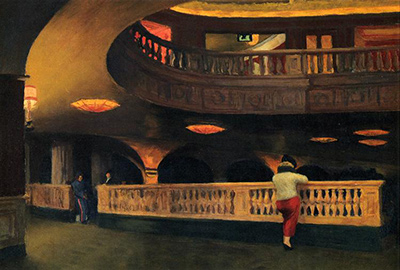
A woman in a white jacket and red skirt leans over a pale balustrade. Farther left, two smaller figures stand near another part of the rail. Above them, a curved gallery, glowing ceiling lamps and a great arch make the cinema lobby feel unusually spacious. In Edward Hopper's The Sheridan Theatre, the building's circulation space becomes a spectacle of its own.
The Newark Museum of Art dates the painting to 1937 and identifies oil on canvas, 17 × 25 inches, accession 40.118. It was purchased in 1940 through the Felix Fuld Bequest Fund. [1] The title names a real Greenwich Village cinema, but the painting does more than record its fittings. Hopper gives architecture, light and a few widely separated people an independent arrangement.
At a Glance
- ArtistEdward Hopper [1]
- Date1937 [1]
- Mediumoil on canvas [1]
- Collection / recordNewark Museum of Art [1]
- Accession40.118 [1]
This work across Edward Hopper’s career
American Village
1912Soir Bleu
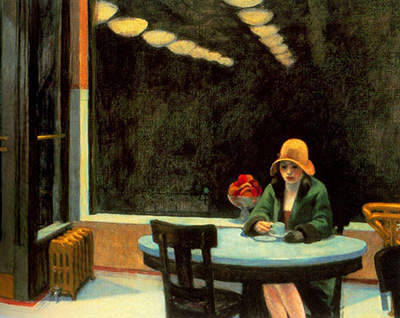
1914Automat
1927New York Movie
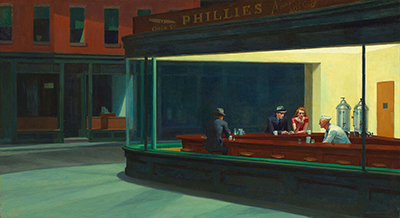
1939Nighthawks
1942Morning Sun
1952Two Comedians
1966Contents
- A lobby seen from the mezzanine
- The back-turned visitor
- Two figures at a distance
- Balusters, roundels and arches
- Electric light without daylight
- A named building, an altered space
- Drawing the curves
- A vanished cinema and a surviving painting
- Other ways into Hopper's theatres
A lobby seen from the mezzanine
The viewpoint places us on an upper level, facing a curved opening enclosed by a balustrade. The floor runs broadly across the foreground, while the far side turns away towards the left. That curve invites the eye to travel through the building rather than settle on one frontal wall.
The nearer woman occupies the right side of this circuit. Her position is clear because the pale rail separates her lower body from the darker space beyond. The two figures at the left are smaller and less emphatic, allowing the building's scale to register through the difference between them.
Above, another long balustrade repeats the curve. Its narrow uprights and broad panelled base make the upper level feel substantial, although much of it lies in shadow. The repetition gives the room an ordered structure that extends beyond the immediate landing.
The view includes neither a screen nor rows of cinema seats. It selects the space people pass through on their way to the main attraction. That selection allows the lobby to hold attention through its own surfaces, intervals and artificial light.
The back-turned visitor
The woman's white jacket is one of the clearest light shapes in the painting. Its sleeves extend towards the rail, spreading her upper body across a small part of the architecture. The red skirt carries a warmer, narrower shape below.
Her feet stand close together, with one lower leg angled slightly differently from the other. The dark high-heeled shoes meet the greenish floor in a small, pointed contact. These details make the posture more specific than a generic silhouette used only to establish scale.
Her head is turned away. The light hair stands against the darker recess behind, while the face remains unavailable. We can follow the body's orientation across the balustrade without seeing a particular expression or identifying precisely what has drawn her attention.
The pose connects person and building through contact. The rail gives the arms somewhere to rest, and the opening beyond gives the head a direction. Hopper makes looking visible as a bodily arrangement: feet on the promenade, arms near the barrier, face turned into the larger interior.
The white and red also have echoes elsewhere. Pale balusters, warm ceiling surfaces and reddish passages connect the visitor with the room around her. She remains conspicuous because those colours are gathered into one small human form near the foreground.
Two figures at a distance
The left-hand figures occupy a much darker area. A blue-clad person stands near the rail, while another figure appears beside the adjoining opening. Their reduced scale and comparatively low contrast make them secondary to the visitor at the right.
The distance between the groups is extensive. A long run of balustrade and open floor occupies the interval, so the three people do not immediately form one social gathering. The architecture supplies the strongest connection between their positions.
Their presence nevertheless changes the room. Without them, the lobby might be read primarily as an exercise in curved construction and glowing fixtures. Small bodies at different depths make it a place being used, even at a moment when relatively few users are visible.
Balusters, roundels and arches
The pale barrier has closely spaced vertical supports. Seen across a long curve, they form a rhythm that changes as the rail turns into depth. Their repeated openings let darkness show through, preventing the balustrade from becoming one solid band.
The upper gallery repeats this pattern above a panelled base decorated with round forms. The building is therefore organized through several scales of repetition: small balusters, larger panels, circular ornaments and broad arches. These patterns remain recognizable despite the low illumination.
A massive arch enters from the upper left and reaches towards the centre. Its underside is comparatively plain beside the more intricate rails, making its broad curve especially forceful. The visitor stands near the point where that great sweep approaches the darker vertical structure at the right.
Below the upper gallery, arches form a further sequence of openings. Their dark centres imply adjoining spaces without letting us inspect them fully. The cinema becomes a layered construction, with one visible circulation area surrounded by other partially concealed parts.
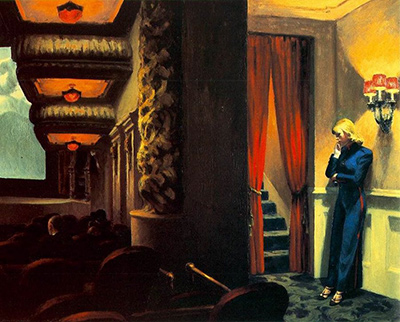
Compare: New York Movie, 1939.
Electric light without daylight
The ceiling lamps are among the picture's most distinctive objects. Their flattened, bowl-like shapes glow in warm orange and yellow, suspended within darker surrounding surfaces. Their repeated positions guide attention through the middle distance.
Each fixture creates a small area of intensity. The light does not make every part of the lobby equally visible. Instead, warmer patches reveal selected ceilings and edges while recesses remain dark. The theatre's design is understood through this uneven distribution.
The effect differs from the daylight interiors in which Hopper lets one window provide an obvious source. Here, several electric fixtures create overlapping areas of illumination. Their glow is part of the room's manufactured attraction, as conspicuous in its own way as the railings and decoration.
The Whitney's account notes that Hopper worked on the painting with his Washington Square studio lights off while trying to reproduce the Sheridan's electric glow. [2] The observation gives the finished lighting a connection with his working conditions, without turning it into a simple copy of a photograph.
The green floor is particularly important beneath those warmer lights. It gives the foreground a broad, comparatively subdued area, allowing the white jacket, red skirt and amber fixtures to remain distinct. The room's atmosphere depends on how those colours are kept apart as well as brought together.
Watch: Edward Hopper’s Life and Art
Explore Hopper’s paintings and the places behind them in these museum films. Choose a film below.
A named building, an altered space
The Sheridan stood close to Hopper's home and was one of the cinemas he frequented. The Whitney distinguishes this painting's identifiable theatre from the combined architectural sources of other interiors, including New York Movie. [2] Naming the building, however, does not make every level in the painting an exact transcription.
Art historian Viola Rühse compares the image with an early photograph of the lobby and argues that Hopper enlarged its effect by adding another upper level. She reads the warm, imposing interior as a nostalgic reworking of the older cinema palace. [3] That interpretation concerns how the artist transformed a known place, rather than proving a declared message from Hopper.
The historical photograph shows an elaborate chandelier, curved balustrade and gallery wall. The painting gives greater prominence to broad arches, smaller glowing fixtures and repeated levels. The family resemblance is visible, but so is the difference between a record of the lobby and the space made for the canvas.
This distinction makes the painting useful in two ways. It preserves an encounter with a particular kind of Greenwich Village cinema, and it shows Hopper reorganizing that encounter into a controlled image. Recognition of the site and invention within it can coexist.
Drawing the curves
A 1937 graphite study in the Whitney, accession 70.969, investigates the theatre's stacked forms on a sheet only about 11.3 × 18.1 cm. [4] An upper balustrade, round ornaments, oval ceiling fixtures and a lower sequence of arches are indicated through quick lines and shading.
The drawing emphasizes relationships that can be difficult to isolate in the coloured painting. The upper curve runs over the ellipses of the lamps; below them, repeated arches lead towards the front rail. Darker marks establish depth without fully describing every decorative surface.
Its small size also makes the scale of the task apparent. Hopper was finding ways to fit the lobby's long curves and superimposed levels into a compact rectangular field. The final canvas gives those relationships greater material weight through colour, light and the placement of people.
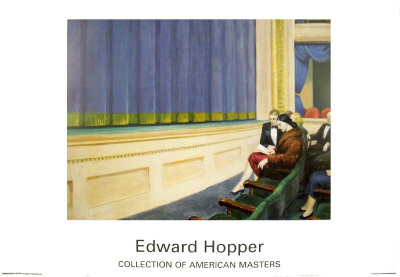
Compare: First Row Orchestra, 1951.
A vanished cinema and a surviving painting
Village Preservation locates the former theatre on the triangle bounded by Greenwich Avenue, Seventh Avenue and West 12th Street. Its account records demolition in 1969 and the site's later transformation for hospital facilities and, subsequently, a park and AIDS memorial. [5] The cinema in the title therefore belongs to a lost part of the neighbourhood's built environment.
The painting's life in Newark began much earlier, with the museum's 1940 purchase. [1] The date separates its institutional history from the later disappearance of the building. Hopper's selected and altered view had become a museum object while the cinema itself was still operating.
Newark's exhibition record includes a focused presentation, At the Movies: Edward Hopper's The Sheridan Theatre, in 2007. It also records the painting's later loans to major Hopper exhibitions. [1] The concentrated lobby scene has sustained attention both as an individual museum work and within broader accounts of his city pictures.
Other ways into Hopper's theatres
The Circle Theatre approaches moviegoing from the street. Its façade, marquee and traffic infrastructure make the cinema part of an urban exterior. The Sheridan Theatre takes us into a more enclosed system of curved passages and artificial illumination.
New York Movie moves closer to a cinema employee, setting her apart from the seated audience and screen. The Sheridan visitor has a different role in the composition: she stands within the lobby's great curves, looking across a space whose attraction is the building itself.
In Two on the Aisle, the closed stage curtain gives arriving spectators the painting's main action. The Sheridan's curtain and performance remain outside the view altogether. A person pausing at the rail, beneath repeated amber lights, is enough to make the cinema a place of sustained looking.
Artworks and studies directory
This researched directory includes finished works and separately identified studies. It is not a complete catalogue raisonné. Linked titles open the articles; unlinked studies are identified by their collection accessions. Watercolours retain their recorded media, and original prints remain distinct from reproductions.
| Name | Date | Medium |
|---|---|---|
| (Bridge and Embankment) (70.1298) | 1906 | Oil on wood |
| (Jo Sketching at Good Harbor Beach) (70.1129) | 1923–1924 | Watercolor and fabricated chalk on paper |
| (Manhattan Bridge) (70.1098) | 1925–1926 | Watercolor and graphite pencil on paper |
| (Rooftops) (70.1114) | 1926 | Watercolor and graphite pencil on paper |
| (Seated Male Model, Bent Over) (70.1277) | c. 1902–1903 | Oil on canvas |
| (Self-Portrait) (70.1254) | 1903–1906 | Oil on canvas |
| (Solitary Figure in a Theater) (70.1418) | c. 1902–1904 | Oil on board |
| 5 A.M. | 1937 | oil on canvas |
| Adam's House | 1928 | watercolour and charcoal on paper |
| American Village | 1912 | Oil on canvas |
| Apartment Houses | 1923 | oil on canvas |
| Approaching a City | 1946 | oil on canvas |
| August in the City | 1945 | oil on canvas |
| Automat | 1927 | oil on canvas |
| Barber Shop | 1931 | oil on canvas |
| Blackwell's Island | 1928 | oil on canvas |
| Bridge on the Seine | 1909 | Oil on canvas |
| Bridle Path | 1939 | oil on canvas |
| Burly Cobb's House South Truro | 1930–1933 | oil on canvas |
| Cape Cod Evening | 1939 | oil on canvas |
| Cape Cod Morning | 1950 | oil on canvas |
| Chair Car | 1965 | oil on canvas |
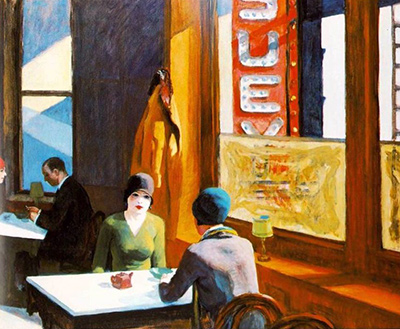
| Chop Suey | 1929 | oil on canvas |
| City Roofs | 1932 | Oil on canvas |
| Coast Guard Station | 1929 | oil on canvas |
| Compartment C, Car 293 | 1938 | oil on canvas |
| Conference at Night | 1949 | oil on canvas |
| Corn Hill | 1930 | oil on canvas |
| Dawn in Pennsylvania | 1942 | oil on canvas |
| Drug Store | 1927 | oil on canvas |
| Early Sunday Morning | 1930 | Oil on canvas |
| East Side Interior (70.1020) | 1922 | Etching |
| East Wind Over Weehawken | 1934 | oil on canvas |
| El Palacio | 1946 | Watercolor and graphite pencil on paper |
| Eleven A.M. | 1926 | oil on canvas |
| Evening Wind | 1921 | etching |
| Excursion into Philosophy | 1959 | oil on canvas |
| First Row Orchestra | 1951 | oil on canvas |
| Freight Car at Truro | 1931 | watercolour over graphite on paper |
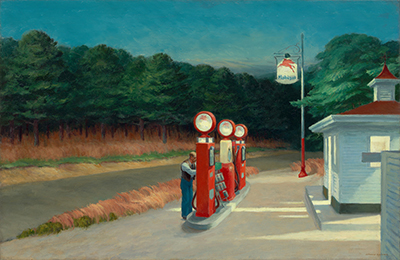
| Gas | 1940 | oil on canvas |
| Girl at a Sewing Machine | c. 1921 | oil on canvas |
| Gloucester Harbor | 1912 | Oil on canvas |
| Ground Swell | 1939 | oil on canvas |
| Haskell's House | 1924 | watercolour over graphite on paperboard |
| High Noon | 1949 | oil on canvas |
| Hill and Houses Cape Elizabeth Maine | 1927 | watercolour over graphite pencil |
| Hills South Truro | 1930 | oil on canvas |
| Hotel by a Railroad | 1952 | oil on canvas |
| Hotel Lobby | 1943 | oil on canvas |
| Hotel Room | 1931 | oil on canvas |
| Hotel Window | 1955 | oil on canvas |
| House by the Railroad | 1925 | oil on canvas |
| House by the Squam River | 1926 | watercolour over graphite on paper |
| Le Bistro or The Wine Shop | 1909 | Oil on canvas |
| Le Pont des Arts | 1907 | Oil on canvas |
| Le Pont Royal | 1909 | Oil on canvas |
| Le Quai des Grands Augustins | 1909 | Oil on canvas |
| Lighthouse and Buildings Portland Head | 1927 | watercolour over graphite pencil on paper |
| Lighthouse Hill | 1927 | oil painting |
| Manhattan Bridge Loop | 1928 | oil on canvas |
| Model Sitting | c. 1902 | oil painting; support not asserted |
| Morning Sun | 1952 | oil on canvas |
| New York Movie | 1939 | oil on canvas |
| New York New Haven and Hartford | 1931 | oil on canvas |
| New York Office | 1962 | oil on canvas |
| New York Pavements | 1924–1925 | oil on canvas |
| New York Restaurant | c. 1922 | oil on canvas |
| Night Windows | 1928 | oil on canvas |
| Nighthawks | 1942 | oil on canvas |
| October on Cape Cod | 1946 | oil on canvas |
| Office at Night | 1940 | oil on canvas |
| Office in a Small City | 1953 | oil on canvas |
| Pennsylvania Coal Town | 1947 | oil on canvas |
| People in the Sun | 1960 | oil on canvas |
| Portrait of Orleans | 1950 | oil on canvas |
| Queensborough Bridge | 1913 | Oil on canvas |
| Railroad Sunset | 1929 | Oil on canvas |
| Railroad Train | 1908 | oil on canvas |
| Road in Maine | 1914 | oil on canvas |
| Room in Brooklyn | 1932 | oil on canvas |
| Room in New York | 1932 | oil on canvas |
| Rooms by the Sea | 1951 | oil on canvas |
| Rooms for Tourists | 1945 | oil on canvas |
| Route 6 Eastham | 1941 | oil on canvas |
| Second Story Sunlight | 1960 | Oil on canvas |
| Self-Portrait | 1925–1930 | Oil on canvas |
| Self-Portrait with Hat (70.1903) | c. 1918, posthumous print | Drypoint |
| Seven A.M. | 1948 | Oil on canvas |
| Soir Bleu | 1914 | oil on canvas |
| South Carolina Morning | 1955 | Oil on canvas |
| Stairway at 48 Rue de Lille Paris | 1906 | Oil on wood |
| Study for 5 A.M. (70.153) | 1937 | Fabricated chalk on paper |
| Study for 5 A.M. (70.429) | 1937 | Fabricated chalk and graphite pencil on paper |
| Study for Approaching a City (70.869) | 1946 | Fabricated chalk and charcoal on paper |
| Study for August in the City (70.158a-b) | 1945 | Fabricated chalk on paper |
| Study for August in the City (70.159) | 1945 | Fabricated chalk on paper |
| Study for Bridle Path (70.220) | 1939 | Fabricated chalk on paper |
| Study for Bridle Path (70.235) | 1939 | Fabricated chalk on paper |
| Study for Compartment C, Car 293 (70.430) | 1938 | Fabricated chalk on paper |
| Study for Compartment C, Car 293 (70.431a-b) | 1938 | Fabricated chalk and charcoal on paper |
| Study for Conference at Night (70.170) | 1949 | Fabricated chalk on paper (recto); Typewriter ink on paper (verso) |
| Study for Conference at Night (70.174) | 1949 | Fabricated chalk on paper ( recto); Typewriter ink on paper (verso) |
| Study for East Wind over Weehawken (70.249) | 1934 | Graphite pencil on paper |
| Study for East Wind over Weehawken (70.252) | 1934 | Fabricated chalk and charcoal on paper |
| Study for Evening Wind (70.343a-b) | 1921 | Fabricated chalk on paper |
| Study for First Row Orchestra (70.841) | 1951 | Fabricated chalk and charcoal on paper |
| Study for Gas (70.263) | 1940 | Fabricated chalk on paper |
| Study for Ground Swell (70.339) | 1939 | Fabricated chalk, charcoal and graphite pencil on paper |
| Study for Hotel by a Railroad (70.199) | 1952 | Fabricated chalk on paper |
| Study for Hotel by a Railroad (70.427) | 1952 | Fabricated chalk on paper |
| Study for Hotel by a Railroad (70.428) | 1952 | Fabricated chalk on paper |
| Study for Hotel Lobby (70.117) | 1942 | Fabricated chalk and graphite pencil on paper |
| Study for Hotel Lobby (70.839) | 1942 | Fabricated chalk and charcoal on paper |
| Study for Hotel Window (70.161) | 1955 | Fabricated chalk, graphite pencil and colored pencil on paper |
| Study for Morning Sun (70.243) | 1952 | Fabricated chalk on paper |
| Study for Morning Sun (70.244) | 1952 | Fabricated chalk on paper |
| Study for Morning Sun (70.290) | 1952 | Fabricated chalk on paper |
| Study for Morning Sun (70.291) | 1952 | Fabricated chalk and graphite pencil on paper |
| Study for New York Movie (70.273) | 1939 | Fabricated chalk on paper |
| Study for New York Movie (70.274a-b) | 1938 or 1939 | Fabricated chalk and charcoal on paper (recto); Fabricated chalk on paper (verso) |
| Study for New York Movie (70.455) | 1939 | Fabricated chalk and charcoal on paper |
| Study for New York Office (70.822) | 1962 | Fabricated chalk on paper |
| Study for Nighthawks (70.192) | 1941 or 1942 | Fabricated chalk on paper |
| Study for Nighthawks (70.193) | 1941 or 1942 | Fabricated chalk on paper |
| Study for Office at Night (70.340) | 1940 | Fabricated chalk and charcoal on paper |
| Study for Office at Night (70.341) | 1940 | Fabricated chalk and graphite pencil on paper |
| Study for Pennsylvania Coal Town (70.198) | 1947 | Fabricated chalk on paper |
| Study for Pennsylvania Coal Town (70.229) | 1947 | Fabricated chalk and charcoal on paper |
| Study for Rooms for Tourists (70.438) | 1945 | Fabricated chalk and charcoal on paper |
| Study for Rooms for Tourists (70.848) | 1945 | Fabricated chalk and charcoal on paper |
| Study for Route 6, Eastham (70.369) | 1941 | Fabricated chalk and graphite pencil on paper |
| Study for Route 6, Eastham (70.854) | 1941 | Fabricated chalk and graphite pencil on paper |
| Study for South Carolina Morning (70.162a-b) | 1955 | Fabricated chalk on paper (recto and verso) |
| Study for The Sheridan Theatre (70.969) | 1937 | Graphite pencil on paper |
| Study for Two on the Aisle (70.128) | 1927 | Fabricated chalk on paper |
| Study for Two on the Aisle (70.129) | 1927 | Fabricated chalk on paper |
| Study for Yawl Riding a Swell (70.439) | 1935 | Fabricated chalk and graphite pencil on paper |
| Summer Evening | 1947 | oil on canvas |
| Summer Interior | 1909 | Oil on canvas |
| Sun in an Empty Room | 1963 | oil on canvas |
| Sunlight in a Cafeteria | 1958 | oil on canvas |
| Sunlight on Brownstones | 1956 | oil on canvas |
| Tables for Ladies | 1930 | oil on canvas |
| The Bootleggers | 1925 | oil on canvas |
| The Camel's Hump | 1931 | oil on canvas |
| The Circle Theatre | 1936 | oil on canvas |
| The City | 1927 | oil on canvas |
| The Lighthouse at Two Lights | 1929 | oil on canvas |
| The Long Leg | 1935 | oil on canvas |
| The Mansard Roof | 1923 | watercolour over graphite on paper |
| The Sheridan Theatre | 1937 | oil on canvas |
| Tramp Steamer | 1908 | oil on canvas |
| Two Comedians | 1966 | oil on canvas |
| Two on the Aisle | 1927 | oil on canvas |
| Valley of the Seine | 1909 | Oil on canvas |
| Western Motel | 1957 | oil on canvas |
Frequently Asked Questions
Edward Hopper made The Sheridan Theatre in 1937. [1]
The recorded medium is oil on canvas. [1]
A woman in a white jacket and red skirt leans over a pale balustrade. Farther left, two smaller figures stand near another part of the rail. Above them, a curved gallery, glowing ceiling lamps and a great arch make the cinema lobby feel unusually spacious. In Edward Hopper's The Sheridan Theatre, the building's circulation space becomes a spectacle of its own.
Discussion
Look again at the images and ideas explored in The Sheridan Theatre. These editorial prompts invite your observations.
Reader Insights
Which boundary, gesture or change of light first holds your attention in The Sheridan Theatre?
Compare New York Movie with The Sheridan Theatre. Which visual difference matters most to your reading?
Which detail would you look at again after reading “Two figures at a distance”?
Join the Conversation
Share a detail, comparison or question about The Sheridan Theatre below.
References
- Newark Museum of Art, The Sheridan Theatre, 1937, accession 40.118; current object record, overall inches and 1940 Felix Fuld Bequest Fund purchase. View source.
- Whitney Museum of American Art, Edward Hopper's New York, exhibition labels, 2022, PDF p. 54, printed label 38; the specific cinema, preparatory work and studio lighting. View source.
- Viola Rühse, “Edward Hopper's Cinema Paintings: Film Palace Nostalgia, Usherette's Disillusionment, and Bomb Threats”, Boletín de Arte, no. 20, September 2020, e023, pp. 6–8, especially fig. 5; the historical photograph and attributed architectural interpretation. View source.
- Whitney Museum of American Art, Study for The Sheridan Theatre, 1937, graphite pencil on paper, accession 70.969; object record and drawing. View source.
- Ariel Kates, “Edward Hopper's Village Muses”, Village Preservation, 22 February 2018; the Sheridan site and its subsequent history. View source.
- Collection or catalogue record, American Village, 1912; medium and identity as discussed in the linked article. View source.
- Collection or catalogue record, Soir Bleu, 1914; medium and identity as discussed in the linked article. View source.
- Collection or catalogue record, House by the Railroad, 1925; medium and identity as discussed in the linked article. View source.
- Collection or catalogue record, Automat, 1927; medium and identity as discussed in the linked article. View source.
- Collection or catalogue record, Early Sunday Morning, 1930; medium and identity as discussed in the linked article. View source.
- Collection or catalogue record, New York Movie, 1939; medium and identity as discussed in the linked article. View source.
- Collection or catalogue record, Nighthawks, 1942; medium and identity as discussed in the linked article. View source.
- Collection or catalogue record, Morning Sun, 1952; medium and identity as discussed in the linked article. View source.
- Collection or catalogue record, Second Story Sunlight, 1960; medium and identity as discussed in the linked article. View source.
- Collection or catalogue record, Two Comedians, 1966; medium and identity as discussed in the linked article. View source.
- Whitney Museum of American Art, Study for Route 6, Eastham, 1941, accession 70.854; exact object record. View source.
- Whitney Museum of American Art, Study for Conference at Night, 1949, accession 70.170; exact object record. View source.
- Whitney Museum of American Art, Study for First Row Orchestra, 1951, accession 70.841; exact object record. View source.
- Whitney Museum of American Art, (Bridge and Embankment), 1906, accession 70.1298; exact object record. View source.
- Whitney Museum of American Art, (Seated Male Model, Bent Over), c. 1902–1903, accession 70.1277; exact object record. View source.
- Whitney Museum of American Art, Study for Morning Sun, 1952, accession 70.244; exact object record. View source.
- Whitney Museum of American Art, Study for Morning Sun, 1952, accession 70.243; exact object record. View source.
- Whitney Museum of American Art, Study for Two on the Aisle, 1927, accession 70.128; exact object record. View source.
- Whitney Museum of American Art, Study for New York Office, 1962, accession 70.822; exact object record. View source.
- Whitney Museum of American Art, Study for Two on the Aisle, 1927, accession 70.129; exact object record. View source.
- Whitney Museum of American Art, Study for Pennsylvania Coal Town, 1947, accession 70.229; exact object record. View source.
- Whitney Museum of American Art, (Rooftops), 1926, accession 70.1114; exact object record. View source.
- Whitney Museum of American Art, Study for South Carolina Morning, 1955, accession 70.162a-b; exact object record. View source.
- Whitney Museum of American Art, (Self-Portrait), 1903–1906, accession 70.1254; exact object record. View source.
- Whitney Museum of American Art, (Manhattan Bridge), 1925–1926, accession 70.1098; exact object record. View source.
- Whitney Museum of American Art, (Solitary Figure in a Theater), c. 1902–1904, accession 70.1418; exact object record. View source.
- Whitney Museum of American Art, Study for Approaching a City, 1946, accession 70.869; exact object record. View source.
- Whitney Museum of American Art, Study for August in the City, 1945, accession 70.159; exact object record. View source.
- Whitney Museum of American Art, Study for Compartment C, Car 293, 1938, accession 70.430; exact object record. View source.
- Whitney Museum of American Art, Study for Compartment C, Car 293, 1938, accession 70.431a-b; exact object record. View source.
- Whitney Museum of American Art, Study for East Wind over Weehawken, 1934, accession 70.252; exact object record. View source.
- Whitney Museum of American Art, Study for East Wind over Weehawken, 1934, accession 70.249; exact object record. View source.
- Whitney Museum of American Art, Study for Evening Wind, 1921, accession 70.343a-b; exact object record. View source.
- Whitney Museum of American Art, Study for The Sheridan Theatre, 1937, accession 70.969; exact object record. View source.
- Whitney Museum of American Art, Study for New York Movie, 1939, accession 70.455; exact object record. View source.
- Whitney Museum of American Art, Study for New York Movie, 1939, accession 70.273; exact object record. View source.
- Whitney Museum of American Art, Study for New York Movie, 1938 or 1939, accession 70.274a-b; exact object record. View source.
- Whitney Museum of American Art, Study for 5 A.M., 1937, accession 70.153; exact object record. View source.
- Whitney Museum of American Art, Study for 5 A.M., 1937, accession 70.429; exact object record. View source.
- Whitney Museum of American Art, (Jo Sketching at Good Harbor Beach), 1923–1924, accession 70.1129; exact object record. View source.
- Whitney Museum of American Art, Study for August in the City, 1945, accession 70.158a-b; exact object record. View source.
- Whitney Museum of American Art, Study for Morning Sun, 1952, accession 70.291; exact object record. View source.
- Whitney Museum of American Art, Study for Morning Sun, 1952, accession 70.290; exact object record. View source.
- Whitney Museum of American Art, Study for Office at Night, 1940, accession 70.340; exact object record. View source.
- Whitney Museum of American Art, Study for Office at Night, 1940, accession 70.341; exact object record. View source.
- Whitney Museum of American Art, Study for Hotel by a Railroad, 1952, accession 70.427; exact object record. View source.
- Whitney Museum of American Art, Study for Hotel by a Railroad, 1952, accession 70.199; exact object record. View source.
- Whitney Museum of American Art, Study for Hotel by a Railroad, 1952, accession 70.428; exact object record. View source.
- Whitney Museum of American Art, Study for Hotel Lobby, 1942, accession 70.117; exact object record. View source.
- Whitney Museum of American Art, Study for Hotel Lobby, 1942, accession 70.839; exact object record. View source.
- Whitney Museum of American Art, Study for Conference at Night, 1949, accession 70.174; exact object record. View source.
- Whitney Museum of American Art, Study for Hotel Window, 1955, accession 70.161; exact object record. View source.
- Whitney Museum of American Art, Study for Pennsylvania Coal Town, 1947, accession 70.198; exact object record. View source.
- Whitney Museum of American Art, Study for Route 6, Eastham, 1941, accession 70.369; exact object record. View source.
- Whitney Museum of American Art, Study for Bridle Path, 1939, accession 70.220; exact object record. View source.
- Whitney Museum of American Art, Study for Bridle Path, 1939, accession 70.235; exact object record. View source.
- Whitney Museum of American Art, Study for Ground Swell, 1939, accession 70.339; exact object record. View source.
- Whitney Museum of American Art, Study for Yawl Riding a Swell, 1935, accession 70.439; exact object record. View source.
- Whitney Museum of American Art, Study for Rooms for Tourists, 1945, accession 70.848; exact object record. View source.
- Whitney Museum of American Art, Study for Rooms for Tourists, 1945, accession 70.438; exact object record. View source.
- Whitney Museum of American Art, Study for Nighthawks, 1941 or 1942, accession 70.193; exact object record. View source.
- Whitney Museum of American Art, Study for Nighthawks, 1941 or 1942, accession 70.192; exact object record. View source.
- Whitney Museum of American Art, Study for Gas, 1940, accession 70.263; exact object record. View source.
- Whitney Museum of American Art, Self-Portrait with Hat, c. 1918, posthumous print, accession 70.1903; exact object record. View source.
- Whitney Museum of American Art, East Side Interior, 1922, accession 70.1020; exact object record. View source.
- Art Institute of Chicago, Selected Chronology for Edward Hopper; training, travels, exhibitions, New York and Truro chronology. View source.
- Emily C. Burns, Spectral figures: Edward Hopper’s empty Paris, chapter 5 in Empty Spaces: Confronting Emptiness in National, Cultural and Urban Histories, 2019; complete chapter and notes consulted. View source.
- Charles Brock, Regionalism and Folk Art, National Gallery of Art; complete essay and two notes consulted. View source.