 by Tom Gurney
Tom Gurney BSc (Hons) is an art history expert with over 20 years experience
Email: tomgurney1@gmail.com / Phone: +44 7429 011000
The Camel's Hump: Introduction
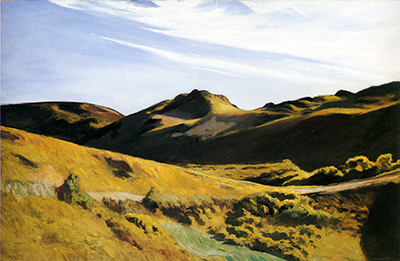
A rounded hill rises beyond a bright grassy hollow. Dark slopes extend to either side, while a pale road crosses the middle distance and turns towards the right. Edward Hopper's The Camel's Hump gives this apparently unremarkable stretch of Cape Cod a forceful arrangement of light, colour and uneven ground.
The painting dates from 1931. A museum exhibition record identifies oil on canvas, accession 57.160, Edward Wales Root Bequest, in the collection of the Munson-Williams-Proctor Arts Institute, now Munson, in Utica, New York. [1] Its broad landscape contains no prominent building or human figure. The main activity belongs to the way sunlight distinguishes one part of the terrain from another.
At a Glance
- ArtistEdward Hopper [1]
- Date1931 [1]
- Mediumoil on canvas [1]
- Collection / recordMunson Museum of Art, Utica (formerly Munson-Williams-Proctor Arts Institute) [1]
- Accession57.160 [1]
This work across Edward Hopper’s career
American Village
1912Soir Bleu
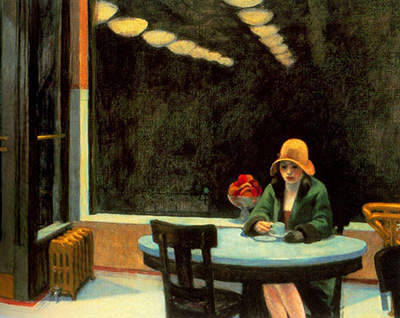
1914Automat
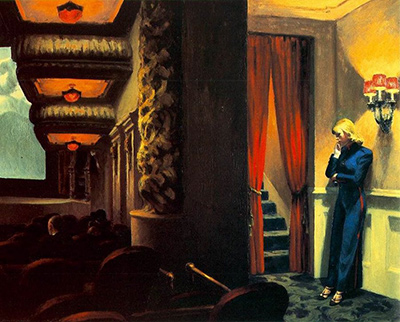
1927New York Movie
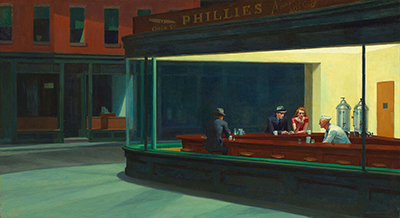
1939Nighthawks
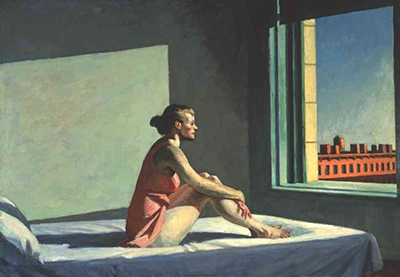
1942Morning Sun
1952Two Comedians
1966Contents
- A hill in Truro
- Sunlight across the foreground
- The darker bank at the right
- The road across the valley
- Sky and the low horizon
- Observation and invention
- A frame made for the painting
- Early exhibition and later collection
- Other Cape landscapes
A hill in Truro
The title refers to a hill in Truro on Cape Cod. In his discussion for the Whitney, curator Carter Foster locates the subject there and connects it with Hopper's early years of regular visits to the area. [2] The name belongs to this coastal landscape rather than identifying a distant mountain range.
The rounded central rise is not especially high within the canvas. It appears beyond several lower folds of land, with a dark side and a brighter shoulder making its shape clear. The surrounding slopes give it prominence through their directions and tonal differences.
This is a landscape understood by looking across and into it. The foreground descends towards a hollow, the road crosses beyond, and the land rises again towards the named hill. Hopper gives the eye a succession of changes in level before it reaches the most conspicuous summit.
The absence of a large architectural landmark makes those landforms carry more responsibility. A house or lighthouse could provide an immediate measure of size. Here, the relations between slopes, bushes, road and sky establish the scale more gradually.
Sunlight across the foreground
The near left slope is a broad area of yellow and warm green. Smaller marks suggest grass and uneven vegetation, while darker patches interrupt the light. Its brightness gives the foreground a substantial presence rather than treating it merely as a route towards the hill.
Lower down, cooler greens gather in the hollow. Bushes make irregular masses beside the more open grass, and the changing colour helps distinguish the descent from the slope above. The terrain has depth without requiring a clearly marked stream or a figure walking through it.
The brighter ground is not a single unbroken surface. Short changes of tone and colour give it texture, while selected paler passages connect across the slope. Hopper balances the larger shape of illumination with smaller indications of what covers the land.
The darker bank at the right
A heavily shaded slope occupies much of the right side. Its dark green and brown passages differ sharply from the bright foreground, creating one of the painting's strongest divisions. The ridge above remains irregular, with touches of lighter vegetation marking its edge.
The darkness gives the valley a more enclosed character. The eye can follow the brighter hollow towards the distance, but a substantial mass rises beside that opening. The scene therefore combines an extensive view with the physical presence of nearby land.
The central hill continues this contrast on a smaller scale. One face is darker, while a sunlit shoulder catches the eye near the top. Similar changes occur across the farther ridges, joining foreground and distance through repeated differences between exposed and shaded ground.
The effect is more specific than a general bright-day atmosphere. Light gives each slope a different orientation and weight. Hopper makes the landscape readable through those unequal areas, allowing shadow to establish form as decisively as the illuminated grass.
The road across the valley
The pale road is a narrow but important interruption. It crosses between vegetation and rising ground, curving as it moves towards the right edge. Its comparatively smooth line differs from the irregular bushes and grass around it.
The road supplies an ordinary human trace within an otherwise largely unbuilt view. No vehicle travels along it, and no conspicuous structure explains where it leads. Its role is to pass through the landscape and make a route visible without becoming the main subject.
Its colour also helps separate depths. The pale strip crosses a darker area, allowing the eye to distinguish the nearer hollow from the land behind. It gives a firmer direction to a terrain whose other edges are more broken and organic.
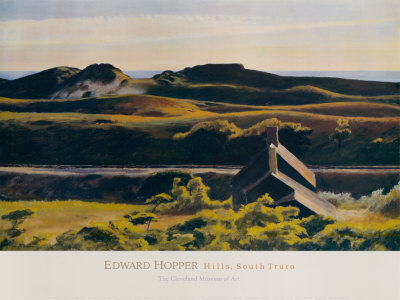
Compare: Hills South Truro, 1930.
Sky and the low horizon
The sky occupies a relatively shallow band above the ridges. Long pale cloud passages cross its blue surface, extending the horizontal reach of the landscape. Their lighter, softer forms differ from the darker, more firmly bounded hills below.
The central hump breaks that division without rising into a dramatic peak. Its rounded silhouette remains part of a continuous sequence of landforms. The picture gives the hill distinction while keeping the larger terrain present on both sides.
The proportions also keep attention near the ground. A much greater expanse of sky could have turned the hill into a small feature within changing weather. Here, the grassy hollow, shaded bank and connecting road remain large enough to reward sustained inspection.
Watch: Edward Hopper’s Life and Art
Explore Hopper’s paintings and the places behind them in these museum films. Choose a film below.
Observation and invention
Foster uses a drawing of the Truro subject to explain two aspects of Hopper's working practice: direct observation and later imaginative construction. In that account, a study made before the motif supplies material that can be reconsidered in the studio. [2] His discussion concerns a drawing and a method, rather than making the finished oil a complete record of one uninterrupted outdoor session.
That distinction is useful when looking at the canvas. The terrain feels particular, yet its strongest effect comes from selected relationships: the bright foreground against the dark bank, the road crossing the valley, and the rounded rise held beneath a narrow sky. Recognition of a place and deliberate organization of a painting can work together.
The year also places the scene before the completion of Hopper's own Truro house and studio. The Art Institute of Chicago's chronology records regular Cape summers from 1930, the land purchase in 1933 and the new home's completion in 1934. [3] The Camel's Hump belongs to the early development of a landscape subject he would continue to explore over many summers.
A frame made for the painting
The landscape also has a documented history of framing. Suzanne Smeaton and Lisa Koenigsberg identify a frame made by Carl Sandelin for The Camel's Hump, with an inscription naming the maker and his Lexington Avenue address. Their study describes scored gesso creating a crosshatched texture beneath silver gilding. [4]
The reproduced framed view shows a broad, restrained border around the uneven terrain. Its repeated straight mouldings differ from the organic slopes, giving the landscape a firm outer boundary. The quieter metallic surface allows the painting's yellows, greens and blue sky to remain the more conspicuous colours.
This is a particular object surrounding a particular canvas, rather than a generic decorative addition. The inscription and material description preserve the work of a craftsperson whose contribution might otherwise disappear when the image is reproduced without its frame.
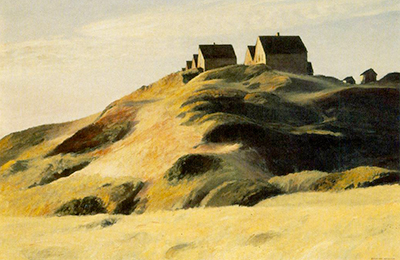
Compare: Corn Hill, 1930.
Early exhibition and later collection
The Museum of Modern Art included Camel's Hump as number 22 in its 1933 Hopper retrospective, describing the subject as Cape Cod and listing it as privately owned. [5] The entry places the recently painted landscape within an early major exhibition of the artist's work.
Its present museum identity is recorded through the Edward Wales Root Bequest and accession 57.160. [1] That collection history gives the rural view a place within a larger account of modern American painting, alongside Hopper's more familiar architectural and figure subjects.
Munson's 2010–11 annual report records a loan of the painting to the Fenimore Art Museum, together with two undated works by Jo Hopper described as a South Truro map and a Cape Cod Bay sketch. [6] These separate objects add a documentary connection with the local terrain; the loan record does not make Jo's sheets preparatory drawings for Edward's canvas.
Other Cape landscapes
Hills, South Truro brings buildings and a railway into a layered view of the Cape. The Camel's Hump gives the folds of land greater independence, allowing a small road and varied vegetation to establish the setting.
In Corn Hill, clustered roofs lead the eye up a more inhabited slope. Here, the broad yellow foreground and dark right bank make the terrain itself the strongest presence. Hopper finds enough variety in the meeting of hollow, road, rounded hill and light to sustain the picture without a prominent house or figure.
Artworks and studies directory
This researched directory includes finished works and separately identified studies. It is not a complete catalogue raisonné. Linked titles open the articles; unlinked studies are identified by their collection accessions. Watercolours retain their recorded media, and original prints remain distinct from reproductions.
| Name | Date | Medium |
|---|---|---|
| (Bridge and Embankment) (70.1298) | 1906 | Oil on wood |
| (Jo Sketching at Good Harbor Beach) (70.1129) | 1923–1924 | Watercolor and fabricated chalk on paper |
| (Manhattan Bridge) (70.1098) | 1925–1926 | Watercolor and graphite pencil on paper |
| (Rooftops) (70.1114) | 1926 | Watercolor and graphite pencil on paper |
| (Seated Male Model, Bent Over) (70.1277) | c. 1902–1903 | Oil on canvas |
| (Self-Portrait) (70.1254) | 1903–1906 | Oil on canvas |
| (Solitary Figure in a Theater) (70.1418) | c. 1902–1904 | Oil on board |
| 5 A.M. | 1937 | oil on canvas |
| Adam's House | 1928 | watercolour and charcoal on paper |
| American Village | 1912 | Oil on canvas |
| Apartment Houses | 1923 | oil on canvas |
| Approaching a City | 1946 | oil on canvas |
| August in the City | 1945 | oil on canvas |
| Automat | 1927 | oil on canvas |
| Barber Shop | 1931 | oil on canvas |
| Blackwell's Island | 1928 | oil on canvas |
| Bridge on the Seine | 1909 | Oil on canvas |
| Bridle Path | 1939 | oil on canvas |
| Burly Cobb's House South Truro | 1930–1933 | oil on canvas |
| Cape Cod Evening | 1939 | oil on canvas |
| Cape Cod Morning | 1950 | oil on canvas |
| Chair Car | 1965 | oil on canvas |
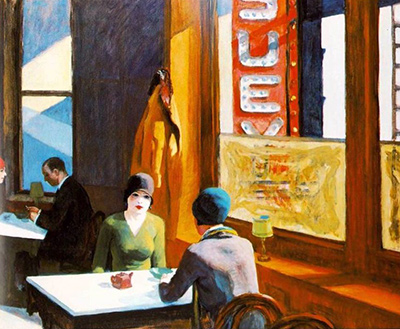
| Chop Suey | 1929 | oil on canvas |
| City Roofs | 1932 | Oil on canvas |
| Coast Guard Station | 1929 | oil on canvas |
| Compartment C, Car 293 | 1938 | oil on canvas |
| Conference at Night | 1949 | oil on canvas |
| Corn Hill | 1930 | oil on canvas |
| Dawn in Pennsylvania | 1942 | oil on canvas |
| Drug Store | 1927 | oil on canvas |
| Early Sunday Morning | 1930 | Oil on canvas |
| East Side Interior (70.1020) | 1922 | Etching |
| East Wind Over Weehawken | 1934 | oil on canvas |
| El Palacio | 1946 | Watercolor and graphite pencil on paper |
| Eleven A.M. | 1926 | oil on canvas |
| Evening Wind | 1921 | etching |
| Excursion into Philosophy | 1959 | oil on canvas |
| First Row Orchestra | 1951 | oil on canvas |
| Freight Car at Truro | 1931 | watercolour over graphite on paper |
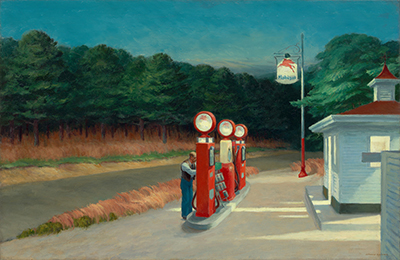
| Gas | 1940 | oil on canvas |
| Girl at a Sewing Machine | c. 1921 | oil on canvas |
| Gloucester Harbor | 1912 | Oil on canvas |
| Ground Swell | 1939 | oil on canvas |
| Haskell's House | 1924 | watercolour over graphite on paperboard |
| High Noon | 1949 | oil on canvas |
| Hill and Houses Cape Elizabeth Maine | 1927 | watercolour over graphite pencil |
| Hills South Truro | 1930 | oil on canvas |
| Hotel by a Railroad | 1952 | oil on canvas |
| Hotel Lobby | 1943 | oil on canvas |
| Hotel Room | 1931 | oil on canvas |
| Hotel Window | 1955 | oil on canvas |
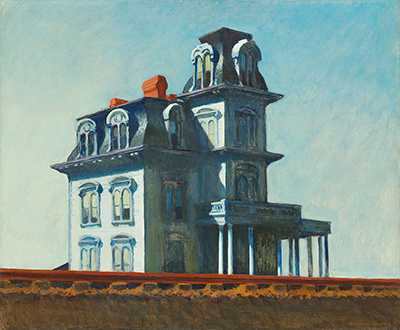
| House by the Railroad | 1925 | oil on canvas |
| House by the Squam River | 1926 | watercolour over graphite on paper |
| Le Bistro or The Wine Shop | 1909 | Oil on canvas |
| Le Pont des Arts | 1907 | Oil on canvas |
| Le Pont Royal | 1909 | Oil on canvas |
| Le Quai des Grands Augustins | 1909 | Oil on canvas |
| Lighthouse and Buildings Portland Head | 1927 | watercolour over graphite pencil on paper |
| Lighthouse Hill | 1927 | oil painting |
| Manhattan Bridge Loop | 1928 | oil on canvas |
| Model Sitting | c. 1902 | oil painting; support not asserted |
| Morning Sun | 1952 | oil on canvas |
| New York Movie | 1939 | oil on canvas |
| New York New Haven and Hartford | 1931 | oil on canvas |
| New York Office | 1962 | oil on canvas |
| New York Pavements | 1924–1925 | oil on canvas |
| New York Restaurant | c. 1922 | oil on canvas |
| Night Windows | 1928 | oil on canvas |
| Nighthawks | 1942 | oil on canvas |
| October on Cape Cod | 1946 | oil on canvas |
| Office at Night | 1940 | oil on canvas |
| Office in a Small City | 1953 | oil on canvas |
| Pennsylvania Coal Town | 1947 | oil on canvas |
| People in the Sun | 1960 | oil on canvas |
| Portrait of Orleans | 1950 | oil on canvas |
| Queensborough Bridge | 1913 | Oil on canvas |
| Railroad Sunset | 1929 | Oil on canvas |
| Railroad Train | 1908 | oil on canvas |
| Road in Maine | 1914 | oil on canvas |
| Room in Brooklyn | 1932 | oil on canvas |
| Room in New York | 1932 | oil on canvas |
| Rooms by the Sea | 1951 | oil on canvas |
| Rooms for Tourists | 1945 | oil on canvas |
| Route 6 Eastham | 1941 | oil on canvas |
| Second Story Sunlight | 1960 | Oil on canvas |
| Self-Portrait | 1925–1930 | Oil on canvas |
| Self-Portrait with Hat (70.1903) | c. 1918, posthumous print | Drypoint |
| Seven A.M. | 1948 | Oil on canvas |
| Soir Bleu | 1914 | oil on canvas |
| South Carolina Morning | 1955 | Oil on canvas |
| Stairway at 48 Rue de Lille Paris | 1906 | Oil on wood |
| Study for 5 A.M. (70.153) | 1937 | Fabricated chalk on paper |
| Study for 5 A.M. (70.429) | 1937 | Fabricated chalk and graphite pencil on paper |
| Study for Approaching a City (70.869) | 1946 | Fabricated chalk and charcoal on paper |
| Study for August in the City (70.158a-b) | 1945 | Fabricated chalk on paper |
| Study for August in the City (70.159) | 1945 | Fabricated chalk on paper |
| Study for Bridle Path (70.220) | 1939 | Fabricated chalk on paper |
| Study for Bridle Path (70.235) | 1939 | Fabricated chalk on paper |
| Study for Compartment C, Car 293 (70.430) | 1938 | Fabricated chalk on paper |
| Study for Compartment C, Car 293 (70.431a-b) | 1938 | Fabricated chalk and charcoal on paper |
| Study for Conference at Night (70.170) | 1949 | Fabricated chalk on paper (recto); Typewriter ink on paper (verso) |
| Study for Conference at Night (70.174) | 1949 | Fabricated chalk on paper ( recto); Typewriter ink on paper (verso) |
| Study for East Wind over Weehawken (70.249) | 1934 | Graphite pencil on paper |
| Study for East Wind over Weehawken (70.252) | 1934 | Fabricated chalk and charcoal on paper |
| Study for Evening Wind (70.343a-b) | 1921 | Fabricated chalk on paper |
| Study for First Row Orchestra (70.841) | 1951 | Fabricated chalk and charcoal on paper |
| Study for Gas (70.263) | 1940 | Fabricated chalk on paper |
| Study for Ground Swell (70.339) | 1939 | Fabricated chalk, charcoal and graphite pencil on paper |
| Study for Hotel by a Railroad (70.199) | 1952 | Fabricated chalk on paper |
| Study for Hotel by a Railroad (70.427) | 1952 | Fabricated chalk on paper |
| Study for Hotel by a Railroad (70.428) | 1952 | Fabricated chalk on paper |
| Study for Hotel Lobby (70.117) | 1942 | Fabricated chalk and graphite pencil on paper |
| Study for Hotel Lobby (70.839) | 1942 | Fabricated chalk and charcoal on paper |
| Study for Hotel Window (70.161) | 1955 | Fabricated chalk, graphite pencil and colored pencil on paper |
| Study for Morning Sun (70.243) | 1952 | Fabricated chalk on paper |
| Study for Morning Sun (70.244) | 1952 | Fabricated chalk on paper |
| Study for Morning Sun (70.290) | 1952 | Fabricated chalk on paper |
| Study for Morning Sun (70.291) | 1952 | Fabricated chalk and graphite pencil on paper |
| Study for New York Movie (70.273) | 1939 | Fabricated chalk on paper |
| Study for New York Movie (70.274a-b) | 1938 or 1939 | Fabricated chalk and charcoal on paper (recto); Fabricated chalk on paper (verso) |
| Study for New York Movie (70.455) | 1939 | Fabricated chalk and charcoal on paper |
| Study for New York Office (70.822) | 1962 | Fabricated chalk on paper |
| Study for Nighthawks (70.192) | 1941 or 1942 | Fabricated chalk on paper |
| Study for Nighthawks (70.193) | 1941 or 1942 | Fabricated chalk on paper |
| Study for Office at Night (70.340) | 1940 | Fabricated chalk and charcoal on paper |
| Study for Office at Night (70.341) | 1940 | Fabricated chalk and graphite pencil on paper |
| Study for Pennsylvania Coal Town (70.198) | 1947 | Fabricated chalk on paper |
| Study for Pennsylvania Coal Town (70.229) | 1947 | Fabricated chalk and charcoal on paper |
| Study for Rooms for Tourists (70.438) | 1945 | Fabricated chalk and charcoal on paper |
| Study for Rooms for Tourists (70.848) | 1945 | Fabricated chalk and charcoal on paper |
| Study for Route 6, Eastham (70.369) | 1941 | Fabricated chalk and graphite pencil on paper |
| Study for Route 6, Eastham (70.854) | 1941 | Fabricated chalk and graphite pencil on paper |
| Study for South Carolina Morning (70.162a-b) | 1955 | Fabricated chalk on paper (recto and verso) |
| Study for The Sheridan Theatre (70.969) | 1937 | Graphite pencil on paper |
| Study for Two on the Aisle (70.128) | 1927 | Fabricated chalk on paper |
| Study for Two on the Aisle (70.129) | 1927 | Fabricated chalk on paper |
| Study for Yawl Riding a Swell (70.439) | 1935 | Fabricated chalk and graphite pencil on paper |
| Summer Evening | 1947 | oil on canvas |
| Summer Interior | 1909 | Oil on canvas |
| Sun in an Empty Room | 1963 | oil on canvas |
| Sunlight in a Cafeteria | 1958 | oil on canvas |
| Sunlight on Brownstones | 1956 | oil on canvas |
| Tables for Ladies | 1930 | oil on canvas |
| The Bootleggers | 1925 | oil on canvas |
| The Camel's Hump | 1931 | oil on canvas |
| The Circle Theatre | 1936 | oil on canvas |
| The City | 1927 | oil on canvas |
| The Lighthouse at Two Lights | 1929 | oil on canvas |
| The Long Leg | 1935 | oil on canvas |
| The Mansard Roof | 1923 | watercolour over graphite on paper |
| The Sheridan Theatre | 1937 | oil on canvas |
| Tramp Steamer | 1908 | oil on canvas |
| Two Comedians | 1966 | oil on canvas |
| Two on the Aisle | 1927 | oil on canvas |
| Valley of the Seine | 1909 | Oil on canvas |
| Western Motel | 1957 | oil on canvas |
Frequently Asked Questions
Edward Hopper made The Camel's Hump in 1931. [1]
The recorded medium is oil on canvas. [1]
A rounded hill rises beyond a bright grassy hollow. Dark slopes extend to either side, while a pale road crosses the middle distance and turns towards the right. Edward Hopper's The Camel's Hump gives this apparently unremarkable stretch of Cape Cod a forceful arrangement of light, colour and uneven ground.
Discussion
Look again at the images and ideas explored in The Camel's Hump. These editorial prompts invite your observations.
Reader Insights
Which boundary, gesture or change of light first holds your attention in The Camel's Hump?
Compare Hills South Truro with The Camel's Hump. Which visual difference matters most to your reading?
Which detail would you look at again after reading “The darker bank at the right”?
Join the Conversation
Share a detail, comparison or question about The Camel's Hump below.
References
- Everson Museum of Art, Prendergast to Pollock: American Modernism from the Munson-Williams-Proctor Arts Institute, education guide, PDF pp. 2 and 4; museum loan identity, 1931 oil, Edward Wales Root Bequest, accession 57.160. View source.
- Carter Foster, “Edward Hopper, The Camel's Hump, 1931”, Whitney Museum of American Art, 21 May 2013, transcript; the Truro subject and direct observation versus studio invention, discussed through a drawing. View source.
- Art Institute of Chicago, Edward Hopper: Selected Chronology, 1930–34; Cape summers, land purchase and Truro house. View source.
- Suzanne Smeaton and Lisa Koenigsberg, “Trends in Modern American Framing: The Edward Wales Root Bequest—A Case Study”, in Mary E. Murray, Paul D. Schweizer and Michael D. Somple, Auspicious Vision: Edward Wales Root and American Modernism, Utica, Munson-Williams-Proctor Arts Institute, 2008, p. 6, fig. 5 and note 20; Sandelin's frame and inscription. View source.
- Museum of Modern Art, Edward Hopper, 1933, catalogue no. 22, printed p. 27; historical Cape Cod date and private-collection entry. View source.
- Munson-Williams-Proctor Arts Institute, Annual Report 2010–2011, PDF p. 7, printed p. 5, loans to A Window into Edward Hopper, Fenimore Art Museum, 28 May–11 September 2011; painting and two separately attributed Jo Hopper map/sketch titles. View source.
- Collection or catalogue record, American Village, 1912; medium and identity as discussed in the linked article. View source.
- Collection or catalogue record, Soir Bleu, 1914; medium and identity as discussed in the linked article. View source.
- Collection or catalogue record, House by the Railroad, 1925; medium and identity as discussed in the linked article. View source.
- Collection or catalogue record, Automat, 1927; medium and identity as discussed in the linked article. View source.
- Collection or catalogue record, Early Sunday Morning, 1930; medium and identity as discussed in the linked article. View source.
- Collection or catalogue record, New York Movie, 1939; medium and identity as discussed in the linked article. View source.
- Collection or catalogue record, Nighthawks, 1942; medium and identity as discussed in the linked article. View source.
- Collection or catalogue record, Morning Sun, 1952; medium and identity as discussed in the linked article. View source.
- Collection or catalogue record, Second Story Sunlight, 1960; medium and identity as discussed in the linked article. View source.
- Collection or catalogue record, Two Comedians, 1966; medium and identity as discussed in the linked article. View source.
- Whitney Museum of American Art, Study for Route 6, Eastham, 1941, accession 70.854; exact object record. View source.
- Whitney Museum of American Art, Study for Conference at Night, 1949, accession 70.170; exact object record. View source.
- Whitney Museum of American Art, Study for First Row Orchestra, 1951, accession 70.841; exact object record. View source.
- Whitney Museum of American Art, (Bridge and Embankment), 1906, accession 70.1298; exact object record. View source.
- Whitney Museum of American Art, (Seated Male Model, Bent Over), c. 1902–1903, accession 70.1277; exact object record. View source.
- Whitney Museum of American Art, Study for Morning Sun, 1952, accession 70.244; exact object record. View source.
- Whitney Museum of American Art, Study for Morning Sun, 1952, accession 70.243; exact object record. View source.
- Whitney Museum of American Art, Study for Two on the Aisle, 1927, accession 70.128; exact object record. View source.
- Whitney Museum of American Art, Study for New York Office, 1962, accession 70.822; exact object record. View source.
- Whitney Museum of American Art, Study for Two on the Aisle, 1927, accession 70.129; exact object record. View source.
- Whitney Museum of American Art, Study for Pennsylvania Coal Town, 1947, accession 70.229; exact object record. View source.
- Whitney Museum of American Art, (Rooftops), 1926, accession 70.1114; exact object record. View source.
- Whitney Museum of American Art, Study for South Carolina Morning, 1955, accession 70.162a-b; exact object record. View source.
- Whitney Museum of American Art, (Self-Portrait), 1903–1906, accession 70.1254; exact object record. View source.
- Whitney Museum of American Art, (Manhattan Bridge), 1925–1926, accession 70.1098; exact object record. View source.
- Whitney Museum of American Art, (Solitary Figure in a Theater), c. 1902–1904, accession 70.1418; exact object record. View source.
- Whitney Museum of American Art, Study for Approaching a City, 1946, accession 70.869; exact object record. View source.
- Whitney Museum of American Art, Study for August in the City, 1945, accession 70.159; exact object record. View source.
- Whitney Museum of American Art, Study for Compartment C, Car 293, 1938, accession 70.430; exact object record. View source.
- Whitney Museum of American Art, Study for Compartment C, Car 293, 1938, accession 70.431a-b; exact object record. View source.
- Whitney Museum of American Art, Study for East Wind over Weehawken, 1934, accession 70.252; exact object record. View source.
- Whitney Museum of American Art, Study for East Wind over Weehawken, 1934, accession 70.249; exact object record. View source.
- Whitney Museum of American Art, Study for Evening Wind, 1921, accession 70.343a-b; exact object record. View source.
- Whitney Museum of American Art, Study for The Sheridan Theatre, 1937, accession 70.969; exact object record. View source.
- Whitney Museum of American Art, Study for New York Movie, 1939, accession 70.455; exact object record. View source.
- Whitney Museum of American Art, Study for New York Movie, 1939, accession 70.273; exact object record. View source.
- Whitney Museum of American Art, Study for New York Movie, 1938 or 1939, accession 70.274a-b; exact object record. View source.
- Whitney Museum of American Art, Study for 5 A.M., 1937, accession 70.153; exact object record. View source.
- Whitney Museum of American Art, Study for 5 A.M., 1937, accession 70.429; exact object record. View source.
- Whitney Museum of American Art, (Jo Sketching at Good Harbor Beach), 1923–1924, accession 70.1129; exact object record. View source.
- Whitney Museum of American Art, Study for August in the City, 1945, accession 70.158a-b; exact object record. View source.
- Whitney Museum of American Art, Study for Morning Sun, 1952, accession 70.291; exact object record. View source.
- Whitney Museum of American Art, Study for Morning Sun, 1952, accession 70.290; exact object record. View source.
- Whitney Museum of American Art, Study for Office at Night, 1940, accession 70.340; exact object record. View source.
- Whitney Museum of American Art, Study for Office at Night, 1940, accession 70.341; exact object record. View source.
- Whitney Museum of American Art, Study for Hotel by a Railroad, 1952, accession 70.427; exact object record. View source.
- Whitney Museum of American Art, Study for Hotel by a Railroad, 1952, accession 70.199; exact object record. View source.
- Whitney Museum of American Art, Study for Hotel by a Railroad, 1952, accession 70.428; exact object record. View source.
- Whitney Museum of American Art, Study for Hotel Lobby, 1942, accession 70.117; exact object record. View source.
- Whitney Museum of American Art, Study for Hotel Lobby, 1942, accession 70.839; exact object record. View source.
- Whitney Museum of American Art, Study for Conference at Night, 1949, accession 70.174; exact object record. View source.
- Whitney Museum of American Art, Study for Hotel Window, 1955, accession 70.161; exact object record. View source.
- Whitney Museum of American Art, Study for Pennsylvania Coal Town, 1947, accession 70.198; exact object record. View source.
- Whitney Museum of American Art, Study for Route 6, Eastham, 1941, accession 70.369; exact object record. View source.
- Whitney Museum of American Art, Study for Bridle Path, 1939, accession 70.220; exact object record. View source.
- Whitney Museum of American Art, Study for Bridle Path, 1939, accession 70.235; exact object record. View source.
- Whitney Museum of American Art, Study for Ground Swell, 1939, accession 70.339; exact object record. View source.
- Whitney Museum of American Art, Study for Yawl Riding a Swell, 1935, accession 70.439; exact object record. View source.
- Whitney Museum of American Art, Study for Rooms for Tourists, 1945, accession 70.848; exact object record. View source.
- Whitney Museum of American Art, Study for Rooms for Tourists, 1945, accession 70.438; exact object record. View source.
- Whitney Museum of American Art, Study for Nighthawks, 1941 or 1942, accession 70.193; exact object record. View source.
- Whitney Museum of American Art, Study for Nighthawks, 1941 or 1942, accession 70.192; exact object record. View source.
- Whitney Museum of American Art, Study for Gas, 1940, accession 70.263; exact object record. View source.
- Whitney Museum of American Art, Self-Portrait with Hat, c. 1918, posthumous print, accession 70.1903; exact object record. View source.
- Whitney Museum of American Art, East Side Interior, 1922, accession 70.1020; exact object record. View source.
- Art Institute of Chicago, Selected Chronology for Edward Hopper; training, travels, exhibitions, New York and Truro chronology. View source.
- Emily C. Burns, Spectral figures: Edward Hopper’s empty Paris, chapter 5 in Empty Spaces: Confronting Emptiness in National, Cultural and Urban Histories, 2019; complete chapter and notes consulted. View source.
- Charles Brock, Regionalism and Folk Art, National Gallery of Art; complete essay and two notes consulted. View source.