 by Tom Gurney
Tom Gurney BSc (Hons) is an art history expert with over 20 years experience
Email: tomgurney1@gmail.com / Phone: +44 7429 011000
Hills, South Truro: Introduction
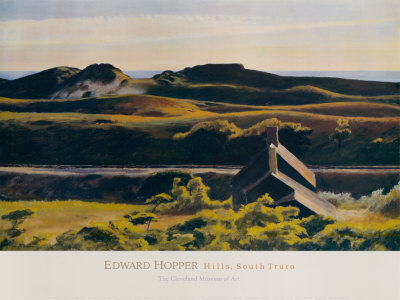
A steep roof rises out of the bright foreground, its chimney cutting a narrow upright through the land behind. Beyond the house, a railway crosses the view. Then the ground unfolds into successive hills, with long shadows gathering in their hollows and a thin blue strip of water near the horizon. Edward Hopper's Hills, South Truro makes the landscape expansive while keeping one small building close enough to give that expanse a measure.
Hopper painted the oil on canvas in 1930. The Cleveland Museum of Art records its unframed dimensions as 69.5 × 109.5 cm and holds it in the Hinman B. Hurlbut Collection, accession 1931.2647. At just over a metre wide, the canvas gives its layers of ground considerable room to develop. [1]
The date places the painting at the beginning of the Hoppers' long association with Truro. Their first summer there was in 1930; they bought land in 1933 and completed their own house in July 1934. The building depicted here belongs to that earlier encounter with the area. [2]
At a Glance
- ArtistEdward Hopper [1]
- Date1930 [1]
- Mediumoil on canvas [1]
- Collection / recordCleveland Museum of Art [1]
- Accession1931.2647 [1]
This work across Edward Hopper’s career
American Village
1912Soir Bleu
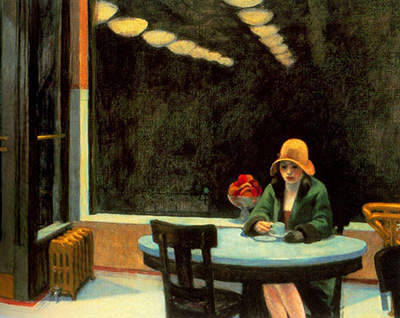
1914Automat
1927New York Movie
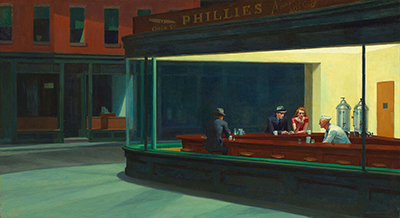
1939Nighthawks
1942Morning Sun
1952Two Comedians
1966Contents
- A landscape built in layers
- The house as a foreground measure
- The straight railway and the turning land
- Hills shaped by light and shadow
- Bright vegetation and a quiet horizon
- The Hogsback and a working South Truro
- An early museum acquisition
- A landscape with more than one emphasis
A landscape built in layers
The view is organized through a series of broad horizontal passages. Bright foreground vegetation gives way to the house and railway, then to a darker belt and the rolling land beyond. Near the top, water and sky establish more continuous bands. Each layer has its own degree of light, texture and emphasis.
Writing about the painting in 1932, Cleveland curator Henry Sayles Francis identified roughly seven horizontal planes, interrupted by a smaller number of vertical forms. His early account makes the picture's construction a central part of its interest. [3]
The layers do not look like separate strips laid one above another. The hills rise and fall, the nearer vegetation breaks into small shapes, and the house cuts across the lower intervals. Hopper allows the general order to remain clear while varying its boundaries.
This combination gives the panorama depth without depending on a road winding towards a single vanishing point. We move into the distance by comparing one area with the next. Differences of scale, colour and contrast tell us how far each part lies from the spectator.
The result is a landscape that can be read broadly and locally. A first glance grasps the long succession of landforms. A closer look finds changes within a slope, a bright patch of exposed ground or the exact turn of the near roof. The composition supports several distances of attention.
The house as a foreground measure
Much of the house is concealed by the near ground and vegetation. Its roof remains the most emphatic part, forming a pair of steeply angled planes beside the chimney. The building feels close because the picture gives us a view across its upper structure, with its lower portion partly hidden.
One roof plane is much lighter than the other. The difference makes the form turn decisively in space. Its sharp geometry contrasts with the softer changes in the hills behind, giving the eye a compact, easily understood object before the larger landscape opens out.
The chimney is especially important. Thin and upright, it interrupts several horizontal intervals at once. It links the near building with the darker band behind it and gives the lower scene a clear point of emphasis. A modest architectural feature can organize a much wider field around it.
The house also supplies a human scale without presenting a person. Its familiar proportions help us judge the surrounding vegetation and the height of the land beyond. The building makes the hills feel larger by giving us something smaller and more readily measurable within their setting.
The straight railway and the turning land
The railway introduces an unusually firm horizontal across the lower part of the landscape. It cuts through the view more directly than the changing contours of the hills. Its continuity gives the eye a stable line against which to judge the land's movement.
There is a difference between following that line and exploring the slopes. The track suggests a route extending laterally beyond the frame. The hills invite attention to their rises, dips and overlapping shapes. One element is directed through the terrain; the others describe the terrain's own variations.
The railway also establishes an interval between the near house and the further land. A band of darker ground and vegetation gathers around it, separating the foreground brightness from the sunlit hills. The crossing line therefore has a spatial role as well as a practical one.
No train occupies it in the painting. Its presence is enough to introduce the idea of travel into the landscape, while leaving the broad forms unobstructed. The route can be understood through its structure and course, just as the house can be understood through its roof.
The interplay is particularly effective because the railway does not demand the largest share of attention. Its relatively narrow band remains a strong organizing element within a view dominated by land and light. Hopper integrates infrastructure into the panorama without making a passing vehicle its main event.
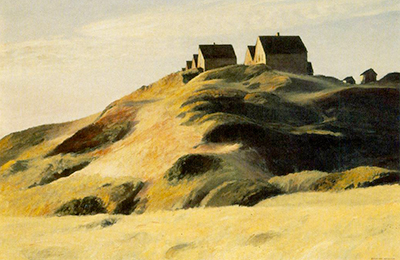
Compare: Corn Hill, 1930.
Hills shaped by light and shadow
The distant land rises in a sequence of rounded and irregular forms. Some slopes catch warm light; others fall into deep green and brown shadow. The changes make the hills feel sculptural, with each rise presenting a different surface to the illumination.
Pale exposed ground appears among the darker forms towards the left. Its brightness gives that part of the distance a distinct accent. The painting can move from one broad area to another without losing the smaller variations that make the terrain particular.
The hills also overlap. A darker ridge can conceal part of the next, while a lighter slope seems to emerge between two more shadowed masses. These relationships make distance continuous. The eye moves through intervals rather than jumping from one isolated hill to another.
Their outlines are less rigid than the roof's edges. The contrast gives the architecture and land different kinds of presence. The house is assembled from clear planes and a narrow chimney; the hills are understood through long contours and changing fields of colour.
The painting's wide proportions allow those contours to develop. A hill can rise slowly, stretch into a lower ridge and meet another form further along. Hopper gives the viewer time to follow the land laterally as well as into the distance.
Bright vegetation and a quiet horizon
The foreground has a much finer surface. Yellow-green growth catches the light in small, irregular patches, with darker intervals between. Its broken rhythm contrasts with the larger areas of colour in the hills. The difference helps establish nearness.
Around the house, the vegetation partly conceals the building while making its dark roof more visible. Light and obstruction work together. The foreground does not have to be empty for the architecture to stand out; it has to provide a sufficiently distinct surrounding tone and pattern.
Near the horizon, a thin strip of blue water offers another change. Its relatively continuous colour differs from the rolling ground below and the pale sky above. Even a narrow glimpse can suggest a more extensive body of water beyond the hills.
The sky is arranged in long, soft passages of cream, peach and cooler grey. Its horizontal movement continues the broad order of the landscape while reducing the amount of internal detail. After the intricate near vegetation and forceful hill shadows, this upper area gives the picture a calmer limit.
The colour range is richer than the scene's apparent simplicity first suggests. Bright green, deep brown, muted blue and warm pale sky all carry different parts of the view. Their distribution makes the image feel spacious without weakening its structure.
Watch: Edward Hopper’s Life and Art
Explore Hopper’s paintings and the places behind them in these museum films. Choose a film below.
The Hogsback and a working South Truro
The Truro Historical Commission and Truro Historical Society identify the hills in the painting with the area known as the Hogsback. Their 2023 guide explains the name through an old comparison with animals gathered in a pen. The local name gives the landforms a historical presence beyond their role within Hopper's composition. [4]
The same guide places the old South Truro centre near Old County Road and Ryder Beach Road, with a post office and railway station. Its station history records the end of passenger service in July 1938 and the continuation of freight service until 1960. The painting's 1930 date therefore belongs to a period when the railway was still part of the area's transport life. [4]
That context enriches the straight line across the scene. The landscape contains a house, a railway and locally recognized hills, bringing different kinds of human association together. It is a particular place with practical routes and remembered names, as well as a carefully organized field of colour.
The title keeps its attention on the land. The house remains subordinate in scale, and the railway occupies a narrow passage. Yet both help establish how the hills are encountered. The panorama gains meaning through the relation between a large terrain and the structures placed within it.
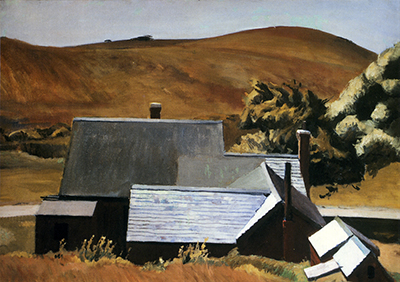
Compare: Burly Cobb's House South Truro, 1930–1933.
An early museum acquisition
Francis's 1932 article supplies a precise account of the painting's arrival in Cleveland. He states that the museum added Hills, South Truro to the Hurlbut Collection in June 1931 from its Eleventh Annual Exhibition of Contemporary American Oils. The work therefore entered a museum collection soon after it was painted. [3]
His discussion praises colour, control and an individual compositional viewpoint. It also interprets Hopper's restraint through Puritan discipline and a strongly national idea of American art. Quoting Guy Pène du Bois, Francis presents the landscape as a particularly accomplished and dignified expression of the artist's work. These are revealing judgments from its early reception. [3]
The period language adds a historical layer to the picture. The forms before us were being valued not only for their appearance, but for qualities critics associated with a national artistic character. That context helps explain how a relatively unassuming Cape Cod landscape could acquire such importance within contemporary collecting.
The painting soon appeared in Hopper's 1933 Museum of Modern Art retrospective. Its catalogue lists Hills, South Truro as a 1930 oil in the Cleveland Museum of Art collection. The early exhibition placed this landscape beside the urban, architectural and coastal subjects through which his reputation was taking shape. [5]
A landscape with more than one emphasis
Cleveland's present interpretation emphasizes the solitary house and the sense of solitude within the terrain. That reading directs attention towards the building's small scale and its separation from other visible dwellings. It is one way to experience the relationship between foreground and distance. [1]
The same arrangement can also make colour and breadth especially compelling. The near vegetation is luminous, the hills have substantial volume, and the narrow sea opens a further distance. The house provides a point from which to measure these qualities. Its smallness can intensify the landscape's abundance as well as its quietness.
Later exhibitions have placed the work in different contexts. Cleveland's loan history includes Hopper Drawing at the Whitney in 2013 and the 2022 Lausanne exhibition Train Zug Treno Tren: Voyages imaginaires. [1] The latter explored railway subjects as material for artistic imagination, with Hopper among its artists. [6]
The railway line helps explain why the picture can reward that further emphasis. A scene dominated by hills can also contain the suggestion of a journey, extending across the frame without a visible destination. The house, track and land remain available to one another within a coherent arrangement.
Returning to the roof, the viewer can follow its bright edge towards the chimney, then let the hills carry attention into the distance. The near building gives a scale to the land; the land gives the building a setting far greater than itself. Hopper makes both relationships visible within a single expansive view.
Artworks and studies directory
This researched directory includes finished works and separately identified studies. It is not a complete catalogue raisonné. Linked titles open the articles; unlinked studies are identified by their collection accessions. Watercolours retain their recorded media, and original prints remain distinct from reproductions.
| Name | Date | Medium |
|---|---|---|
| (Bridge and Embankment) (70.1298) | 1906 | Oil on wood |
| (Jo Sketching at Good Harbor Beach) (70.1129) | 1923–1924 | Watercolor and fabricated chalk on paper |
| (Manhattan Bridge) (70.1098) | 1925–1926 | Watercolor and graphite pencil on paper |
| (Rooftops) (70.1114) | 1926 | Watercolor and graphite pencil on paper |
| (Seated Male Model, Bent Over) (70.1277) | c. 1902–1903 | Oil on canvas |
| (Self-Portrait) (70.1254) | 1903–1906 | Oil on canvas |
| (Solitary Figure in a Theater) (70.1418) | c. 1902–1904 | Oil on board |
| 5 A.M. | 1937 | oil on canvas |
| Adam's House | 1928 | watercolour and charcoal on paper |
| American Village | 1912 | Oil on canvas |
| Apartment Houses | 1923 | oil on canvas |
| Approaching a City | 1946 | oil on canvas |
| August in the City | 1945 | oil on canvas |
| Automat | 1927 | oil on canvas |
| Barber Shop | 1931 | oil on canvas |
| Blackwell's Island | 1928 | oil on canvas |
| Bridge on the Seine | 1909 | Oil on canvas |
| Bridle Path | 1939 | oil on canvas |
| Burly Cobb's House South Truro | 1930–1933 | oil on canvas |
| Cape Cod Evening | 1939 | oil on canvas |
| Cape Cod Morning | 1950 | oil on canvas |
| Chair Car | 1965 | oil on canvas |
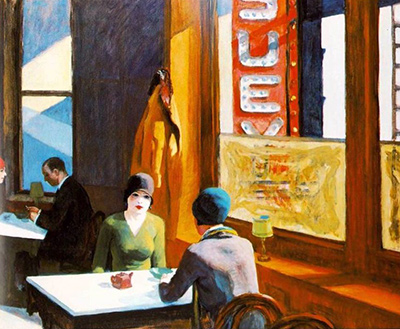
| Chop Suey | 1929 | oil on canvas |
| City Roofs | 1932 | Oil on canvas |
| Coast Guard Station | 1929 | oil on canvas |
| Compartment C, Car 293 | 1938 | oil on canvas |
| Conference at Night | 1949 | oil on canvas |
| Corn Hill | 1930 | oil on canvas |
| Dawn in Pennsylvania | 1942 | oil on canvas |
| Drug Store | 1927 | oil on canvas |
| Early Sunday Morning | 1930 | Oil on canvas |
| East Side Interior (70.1020) | 1922 | Etching |
| East Wind Over Weehawken | 1934 | oil on canvas |
| El Palacio | 1946 | Watercolor and graphite pencil on paper |
| Eleven A.M. | 1926 | oil on canvas |
| Evening Wind | 1921 | etching |
| Excursion into Philosophy | 1959 | oil on canvas |
| First Row Orchestra | 1951 | oil on canvas |
| Freight Car at Truro | 1931 | watercolour over graphite on paper |
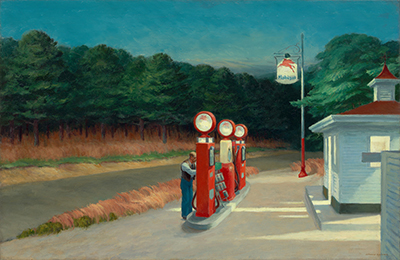
| Gas | 1940 | oil on canvas |
| Girl at a Sewing Machine | c. 1921 | oil on canvas |
| Gloucester Harbor | 1912 | Oil on canvas |
| Ground Swell | 1939 | oil on canvas |
| Haskell's House | 1924 | watercolour over graphite on paperboard |
| High Noon | 1949 | oil on canvas |
| Hill and Houses Cape Elizabeth Maine | 1927 | watercolour over graphite pencil |
| Hills South Truro | 1930 | oil on canvas |
| Hotel by a Railroad | 1952 | oil on canvas |
| Hotel Lobby | 1943 | oil on canvas |
| Hotel Room | 1931 | oil on canvas |
| Hotel Window | 1955 | oil on canvas |
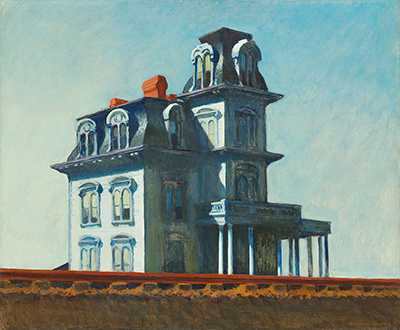
| House by the Railroad | 1925 | oil on canvas |
| House by the Squam River | 1926 | watercolour over graphite on paper |
| Le Bistro or The Wine Shop | 1909 | Oil on canvas |
| Le Pont des Arts | 1907 | Oil on canvas |
| Le Pont Royal | 1909 | Oil on canvas |
| Le Quai des Grands Augustins | 1909 | Oil on canvas |
| Lighthouse and Buildings Portland Head | 1927 | watercolour over graphite pencil on paper |
| Lighthouse Hill | 1927 | oil painting |
| Manhattan Bridge Loop | 1928 | oil on canvas |
| Model Sitting | c. 1902 | oil painting; support not asserted |
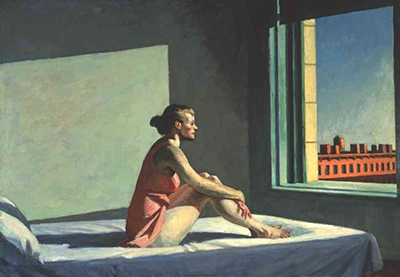
| Morning Sun | 1952 | oil on canvas |
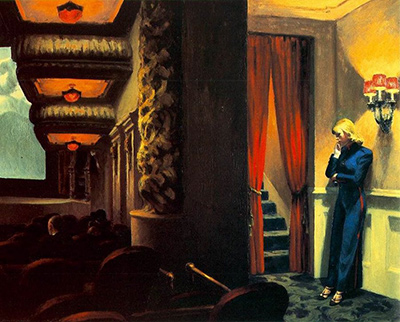
| New York Movie | 1939 | oil on canvas |
| New York New Haven and Hartford | 1931 | oil on canvas |
| New York Office | 1962 | oil on canvas |
| New York Pavements | 1924–1925 | oil on canvas |
| New York Restaurant | c. 1922 | oil on canvas |
| Night Windows | 1928 | oil on canvas |
| Nighthawks | 1942 | oil on canvas |
| October on Cape Cod | 1946 | oil on canvas |
| Office at Night | 1940 | oil on canvas |
| Office in a Small City | 1953 | oil on canvas |
| Pennsylvania Coal Town | 1947 | oil on canvas |
| People in the Sun | 1960 | oil on canvas |
| Portrait of Orleans | 1950 | oil on canvas |
| Queensborough Bridge | 1913 | Oil on canvas |
| Railroad Sunset | 1929 | Oil on canvas |
| Railroad Train | 1908 | oil on canvas |
| Road in Maine | 1914 | oil on canvas |
| Room in Brooklyn | 1932 | oil on canvas |
| Room in New York | 1932 | oil on canvas |
| Rooms by the Sea | 1951 | oil on canvas |
| Rooms for Tourists | 1945 | oil on canvas |
| Route 6 Eastham | 1941 | oil on canvas |
| Second Story Sunlight | 1960 | Oil on canvas |
| Self-Portrait | 1925–1930 | Oil on canvas |
| Self-Portrait with Hat (70.1903) | c. 1918, posthumous print | Drypoint |
| Seven A.M. | 1948 | Oil on canvas |
| Soir Bleu | 1914 | oil on canvas |
| South Carolina Morning | 1955 | Oil on canvas |
| Stairway at 48 Rue de Lille Paris | 1906 | Oil on wood |
| Study for 5 A.M. (70.153) | 1937 | Fabricated chalk on paper |
| Study for 5 A.M. (70.429) | 1937 | Fabricated chalk and graphite pencil on paper |
| Study for Approaching a City (70.869) | 1946 | Fabricated chalk and charcoal on paper |
| Study for August in the City (70.158a-b) | 1945 | Fabricated chalk on paper |
| Study for August in the City (70.159) | 1945 | Fabricated chalk on paper |
| Study for Bridle Path (70.220) | 1939 | Fabricated chalk on paper |
| Study for Bridle Path (70.235) | 1939 | Fabricated chalk on paper |
| Study for Compartment C, Car 293 (70.430) | 1938 | Fabricated chalk on paper |
| Study for Compartment C, Car 293 (70.431a-b) | 1938 | Fabricated chalk and charcoal on paper |
| Study for Conference at Night (70.170) | 1949 | Fabricated chalk on paper (recto); Typewriter ink on paper (verso) |
| Study for Conference at Night (70.174) | 1949 | Fabricated chalk on paper ( recto); Typewriter ink on paper (verso) |
| Study for East Wind over Weehawken (70.249) | 1934 | Graphite pencil on paper |
| Study for East Wind over Weehawken (70.252) | 1934 | Fabricated chalk and charcoal on paper |
| Study for Evening Wind (70.343a-b) | 1921 | Fabricated chalk on paper |
| Study for First Row Orchestra (70.841) | 1951 | Fabricated chalk and charcoal on paper |
| Study for Gas (70.263) | 1940 | Fabricated chalk on paper |
| Study for Ground Swell (70.339) | 1939 | Fabricated chalk, charcoal and graphite pencil on paper |
| Study for Hotel by a Railroad (70.199) | 1952 | Fabricated chalk on paper |
| Study for Hotel by a Railroad (70.427) | 1952 | Fabricated chalk on paper |
| Study for Hotel by a Railroad (70.428) | 1952 | Fabricated chalk on paper |
| Study for Hotel Lobby (70.117) | 1942 | Fabricated chalk and graphite pencil on paper |
| Study for Hotel Lobby (70.839) | 1942 | Fabricated chalk and charcoal on paper |
| Study for Hotel Window (70.161) | 1955 | Fabricated chalk, graphite pencil and colored pencil on paper |
| Study for Morning Sun (70.243) | 1952 | Fabricated chalk on paper |
| Study for Morning Sun (70.244) | 1952 | Fabricated chalk on paper |
| Study for Morning Sun (70.290) | 1952 | Fabricated chalk on paper |
| Study for Morning Sun (70.291) | 1952 | Fabricated chalk and graphite pencil on paper |
| Study for New York Movie (70.273) | 1939 | Fabricated chalk on paper |
| Study for New York Movie (70.274a-b) | 1938 or 1939 | Fabricated chalk and charcoal on paper (recto); Fabricated chalk on paper (verso) |
| Study for New York Movie (70.455) | 1939 | Fabricated chalk and charcoal on paper |
| Study for New York Office (70.822) | 1962 | Fabricated chalk on paper |
| Study for Nighthawks (70.192) | 1941 or 1942 | Fabricated chalk on paper |
| Study for Nighthawks (70.193) | 1941 or 1942 | Fabricated chalk on paper |
| Study for Office at Night (70.340) | 1940 | Fabricated chalk and charcoal on paper |
| Study for Office at Night (70.341) | 1940 | Fabricated chalk and graphite pencil on paper |
| Study for Pennsylvania Coal Town (70.198) | 1947 | Fabricated chalk on paper |
| Study for Pennsylvania Coal Town (70.229) | 1947 | Fabricated chalk and charcoal on paper |
| Study for Rooms for Tourists (70.438) | 1945 | Fabricated chalk and charcoal on paper |
| Study for Rooms for Tourists (70.848) | 1945 | Fabricated chalk and charcoal on paper |
| Study for Route 6, Eastham (70.369) | 1941 | Fabricated chalk and graphite pencil on paper |
| Study for Route 6, Eastham (70.854) | 1941 | Fabricated chalk and graphite pencil on paper |
| Study for South Carolina Morning (70.162a-b) | 1955 | Fabricated chalk on paper (recto and verso) |
| Study for The Sheridan Theatre (70.969) | 1937 | Graphite pencil on paper |
| Study for Two on the Aisle (70.128) | 1927 | Fabricated chalk on paper |
| Study for Two on the Aisle (70.129) | 1927 | Fabricated chalk on paper |
| Study for Yawl Riding a Swell (70.439) | 1935 | Fabricated chalk and graphite pencil on paper |
| Summer Evening | 1947 | oil on canvas |
| Summer Interior | 1909 | Oil on canvas |
| Sun in an Empty Room | 1963 | oil on canvas |
| Sunlight in a Cafeteria | 1958 | oil on canvas |
| Sunlight on Brownstones | 1956 | oil on canvas |
| Tables for Ladies | 1930 | oil on canvas |
| The Bootleggers | 1925 | oil on canvas |
| The Camel's Hump | 1931 | oil on canvas |
| The Circle Theatre | 1936 | oil on canvas |
| The City | 1927 | oil on canvas |
| The Lighthouse at Two Lights | 1929 | oil on canvas |
| The Long Leg | 1935 | oil on canvas |
| The Mansard Roof | 1923 | watercolour over graphite on paper |
| The Sheridan Theatre | 1937 | oil on canvas |
| Tramp Steamer | 1908 | oil on canvas |
| Two Comedians | 1966 | oil on canvas |
| Two on the Aisle | 1927 | oil on canvas |
| Valley of the Seine | 1909 | Oil on canvas |
| Western Motel | 1957 | oil on canvas |
Frequently Asked Questions
Edward Hopper made Hills South Truro in 1930. [1]
The recorded medium is oil on canvas. [1]
A steep roof rises out of the bright foreground, its chimney cutting a narrow upright through the land behind. Beyond the house, a railway crosses the view. Then the ground unfolds into successive hills, with long shadows gathering in their hollows and a thin blue strip of water near the horizon. Edward Hopper's Hills, South Truro makes the landscape expansive while keeping one small building close enough to give that expanse a measure.
Discussion
Look again at the images and ideas explored in Hills, South Truro. These editorial prompts invite your observations.
Reader Insights
Which boundary, gesture or change of light first holds your attention in Hills South Truro?
Compare Corn Hill with Hills South Truro. Which visual difference matters most to your reading?
Which detail would you look at again after reading “The straight railway and the turning land”?
Join the Conversation
Share a detail, comparison or question about Hills, South Truro below.
References
- Cleveland Museum of Art, Hills, South Truro, 1930, oil on canvas, unframed 69.5 × 109.5 cm, Hinman B. Hurlbut Collection, accession 1931.2647; full provenance, bibliography and exhibition history. View source 1. View source 2.
- The Art Institute of Chicago, “Selected Chronology for Edward Hopper (1882–1967)”, entries for 1930, 1933 and 1934. View source.
- Henry Sayles Francis, “A New England Landscape by Edward Hopper”, The Bulletin of the Cleveland Museum of Art 19, no. 2 (February 1932), pp. 22–23. The article includes quotations from Guy Pène du Bois's 1931 Edward Hopper. View source.
- Truro Historical Commission and Truro Historical Society, Historic Truro: Landmarks and Legends, Self-Guided Tours, June 2023, p. 24, Hogsback hills and South Truro station history. View source.
- The Museum of Modern Art, Edward Hopper: Retrospective Exhibition, 1933, p. 26, cat. 16, Hills, South Truro. View source.
- Musée cantonal des Beaux-Arts, Lausanne, Train Zug Treno Tren: Voyages imaginaires, exhibition overview, 2022, curator Camille Lévêque-Claudet. View source.
- Collection or catalogue record, American Village, 1912; medium and identity as discussed in the linked article. View source.
- Collection or catalogue record, Soir Bleu, 1914; medium and identity as discussed in the linked article. View source.
- Collection or catalogue record, House by the Railroad, 1925; medium and identity as discussed in the linked article. View source.
- Collection or catalogue record, Automat, 1927; medium and identity as discussed in the linked article. View source.
- Collection or catalogue record, Early Sunday Morning, 1930; medium and identity as discussed in the linked article. View source.
- Collection or catalogue record, New York Movie, 1939; medium and identity as discussed in the linked article. View source.
- Collection or catalogue record, Nighthawks, 1942; medium and identity as discussed in the linked article. View source.
- Collection or catalogue record, Morning Sun, 1952; medium and identity as discussed in the linked article. View source.
- Collection or catalogue record, Second Story Sunlight, 1960; medium and identity as discussed in the linked article. View source.
- Collection or catalogue record, Two Comedians, 1966; medium and identity as discussed in the linked article. View source.
- Whitney Museum of American Art, Study for Route 6, Eastham, 1941, accession 70.854; exact object record. View source.
- Whitney Museum of American Art, Study for Conference at Night, 1949, accession 70.170; exact object record. View source.
- Whitney Museum of American Art, Study for First Row Orchestra, 1951, accession 70.841; exact object record. View source.
- Whitney Museum of American Art, (Bridge and Embankment), 1906, accession 70.1298; exact object record. View source.
- Whitney Museum of American Art, (Seated Male Model, Bent Over), c. 1902–1903, accession 70.1277; exact object record. View source.
- Whitney Museum of American Art, Study for Morning Sun, 1952, accession 70.244; exact object record. View source.
- Whitney Museum of American Art, Study for Morning Sun, 1952, accession 70.243; exact object record. View source.
- Whitney Museum of American Art, Study for Two on the Aisle, 1927, accession 70.128; exact object record. View source.
- Whitney Museum of American Art, Study for New York Office, 1962, accession 70.822; exact object record. View source.
- Whitney Museum of American Art, Study for Two on the Aisle, 1927, accession 70.129; exact object record. View source.
- Whitney Museum of American Art, Study for Pennsylvania Coal Town, 1947, accession 70.229; exact object record. View source.
- Whitney Museum of American Art, (Rooftops), 1926, accession 70.1114; exact object record. View source.
- Whitney Museum of American Art, Study for South Carolina Morning, 1955, accession 70.162a-b; exact object record. View source.
- Whitney Museum of American Art, (Self-Portrait), 1903–1906, accession 70.1254; exact object record. View source.
- Whitney Museum of American Art, (Manhattan Bridge), 1925–1926, accession 70.1098; exact object record. View source.
- Whitney Museum of American Art, (Solitary Figure in a Theater), c. 1902–1904, accession 70.1418; exact object record. View source.
- Whitney Museum of American Art, Study for Approaching a City, 1946, accession 70.869; exact object record. View source.
- Whitney Museum of American Art, Study for August in the City, 1945, accession 70.159; exact object record. View source.
- Whitney Museum of American Art, Study for Compartment C, Car 293, 1938, accession 70.430; exact object record. View source.
- Whitney Museum of American Art, Study for Compartment C, Car 293, 1938, accession 70.431a-b; exact object record. View source.
- Whitney Museum of American Art, Study for East Wind over Weehawken, 1934, accession 70.252; exact object record. View source.
- Whitney Museum of American Art, Study for East Wind over Weehawken, 1934, accession 70.249; exact object record. View source.
- Whitney Museum of American Art, Study for Evening Wind, 1921, accession 70.343a-b; exact object record. View source.
- Whitney Museum of American Art, Study for The Sheridan Theatre, 1937, accession 70.969; exact object record. View source.
- Whitney Museum of American Art, Study for New York Movie, 1939, accession 70.455; exact object record. View source.
- Whitney Museum of American Art, Study for New York Movie, 1939, accession 70.273; exact object record. View source.
- Whitney Museum of American Art, Study for New York Movie, 1938 or 1939, accession 70.274a-b; exact object record. View source.
- Whitney Museum of American Art, Study for 5 A.M., 1937, accession 70.153; exact object record. View source.
- Whitney Museum of American Art, Study for 5 A.M., 1937, accession 70.429; exact object record. View source.
- Whitney Museum of American Art, (Jo Sketching at Good Harbor Beach), 1923–1924, accession 70.1129; exact object record. View source.
- Whitney Museum of American Art, Study for August in the City, 1945, accession 70.158a-b; exact object record. View source.
- Whitney Museum of American Art, Study for Morning Sun, 1952, accession 70.291; exact object record. View source.
- Whitney Museum of American Art, Study for Morning Sun, 1952, accession 70.290; exact object record. View source.
- Whitney Museum of American Art, Study for Office at Night, 1940, accession 70.340; exact object record. View source.
- Whitney Museum of American Art, Study for Office at Night, 1940, accession 70.341; exact object record. View source.
- Whitney Museum of American Art, Study for Hotel by a Railroad, 1952, accession 70.427; exact object record. View source.
- Whitney Museum of American Art, Study for Hotel by a Railroad, 1952, accession 70.199; exact object record. View source.
- Whitney Museum of American Art, Study for Hotel by a Railroad, 1952, accession 70.428; exact object record. View source.
- Whitney Museum of American Art, Study for Hotel Lobby, 1942, accession 70.117; exact object record. View source.
- Whitney Museum of American Art, Study for Hotel Lobby, 1942, accession 70.839; exact object record. View source.
- Whitney Museum of American Art, Study for Conference at Night, 1949, accession 70.174; exact object record. View source.
- Whitney Museum of American Art, Study for Hotel Window, 1955, accession 70.161; exact object record. View source.
- Whitney Museum of American Art, Study for Pennsylvania Coal Town, 1947, accession 70.198; exact object record. View source.
- Whitney Museum of American Art, Study for Route 6, Eastham, 1941, accession 70.369; exact object record. View source.
- Whitney Museum of American Art, Study for Bridle Path, 1939, accession 70.220; exact object record. View source.
- Whitney Museum of American Art, Study for Bridle Path, 1939, accession 70.235; exact object record. View source.
- Whitney Museum of American Art, Study for Ground Swell, 1939, accession 70.339; exact object record. View source.
- Whitney Museum of American Art, Study for Yawl Riding a Swell, 1935, accession 70.439; exact object record. View source.
- Whitney Museum of American Art, Study for Rooms for Tourists, 1945, accession 70.848; exact object record. View source.
- Whitney Museum of American Art, Study for Rooms for Tourists, 1945, accession 70.438; exact object record. View source.
- Whitney Museum of American Art, Study for Nighthawks, 1941 or 1942, accession 70.193; exact object record. View source.
- Whitney Museum of American Art, Study for Nighthawks, 1941 or 1942, accession 70.192; exact object record. View source.
- Whitney Museum of American Art, Study for Gas, 1940, accession 70.263; exact object record. View source.
- Whitney Museum of American Art, Self-Portrait with Hat, c. 1918, posthumous print, accession 70.1903; exact object record. View source.
- Whitney Museum of American Art, East Side Interior, 1922, accession 70.1020; exact object record. View source.
- Art Institute of Chicago, Selected Chronology for Edward Hopper; training, travels, exhibitions, New York and Truro chronology. View source.
- Emily C. Burns, Spectral figures: Edward Hopper’s empty Paris, chapter 5 in Empty Spaces: Confronting Emptiness in National, Cultural and Urban Histories, 2019; complete chapter and notes consulted. View source.
- Charles Brock, Regionalism and Folk Art, National Gallery of Art; complete essay and two notes consulted. View source.