 by Tom Gurney
Tom Gurney BSc (Hons) is an art history expert with over 20 years experience
Email: tomgurney1@gmail.com / Phone: +44 7429 011000
Sunlight on Brownstones: Introduction
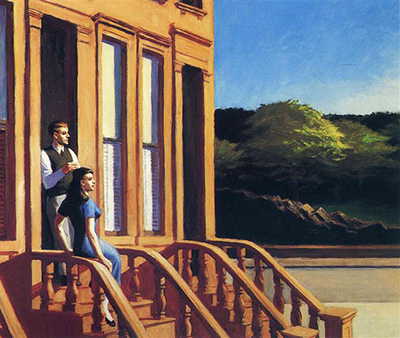
A woman in a blue dress sits on the steps of a brownstone. Behind her, a man in a pale jacket stands near the entrance. Sunlight warms the tall facade and curved stair rails, while the road opens towards dark greenery beneath a clear blue sky. Edward Hopper's Sunlight on Brownstones brings a closely framed piece of domestic architecture into contact with a much broader view beyond it.
The Wichita Art Museum records the painting as a 1956 oil on canvas, accession M148.57, Roland P. Murdock Collection. Its catalogue gives 30⅜ × 40¼ inches for the painted work. [1] The two figures occupy a small part of the scene, but their positions on the stoop connect the building's enclosed spaces with the open ground outside.
At a Glance
- ArtistEdward Hopper [1]
- Date1956 [1]
- Mediumoil on canvas [1]
- Collection / recordWichita Art Museum [1]
- AccessionM148.57 [1]
This work across Edward Hopper’s career
American Village
1912Soir Bleu
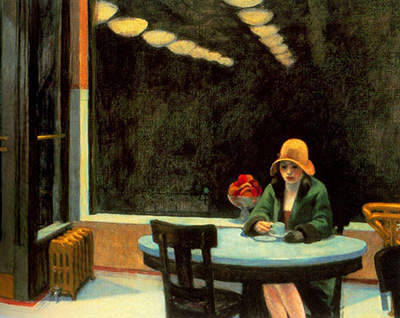
1914Automat
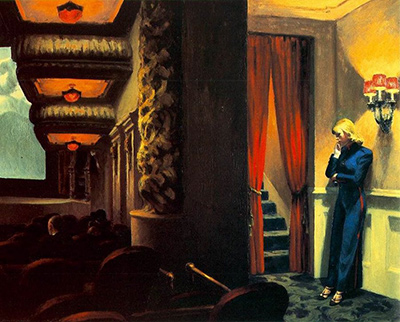
1927New York Movie
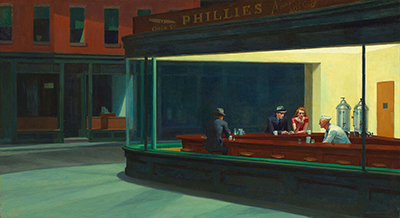
1939Nighthawks
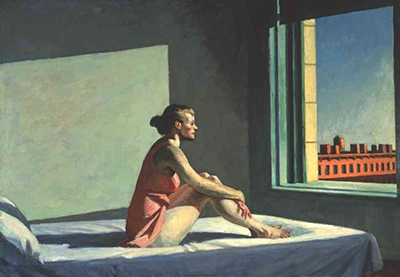
1942Morning Sun
1952Two Comedians
1966Contents
- A facade rising out of the frame
- The stair rails move differently
- Sitting and standing
- An empty road and dark vegetation
- Observed brownstones, improvised light
- A 1954 study with three figures
- Sunlight across a late urban subject
A facade rising out of the frame
The building fills the left-hand portion of the canvas. Its upper edge and much of its width are cropped, allowing tall windows and door surrounds to continue beyond the view. We encounter part of a row rather than a complete house presented from roof to basement.
The upright openings are long and narrow. Pale frames, dark interiors and projecting surrounds create a sequence of vertical bands across the warm wall. Small changes of tone distinguish adjacent surfaces without breaking their overall continuity.
The colour gives the architecture considerable force. Pink, ochre and warmer brown passages stand against the cooler sky and greenery. The facade's illumination makes it the picture's principal bright mass, even where dark openings cut deeply into it.
Its repeated divisions establish a measured environment around the figures. A person standing near an entrance is held between tall uprights; the seated woman occupies a lower interval near the rail. Human positions become legible partly through the architecture's larger scale.
Cropping also affects the spectator's relationship to the scene. There is no comfortable distance from which to survey the whole building. Its surfaces arrive close to us, while the right side opens towards a less confined setting.
The stair rails move differently
The stoop supplies curves beneath the vertical facade. Rails descend towards the foreground, and repeated balusters follow their changes in height. These forms give the lower architecture a movement absent from the tall windows above.
The rails also establish separate approaches. Their repeated curves suggest neighbouring entrances and stairs within the same row. We see enough of these adjoining structures to understand the main stoop as part of a larger domestic arrangement.
Light catches the upper edges and rounded members, while darker intervals remain between them. The rails therefore describe depth through a rapid alternation of bright surfaces and shadow. Their small shapes are more intricate than the broad wall, but they remain linked to its warm colour.
The steps beneath are only partly visible. Architecture and figures overlap them, preventing the stairway from becoming a complete diagram. We can understand the route from pavement to doorway through the slope of the rails and the changing level of the bodies.
The structure is a threshold in several senses. It connects different heights, stands between interior and street, and provides a place where someone can remain without fully entering either space.
Sitting and standing
The woman sits near the foreground, with the blue of her clothing contrasting against the warmer stone. Her upright torso and lowered legs give her a different rhythm from the stairway's descending curve. The rail partly encloses her position without hiding her.
The man stands higher and further back. His pale clothing catches the light near a much darker opening, making his figure conspicuous within the entrance. The difference in height and depth separates the two people before we attempt to interpret their relationship.
Their orientations direct attention beyond an immediate face-to-face exchange. Both remain part of the same stoop, but the painting does not show a clear conversation or shared task. Their proximity supplies a relationship in space without explaining their personal history.
It is tempting to make them a couple at home, yet the image does not establish ownership, marriage or the reason they are outside. The visible distinction is simpler and more useful: one person sits closer to the spectator, while another stands near the building's deeper threshold.
The blue dress and pale jacket also divide the figures by colour. One cool accent appears against warm architectural forms; one lighter shape stands against darkness. Hopper makes each body readable through its particular setting.
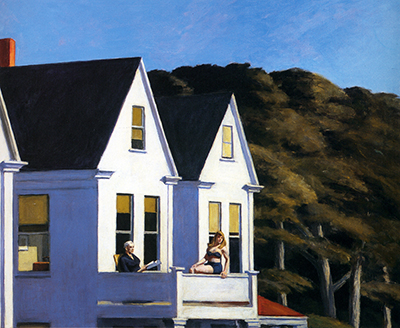
Compare: Second Story Sunlight, 1960.
An empty road and dark vegetation
Beyond the stoop, the road creates a relatively open horizontal interval. It separates the close architecture from the dark mass of vegetation further away. The absence of a passing vehicle or pedestrian allows that interval to remain visually quiet.
The greenery has a different structure from the building. Irregular masses overlap and rise beneath the sky, with a lighter patch catching attention above a deeper shaded bank. No repeated window pattern organizes this part of the picture.
The contrast is not simply one of solid building and empty nature. The vegetation has considerable weight of its own. Its darkness balances the facade's brightness, while its uneven contours make the open side feel less geometrically regulated.
The sky provides a larger cool field above it. Its blue differs from the woman's clothing, but the two passages help connect foreground and distance across the warmer architectural setting. Colour creates relationships that do not depend on the figures looking at one another.
The spectator therefore moves between two scales. A handrail, sleeve or window surround belongs to a close environment; the vegetation and sky belong to a wider view. The painting brings them together across a narrow strip of street.
Watch: Edward Hopper’s Life and Art
Explore Hopper’s paintings and the places behind them in these museum films. Choose a film below.
Observed brownstones, improvised light
The Whitney's 2022 exhibition labels transmit Hopper's account of sketching brownstones near the park in Manhattan's West Eighties. He also described the light as largely improvised and questioned the pinkness he had given the scene. [2] His recollection connects the painting with observed architecture while leaving considerable room for adjustment.
That account helps explain why the work feels both specific and composed. The windows, stoops and projecting surrounds have a recognizable urban character, but their illumination belongs to the painter's decisions. A particular kind of building supplies material for a selected arrangement of colour and shadow.
The museum relates the distant landscape, probably drawing on Central Park, to the effect of a theatrical backdrop. [2] The qualification is useful. We need not identify one exact position in the park to understand how its dark mass gives the bright stoop a different surrounding world.
The figures can consequently seem poised between a substantial architectural setting and a more remote field of scenery. The effect comes from the painting's compression of those zones, rather than requiring a story in which the people are literally performing.
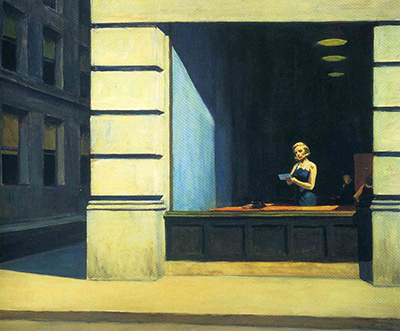
Compare: New York Office, 1962.
A 1954 study with three figures
The Whitney's 2022 checklist includes Three Figures on Steps, identified as a study for Sunlight on Brownstones. It dates the drawing to 1954 and records fabricated chalk on paper, 21.6 × 27.9 cm, then in the collection of Ellie and Edgar Cullman. [3]
The reproduced sheet groups people among door frames and the curves of steps. Darkly worked passages sit beside more lightly described architectural divisions, and repeated lines explore the relation between bodies and the entrance.
Its three-figure title contrasts with the two people in the finished painting. The difference shows that the human grouping was considered in another form before the final arrangement. The 1954 date belongs to that study. [3] The Wichita canvas is dated 1956. [1]
The drawing's importance lies in that active reconsideration. Figures and architecture were worked out together, rather than people simply being inserted into a fully resolved backdrop. A stoop offers several possible positions, and the finished canvas makes a particular selection from them.
Sunlight across a late urban subject
The painting belongs to Hopper's mature return to the relation between people, architecture and strong light. The title names both an effect and a building type, keeping the subject close to what the picture visibly organizes.
In Second Story Sunlight, two women occupy a higher outdoor space within a sharply defined building. Sunlight on Brownstones places its figures nearer street level, where the stoop connects a dark entrance with the open road.
New York Office gives a window a different public and private relationship. The spectator's attention moves towards a person inside the building, whereas the Wichita painting lets the figures remain in the intermediate space outside its entrance.
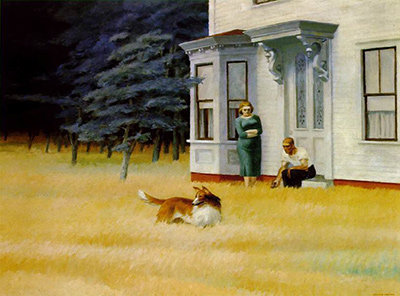
Cape Cod Morning concentrates a woman's forward movement within a projecting window. Here, sitting and standing supply quieter alternatives on the same steps, while the building's tall openings remain behind them.
The rails are a rewarding place to finish looking. Their warm curves lead towards the woman, then back towards the standing man and the doorway. Beyond this compact route, the road and dark greenery extend sideways under the blue sky. Hopper gives a small domestic threshold an unusually expansive setting.
Artworks and studies directory
This researched directory includes finished works and separately identified studies. It is not a complete catalogue raisonné. Linked titles open the articles; unlinked studies are identified by their collection accessions. Watercolours retain their recorded media, and original prints remain distinct from reproductions.
| Name | Date | Medium |
|---|---|---|
| (Bridge and Embankment) (70.1298) | 1906 | Oil on wood |
| (Jo Sketching at Good Harbor Beach) (70.1129) | 1923–1924 | Watercolor and fabricated chalk on paper |
| (Manhattan Bridge) (70.1098) | 1925–1926 | Watercolor and graphite pencil on paper |
| (Rooftops) (70.1114) | 1926 | Watercolor and graphite pencil on paper |
| (Seated Male Model, Bent Over) (70.1277) | c. 1902–1903 | Oil on canvas |
| (Self-Portrait) (70.1254) | 1903–1906 | Oil on canvas |
| (Solitary Figure in a Theater) (70.1418) | c. 1902–1904 | Oil on board |
| 5 A.M. | 1937 | oil on canvas |
| Adam's House | 1928 | watercolour and charcoal on paper |
| American Village | 1912 | Oil on canvas |
| Apartment Houses | 1923 | oil on canvas |
| Approaching a City | 1946 | oil on canvas |
| August in the City | 1945 | oil on canvas |
| Automat | 1927 | oil on canvas |
| Barber Shop | 1931 | oil on canvas |
| Blackwell's Island | 1928 | oil on canvas |
| Bridge on the Seine | 1909 | Oil on canvas |
| Bridle Path | 1939 | oil on canvas |
| Burly Cobb's House South Truro | 1930–1933 | oil on canvas |
| Cape Cod Evening | 1939 | oil on canvas |
| Cape Cod Morning | 1950 | oil on canvas |
| Chair Car | 1965 | oil on canvas |
| Chop Suey | 1929 | oil on canvas |
| City Roofs | 1932 | Oil on canvas |
| Coast Guard Station | 1929 | oil on canvas |
| Compartment C, Car 293 | 1938 | oil on canvas |
| Conference at Night | 1949 | oil on canvas |
| Corn Hill | 1930 | oil on canvas |
| Dawn in Pennsylvania | 1942 | oil on canvas |
| Drug Store | 1927 | oil on canvas |
| Early Sunday Morning | 1930 | Oil on canvas |
| East Side Interior (70.1020) | 1922 | Etching |
| East Wind Over Weehawken | 1934 | oil on canvas |
| El Palacio | 1946 | Watercolor and graphite pencil on paper |
| Eleven A.M. | 1926 | oil on canvas |
| Evening Wind | 1921 | etching |
| Excursion into Philosophy | 1959 | oil on canvas |
| First Row Orchestra | 1951 | oil on canvas |
| Freight Car at Truro | 1931 | watercolour over graphite on paper |
| Gas | 1940 | oil on canvas |
| Girl at a Sewing Machine | c. 1921 | oil on canvas |
| Gloucester Harbor | 1912 | Oil on canvas |
| Ground Swell | 1939 | oil on canvas |
| Haskell's House | 1924 | watercolour over graphite on paperboard |
| High Noon | 1949 | oil on canvas |
| Hill and Houses Cape Elizabeth Maine | 1927 | watercolour over graphite pencil |
| Hills South Truro | 1930 | oil on canvas |
| Hotel by a Railroad | 1952 | oil on canvas |
| Hotel Lobby | 1943 | oil on canvas |
| Hotel Room | 1931 | oil on canvas |
| Hotel Window | 1955 | oil on canvas |
| House by the Railroad | 1925 | oil on canvas |
| House by the Squam River | 1926 | watercolour over graphite on paper |
| Le Bistro or The Wine Shop | 1909 | Oil on canvas |
| Le Pont des Arts | 1907 | Oil on canvas |
| Le Pont Royal | 1909 | Oil on canvas |
| Le Quai des Grands Augustins | 1909 | Oil on canvas |
| Lighthouse and Buildings Portland Head | 1927 | watercolour over graphite pencil on paper |
| Lighthouse Hill | 1927 | oil painting |
| Manhattan Bridge Loop | 1928 | oil on canvas |
| Model Sitting | c. 1902 | oil painting; support not asserted |
| Morning Sun | 1952 | oil on canvas |
| New York Movie | 1939 | oil on canvas |
| New York New Haven and Hartford | 1931 | oil on canvas |
| New York Office | 1962 | oil on canvas |
| New York Pavements | 1924–1925 | oil on canvas |
| New York Restaurant | c. 1922 | oil on canvas |
| Night Windows | 1928 | oil on canvas |
| Nighthawks | 1942 | oil on canvas |
| October on Cape Cod | 1946 | oil on canvas |
| Office at Night | 1940 | oil on canvas |
| Office in a Small City | 1953 | oil on canvas |
| Pennsylvania Coal Town | 1947 | oil on canvas |
| People in the Sun | 1960 | oil on canvas |
| Portrait of Orleans | 1950 | oil on canvas |
| Queensborough Bridge | 1913 | Oil on canvas |
| Railroad Sunset | 1929 | Oil on canvas |
| Railroad Train | 1908 | oil on canvas |
| Road in Maine | 1914 | oil on canvas |
| Room in Brooklyn | 1932 | oil on canvas |
| Room in New York | 1932 | oil on canvas |
| Rooms by the Sea | 1951 | oil on canvas |
| Rooms for Tourists | 1945 | oil on canvas |
| Route 6 Eastham | 1941 | oil on canvas |
| Second Story Sunlight | 1960 | Oil on canvas |
| Self-Portrait | 1925–1930 | Oil on canvas |
| Self-Portrait with Hat (70.1903) | c. 1918, posthumous print | Drypoint |
| Seven A.M. | 1948 | Oil on canvas |
| Soir Bleu | 1914 | oil on canvas |
| South Carolina Morning | 1955 | Oil on canvas |
| Stairway at 48 Rue de Lille Paris | 1906 | Oil on wood |
| Study for 5 A.M. (70.153) | 1937 | Fabricated chalk on paper |
| Study for 5 A.M. (70.429) | 1937 | Fabricated chalk and graphite pencil on paper |
| Study for Approaching a City (70.869) | 1946 | Fabricated chalk and charcoal on paper |
| Study for August in the City (70.158a-b) | 1945 | Fabricated chalk on paper |
| Study for August in the City (70.159) | 1945 | Fabricated chalk on paper |
| Study for Bridle Path (70.220) | 1939 | Fabricated chalk on paper |
| Study for Bridle Path (70.235) | 1939 | Fabricated chalk on paper |
| Study for Compartment C, Car 293 (70.430) | 1938 | Fabricated chalk on paper |
| Study for Compartment C, Car 293 (70.431a-b) | 1938 | Fabricated chalk and charcoal on paper |
| Study for Conference at Night (70.170) | 1949 | Fabricated chalk on paper (recto); Typewriter ink on paper (verso) |
| Study for Conference at Night (70.174) | 1949 | Fabricated chalk on paper ( recto); Typewriter ink on paper (verso) |
| Study for East Wind over Weehawken (70.249) | 1934 | Graphite pencil on paper |
| Study for East Wind over Weehawken (70.252) | 1934 | Fabricated chalk and charcoal on paper |
| Study for Evening Wind (70.343a-b) | 1921 | Fabricated chalk on paper |
| Study for First Row Orchestra (70.841) | 1951 | Fabricated chalk and charcoal on paper |
| Study for Gas (70.263) | 1940 | Fabricated chalk on paper |
| Study for Ground Swell (70.339) | 1939 | Fabricated chalk, charcoal and graphite pencil on paper |
| Study for Hotel by a Railroad (70.199) | 1952 | Fabricated chalk on paper |
| Study for Hotel by a Railroad (70.427) | 1952 | Fabricated chalk on paper |
| Study for Hotel by a Railroad (70.428) | 1952 | Fabricated chalk on paper |
| Study for Hotel Lobby (70.117) | 1942 | Fabricated chalk and graphite pencil on paper |
| Study for Hotel Lobby (70.839) | 1942 | Fabricated chalk and charcoal on paper |
| Study for Hotel Window (70.161) | 1955 | Fabricated chalk, graphite pencil and colored pencil on paper |
| Study for Morning Sun (70.243) | 1952 | Fabricated chalk on paper |
| Study for Morning Sun (70.244) | 1952 | Fabricated chalk on paper |
| Study for Morning Sun (70.290) | 1952 | Fabricated chalk on paper |
| Study for Morning Sun (70.291) | 1952 | Fabricated chalk and graphite pencil on paper |
| Study for New York Movie (70.273) | 1939 | Fabricated chalk on paper |
| Study for New York Movie (70.274a-b) | 1938 or 1939 | Fabricated chalk and charcoal on paper (recto); Fabricated chalk on paper (verso) |
| Study for New York Movie (70.455) | 1939 | Fabricated chalk and charcoal on paper |
| Study for New York Office (70.822) | 1962 | Fabricated chalk on paper |
| Study for Nighthawks (70.192) | 1941 or 1942 | Fabricated chalk on paper |
| Study for Nighthawks (70.193) | 1941 or 1942 | Fabricated chalk on paper |
| Study for Office at Night (70.340) | 1940 | Fabricated chalk and charcoal on paper |
| Study for Office at Night (70.341) | 1940 | Fabricated chalk and graphite pencil on paper |
| Study for Pennsylvania Coal Town (70.198) | 1947 | Fabricated chalk on paper |
| Study for Pennsylvania Coal Town (70.229) | 1947 | Fabricated chalk and charcoal on paper |
| Study for Rooms for Tourists (70.438) | 1945 | Fabricated chalk and charcoal on paper |
| Study for Rooms for Tourists (70.848) | 1945 | Fabricated chalk and charcoal on paper |
| Study for Route 6, Eastham (70.369) | 1941 | Fabricated chalk and graphite pencil on paper |
| Study for Route 6, Eastham (70.854) | 1941 | Fabricated chalk and graphite pencil on paper |
| Study for South Carolina Morning (70.162a-b) | 1955 | Fabricated chalk on paper (recto and verso) |
| Study for The Sheridan Theatre (70.969) | 1937 | Graphite pencil on paper |
| Study for Two on the Aisle (70.128) | 1927 | Fabricated chalk on paper |
| Study for Two on the Aisle (70.129) | 1927 | Fabricated chalk on paper |
| Study for Yawl Riding a Swell (70.439) | 1935 | Fabricated chalk and graphite pencil on paper |
| Summer Evening | 1947 | oil on canvas |
| Summer Interior | 1909 | Oil on canvas |
| Sun in an Empty Room | 1963 | oil on canvas |
| Sunlight in a Cafeteria | 1958 | oil on canvas |
| Sunlight on Brownstones | 1956 | oil on canvas |
| Tables for Ladies | 1930 | oil on canvas |
| The Bootleggers | 1925 | oil on canvas |
| The Camel's Hump | 1931 | oil on canvas |
| The Circle Theatre | 1936 | oil on canvas |
| The City | 1927 | oil on canvas |
| The Lighthouse at Two Lights | 1929 | oil on canvas |
| The Long Leg | 1935 | oil on canvas |
| The Mansard Roof | 1923 | watercolour over graphite on paper |
| The Sheridan Theatre | 1937 | oil on canvas |
| Tramp Steamer | 1908 | oil on canvas |
| Two Comedians | 1966 | oil on canvas |
| Two on the Aisle | 1927 | oil on canvas |
| Valley of the Seine | 1909 | Oil on canvas |
| Western Motel | 1957 | oil on canvas |
Frequently Asked Questions
Edward Hopper made Sunlight on Brownstones in 1956. [1]
The recorded medium is oil on canvas. [1]
A woman in a blue dress sits on the steps of a brownstone. Behind her, a man in a pale jacket stands near the entrance. Sunlight warms the tall facade and curved stair rails, while the road opens towards dark greenery beneath a clear blue sky. Edward Hopper's Sunlight on Brownstones brings a closely framed piece of domestic architecture into contact with a much broader view beyond it.
Discussion
Look again at the images and ideas explored in Sunlight on Brownstones. These editorial prompts invite your observations.
Reader Insights
Which boundary, gesture or change of light first holds your attention in Sunlight on Brownstones?
Compare Second Story Sunlight with Sunlight on Brownstones. Which visual difference matters most to your reading?
Which detail would you look at again after reading “Sitting and standing”?
Join the Conversation
Share a detail, comparison or question about Sunlight on Brownstones below.
References
- Wichita Art Museum, Sunlight on Brownstones, 1956, oil on canvas, accession M148.57, Roland P. Murdock Collection; current online catalogue, original-work dimensions 30⅜ × 40¼ inches. View source.
- Whitney Museum of American Art, Edward Hopper's New York, exhibition labels, 2022, printed p.48, PDF p.65; Hopper's account of the West Eighties and improvised light, transmitted by the museum, and the qualified Central Park/theatrical-backdrop interpretation. View source.
- Whitney Museum of American Art, Edward Hopper's New York, final checklist, 2022, p.33, Three Figures on Steps (Study for Sunlight on Brownstones), 1954; medium, sheet dimensions, 2022 collection credit and reproduced study. View source.
- Collection or catalogue record, American Village, 1912; medium and identity as discussed in the linked article. View source.
- Collection or catalogue record, Soir Bleu, 1914; medium and identity as discussed in the linked article. View source.
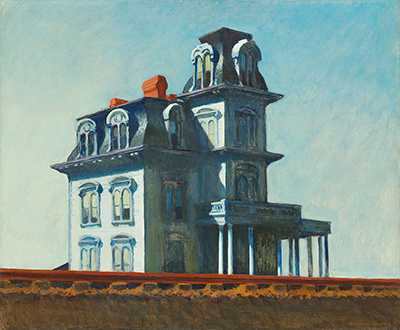
- Collection or catalogue record, House by the Railroad, 1925; medium and identity as discussed in the linked article. View source.
- Collection or catalogue record, Automat, 1927; medium and identity as discussed in the linked article. View source.
- Collection or catalogue record, Early Sunday Morning, 1930; medium and identity as discussed in the linked article. View source.
- Collection or catalogue record, New York Movie, 1939; medium and identity as discussed in the linked article. View source.
- Collection or catalogue record, Nighthawks, 1942; medium and identity as discussed in the linked article. View source.
- Collection or catalogue record, Morning Sun, 1952; medium and identity as discussed in the linked article. View source.
- Collection or catalogue record, Second Story Sunlight, 1960; medium and identity as discussed in the linked article. View source.
- Collection or catalogue record, Two Comedians, 1966; medium and identity as discussed in the linked article. View source.
- Whitney Museum of American Art, Study for Route 6, Eastham, 1941, accession 70.854; exact object record. View source.
- Whitney Museum of American Art, Study for Conference at Night, 1949, accession 70.170; exact object record. View source.
- Whitney Museum of American Art, Study for First Row Orchestra, 1951, accession 70.841; exact object record. View source.
- Whitney Museum of American Art, (Bridge and Embankment), 1906, accession 70.1298; exact object record. View source.
- Whitney Museum of American Art, (Seated Male Model, Bent Over), c. 1902–1903, accession 70.1277; exact object record. View source.
- Whitney Museum of American Art, Study for Morning Sun, 1952, accession 70.244; exact object record. View source.
- Whitney Museum of American Art, Study for Morning Sun, 1952, accession 70.243; exact object record. View source.
- Whitney Museum of American Art, Study for Two on the Aisle, 1927, accession 70.128; exact object record. View source.
- Whitney Museum of American Art, Study for New York Office, 1962, accession 70.822; exact object record. View source.
- Whitney Museum of American Art, Study for Two on the Aisle, 1927, accession 70.129; exact object record. View source.
- Whitney Museum of American Art, Study for Pennsylvania Coal Town, 1947, accession 70.229; exact object record. View source.
- Whitney Museum of American Art, (Rooftops), 1926, accession 70.1114; exact object record. View source.
- Whitney Museum of American Art, Study for South Carolina Morning, 1955, accession 70.162a-b; exact object record. View source.
- Whitney Museum of American Art, (Self-Portrait), 1903–1906, accession 70.1254; exact object record. View source.
- Whitney Museum of American Art, (Manhattan Bridge), 1925–1926, accession 70.1098; exact object record. View source.
- Whitney Museum of American Art, (Solitary Figure in a Theater), c. 1902–1904, accession 70.1418; exact object record. View source.
- Whitney Museum of American Art, Study for Approaching a City, 1946, accession 70.869; exact object record. View source.
- Whitney Museum of American Art, Study for August in the City, 1945, accession 70.159; exact object record. View source.
- Whitney Museum of American Art, Study for Compartment C, Car 293, 1938, accession 70.430; exact object record. View source.
- Whitney Museum of American Art, Study for Compartment C, Car 293, 1938, accession 70.431a-b; exact object record. View source.
- Whitney Museum of American Art, Study for East Wind over Weehawken, 1934, accession 70.252; exact object record. View source.
- Whitney Museum of American Art, Study for East Wind over Weehawken, 1934, accession 70.249; exact object record. View source.
- Whitney Museum of American Art, Study for Evening Wind, 1921, accession 70.343a-b; exact object record. View source.
- Whitney Museum of American Art, Study for The Sheridan Theatre, 1937, accession 70.969; exact object record. View source.
- Whitney Museum of American Art, Study for New York Movie, 1939, accession 70.455; exact object record. View source.
- Whitney Museum of American Art, Study for New York Movie, 1939, accession 70.273; exact object record. View source.
- Whitney Museum of American Art, Study for New York Movie, 1938 or 1939, accession 70.274a-b; exact object record. View source.
- Whitney Museum of American Art, Study for 5 A.M., 1937, accession 70.153; exact object record. View source.
- Whitney Museum of American Art, Study for 5 A.M., 1937, accession 70.429; exact object record. View source.
- Whitney Museum of American Art, (Jo Sketching at Good Harbor Beach), 1923–1924, accession 70.1129; exact object record. View source.
- Whitney Museum of American Art, Study for August in the City, 1945, accession 70.158a-b; exact object record. View source.
- Whitney Museum of American Art, Study for Morning Sun, 1952, accession 70.291; exact object record. View source.
- Whitney Museum of American Art, Study for Morning Sun, 1952, accession 70.290; exact object record. View source.
- Whitney Museum of American Art, Study for Office at Night, 1940, accession 70.340; exact object record. View source.
- Whitney Museum of American Art, Study for Office at Night, 1940, accession 70.341; exact object record. View source.
- Whitney Museum of American Art, Study for Hotel by a Railroad, 1952, accession 70.427; exact object record. View source.
- Whitney Museum of American Art, Study for Hotel by a Railroad, 1952, accession 70.199; exact object record. View source.
- Whitney Museum of American Art, Study for Hotel by a Railroad, 1952, accession 70.428; exact object record. View source.
- Whitney Museum of American Art, Study for Hotel Lobby, 1942, accession 70.117; exact object record. View source.
- Whitney Museum of American Art, Study for Hotel Lobby, 1942, accession 70.839; exact object record. View source.
- Whitney Museum of American Art, Study for Conference at Night, 1949, accession 70.174; exact object record. View source.
- Whitney Museum of American Art, Study for Hotel Window, 1955, accession 70.161; exact object record. View source.
- Whitney Museum of American Art, Study for Pennsylvania Coal Town, 1947, accession 70.198; exact object record. View source.
- Whitney Museum of American Art, Study for Route 6, Eastham, 1941, accession 70.369; exact object record. View source.
- Whitney Museum of American Art, Study for Bridle Path, 1939, accession 70.220; exact object record. View source.
- Whitney Museum of American Art, Study for Bridle Path, 1939, accession 70.235; exact object record. View source.
- Whitney Museum of American Art, Study for Ground Swell, 1939, accession 70.339; exact object record. View source.
- Whitney Museum of American Art, Study for Yawl Riding a Swell, 1935, accession 70.439; exact object record. View source.
- Whitney Museum of American Art, Study for Rooms for Tourists, 1945, accession 70.848; exact object record. View source.
- Whitney Museum of American Art, Study for Rooms for Tourists, 1945, accession 70.438; exact object record. View source.
- Whitney Museum of American Art, Study for Nighthawks, 1941 or 1942, accession 70.193; exact object record. View source.
- Whitney Museum of American Art, Study for Nighthawks, 1941 or 1942, accession 70.192; exact object record. View source.
- Whitney Museum of American Art, Study for Gas, 1940, accession 70.263; exact object record. View source.
- Whitney Museum of American Art, Self-Portrait with Hat, c. 1918, posthumous print, accession 70.1903; exact object record. View source.
- Whitney Museum of American Art, East Side Interior, 1922, accession 70.1020; exact object record. View source.
- Art Institute of Chicago, Selected Chronology for Edward Hopper; training, travels, exhibitions, New York and Truro chronology. View source.
- Emily C. Burns, Spectral figures: Edward Hopper’s empty Paris, chapter 5 in Empty Spaces: Confronting Emptiness in National, Cultural and Urban Histories, 2019; complete chapter and notes consulted. View source.
- Charles Brock, Regionalism and Folk Art, National Gallery of Art; complete essay and two notes consulted. View source.