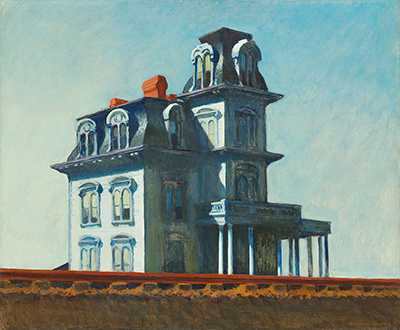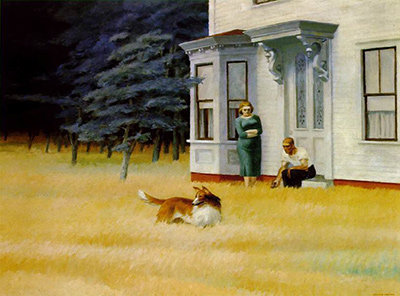
 by Tom Gurney
Tom Gurney BSc (Hons) is an art history expert with over 20 years experience
Email: tomgurney1@gmail.com / Phone: +44 7429 011000
People in the Sun: Introduction
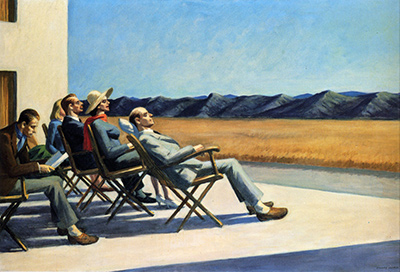
Five people sit in folding chairs on a pale terrace. Four turn towards the bright open setting, while a man at the left lowers his head over a book. Beyond them, an ochre field meets a distant line of blue mountains beneath an extensive sky. Edward Hopper's People in the Sun brings a tightly arranged group into contact with a landscape that seems much larger and less occupied.
The Smithsonian American Art Museum records the painting as a 1960 oil on canvas, 102.6 × 153.4 cm, accession 1969.47.61, gift of S. C. Johnson & Son, Inc. [1] The figures share a place and a condition of light, but they do not all attend to the same thing.
At a Glance
- ArtistEdward Hopper [1]
- Date1960 [1]
- Mediumoil on canvas [1]
- Collection / recordSmithsonian American Art Museum [1]
- Accession1969.47.61 [1]
This work across Edward Hopper’s career
American Village
1912Soir Bleu
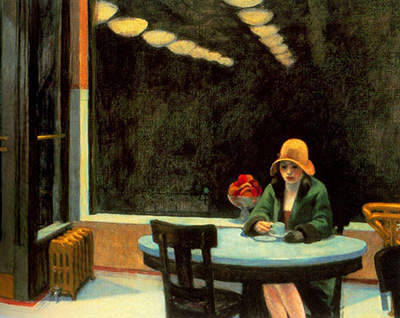
1914Automat
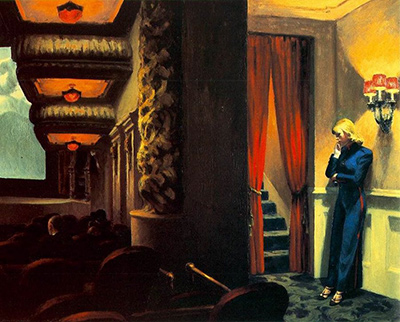
1927New York Movie
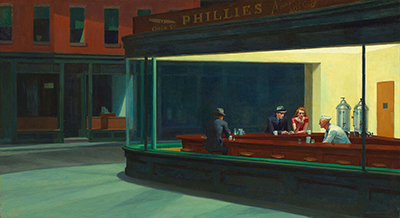
1939Nighthawks
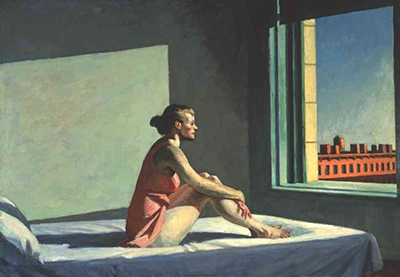
1942Morning Sun
1952Two Comedians
1966Contents
- A group concentrated at one side
- Looking out and looking down
- Profiles, hands and small changes of direction
- Clothes for sitting outdoors
- Folding chairs and crossed legs
- Shadows across the terrace
- The spectator's place in the shade
- The field and mountains
- A building at the margin
- A landscape available to an audience
A group concentrated at one side
The chairs gather beside a cropped building at the left. Bodies overlap, and some heads and limbs are more fully visible than others. The group occupies the foreground while much of the landscape extends unoccupied towards the right.
The front man reclines in a pale suit, with his legs projecting beyond the chair. His posture has a different reach from those further back, where bodies are held more upright and closer together. The line of figures is staggered rather than arranged as a single flat row.
A woman in a broad hat sits behind him, her red scarf creating a conspicuous warm accent among the cooler clothes. A red-haired man and a more concealed blond woman occupy further positions within the overlapping arrangement.
The reader sits towards the left edge. His brown jacket separates him from the predominantly blue and grey clothing around him, while the open book gives his hands and lowered head a different focus.
These differences matter to the whole picture. The people share similar furniture and a common terrace, yet their individual shapes, colours and orientations prevent the group from becoming one repeated pose.
Looking out and looking down
The outward-facing heads give the arrangement a strong direction. Several profiles turn towards the right, and the reclining man's face tilts upwards. Their shared orientation encourages the spectator to look beyond the cluster into the larger setting.
The reader interrupts that movement. His eyes are directed towards the pages rather than the horizon, and his bent head produces a more inward shape. A person can occupy the same sunny place while remaining absorbed in a different activity.
This distinction makes the group more complex than a collective audience watching one visible event. The painting gives us no performer, arriving vehicle or other immediate spectacle to explain the outward looks. The light and open surroundings are sufficient to make the position plausible.
Nor do the people visibly converse. Their proximity does not establish a family relationship or shared purpose beyond occupying the terrace. Hopper leaves their social connection less defined than their physical arrangement.
The result is a painting about several kinds of attention. Some figures face the world before them, one attends to a book, and the spectator examines both the people and the view. Those positions coexist without merging into a complete narrative.
Profiles, hands and small changes of direction
The reclining man's raised face makes the group's outward orientation unusually emphatic. His head follows a different angle from the upright profiles behind him, but both direct attention away from the building. The faces form a staggered sequence that moves the eye towards the unoccupied right side.
His hands do something quieter. They rest near the chair arms rather than pointing towards a spectacle. The body appears accommodated by the furniture, with its long legs extending the same general direction as the chair's recline. Outward attention is made legible through the body's arrangement rather than a demonstrative gesture.
The hat interrupts that sequence. Its broad brim introduces a light diagonal around one woman's head, turning an item of dress into an emphatic shape against the sky and the darker figures. The red scarf descends from it, providing a narrow warm passage in the dense group.
That scarf differs from the ochre field even though both bring warmth into a predominantly cool setting. One belongs to a particular body and occupies a tight upright interval; the other stretches far across the distance. Hopper can relate the human cluster to the landscape through colour while keeping their scales distinct.
The reader's pale pages introduce another small directional change. The open book sits low, and the bend of his head returns attention towards his own hands. This creates a pocket of activity within the larger outward movement. The exception is visible enough to keep the group from becoming a single collective expression.
Clothes for sitting outdoors
The title describes exposure to the sun without identifying the people as bathers. Jackets, trousers, a hat and shoes remain conspicuous. The clothing gives their leisure an ordinary public appearance, quite different from the bathing suit in Second Story Sunlight.
This difference affects how much the light can describe of each body. Hands, heads and ankles provide small passages of flesh among larger areas of fabric. The reclining man's pale suit extends his visibility across torso and legs, while the reader's darker jacket holds his figure closer to the building's shaded side.
The varied clothes also help distinguish people who partly overlap. The fair-haired woman is less extensively visible than the nearer figures, yet her head is enough to make the gathering a group of five. Hopper does not need to display every body completely for us to understand that another person occupies a chair within the arrangement.
Such distinctions make the painting more particular than a row of interchangeable sun-seekers. Different garments, degrees of bodily visibility and directions of attention coexist within the same leisure setting. The common light connects people whose individual presence is established through a carefully varied amount of information.
Folding chairs and crossed legs
The chairs introduce a dense pattern beneath the bodies. Wooden members cross at changing angles, while armrests and back supports create longer diagonals. Their construction is practical, but it also gives the group an intricate lower framework.
The repeated forms are varied by perspective. A chair nearer the spectator has longer, more conspicuous members; one further back is partly concealed or compressed. Their overlapping shapes help establish a shallow but carefully organized space.
The dark joints and crossing legs could easily become the picture's most insistent pattern. Critic Christopher Benfey, transmitting Hopper's own account, notes that keeping the chair legs from demanding too much attention was a particular compositional problem. [2]
The finished painting distributes that activity through bodies, shadows and open ground. Some wooden edges remain clear, while others pass into darker areas or disappear behind a figure. The chair structure is present without receiving an equally sharp emphasis everywhere.
The furniture also makes the group's leisure tangible. These are places to sit, recline, read and remain for a while. Hopper does not need a named holiday destination to establish that practical situation.
Shadows across the terrace
The ground beneath the chairs contains strong cool shadows. Their blue-grey colour differs from the pale sunlit paving, making the furniture and bodies cast visible extensions across the surface.
The shadows connect forms that otherwise have separate outlines. A chair leg, shoe and adjoining dark patch can meet within one larger area, reducing the number of isolated accents. The people remain distinguishable while sharing a common field of shade.
A much broader dark band crosses the bottom of the painting. It creates a firm foreground boundary, with a long diagonal edge separating it from the brighter terrace. The viewer is placed near this change of illumination rather than within the seated group itself.
The sunlit paving extends further towards the right than the figures. Its relative emptiness gives the complex chair arrangement room to settle. Small crossings of wood and cloth can be examined against a much quieter surrounding plane.
Another cooler horizontal passage separates the immediate terrace from the field beyond. Its broad shape helps organize distance without requiring an identified road, pool or other specific amenity.
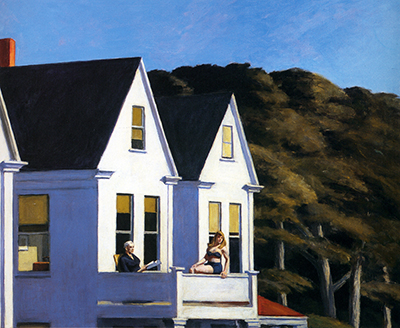
Compare: Second Story Sunlight, 1960.
The spectator's place in the shade
The broad foreground shadow gives us a position separate from the chairs. Its oblique edge leads into the brighter paving without placing a visible spectator beside the seated people. We look from one condition of illumination towards another.
This distinction helps explain why the sunny terrace can feel both inviting and difficult to join. There is ample empty ground at the right, but the chairs are already closely arranged at the left. The picture provides space around the people while withholding the ordinary social gesture that might welcome someone into their company.
The pale paving also changes the effect of the bodies' overlap. Against a busier foreground, the crossings of chair legs and trousers might become harder to disentangle. Here the quiet surface allows the group to remain intricate without making the whole lower canvas equally dense.
The strongest shadow is not simply a dark outline under each person. Larger areas spread across the ground and connect objects. The painting uses those connections to give several separate seats a common location. We can recognise an assembly of individuals while also seeing one concentrated arrangement of bodies, wood and shade.
At the right, the empty paving continues that location after the group ends. It is still part of the terrace, although no figure occupies it. The distinction between occupied and unoccupied ground becomes as important as the later distinction between terrace and field.
The field and mountains
The ochre field stretches across most of the canvas. Its relatively continuous colour supplies a wide interval between the terrace and mountain ridge. The people seem close to an extensive landscape while remaining physically separate from it.
The mountains have a varied upper profile. Peaks and sloping ridges rise unevenly, with darker and lighter blue passages distinguishing their faces. Their scale is established more through the long sequence than through one dominant summit.
The sky gives that sequence ample space. It occupies a substantial part of the painting, with lightly varied colour rather than a dramatic cloud formation commanding attention. Its breadth makes the lower cluster of people appear more compact.
These long bands have a different rhythm from the chairs. Field, ridge and sky extend horizontally, while the furniture produces repeated crossings and diagonals. Hopper allows a complicated foreground and a simplified distance to occupy the same painting.
The distant setting also offers no obvious path or destination. The picture presents land to be seen, but it does not show the figures beginning an excursion into it. Their encounter takes place from the terrace.
A building at the margin
The pale wall at the left is only partly included. Cropped windows with warm coverings interrupt its surface, giving the seated people an architectural setting without explaining the complete building.
The Smithsonian identifies the location as a hotel terrace. [1] The surviving fragment is enough to suggest accommodation beside the view, while leaving the particular establishment unnamed.
The wall's upright edge provides a strong contrast with the horizon. It anchors the group to one side and supplies a relatively continuous pale surface behind several heads. The people are not simply scattered across an empty field.
Its windows also introduce possible interiors at the margin. Rooms exist behind the terrace, but the painting gives us no occupants or details beyond their coverings. The outside group remains the immediate human subject.
Watch: Edward Hopper’s Life and Art
Explore Hopper’s paintings and the places behind them in these museum films. Choose a film below.
A landscape available to an audience
The field has almost no objects on which a person's outward look could settle. Its attraction lies in its breadth and the mountain ridge beyond. Hopper has given the people a view that can be contemplated for its general appearance, without furnishing an obvious event that every profile must be following.
The ridge supplies enough variation to sustain that attention. Sloping blue faces and uneven summits break the long horizontal band into a sequence. A gaze can move across those changes without arriving at a single central peak.
The proportions matter too. A large sky sits above the low mountains, and the ochre field occupies another broad interval below. The terrace group is surrounded by expanses that have relatively few small details. The seated people can consequently seem both conspicuous in the foreground and minor within the larger environment.
This is a landscape seen through the conditions of leisure. Chairs and a building offer a stable place from which to observe it. The figures are not carrying equipment through the field or following a visible trail. Their experience is organised from the edge of accommodation, where the land can become a view.
The reader's choice remains important within that arrangement. A panorama need not compel everyone present to look at it. His book offers another sustained object of attention, one that can be brought onto the terrace and held within the same light.
New York sunbathers in a western setting
The museum traces the painting's initial idea to people taking the sun in Washington Square Park, near the Hoppers' New York home. Hopper moved that situation into a western setting assembled from travel memories. [1]
This makes the picture more than a record of one resort view. A familiar arrangement of people sitting outdoors could be reconsidered within a quite different landscape. The mountain distance and hotel setting give the activity a new scale and atmosphere.
The change also helps explain the relation between observation and invention. The figures' leisure has a recognizable everyday basis, while the setting combines remembered experience rather than supplying a complete map of a named place.
It would therefore be misleading to identify a particular Californian hotel simply because the mountains seem western. The important relationship is the one Hopper constructed between a compact group and an extensive view.
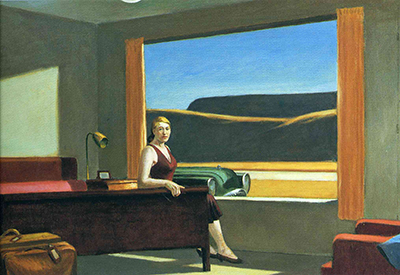
Compare: Western Motel, 1957.
Leisure and the possibility of unease
The scene contains several signs of comfort: chairs, an open terrace, a book and sustained sunlight. Yet the figures' relatively fixed poses and their separation from one another can make that leisure feel less straightforwardly sociable.
The Smithsonian's Luce Center interpretation reads them as tourists who seem obliged to take in a view, and relates the scene's constructed quality to a stage set. [1] These are readings of the painting's arrangement, rather than a documented itinerary or statement of the figures' feelings.
The reader complicates a uniformly uncomfortable account. His activity provides a practical reason for looking down, just as the other figures' positions allow them to face the light. The painting does not require every person to feel the same emotion.
The distant land offers openness without requiring the seated figures to move into it.
A literary comparison with people watching the sea
Benfey also approaches the painting through Robert Frost's “Neither Out Far Nor In Deep.” His 2023 discussion connects the mood of Hopper's group with the poem's persistent watchers. [2] This is a later critic's comparison, rather than a documented account of the painting's conception.
Frost describes people turning from the land towards the sea. The poem includes a passing ship and a gull reflected on wet ground, but its conclusion returns to the limits of the watchers' vision and their continued attention. [3] Ordinary looking becomes a question about what can be known from a particular place.
The comparison sharpens one feature of People in the Sun: the outward-facing group does not acquire the same knowledge as the spectator who sees the whole arrangement. We can examine their profiles, chairs and shared setting, while their attention points towards an environment whose attraction remains only partly explained.
The difference from Frost is equally useful. Hopper gives the group mountains rather than the sea, and includes a reader who interrupts a uniformly directed watch. His scene also lacks the poem's movement of water and ship. The painting holds an arrangement through which we can imagine sustained attention, while the poem makes that duration explicit.
Reading the works together need not make either one a verdict on human emptiness. Both invite us to notice the persistence of looking alongside its limits. Hopper's terrace gives that question a concrete shape through furniture, bodily direction and a view whose extent exceeds the small group.
A more charged critical proposal
David Anfam's 2013 review of Hopper exhibitions in Madrid and Paris proposed a nuclear-test photograph of seated military observers as a source. He connected the watchers and unseen illumination with a more unsettling reading of the group. [4]
This is a critical source hypothesis; the review supplies no artist's letter establishing that Hopper used the photograph. The documented account of New York sunbathers and a changed western setting remains distinct from that proposed association. Anfam's reading shows how much historical weight the outward-facing figures can invite without a visible spectacle settling their attention.
The historical photograph and the limits of a source claim
The photograph behind Anfam's proposal can be considered more closely through a public historical record. The Defense Nuclear Agency's 1983 report on Operation Greenhouse reproduces a group of VIP visitors observing the DOG test from the Officer's Beach Club patio. Its surrounding account places them on Parry Island at Enewetak Atoll during the test of 8 April 1951. [5]
The photograph has an unmistakable visual resemblance to Hopper's subject. A closely arranged outdoor audience occupies wooden chairs, and most heads turn in the same direction. The nearest legs extend towards open space at the right. A low horizon and substantial sky give the people a setting much larger than the places they occupy.
The differences are substantial. The photograph shows many more observers, several wearing conspicuous protective goggles, and a denser sequence of chair backs. Hopper selects five people, changes the setting to mountains and field, and gives one figure a book. The painted arrangement has fewer bodies and a stronger interruption of collective attention.
The 1951 photograph precedes Hopper's canvas and gives its real spectators a documented occasion. The museum's account of park sunbathers and remembered western travel offers a different starting point for the painting; the resemblance between the two images remains to be weighed within that evidence.
Looking directly at the photograph nevertheless improves the discussion. We can identify the similarities in seating, orientation and empty space, then see how much changes when the protective equipment, larger audience and documented purpose are removed. The comparison shows the particular choices in Hopper's arrangement even if its proposed historical source remains unconfirmed.
Other groups in the light
Second Story Sunlight places two women within a much closer architectural arrangement. Its gables and dark trees frame a smaller outdoor space, while People in the Sun lets land and sky extend well beyond the figures.
Sunlight on Brownstones gives two people separate positions on a domestic stoop. The terrace picture expands that distinction into five bodies, with overlapping chairs making their common setting especially clear.
Ground Swell offers a different group encounter with an open environment. There, figures and boat belong to movement on water; here, the seated people remain on a stable terrace, attending to the day in different ways.
Return to the reader's lowered head, then follow the chair legs towards the reclining man and the empty paving beyond. The group can appear still from a distance, but its arrangement contains considerable variation. Hopper gives that small network of bodies and furniture a large, quietly persistent world around it.
Artworks and studies directory
This researched directory includes finished works and separately identified studies. It is not a complete catalogue raisonné. Linked titles open the articles; unlinked studies are identified by their collection accessions. Watercolours retain their recorded media, and original prints remain distinct from reproductions.
| Name | Date | Medium |
|---|---|---|
| (Bridge and Embankment) (70.1298) | 1906 | Oil on wood |
| (Jo Sketching at Good Harbor Beach) (70.1129) | 1923–1924 | Watercolor and fabricated chalk on paper |
| (Manhattan Bridge) (70.1098) | 1925–1926 | Watercolor and graphite pencil on paper |
| (Rooftops) (70.1114) | 1926 | Watercolor and graphite pencil on paper |
| (Seated Male Model, Bent Over) (70.1277) | c. 1902–1903 | Oil on canvas |
| (Self-Portrait) (70.1254) | 1903–1906 | Oil on canvas |
| (Solitary Figure in a Theater) (70.1418) | c. 1902–1904 | Oil on board |
| 5 A.M. | 1937 | oil on canvas |
| Adam's House | 1928 | watercolour and charcoal on paper |
| American Village | 1912 | Oil on canvas |
| Apartment Houses | 1923 | oil on canvas |
| Approaching a City | 1946 | oil on canvas |
| August in the City | 1945 | oil on canvas |
| Automat | 1927 | oil on canvas |
| Barber Shop | 1931 | oil on canvas |
| Blackwell's Island | 1928 | oil on canvas |
| Bridge on the Seine | 1909 | Oil on canvas |
| Bridle Path | 1939 | oil on canvas |
| Burly Cobb's House South Truro | 1930–1933 | oil on canvas |
| Cape Cod Evening | 1939 | oil on canvas |
| Cape Cod Morning | 1950 | oil on canvas |
| Chair Car | 1965 | oil on canvas |
| Chop Suey | 1929 | oil on canvas |
| City Roofs | 1932 | Oil on canvas |
| Coast Guard Station | 1929 | oil on canvas |
| Compartment C, Car 293 | 1938 | oil on canvas |
| Conference at Night | 1949 | oil on canvas |
| Corn Hill | 1930 | oil on canvas |
| Dawn in Pennsylvania | 1942 | oil on canvas |
| Drug Store | 1927 | oil on canvas |
| Early Sunday Morning | 1930 | Oil on canvas |
| East Side Interior (70.1020) | 1922 | Etching |
| East Wind Over Weehawken | 1934 | oil on canvas |
| El Palacio | 1946 | Watercolor and graphite pencil on paper |
| Eleven A.M. | 1926 | oil on canvas |
| Evening Wind | 1921 | etching |
| Excursion into Philosophy | 1959 | oil on canvas |
| First Row Orchestra | 1951 | oil on canvas |
| Freight Car at Truro | 1931 | watercolour over graphite on paper |
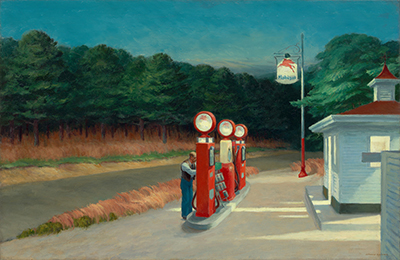
| Gas | 1940 | oil on canvas |
| Girl at a Sewing Machine | c. 1921 | oil on canvas |
| Gloucester Harbor | 1912 | Oil on canvas |
| Ground Swell | 1939 | oil on canvas |
| Haskell's House | 1924 | watercolour over graphite on paperboard |
| High Noon | 1949 | oil on canvas |
| Hill and Houses Cape Elizabeth Maine | 1927 | watercolour over graphite pencil |
| Hills South Truro | 1930 | oil on canvas |
| Hotel by a Railroad | 1952 | oil on canvas |
| Hotel Lobby | 1943 | oil on canvas |
| Hotel Room | 1931 | oil on canvas |
| Hotel Window | 1955 | oil on canvas |
| House by the Railroad | 1925 | oil on canvas |
| House by the Squam River | 1926 | watercolour over graphite on paper |
| Le Bistro or The Wine Shop | 1909 | Oil on canvas |
| Le Pont des Arts | 1907 | Oil on canvas |
| Le Pont Royal | 1909 | Oil on canvas |
| Le Quai des Grands Augustins | 1909 | Oil on canvas |
| Lighthouse and Buildings Portland Head | 1927 | watercolour over graphite pencil on paper |
| Lighthouse Hill | 1927 | oil painting |
| Manhattan Bridge Loop | 1928 | oil on canvas |
| Model Sitting | c. 1902 | oil painting; support not asserted |
| Morning Sun | 1952 | oil on canvas |
| New York Movie | 1939 | oil on canvas |
| New York New Haven and Hartford | 1931 | oil on canvas |
| New York Office | 1962 | oil on canvas |
| New York Pavements | 1924–1925 | oil on canvas |
| New York Restaurant | c. 1922 | oil on canvas |
| Night Windows | 1928 | oil on canvas |
| Nighthawks | 1942 | oil on canvas |
| October on Cape Cod | 1946 | oil on canvas |
| Office at Night | 1940 | oil on canvas |
| Office in a Small City | 1953 | oil on canvas |
| Pennsylvania Coal Town | 1947 | oil on canvas |
| People in the Sun | 1960 | oil on canvas |
| Portrait of Orleans | 1950 | oil on canvas |
| Queensborough Bridge | 1913 | Oil on canvas |
| Railroad Sunset | 1929 | Oil on canvas |
| Railroad Train | 1908 | oil on canvas |
| Road in Maine | 1914 | oil on canvas |
| Room in Brooklyn | 1932 | oil on canvas |
| Room in New York | 1932 | oil on canvas |
| Rooms by the Sea | 1951 | oil on canvas |
| Rooms for Tourists | 1945 | oil on canvas |
| Route 6 Eastham | 1941 | oil on canvas |
| Second Story Sunlight | 1960 | Oil on canvas |
| Self-Portrait | 1925–1930 | Oil on canvas |
| Self-Portrait with Hat (70.1903) | c. 1918, posthumous print | Drypoint |
| Seven A.M. | 1948 | Oil on canvas |
| Soir Bleu | 1914 | oil on canvas |
| South Carolina Morning | 1955 | Oil on canvas |
| Stairway at 48 Rue de Lille Paris | 1906 | Oil on wood |
| Study for 5 A.M. (70.153) | 1937 | Fabricated chalk on paper |
| Study for 5 A.M. (70.429) | 1937 | Fabricated chalk and graphite pencil on paper |
| Study for Approaching a City (70.869) | 1946 | Fabricated chalk and charcoal on paper |
| Study for August in the City (70.158a-b) | 1945 | Fabricated chalk on paper |
| Study for August in the City (70.159) | 1945 | Fabricated chalk on paper |
| Study for Bridle Path (70.220) | 1939 | Fabricated chalk on paper |
| Study for Bridle Path (70.235) | 1939 | Fabricated chalk on paper |
| Study for Compartment C, Car 293 (70.430) | 1938 | Fabricated chalk on paper |
| Study for Compartment C, Car 293 (70.431a-b) | 1938 | Fabricated chalk and charcoal on paper |
| Study for Conference at Night (70.170) | 1949 | Fabricated chalk on paper (recto); Typewriter ink on paper (verso) |
| Study for Conference at Night (70.174) | 1949 | Fabricated chalk on paper ( recto); Typewriter ink on paper (verso) |
| Study for East Wind over Weehawken (70.249) | 1934 | Graphite pencil on paper |
| Study for East Wind over Weehawken (70.252) | 1934 | Fabricated chalk and charcoal on paper |
| Study for Evening Wind (70.343a-b) | 1921 | Fabricated chalk on paper |
| Study for First Row Orchestra (70.841) | 1951 | Fabricated chalk and charcoal on paper |
| Study for Gas (70.263) | 1940 | Fabricated chalk on paper |
| Study for Ground Swell (70.339) | 1939 | Fabricated chalk, charcoal and graphite pencil on paper |
| Study for Hotel by a Railroad (70.199) | 1952 | Fabricated chalk on paper |
| Study for Hotel by a Railroad (70.427) | 1952 | Fabricated chalk on paper |
| Study for Hotel by a Railroad (70.428) | 1952 | Fabricated chalk on paper |
| Study for Hotel Lobby (70.117) | 1942 | Fabricated chalk and graphite pencil on paper |
| Study for Hotel Lobby (70.839) | 1942 | Fabricated chalk and charcoal on paper |
| Study for Hotel Window (70.161) | 1955 | Fabricated chalk, graphite pencil and colored pencil on paper |
| Study for Morning Sun (70.243) | 1952 | Fabricated chalk on paper |
| Study for Morning Sun (70.244) | 1952 | Fabricated chalk on paper |
| Study for Morning Sun (70.290) | 1952 | Fabricated chalk on paper |
| Study for Morning Sun (70.291) | 1952 | Fabricated chalk and graphite pencil on paper |
| Study for New York Movie (70.273) | 1939 | Fabricated chalk on paper |
| Study for New York Movie (70.274a-b) | 1938 or 1939 | Fabricated chalk and charcoal on paper (recto); Fabricated chalk on paper (verso) |
| Study for New York Movie (70.455) | 1939 | Fabricated chalk and charcoal on paper |
| Study for New York Office (70.822) | 1962 | Fabricated chalk on paper |
| Study for Nighthawks (70.192) | 1941 or 1942 | Fabricated chalk on paper |
| Study for Nighthawks (70.193) | 1941 or 1942 | Fabricated chalk on paper |
| Study for Office at Night (70.340) | 1940 | Fabricated chalk and charcoal on paper |
| Study for Office at Night (70.341) | 1940 | Fabricated chalk and graphite pencil on paper |
| Study for Pennsylvania Coal Town (70.198) | 1947 | Fabricated chalk on paper |
| Study for Pennsylvania Coal Town (70.229) | 1947 | Fabricated chalk and charcoal on paper |
| Study for Rooms for Tourists (70.438) | 1945 | Fabricated chalk and charcoal on paper |
| Study for Rooms for Tourists (70.848) | 1945 | Fabricated chalk and charcoal on paper |
| Study for Route 6, Eastham (70.369) | 1941 | Fabricated chalk and graphite pencil on paper |
| Study for Route 6, Eastham (70.854) | 1941 | Fabricated chalk and graphite pencil on paper |
| Study for South Carolina Morning (70.162a-b) | 1955 | Fabricated chalk on paper (recto and verso) |
| Study for The Sheridan Theatre (70.969) | 1937 | Graphite pencil on paper |
| Study for Two on the Aisle (70.128) | 1927 | Fabricated chalk on paper |
| Study for Two on the Aisle (70.129) | 1927 | Fabricated chalk on paper |
| Study for Yawl Riding a Swell (70.439) | 1935 | Fabricated chalk and graphite pencil on paper |
| Summer Evening | 1947 | oil on canvas |
| Summer Interior | 1909 | Oil on canvas |
| Sun in an Empty Room | 1963 | oil on canvas |
| Sunlight in a Cafeteria | 1958 | oil on canvas |
| Sunlight on Brownstones | 1956 | oil on canvas |
| Tables for Ladies | 1930 | oil on canvas |
| The Bootleggers | 1925 | oil on canvas |
| The Camel's Hump | 1931 | oil on canvas |
| The Circle Theatre | 1936 | oil on canvas |
| The City | 1927 | oil on canvas |
| The Lighthouse at Two Lights | 1929 | oil on canvas |
| The Long Leg | 1935 | oil on canvas |
| The Mansard Roof | 1923 | watercolour over graphite on paper |
| The Sheridan Theatre | 1937 | oil on canvas |
| Tramp Steamer | 1908 | oil on canvas |
| Two Comedians | 1966 | oil on canvas |
| Two on the Aisle | 1927 | oil on canvas |
| Valley of the Seine | 1909 | Oil on canvas |
| Western Motel | 1957 | oil on canvas |
Frequently Asked Questions
Edward Hopper made People in the Sun in 1960. [1]
The recorded medium is oil on canvas. [1]
Five people sit in folding chairs on a pale terrace. Four turn towards the bright open setting, while a man at the left lowers his head over a book. Beyond them, an ochre field meets a distant line of blue mountains beneath an extensive sky. Edward Hopper's People in the Sun brings a tightly arranged group into contact with a landscape that seems much larger and less occupied.
Discussion
Look again at the images and ideas explored in People in the Sun. These editorial prompts invite your observations.
Reader Insights
Which boundary, gesture or change of light first holds your attention in People in the Sun?
Compare Second Story Sunlight with People in the Sun. Which visual difference matters most to your reading?
Which detail would you look at again after reading “Folding chairs and crossed legs”?
Join the Conversation
Share a detail, comparison or question about People in the Sun below.
References
- Smithsonian American Art Museum, People in the Sun, 1960, oil on canvas, accession 1969.47.61, gift of S. C. Johnson & Son, Inc.; current metadata, complete painting image, museum essay and Luce Center label. View source.
- Christopher Benfey, “Buildings Come to Life”, The New York Review of Books, 23 February 2023, discussion of People in the Sun and Hopper's account of the chair legs, transmitted by Benfey. View source.
- Robert Frost, “Neither Out Far Nor In Deep,” complete poem in an online reprint; the comparison with Hopper is proposed by Benfey in reference 2. No verse is reproduced here. View source.
- David Anfam, “Edward Hopper. Madrid and Paris”, The Burlington Magazine, January 2013, concluding discussion and note 6; proposed nuclear-test photograph association, a critical source hypothesis. View source.
- L. Berkhouse and others, Operation Greenhouse, 1951, Defense Nuclear Agency, report DNA 6034F, 15 June 1983, printed p. 103, figure 25 and surrounding DOG-test account (PDF p. 109). The photograph and caption were inspected; the report is evidence for the historical event, not proof of Hopper’s use of the image. View source.
- Collection or catalogue record, American Village, 1912; medium and identity as discussed in the linked article. View source.
- Collection or catalogue record, Soir Bleu, 1914; medium and identity as discussed in the linked article. View source.
- Collection or catalogue record, House by the Railroad, 1925; medium and identity as discussed in the linked article. View source.
- Collection or catalogue record, Automat, 1927; medium and identity as discussed in the linked article. View source.
- Collection or catalogue record, Early Sunday Morning, 1930; medium and identity as discussed in the linked article. View source.
- Collection or catalogue record, New York Movie, 1939; medium and identity as discussed in the linked article. View source.
- Collection or catalogue record, Nighthawks, 1942; medium and identity as discussed in the linked article. View source.
- Collection or catalogue record, Morning Sun, 1952; medium and identity as discussed in the linked article. View source.
- Collection or catalogue record, Second Story Sunlight, 1960; medium and identity as discussed in the linked article. View source.
- Collection or catalogue record, Two Comedians, 1966; medium and identity as discussed in the linked article. View source.
- Whitney Museum of American Art, Study for Route 6, Eastham, 1941, accession 70.854; exact object record. View source.
- Whitney Museum of American Art, Study for Conference at Night, 1949, accession 70.170; exact object record. View source.
- Whitney Museum of American Art, Study for First Row Orchestra, 1951, accession 70.841; exact object record. View source.
- Whitney Museum of American Art, (Bridge and Embankment), 1906, accession 70.1298; exact object record. View source.
- Whitney Museum of American Art, (Seated Male Model, Bent Over), c. 1902–1903, accession 70.1277; exact object record. View source.
- Whitney Museum of American Art, Study for Morning Sun, 1952, accession 70.244; exact object record. View source.
- Whitney Museum of American Art, Study for Morning Sun, 1952, accession 70.243; exact object record. View source.
- Whitney Museum of American Art, Study for Two on the Aisle, 1927, accession 70.128; exact object record. View source.
- Whitney Museum of American Art, Study for New York Office, 1962, accession 70.822; exact object record. View source.
- Whitney Museum of American Art, Study for Two on the Aisle, 1927, accession 70.129; exact object record. View source.
- Whitney Museum of American Art, Study for Pennsylvania Coal Town, 1947, accession 70.229; exact object record. View source.
- Whitney Museum of American Art, (Rooftops), 1926, accession 70.1114; exact object record. View source.
- Whitney Museum of American Art, Study for South Carolina Morning, 1955, accession 70.162a-b; exact object record. View source.
- Whitney Museum of American Art, (Self-Portrait), 1903–1906, accession 70.1254; exact object record. View source.
- Whitney Museum of American Art, (Manhattan Bridge), 1925–1926, accession 70.1098; exact object record. View source.
- Whitney Museum of American Art, (Solitary Figure in a Theater), c. 1902–1904, accession 70.1418; exact object record. View source.
- Whitney Museum of American Art, Study for Approaching a City, 1946, accession 70.869; exact object record. View source.
- Whitney Museum of American Art, Study for August in the City, 1945, accession 70.159; exact object record. View source.
- Whitney Museum of American Art, Study for Compartment C, Car 293, 1938, accession 70.430; exact object record. View source.
- Whitney Museum of American Art, Study for Compartment C, Car 293, 1938, accession 70.431a-b; exact object record. View source.
- Whitney Museum of American Art, Study for East Wind over Weehawken, 1934, accession 70.252; exact object record. View source.
- Whitney Museum of American Art, Study for East Wind over Weehawken, 1934, accession 70.249; exact object record. View source.
- Whitney Museum of American Art, Study for Evening Wind, 1921, accession 70.343a-b; exact object record. View source.
- Whitney Museum of American Art, Study for The Sheridan Theatre, 1937, accession 70.969; exact object record. View source.
- Whitney Museum of American Art, Study for New York Movie, 1939, accession 70.455; exact object record. View source.
- Whitney Museum of American Art, Study for New York Movie, 1939, accession 70.273; exact object record. View source.
- Whitney Museum of American Art, Study for New York Movie, 1938 or 1939, accession 70.274a-b; exact object record. View source.
- Whitney Museum of American Art, Study for 5 A.M., 1937, accession 70.153; exact object record. View source.
- Whitney Museum of American Art, Study for 5 A.M., 1937, accession 70.429; exact object record. View source.
- Whitney Museum of American Art, (Jo Sketching at Good Harbor Beach), 1923–1924, accession 70.1129; exact object record. View source.
- Whitney Museum of American Art, Study for August in the City, 1945, accession 70.158a-b; exact object record. View source.
- Whitney Museum of American Art, Study for Morning Sun, 1952, accession 70.291; exact object record. View source.
- Whitney Museum of American Art, Study for Morning Sun, 1952, accession 70.290; exact object record. View source.
- Whitney Museum of American Art, Study for Office at Night, 1940, accession 70.340; exact object record. View source.
- Whitney Museum of American Art, Study for Office at Night, 1940, accession 70.341; exact object record. View source.
- Whitney Museum of American Art, Study for Hotel by a Railroad, 1952, accession 70.427; exact object record. View source.
- Whitney Museum of American Art, Study for Hotel by a Railroad, 1952, accession 70.199; exact object record. View source.
- Whitney Museum of American Art, Study for Hotel by a Railroad, 1952, accession 70.428; exact object record. View source.
- Whitney Museum of American Art, Study for Hotel Lobby, 1942, accession 70.117; exact object record. View source.
- Whitney Museum of American Art, Study for Hotel Lobby, 1942, accession 70.839; exact object record. View source.
- Whitney Museum of American Art, Study for Conference at Night, 1949, accession 70.174; exact object record. View source.
- Whitney Museum of American Art, Study for Hotel Window, 1955, accession 70.161; exact object record. View source.
- Whitney Museum of American Art, Study for Pennsylvania Coal Town, 1947, accession 70.198; exact object record. View source.
- Whitney Museum of American Art, Study for Route 6, Eastham, 1941, accession 70.369; exact object record. View source.
- Whitney Museum of American Art, Study for Bridle Path, 1939, accession 70.220; exact object record. View source.
- Whitney Museum of American Art, Study for Bridle Path, 1939, accession 70.235; exact object record. View source.
- Whitney Museum of American Art, Study for Ground Swell, 1939, accession 70.339; exact object record. View source.
- Whitney Museum of American Art, Study for Yawl Riding a Swell, 1935, accession 70.439; exact object record. View source.
- Whitney Museum of American Art, Study for Rooms for Tourists, 1945, accession 70.848; exact object record. View source.
- Whitney Museum of American Art, Study for Rooms for Tourists, 1945, accession 70.438; exact object record. View source.
- Whitney Museum of American Art, Study for Nighthawks, 1941 or 1942, accession 70.193; exact object record. View source.
- Whitney Museum of American Art, Study for Nighthawks, 1941 or 1942, accession 70.192; exact object record. View source.
- Whitney Museum of American Art, Study for Gas, 1940, accession 70.263; exact object record. View source.
- Whitney Museum of American Art, Self-Portrait with Hat, c. 1918, posthumous print, accession 70.1903; exact object record. View source.
- Whitney Museum of American Art, East Side Interior, 1922, accession 70.1020; exact object record. View source.
- Art Institute of Chicago, Selected Chronology for Edward Hopper; training, travels, exhibitions, New York and Truro chronology. View source.
- Emily C. Burns, Spectral figures: Edward Hopper’s empty Paris, chapter 5 in Empty Spaces: Confronting Emptiness in National, Cultural and Urban Histories, 2019; complete chapter and notes consulted. View source.
- Charles Brock, Regionalism and Folk Art, National Gallery of Art; complete essay and two notes consulted. View source.