 by Tom Gurney
Tom Gurney BSc (Hons) is an art history expert with over 20 years experience
Email: tomgurney1@gmail.com / Phone: +44 7429 011000
New York Movie: Introduction
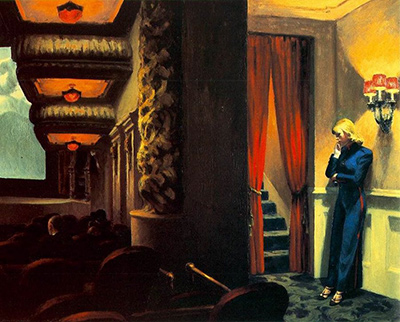
A film is showing at the far left, but the brightest person in the picture is looking away from it. An usher in blue stands beside a staircase, her head lowered towards one hand. Between her and the seated audience, a massive dark wall and an ornate column divide the cinema almost in two. Edward Hopper's New York Movie gives the spectator several places to look while withholding a single, shared centre of attention.
Painted in 1939, the work belongs to the Museum of Modern Art, New York. The museum records oil on canvas, 81.9 × 101.9 cm, accession 396.1941, given anonymously. [1] Its modest physical scale accommodates an unusually complicated interior: screen, audience, architectural ornament, standing employee and an opening towards a space beyond.
At a Glance
- ArtistEdward Hopper [1]
- Date1939 [1]
- Mediumoil on canvas [1]
- Collection / recordThe Museum of Modern Art [1]
- Accession396.1941 [1]
This work across Edward Hopper’s career
American Village
1912Soir Bleu
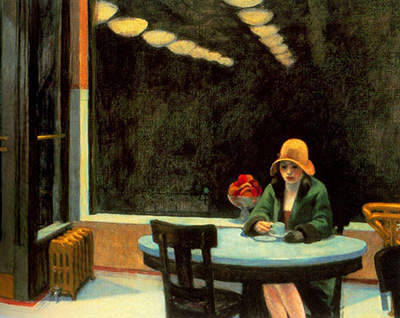
1914Automat
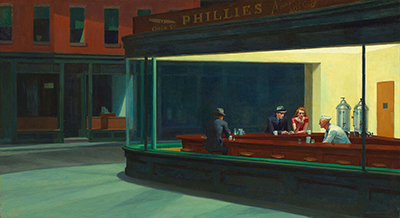
1927Nighthawks
1942Morning Sun
1952Two Comedians
1966Contents
- The division down the middle
- A palace built for looking
- The usher's pose
- Lights above the audience and beside the wall
- The screen at the edge
- Four theatres brought together
- The Palace drawing: space before the final figure
- Tickets, visits and the work of remembering
- Jo's participation and the figure studies
- A drawing of the divided interior
The division down the middle
The central structure is too large to ignore. Its darker face occupies a substantial part of the painting, while the decorated column on its left catches warmer light. The auditorium and the side passage appear to belong to the same building, yet their relationship is interrupted by this heavy piece of construction.
The column's leaf-like ornament supplies a succession of small projecting forms. Light catches their edges unevenly, turning decoration into a textured boundary between the repeated ceiling forms on the left and the plainer wall on the right. The cinema's richness is concentrated here rather than distributed evenly across every surface.
Below, narrow rails introduce further obstructions. They keep the seating area and the usher's position from merging into one open floor. The spectator can see both parts but cannot simply pass between them within the picture.
The division also creates different kinds of depth. The auditorium recedes through repeated seats and ceiling compartments towards the screen. The right-hand area has a shallower illuminated wall, then a more abrupt route into the stairs. Two spatial systems coexist beside the broad dark centre.
Kim Conaty, discussing the painting for the Whitney, emphasizes the difficulty of finding one central resting place for the eye. She treats its divided view as one of Hopper's most radical compositional decisions. [2] The observation helps explain why the painting can feel both immediately clear and difficult to grasp as a single room.
A palace built for looking
The real Palace Theatre helps explain the architectural abundance from which Hopper selected. The Historic Districts Council dates Kirchhoff & Rose's Broadway theatre to 1912–13 and describes its Baroque relief ornament, double balconies, boxes and generous promenade areas. Those features belonged to an interior designed to make attendance an experience extending beyond the performance itself. They provide context for one of Hopper's source buildings, rather than a floor plan for the composite painting. [3]
In the canvas, a few concentrated details carry that richness. The column, ceiling recesses, red curtains and patterned carpet are sufficient to distinguish this environment from an undecorated projection room. The painted spectator encounters the cinema's architecture almost as insistently as its screen.
The decorative column is particularly effective because it does not offer an unobstructed welcome. Its leaves catch the light, but the structure to which it belongs divides our access to the room. An ornament intended to enrich an interior becomes part of the painting's difficulty: we can admire its forms while finding our view stopped beside them.
The carpet offers another kind of visual activity. Its pattern occupies the walking surface beneath the usher, where the room's large upright divisions meet a denser field of small shapes. Her shoes belong to that surface, connecting a carefully posed person to a decorated public setting.
This distinction between architectural display and useful circulation matters throughout the image. Curtains embellish an opening through which someone might pass. Rails mark a division within an audience area. Wall lighting makes a passage visible. Hopper retains the practical functions while arranging them into a room whose attractions and barriers are inseparable.
The usher's pose
The woman stands close to the right wall, with her body turned partly towards the darker auditorium. One forearm lies across the torso, providing support for the other arm as the hand meets her face. The pose closes around a small area of head, wrist and elbow.
Her blonde hair catches the light differently from the blue uniform. Pale highlights make the head conspicuous, while the darker clothing has smaller changes of tone along the sleeve and trousers. The figure's outline remains readable against the wall without becoming a flat silhouette.
The lowered face limits the information available through expression. The gesture can suggest thought, fatigue, distraction or a momentary pause, but the painting does not supply the words that would settle those possibilities. It gives the body a definite position while leaving its inward attention less accessible.
The shoes are small light-and-dark shapes against the patterned floor. Their placement establishes a standing person whose weight is held near the wall, rather than an isolated head-and-shoulders study. The full pose extends from hair and hands down to that quiet contact with the carpet.
Her position also distinguishes her from the audience. The seated people face a screen; she occupies the side of the room from which an employee could attend to them. The difference in role is visible through posture and location before any social interpretation is added.
Lights above the audience and beside the wall
On the left, ceiling compartments repeat into the distance. Their warm interiors contain smaller red-orange fixtures, each becoming more compressed as the room recedes. The repetition helps establish the cinema's depth above a darker sequence of seats.
The light is neither uniform nor wholly naturalistic in effect. Upper surfaces glow while the heads and upholstery below remain dark. A viewer can follow the building towards the screen through a rhythm of illuminated compartments without seeing every part of the audience equally clearly.
At the right, a wall fitting with three red shades provides another source. It is close to the usher's head but does not become the sole subject of her area. The pale wall, bright hair and blue clothing make a compact arrangement around the standing figure.
The warmer curtains beside the stairs introduce a further concentration of red. Their folds frame the cool steps and make the opening feel distinct from the room's wall. The cinema's several lights and coloured surfaces divide the experience of its interior into connected but unequal zones.
These differences are central to the painting's effect. The audience has the film's light ahead; the usher is more available to our gaze through the side passage's illumination. The people watching and the person near them are made visible in different ways.
The screen at the edge
Only a narrow part of the screen appears at the far left. Its pale greenish field differs from the warmer ceiling and dark red seats, but the film image is too restricted to become a complete scene for us. We are given the presence of a projection without the audience's full view of it.
That restriction changes our relation to the people below. They face something partly unavailable to us, while we can inspect the cinema and the usher beside them. The painting makes us spectators of spectators rather than simply another member of the depicted audience.
The screen also sits at a different angle from the main plane of the canvas. Its cropped edge belongs to a larger surface extending outside the image. Hopper gives the film a place within the room while preventing it from taking over the painting's own rectangular field.
The Whitney's teaching guide associates the fragment with Frank Capra's Lost Horizon of 1937. [4] This is an identification proposed in the discussion of the painting, rather than a legible title or a complete frame visible on the canvas. The composition's division between film, audience and employee remains effective whether that proposed identification is accepted or left open.
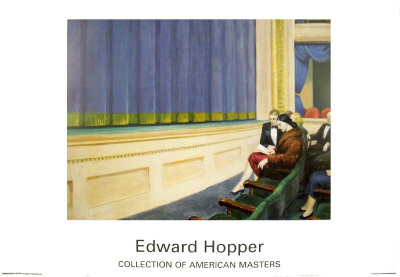
Compare: First Row Orchestra, 1951.
Four theatres brought together
The interior combines material from the Globe, Palace, Republic and Strand theatres. The Whitney's 2022 exhibition account identifies fifty-three surviving sketches connected with the painting and records that Jo posed for both the usher and audience figures. [5] The finished room was constructed through substantial looking and study rather than copied as one complete existing interior.
In the museum's guide, Melinda Lang describes Hopper visiting cinemas with small sketchbook sheets, recording architectural features and returning to paint in the studio. The theatres' names appear on the drawings. [2] The method connected portable observation with the slower work of assembling a canvas elsewhere.
This is important to the central division. Its force need not be explained as an awkward feature Hopper happened to encounter in one room. Architecture from several sites could be selected and brought into a new relation with seats, screen and figure.
The resulting space is recognizable as a cinema while retaining a peculiar organization of its own. The repeated ceiling compartments, elaborate column and curtained stairs do not have to be assigned to a single floor plan for the painting to make sense. Their relationship serves the image's different areas of attention.
The composite also allows the title to remain broad. New York Movie names a city and an experience rather than one establishment. Details observed in particular places become a convincing public interior with its own carefully restricted views.
The Palace drawing: space before the final figure
A 1938 sheet explicitly associated with the Palace Theatre, Whitney accession 70.110, lets us inspect one stage of this selection. It is a small fabricated-chalk drawing on paper, 22.4 × 30 cm. The image contains repeated seat backs, a broad dark central pier, receding ceiling forms and a staircase at the right. [6]
The rows of seats are established economically. Curving lines distinguish their rounded tops, while darker strokes gather some into groups. Small marks suggest figures or heads among them, but the drawing's larger task is to locate the seating within a deep interior. We should not count every rounded mark as a separately observed patron.
Above them, projecting ceiling compartments supply a stronger directional rhythm. Their edges recede, and their shaded interiors contrast with lighter wall areas. A vertical mass interrupts that depth near the centre. The drawing already contains the problem that will become so powerful in the oil: how to make the view towards the auditorium coexist with a substantially different space beside it.
At the right, the stairs are more exposed than those in the finished painting. A curved handrail leads into an opening whose steps and landing can be examined without the final canvas's conspicuous red curtain enclosure. Nearby light fittings and wall edges give this area a relatively complex architectural identity.
The oil concentrates that complexity. The staircase becomes a more tightly framed route beyond the usher, while the illuminated wall provides an effective background for her silhouette. A change in the architecture consequently changes the kind of figure the painting can accommodate. Her pose is easy to follow partly because the surfaces immediately around it have been controlled.
The Palace sheet contains no prominent standing usher in the position that commands attention in the finished canvas. This does not establish that Hopper had yet to think of such a person; a single architectural drawing cannot tell us the whole sequence of his intentions. It does show that this sheet can be understood through its spatial investigation before we supply the painting's best-known human presence.
Comparison also makes the difference between chalk and oil useful. The paper's exposed light areas and quick dark strokes state a structure with relatively few tonal steps. Painted colour later distinguishes warm curtains, blue uniform, pale wall and dark auditorium. The final division is sustained through hue and surface as well as through the placement of lines.
Calling the canvas a composite can sound like assembling a room from a set of interchangeable pieces. The drawing suggests a more searching process. A staircase observed in one setting becomes useful in another because its exposure, enclosure and relationship to a wall can be changed. Hopper's recorded material supplied possibilities to work through.
Tickets, visits and the work of remembering
The Whitney preserves another kind of theatre evidence alongside the drawings: more than 130 ticket stubs, annotated with the productions' titles, and a list of theatres with second balconies. These records make the Hoppers' attendance a sustained practice rather than an interest reconstructed only from the paintings. [4]
A ticket and a sketch preserve different aspects of a visit. The ticket records an occasion of admission; an annotation can connect that small remnant with a remembered production. A drawing selects a column, ceiling or figure for a different purpose, retaining visual relationships that might become useful after the performance has ended.
That difference helps us understand how looking could continue beyond the experience of being entertained. A theatre was somewhere to watch a show, but it was also an interior whose arrangement could be examined from a particular seat or passage. The surviving objects make those overlapping interests tangible.
They do not give every painted feature an exact dated visit. The composite room still has to be understood as a constructed image. What the archive adds is evidence of repeated encounters from which details, preferences and spatial memories could accumulate.
Jo's participation and the figure studies
Jo's role went beyond providing a body to copy. The Whitney describes her participation in posing, costumes and the staging of imagined characters, with individual features becoming less explicit as Hopper developed the finished figures. [5] Model, working pose and fictional cinema employee belong to related but distinct stages of making the painting.
A 1939 study, accession 70.455, gives close attention to the bent head, hand against the cheek and other arm across the body. The Whitney identifies fabricated chalk and charcoal on paper. [7] The face is more individually described than in the oil, where the brighter hair, lowered head and surrounding illumination carry much of the figure's effect.
The drawing's dark sleeve and shaded torso also establish the support beneath the raised hand. The gesture is not only a face touching a palm; it depends on the lower arm holding a position across the body. Hopper studied that physical arrangement closely enough for it to remain convincing after the figure was set within the larger room.
Another sheet, accession 70.273, separates details. A headless upper-body study occupies the right, while two groups of shoes and lower clothing appear at the left. The museum dates this fabricated-chalk drawing to 1939. [7] It shows attention moving between the overall stance, the fall of the garment and the small forms that meet the floor.
Those details help explain the finished figure's specificity. Uniform folds, bent arms and strapped shoes give the usher a bodily presence within the theatre. They do not identify the employee's private life or make the image a documentary portrait of Jo at work in a cinema.
Watch: Edward Hopper’s Life and Art
Explore Hopper’s paintings and the places behind them in these museum films. Choose a film below.
A drawing of the divided interior
A wider study in the Whitney, accession 70.274a-b, considers the auditorium beside a tall curtained opening. Its recto uses fabricated chalk and charcoal; the museum dates the sheet to 1938 or 1939. [8]
On the left, repeated ceiling forms descend towards a dark group of seating shapes. A strong vertical construction divides that area from the opening at the right. Within the opening, steps and a handrail lead into another depth, framed by heavy curtains and an arch.
The right foreground is not occupied by the prominent standing usher of the final canvas. This makes the architectural problem especially clear. The drawing gives the passage a force of its own through the dark curtain edges, the steps and the contrast between the opening and surrounding wall.
The painting retains the division while making the employee its brightest human presence. The change in emphasis is substantial: a route through the building becomes the setting for a person paused beside it. Looking at the drawing and canvas together reveals how strongly the figure's effect depends on the designed space around her.
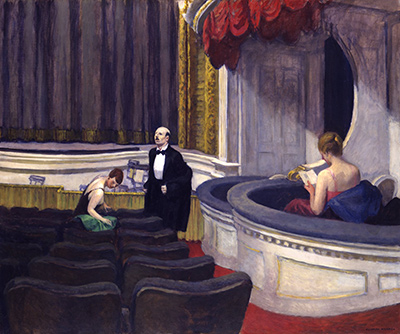
Compare: Two on the Aisle, 1927.
The woman who works and the people who watch
Eva Balogh's research on cinema usherettes offers a useful extension of the labour question. Her 2017 article uses Hopper's painting to introduce the employee's position as both a visible part of the cinema spectacle and a watcher of its audience. Drawing mainly on British evidence, she distinguishes the promise of a glamorous job from the fragmented experience of attending to patrons during a performance. Her interview material also records workers catching parts of films across repeated screenings. [9]
That history enlarges the question of looking without supplying the painted woman's thoughts. An employee in an auditorium can be available to the audience's gaze and responsible for observing its behaviour. Watching the screen is only one of several possible uses of sight in such a place.
The distinction is especially apt here because the usher is highly visible to us while the patrons are largely identified by the backs of their heads. The person who may help organize the audience is the person whose own attention we cannot follow. Her lowered face turns a public role into a private-looking interval.
The British testimony does not prove the working rules of this fictional New York cinema. Its value is to recover the practical relations that can disappear when she is described only as an emblem of solitude.
The uniform contributes to those relations. It identifies a role within the establishment, while its blue colour also separates the figure from the warm wall and curtains. Clothing operates as social information and as paint. The figure's individuality arises through the posture and light within that shared working costume.
The three red wall shades offer a further complication. Their brightness directs our attention towards a person who does not appear to be performing for anyone. She becomes the painting's conspicuous human subject through a moment of reduced outward activity. The room provides a visual emphasis that her own gesture does not solicit.
Across the dark division, the patrons are participating in an event whose content remains only partly available to us. We see where they look, but not enough of the screen to share the same experience. The painting positions us outside both kinds of absorption: the film's hold on the audience and the usher's inward-looking pause.
Work, fantasy and different readings
Viola Rühse approaches New York Movie through the cinema employee's work. She relates the usher's separate position to the duties and public image of usherettes, reading the scene as a qualification of the glamour associated with moviegoing. [10] This account gives the employee's location a social context while remaining an interpretation of the painted figure.
The composition supports attention to that difference in roles. The audience looks towards a paid entertainment; the employee stands beside the circulation route, visible to us but not sharing their direction of looking. The cinema contains both leisure and the work that helps organize it.
An early response moved in another direction. Gail Levin records André Breton's discussion of the painting in a 1941 interview with Nicolas Calas for View. Breton attended to the woman, column, lights and curtained stairway through a Surrealist interest in dream and symbolic significance. [11] His response is evidence of the painting's reception, rather than a declaration of Hopper's intention.
The difference between these readings is productive. One asks what it means to work beside a spectacle; another treats the room's divisions and openings as invitations to imaginative association. Both begin with features Hopper made conspicuous, but neither turns the usher's hidden thoughts into an established fact.
The material arrangement continues to resist a single explanation. The woman is close enough to inspect but not available for conversation. The audience is present but largely turned away. The stairs offer a route onward while their destination remains beyond the frame.
A comparison with Manet's barmaid
Rühse also relates Hopper's employee to the woman in Édouard Manet's A Bar at the Folies-Bergère of 1882. [10] The comparison connects two public places of entertainment through the person working within them. It is useful as a critical relation between paintings, without requiring a claim that Hopper copied Manet's arrangement.
Manet places the barmaid centrally, behind a counter crowded with bottles, fruit and flowers. The surrounding audience is presented through a mirror, which also contains a displaced view of the woman and a male customer. The Courtauld's account emphasizes the uncertainty this creates about the spectator's position in relation to her. [12]
Hopper distributes the corresponding difficulties across a divided room. His usher stands to one side and lowers her face, while the audience is seen directly from behind. There is no large mirror joining their world to ours. Instead, architecture allows the employee and patrons to be visible together while keeping them distinct.
The contrast in bodily address is especially telling. Manet's woman faces outward, making the encounter across the counter difficult to avoid. Hopper's woman turns her attention away from the audience and withholds a direct exchange with us. Each painting makes a worker conspicuous through a very different relation to being looked at.
The room's riches also have different effects. Manet gathers display around the central barmaid and multiplies the venue through reflection. Hopper places much of the ornament in the dark division and auditorium, while the usher stands against a plainer wall. Her separation becomes a major part of her visibility.
The comparison brings the cinema into a longer history of painting modern leisure. A public interior includes goods, spectacle and service as well as private-looking moments. The employee's stillness can expose those relations without telling us exactly what she feels about them.
A painting with several kinds of duration
A cinema implies time passing in a particularly structured way. The projected sequence continues even when a viewer looks away. A member of staff may wait for a late arrival or an instruction; a patron may follow a scene towards its next cut. None of those rhythms can be read directly from a single painted instant.
Hopper makes their coexistence visible by distributing attention. The screen's pale fragment implies an ongoing performance at the edge. The seating suggests a settled audience. The woman's stationary pose offers a different interval beside a route designed for movement. The painting brings these conditions into one view without making them synchronize around a common action.
The stairs deepen the effect because they imply a place a person could go. They do not supply a second scene happening on a landing. Their upper continuation is withheld, so that a possible transition remains part of the room's structure rather than becoming a narrated departure.
The title's singular Movie can consequently feel broader than the small visible projection. Screen, architecture, audience and employee belong to the experience it names. The cinema appears as a setting that produces different kinds of attention, not only a machine for showing an identifiable film.
This also helps explain the variety of later responses. A critic interested in labour can attend to the uniform and the employee's location. A Surrealist can follow the opening, lights and column into an associative interior. A painter can concentrate on the unequal distribution of warm and cool colour. Each approach selects a relation Hopper made available, rather than exhausting the room's other possibilities.
Within Hopper's theatre pictures
The Sheridan Theatre gives the lobby and mezzanine of a named cinema a broad, warm architectural presence. Its visitor stands against curved balustrades, surrounded by glowing fixtures. New York Movie makes a more abrupt division, bringing the illuminated employee close while pressing the auditorium to one side.
Two on the Aisle selects the interval before a stage performance. A standing man, a bending woman and a reader in a box occupy a theatre whose curtain remains closed. In New York Movie, the performance is underway, but the figure who holds much of our attention is elsewhere within the building.
First Row Orchestra returns to seated spectators beside a great curtain in 1951. Its long pale stage front joins the small audience to an expansive field of fabric. The 1939 painting gives that relationship between setting and people a sharper interruption through the wall at its centre.
The curtained staircase offers one of its most persistent openings. We can see enough steps to understand an upward route, while the usher remains motionless beside them. The audience has a film to follow; the painting gives us a person, a divided room and a route whose continuation we must imagine.
Artworks and studies directory
This researched directory includes finished works and separately identified studies. It is not a complete catalogue raisonné. Linked titles open the articles; unlinked studies are identified by their collection accessions. Watercolours retain their recorded media, and original prints remain distinct from reproductions.
| Name | Date | Medium |
|---|---|---|
| (Bridge and Embankment) (70.1298) | 1906 | Oil on wood |
| (Jo Sketching at Good Harbor Beach) (70.1129) | 1923–1924 | Watercolor and fabricated chalk on paper |
| (Manhattan Bridge) (70.1098) | 1925–1926 | Watercolor and graphite pencil on paper |
| (Rooftops) (70.1114) | 1926 | Watercolor and graphite pencil on paper |
| (Seated Male Model, Bent Over) (70.1277) | c. 1902–1903 | Oil on canvas |
| (Self-Portrait) (70.1254) | 1903–1906 | Oil on canvas |
| (Solitary Figure in a Theater) (70.1418) | c. 1902–1904 | Oil on board |
| 5 A.M. | 1937 | oil on canvas |
| Adam's House | 1928 | watercolour and charcoal on paper |
| American Village | 1912 | Oil on canvas |
| Apartment Houses | 1923 | oil on canvas |
| Approaching a City | 1946 | oil on canvas |
| August in the City | 1945 | oil on canvas |
| Automat | 1927 | oil on canvas |
| Barber Shop | 1931 | oil on canvas |
| Blackwell's Island | 1928 | oil on canvas |
| Bridge on the Seine | 1909 | Oil on canvas |
| Bridle Path | 1939 | oil on canvas |
| Burly Cobb's House South Truro | 1930–1933 | oil on canvas |
| Cape Cod Evening | 1939 | oil on canvas |
| Cape Cod Morning | 1950 | oil on canvas |
| Chair Car | 1965 | oil on canvas |
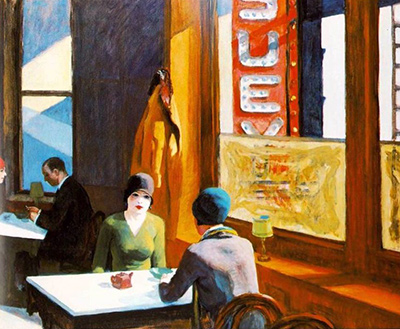
| Chop Suey | 1929 | oil on canvas |
| City Roofs | 1932 | Oil on canvas |
| Coast Guard Station | 1929 | oil on canvas |
| Compartment C, Car 293 | 1938 | oil on canvas |
| Conference at Night | 1949 | oil on canvas |
| Corn Hill | 1930 | oil on canvas |
| Dawn in Pennsylvania | 1942 | oil on canvas |
| Drug Store | 1927 | oil on canvas |
| Early Sunday Morning | 1930 | Oil on canvas |
| East Side Interior (70.1020) | 1922 | Etching |
| East Wind Over Weehawken | 1934 | oil on canvas |
| El Palacio | 1946 | Watercolor and graphite pencil on paper |
| Eleven A.M. | 1926 | oil on canvas |
| Evening Wind | 1921 | etching |
| Excursion into Philosophy | 1959 | oil on canvas |
| First Row Orchestra | 1951 | oil on canvas |
| Freight Car at Truro | 1931 | watercolour over graphite on paper |
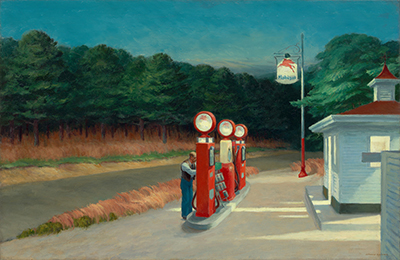
| Gas | 1940 | oil on canvas |
| Girl at a Sewing Machine | c. 1921 | oil on canvas |
| Gloucester Harbor | 1912 | Oil on canvas |
| Ground Swell | 1939 | oil on canvas |
| Haskell's House | 1924 | watercolour over graphite on paperboard |
| High Noon | 1949 | oil on canvas |
| Hill and Houses Cape Elizabeth Maine | 1927 | watercolour over graphite pencil |
| Hills South Truro | 1930 | oil on canvas |
| Hotel by a Railroad | 1952 | oil on canvas |
| Hotel Lobby | 1943 | oil on canvas |
| Hotel Room | 1931 | oil on canvas |
| Hotel Window | 1955 | oil on canvas |
| House by the Railroad | 1925 | oil on canvas |
| House by the Squam River | 1926 | watercolour over graphite on paper |
| Le Bistro or The Wine Shop | 1909 | Oil on canvas |
| Le Pont des Arts | 1907 | Oil on canvas |
| Le Pont Royal | 1909 | Oil on canvas |
| Le Quai des Grands Augustins | 1909 | Oil on canvas |
| Lighthouse and Buildings Portland Head | 1927 | watercolour over graphite pencil on paper |
| Lighthouse Hill | 1927 | oil painting |
| Manhattan Bridge Loop | 1928 | oil on canvas |
| Model Sitting | c. 1902 | oil painting; support not asserted |
| Morning Sun | 1952 | oil on canvas |
| New York Movie | 1939 | oil on canvas |
| New York New Haven and Hartford | 1931 | oil on canvas |
| New York Office | 1962 | oil on canvas |
| New York Pavements | 1924–1925 | oil on canvas |
| New York Restaurant | c. 1922 | oil on canvas |
| Night Windows | 1928 | oil on canvas |
| Nighthawks | 1942 | oil on canvas |
| October on Cape Cod | 1946 | oil on canvas |
| Office at Night | 1940 | oil on canvas |
| Office in a Small City | 1953 | oil on canvas |
| Pennsylvania Coal Town | 1947 | oil on canvas |
| People in the Sun | 1960 | oil on canvas |
| Portrait of Orleans | 1950 | oil on canvas |
| Queensborough Bridge | 1913 | Oil on canvas |
| Railroad Sunset | 1929 | Oil on canvas |
| Railroad Train | 1908 | oil on canvas |
| Road in Maine | 1914 | oil on canvas |
| Room in Brooklyn | 1932 | oil on canvas |
| Room in New York | 1932 | oil on canvas |
| Rooms by the Sea | 1951 | oil on canvas |
| Rooms for Tourists | 1945 | oil on canvas |
| Route 6 Eastham | 1941 | oil on canvas |
| Second Story Sunlight | 1960 | Oil on canvas |
| Self-Portrait | 1925–1930 | Oil on canvas |
| Self-Portrait with Hat (70.1903) | c. 1918, posthumous print | Drypoint |
| Seven A.M. | 1948 | Oil on canvas |
| Soir Bleu | 1914 | oil on canvas |
| South Carolina Morning | 1955 | Oil on canvas |
| Stairway at 48 Rue de Lille Paris | 1906 | Oil on wood |
| Study for 5 A.M. (70.153) | 1937 | Fabricated chalk on paper |
| Study for 5 A.M. (70.429) | 1937 | Fabricated chalk and graphite pencil on paper |
| Study for Approaching a City (70.869) | 1946 | Fabricated chalk and charcoal on paper |
| Study for August in the City (70.158a-b) | 1945 | Fabricated chalk on paper |
| Study for August in the City (70.159) | 1945 | Fabricated chalk on paper |
| Study for Bridle Path (70.220) | 1939 | Fabricated chalk on paper |
| Study for Bridle Path (70.235) | 1939 | Fabricated chalk on paper |
| Study for Compartment C, Car 293 (70.430) | 1938 | Fabricated chalk on paper |
| Study for Compartment C, Car 293 (70.431a-b) | 1938 | Fabricated chalk and charcoal on paper |
| Study for Conference at Night (70.170) | 1949 | Fabricated chalk on paper (recto); Typewriter ink on paper (verso) |
| Study for Conference at Night (70.174) | 1949 | Fabricated chalk on paper ( recto); Typewriter ink on paper (verso) |
| Study for East Wind over Weehawken (70.249) | 1934 | Graphite pencil on paper |
| Study for East Wind over Weehawken (70.252) | 1934 | Fabricated chalk and charcoal on paper |
| Study for Evening Wind (70.343a-b) | 1921 | Fabricated chalk on paper |
| Study for First Row Orchestra (70.841) | 1951 | Fabricated chalk and charcoal on paper |
| Study for Gas (70.263) | 1940 | Fabricated chalk on paper |
| Study for Ground Swell (70.339) | 1939 | Fabricated chalk, charcoal and graphite pencil on paper |
| Study for Hotel by a Railroad (70.199) | 1952 | Fabricated chalk on paper |
| Study for Hotel by a Railroad (70.427) | 1952 | Fabricated chalk on paper |
| Study for Hotel by a Railroad (70.428) | 1952 | Fabricated chalk on paper |
| Study for Hotel Lobby (70.117) | 1942 | Fabricated chalk and graphite pencil on paper |
| Study for Hotel Lobby (70.839) | 1942 | Fabricated chalk and charcoal on paper |
| Study for Hotel Window (70.161) | 1955 | Fabricated chalk, graphite pencil and colored pencil on paper |
| Study for Morning Sun (70.243) | 1952 | Fabricated chalk on paper |
| Study for Morning Sun (70.244) | 1952 | Fabricated chalk on paper |
| Study for Morning Sun (70.290) | 1952 | Fabricated chalk on paper |
| Study for Morning Sun (70.291) | 1952 | Fabricated chalk and graphite pencil on paper |
| Study for New York Movie (70.273) | 1939 | Fabricated chalk on paper |
| Study for New York Movie (70.274a-b) | 1938 or 1939 | Fabricated chalk and charcoal on paper (recto); Fabricated chalk on paper (verso) |
| Study for New York Movie (70.455) | 1939 | Fabricated chalk and charcoal on paper |
| Study for New York Office (70.822) | 1962 | Fabricated chalk on paper |
| Study for Nighthawks (70.192) | 1941 or 1942 | Fabricated chalk on paper |
| Study for Nighthawks (70.193) | 1941 or 1942 | Fabricated chalk on paper |
| Study for Office at Night (70.340) | 1940 | Fabricated chalk and charcoal on paper |
| Study for Office at Night (70.341) | 1940 | Fabricated chalk and graphite pencil on paper |
| Study for Pennsylvania Coal Town (70.198) | 1947 | Fabricated chalk on paper |
| Study for Pennsylvania Coal Town (70.229) | 1947 | Fabricated chalk and charcoal on paper |
| Study for Rooms for Tourists (70.438) | 1945 | Fabricated chalk and charcoal on paper |
| Study for Rooms for Tourists (70.848) | 1945 | Fabricated chalk and charcoal on paper |
| Study for Route 6, Eastham (70.369) | 1941 | Fabricated chalk and graphite pencil on paper |
| Study for Route 6, Eastham (70.854) | 1941 | Fabricated chalk and graphite pencil on paper |
| Study for South Carolina Morning (70.162a-b) | 1955 | Fabricated chalk on paper (recto and verso) |
| Study for The Sheridan Theatre (70.969) | 1937 | Graphite pencil on paper |
| Study for Two on the Aisle (70.128) | 1927 | Fabricated chalk on paper |
| Study for Two on the Aisle (70.129) | 1927 | Fabricated chalk on paper |
| Study for Yawl Riding a Swell (70.439) | 1935 | Fabricated chalk and graphite pencil on paper |
| Summer Evening | 1947 | oil on canvas |
| Summer Interior | 1909 | Oil on canvas |
| Sun in an Empty Room | 1963 | oil on canvas |
| Sunlight in a Cafeteria | 1958 | oil on canvas |
| Sunlight on Brownstones | 1956 | oil on canvas |
| Tables for Ladies | 1930 | oil on canvas |
| The Bootleggers | 1925 | oil on canvas |
| The Camel's Hump | 1931 | oil on canvas |
| The Circle Theatre | 1936 | oil on canvas |
| The City | 1927 | oil on canvas |
| The Lighthouse at Two Lights | 1929 | oil on canvas |
| The Long Leg | 1935 | oil on canvas |
| The Mansard Roof | 1923 | watercolour over graphite on paper |
| The Sheridan Theatre | 1937 | oil on canvas |
| Tramp Steamer | 1908 | oil on canvas |
| Two Comedians | 1966 | oil on canvas |
| Two on the Aisle | 1927 | oil on canvas |
| Valley of the Seine | 1909 | Oil on canvas |
| Western Motel | 1957 | oil on canvas |
Frequently Asked Questions
Edward Hopper made New York Movie in 1939. [1]
The recorded medium is oil on canvas. [1]
A film is showing at the far left, but the brightest person in the picture is looking away from it. An usher in blue stands beside a staircase, her head lowered towards one hand. Between her and the seated audience, a massive dark wall and an ornate column divide the cinema almost in two. Edward Hopper's New York Movie gives the spectator several places to look while withholding a single, shared centre of attention.
Discussion
Look again at the images and ideas explored in New York Movie. These editorial prompts invite your observations.
Reader Insights
Which boundary, gesture or change of light first holds your attention in New York Movie?
Compare First Row Orchestra with New York Movie. Which visual difference matters most to your reading?
Which detail would you look at again after reading “Lights above the audience and beside the wall”?
Join the Conversation
Share a detail, comparison or question about New York Movie below.
References
- Museum of Modern Art, New York Movie, 1939, accession 396.1941; current medium, dimensions and anonymous gift credit. View source.
- Whitney Museum of American Art, Edward Hopper's New York, guide, 2022, stop 512, transcript with Kim Conaty and Melinda Lang; divided composition, sketching routine and named theatre sources. View source.
- Historic Districts Council, “Palace Theatre Interior”, complete building entry; Kirchhoff & Rose, 1912–13, Baroque ornament, balconies and circulation spaces. Architectural context for a source theatre, not identification of the whole painted interior. View source.
- Whitney Museum of American Art, “New York Scenes,” teaching guide; proposed Lost Horizon identification and figure-staging context. View source.
- Whitney Museum of American Art, Edward Hopper's New York, exhibition labels, 2022, PDF pp. 52 and 57, printed labels 36 and 41; four theatre sources, fifty-three extant sketches, Jo's modelling and active staging. View source.
- Whitney Museum of American Art, Study for New York Movie (Palace theatre), 1938, fabricated chalk on paper, 70.110, Josephine N. Hopper Bequest; current metadata and complete drawing. View source.
- Whitney Museum of American Art, Study for New York Movie, 70.455 and Study for New York Movie, 70.273, 1939; object records and figure, costume and shoe drawings. View source 1. View source 2.
- Whitney Museum of American Art, Study for New York Movie, 70.274a-b, 1938 or 1939; object record and recto compositional drawing. View source.
- Eva Balogh, “Stars in the Aisles: Cinema Usherettes, Identity and Ideology”, Participations: Journal of Audience & Reception Studies, vol.14, no.1, May 2017, pp.35–43, with abstract and notes; direct discussion of Hopper on p.35 and primarily British oral-history evidence, distinguished here from the painted New York employee. View source.
- Viola Rühse, “Edward Hopper's Cinema Paintings: Film Palace Nostalgia, Usherette's Disillusionment, and Bomb Threats”, Boletín de Arte, no. 20, September 2020, e023, pp. 9–10; attributed labour and usherette interpretation. View source.
- Gail Levin, “Edward Hopper's Nighthawks, Surrealism, and the War”, Art Institute of Chicago Museum Studies, vol. 22, no. 2, 1996, pp. 191–92 and note 28; Breton's 1941 response cited through Levin, rather than a directly examined original View interview. View source.
- The Courtauld, A Bar at the Folies-Bergère, complete collection interpretation, and A Closer Look, complete one-page reproduction examined; Manet's 1882 painting, barmaid, mirror and spectator problem. Comparison with Hopper introduced through Rühse rather than asserted as a documented direct source. View source 1. View source 2.
- Collection or catalogue record, American Village, 1912; medium and identity as discussed in the linked article. View source.
- Collection or catalogue record, Soir Bleu, 1914; medium and identity as discussed in the linked article. View source.
- Collection or catalogue record, House by the Railroad, 1925; medium and identity as discussed in the linked article. View source.
- Collection or catalogue record, Automat, 1927; medium and identity as discussed in the linked article. View source.
- Collection or catalogue record, Early Sunday Morning, 1930; medium and identity as discussed in the linked article. View source.
- Collection or catalogue record, New York Movie, 1939; medium and identity as discussed in the linked article. View source.
- Collection or catalogue record, Nighthawks, 1942; medium and identity as discussed in the linked article. View source.
- Collection or catalogue record, Morning Sun, 1952; medium and identity as discussed in the linked article. View source.
- Collection or catalogue record, Second Story Sunlight, 1960; medium and identity as discussed in the linked article. View source.
- Collection or catalogue record, Two Comedians, 1966; medium and identity as discussed in the linked article. View source.
- Whitney Museum of American Art, Study for Route 6, Eastham, 1941, accession 70.854; exact object record. View source.
- Whitney Museum of American Art, Study for Conference at Night, 1949, accession 70.170; exact object record. View source.
- Whitney Museum of American Art, Study for First Row Orchestra, 1951, accession 70.841; exact object record. View source.
- Whitney Museum of American Art, (Bridge and Embankment), 1906, accession 70.1298; exact object record. View source.
- Whitney Museum of American Art, (Seated Male Model, Bent Over), c. 1902–1903, accession 70.1277; exact object record. View source.
- Whitney Museum of American Art, Study for Morning Sun, 1952, accession 70.244; exact object record. View source.
- Whitney Museum of American Art, Study for Morning Sun, 1952, accession 70.243; exact object record. View source.
- Whitney Museum of American Art, Study for Two on the Aisle, 1927, accession 70.128; exact object record. View source.
- Whitney Museum of American Art, Study for New York Office, 1962, accession 70.822; exact object record. View source.
- Whitney Museum of American Art, Study for Two on the Aisle, 1927, accession 70.129; exact object record. View source.
- Whitney Museum of American Art, Study for Pennsylvania Coal Town, 1947, accession 70.229; exact object record. View source.
- Whitney Museum of American Art, (Rooftops), 1926, accession 70.1114; exact object record. View source.
- Whitney Museum of American Art, Study for South Carolina Morning, 1955, accession 70.162a-b; exact object record. View source.
- Whitney Museum of American Art, (Self-Portrait), 1903–1906, accession 70.1254; exact object record. View source.
- Whitney Museum of American Art, (Manhattan Bridge), 1925–1926, accession 70.1098; exact object record. View source.
- Whitney Museum of American Art, (Solitary Figure in a Theater), c. 1902–1904, accession 70.1418; exact object record. View source.
- Whitney Museum of American Art, Study for Approaching a City, 1946, accession 70.869; exact object record. View source.
- Whitney Museum of American Art, Study for August in the City, 1945, accession 70.159; exact object record. View source.
- Whitney Museum of American Art, Study for Compartment C, Car 293, 1938, accession 70.430; exact object record. View source.
- Whitney Museum of American Art, Study for Compartment C, Car 293, 1938, accession 70.431a-b; exact object record. View source.
- Whitney Museum of American Art, Study for East Wind over Weehawken, 1934, accession 70.252; exact object record. View source.
- Whitney Museum of American Art, Study for East Wind over Weehawken, 1934, accession 70.249; exact object record. View source.
- Whitney Museum of American Art, Study for Evening Wind, 1921, accession 70.343a-b; exact object record. View source.
- Whitney Museum of American Art, Study for The Sheridan Theatre, 1937, accession 70.969; exact object record. View source.
- Whitney Museum of American Art, Study for New York Movie, 1939, accession 70.455; exact object record. View source.
- Whitney Museum of American Art, Study for New York Movie, 1939, accession 70.273; exact object record. View source.
- Whitney Museum of American Art, Study for New York Movie, 1938 or 1939, accession 70.274a-b; exact object record. View source.
- Whitney Museum of American Art, Study for 5 A.M., 1937, accession 70.153; exact object record. View source.
- Whitney Museum of American Art, Study for 5 A.M., 1937, accession 70.429; exact object record. View source.
- Whitney Museum of American Art, (Jo Sketching at Good Harbor Beach), 1923–1924, accession 70.1129; exact object record. View source.
- Whitney Museum of American Art, Study for August in the City, 1945, accession 70.158a-b; exact object record. View source.
- Whitney Museum of American Art, Study for Morning Sun, 1952, accession 70.291; exact object record. View source.
- Whitney Museum of American Art, Study for Morning Sun, 1952, accession 70.290; exact object record. View source.
- Whitney Museum of American Art, Study for Office at Night, 1940, accession 70.340; exact object record. View source.
- Whitney Museum of American Art, Study for Office at Night, 1940, accession 70.341; exact object record. View source.
- Whitney Museum of American Art, Study for Hotel by a Railroad, 1952, accession 70.427; exact object record. View source.
- Whitney Museum of American Art, Study for Hotel by a Railroad, 1952, accession 70.199; exact object record. View source.
- Whitney Museum of American Art, Study for Hotel by a Railroad, 1952, accession 70.428; exact object record. View source.
- Whitney Museum of American Art, Study for Hotel Lobby, 1942, accession 70.117; exact object record. View source.
- Whitney Museum of American Art, Study for Hotel Lobby, 1942, accession 70.839; exact object record. View source.
- Whitney Museum of American Art, Study for Conference at Night, 1949, accession 70.174; exact object record. View source.
- Whitney Museum of American Art, Study for Hotel Window, 1955, accession 70.161; exact object record. View source.
- Whitney Museum of American Art, Study for Pennsylvania Coal Town, 1947, accession 70.198; exact object record. View source.
- Whitney Museum of American Art, Study for Route 6, Eastham, 1941, accession 70.369; exact object record. View source.
- Whitney Museum of American Art, Study for Bridle Path, 1939, accession 70.220; exact object record. View source.
- Whitney Museum of American Art, Study for Bridle Path, 1939, accession 70.235; exact object record. View source.
- Whitney Museum of American Art, Study for Ground Swell, 1939, accession 70.339; exact object record. View source.
- Whitney Museum of American Art, Study for Yawl Riding a Swell, 1935, accession 70.439; exact object record. View source.
- Whitney Museum of American Art, Study for Rooms for Tourists, 1945, accession 70.848; exact object record. View source.
- Whitney Museum of American Art, Study for Rooms for Tourists, 1945, accession 70.438; exact object record. View source.
- Whitney Museum of American Art, Study for Nighthawks, 1941 or 1942, accession 70.193; exact object record. View source.
- Whitney Museum of American Art, Study for Nighthawks, 1941 or 1942, accession 70.192; exact object record. View source.
- Whitney Museum of American Art, Study for Gas, 1940, accession 70.263; exact object record. View source.
- Whitney Museum of American Art, Self-Portrait with Hat, c. 1918, posthumous print, accession 70.1903; exact object record. View source.
- Whitney Museum of American Art, East Side Interior, 1922, accession 70.1020; exact object record. View source.
- Art Institute of Chicago, Selected Chronology for Edward Hopper; training, travels, exhibitions, New York and Truro chronology. View source.
- Emily C. Burns, Spectral figures: Edward Hopper’s empty Paris, chapter 5 in Empty Spaces: Confronting Emptiness in National, Cultural and Urban Histories, 2019; complete chapter and notes consulted. View source.
- Charles Brock, Regionalism and Folk Art, National Gallery of Art; complete essay and two notes consulted. View source.