 by Tom Gurney
Tom Gurney BSc (Hons) is an art history expert with over 20 years experience
Email: tomgurney1@gmail.com / Phone: +44 7429 011000
Rooms for Tourists: Introduction
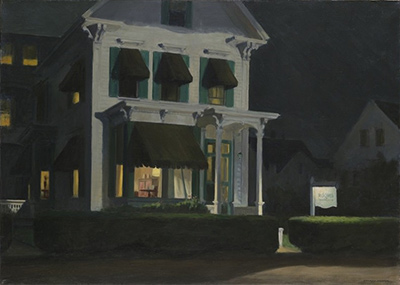
A white house shines against a dark street. Its windows reveal patches of warm light, but no clearly visible person comes forward to receive the spectator. Edward Hopper's Rooms for Tourists turns a place offering accommodation into a scene of looking from outside: we can recognise an invitation to stay without knowing what a stay would be like.
Painted in 1945, the oil on canvas measures 30¼ by 42⅛ inches, or 76.8 by 107 centimetres. It belongs to the Yale University Art Gallery through Stephen Carlton Clark's bequest. [1] The building's strong presence and the lack of a visible guest make architecture carry much of the picture's human interest.
At a Glance
- ArtistEdward Hopper [1]
- Date1945 [1]
- Mediumoil on canvas [1]
- Collection / recordYale University Art Gallery [1]
- Accession1961.18.30 [1]
This work across Edward Hopper’s career
American Village
1912Soir Bleu
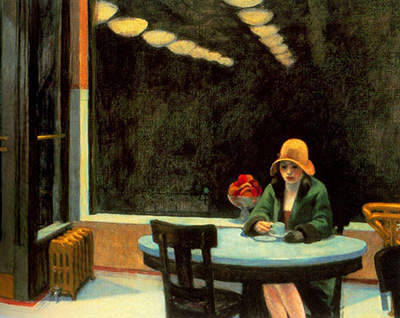
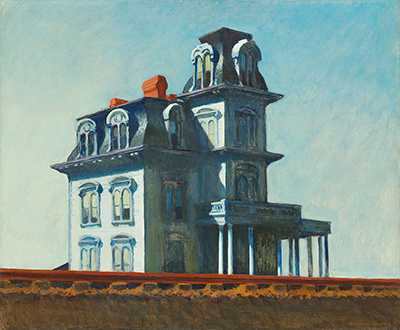
1914Automat
1927New York Movie
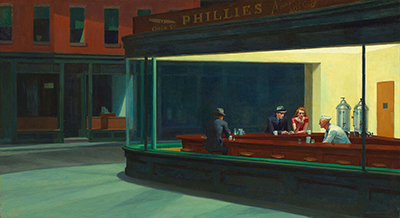
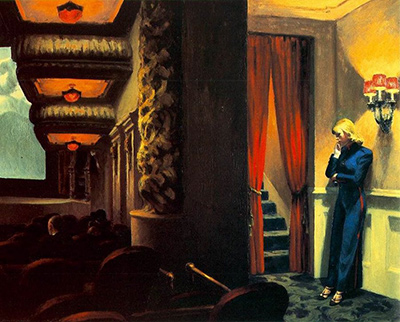
1939Nighthawks
1942Morning Sun
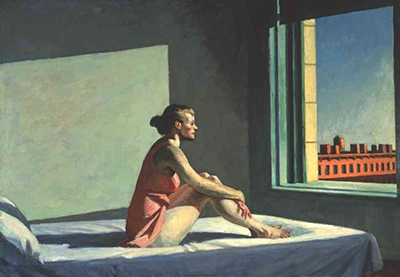
1952Two Comedians
1966Contents
- An inn seen from the street
- The illuminated front
- Hedges, windows and distance
- Day and night as different designs
- Drawing as a record of light
- Welcome, privacy and possible unease
- Among Hopper's places of temporary residence
- The house as an invitation
An inn seen from the street
Curatorial scholar Janet L. Comey identifies the subject as a particular inn in Provincetown, Massachusetts. She reports that Hopper developed it through evening sketches made from his parked car. [2] This gives the scene a firmer relation to one building than many of his assembled urban and rural settings.
A particular source does not make the painting a neutral property record. The view is selected, framed and organised through darkness. The building's bright front commands attention, while neighbouring forms are reduced to shadowy outlines and small lighted openings. We understand the immediate setting without receiving equal information about every house along the street.
The inn also combines two kinds of identity. Its scale and ornament belong to a house; its title announces accommodation for people passing through. Domestic architecture becomes a place where strangers may temporarily occupy rooms. Hopper makes that overlap visible through a façade rather than through a scene at a reception desk.
There is no evidence in the image of how many rooms are free, how long a visitor might stay or whether the house is busy. Lights establish activity and visibility, but do not amount to an occupancy register. The painting gives the establishment a public face while retaining its private interior.
The illuminated front
Pale columns and trim stand out against the surrounding darkness. Above the porch, a row of projecting awnings interrupts the windows. They make a sequence of dark shapes within the bright façade, giving the front a depth that a uniformly light wall would lack.
The awnings are especially effective because they partly conceal what the windows might reveal. The building seems open through illumination, yet its openings remain screened. Seeing light is not the same as seeing clearly into a room. The picture offers several degrees of access rather than a simple division between a visible house and an invisible interior.
The porch adds another layer. Columns stand in front of the wall, and the covered entrance is set among bands of light and shadow. A visitor would have to pass through these successive boundaries to enter. The spectator remains at a distance where they can be taken in as a single architectural arrangement.
The roof extends beyond the upper edge of the canvas. Its cropping makes the front feel large and close enough to exceed our view, while the low neighbouring buildings remain more contained. The composition is therefore not merely a portrait of a complete object placed centrally within empty space. It makes us encounter a selected portion of a larger structure.
The bright sign at the right provides a smaller echo of the façade. Standing apart from the main mass, it draws attention across a darker interval. Its pale surface belongs to the inn's outward communication. The board addresses the street, while the painting's title identifies the establishment's offer: temporary rooms.
Hedges, windows and distance
The hedge forms a broad, low barrier across the front. Its dark horizontal mass anchors the building and separates its lit rooms from the street. Openings and vertical accents interrupt that boundary, but it remains a substantial part of the approach.
This foreground is important because the painting is not taken from inside the porch. The viewer must look across an area of darkness before reaching the luminous house. The gap between spectator and accommodation becomes a visible condition of the scene, rather than a detail supplied by the title alone.
Individual windows differ in brightness. Some offer concentrated yellow light; others remain comparatively subdued beneath their awnings. This variation prevents the house from becoming a single lantern. It suggests separate interior spaces without giving each one an episode or an occupant.
Furniture can be glimpsed through a lower opening, but the view does not expand into a room whose whole purpose can be read. Small interior forms remain subordinate to the larger structure of light. The life of the inn is suggested through fragments rather than through an exposed domestic tableau.
The darker buildings nearby make that selectiveness even clearer. They retain enough shape to establish a neighbourhood, yet do not compete equally for attention. Darkness is doing compositional work. It reduces the amount of description required outside the inn and lets a few lighted areas carry the scene.
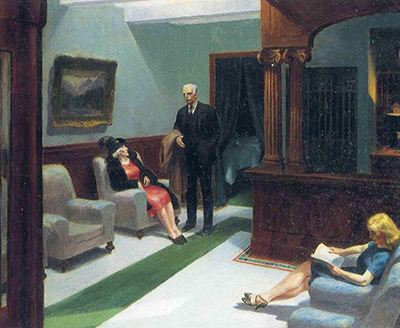
Compare: Hotel Lobby, 1943.
Day and night as different designs
The Whitney holds two particularly useful 1945 studies. One, accession 70.848, is a large drawing in fabricated chalk and charcoal. It presents the building with its complete roof, adjacent houses and hedges more openly available against the paper. In the accompanying transcript, Carter Foster discusses the difference between daytime and nighttime studies while leaving the timing of Hopper's decision for a night painting unresolved. [3]
The daylight drawing makes the building comparatively easy to survey. The roof peak has space above it, and the neighbouring forms can be followed through lines and lighter shading. Window awnings and porch columns already contribute strongly to the design. They do not depend on the night setting to become interesting architectural forms.
The night study, accession 70.438, also uses fabricated chalk and charcoal. Here dark passages surround the front, which is picked out through stronger tonal contrasts. [4] The upper roof is cropped, the sign becomes an emphatic light area, and the windows register as separate bright interruptions.
The difference is more than a change of colour or an instruction to darken the sky. The night drawing reorganises how information reaches the viewer. A façade that can be surveyed by its edges in daylight becomes an arrangement of selected illuminated surfaces. The eye must negotiate lighted openings and dark coverings, rather than simply follow the outline of a house.
The painting develops that concentration through colour. The pale façade gains a cooler cast against warm window light, and the surroundings acquire distinctions within darkness. A night scene can therefore contain a surprising range of colour even when its first impression is one of restricted visibility.
The two studies should not be forced into a simple story in which one was certainly rejected only after the other was finished. Foster's uncertainty about the decision is part of the evidence. What the drawings securely offer is a comparison of possibilities available to Hopper before the canvas settled on night.
Watch: Edward Hopper’s Life and Art
Explore Hopper’s paintings and the places behind them in these museum films. Choose a film below.
Drawing as a record of light
The Whitney's account of another preparatory drawing, accession 70.221, describes written notes about greens, shadow and warmer or cooler light. [1] Such observations help explain how a drawing could contribute to an oil painting without duplicating its colours on paper.
The distinction is practical. A line can establish the position of a column or the slope of an awning, while a written note preserves a colour relation that the drawing material cannot directly reproduce. Different kinds of record can work together within one sheet.
That process matters particularly in a scene where adjacent surfaces do not receive the same light. An awning, a window and a pale column may be close together in space while differing sharply in tone and colour. The painter has to preserve those differences if the front is to feel illuminated rather than uniformly bright.
Comey also recounts Hopper's comment that he did not want to intrude by explaining his activity to the landlady. [2] This is a reported account of his working situation, rather than evidence that an incident of suspicion took place inside the painting. It nevertheless brings the act of observation into focus: a person outside a house can spend a long time looking without becoming part of its visible life.
Welcome, privacy and possible unease
Comey describes the picture's atmosphere as comparatively mellow. [2] Foster finds the night drawing eerie. [3] These responses need not cancel one another. Light can make a building attractive while the inability to see who is inside keeps the encounter uncertain.
The title supplies a reason to approach. Tourists need a place to stay, and rooms offer the possibility of rest. Yet the façade does not display a personal welcome through a figure at the door. It communicates through architecture, illumination and a sign. A public offer remains attached to a largely private interior.
This is different from saying that the inn is deserted. No identifiable person appears, but absence from the visible openings does not prove absence from the whole building. The painting's quiet comes partly from that distinction. We can imagine life behind the façade without being given access to it.
Nor is the dark street automatically threatening. It creates contrast and distance, and allows the illuminated building to stand forward. A frightening narrative is possible to invent, but it is not necessary to explain the force of the image. The contrast between readiness for visitors and withheld personal contact is already enough.
The viewer's position remains especially consequential. We are neither an established inhabitant nor a guest shown arriving with luggage. We occupy a space of consideration before entry. The inn can be contemplated as a possible destination while its actual experience stays unknown.
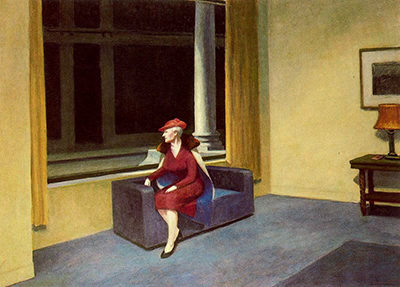
Compare: Hotel Window, 1955.
Among Hopper's places of temporary residence
Yale's 2019–20 annual report records the canvas among its loans to Edward Hopper and the American Hotel. [5] That exhibition context places the work within his sustained interest in places where people stay without necessarily making a permanent home.
Hotel Lobby brings the viewer into a communal interior and gives temporary occupants visible positions. Here the public encounter happens at the building's edge. The absence of an exposed group leaves the sign and façade to establish the inn's function.
Hotel Window turns attention towards a figure within a room looking outward. Rooms for Tourists keeps the spectator outside, looking in. These are different experiences of the boundary between temporary accommodation and the surrounding world, rather than repetitions of one standard image of isolation.
The guest house also differs from a modern motel organised around a visible car. Its offer is housed in an older domestic form, with columns, awnings and a substantial front. The painting can suggest travel without making the vehicle or the traveller its principal subject.
The house as an invitation
The picture's large forms remain clear even when the smaller details are difficult to identify. A pale front, repeated dark awnings, warm windows, a hedge and a bright board give the scene its structure. The night setting does not erase the building. It makes its different degrees of visibility the subject.
Look from the sign back to the porch, then from the porch to the lit windows. Each offers information about the inn, but none completes the encounter. There is still an interval to cross and a door to approach.
Hopper leaves the house available as a destination without showing an arrival. Its rooms are offered to travellers whose faces and histories remain outside the picture. The light makes the building noticeable; the distance lets us continue considering it.
Artworks and studies directory
This researched directory includes finished works and separately identified studies. It is not a complete catalogue raisonné. Linked titles open the articles; unlinked studies are identified by their collection accessions. Watercolours retain their recorded media, and original prints remain distinct from reproductions.
| Name | Date | Medium |
|---|---|---|
| (Bridge and Embankment) (70.1298) | 1906 | Oil on wood |
| (Jo Sketching at Good Harbor Beach) (70.1129) | 1923–1924 | Watercolor and fabricated chalk on paper |
| (Manhattan Bridge) (70.1098) | 1925–1926 | Watercolor and graphite pencil on paper |
| (Rooftops) (70.1114) | 1926 | Watercolor and graphite pencil on paper |
| (Seated Male Model, Bent Over) (70.1277) | c. 1902–1903 | Oil on canvas |
| (Self-Portrait) (70.1254) | 1903–1906 | Oil on canvas |
| (Solitary Figure in a Theater) (70.1418) | c. 1902–1904 | Oil on board |
| 5 A.M. | 1937 | oil on canvas |
| Adam's House | 1928 | watercolour and charcoal on paper |
| American Village | 1912 | Oil on canvas |
| Apartment Houses | 1923 | oil on canvas |
| Approaching a City | 1946 | oil on canvas |
| August in the City | 1945 | oil on canvas |
| Automat | 1927 | oil on canvas |
| Barber Shop | 1931 | oil on canvas |
| Blackwell's Island | 1928 | oil on canvas |
| Bridge on the Seine | 1909 | Oil on canvas |
| Bridle Path | 1939 | oil on canvas |
| Burly Cobb's House South Truro | 1930–1933 | oil on canvas |
| Cape Cod Evening | 1939 | oil on canvas |
| Cape Cod Morning | 1950 | oil on canvas |
| Chair Car | 1965 | oil on canvas |
| Chop Suey | 1929 | oil on canvas |
| City Roofs | 1932 | Oil on canvas |
| Coast Guard Station | 1929 | oil on canvas |
| Compartment C, Car 293 | 1938 | oil on canvas |
| Conference at Night | 1949 | oil on canvas |
| Corn Hill | 1930 | oil on canvas |
| Dawn in Pennsylvania | 1942 | oil on canvas |
| Drug Store | 1927 | oil on canvas |
| Early Sunday Morning | 1930 | Oil on canvas |
| East Side Interior (70.1020) | 1922 | Etching |
| East Wind Over Weehawken | 1934 | oil on canvas |
| El Palacio | 1946 | Watercolor and graphite pencil on paper |
| Eleven A.M. | 1926 | oil on canvas |
| Evening Wind | 1921 | etching |
| Excursion into Philosophy | 1959 | oil on canvas |
| First Row Orchestra | 1951 | oil on canvas |
| Freight Car at Truro | 1931 | watercolour over graphite on paper |
| Gas | 1940 | oil on canvas |
| Girl at a Sewing Machine | c. 1921 | oil on canvas |
| Gloucester Harbor | 1912 | Oil on canvas |
| Ground Swell | 1939 | oil on canvas |
| Haskell's House | 1924 | watercolour over graphite on paperboard |
| High Noon | 1949 | oil on canvas |
| Hill and Houses Cape Elizabeth Maine | 1927 | watercolour over graphite pencil |
| Hills South Truro | 1930 | oil on canvas |
| Hotel by a Railroad | 1952 | oil on canvas |
| Hotel Lobby | 1943 | oil on canvas |
| Hotel Room | 1931 | oil on canvas |
| Hotel Window | 1955 | oil on canvas |
| House by the Railroad | 1925 | oil on canvas |
| House by the Squam River | 1926 | watercolour over graphite on paper |
| Le Bistro or The Wine Shop | 1909 | Oil on canvas |
| Le Pont des Arts | 1907 | Oil on canvas |
| Le Pont Royal | 1909 | Oil on canvas |
| Le Quai des Grands Augustins | 1909 | Oil on canvas |
| Lighthouse and Buildings Portland Head | 1927 | watercolour over graphite pencil on paper |
| Lighthouse Hill | 1927 | oil painting |
| Manhattan Bridge Loop | 1928 | oil on canvas |
| Model Sitting | c. 1902 | oil painting; support not asserted |
| Morning Sun | 1952 | oil on canvas |
| New York Movie | 1939 | oil on canvas |
| New York New Haven and Hartford | 1931 | oil on canvas |
| New York Office | 1962 | oil on canvas |
| New York Pavements | 1924–1925 | oil on canvas |
| New York Restaurant | c. 1922 | oil on canvas |
| Night Windows | 1928 | oil on canvas |
| Nighthawks | 1942 | oil on canvas |
| October on Cape Cod | 1946 | oil on canvas |
| Office at Night | 1940 | oil on canvas |
| Office in a Small City | 1953 | oil on canvas |
| Pennsylvania Coal Town | 1947 | oil on canvas |
| People in the Sun | 1960 | oil on canvas |
| Portrait of Orleans | 1950 | oil on canvas |
| Queensborough Bridge | 1913 | Oil on canvas |
| Railroad Sunset | 1929 | Oil on canvas |
| Railroad Train | 1908 | oil on canvas |
| Road in Maine | 1914 | oil on canvas |
| Room in Brooklyn | 1932 | oil on canvas |
| Room in New York | 1932 | oil on canvas |
| Rooms by the Sea | 1951 | oil on canvas |
| Rooms for Tourists | 1945 | oil on canvas |
| Route 6 Eastham | 1941 | oil on canvas |
| Second Story Sunlight | 1960 | Oil on canvas |
| Self-Portrait | 1925–1930 | Oil on canvas |
| Self-Portrait with Hat (70.1903) | c. 1918, posthumous print | Drypoint |
| Seven A.M. | 1948 | Oil on canvas |
| Soir Bleu | 1914 | oil on canvas |
| South Carolina Morning | 1955 | Oil on canvas |
| Stairway at 48 Rue de Lille Paris | 1906 | Oil on wood |
| Study for 5 A.M. (70.153) | 1937 | Fabricated chalk on paper |
| Study for 5 A.M. (70.429) | 1937 | Fabricated chalk and graphite pencil on paper |
| Study for Approaching a City (70.869) | 1946 | Fabricated chalk and charcoal on paper |
| Study for August in the City (70.158a-b) | 1945 | Fabricated chalk on paper |
| Study for August in the City (70.159) | 1945 | Fabricated chalk on paper |
| Study for Bridle Path (70.220) | 1939 | Fabricated chalk on paper |
| Study for Bridle Path (70.235) | 1939 | Fabricated chalk on paper |
| Study for Compartment C, Car 293 (70.430) | 1938 | Fabricated chalk on paper |
| Study for Compartment C, Car 293 (70.431a-b) | 1938 | Fabricated chalk and charcoal on paper |
| Study for Conference at Night (70.170) | 1949 | Fabricated chalk on paper (recto); Typewriter ink on paper (verso) |
| Study for Conference at Night (70.174) | 1949 | Fabricated chalk on paper ( recto); Typewriter ink on paper (verso) |
| Study for East Wind over Weehawken (70.249) | 1934 | Graphite pencil on paper |
| Study for East Wind over Weehawken (70.252) | 1934 | Fabricated chalk and charcoal on paper |
| Study for Evening Wind (70.343a-b) | 1921 | Fabricated chalk on paper |
| Study for First Row Orchestra (70.841) | 1951 | Fabricated chalk and charcoal on paper |
| Study for Gas (70.263) | 1940 | Fabricated chalk on paper |
| Study for Ground Swell (70.339) | 1939 | Fabricated chalk, charcoal and graphite pencil on paper |
| Study for Hotel by a Railroad (70.199) | 1952 | Fabricated chalk on paper |
| Study for Hotel by a Railroad (70.427) | 1952 | Fabricated chalk on paper |
| Study for Hotel by a Railroad (70.428) | 1952 | Fabricated chalk on paper |
| Study for Hotel Lobby (70.117) | 1942 | Fabricated chalk and graphite pencil on paper |
| Study for Hotel Lobby (70.839) | 1942 | Fabricated chalk and charcoal on paper |
| Study for Hotel Window (70.161) | 1955 | Fabricated chalk, graphite pencil and colored pencil on paper |
| Study for Morning Sun (70.243) | 1952 | Fabricated chalk on paper |
| Study for Morning Sun (70.244) | 1952 | Fabricated chalk on paper |
| Study for Morning Sun (70.290) | 1952 | Fabricated chalk on paper |
| Study for Morning Sun (70.291) | 1952 | Fabricated chalk and graphite pencil on paper |
| Study for New York Movie (70.273) | 1939 | Fabricated chalk on paper |
| Study for New York Movie (70.274a-b) | 1938 or 1939 | Fabricated chalk and charcoal on paper (recto); Fabricated chalk on paper (verso) |
| Study for New York Movie (70.455) | 1939 | Fabricated chalk and charcoal on paper |
| Study for New York Office (70.822) | 1962 | Fabricated chalk on paper |
| Study for Nighthawks (70.192) | 1941 or 1942 | Fabricated chalk on paper |
| Study for Nighthawks (70.193) | 1941 or 1942 | Fabricated chalk on paper |
| Study for Office at Night (70.340) | 1940 | Fabricated chalk and charcoal on paper |
| Study for Office at Night (70.341) | 1940 | Fabricated chalk and graphite pencil on paper |
| Study for Pennsylvania Coal Town (70.198) | 1947 | Fabricated chalk on paper |
| Study for Pennsylvania Coal Town (70.229) | 1947 | Fabricated chalk and charcoal on paper |
| Study for Rooms for Tourists (70.438) | 1945 | Fabricated chalk and charcoal on paper |
| Study for Rooms for Tourists (70.848) | 1945 | Fabricated chalk and charcoal on paper |
| Study for Route 6, Eastham (70.369) | 1941 | Fabricated chalk and graphite pencil on paper |
| Study for Route 6, Eastham (70.854) | 1941 | Fabricated chalk and graphite pencil on paper |
| Study for South Carolina Morning (70.162a-b) | 1955 | Fabricated chalk on paper (recto and verso) |
| Study for The Sheridan Theatre (70.969) | 1937 | Graphite pencil on paper |
| Study for Two on the Aisle (70.128) | 1927 | Fabricated chalk on paper |
| Study for Two on the Aisle (70.129) | 1927 | Fabricated chalk on paper |
| Study for Yawl Riding a Swell (70.439) | 1935 | Fabricated chalk and graphite pencil on paper |
| Summer Evening | 1947 | oil on canvas |
| Summer Interior | 1909 | Oil on canvas |
| Sun in an Empty Room | 1963 | oil on canvas |
| Sunlight in a Cafeteria | 1958 | oil on canvas |
| Sunlight on Brownstones | 1956 | oil on canvas |
| Tables for Ladies | 1930 | oil on canvas |
| The Bootleggers | 1925 | oil on canvas |
| The Camel's Hump | 1931 | oil on canvas |
| The Circle Theatre | 1936 | oil on canvas |
| The City | 1927 | oil on canvas |
| The Lighthouse at Two Lights | 1929 | oil on canvas |
| The Long Leg | 1935 | oil on canvas |
| The Mansard Roof | 1923 | watercolour over graphite on paper |
| The Sheridan Theatre | 1937 | oil on canvas |
| Tramp Steamer | 1908 | oil on canvas |
| Two Comedians | 1966 | oil on canvas |
| Two on the Aisle | 1927 | oil on canvas |
| Valley of the Seine | 1909 | Oil on canvas |
| Western Motel | 1957 | oil on canvas |
Frequently Asked Questions
Edward Hopper made Rooms for Tourists in 1945. [1]
The recorded medium is oil on canvas. [1]
A white house shines against a dark street. Its windows reveal patches of warm light, but no clearly visible person comes forward to receive the spectator. Edward Hopper's Rooms for Tourists turns a place offering accommodation into a scene of looking from outside: we can recognise an invitation to stay without knowing what a stay would be like.
Discussion
Look again at the images and ideas explored in Rooms for Tourists. These editorial prompts invite your observations.
Reader Insights
Which boundary, gesture or change of light first holds your attention in Rooms for Tourists?
Compare Hotel Lobby with Rooms for Tourists. Which visual difference matters most to your reading?
Which detail would you look at again after reading “Hedges, windows and distance”?
Join the Conversation
Share a detail, comparison or question about Rooms for Tourists below.
References
- Billie Rae Vinson, “Hopper Drawing: Notes For A Painting”, Whitney Museum of American Art, 15 October 2013. Complete article, painting caption and discussion of study 70.221. View source.
- Janet L. Comey, “Edward Hopper: Hours of Darkness”, Antiques & Fine Art, Summer 2007, pp. 153–157. Complete five-page essay and notes; Rooms for Tourists discussion on p. 157, with Hopper's reported comment cited there to “Traveling Man,” Time, 19 January 1948, p. 59. View source.
- Whitney Museum of American Art, Study for Rooms for Tourists, 1945, accession 70.848. Current object record, daylight drawing and complete Carter Foster transcript. View source.
- Whitney Museum of American Art, Study for Rooms for Tourists, 1945, accession 70.438. Current object record and night drawing. View source.
- Yale University Art Gallery, Annual Report 2019–2020, p. 130, outgoing-loans entry for Rooms for Tourists, accession 1961.18.30, and Edward Hopper and the American Hotel. View source.
- Collection or catalogue record, American Village, 1912; medium and identity as discussed in the linked article. View source.
- Collection or catalogue record, Soir Bleu, 1914; medium and identity as discussed in the linked article. View source.
- Collection or catalogue record, House by the Railroad, 1925; medium and identity as discussed in the linked article. View source.
- Collection or catalogue record, Automat, 1927; medium and identity as discussed in the linked article. View source.
- Collection or catalogue record, Early Sunday Morning, 1930; medium and identity as discussed in the linked article. View source.
- Collection or catalogue record, New York Movie, 1939; medium and identity as discussed in the linked article. View source.
- Collection or catalogue record, Nighthawks, 1942; medium and identity as discussed in the linked article. View source.
- Collection or catalogue record, Morning Sun, 1952; medium and identity as discussed in the linked article. View source.
- Collection or catalogue record, Second Story Sunlight, 1960; medium and identity as discussed in the linked article. View source.
- Collection or catalogue record, Two Comedians, 1966; medium and identity as discussed in the linked article. View source.
- Whitney Museum of American Art, Study for Route 6, Eastham, 1941, accession 70.854; exact object record. View source.
- Whitney Museum of American Art, Study for Conference at Night, 1949, accession 70.170; exact object record. View source.
- Whitney Museum of American Art, Study for First Row Orchestra, 1951, accession 70.841; exact object record. View source.
- Whitney Museum of American Art, (Bridge and Embankment), 1906, accession 70.1298; exact object record. View source.
- Whitney Museum of American Art, (Seated Male Model, Bent Over), c. 1902–1903, accession 70.1277; exact object record. View source.
- Whitney Museum of American Art, Study for Morning Sun, 1952, accession 70.244; exact object record. View source.
- Whitney Museum of American Art, Study for Morning Sun, 1952, accession 70.243; exact object record. View source.
- Whitney Museum of American Art, Study for Two on the Aisle, 1927, accession 70.128; exact object record. View source.
- Whitney Museum of American Art, Study for New York Office, 1962, accession 70.822; exact object record. View source.
- Whitney Museum of American Art, Study for Two on the Aisle, 1927, accession 70.129; exact object record. View source.
- Whitney Museum of American Art, Study for Pennsylvania Coal Town, 1947, accession 70.229; exact object record. View source.
- Whitney Museum of American Art, (Rooftops), 1926, accession 70.1114; exact object record. View source.
- Whitney Museum of American Art, Study for South Carolina Morning, 1955, accession 70.162a-b; exact object record. View source.
- Whitney Museum of American Art, (Self-Portrait), 1903–1906, accession 70.1254; exact object record. View source.
- Whitney Museum of American Art, (Manhattan Bridge), 1925–1926, accession 70.1098; exact object record. View source.
- Whitney Museum of American Art, (Solitary Figure in a Theater), c. 1902–1904, accession 70.1418; exact object record. View source.
- Whitney Museum of American Art, Study for Approaching a City, 1946, accession 70.869; exact object record. View source.
- Whitney Museum of American Art, Study for August in the City, 1945, accession 70.159; exact object record. View source.
- Whitney Museum of American Art, Study for Compartment C, Car 293, 1938, accession 70.430; exact object record. View source.
- Whitney Museum of American Art, Study for Compartment C, Car 293, 1938, accession 70.431a-b; exact object record. View source.
- Whitney Museum of American Art, Study for East Wind over Weehawken, 1934, accession 70.252; exact object record. View source.
- Whitney Museum of American Art, Study for East Wind over Weehawken, 1934, accession 70.249; exact object record. View source.
- Whitney Museum of American Art, Study for Evening Wind, 1921, accession 70.343a-b; exact object record. View source.
- Whitney Museum of American Art, Study for The Sheridan Theatre, 1937, accession 70.969; exact object record. View source.
- Whitney Museum of American Art, Study for New York Movie, 1939, accession 70.455; exact object record. View source.
- Whitney Museum of American Art, Study for New York Movie, 1939, accession 70.273; exact object record. View source.
- Whitney Museum of American Art, Study for New York Movie, 1938 or 1939, accession 70.274a-b; exact object record. View source.
- Whitney Museum of American Art, Study for 5 A.M., 1937, accession 70.153; exact object record. View source.
- Whitney Museum of American Art, Study for 5 A.M., 1937, accession 70.429; exact object record. View source.
- Whitney Museum of American Art, (Jo Sketching at Good Harbor Beach), 1923–1924, accession 70.1129; exact object record. View source.
- Whitney Museum of American Art, Study for August in the City, 1945, accession 70.158a-b; exact object record. View source.
- Whitney Museum of American Art, Study for Morning Sun, 1952, accession 70.291; exact object record. View source.
- Whitney Museum of American Art, Study for Morning Sun, 1952, accession 70.290; exact object record. View source.
- Whitney Museum of American Art, Study for Office at Night, 1940, accession 70.340; exact object record. View source.
- Whitney Museum of American Art, Study for Office at Night, 1940, accession 70.341; exact object record. View source.
- Whitney Museum of American Art, Study for Hotel by a Railroad, 1952, accession 70.427; exact object record. View source.
- Whitney Museum of American Art, Study for Hotel by a Railroad, 1952, accession 70.199; exact object record. View source.
- Whitney Museum of American Art, Study for Hotel by a Railroad, 1952, accession 70.428; exact object record. View source.
- Whitney Museum of American Art, Study for Hotel Lobby, 1942, accession 70.117; exact object record. View source.
- Whitney Museum of American Art, Study for Hotel Lobby, 1942, accession 70.839; exact object record. View source.
- Whitney Museum of American Art, Study for Conference at Night, 1949, accession 70.174; exact object record. View source.
- Whitney Museum of American Art, Study for Hotel Window, 1955, accession 70.161; exact object record. View source.
- Whitney Museum of American Art, Study for Pennsylvania Coal Town, 1947, accession 70.198; exact object record. View source.
- Whitney Museum of American Art, Study for Route 6, Eastham, 1941, accession 70.369; exact object record. View source.
- Whitney Museum of American Art, Study for Bridle Path, 1939, accession 70.220; exact object record. View source.
- Whitney Museum of American Art, Study for Bridle Path, 1939, accession 70.235; exact object record. View source.
- Whitney Museum of American Art, Study for Ground Swell, 1939, accession 70.339; exact object record. View source.
- Whitney Museum of American Art, Study for Yawl Riding a Swell, 1935, accession 70.439; exact object record. View source.
- Whitney Museum of American Art, Study for Rooms for Tourists, 1945, accession 70.848; exact object record. View source.
- Whitney Museum of American Art, Study for Rooms for Tourists, 1945, accession 70.438; exact object record. View source.
- Whitney Museum of American Art, Study for Nighthawks, 1941 or 1942, accession 70.193; exact object record. View source.
- Whitney Museum of American Art, Study for Nighthawks, 1941 or 1942, accession 70.192; exact object record. View source.
- Whitney Museum of American Art, Study for Gas, 1940, accession 70.263; exact object record. View source.
- Whitney Museum of American Art, Self-Portrait with Hat, c. 1918, posthumous print, accession 70.1903; exact object record. View source.
- Whitney Museum of American Art, East Side Interior, 1922, accession 70.1020; exact object record. View source.
- Art Institute of Chicago, Selected Chronology for Edward Hopper; training, travels, exhibitions, New York and Truro chronology. View source.
- Emily C. Burns, Spectral figures: Edward Hopper’s empty Paris, chapter 5 in Empty Spaces: Confronting Emptiness in National, Cultural and Urban Histories, 2019; complete chapter and notes consulted. View source.
- Charles Brock, Regionalism and Folk Art, National Gallery of Art; complete essay and two notes consulted. View source.