 by Tom Gurney
Tom Gurney BSc (Hons) is an art history expert with over 20 years experience
Email: tomgurney1@gmail.com / Phone: +44 7429 011000
Sun in an Empty Room: Introduction
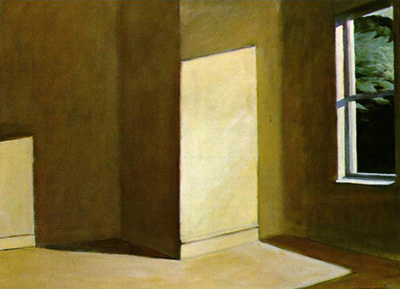
The subject of Edward Hopper's Sun in an Empty Room can be named almost completely in a few words: walls, floor, window, foliage and sunlight. Yet the painting does not become simple once its contents have been listed. Light divides the walls into shapes whose relationship to the room takes time to understand. A projecting corner interrupts one surface, while a bright area on the floor brings the illumination towards the viewer.
Hopper painted this oil on canvas in 1963. Crystal Bridges Museum of American Art in Bentonville, Arkansas, currently records it as a promised gift. [1] The Art Institute of Chicago's historical exhibition record gives the canvas dimensions as 73 × 100.3 cm, or 28¾ × 39½ inches. [2] This is a substantial horizontal interior, large enough for its few shapes to establish a convincing space around an absent human body.
At a Glance
- ArtistEdward Hopper [1]
- Date1963 [1]
- Mediumoil on canvas [1]
- Collection / recordPromised gift to Crystal Bridges Museum of American Art, Bentonville, Arkansas [1]
This work across Edward Hopper’s career
American Village
1912Soir Bleu
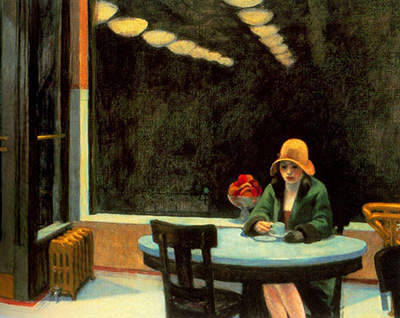
1914Automat
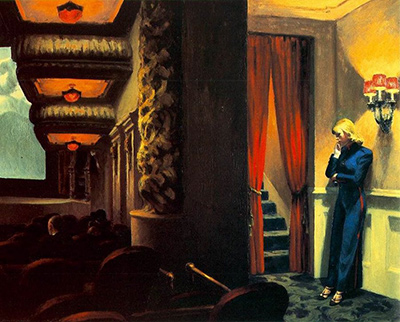
1927New York Movie
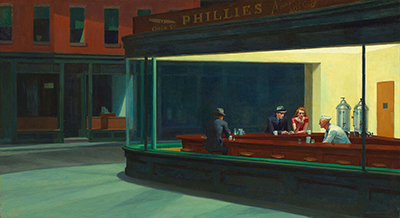
1939Nighthawks
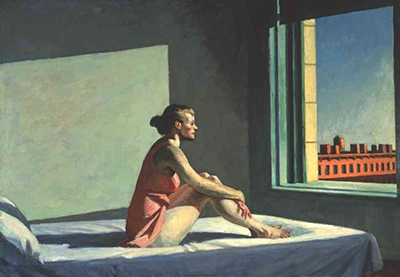
1942Morning Sun
1952Two Comedians
1966Contents
- Looking into the corner
- A corner that makes two views of one wall
- Sunlight as a shape with edges
- The window and the green outside
- Shadow has a colour of its own
- What emptiness changes
- The viewer's place in the room
- Could a room be seen by nobody?
- How close is it to abstraction?
- What a close crop can change
Looking into the corner
The central feature is a change in the wall. A broad vertical section projects forwards, creating a corner that separates lighter and darker planes. Its lower edge meets a baseboard, and the baseboard helps us follow the wall down to the floor.
This apparently modest architectural feature does much of the work. Without it, the central light shape might read as a patch on a flat background. The corner turns the illuminated surface into part of a room with depth. It also prevents the eye from moving across the wall without interruption.
The left side is comparatively dark, although a narrow portion of light appears near the edge. To the right, a window brings a different kind of rectangle into the painting: an actual opening with a pale frame, sash and a view beyond. Its frame gives the room a scale that the broad wall surfaces alone would leave uncertain.
We do not receive a complete floor plan. The painting cuts off the room at every edge, showing enough of its construction for the corner, floor and window to relate to one another. What lies farther left or behind us remains outside the view.
A corner that makes two views of one wall
The projecting section gives the room an asymmetry that is easy to overlook in a familiar reproduction. A relatively dark upright occupies the middle, with brightness appearing on either side in different amounts. The light does not spread evenly around a central opening. It has to be understood through a structure that interrupts it.
The baseboard makes that interruption tangible. It follows the lower part of the wall and changes direction at the corner. Even where the larger colour areas could be taken for adjoining panels, this small construction detail restores a continuous room whose surfaces turn through space.
The floor gives the turning wall another relation to the spectator. Its nearer area lies below us, while the upright remains before us. A few connected edges allow these orientations to be grasped without the help of furniture. The room is recognizable through the meeting of its own surfaces.
The small bright passage at the left also has a consequence for the imagined whole. It suggests that the effect of the sun is not confined to the large central area we first notice. Some of the illuminated room continues beyond the selected view. Emptiness has not made every part available to inspection.
This is one reason the architecture retains such force. The corner divides what can be seen while the floor joins the visible parts. Hopper gives us enough to understand their relationship, and withholds enough for the room to continue beyond its image.
Sunlight as a shape with edges
The brightest wall area is not simply a general glow. It has boundaries, an angled upper edge and an uneven relationship to the vertical architecture around it. Its geometry is sufficiently clear to become an object of attention in its own right.
At the bottom, the light meets the baseboard and changes its direction as the illuminated area passes onto the floor. The shift is essential. It tells us that a single experience of light can belong to surfaces with different orientations. The wall receives it vertically; the floor carries it outwards.
Hopper's distinction between light and shadow is forceful, but the shadowed wall is not a blank black area. Ochre, brown and muted green tones allow the darker planes to remain present. We continue to see the architecture inside the shadow rather than encountering an empty hole.
The small area of light at the left complicates the larger central arrangement. It suggests that the illumination extends beyond the part of the room we can inspect. The canvas therefore holds both a clearly bounded pattern and the possibility of a larger pattern outside its edges.
Crystal Bridges reproduces a notebook description in which Hopper recorded the bushes, the white light and the severity of the shadow. [1] Those concrete observations offer a useful starting point. They identify what mattered in the scene without requiring the light to stand for a single abstract message.
The window and the green outside
The window occupies the right-hand side rather than the centre. Its pale frame introduces thin, bright lines that differ from the broad illuminated wall. The sash cuts across the view, giving the opening its own internal structure.
Beyond it, green foliage supplies a denser and less regular pattern. Leaves and branches do not form the same large, continuous planes as the room. Their presence keeps the interior connected to an exterior whose textures have a different rhythm.
The foliage also limits the view. There is no panoramic landscape to take over from the room. We can look through the glass, but our attention soon returns to the frame and the wall beside it. The window offers an outside without turning that outside into the principal subject.
This balance is easy to miss when the work is described only as a painting of geometric light. The greens remain recognisable as something growing beyond the architecture. The frame remains a constructed object. Hopper simplifies the scene while preserving the difference between a room and the world it opens onto.
Shadow has a colour of its own
The painting's strong contrast can make light seem to be its only positive subject. Yet the larger dark passages are sustained through brown, ochre and muted green rather than a single black. Their differences help establish which plane faces us and which turns away.
The window's pale edges are especially effective against this darkness. Their relatively narrow marks give an opening thickness and structure. The foliage beyond has another set of values and textures, so that a small part of the canvas contains a densely varied transition from built interior to growing exterior.
On the floor, brightness and shade behave differently again. A lighter area extends towards the spectator, while darker passages keep the corner grounded. Looking down allows us to see light as a shape laid across a surface, rather than only as a vertical patch before us.
The relationships resist a simple division between warm sun and cold darkness. Some of the shaded interior remains warm in colour, while the lit passages have their own small variations. The room is organized through a hierarchy of contrasts, not reduced to two opposing tones.
This helps explain why its apparent severity does not exhaust the experience of looking. The initial arrangement is quickly understood, but the surfaces are less uniform than their large scale first suggests. A prolonged view can move from a conspicuous boundary into quieter differences within either side.
What emptiness changes
There is no bed, chair, table or person to explain how the room is used. These absences distinguish it from many Hopper interiors, where a body or a piece of furniture establishes a particular activity. Here we cannot readily name the room as a bedroom, office or waiting area from its furnishings.
Emptiness also changes the scale of our attention. A hand, a face or an open book would create small points of descriptive interest. Without them, the meeting of wall and floor becomes consequential. A baseboard can hold the eye; a shadow edge can establish the main movement through the picture.
The missing furniture does not prove that someone has just moved out. The painting presents an unfurnished view, rather than a record of a tenancy ending. A spectator may associate the room with departure, anticipation or rest, but none of those stories is completed by an object left behind.
The same restraint applies to sound. We can imagine a quiet room, yet no painted feature tells us what can be heard beyond the window. The absence of depicted action and the stable forms make the scene feel still, even while the surroundings remain unknown.
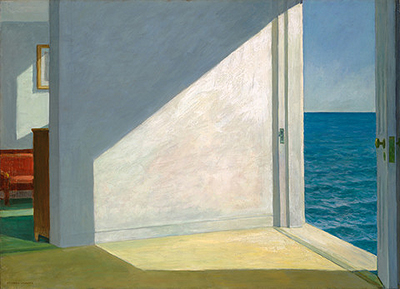
Compare: Rooms by the Sea, 1951.
The viewer's place in the room
The view establishes a position from which the corner and window can be seen together. The floor extends towards the lower edge, close enough to suggest that the spectator shares the interior's space. There is no figure between us and the light to serve as a ready guide to the scene.
In his commentary for the Whitney's 2013 Hopper Drawing exhibition, Carter Foster described the painting as a culmination of Hopper's interest in emptying out interiors. With no depicted person to respond to, Foster argued, more of the interpretive work falls to the viewer. [3] This account helps explain why the room can feel both clearly shown and unusually open to different responses.
Foster’s comparison concerns the broader relation between Hopper’s earlier interiors and this reduced scene. It does not establish that a figure was removed from a particular study for this canvas. The finished painting asks us to follow light across an unoccupied space.
Our position is consequently important without becoming a character in a story. We can imagine standing in the room, but the canvas supplies no name, errand or relationship for us. The floor allows a bodily sense of proximity while the broad planes keep attention on the visible architecture.
Could a room be seen by nobody?
Margaret Iversen makes this painting a starting point for her 2018 essay The World without a Self. Drawing on Hopper's remarks as recorded by Brian O'Doherty, she considers the paradox of representing a room from which even an observer seems absent. Her account connects the problem with Virginia Woolf's descriptions of a world continuing without its human occupants. [4]
That question differs from simply asking why there are no people in the image. An unfurnished room can be seen by a visitor who has just entered. Iversen's reading asks how a painting might suggest the room's existence apart from any such visit: sunlight can continue to fall whether anyone attends to it or not.
The image makes the problem unusually clear because its perspective still implies a position of looking. We see particular surfaces from a particular angle. A depiction cannot give us every possible view of the room at once, yet no named observer appears to own this one.
The floor contributes to that tension. It offers a place our bodies can imagine occupying, even while the room contains no trace of a task or errand that would explain our presence. The picture creates proximity without supplying a fictional occasion for it.
Iversen also acknowledges the difficulty of reconciling an impersonal view with Hopper's own emphasis on personal vision. [4] A room imagined as independent of observers is still a painting made through someone's decisions. The choice of corner, window, crop and illumination remains particular.
The tension is productive rather than something that needs to be eliminated. Hopper can give material space an apparent independence while making its visible arrangement unmistakably selective. We encounter the world continuing beyond us through an image that has been carefully made for looking.
Watch: Edward Hopper’s Life and Art
Explore Hopper’s paintings and the places behind them in these museum films. Choose a film below.
How close is it to abstraction?
The Art Institute's Late Work essay described Sun in an Empty Room as nearly abstract in its concentration on light and shadow. [5] The phrase makes sense when the canvas is viewed from a distance. A few large colour areas carry much of the composition, and their edges matter before individual architectural details are identified.
Closer inspection preserves another experience. The baseboard runs where a baseboard should; the window frame has thickness; the corner separates planes that turn away from one another. These details continually restore the broad shapes to a recognisable interior.
Light itself cannot be detached from those objects here. Its form depends on the wall that receives it and the floor across which it spreads. The painting's reduction therefore intensifies the relation between illumination and material surfaces. The fewer objects Hopper includes, the more clearly we can see what each remaining surface does.
The foliage resists a completely geometric reading as well. Its irregular greens are contained by a rectilinear opening, but they do not become another wall. The contrast between organic texture and built form remains active even within this spare arrangement.
What a close crop can change
Richard Phelan's 2019 essay Abstracting Hopper offers another way to approach the formal concentration. He asks how a painting's figurative subject and its arrangements of line and colour work together. In discussing Sun in an Empty Room, he considers Mathieu Amalric's 2012 film Next to Last (Autumn 63), whose close framings let parts of the canvas suggest abstract painting. Phelan uses the film to consider how a change of framing can alter the experience of Hopper's painted surface. [6]
A close view of a single illuminated passage can indeed temporarily suppress the room's identity. An angled edge and adjoining colours may become the first things we register. Restoring the window, corner and baseboard changes the reading again, because the same boundary now belongs to light falling on architecture.
The difference is useful precisely because the full painting has not discarded those architectural details. Its large shapes sustain a formal arrangement, while their connections repeatedly make a room legible. Recognition can emerge, recede and return as attention changes scale.
The light's upper edge is a particularly clear example. Seen locally, it can look like a diagonal dividing two areas of colour. In the whole interior, that diagonal has to be understood in relation to an opening, a wall and a source beyond the canvas. Its physical setting gives the same painted line further consequences.
Phelan ultimately keeps narrative and formal experience in relation rather than allowing either to cancel the other. [6] In this canvas, even the apparent absence of narrative has a setting. A recognizable room gives the coloured areas their distinctive relationship to bodily scale and ordinary daylight.
The painting therefore does more than approach abstraction by subtracting things. It uses a small number of recognizable elements to make colour and shape unusually prominent. The result can be read through several kinds of attention without needing to abandon its concrete subject.
A late painting, with work still to follow
The 1963 date places the canvas late in Hopper's career. It is reasonable to consider its concentration in relation to a lifetime of paintings involving windows, rooms and sunlight. It is less secure to turn that concentration into evidence that he intended a final statement about his own death.
This was not his last painting. Two Comedians, dated 1966 in the Whitney's later account, brought costumed human figures back into the picture. [7] The sequence matters because an empty interior can otherwise be made to sound like a predetermined ending.
The painting also resists the idea that a late style must abandon an earlier subject. Hopper continues to work with familiar architectural elements. The change is in how little accompanies them and how much compositional responsibility falls to light, corner, frame and floor.
This concentration can feel severe without being uniformly bleak. The brightness has substantial presence. It spreads across two surfaces and establishes a vigorous contrast with the shadow. A viewer need not choose between acknowledging the room's emptiness and responding to the strength of its illumination.
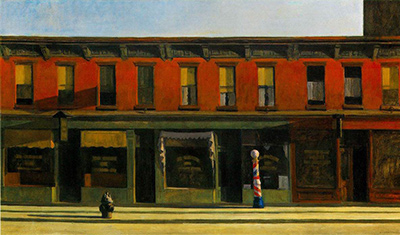
Compare: Early Sunday Morning, 1930.
The time carried by a patch of sun
The image shows one arrangement of light, but the event it depicts implies change. Sunlight can advance across a floor or alter its angle on a wall without anyone entering the room. The bare surfaces make that possibility easier to imagine because there are few other activities to compete with it.
This does not give us a painted time-lapse. The canvas holds one pattern still; it does not show earlier or later positions of the bright edges. The sense of duration comes from recognizing a physical effect that ordinarily changes, then encountering it fixed within paint.
The foliage helps maintain that relation to the world outside. It is not an abstract green insert placed in an otherwise closed arrangement. It remains a glimpse through a window, giving the interior contact with something growing beyond it. The room's quietness does not make the surrounding day stop.
The contrast between time and stability also clarifies the wall's role. A wall normally appears more permanent than a passing patch of sunlight. Here both are made equally available to prolonged inspection. Paint lets a temporary illumination carry weight beside the construction that receives it.
No imagined departure is required for this to be moving. An empty space can register the continuity of a day, the persistence of materials and the temporary position of a viewer. The picture's concentration gives those ordinary conditions enough presence to become its subject.
The painting's collection record
The Art Institute's archived exhibition entry credited the picture to a private collection. That wording belongs to the historical exhibition record. Crystal Bridges' present credit identifies a promised gift to that museum, which is a different and more current statement of its status. [1] A promised gift should retain that qualification.
The records also present dimensions differently. The historical Art Institute entry explicitly measures the canvas. [2] Crystal Bridges lists 37 × 48 × 2 inches without identifying those measurements as the canvas. [1] The unqualified measurements should remain distinct from the documented size of the painted support.
These distinctions allow the painting to be located accurately without inferring an unnamed donor or a completed transfer of title. They also help a viewer separate the size of the painted support from the presentation in which a museum may measure the work.
Other rooms, other roles for light
In Morning Sun, a seated woman gives the illumination a bodily scale and an immediate human focus. Her presence directs attention towards pose, skin, gaze and the relationship between a person and a window. Removing a comparable figure here leaves the architecture to establish those relationships on its own.
Rooms by the Sea offers another useful comparison. There, an open doorway brings the sea unusually close to an interior. In Sun in an Empty Room, the framed view of foliage is smaller and more firmly bounded. The outside reaches the room chiefly through the effect of light.
The difference clarifies the force of the window. It does not need to offer an expansive view to organise the painting. A narrow opening, a projecting wall and the floor are enough to give sunlight edges, directions and depth. The room's few remaining features make illumination something we can follow across space.
Artworks and studies directory
This researched directory includes finished works and separately identified studies. It is not a complete catalogue raisonné. Linked titles open the articles; unlinked studies are identified by their collection accessions. Watercolours retain their recorded media, and original prints remain distinct from reproductions.
| Name | Date | Medium |
|---|---|---|
| (Bridge and Embankment) (70.1298) | 1906 | Oil on wood |
| (Jo Sketching at Good Harbor Beach) (70.1129) | 1923–1924 | Watercolor and fabricated chalk on paper |
| (Manhattan Bridge) (70.1098) | 1925–1926 | Watercolor and graphite pencil on paper |
| (Rooftops) (70.1114) | 1926 | Watercolor and graphite pencil on paper |
| (Seated Male Model, Bent Over) (70.1277) | c. 1902–1903 | Oil on canvas |
| (Self-Portrait) (70.1254) | 1903–1906 | Oil on canvas |
| (Solitary Figure in a Theater) (70.1418) | c. 1902–1904 | Oil on board |
| 5 A.M. | 1937 | oil on canvas |
| Adam's House | 1928 | watercolour and charcoal on paper |
| American Village | 1912 | Oil on canvas |
| Apartment Houses | 1923 | oil on canvas |
| Approaching a City | 1946 | oil on canvas |
| August in the City | 1945 | oil on canvas |
| Automat | 1927 | oil on canvas |
| Barber Shop | 1931 | oil on canvas |
| Blackwell's Island | 1928 | oil on canvas |
| Bridge on the Seine | 1909 | Oil on canvas |
| Bridle Path | 1939 | oil on canvas |
| Burly Cobb's House South Truro | 1930–1933 | oil on canvas |
| Cape Cod Evening | 1939 | oil on canvas |
| Cape Cod Morning | 1950 | oil on canvas |
| Chair Car | 1965 | oil on canvas |
| Chop Suey | 1929 | oil on canvas |
| City Roofs | 1932 | Oil on canvas |
| Coast Guard Station | 1929 | oil on canvas |
| Compartment C, Car 293 | 1938 | oil on canvas |
| Conference at Night | 1949 | oil on canvas |
| Corn Hill | 1930 | oil on canvas |
| Dawn in Pennsylvania | 1942 | oil on canvas |
| Drug Store | 1927 | oil on canvas |
| Early Sunday Morning | 1930 | Oil on canvas |
| East Side Interior (70.1020) | 1922 | Etching |
| East Wind Over Weehawken | 1934 | oil on canvas |
| El Palacio | 1946 | Watercolor and graphite pencil on paper |
| Eleven A.M. | 1926 | oil on canvas |
| Evening Wind | 1921 | etching |
| Excursion into Philosophy | 1959 | oil on canvas |
| First Row Orchestra | 1951 | oil on canvas |
| Freight Car at Truro | 1931 | watercolour over graphite on paper |
| Gas | 1940 | oil on canvas |
| Girl at a Sewing Machine | c. 1921 | oil on canvas |
| Gloucester Harbor | 1912 | Oil on canvas |
| Ground Swell | 1939 | oil on canvas |
| Haskell's House | 1924 | watercolour over graphite on paperboard |
| High Noon | 1949 | oil on canvas |
| Hill and Houses Cape Elizabeth Maine | 1927 | watercolour over graphite pencil |
| Hills South Truro | 1930 | oil on canvas |
| Hotel by a Railroad | 1952 | oil on canvas |
| Hotel Lobby | 1943 | oil on canvas |
| Hotel Room | 1931 | oil on canvas |
| Hotel Window | 1955 | oil on canvas |
| House by the Railroad | 1925 | oil on canvas |
| House by the Squam River | 1926 | watercolour over graphite on paper |
| Le Bistro or The Wine Shop | 1909 | Oil on canvas |
| Le Pont des Arts | 1907 | Oil on canvas |
| Le Pont Royal | 1909 | Oil on canvas |
| Le Quai des Grands Augustins | 1909 | Oil on canvas |
| Lighthouse and Buildings Portland Head | 1927 | watercolour over graphite pencil on paper |
| Lighthouse Hill | 1927 | oil painting |
| Manhattan Bridge Loop | 1928 | oil on canvas |
| Model Sitting | c. 1902 | oil painting; support not asserted |
| Morning Sun | 1952 | oil on canvas |
| New York Movie | 1939 | oil on canvas |
| New York New Haven and Hartford | 1931 | oil on canvas |
| New York Office | 1962 | oil on canvas |
| New York Pavements | 1924–1925 | oil on canvas |
| New York Restaurant | c. 1922 | oil on canvas |
| Night Windows | 1928 | oil on canvas |
| Nighthawks | 1942 | oil on canvas |
| October on Cape Cod | 1946 | oil on canvas |
| Office at Night | 1940 | oil on canvas |
| Office in a Small City | 1953 | oil on canvas |
| Pennsylvania Coal Town | 1947 | oil on canvas |
| People in the Sun | 1960 | oil on canvas |
| Portrait of Orleans | 1950 | oil on canvas |
| Queensborough Bridge | 1913 | Oil on canvas |
| Railroad Sunset | 1929 | Oil on canvas |
| Railroad Train | 1908 | oil on canvas |
| Road in Maine | 1914 | oil on canvas |
| Room in Brooklyn | 1932 | oil on canvas |
| Room in New York | 1932 | oil on canvas |
| Rooms by the Sea | 1951 | oil on canvas |
| Rooms for Tourists | 1945 | oil on canvas |
| Route 6 Eastham | 1941 | oil on canvas |
| Second Story Sunlight | 1960 | Oil on canvas |
| Self-Portrait | 1925–1930 | Oil on canvas |
| Self-Portrait with Hat (70.1903) | c. 1918, posthumous print | Drypoint |
| Seven A.M. | 1948 | Oil on canvas |
| Soir Bleu | 1914 | oil on canvas |
| South Carolina Morning | 1955 | Oil on canvas |
| Stairway at 48 Rue de Lille Paris | 1906 | Oil on wood |
| Study for 5 A.M. (70.153) | 1937 | Fabricated chalk on paper |
| Study for 5 A.M. (70.429) | 1937 | Fabricated chalk and graphite pencil on paper |
| Study for Approaching a City (70.869) | 1946 | Fabricated chalk and charcoal on paper |
| Study for August in the City (70.158a-b) | 1945 | Fabricated chalk on paper |
| Study for August in the City (70.159) | 1945 | Fabricated chalk on paper |
| Study for Bridle Path (70.220) | 1939 | Fabricated chalk on paper |
| Study for Bridle Path (70.235) | 1939 | Fabricated chalk on paper |
| Study for Compartment C, Car 293 (70.430) | 1938 | Fabricated chalk on paper |
| Study for Compartment C, Car 293 (70.431a-b) | 1938 | Fabricated chalk and charcoal on paper |
| Study for Conference at Night (70.170) | 1949 | Fabricated chalk on paper (recto); Typewriter ink on paper (verso) |
| Study for Conference at Night (70.174) | 1949 | Fabricated chalk on paper ( recto); Typewriter ink on paper (verso) |
| Study for East Wind over Weehawken (70.249) | 1934 | Graphite pencil on paper |
| Study for East Wind over Weehawken (70.252) | 1934 | Fabricated chalk and charcoal on paper |
| Study for Evening Wind (70.343a-b) | 1921 | Fabricated chalk on paper |
| Study for First Row Orchestra (70.841) | 1951 | Fabricated chalk and charcoal on paper |
| Study for Gas (70.263) | 1940 | Fabricated chalk on paper |
| Study for Ground Swell (70.339) | 1939 | Fabricated chalk, charcoal and graphite pencil on paper |
| Study for Hotel by a Railroad (70.199) | 1952 | Fabricated chalk on paper |
| Study for Hotel by a Railroad (70.427) | 1952 | Fabricated chalk on paper |
| Study for Hotel by a Railroad (70.428) | 1952 | Fabricated chalk on paper |
| Study for Hotel Lobby (70.117) | 1942 | Fabricated chalk and graphite pencil on paper |
| Study for Hotel Lobby (70.839) | 1942 | Fabricated chalk and charcoal on paper |
| Study for Hotel Window (70.161) | 1955 | Fabricated chalk, graphite pencil and colored pencil on paper |
| Study for Morning Sun (70.243) | 1952 | Fabricated chalk on paper |
| Study for Morning Sun (70.244) | 1952 | Fabricated chalk on paper |
| Study for Morning Sun (70.290) | 1952 | Fabricated chalk on paper |
| Study for Morning Sun (70.291) | 1952 | Fabricated chalk and graphite pencil on paper |
| Study for New York Movie (70.273) | 1939 | Fabricated chalk on paper |
| Study for New York Movie (70.274a-b) | 1938 or 1939 | Fabricated chalk and charcoal on paper (recto); Fabricated chalk on paper (verso) |
| Study for New York Movie (70.455) | 1939 | Fabricated chalk and charcoal on paper |
| Study for New York Office (70.822) | 1962 | Fabricated chalk on paper |
| Study for Nighthawks (70.192) | 1941 or 1942 | Fabricated chalk on paper |
| Study for Nighthawks (70.193) | 1941 or 1942 | Fabricated chalk on paper |
| Study for Office at Night (70.340) | 1940 | Fabricated chalk and charcoal on paper |
| Study for Office at Night (70.341) | 1940 | Fabricated chalk and graphite pencil on paper |
| Study for Pennsylvania Coal Town (70.198) | 1947 | Fabricated chalk on paper |
| Study for Pennsylvania Coal Town (70.229) | 1947 | Fabricated chalk and charcoal on paper |
| Study for Rooms for Tourists (70.438) | 1945 | Fabricated chalk and charcoal on paper |
| Study for Rooms for Tourists (70.848) | 1945 | Fabricated chalk and charcoal on paper |
| Study for Route 6, Eastham (70.369) | 1941 | Fabricated chalk and graphite pencil on paper |
| Study for Route 6, Eastham (70.854) | 1941 | Fabricated chalk and graphite pencil on paper |
| Study for South Carolina Morning (70.162a-b) | 1955 | Fabricated chalk on paper (recto and verso) |
| Study for The Sheridan Theatre (70.969) | 1937 | Graphite pencil on paper |
| Study for Two on the Aisle (70.128) | 1927 | Fabricated chalk on paper |
| Study for Two on the Aisle (70.129) | 1927 | Fabricated chalk on paper |
| Study for Yawl Riding a Swell (70.439) | 1935 | Fabricated chalk and graphite pencil on paper |
| Summer Evening | 1947 | oil on canvas |
| Summer Interior | 1909 | Oil on canvas |
| Sun in an Empty Room | 1963 | oil on canvas |
| Sunlight in a Cafeteria | 1958 | oil on canvas |
| Sunlight on Brownstones | 1956 | oil on canvas |
| Tables for Ladies | 1930 | oil on canvas |
| The Bootleggers | 1925 | oil on canvas |
| The Camel's Hump | 1931 | oil on canvas |
| The Circle Theatre | 1936 | oil on canvas |
| The City | 1927 | oil on canvas |
| The Lighthouse at Two Lights | 1929 | oil on canvas |
| The Long Leg | 1935 | oil on canvas |
| The Mansard Roof | 1923 | watercolour over graphite on paper |
| The Sheridan Theatre | 1937 | oil on canvas |
| Tramp Steamer | 1908 | oil on canvas |
| Two Comedians | 1966 | oil on canvas |
| Two on the Aisle | 1927 | oil on canvas |
| Valley of the Seine | 1909 | Oil on canvas |
| Western Motel | 1957 | oil on canvas |
Frequently Asked Questions
Edward Hopper made Sun in an Empty Room in 1963. [1]
The recorded medium is oil on canvas. [1]
The subject of Edward Hopper's Sun in an Empty Room can be named almost completely in a few words: walls, floor, window, foliage and sunlight. Yet the painting does not become simple once its contents have been listed. Light divides the walls into shapes whose relationship to the room takes time to understand. A projecting corner interrupts one surface, while a bright area on the floor brings the illumination towards the viewer.
Discussion
Look again at the images and ideas explored in Sun in an Empty Room. These editorial prompts invite your observations.
Reader Insights
Which boundary, gesture or change of light first holds your attention in Sun in an Empty Room?
Compare Rooms by the Sea with Sun in an Empty Room. Which visual difference matters most to your reading?
Which detail would you look at again after reading “The window and the green outside”?
Join the Conversation
Share a detail, comparison or question about Sun in an Empty Room below.
References
- Crystal Bridges Museum of American Art, Sun in an Empty Room, 1963, current artwork entry. Medium, promised-gift credit, unqualified three-dimensional measurements and notebook passage reproduced by the museum; the original notebook leaf was not independently inspected. View source.
- Art Institute of Chicago, Sun in an Empty Room, 1963, archived exhibition entry. Explicit canvas measurements and historical private-collection credit. View source.
- Whitney Museum of American Art, Carter Foster on Sun in an Empty Room, 21 May 2013, complete English transcript for Hopper Drawing. Interpretive comparison with earlier interiors; not a report of a particular figure removed from a study for this painting. View source.
- Margaret Iversen, “The World without a Self: Edward Hopper and Chantal Akerman”, Art History, 41, no. 4, September 2018, pp. 742–760, DOI 10.1111/1467-8365.12398; author-uploaded opening discussion and “Describing the Unobserved” examined. Hopper's O'Doherty interview remarks and Woolf/Banfield texts are transmitted through Iversen here, rather than claimed as independently examined originals. View source.
- Art Institute of Chicago, Late Work, archived exhibition essay. The account of reduction and near-abstraction is distinguished from the essay's speculative reading of an interior recently vacated. View source.
- Richard Phelan, “Abstracting Hopper”, Textes et contextes, 14-2, 19 December 2019, sections II–III and conclusion; DOI 10.58335/textesetcontextes.2495. Phelan's critical account of Amalric's film and his argument about formal/figurative relations are distinguished from direct viewing of the film. View source.
- Whitney Museum of American Art, Two Comedians, 1966: Kambui Olujimi commentary, 2 October 2022, published transcript and accompanying date. View source.
- Collection or catalogue record, American Village, 1912; medium and identity as discussed in the linked article. View source.
- Collection or catalogue record, Soir Bleu, 1914; medium and identity as discussed in the linked article. View source.
- Collection or catalogue record, House by the Railroad, 1925; medium and identity as discussed in the linked article. View source.
- Collection or catalogue record, Automat, 1927; medium and identity as discussed in the linked article. View source.
- Collection or catalogue record, Early Sunday Morning, 1930; medium and identity as discussed in the linked article. View source.
- Collection or catalogue record, New York Movie, 1939; medium and identity as discussed in the linked article. View source.
- Collection or catalogue record, Nighthawks, 1942; medium and identity as discussed in the linked article. View source.
- Collection or catalogue record, Morning Sun, 1952; medium and identity as discussed in the linked article. View source.
- Collection or catalogue record, Second Story Sunlight, 1960; medium and identity as discussed in the linked article. View source.
- Collection or catalogue record, Two Comedians, 1966; medium and identity as discussed in the linked article. View source.
- Whitney Museum of American Art, Study for Route 6, Eastham, 1941, accession 70.854; exact object record. View source.
- Whitney Museum of American Art, Study for Conference at Night, 1949, accession 70.170; exact object record. View source.
- Whitney Museum of American Art, Study for First Row Orchestra, 1951, accession 70.841; exact object record. View source.
- Whitney Museum of American Art, (Bridge and Embankment), 1906, accession 70.1298; exact object record. View source.
- Whitney Museum of American Art, (Seated Male Model, Bent Over), c. 1902–1903, accession 70.1277; exact object record. View source.
- Whitney Museum of American Art, Study for Morning Sun, 1952, accession 70.244; exact object record. View source.
- Whitney Museum of American Art, Study for Morning Sun, 1952, accession 70.243; exact object record. View source.
- Whitney Museum of American Art, Study for Two on the Aisle, 1927, accession 70.128; exact object record. View source.
- Whitney Museum of American Art, Study for New York Office, 1962, accession 70.822; exact object record. View source.
- Whitney Museum of American Art, Study for Two on the Aisle, 1927, accession 70.129; exact object record. View source.
- Whitney Museum of American Art, Study for Pennsylvania Coal Town, 1947, accession 70.229; exact object record. View source.
- Whitney Museum of American Art, (Rooftops), 1926, accession 70.1114; exact object record. View source.
- Whitney Museum of American Art, Study for South Carolina Morning, 1955, accession 70.162a-b; exact object record. View source.
- Whitney Museum of American Art, (Self-Portrait), 1903–1906, accession 70.1254; exact object record. View source.
- Whitney Museum of American Art, (Manhattan Bridge), 1925–1926, accession 70.1098; exact object record. View source.
- Whitney Museum of American Art, (Solitary Figure in a Theater), c. 1902–1904, accession 70.1418; exact object record. View source.
- Whitney Museum of American Art, Study for Approaching a City, 1946, accession 70.869; exact object record. View source.
- Whitney Museum of American Art, Study for August in the City, 1945, accession 70.159; exact object record. View source.
- Whitney Museum of American Art, Study for Compartment C, Car 293, 1938, accession 70.430; exact object record. View source.
- Whitney Museum of American Art, Study for Compartment C, Car 293, 1938, accession 70.431a-b; exact object record. View source.
- Whitney Museum of American Art, Study for East Wind over Weehawken, 1934, accession 70.252; exact object record. View source.
- Whitney Museum of American Art, Study for East Wind over Weehawken, 1934, accession 70.249; exact object record. View source.
- Whitney Museum of American Art, Study for Evening Wind, 1921, accession 70.343a-b; exact object record. View source.
- Whitney Museum of American Art, Study for The Sheridan Theatre, 1937, accession 70.969; exact object record. View source.
- Whitney Museum of American Art, Study for New York Movie, 1939, accession 70.455; exact object record. View source.
- Whitney Museum of American Art, Study for New York Movie, 1939, accession 70.273; exact object record. View source.
- Whitney Museum of American Art, Study for New York Movie, 1938 or 1939, accession 70.274a-b; exact object record. View source.
- Whitney Museum of American Art, Study for 5 A.M., 1937, accession 70.153; exact object record. View source.
- Whitney Museum of American Art, Study for 5 A.M., 1937, accession 70.429; exact object record. View source.
- Whitney Museum of American Art, (Jo Sketching at Good Harbor Beach), 1923–1924, accession 70.1129; exact object record. View source.
- Whitney Museum of American Art, Study for August in the City, 1945, accession 70.158a-b; exact object record. View source.
- Whitney Museum of American Art, Study for Morning Sun, 1952, accession 70.291; exact object record. View source.
- Whitney Museum of American Art, Study for Morning Sun, 1952, accession 70.290; exact object record. View source.
- Whitney Museum of American Art, Study for Office at Night, 1940, accession 70.340; exact object record. View source.
- Whitney Museum of American Art, Study for Office at Night, 1940, accession 70.341; exact object record. View source.
- Whitney Museum of American Art, Study for Hotel by a Railroad, 1952, accession 70.427; exact object record. View source.
- Whitney Museum of American Art, Study for Hotel by a Railroad, 1952, accession 70.199; exact object record. View source.
- Whitney Museum of American Art, Study for Hotel by a Railroad, 1952, accession 70.428; exact object record. View source.
- Whitney Museum of American Art, Study for Hotel Lobby, 1942, accession 70.117; exact object record. View source.
- Whitney Museum of American Art, Study for Hotel Lobby, 1942, accession 70.839; exact object record. View source.
- Whitney Museum of American Art, Study for Conference at Night, 1949, accession 70.174; exact object record. View source.
- Whitney Museum of American Art, Study for Hotel Window, 1955, accession 70.161; exact object record. View source.
- Whitney Museum of American Art, Study for Pennsylvania Coal Town, 1947, accession 70.198; exact object record. View source.
- Whitney Museum of American Art, Study for Route 6, Eastham, 1941, accession 70.369; exact object record. View source.
- Whitney Museum of American Art, Study for Bridle Path, 1939, accession 70.220; exact object record. View source.
- Whitney Museum of American Art, Study for Bridle Path, 1939, accession 70.235; exact object record. View source.
- Whitney Museum of American Art, Study for Ground Swell, 1939, accession 70.339; exact object record. View source.
- Whitney Museum of American Art, Study for Yawl Riding a Swell, 1935, accession 70.439; exact object record. View source.
- Whitney Museum of American Art, Study for Rooms for Tourists, 1945, accession 70.848; exact object record. View source.
- Whitney Museum of American Art, Study for Rooms for Tourists, 1945, accession 70.438; exact object record. View source.
- Whitney Museum of American Art, Study for Nighthawks, 1941 or 1942, accession 70.193; exact object record. View source.
- Whitney Museum of American Art, Study for Nighthawks, 1941 or 1942, accession 70.192; exact object record. View source.
- Whitney Museum of American Art, Study for Gas, 1940, accession 70.263; exact object record. View source.
- Whitney Museum of American Art, Self-Portrait with Hat, c. 1918, posthumous print, accession 70.1903; exact object record. View source.
- Whitney Museum of American Art, East Side Interior, 1922, accession 70.1020; exact object record. View source.
- Art Institute of Chicago, Selected Chronology for Edward Hopper; training, travels, exhibitions, New York and Truro chronology. View source.
- Emily C. Burns, Spectral figures: Edward Hopper’s empty Paris, chapter 5 in Empty Spaces: Confronting Emptiness in National, Cultural and Urban Histories, 2019; complete chapter and notes consulted. View source.
- Charles Brock, Regionalism and Folk Art, National Gallery of Art; complete essay and two notes consulted. View source.