 by Tom Gurney
Tom Gurney BSc (Hons) is an art history expert with over 20 years experience
Email: tomgurney1@gmail.com / Phone: +44 7429 011000
Queensborough Bridge: Introduction
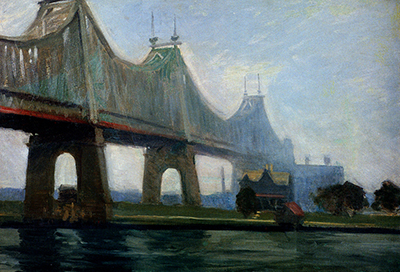
The bridge enters from beyond the left edge, its great upper forms descending into the distance. Beneath it, pale masonry piers frame openings onto water, land and a few small buildings. Edward Hopper's Queensborough Bridge brings a new piece of New York engineering into a softly painted riverside landscape. The structure is immense, but its further reaches seem to dissolve into the surrounding light.
Hopper painted the work in 1913. The Whitney Museum of American Art records oil on canvas, 65.7 × 96.8 cm, accession 70.1184, from the Josephine N. Hopper Bequest. The museum retains Queensborough Bridge as the painting's title, while the structure itself is generally known as the Queensboro Bridge. [1]
At a Glance
- ArtistEdward Hopper [1]
- Date1913 [1]
- MediumOil on canvas [1]
- Collection / recordWhitney Museum of American Art [1]
- Accession70.1184 [1]
This work across Edward Hopper’s career
American Village
1912Soir Bleu
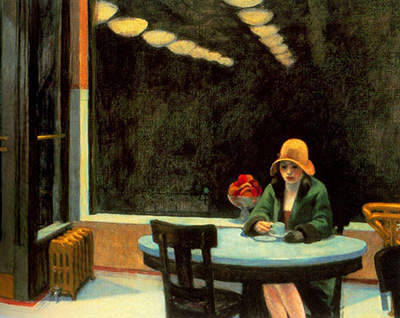
1914Automat
1927New York Movie
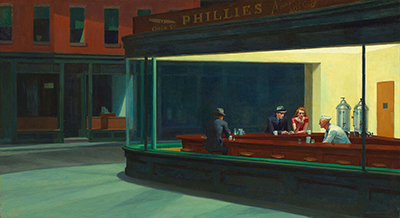
1939Nighthawks
1942Morning Sun
1952Two Comedians
1966Contents
- A bridge that exceeds the canvas
- Piers and openings below
- A cantilever with a curving silhouette
- The smaller world underneath
- Water and reflected colour
- Paris looking, New York subject
- A later artist's response
- Beside the later river pictures
A bridge that exceeds the canvas
The nearest part of the structure is cropped at the left. We do not see a complete approach, a neatly contained span or a matching endpoint. The bridge arrives already larger than the selected view and continues away towards the right.
The upper outline rises and falls between the high supports. Repeated narrow members fill the space beneath those curves, creating a complicated pattern whose detail changes with distance. The closest section is relatively forceful; the farther one becomes paler and less distinct.
A darker line marks the lower edge of the steelwork. It moves obliquely across the painting, helping us understand the structure's direction even where the upper parts become hazier. Warm reddish accents along this edge introduce a small but persistent contrast with the cooler green-grey construction above.
The bridge therefore operates at two scales. As a whole, it is a monumental form carrying the eye across the canvas. Within it, numerous small divisions supply a dense rhythm. Hopper lets those divisions lose definition as the structure recedes, making scale and atmosphere work together.
The pale sky gives this recession room to develop. There is no sharply defined skyline competing with the bridge's upper profile. Its far end can become less certain without disappearing into a crowded background of equally emphatic objects.
Piers and openings below
The masonry piers have a different character from the upper structure. They are broad and relatively solid, with large openings cutting through their lower portions. The nearest one stands darkly above the water, while those beyond grow lighter.
The openings are important to the view's depth. We can look through and beneath the engineering rather than merely up at an opaque wall. Pale areas of sky and distant land appear between the supports, separating one heavy mass from the next.
The nearest pier's reflection extends into the foreground water. Its darkness makes a connection between the large construction above and the rippling surface below. The reflection is less stable than the pier itself, broken by small horizontal changes of colour.
Further right, the supporting forms become more economical. Their outlines remain sufficient to describe the bridge's course, but their surfaces are less insistently modelled. The reduction of detail contributes to the sense of distance.
These differences keep the picture from becoming an engineering elevation. We encounter the bridge from one position, at an angle, with some parts close and others receding through light. The relation between the piers matters as much as the exact construction of any one support.
A cantilever with a curving silhouette
Despite the curved upper outline, the Queensboro is a cantilever bridge. New York's 1974 landmark report describes its steel superstructure, masonry piers and the upper eye-bars with diagonal and vertical stiffening members beneath. It identifies engineer Gustav Lindenthal and architect Henry Hornbostel with the design developed for the crossing. [2]
This helps explain why the silhouette can seem both strong and surprisingly fluid. The repeated high points and sloping upper members form long curves, while the framework below supplies a much denser arrangement of lines. Hopper's broad handling makes the difference between overall contour and internal division especially apparent.
The same landmark report compares the outer spans' curves with the Pont Mirabeau in Paris, proposing a connection in Hornbostel's architectural design. [2]
The comparison is nevertheless a reminder that practical engineering and architectural appearance were closely joined in this structure. Its skyline was designed as well as calculated. Hopper's painting responds vividly to that skyline, with the high supports and descending curves becoming the dominant movement across the image.
Compare: Manhattan Bridge Loop, 1928.
The smaller world underneath
The bridge's size is clearest beside the buildings below it. A low house with a darker roof stands near the right of centre, accompanied by a smaller red-roofed structure and groups of trees. Their scale is modest beside the piers and upper framework.
A strip of green ground runs along the water. It supplies a more nearly horizontal line beneath the bridge's recession, giving the lower landscape a different pace. The small buildings sit within that narrow area rather than forming a dense urban wall.
The Whitney's 2022 exhibition label identifies this pastoral-looking ground with Blackwell's Island, now Roosevelt Island. It interprets the juxtaposition between the island landscape and the large engineered crossing as an expression of New York's rapid development. The bridge had opened in 1909, only four years before the painting. [3]
The contrast is visible without requiring the houses to become symbols of a vanished way of life. Their low roofs and tree-covered surroundings coexist with the large structure above. The bridge imposes a new scale on the scene, while the island retains smaller intervals of building and open ground.
There is also a difference in how we look at them. The bridge pulls attention across its length; the house holds a more compact place. The painting allows these two experiences of size to remain active together.
Watch: Edward Hopper’s Life and Art
Explore Hopper’s paintings and the places behind them in these museum films. Choose a film below.
Water and reflected colour
The foreground water is darker than much of the sky. Greens, blues and greys gather into short strokes, interrupted by reflections from the piers and lighter parts of the scene. The surface is mobile without becoming violently broken.
Its horizontal marks answer the narrow strip of island. Against those steadier directions, the bridge recedes diagonally. The river consequently supplies more than a setting: it gives the structure's movement a contrasting framework.
The darkest reflection belongs near the closer support. Further away, the water's variations are more closely related in tone, with fewer emphatic divisions. The surface helps maintain a distinction between near weight and distant lightness.
The house and trees introduce warmer notes above it. These small colour changes matter because the view is otherwise largely held within a cooler range. Their restraint keeps the buildings subordinate while allowing them to remain distinct.
Hopper's handling leaves the picture open to the movement of individual marks. The bridge is recognizable, yet the paint does not attempt to describe every metal connection with equal precision. The water is similarly organized through related strokes rather than a fixed outline for each ripple.
Paris looking, New York subject
The painting belongs to the years after Hopper's final European visit in 1910. The Whitney's exhibition account places him on East Fifty-ninth Street when he made this nearby bridge subject and connects its luminous palette and looser handling with his experience of French Impressionism. [3]
That interpretation is particularly useful beside Le Pont des Arts, painted in Paris in 1907. Both works bring bridge, water and surrounding life into a broad outdoor view. Their structures differ, and the New York crossing has a much more imposing scale, but neither is treated as a purely technical object.
The comparison also shows a change of setting without requiring a complete break in painting language. The paler distance, varied water and responsiveness to light remain important in Queensborough Bridge. Hopper was applying those interests to a city and a structure he could encounter near his own residence.
It would be misleading to approach the picture only as an incomplete version of his later, more sharply bounded city paintings. Its less definite edges are central to its effect. The bridge's apparent movement into light depends on the loosening of detail as much as on the correctness of its overall silhouette.
Compare: Blackwell's Island, 1928.
A later artist's response
In the Whitney's 2022 audio-guide transcript, artist Kambui Olujimi draws attention to the way the bridge seems to vanish as it recedes. He describes this painting as unusually lyrical compared with the firmer architectural renderings he associates with Hopper. His response returns us to a visible feature that can easily be missed if we look only for the bridge's identity. [1]
Olujimi also speaks from his own experience as a New Yorker, considering Hopper's choice of a bridge less culturally dominant than the Brooklyn Bridge. His personal account considers the city's landmarks through their different places in memory. [1]
The response shows how the painting can remain specific to New York while inviting different kinds of attention. One viewer may begin with the familiar crossing; another with the way its paint breaks into distance. The work accommodates both recognition and the discovery of an unexpectedly delicate effect.
Beside the later river pictures
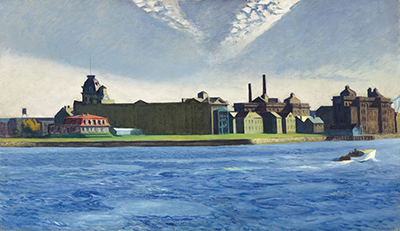
Hopper returned to the island and the East River in Blackwell's Island in 1928. That canvas places a long architectural silhouette between broad areas of water and sky. The river is more expansive, and the buildings form a more continuous band than the small settlement beneath this bridge.
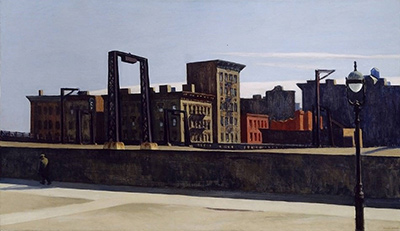
Manhattan Bridge Loop, also painted in 1928, makes a different use of urban infrastructure. A broad embankment separates the spectator from buildings behind, and a small pedestrian occupies the nearer passage. Its longer horizontal format gives the city another kind of extension.
Queensborough Bridge retains its own balance: massive engineering above, modest ground below and a river close to the spectator. The structure's furthest portions become lighter and less distinct, allowing an immense crossing to end in a passage of pale, loosely worked atmosphere.
Artworks and studies directory
This researched directory includes finished works and separately identified studies. It is not a complete catalogue raisonné. Linked titles open the articles; unlinked studies are identified by their collection accessions. Watercolours retain their recorded media, and original prints remain distinct from reproductions.
| Name | Date | Medium |
|---|---|---|
| (Bridge and Embankment) (70.1298) | 1906 | Oil on wood |
| (Jo Sketching at Good Harbor Beach) (70.1129) | 1923–1924 | Watercolor and fabricated chalk on paper |
| (Manhattan Bridge) (70.1098) | 1925–1926 | Watercolor and graphite pencil on paper |
| (Rooftops) (70.1114) | 1926 | Watercolor and graphite pencil on paper |
| (Seated Male Model, Bent Over) (70.1277) | c. 1902–1903 | Oil on canvas |
| (Self-Portrait) (70.1254) | 1903–1906 | Oil on canvas |
| (Solitary Figure in a Theater) (70.1418) | c. 1902–1904 | Oil on board |
| 5 A.M. | 1937 | oil on canvas |
| Adam's House | 1928 | watercolour and charcoal on paper |
| American Village | 1912 | Oil on canvas |
| Apartment Houses | 1923 | oil on canvas |
| Approaching a City | 1946 | oil on canvas |
| August in the City | 1945 | oil on canvas |
| Automat | 1927 | oil on canvas |
| Barber Shop | 1931 | oil on canvas |
| Blackwell's Island | 1928 | oil on canvas |
| Bridge on the Seine | 1909 | Oil on canvas |
| Bridle Path | 1939 | oil on canvas |
| Burly Cobb's House South Truro | 1930–1933 | oil on canvas |
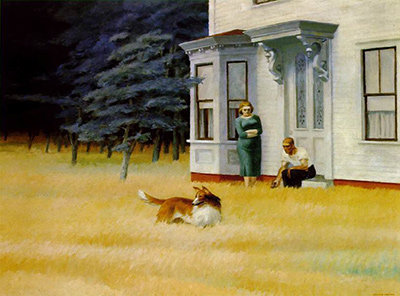
| Cape Cod Evening | 1939 | oil on canvas |
| Cape Cod Morning | 1950 | oil on canvas |
| Chair Car | 1965 | oil on canvas |
| Chop Suey | 1929 | oil on canvas |
| City Roofs | 1932 | Oil on canvas |
| Coast Guard Station | 1929 | oil on canvas |
| Compartment C, Car 293 | 1938 | oil on canvas |
| Conference at Night | 1949 | oil on canvas |
| Corn Hill | 1930 | oil on canvas |
| Dawn in Pennsylvania | 1942 | oil on canvas |
| Drug Store | 1927 | oil on canvas |
| Early Sunday Morning | 1930 | Oil on canvas |
| East Side Interior (70.1020) | 1922 | Etching |
| East Wind Over Weehawken | 1934 | oil on canvas |
| El Palacio | 1946 | Watercolor and graphite pencil on paper |
| Eleven A.M. | 1926 | oil on canvas |
| Evening Wind | 1921 | etching |
| Excursion into Philosophy | 1959 | oil on canvas |
| First Row Orchestra | 1951 | oil on canvas |
| Freight Car at Truro | 1931 | watercolour over graphite on paper |
| Gas | 1940 | oil on canvas |
| Girl at a Sewing Machine | c. 1921 | oil on canvas |
| Gloucester Harbor | 1912 | Oil on canvas |
| Ground Swell | 1939 | oil on canvas |
| Haskell's House | 1924 | watercolour over graphite on paperboard |
| High Noon | 1949 | oil on canvas |
| Hill and Houses Cape Elizabeth Maine | 1927 | watercolour over graphite pencil |
| Hills South Truro | 1930 | oil on canvas |
| Hotel by a Railroad | 1952 | oil on canvas |
| Hotel Lobby | 1943 | oil on canvas |
| Hotel Room | 1931 | oil on canvas |
| Hotel Window | 1955 | oil on canvas |
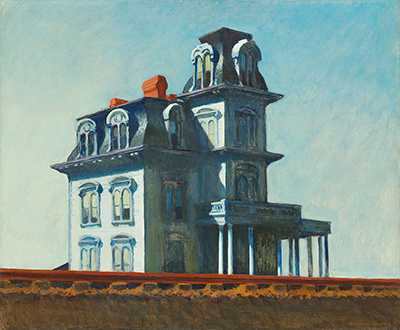
| House by the Railroad | 1925 | oil on canvas |
| House by the Squam River | 1926 | watercolour over graphite on paper |
| Le Bistro or The Wine Shop | 1909 | Oil on canvas |
| Le Pont des Arts | 1907 | Oil on canvas |
| Le Pont Royal | 1909 | Oil on canvas |
| Le Quai des Grands Augustins | 1909 | Oil on canvas |
| Lighthouse and Buildings Portland Head | 1927 | watercolour over graphite pencil on paper |
| Lighthouse Hill | 1927 | oil painting |
| Manhattan Bridge Loop | 1928 | oil on canvas |
| Model Sitting | c. 1902 | oil painting; support not asserted |
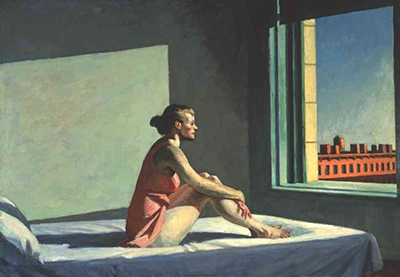
| Morning Sun | 1952 | oil on canvas |
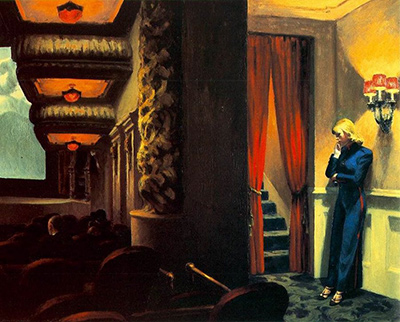
| New York Movie | 1939 | oil on canvas |
| New York New Haven and Hartford | 1931 | oil on canvas |
| New York Office | 1962 | oil on canvas |
| New York Pavements | 1924–1925 | oil on canvas |
| New York Restaurant | c. 1922 | oil on canvas |
| Night Windows | 1928 | oil on canvas |
| Nighthawks | 1942 | oil on canvas |
| October on Cape Cod | 1946 | oil on canvas |
| Office at Night | 1940 | oil on canvas |
| Office in a Small City | 1953 | oil on canvas |
| Pennsylvania Coal Town | 1947 | oil on canvas |
| People in the Sun | 1960 | oil on canvas |
| Portrait of Orleans | 1950 | oil on canvas |
| Queensborough Bridge | 1913 | Oil on canvas |
| Railroad Sunset | 1929 | Oil on canvas |
| Railroad Train | 1908 | oil on canvas |
| Road in Maine | 1914 | oil on canvas |
| Room in Brooklyn | 1932 | oil on canvas |
| Room in New York | 1932 | oil on canvas |
| Rooms by the Sea | 1951 | oil on canvas |
| Rooms for Tourists | 1945 | oil on canvas |
| Route 6 Eastham | 1941 | oil on canvas |
| Second Story Sunlight | 1960 | Oil on canvas |
| Self-Portrait | 1925–1930 | Oil on canvas |
| Self-Portrait with Hat (70.1903) | c. 1918, posthumous print | Drypoint |
| Seven A.M. | 1948 | Oil on canvas |
| Soir Bleu | 1914 | oil on canvas |
| South Carolina Morning | 1955 | Oil on canvas |
| Stairway at 48 Rue de Lille Paris | 1906 | Oil on wood |
| Study for 5 A.M. (70.153) | 1937 | Fabricated chalk on paper |
| Study for 5 A.M. (70.429) | 1937 | Fabricated chalk and graphite pencil on paper |
| Study for Approaching a City (70.869) | 1946 | Fabricated chalk and charcoal on paper |
| Study for August in the City (70.158a-b) | 1945 | Fabricated chalk on paper |
| Study for August in the City (70.159) | 1945 | Fabricated chalk on paper |
| Study for Bridle Path (70.220) | 1939 | Fabricated chalk on paper |
| Study for Bridle Path (70.235) | 1939 | Fabricated chalk on paper |
| Study for Compartment C, Car 293 (70.430) | 1938 | Fabricated chalk on paper |
| Study for Compartment C, Car 293 (70.431a-b) | 1938 | Fabricated chalk and charcoal on paper |
| Study for Conference at Night (70.170) | 1949 | Fabricated chalk on paper (recto); Typewriter ink on paper (verso) |
| Study for Conference at Night (70.174) | 1949 | Fabricated chalk on paper ( recto); Typewriter ink on paper (verso) |
| Study for East Wind over Weehawken (70.249) | 1934 | Graphite pencil on paper |
| Study for East Wind over Weehawken (70.252) | 1934 | Fabricated chalk and charcoal on paper |
| Study for Evening Wind (70.343a-b) | 1921 | Fabricated chalk on paper |
| Study for First Row Orchestra (70.841) | 1951 | Fabricated chalk and charcoal on paper |
| Study for Gas (70.263) | 1940 | Fabricated chalk on paper |
| Study for Ground Swell (70.339) | 1939 | Fabricated chalk, charcoal and graphite pencil on paper |
| Study for Hotel by a Railroad (70.199) | 1952 | Fabricated chalk on paper |
| Study for Hotel by a Railroad (70.427) | 1952 | Fabricated chalk on paper |
| Study for Hotel by a Railroad (70.428) | 1952 | Fabricated chalk on paper |
| Study for Hotel Lobby (70.117) | 1942 | Fabricated chalk and graphite pencil on paper |
| Study for Hotel Lobby (70.839) | 1942 | Fabricated chalk and charcoal on paper |
| Study for Hotel Window (70.161) | 1955 | Fabricated chalk, graphite pencil and colored pencil on paper |
| Study for Morning Sun (70.243) | 1952 | Fabricated chalk on paper |
| Study for Morning Sun (70.244) | 1952 | Fabricated chalk on paper |
| Study for Morning Sun (70.290) | 1952 | Fabricated chalk on paper |
| Study for Morning Sun (70.291) | 1952 | Fabricated chalk and graphite pencil on paper |
| Study for New York Movie (70.273) | 1939 | Fabricated chalk on paper |
| Study for New York Movie (70.274a-b) | 1938 or 1939 | Fabricated chalk and charcoal on paper (recto); Fabricated chalk on paper (verso) |
| Study for New York Movie (70.455) | 1939 | Fabricated chalk and charcoal on paper |
| Study for New York Office (70.822) | 1962 | Fabricated chalk on paper |
| Study for Nighthawks (70.192) | 1941 or 1942 | Fabricated chalk on paper |
| Study for Nighthawks (70.193) | 1941 or 1942 | Fabricated chalk on paper |
| Study for Office at Night (70.340) | 1940 | Fabricated chalk and charcoal on paper |
| Study for Office at Night (70.341) | 1940 | Fabricated chalk and graphite pencil on paper |
| Study for Pennsylvania Coal Town (70.198) | 1947 | Fabricated chalk on paper |
| Study for Pennsylvania Coal Town (70.229) | 1947 | Fabricated chalk and charcoal on paper |
| Study for Rooms for Tourists (70.438) | 1945 | Fabricated chalk and charcoal on paper |
| Study for Rooms for Tourists (70.848) | 1945 | Fabricated chalk and charcoal on paper |
| Study for Route 6, Eastham (70.369) | 1941 | Fabricated chalk and graphite pencil on paper |
| Study for Route 6, Eastham (70.854) | 1941 | Fabricated chalk and graphite pencil on paper |
| Study for South Carolina Morning (70.162a-b) | 1955 | Fabricated chalk on paper (recto and verso) |
| Study for The Sheridan Theatre (70.969) | 1937 | Graphite pencil on paper |
| Study for Two on the Aisle (70.128) | 1927 | Fabricated chalk on paper |
| Study for Two on the Aisle (70.129) | 1927 | Fabricated chalk on paper |
| Study for Yawl Riding a Swell (70.439) | 1935 | Fabricated chalk and graphite pencil on paper |
| Summer Evening | 1947 | oil on canvas |
| Summer Interior | 1909 | Oil on canvas |
| Sun in an Empty Room | 1963 | oil on canvas |
| Sunlight in a Cafeteria | 1958 | oil on canvas |
| Sunlight on Brownstones | 1956 | oil on canvas |
| Tables for Ladies | 1930 | oil on canvas |
| The Bootleggers | 1925 | oil on canvas |
| The Camel's Hump | 1931 | oil on canvas |
| The Circle Theatre | 1936 | oil on canvas |
| The City | 1927 | oil on canvas |
| The Lighthouse at Two Lights | 1929 | oil on canvas |
| The Long Leg | 1935 | oil on canvas |
| The Mansard Roof | 1923 | watercolour over graphite on paper |
| The Sheridan Theatre | 1937 | oil on canvas |
| Tramp Steamer | 1908 | oil on canvas |
| Two Comedians | 1966 | oil on canvas |
| Two on the Aisle | 1927 | oil on canvas |
| Valley of the Seine | 1909 | Oil on canvas |
| Western Motel | 1957 | oil on canvas |
Frequently Asked Questions
Edward Hopper made Queensborough Bridge in 1913. [1]
The recorded medium is Oil on canvas. [1]
The bridge enters from beyond the left edge, its great upper forms descending into the distance. Beneath it, pale masonry piers frame openings onto water, land and a few small buildings. Edward Hopper's Queensborough Bridge brings a new piece of New York engineering into a softly painted riverside landscape. The structure is immense, but its further reaches seem to dissolve into the surrounding light.
Discussion
Look again at the images and ideas explored in Queensborough Bridge. These editorial prompts invite your observations.
Reader Insights
Which boundary, gesture or change of light first holds your attention in Queensborough Bridge?
Compare Manhattan Bridge Loop with Queensborough Bridge. Which visual difference matters most to your reading?
Which detail would you look at again after reading “A cantilever with a curving silhouette”?
Join the Conversation
Share a detail, comparison or question about Queensborough Bridge below.
References
- Whitney Museum of American Art, Queensborough Bridge, 1913, accession 70.1184; current metadata and complete English audio-guide transcript with Kambui Olujimi for Edward Hopper's New York, 2022. View source.
- New York City Landmarks Preservation Commission, Queensboro Bridge, LP-0828, 16 April 1974, description and analysis, pp. 1–2. The historical engineering and architectural account is used here, including its qualified comparison with the Pont Mirabeau. View source.
- Whitney Museum of American Art, Edward Hopper's New York, exhibition labels, 2022, Queensborough Bridge, PDF p. 6. View source.
- Collection or catalogue record, American Village, 1912; medium and identity as discussed in the linked article. View source.
- Collection or catalogue record, Soir Bleu, 1914; medium and identity as discussed in the linked article. View source.
- Collection or catalogue record, House by the Railroad, 1925; medium and identity as discussed in the linked article. View source.
- Collection or catalogue record, Automat, 1927; medium and identity as discussed in the linked article. View source.
- Collection or catalogue record, Early Sunday Morning, 1930; medium and identity as discussed in the linked article. View source.
- Collection or catalogue record, New York Movie, 1939; medium and identity as discussed in the linked article. View source.
- Collection or catalogue record, Nighthawks, 1942; medium and identity as discussed in the linked article. View source.
- Collection or catalogue record, Morning Sun, 1952; medium and identity as discussed in the linked article. View source.
- Collection or catalogue record, Second Story Sunlight, 1960; medium and identity as discussed in the linked article. View source.
- Collection or catalogue record, Two Comedians, 1966; medium and identity as discussed in the linked article. View source.
- Whitney Museum of American Art, Study for Route 6, Eastham, 1941, accession 70.854; exact object record. View source.
- Whitney Museum of American Art, Study for Conference at Night, 1949, accession 70.170; exact object record. View source.
- Whitney Museum of American Art, Study for First Row Orchestra, 1951, accession 70.841; exact object record. View source.
- Whitney Museum of American Art, (Bridge and Embankment), 1906, accession 70.1298; exact object record. View source.
- Whitney Museum of American Art, (Seated Male Model, Bent Over), c. 1902–1903, accession 70.1277; exact object record. View source.
- Whitney Museum of American Art, Study for Morning Sun, 1952, accession 70.244; exact object record. View source.
- Whitney Museum of American Art, Study for Morning Sun, 1952, accession 70.243; exact object record. View source.
- Whitney Museum of American Art, Study for Two on the Aisle, 1927, accession 70.128; exact object record. View source.
- Whitney Museum of American Art, Study for New York Office, 1962, accession 70.822; exact object record. View source.
- Whitney Museum of American Art, Study for Two on the Aisle, 1927, accession 70.129; exact object record. View source.
- Whitney Museum of American Art, Study for Pennsylvania Coal Town, 1947, accession 70.229; exact object record. View source.
- Whitney Museum of American Art, (Rooftops), 1926, accession 70.1114; exact object record. View source.
- Whitney Museum of American Art, Study for South Carolina Morning, 1955, accession 70.162a-b; exact object record. View source.
- Whitney Museum of American Art, (Self-Portrait), 1903–1906, accession 70.1254; exact object record. View source.
- Whitney Museum of American Art, (Manhattan Bridge), 1925–1926, accession 70.1098; exact object record. View source.
- Whitney Museum of American Art, (Solitary Figure in a Theater), c. 1902–1904, accession 70.1418; exact object record. View source.
- Whitney Museum of American Art, Study for Approaching a City, 1946, accession 70.869; exact object record. View source.
- Whitney Museum of American Art, Study for August in the City, 1945, accession 70.159; exact object record. View source.
- Whitney Museum of American Art, Study for Compartment C, Car 293, 1938, accession 70.430; exact object record. View source.
- Whitney Museum of American Art, Study for Compartment C, Car 293, 1938, accession 70.431a-b; exact object record. View source.
- Whitney Museum of American Art, Study for East Wind over Weehawken, 1934, accession 70.252; exact object record. View source.
- Whitney Museum of American Art, Study for East Wind over Weehawken, 1934, accession 70.249; exact object record. View source.
- Whitney Museum of American Art, Study for Evening Wind, 1921, accession 70.343a-b; exact object record. View source.
- Whitney Museum of American Art, Study for The Sheridan Theatre, 1937, accession 70.969; exact object record. View source.
- Whitney Museum of American Art, Study for New York Movie, 1939, accession 70.455; exact object record. View source.
- Whitney Museum of American Art, Study for New York Movie, 1939, accession 70.273; exact object record. View source.
- Whitney Museum of American Art, Study for New York Movie, 1938 or 1939, accession 70.274a-b; exact object record. View source.
- Whitney Museum of American Art, Study for 5 A.M., 1937, accession 70.153; exact object record. View source.
- Whitney Museum of American Art, Study for 5 A.M., 1937, accession 70.429; exact object record. View source.
- Whitney Museum of American Art, (Jo Sketching at Good Harbor Beach), 1923–1924, accession 70.1129; exact object record. View source.
- Whitney Museum of American Art, Study for August in the City, 1945, accession 70.158a-b; exact object record. View source.
- Whitney Museum of American Art, Study for Morning Sun, 1952, accession 70.291; exact object record. View source.
- Whitney Museum of American Art, Study for Morning Sun, 1952, accession 70.290; exact object record. View source.
- Whitney Museum of American Art, Study for Office at Night, 1940, accession 70.340; exact object record. View source.
- Whitney Museum of American Art, Study for Office at Night, 1940, accession 70.341; exact object record. View source.
- Whitney Museum of American Art, Study for Hotel by a Railroad, 1952, accession 70.427; exact object record. View source.
- Whitney Museum of American Art, Study for Hotel by a Railroad, 1952, accession 70.199; exact object record. View source.
- Whitney Museum of American Art, Study for Hotel by a Railroad, 1952, accession 70.428; exact object record. View source.
- Whitney Museum of American Art, Study for Hotel Lobby, 1942, accession 70.117; exact object record. View source.
- Whitney Museum of American Art, Study for Hotel Lobby, 1942, accession 70.839; exact object record. View source.
- Whitney Museum of American Art, Study for Conference at Night, 1949, accession 70.174; exact object record. View source.
- Whitney Museum of American Art, Study for Hotel Window, 1955, accession 70.161; exact object record. View source.
- Whitney Museum of American Art, Study for Pennsylvania Coal Town, 1947, accession 70.198; exact object record. View source.
- Whitney Museum of American Art, Study for Route 6, Eastham, 1941, accession 70.369; exact object record. View source.
- Whitney Museum of American Art, Study for Bridle Path, 1939, accession 70.220; exact object record. View source.
- Whitney Museum of American Art, Study for Bridle Path, 1939, accession 70.235; exact object record. View source.
- Whitney Museum of American Art, Study for Ground Swell, 1939, accession 70.339; exact object record. View source.
- Whitney Museum of American Art, Study for Yawl Riding a Swell, 1935, accession 70.439; exact object record. View source.
- Whitney Museum of American Art, Study for Rooms for Tourists, 1945, accession 70.848; exact object record. View source.
- Whitney Museum of American Art, Study for Rooms for Tourists, 1945, accession 70.438; exact object record. View source.
- Whitney Museum of American Art, Study for Nighthawks, 1941 or 1942, accession 70.193; exact object record. View source.
- Whitney Museum of American Art, Study for Nighthawks, 1941 or 1942, accession 70.192; exact object record. View source.
- Whitney Museum of American Art, Study for Gas, 1940, accession 70.263; exact object record. View source.
- Whitney Museum of American Art, Self-Portrait with Hat, c. 1918, posthumous print, accession 70.1903; exact object record. View source.
- Whitney Museum of American Art, East Side Interior, 1922, accession 70.1020; exact object record. View source.
- Art Institute of Chicago, Selected Chronology for Edward Hopper; training, travels, exhibitions, New York and Truro chronology. View source.
- Emily C. Burns, Spectral figures: Edward Hopper’s empty Paris, chapter 5 in Empty Spaces: Confronting Emptiness in National, Cultural and Urban Histories, 2019; complete chapter and notes consulted. View source.
- Charles Brock, Regionalism and Folk Art, National Gallery of Art; complete essay and two notes consulted. View source.