



 by Tom Gurney
Tom Gurney BSc (Hons) is an art history expert with over 20 years experience
Email: tomgurney1@gmail.com / Phone: +44 7429 011000
Cape Cod Evening: Introduction
A man holds out a hand towards a dog, but the dog's attention goes elsewhere. Behind them, a woman stands with folded arms against a white house. Tall grass separates this small group from the spectator, while dark trees fill the left side of the scene. Edward Hopper's Cape Cod Evening gives us a familiar domestic setting without the easy exchange that would make it a settled picture of home.
Hopper painted the canvas in 1939. The 30-by-40-inch oil painting, measuring 76.2 by 101.6 centimetres, forms part of the John Hay Whitney Collection at Washington's National Gallery of Art. [1] The scene's convincing unity conceals an important fact about its making: the house, landscape and figures were brought together through a process of selection.
At a Glance
- ArtistEdward Hopper [2]
- Date1939 [2]
- Mediumoil on canvas [2]
- Collection / recordNational Gallery of Art [2]
- Accession1982.76.6 [2]
This work across Edward Hopper’s career
American Village
1912Soir Bleu
1914Automat
1927New York Movie
1939Nighthawks
1942Morning Sun
1952Two Comedians
1966Contents
- A place assembled from observations
- A house with an elaborate entrance
- Three positions, three kinds of attention
- The dog's head as a separate subject
- An evening sound beyond the frame
- Drawings that change the encounter
- A composition with the adults and no visible dog
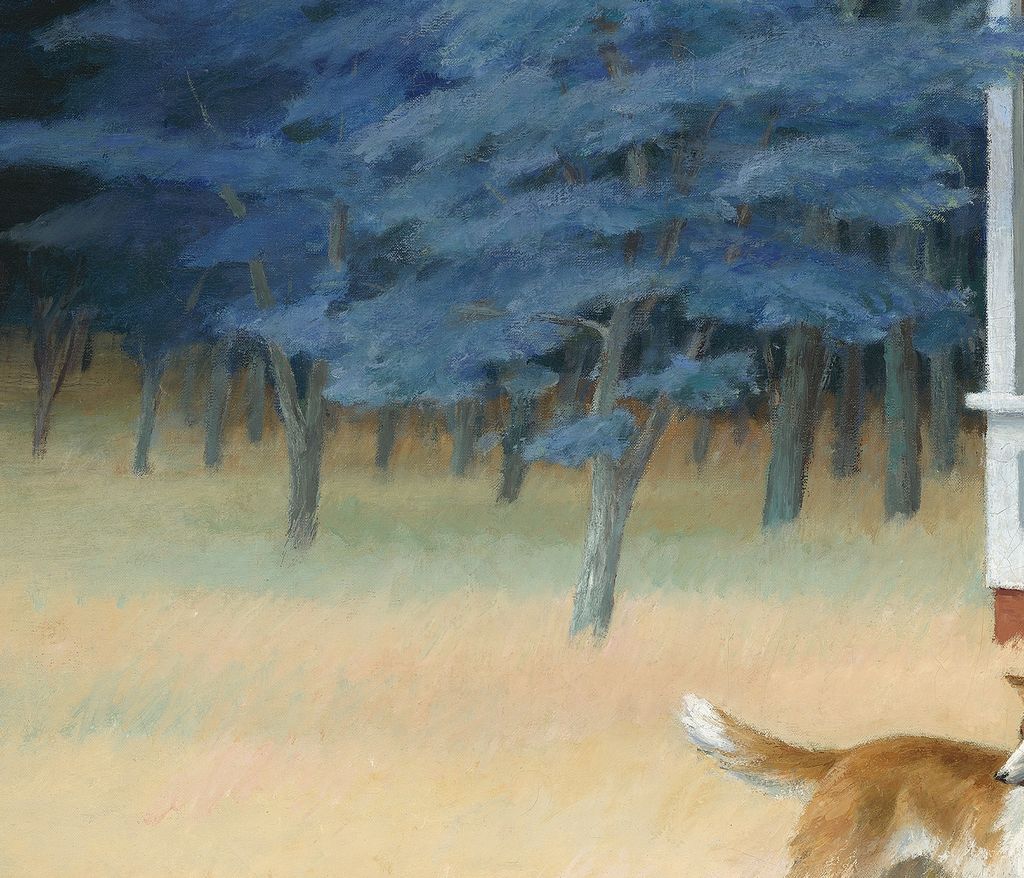
- Why the trees look blue
- Interpreting the distance between the figures
- How the grass changes the scale of the encounter
A place assembled from observations
Hopper explained that the painting combined nearby impressions. The doorway came from Orleans, the grass could be seen from his studio, and the figures were made largely without models. Jo Hopper's ledger dates completion to 30 July 1939. [2] The work should therefore be approached as an invented arrangement of observed things, rather than a record of one identifiable household encountered intact.
That distinction helps with the landscape's peculiar proportions. The house meets a field rather than an obviously maintained lawn. Trees stand close to the wall. The figures occupy a relatively narrow space between architecture and grass. These elements can be plausible individually while their combination produces an unusually concentrated meeting of built and growing forms.
The white wall does not recede politely into a view of the countryside. It rises beyond the top of the picture and continues beyond the right edge. This cropping makes the building feel substantial while preventing us from surveying it completely. We have enough architecture to recognise a house, but not enough to explore its grounds or reconstruct every approach.
The trees are similarly selective. Their dark mass fills the opposite side, withholding the open sky that might otherwise have made the scene spacious. The grass occupies much of the foreground. Between these large areas, the people are clearly visible but do not determine the whole scale of the setting.
A house with an elaborate entrance
The doorway is more ornate than its simple function requires. Curved brackets support a small projecting roof, and narrow vertical panels mark the entrance. Nearby windows offer further rectangles within the larger white wall. Against the loose texture of grass and leaves, these edges look measured and deliberate.
The pale trim also creates a rhythm of repeated verticals. A window frame, the side of the doorway and the standing woman's body rise through the same part of the picture. Her position is connected to the house by proximity and colour contrast: the dark dress remains sharply distinguishable against the light surface.
The seated man creates a different relation to the entrance. His bent legs and lowered body spread the human group towards the ground. The doorstep gives him a place to sit, but his gesture reaches away from the building. The house accommodates the figure while his attention extends into the grass.
A narrow red foundation introduces another colour at the bottom of the wall. It is a small but useful boundary between the pale building and the yellow field. The line helps us locate the structure on the ground without giving us a broad paved terrace or a clear path through the scene.
The windows do not resolve the household's life. We are outside and cannot examine a furnished interior or watch someone moving through the rooms. The building's surfaces are precise; its occupation remains only partly available. That combination lets architecture provide order without explaining the people beside it.
Three positions, three kinds of attention
The standing woman, seated man and dog form a loose triangle. Their different heights make each presence easy to distinguish. A conventional domestic illustration might use the arrangement to show an exchange among them. Hopper leaves the relation incomplete.
The woman's folded arms produce a compact shape. They can suggest reserve, impatience or simple bodily rest, but the position alone cannot establish a quarrel. Her face does not supply a detailed account of what she thinks. She remains present and upright, visually bound to the house without being translated into a single emotional label.
The man's extended hand proposes an action. It draws attention towards the interval between him and the animal. His other arm and bent legs give the seated body a comparatively open, irregular outline. The contrast with the woman's compressed pose makes the two figures different without proving that they are enemies or strangers.
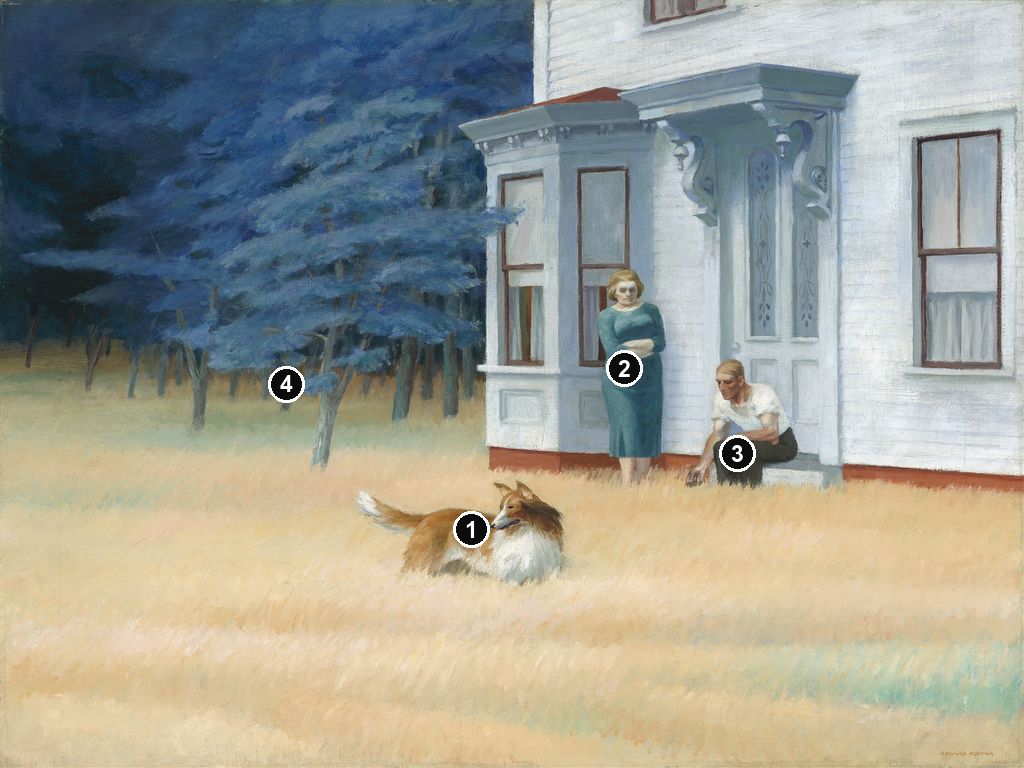
The dog has the most visibly alert silhouette. Pointed ears, an elevated tail and the turn of its head make the body seem responsive to something beyond the immediate gesture. Its pale chest and darker coat keep it distinct from the grass, even where the vegetation partly conceals its lower body.
The important event is therefore very small. A hand is offered and attention does not return along the expected line. The painting can make that missed connection absorbing because it supplies so little competing action. No vehicle passes, no crowd gathers and no open door reveals a second scene demanding explanation.

Compare: Cape Cod Morning, 1950.
The dog's head as a separate subject
The Whitney's sheet catalogued as (Studies of Collies' Heads) makes the animal's alertness a subject of sustained investigation. Dated about 1939, the graphite drawing contains numerous small heads seen from different angles, with repeated attention to ears, eyes and the long muzzle. The studies share one sheet without being arranged into a single complete scene. [3]
Some are little more than contours. A projecting muzzle and a pointed ear establish the direction of a head through a few lines. Others have darker passages around the eye or cheek, giving the same basic construction a more substantial turn. The alternation shows that silhouette and interior modelling could each carry useful information.
The turns are especially relevant to the finished painting. An animal's head can redirect attention without requiring its whole body to move. A small change in ear angle, the alignment of the muzzle or the position of an eye can make the head seem responsive to something outside the immediate encounter.
In the oil, the dog's body occupies the grass as a distinct form, while the head gives that form a direction beyond the man's offered hand. The figure is therefore both a compositional weight and a responsive creature. The studies help us understand the practical difficulty of making those functions coexist.
There is no need to identify every sketch as a direct template for the final head. The sheet's variety is more revealing than a supposed exact match. Hopper could examine the animal's structure through several positions and then use that understanding within the larger design.
The scale of the drawings matters too. A small head has to remain legible with limited description. In the painting, the dog occupies only part of an extensive field, so the direction of its attention must survive at a comparatively modest size. A clear profile and alert ears do substantial work before the spectator has inspected finer details.
The sheet also gives a useful counterweight to accounts centred entirely on the adults. The animal's behaviour was not merely supplied by a reader imagining a household story. Its visible anatomy and orientation were problems Hopper investigated in their own right.
The catalogue title identifies collies, while the actual drawings show their varied head positions. They do not establish a pet's name, ownership or a precise occasion on which Hopper encountered one. What can be followed securely is the painter's effort to make a familiar animal's attention convincing.
An evening sound beyond the frame
Hopper suggested that the dog was listening to an evening sound, possibly a whip-poor-will. Jo recorded that the painting had been intended to bear the bird's name. [2] This documentary context gives the animal's alertness a specific possibility without requiring an invisible threat in the woods.
The bird itself is absent. We do not see it perched in a tree, flying above the grass or confronting the household. Its possible call belongs to the space outside the depicted action. The animal's response lets the painting indicate something it cannot directly show.
Sound would also cross a boundary that the composition makes visually forceful. The house and trees meet as separate areas of light and dark, yet a call could pass between them. The dog's attention reaches into a world that the people do not visibly share in the same way. The landscape becomes active through response rather than through a dramatic event.
This is one reason the title matters. Cape Cod Evening names a location and a time of day, leaving room for more than one account of what is happening. The proposed bird title would have directed attention more firmly towards a cause. The final title preserves the atmosphere while making the viewer work through the relationships within it.
The grass reinforces the sense of an interval. It spreads between the spectator and the house, with small changes of colour and direction interrupting the broad yellow field. We cannot immediately step onto a clear path and join the group. Looking across that space becomes part of the picture's particular quiet.
The suggested bird has an appropriate relation to visibility. The Cornell Lab of Ornithology describes Eastern Whip-poor-wills as well-camouflaged birds that are often easier to hear than see, active at dusk, dawn and on moonlit nights. That natural-history context makes an unseen evening call intelligible. It does not prove that a particular bird occupied the painted grove. [4]
The distinction is valuable for looking at the trees. Their dark surface can contain the possibility of sound without containing a discoverable source. Searching the foliage for a hidden painted bird would turn Hopper's suggestion into a different sort of puzzle from the one the image presents.
The dog's head is enough to indicate a response. The painting can therefore extend beyond its own frame through an attentive body, rather than through a visible path or a distant view. The animal makes an otherwise closed stretch of woods feel connected with a larger environment.
Sound also has a different duration from a gesture. A call might begin, repeat or stop while a hand remains extended. The painting does not give us that sequence, but it allows us to imagine an interruption crossing the household's small exchange. Evening becomes something experienced by the figures and animal, as well as a condition of colour.
Annotated Details from Cape Cod Evening
The numbered points identify visible features discussed in this article. Return from each detail to the whole composition. Cape Cod Evening
Details from CAPE COD EVENING
Compare the cropped details with the complete images above. Notice how their colours, shapes and positions contribute to the larger compositions.
The alert collie
The dog turns away from the two people. Its raised head redirects attention towards something beyond the painted scene.
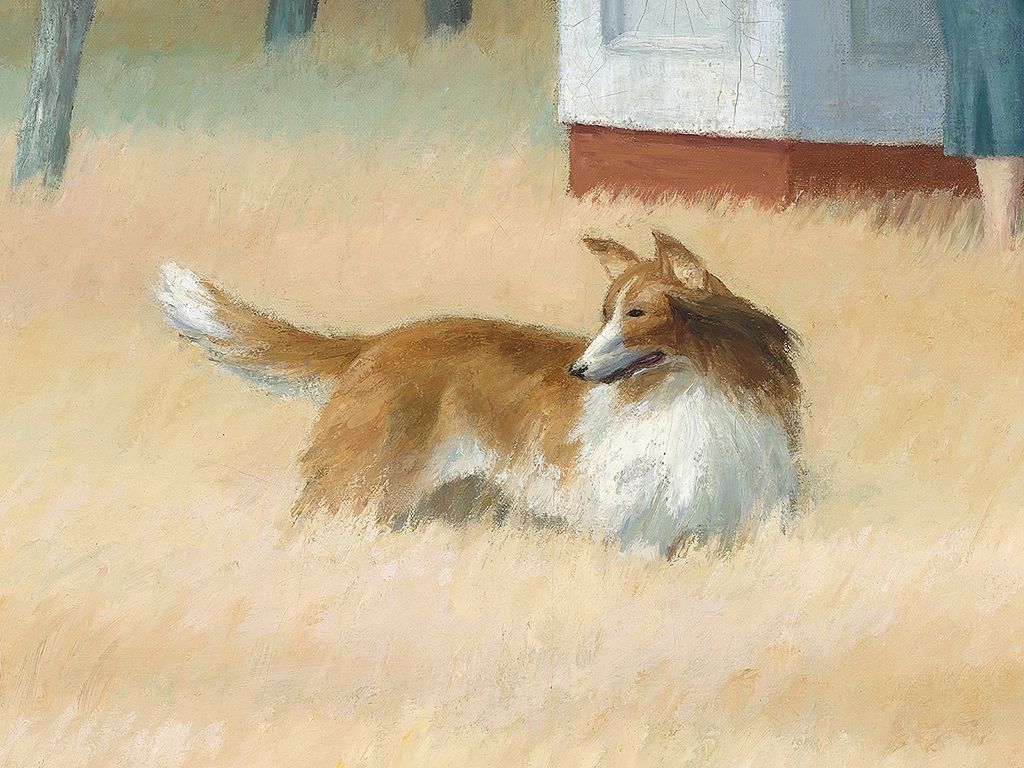
The woman at the doorway
The woman’s folded arms and upright stance sit within the vertical divisions of the doorway and house.
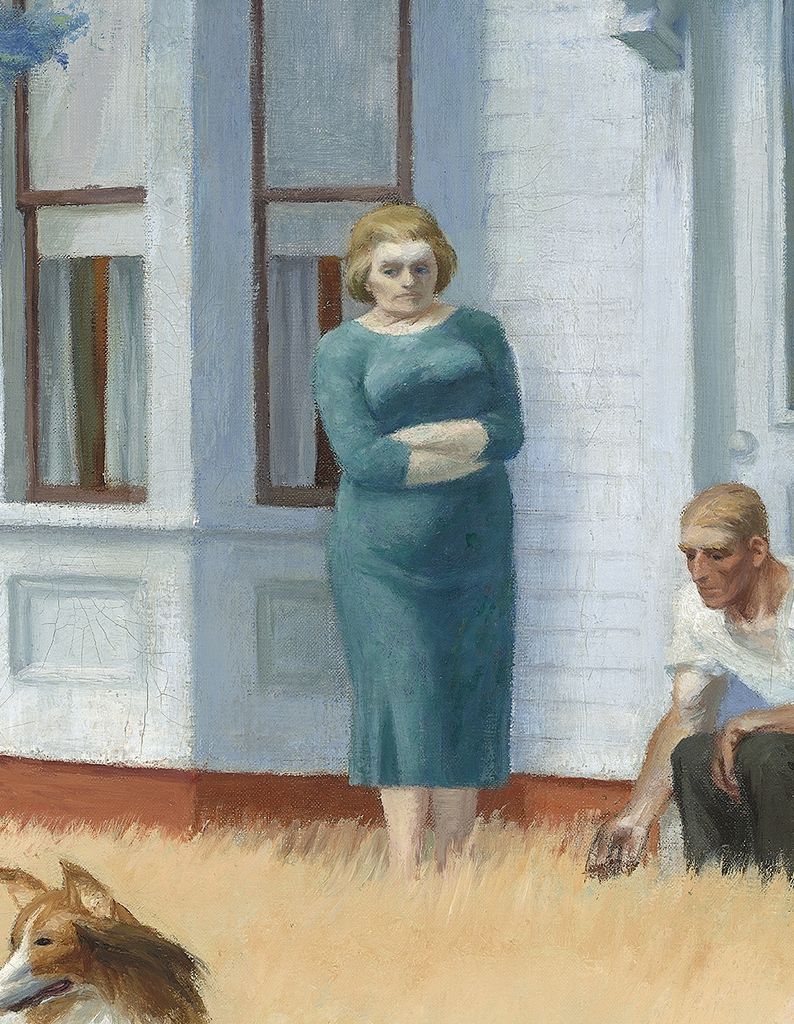
The seated man
The man bends towards the dog, creating an exchange that the animal’s attention does not complete.
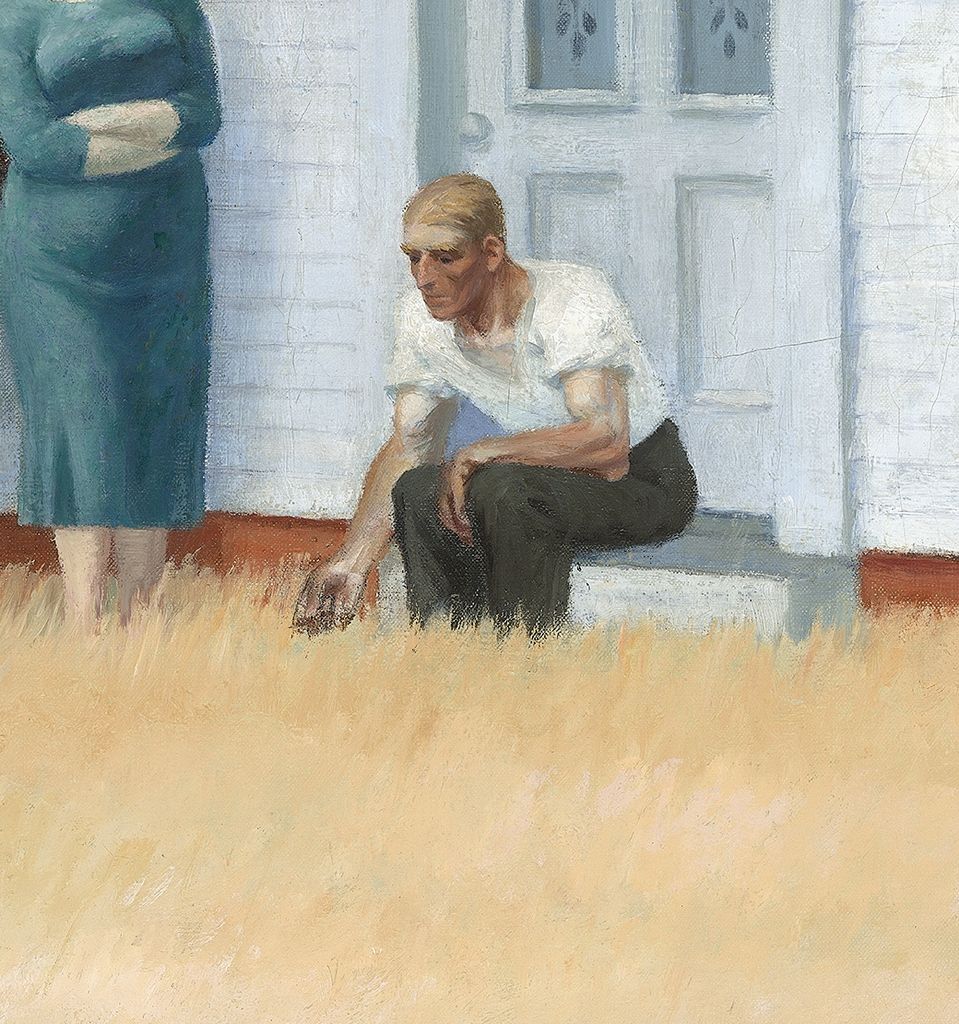
Grass against trees
Pale grass meets a dark stand of trees. The changing edges make an uneven boundary between open ground and woodland.
Drawings that change the encounter
A small 1939 drawing in the Whitney, accession 70.180, brings a seated figure and dog close to the entrance. Executed in fabricated chalk, it establishes the projecting doorway and window with strong, economical lines. [5] The animal is much nearer to the seated person than in the painting, and the final arrangement of two adults is absent.
The difference is instructive. Moving an animal away from a human figure changes more than the amount of grass visible between them. It makes a gesture cross a larger interval. It also gives the dog enough surrounding space to become a separate centre of activity.
Another Whitney drawing, accession 70.338, presents a more developed composition in fabricated chalk, charcoal and graphite. A grid runs through the design, whose main groups closely anticipate the painting. [6] Trees occupy the left, the house and people the right, and the dog stands between the nearer grass and the household.
The grid is particularly revealing beside the loose early study. The final arrangement's apparent informality rests on a design that could be checked in parts and transferred. The dog is not simply a lively detail added to fill an empty patch. Its position belongs to the balance of the whole.
Neither drawing should be treated as a photograph of an event. They show Hopper deciding how an image will work. Architecture, bodies and vegetation can be shifted relative to one another, allowing the final scene to feel immediate while its relations have been carefully constructed.
The drawings also complicate the notion that Hopper's pictures were produced by eliminating everything incidental. Here development includes the establishment and adjustment of a human group. Reduction is one tool among others. The essential question is what each position makes possible for the finished encounter.
A composition with the adults and no visible dog
Another small study, Whitney accession 70.182, approaches the group through a looser arrangement. A framed field contains broad indications of trees at the left and a doorway at the right. Two adults are present: an upright woman to the left of the entrance and a seated person to the right. No dog is visibly established in this design. [7]
The drawing gives the architecture a different degree of completion from that in the oil. A few sloping and upright lines locate the doorway; broad curves and strokes suggest the vegetation. The people are also economical, held within the larger division between the pale house area and the trees.
Beside the study in which a dog stands close to the seated figure, this sheet reveals another problem under consideration. One examines a compact encounter near the entrance; another distributes the adults within a broader setting; the gridded composition brings the principal elements into a closely organized whole.
Their museum dates do not by themselves establish the exact order in which every decision occurred. The differences can be compared without converting accession numbers into a diary. What matters is the range of arrangements available within the process.
The loose sheet also changes how the final grass is understood. Where the small drawing has relatively little foreground incident, the oil establishes a substantial distance across which we look towards the group. The dog can occupy that interval independently, making the space between the house and the spectator part of the encounter.
The final design consequently involves more than placing three figures in a row. It gives each a different relationship to the setting: the woman upright against architecture, the seated man close to its lower edge, and the dog surrounded by the field. Their unequal positions carry the separation before any private history is imagined.
Watch: Edward Hopper’s Life and Art
Explore Hopper’s paintings and the places behind them in these museum films. Choose a film below.
Why the trees look blue
The National Gallery's technical account reports that the trees' green has shifted towards blue, probably through a fading yellow component. Green survives at an edge protected by the frame. The same account identifies underdrawing in the dog and man's hand, and notes reserved and scraped areas around figures. [2]
This evidence changes how the present colour should be discussed. The blue-green woods are part of the painting we encounter now, but their exact hue cannot automatically be assigned to Hopper's original choice. Ageing has a role alongside design. A colour reproduction adds another stage of mediation rather than giving direct access to the canvas as it left the studio.
The protected edge is especially valuable because it offers physical evidence within the same object. The comparison is more precise than assuming that every unusually cool passage must have been expressive distortion. It allows a distinction between a deliberately dark grove and the particular balance of blue and green now visible in it.
The underdrawing and reserved areas reveal another layer of decisions. An apparently firm contour may have a preparation beneath it; a narrow light edge can result from how neighbouring areas were left or scraped. These findings give substance to the relation between drawing and painting without requiring us to imagine a completely different composition hidden below.
The account also records wax lining in 1964. Its frame note reports that Jo disliked the original frame chosen by Edward. [2] Support, surface and frame each have a history. None should be confused with a fictional incident involving the people in the field.
The technical evidence also suggests a useful order of questions when comparing reproductions. First ask what the present object shows: a particularly cool grove beside warmer grass and the pale house. Then ask which evidence concerns its earlier state. A surviving protected green edge is different in kind from an old colour reproduction, whose inks, paper and photography introduce additional variables.
That distinction prevents two opposite mistakes. The current blue cannot simply be assumed to reproduce Hopper's original hue, but an old printed green cannot by itself specify an exact original mixture either. The protected passage and the technical account make the case for change more concrete than either reproduction alone could do. [2]
The composition nevertheless retains relationships that do not depend on naming a precise pigment. The grove remains a large, comparatively dark mass. The house remains strongly light against it, while the foreground supplies a different texture and degree of openness. Colour history modifies our understanding of those relationships without making their visible structure disappear.
The result is a painting whose physical age and imaginative evening have to be considered together. The figures inhabit a represented moment in 1939; the canvas has continued to undergo a material history since then. Attending to both makes its present appearance more interesting and more accurately understood.

Compare: Ground Swell, 1939.
Interpreting the distance between the figures
Robert Torchia's National Gallery essay surveys divergent readings: Gail Levin stresses relationship tensions, while Robert Hobbs gives greater weight to the household's estrangement from a changing rural environment. [2] These proposals direct attention towards different relations already present in the design.
The first encourages us to examine gesture and the separation of the adults. The second draws attention to the house standing amid tall growth, with the grove pressing close. Each can illuminate a part of the picture. Neither makes it necessary to give the figures names or treat them as a documented portrait of the Hoppers' marriage.
The environmental reading is persuasive when it stays with the visible tension between cultivated building and growing field. The architecture has crisp boundaries, but the grass has no comparably sharp division around the people. The figure group seems to occupy a house's edge within vegetation rather than a neatly separated domestic enclosure.
The relationship reading becomes most useful when it acknowledges how little action has been supplied. Folded arms and an unanswered gesture can create tension without revealing what preceded the moment. The painting offers positions from which a story could begin. It does not give a completed history of estrangement.
Its 1939 date can make foreboding seem especially suggestive, but the recorded July completion precedes the outbreak of war in Europe. A later viewer's knowledge should not become an artist's documented prediction. The particular evening remains strong enough to reward attention before it is enlisted as a symbol of an entire historical crisis.
How the grass changes the scale of the encounter
The grass is large enough in the picture to make viewing feel like an approach. Its nearest strokes are not objects we can inspect as easily as a door bracket or a folded arm. They gather into an extensive surface, with individual blades becoming less distinct as the eye moves towards the people.
That change in description gives the figures a particular distance. We are close enough to follow a hand, but we do not stand immediately beside the seated man. The field occupies the intervening space, and no continuous path provides an uncomplicated route to the entrance.
The dog's position makes this interval especially productive. It is nearer to the spectator than the adults and therefore does not belong to exactly the same spatial group. Its alert head can become a first point of engagement before the eye reaches the offered hand and the woman against the wall.
The animal also brings a different kind of edge into the field. Its coat and tail have a stronger overall silhouette than most of the surrounding growth, while the lower body meets a more irregular margin. It belongs to the grass without becoming lost in it. The small pale chest gives the form a light accent of its own.
Compare that contact with the man's position at the house. The step supplies a firmer support and the architecture gives his body a more definite boundary. The dog's stance and the seated man's gesture are connected across two differently described kinds of ground.
The effect is more specific than a general sense of separation. Hopper has made distance legible through changes in texture, support and bodily height. The encounter unfolds across those differences even though the painting presents only one moment.
An early critic puts the landscape first
James Thrall Soby discussed Cape Cod Evening in Romantic Painting in America, published by the Museum of Modern Art in 1943. He recognized the greater suggestion of a plot supplied by the dog and adults, but located much of the painting's mystery in the woods, grass and elaborately detailed house. His account brought Hopper into a history of Romantic perception despite the work's recognizable everyday subjects. [8]
That early response is useful because it does not require the household to be decoded before the setting matters. The grove's extent, the grass's persistence and the house's worked surfaces already make substantial claims on our attention. The people occupy a landscape with its own visual pressures.
Soby's emphasis can be tested directly by temporarily moving attention away from the gesture. The pale doorway still rises against dark growth; the grass still makes the approach uncertain; the cropped house still exceeds the view. Returning to the hand and dog then brings a small action into an environment that has remained active around it.
The reading does not eliminate the human encounter. It changes its scale. The unanswered hand can be absorbing partly because the surrounding areas have been given such broad, sustained presence. A slight redirection of attention becomes perceptible within an evening whose larger shapes seem comparatively settled.
From the studio to the National Gallery
The canvas was with Hopper's dealer Frank Rehn by 1943 and in the Encyclopaedia Britannica Collection by 1945. William Benton purchased it in 1948; John Hay Whitney acquired it in 1950. It reached the National Gallery in 1982 through the Whitney charitable trust. [1] This collection history belongs to the painting as an object, distinct from the imaginary household it contains.
Looking alongside Cape Cod Morning brings the outside world into focus. In that later painting, a woman leans forward at a window. Here the most definite response belongs to the dog in the field. Both images make attention reach beyond the enclosing architecture, but they give the act to different bodies.
Ground Swell offers another variation. Its sailors appear directed towards a bell buoy. In Cape Cod Evening, attention divides between the man's gesture, the woman's reserve and the dog's alertness. The distinction gives the domestic scene its unresolved character.
Return finally to the space the man's hand tries to cross. It is small compared with the field, yet the whole picture makes us notice it. The white house offers a stable backdrop, the grass spreads around the group, and the dog turns towards an evening the viewer cannot hear. The scene holds together through these exact relations, while the exchange at its centre remains unfinished.
Artworks and studies directory
This researched directory includes finished works and separately identified studies. It is not a complete catalogue raisonné. Linked titles open the articles; unlinked studies are identified by their collection accessions. Watercolours retain their recorded media, and original prints remain distinct from reproductions.
| Name | Date | Medium |
|---|---|---|
| (Bridge and Embankment) (70.1298) | 1906 | Oil on wood |
| (Jo Sketching at Good Harbor Beach) (70.1129) | 1923–1924 | Watercolor and fabricated chalk on paper |
| (Manhattan Bridge) (70.1098) | 1925–1926 | Watercolor and graphite pencil on paper |
| (Rooftops) (70.1114) | 1926 | Watercolor and graphite pencil on paper |
| (Seated Male Model, Bent Over) (70.1277) | c. 1902–1903 | Oil on canvas |
| (Self-Portrait) (70.1254) | 1903–1906 | Oil on canvas |
| (Solitary Figure in a Theater) (70.1418) | c. 1902–1904 | Oil on board |
| 5 A.M. | 1937 | oil on canvas |
| Adam's House | 1928 | watercolour and charcoal on paper |
| American Village | 1912 | Oil on canvas |
| Apartment Houses | 1923 | oil on canvas |
| Approaching a City | 1946 | oil on canvas |
| August in the City | 1945 | oil on canvas |
| Automat | 1927 | oil on canvas |
| Barber Shop | 1931 | oil on canvas |
| Blackwell's Island | 1928 | oil on canvas |
| Bridge on the Seine | 1909 | Oil on canvas |
| Bridle Path | 1939 | oil on canvas |
| Burly Cobb's House South Truro | 1930–1933 | oil on canvas |
| Cape Cod Evening | 1939 | oil on canvas |
| Cape Cod Morning | 1950 | oil on canvas |
| Chair Car | 1965 | oil on canvas |
| Chop Suey | 1929 | oil on canvas |
| City Roofs | 1932 | Oil on canvas |
| Coast Guard Station | 1929 | oil on canvas |
| Compartment C, Car 293 | 1938 | oil on canvas |
| Conference at Night | 1949 | oil on canvas |
| Corn Hill | 1930 | oil on canvas |
| Dawn in Pennsylvania | 1942 | oil on canvas |
| Drug Store | 1927 | oil on canvas |
| Early Sunday Morning | 1930 | Oil on canvas |
| East Side Interior (70.1020) | 1922 | Etching |
| East Wind Over Weehawken | 1934 | oil on canvas |
| El Palacio | 1946 | Watercolor and graphite pencil on paper |
| Eleven A.M. | 1926 | oil on canvas |
| Evening Wind | 1921 | etching |
| Excursion into Philosophy | 1959 | oil on canvas |
| First Row Orchestra | 1951 | oil on canvas |
| Freight Car at Truro | 1931 | watercolour over graphite on paper |
| Gas | 1940 | oil on canvas |
| Girl at a Sewing Machine | c. 1921 | oil on canvas |
| Gloucester Harbor | 1912 | Oil on canvas |
| Ground Swell | 1939 | oil on canvas |
| Haskell's House | 1924 | watercolour over graphite on paperboard |
| High Noon | 1949 | oil on canvas |
| Hill and Houses Cape Elizabeth Maine | 1927 | watercolour over graphite pencil |
| Hills South Truro | 1930 | oil on canvas |
| Hotel by a Railroad | 1952 | oil on canvas |
| Hotel Lobby | 1943 | oil on canvas |
| Hotel Room | 1931 | oil on canvas |
| Hotel Window | 1955 | oil on canvas |
| House by the Railroad | 1925 | oil on canvas |
| House by the Squam River | 1926 | watercolour over graphite on paper |
| Le Bistro or The Wine Shop | 1909 | Oil on canvas |
| Le Pont des Arts | 1907 | Oil on canvas |
| Le Pont Royal | 1909 | Oil on canvas |
| Le Quai des Grands Augustins | 1909 | Oil on canvas |
| Lighthouse and Buildings Portland Head | 1927 | watercolour over graphite pencil on paper |
| Lighthouse Hill | 1927 | oil painting |
| Manhattan Bridge Loop | 1928 | oil on canvas |
| Model Sitting | c. 1902 | oil painting; support not asserted |
| Morning Sun | 1952 | oil on canvas |
| New York Movie | 1939 | oil on canvas |
| New York New Haven and Hartford | 1931 | oil on canvas |
| New York Office | 1962 | oil on canvas |
| New York Pavements | 1924–1925 | oil on canvas |
| New York Restaurant | c. 1922 | oil on canvas |
| Night Windows | 1928 | oil on canvas |
| Nighthawks | 1942 | oil on canvas |
| October on Cape Cod | 1946 | oil on canvas |
| Office at Night | 1940 | oil on canvas |
| Office in a Small City | 1953 | oil on canvas |
| Pennsylvania Coal Town | 1947 | oil on canvas |
| People in the Sun | 1960 | oil on canvas |
| Portrait of Orleans | 1950 | oil on canvas |
| Queensborough Bridge | 1913 | Oil on canvas |
| Railroad Sunset | 1929 | Oil on canvas |
| Railroad Train | 1908 | oil on canvas |
| Road in Maine | 1914 | oil on canvas |
| Room in Brooklyn | 1932 | oil on canvas |
| Room in New York | 1932 | oil on canvas |
| Rooms by the Sea | 1951 | oil on canvas |
| Rooms for Tourists | 1945 | oil on canvas |
| Route 6 Eastham | 1941 | oil on canvas |
| Second Story Sunlight | 1960 | Oil on canvas |
| Self-Portrait | 1925–1930 | Oil on canvas |
| Self-Portrait with Hat (70.1903) | c. 1918, posthumous print | Drypoint |
| Seven A.M. | 1948 | Oil on canvas |
| Soir Bleu | 1914 | oil on canvas |
| South Carolina Morning | 1955 | Oil on canvas |
| Stairway at 48 Rue de Lille Paris | 1906 | Oil on wood |
| Study for 5 A.M. (70.153) | 1937 | Fabricated chalk on paper |
| Study for 5 A.M. (70.429) | 1937 | Fabricated chalk and graphite pencil on paper |
| Study for Approaching a City (70.869) | 1946 | Fabricated chalk and charcoal on paper |
| Study for August in the City (70.158a-b) | 1945 | Fabricated chalk on paper |
| Study for August in the City (70.159) | 1945 | Fabricated chalk on paper |
| Study for Bridle Path (70.220) | 1939 | Fabricated chalk on paper |
| Study for Bridle Path (70.235) | 1939 | Fabricated chalk on paper |
| Study for Compartment C, Car 293 (70.430) | 1938 | Fabricated chalk on paper |
| Study for Compartment C, Car 293 (70.431a-b) | 1938 | Fabricated chalk and charcoal on paper |
| Study for Conference at Night (70.170) | 1949 | Fabricated chalk on paper (recto); Typewriter ink on paper (verso) |
| Study for Conference at Night (70.174) | 1949 | Fabricated chalk on paper ( recto); Typewriter ink on paper (verso) |
| Study for East Wind over Weehawken (70.249) | 1934 | Graphite pencil on paper |
| Study for East Wind over Weehawken (70.252) | 1934 | Fabricated chalk and charcoal on paper |
| Study for Evening Wind (70.343a-b) | 1921 | Fabricated chalk on paper |
| Study for First Row Orchestra (70.841) | 1951 | Fabricated chalk and charcoal on paper |
| Study for Gas (70.263) | 1940 | Fabricated chalk on paper |
| Study for Ground Swell (70.339) | 1939 | Fabricated chalk, charcoal and graphite pencil on paper |
| Study for Hotel by a Railroad (70.199) | 1952 | Fabricated chalk on paper |
| Study for Hotel by a Railroad (70.427) | 1952 | Fabricated chalk on paper |
| Study for Hotel by a Railroad (70.428) | 1952 | Fabricated chalk on paper |
| Study for Hotel Lobby (70.117) | 1942 | Fabricated chalk and graphite pencil on paper |
| Study for Hotel Lobby (70.839) | 1942 | Fabricated chalk and charcoal on paper |
| Study for Hotel Window (70.161) | 1955 | Fabricated chalk, graphite pencil and colored pencil on paper |
| Study for Morning Sun (70.243) | 1952 | Fabricated chalk on paper |
| Study for Morning Sun (70.244) | 1952 | Fabricated chalk on paper |
| Study for Morning Sun (70.290) | 1952 | Fabricated chalk on paper |
| Study for Morning Sun (70.291) | 1952 | Fabricated chalk and graphite pencil on paper |
| Study for New York Movie (70.273) | 1939 | Fabricated chalk on paper |
| Study for New York Movie (70.274a-b) | 1938 or 1939 | Fabricated chalk and charcoal on paper (recto); Fabricated chalk on paper (verso) |
| Study for New York Movie (70.455) | 1939 | Fabricated chalk and charcoal on paper |
| Study for New York Office (70.822) | 1962 | Fabricated chalk on paper |
| Study for Nighthawks (70.192) | 1941 or 1942 | Fabricated chalk on paper |
| Study for Nighthawks (70.193) | 1941 or 1942 | Fabricated chalk on paper |
| Study for Office at Night (70.340) | 1940 | Fabricated chalk and charcoal on paper |
| Study for Office at Night (70.341) | 1940 | Fabricated chalk and graphite pencil on paper |
| Study for Pennsylvania Coal Town (70.198) | 1947 | Fabricated chalk on paper |
| Study for Pennsylvania Coal Town (70.229) | 1947 | Fabricated chalk and charcoal on paper |
| Study for Rooms for Tourists (70.438) | 1945 | Fabricated chalk and charcoal on paper |
| Study for Rooms for Tourists (70.848) | 1945 | Fabricated chalk and charcoal on paper |
| Study for Route 6, Eastham (70.369) | 1941 | Fabricated chalk and graphite pencil on paper |
| Study for Route 6, Eastham (70.854) | 1941 | Fabricated chalk and graphite pencil on paper |
| Study for South Carolina Morning (70.162a-b) | 1955 | Fabricated chalk on paper (recto and verso) |
| Study for The Sheridan Theatre (70.969) | 1937 | Graphite pencil on paper |
| Study for Two on the Aisle (70.128) | 1927 | Fabricated chalk on paper |
| Study for Two on the Aisle (70.129) | 1927 | Fabricated chalk on paper |
| Study for Yawl Riding a Swell (70.439) | 1935 | Fabricated chalk and graphite pencil on paper |
| Summer Evening | 1947 | oil on canvas |
| Summer Interior | 1909 | Oil on canvas |
| Sun in an Empty Room | 1963 | oil on canvas |
| Sunlight in a Cafeteria | 1958 | oil on canvas |
| Sunlight on Brownstones | 1956 | oil on canvas |
| Tables for Ladies | 1930 | oil on canvas |
| The Bootleggers | 1925 | oil on canvas |
| The Camel's Hump | 1931 | oil on canvas |
| The Circle Theatre | 1936 | oil on canvas |
| The City | 1927 | oil on canvas |
| The Lighthouse at Two Lights | 1929 | oil on canvas |
| The Long Leg | 1935 | oil on canvas |
| The Mansard Roof | 1923 | watercolour over graphite on paper |
| The Sheridan Theatre | 1937 | oil on canvas |
| Tramp Steamer | 1908 | oil on canvas |
| Two Comedians | 1966 | oil on canvas |
| Two on the Aisle | 1927 | oil on canvas |
| Valley of the Seine | 1909 | Oil on canvas |
| Western Motel | 1957 | oil on canvas |
Frequently Asked Questions
Edward Hopper made Cape Cod Evening in 1939. [2]
The recorded medium is oil on canvas. [2]
A man holds out a hand towards a dog, but the dog's attention goes elsewhere. Behind them, a woman stands with folded arms against a white house. Tall grass separates this small group from the spectator, while dark trees fill the left side of the scene. Edward Hopper's Cape Cod Evening gives us a familiar domestic setting without the easy exchange that would make it a settled picture of home.
Discussion
Look again at the images and ideas explored in Cape Cod Evening. These editorial prompts invite your observations.
Reader Insights
Which boundary, gesture or change of light first holds your attention in Cape Cod Evening?
Compare Cape Cod Morning with Cape Cod Evening. Which visual difference matters most to your reading?
Which detail would you look at again after reading “Three positions, three kinds of attention”?
Join the Conversation
Share a detail, comparison or question about Cape Cod Evening below.
References
- National Gallery of Art, Cape Cod Evening, 1939, accession 1982.76.6. Current object dimensions, credit line and provenance. View source.
- Robert Torchia, “Cape Cod Evening, 1939”, American Paintings, 1900–1945, National Gallery of Art, 29 September 2016. Complete entry, technical summary and notes. Hopper's statement is transmitted from Grace Pagano, Contemporary American Painting (1945), p. 57; Jo's ledger and later scholarly readings are identified through Torchia's citations. View source.
- Whitney Museum of American Art, (Studies of Collies' Heads), c.1939, graphite pencil on paper, 70.165a-b, Josephine N. Hopper Bequest; current catalogue record and complete published recto image. View source.
- Cornell Lab of Ornithology, “Eastern Whip-poor-will: Overview”, basic description and habitat/behaviour summary; limited natural-history context for Hopper's suggested sound, not identification of an unseen painted bird. View source.
- Whitney Museum of American Art, Study for Cape Cod Evening, 1939, accession 70.180. Current object record and early composition drawing. View source.
- Whitney Museum of American Art, Study for Cape Cod Evening, 1939, accession 70.338. Current mixed-medium description and gridded composition drawing. View source.
- Whitney Museum of American Art, Study for Cape Cod Evening, 1939, fabricated chalk on paper, 70.182, Josephine N. Hopper Bequest; current metadata and complete small compositional drawing. View source.
- James Thrall Soby, Romantic Painting in America, Museum of Modern Art, 1943, pp.38–39 and note 78; selected complete Hopper discussion, including Cape Cod Evening, examined rather than a claim to have read every chapter. View source.
- Collection or catalogue record, American Village, 1912; medium and identity as discussed in the linked article. View source.
- Collection or catalogue record, Soir Bleu, 1914; medium and identity as discussed in the linked article. View source.
- Collection or catalogue record, House by the Railroad, 1925; medium and identity as discussed in the linked article. View source.
- Collection or catalogue record, Automat, 1927; medium and identity as discussed in the linked article. View source.
- Collection or catalogue record, Early Sunday Morning, 1930; medium and identity as discussed in the linked article. View source.
- Collection or catalogue record, New York Movie, 1939; medium and identity as discussed in the linked article. View source.
- Collection or catalogue record, Nighthawks, 1942; medium and identity as discussed in the linked article. View source.
- Collection or catalogue record, Morning Sun, 1952; medium and identity as discussed in the linked article. View source.
- Collection or catalogue record, Second Story Sunlight, 1960; medium and identity as discussed in the linked article. View source.
- Collection or catalogue record, Two Comedians, 1966; medium and identity as discussed in the linked article. View source.
- Whitney Museum of American Art, Study for Route 6, Eastham, 1941, accession 70.854; exact object record. View source.
- Whitney Museum of American Art, Study for Conference at Night, 1949, accession 70.170; exact object record. View source.
- Whitney Museum of American Art, Study for First Row Orchestra, 1951, accession 70.841; exact object record. View source.
- Whitney Museum of American Art, (Bridge and Embankment), 1906, accession 70.1298; exact object record. View source.
- Whitney Museum of American Art, (Seated Male Model, Bent Over), c. 1902–1903, accession 70.1277; exact object record. View source.
- Whitney Museum of American Art, Study for Morning Sun, 1952, accession 70.244; exact object record. View source.
- Whitney Museum of American Art, Study for Morning Sun, 1952, accession 70.243; exact object record. View source.
- Whitney Museum of American Art, Study for Two on the Aisle, 1927, accession 70.128; exact object record. View source.
- Whitney Museum of American Art, Study for New York Office, 1962, accession 70.822; exact object record. View source.
- Whitney Museum of American Art, Study for Two on the Aisle, 1927, accession 70.129; exact object record. View source.
- Whitney Museum of American Art, Study for Pennsylvania Coal Town, 1947, accession 70.229; exact object record. View source.
- Whitney Museum of American Art, (Rooftops), 1926, accession 70.1114; exact object record. View source.
- Whitney Museum of American Art, Study for South Carolina Morning, 1955, accession 70.162a-b; exact object record. View source.
- Whitney Museum of American Art, (Self-Portrait), 1903–1906, accession 70.1254; exact object record. View source.
- Whitney Museum of American Art, (Manhattan Bridge), 1925–1926, accession 70.1098; exact object record. View source.
- Whitney Museum of American Art, (Solitary Figure in a Theater), c. 1902–1904, accession 70.1418; exact object record. View source.
- Whitney Museum of American Art, Study for Approaching a City, 1946, accession 70.869; exact object record. View source.
- Whitney Museum of American Art, Study for August in the City, 1945, accession 70.159; exact object record. View source.
- Whitney Museum of American Art, Study for Compartment C, Car 293, 1938, accession 70.430; exact object record. View source.
- Whitney Museum of American Art, Study for Compartment C, Car 293, 1938, accession 70.431a-b; exact object record. View source.
- Whitney Museum of American Art, Study for East Wind over Weehawken, 1934, accession 70.252; exact object record. View source.
- Whitney Museum of American Art, Study for East Wind over Weehawken, 1934, accession 70.249; exact object record. View source.
- Whitney Museum of American Art, Study for Evening Wind, 1921, accession 70.343a-b; exact object record. View source.
- Whitney Museum of American Art, Study for The Sheridan Theatre, 1937, accession 70.969; exact object record. View source.
- Whitney Museum of American Art, Study for New York Movie, 1939, accession 70.455; exact object record. View source.
- Whitney Museum of American Art, Study for New York Movie, 1939, accession 70.273; exact object record. View source.
- Whitney Museum of American Art, Study for New York Movie, 1938 or 1939, accession 70.274a-b; exact object record. View source.
- Whitney Museum of American Art, Study for 5 A.M., 1937, accession 70.153; exact object record. View source.
- Whitney Museum of American Art, Study for 5 A.M., 1937, accession 70.429; exact object record. View source.
- Whitney Museum of American Art, (Jo Sketching at Good Harbor Beach), 1923–1924, accession 70.1129; exact object record. View source.
- Whitney Museum of American Art, Study for August in the City, 1945, accession 70.158a-b; exact object record. View source.
- Whitney Museum of American Art, Study for Morning Sun, 1952, accession 70.291; exact object record. View source.
- Whitney Museum of American Art, Study for Morning Sun, 1952, accession 70.290; exact object record. View source.
- Whitney Museum of American Art, Study for Office at Night, 1940, accession 70.340; exact object record. View source.
- Whitney Museum of American Art, Study for Office at Night, 1940, accession 70.341; exact object record. View source.
- Whitney Museum of American Art, Study for Hotel by a Railroad, 1952, accession 70.427; exact object record. View source.
- Whitney Museum of American Art, Study for Hotel by a Railroad, 1952, accession 70.199; exact object record. View source.
- Whitney Museum of American Art, Study for Hotel by a Railroad, 1952, accession 70.428; exact object record. View source.
- Whitney Museum of American Art, Study for Hotel Lobby, 1942, accession 70.117; exact object record. View source.
- Whitney Museum of American Art, Study for Hotel Lobby, 1942, accession 70.839; exact object record. View source.
- Whitney Museum of American Art, Study for Conference at Night, 1949, accession 70.174; exact object record. View source.
- Whitney Museum of American Art, Study for Hotel Window, 1955, accession 70.161; exact object record. View source.
- Whitney Museum of American Art, Study for Pennsylvania Coal Town, 1947, accession 70.198; exact object record. View source.
- Whitney Museum of American Art, Study for Route 6, Eastham, 1941, accession 70.369; exact object record. View source.
- Whitney Museum of American Art, Study for Bridle Path, 1939, accession 70.220; exact object record. View source.
- Whitney Museum of American Art, Study for Bridle Path, 1939, accession 70.235; exact object record. View source.
- Whitney Museum of American Art, Study for Ground Swell, 1939, accession 70.339; exact object record. View source.
- Whitney Museum of American Art, Study for Yawl Riding a Swell, 1935, accession 70.439; exact object record. View source.
- Whitney Museum of American Art, Study for Rooms for Tourists, 1945, accession 70.848; exact object record. View source.
- Whitney Museum of American Art, Study for Rooms for Tourists, 1945, accession 70.438; exact object record. View source.
- Whitney Museum of American Art, Study for Nighthawks, 1941 or 1942, accession 70.193; exact object record. View source.
- Whitney Museum of American Art, Study for Nighthawks, 1941 or 1942, accession 70.192; exact object record. View source.
- Whitney Museum of American Art, Study for Gas, 1940, accession 70.263; exact object record. View source.
- Whitney Museum of American Art, Self-Portrait with Hat, c. 1918, posthumous print, accession 70.1903; exact object record. View source.
- Whitney Museum of American Art, East Side Interior, 1922, accession 70.1020; exact object record. View source.
- Art Institute of Chicago, Selected Chronology for Edward Hopper; training, travels, exhibitions, New York and Truro chronology. View source.
- Emily C. Burns, Spectral figures: Edward Hopper’s empty Paris, chapter 5 in Empty Spaces: Confronting Emptiness in National, Cultural and Urban Histories, 2019; complete chapter and notes consulted. View source.
- Charles Brock, Regionalism and Folk Art, National Gallery of Art; complete essay and two notes consulted. View source.


