 by Tom Gurney
Tom Gurney BSc (Hons) is an art history expert with over 20 years experience
Email: tomgurney1@gmail.com / Phone: +44 7429 011000
The Lighthouse at Two Lights: Introduction
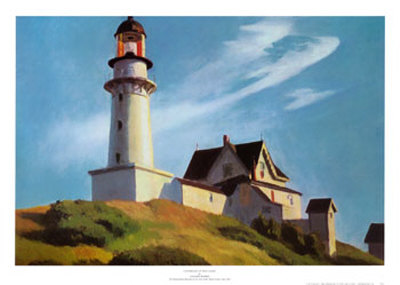
The lighthouse rises from a grassy slope into an expanse of blue sky. Seen from below, its white shaft appears unusually tall, while the attached buildings step down towards the right. A dark lantern and circular gallery interrupt the upward movement near the top. Edward Hopper's The Lighthouse at Two Lights makes a coastal building imposing through the simplest relationships: an upright against a hill, pale walls beside dark roofs, and sunlight meeting shadow.
Hopper painted the oil on canvas in 1929. The Metropolitan Museum of Art records its dimensions as 74.3 × 109.2 cm and holds it under accession 62.95, with the credit Hugo Kastor Fund, 1962. [1]
The site is Two Lights in Cape Elizabeth, Maine. This was one of the coastal districts Hopper explored in 1927 and again in 1929, during summers that yielded both watercolours and oils. Bowdoin College Museum of Art's account connects that wider exploration with the Hoppers' purchase of a car in 1927. [2]
At a Glance
- ArtistEdward Hopper [1]
- Date1929 [1]
- Mediumoil on canvas [1]
- Collection / recordThe Metropolitan Museum of Art [1]
- Accession62.95 [1]
This work across Edward Hopper’s career
American Village
1912Soir Bleu
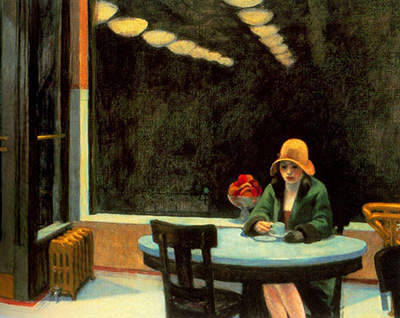
1914Automat
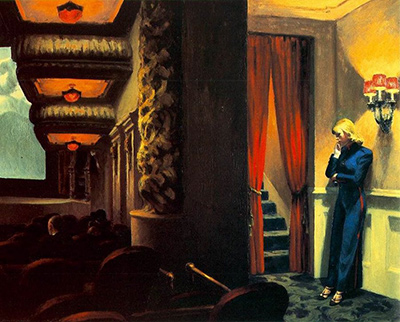
1927New York Movie
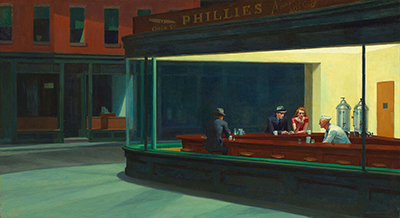
1939Nighthawks
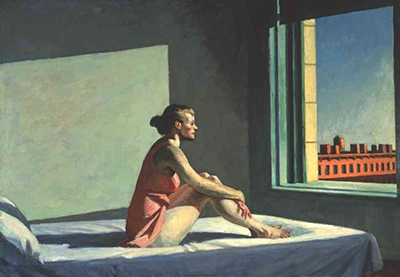
1942Morning Sun
1952Two Comedians
1966Contents
- Why the tower seems so tall
- The white wall is several colours
- Grass, shadow and the route across the picture
- One tower at a place called Two Lights
- An early response to the light
- How much symbolism does it need?
- Looking beside the 1927 paintings
Why the tower seems so tall
The low viewpoint is essential. We look up the incline towards the tower, and its upper parts are seen against the sky. There is little other architecture of a comparable height to moderate its scale. Even the steep roofs on the right remain well below the lantern.
The shaft is also given a long, comparatively uninterrupted surface. Small openings and changes in tone punctuate it, but these details do not break it into a series of equal compartments. The eye can follow the white form upwards almost in one movement.
At the base, a broad squarer structure anchors the round tower. The change from a block to a cylinder is visible without becoming fussy. The lower form offers straight edges and definite corners; the shaft above turns more gradually from light into shade.
Near the top, the circular gallery introduces a sideways extension. Its rim projects beyond the shaft and casts a darker band below. Above it, the lantern becomes more intricate, with framing, glazing and a rounded dark cap. This concentrated detail rewards the upward journey, then stops the pale surface from continuing indefinitely.
The hill contributes as much as the architecture. It rises beneath the tower and places the spectator below the station's level. We cannot walk visually into a broad open forecourt. The slope intervenes, making the tower something approached from lower ground.
The tower's apparent height depends on the agreement of viewpoint, surface, neighbouring roofs and raised ground.
The white wall is several colours
The tower's whiteness is immediately striking, yet its surface contains warmer and cooler passages. One side receives stronger light, while the turning form passes into a subdued tone. These changes make it cylindrical. If the shaft were rendered as a uniformly white shape, much of its physical presence would disappear.
The gallery's shadow operates differently. It produces a more abrupt division under the projecting rim. We can distinguish the gradual change around a curved wall from the harder interruption caused by an overhang. Light describes both the shape of the tower and the construction of its upper parts.
The attached lower wall offers a further variation. Its broad light surface meets a darker face at a firm edge. Here the turn is angular, and the shift of tone feels more sudden. Hopper places curved and squared volumes close enough for us to compare their behaviour in the same daylight.
The house beyond them is more divided. Steep roofs, a gable, smaller projections and shaded walls form a closely joined group. Dark brown and red tones provide a counterweight to the tower's pale surface. The architecture grows busier as it spreads towards the right.
Small dark openings sharpen this relationship. They are clearly subordinate to the main masses, but each gives a light wall a point of definition. Their compactness also emphasizes how large the uninterrupted parts of the tower appear.
Grass, shadow and the route across the picture
The hillside is a substantial subject in its own right. Green patches alternate with yellow-brown grass, darker bushes and uneven strips of exposed-looking ground. Its outline rises beneath the buildings, then moves down towards the right-hand edge.
Across the lower part, diagonals suggest changes in level and direction. They give the spectator a route through the land, though the painting does not provide a single smooth approach leading all the way to the door. The ground feels rough and sloping rather than landscaped for a ceremonial view.
Dark vegetation gathers close to the lower edges of the architecture. These patches make the pale walls brighter by comparison, and they partly obscure the meeting between building and earth. The station appears rooted in the hill while retaining an unusually clear upper silhouette.
At the right, a small upright building or projection repeats the tower on a much reduced scale. Its pale wall and dark roof create another vertical accent, but it remains embedded in the larger architectural group. A further fragment at the edge suggests that the scene extends beyond the selected view.
These lesser forms keep the composition from becoming a diagram of a solitary lighthouse. The main tower dominates, yet it has neighbours, attachments and ground around it. The eye can move away from the lantern, explore the roof group, descend to the slope and find its way back.
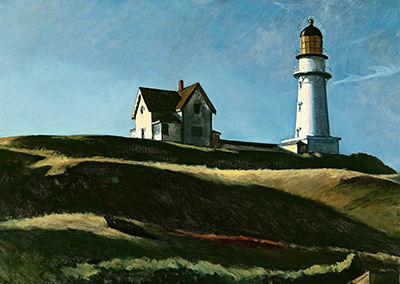
Compare: Lighthouse Hill, 1927.
One tower at a place called Two Lights
The name refers to the history of the station. Two towers were originally established at Cape Elizabeth in 1828. They were later replaced by cast-iron structures in the 1870s, and the western light ceased operation in 1924. The name Two Lights survived this change. [3]
This history explains why a painting of one tower can carry that title. Hopper's canvas selects a portion of a larger place; it does not promise to show both lights simultaneously.
The station's function directs attention towards the sea, although open water is absent from this view. The painting concentrates on land, architecture and sky. We understand the maritime setting through the subject and its known location rather than through a horizon crossed by vessels.
The lighthouse is also seen in daylight, when its silhouette and white walls are more immediately visible than any artificial beam. Hopper has made sunlight the means by which we encounter an object designed to guide people through darkness. Its long shaft remains brightly visible against the blue.
Watch: Edward Hopper’s Life and Art
Explore Hopper’s paintings and the places behind them in these museum films. Choose a film below.
An early response to the light
The intensity of that sunlight was already being discussed in Hopper's lifetime. In the catalogue for the Museum of Modern Art's 1933 exhibition, Alfred H. Barr Jr. singled out Lighthouse at Two Lights when considering the pleasure and expressive force of light in Hopper's painting. He stressed the brilliance of the white walls and treated the illumination as a personal pictorial means, beyond a purely literal record of appearances. [4]
Barr's response is useful because it is specific to this canvas and close to the time of its making. The work was only four years old. His attention went to the visible light and the way it made the architecture forceful.
We can test that response by looking again at the upper wall. The light is convincing as sunlight, but it is also carefully distributed colour within a composition. The pale shaft, dark gallery and blue sky have very different weights. Their juxtaposition allows a relatively small area of black and brown to hold its own against the much larger illuminated form.
The same exhibition catalogue listed the painting as number 14, then in the collection of Mrs. Samuel A. Tucker. That is a historical record of the work's ownership in 1933. Its later entry into the Met is separately recorded by the museum's 1962 acquisition credit. [4] These dates establish a history beyond the moment Hopper painted the Maine coast.
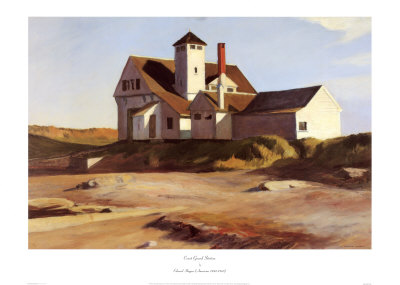
Compare: Coast Guard Station, 1929.
How much symbolism does it need?
The Met interprets the upright lighthouse as suggesting resistance to change and natural forces. Its commentary also places Hopper's Maine summers in relation to his life in New York. These are curatorial readings of the picture, rather than a statement by Hopper prescribing one meaning. [1]
The image gives such a reading a visible basis. The tower is pale, vertical and clearly bounded; the hillside is irregular, and the sky opens widely around it. An impression of endurance can emerge from that contrast. Yet the painting also offers pleasures of colour, changing shape and measured proportion that do not depend on turning the lighthouse into a person.
The attached buildings complicate the simplest emblem of solitary strength. Their roofs are varied, their shadows intersect and their scale is more domestic. They bring the tower into an ensemble. Its height becomes more legible because these smaller forms stand beside it.
The sky offers another complication. A long pale cloud passes diagonally through the blue, introducing a freer movement above the roofs. The architecture may appear stable, but the field around it is not geometrically empty. The different movements of cloud, hill and building keep the view active.
Looking beside the 1927 paintings
Lighthouse Hill, painted two years earlier, gives the land more prominence and leaves a wider separation between tower and house. Its dark ridge crosses the foreground, with the buildings placed along the crest. The spectator's approach is more obstructed, and the tower occupies a different position within the field.
In Hill and Houses, Cape Elizabeth, Maine, a nearer roof partly conceals the lighthouse's base. A utility pole supplies a competing upright. The landmark has to be discovered within the layered settlement, whereas the 1929 oil gives its shaft a much longer exposed reach.
Lighthouse and Buildings, Portland Head includes the sea behind a substantial keepers' dwelling. It shows another station and another arrangement of coastal architecture. Looking between these works makes Hopper's repeated interest more precise: the same broad category of subject could produce different relations of land, tower, dwelling and open space.
In The Lighthouse at Two Lights, the eye eventually returns to the gallery near the top. That narrow projecting ring changes the scale of the white shaft beneath it and gathers the darkest accents into a small area. The painting's monumental effect depends on just such exact, local relationships within its brilliant coastal daylight.
Artworks and studies directory
This researched directory includes finished works and separately identified studies. It is not a complete catalogue raisonné. Linked titles open the articles; unlinked studies are identified by their collection accessions. Watercolours retain their recorded media, and original prints remain distinct from reproductions.
| Name | Date | Medium |
|---|---|---|
| (Bridge and Embankment) (70.1298) | 1906 | Oil on wood |
| (Jo Sketching at Good Harbor Beach) (70.1129) | 1923–1924 | Watercolor and fabricated chalk on paper |
| (Manhattan Bridge) (70.1098) | 1925–1926 | Watercolor and graphite pencil on paper |
| (Rooftops) (70.1114) | 1926 | Watercolor and graphite pencil on paper |
| (Seated Male Model, Bent Over) (70.1277) | c. 1902–1903 | Oil on canvas |
| (Self-Portrait) (70.1254) | 1903–1906 | Oil on canvas |
| (Solitary Figure in a Theater) (70.1418) | c. 1902–1904 | Oil on board |
| 5 A.M. | 1937 | oil on canvas |
| Adam's House | 1928 | watercolour and charcoal on paper |
| American Village | 1912 | Oil on canvas |
| Apartment Houses | 1923 | oil on canvas |
| Approaching a City | 1946 | oil on canvas |
| August in the City | 1945 | oil on canvas |
| Automat | 1927 | oil on canvas |
| Barber Shop | 1931 | oil on canvas |
| Blackwell's Island | 1928 | oil on canvas |
| Bridge on the Seine | 1909 | Oil on canvas |
| Bridle Path | 1939 | oil on canvas |
| Burly Cobb's House South Truro | 1930–1933 | oil on canvas |
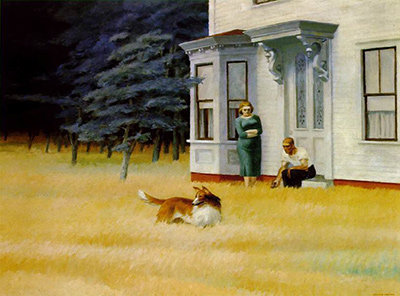
| Cape Cod Evening | 1939 | oil on canvas |
| Cape Cod Morning | 1950 | oil on canvas |
| Chair Car | 1965 | oil on canvas |
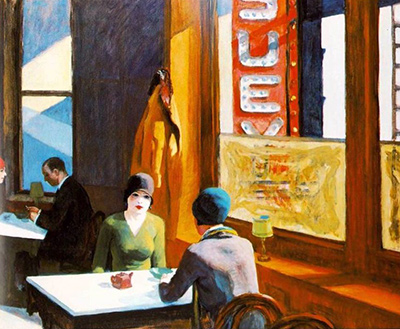
| Chop Suey | 1929 | oil on canvas |
| City Roofs | 1932 | Oil on canvas |
| Coast Guard Station | 1929 | oil on canvas |
| Compartment C, Car 293 | 1938 | oil on canvas |
| Conference at Night | 1949 | oil on canvas |
| Corn Hill | 1930 | oil on canvas |
| Dawn in Pennsylvania | 1942 | oil on canvas |
| Drug Store | 1927 | oil on canvas |
| Early Sunday Morning | 1930 | Oil on canvas |
| East Side Interior (70.1020) | 1922 | Etching |
| East Wind Over Weehawken | 1934 | oil on canvas |
| El Palacio | 1946 | Watercolor and graphite pencil on paper |
| Eleven A.M. | 1926 | oil on canvas |
| Evening Wind | 1921 | etching |
| Excursion into Philosophy | 1959 | oil on canvas |
| First Row Orchestra | 1951 | oil on canvas |
| Freight Car at Truro | 1931 | watercolour over graphite on paper |
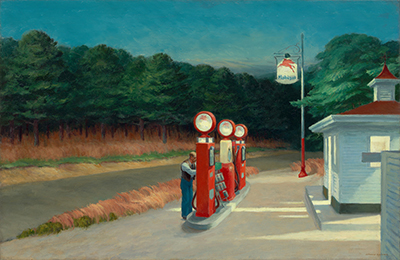
| Gas | 1940 | oil on canvas |
| Girl at a Sewing Machine | c. 1921 | oil on canvas |
| Gloucester Harbor | 1912 | Oil on canvas |
| Ground Swell | 1939 | oil on canvas |
| Haskell's House | 1924 | watercolour over graphite on paperboard |
| High Noon | 1949 | oil on canvas |
| Hill and Houses Cape Elizabeth Maine | 1927 | watercolour over graphite pencil |
| Hills South Truro | 1930 | oil on canvas |
| Hotel by a Railroad | 1952 | oil on canvas |
| Hotel Lobby | 1943 | oil on canvas |
| Hotel Room | 1931 | oil on canvas |
| Hotel Window | 1955 | oil on canvas |
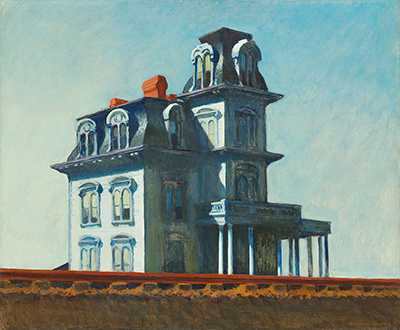
| House by the Railroad | 1925 | oil on canvas |
| House by the Squam River | 1926 | watercolour over graphite on paper |
| Le Bistro or The Wine Shop | 1909 | Oil on canvas |
| Le Pont des Arts | 1907 | Oil on canvas |
| Le Pont Royal | 1909 | Oil on canvas |
| Le Quai des Grands Augustins | 1909 | Oil on canvas |
| Lighthouse and Buildings Portland Head | 1927 | watercolour over graphite pencil on paper |
| Lighthouse Hill | 1927 | oil painting |
| Manhattan Bridge Loop | 1928 | oil on canvas |
| Model Sitting | c. 1902 | oil painting; support not asserted |
| Morning Sun | 1952 | oil on canvas |
| New York Movie | 1939 | oil on canvas |
| New York New Haven and Hartford | 1931 | oil on canvas |
| New York Office | 1962 | oil on canvas |
| New York Pavements | 1924–1925 | oil on canvas |
| New York Restaurant | c. 1922 | oil on canvas |
| Night Windows | 1928 | oil on canvas |
| Nighthawks | 1942 | oil on canvas |
| October on Cape Cod | 1946 | oil on canvas |
| Office at Night | 1940 | oil on canvas |
| Office in a Small City | 1953 | oil on canvas |
| Pennsylvania Coal Town | 1947 | oil on canvas |
| People in the Sun | 1960 | oil on canvas |
| Portrait of Orleans | 1950 | oil on canvas |
| Queensborough Bridge | 1913 | Oil on canvas |
| Railroad Sunset | 1929 | Oil on canvas |
| Railroad Train | 1908 | oil on canvas |
| Road in Maine | 1914 | oil on canvas |
| Room in Brooklyn | 1932 | oil on canvas |
| Room in New York | 1932 | oil on canvas |
| Rooms by the Sea | 1951 | oil on canvas |
| Rooms for Tourists | 1945 | oil on canvas |
| Route 6 Eastham | 1941 | oil on canvas |
| Second Story Sunlight | 1960 | Oil on canvas |
| Self-Portrait | 1925–1930 | Oil on canvas |
| Self-Portrait with Hat (70.1903) | c. 1918, posthumous print | Drypoint |
| Seven A.M. | 1948 | Oil on canvas |
| Soir Bleu | 1914 | oil on canvas |
| South Carolina Morning | 1955 | Oil on canvas |
| Stairway at 48 Rue de Lille Paris | 1906 | Oil on wood |
| Study for 5 A.M. (70.153) | 1937 | Fabricated chalk on paper |
| Study for 5 A.M. (70.429) | 1937 | Fabricated chalk and graphite pencil on paper |
| Study for Approaching a City (70.869) | 1946 | Fabricated chalk and charcoal on paper |
| Study for August in the City (70.158a-b) | 1945 | Fabricated chalk on paper |
| Study for August in the City (70.159) | 1945 | Fabricated chalk on paper |
| Study for Bridle Path (70.220) | 1939 | Fabricated chalk on paper |
| Study for Bridle Path (70.235) | 1939 | Fabricated chalk on paper |
| Study for Compartment C, Car 293 (70.430) | 1938 | Fabricated chalk on paper |
| Study for Compartment C, Car 293 (70.431a-b) | 1938 | Fabricated chalk and charcoal on paper |
| Study for Conference at Night (70.170) | 1949 | Fabricated chalk on paper (recto); Typewriter ink on paper (verso) |
| Study for Conference at Night (70.174) | 1949 | Fabricated chalk on paper ( recto); Typewriter ink on paper (verso) |
| Study for East Wind over Weehawken (70.249) | 1934 | Graphite pencil on paper |
| Study for East Wind over Weehawken (70.252) | 1934 | Fabricated chalk and charcoal on paper |
| Study for Evening Wind (70.343a-b) | 1921 | Fabricated chalk on paper |
| Study for First Row Orchestra (70.841) | 1951 | Fabricated chalk and charcoal on paper |
| Study for Gas (70.263) | 1940 | Fabricated chalk on paper |
| Study for Ground Swell (70.339) | 1939 | Fabricated chalk, charcoal and graphite pencil on paper |
| Study for Hotel by a Railroad (70.199) | 1952 | Fabricated chalk on paper |
| Study for Hotel by a Railroad (70.427) | 1952 | Fabricated chalk on paper |
| Study for Hotel by a Railroad (70.428) | 1952 | Fabricated chalk on paper |
| Study for Hotel Lobby (70.117) | 1942 | Fabricated chalk and graphite pencil on paper |
| Study for Hotel Lobby (70.839) | 1942 | Fabricated chalk and charcoal on paper |
| Study for Hotel Window (70.161) | 1955 | Fabricated chalk, graphite pencil and colored pencil on paper |
| Study for Morning Sun (70.243) | 1952 | Fabricated chalk on paper |
| Study for Morning Sun (70.244) | 1952 | Fabricated chalk on paper |
| Study for Morning Sun (70.290) | 1952 | Fabricated chalk on paper |
| Study for Morning Sun (70.291) | 1952 | Fabricated chalk and graphite pencil on paper |
| Study for New York Movie (70.273) | 1939 | Fabricated chalk on paper |
| Study for New York Movie (70.274a-b) | 1938 or 1939 | Fabricated chalk and charcoal on paper (recto); Fabricated chalk on paper (verso) |
| Study for New York Movie (70.455) | 1939 | Fabricated chalk and charcoal on paper |
| Study for New York Office (70.822) | 1962 | Fabricated chalk on paper |
| Study for Nighthawks (70.192) | 1941 or 1942 | Fabricated chalk on paper |
| Study for Nighthawks (70.193) | 1941 or 1942 | Fabricated chalk on paper |
| Study for Office at Night (70.340) | 1940 | Fabricated chalk and charcoal on paper |
| Study for Office at Night (70.341) | 1940 | Fabricated chalk and graphite pencil on paper |
| Study for Pennsylvania Coal Town (70.198) | 1947 | Fabricated chalk on paper |
| Study for Pennsylvania Coal Town (70.229) | 1947 | Fabricated chalk and charcoal on paper |
| Study for Rooms for Tourists (70.438) | 1945 | Fabricated chalk and charcoal on paper |
| Study for Rooms for Tourists (70.848) | 1945 | Fabricated chalk and charcoal on paper |
| Study for Route 6, Eastham (70.369) | 1941 | Fabricated chalk and graphite pencil on paper |
| Study for Route 6, Eastham (70.854) | 1941 | Fabricated chalk and graphite pencil on paper |
| Study for South Carolina Morning (70.162a-b) | 1955 | Fabricated chalk on paper (recto and verso) |
| Study for The Sheridan Theatre (70.969) | 1937 | Graphite pencil on paper |
| Study for Two on the Aisle (70.128) | 1927 | Fabricated chalk on paper |
| Study for Two on the Aisle (70.129) | 1927 | Fabricated chalk on paper |
| Study for Yawl Riding a Swell (70.439) | 1935 | Fabricated chalk and graphite pencil on paper |
| Summer Evening | 1947 | oil on canvas |
| Summer Interior | 1909 | Oil on canvas |
| Sun in an Empty Room | 1963 | oil on canvas |
| Sunlight in a Cafeteria | 1958 | oil on canvas |
| Sunlight on Brownstones | 1956 | oil on canvas |
| Tables for Ladies | 1930 | oil on canvas |
| The Bootleggers | 1925 | oil on canvas |
| The Camel's Hump | 1931 | oil on canvas |
| The Circle Theatre | 1936 | oil on canvas |
| The City | 1927 | oil on canvas |
| The Lighthouse at Two Lights | 1929 | oil on canvas |
| The Long Leg | 1935 | oil on canvas |
| The Mansard Roof | 1923 | watercolour over graphite on paper |
| The Sheridan Theatre | 1937 | oil on canvas |
| Tramp Steamer | 1908 | oil on canvas |
| Two Comedians | 1966 | oil on canvas |
| Two on the Aisle | 1927 | oil on canvas |
| Valley of the Seine | 1909 | Oil on canvas |
| Western Motel | 1957 | oil on canvas |
Frequently Asked Questions
Edward Hopper made The Lighthouse at Two Lights in 1929. [1]
The recorded medium is oil on canvas. [1]
The lighthouse rises from a grassy slope into an expanse of blue sky. Seen from below, its white shaft appears unusually tall, while the attached buildings step down towards the right. A dark lantern and circular gallery interrupt the upward movement near the top. Edward Hopper's The Lighthouse at Two Lights makes a coastal building imposing through the simplest relationships: an upright against a hill, pale walls beside dark roofs, and sunlight meeting shadow.
Discussion
Look again at the images and ideas explored in The Lighthouse at Two Lights. These editorial prompts invite your observations.
Reader Insights
Which boundary, gesture or change of light first holds your attention in The Lighthouse at Two Lights?
Compare Lighthouse Hill with The Lighthouse at Two Lights. Which visual difference matters most to your reading?
Which detail would you look at again after reading “Grass, shadow and the route across the picture”?
Join the Conversation
Share a detail, comparison or question about The Lighthouse at Two Lights below.
References
- Metropolitan Museum of Art, The Lighthouse at Two Lights, 1929, accession 62.95, current object metadata and curatorial commentary. Current dimensions take precedence over different measurements in older exhibition lists. View source.
- Bowdoin College Museum of Art, A Guide to Hopper's Maine, 2011, Cape Elizabeth section. View source.
- U.S. Coast Guard Historian's Office, Cape Elizabeth Lighthouse, 6 November 2019, station history; Maine Office of Tourism, Two Lights Lighthouse in Cape Elizabeth, historical account of the two towers and the western light's discontinuation in 1924. View source 1. View source 2.
- Alfred H. Barr Jr., introductory essay in Edward Hopper, Museum of Modern Art, 1933, discussion of light, PDF p. 16; catalogue no. 14, printed p. 26. View source.
- Collection or catalogue record, American Village, 1912; medium and identity as discussed in the linked article. View source.
- Collection or catalogue record, Soir Bleu, 1914; medium and identity as discussed in the linked article. View source.
- Collection or catalogue record, House by the Railroad, 1925; medium and identity as discussed in the linked article. View source.
- Collection or catalogue record, Automat, 1927; medium and identity as discussed in the linked article. View source.
- Collection or catalogue record, Early Sunday Morning, 1930; medium and identity as discussed in the linked article. View source.
- Collection or catalogue record, New York Movie, 1939; medium and identity as discussed in the linked article. View source.
- Collection or catalogue record, Nighthawks, 1942; medium and identity as discussed in the linked article. View source.
- Collection or catalogue record, Morning Sun, 1952; medium and identity as discussed in the linked article. View source.
- Collection or catalogue record, Second Story Sunlight, 1960; medium and identity as discussed in the linked article. View source.
- Collection or catalogue record, Two Comedians, 1966; medium and identity as discussed in the linked article. View source.
- Whitney Museum of American Art, Study for Route 6, Eastham, 1941, accession 70.854; exact object record. View source.
- Whitney Museum of American Art, Study for Conference at Night, 1949, accession 70.170; exact object record. View source.
- Whitney Museum of American Art, Study for First Row Orchestra, 1951, accession 70.841; exact object record. View source.
- Whitney Museum of American Art, (Bridge and Embankment), 1906, accession 70.1298; exact object record. View source.
- Whitney Museum of American Art, (Seated Male Model, Bent Over), c. 1902–1903, accession 70.1277; exact object record. View source.
- Whitney Museum of American Art, Study for Morning Sun, 1952, accession 70.244; exact object record. View source.
- Whitney Museum of American Art, Study for Morning Sun, 1952, accession 70.243; exact object record. View source.
- Whitney Museum of American Art, Study for Two on the Aisle, 1927, accession 70.128; exact object record. View source.
- Whitney Museum of American Art, Study for New York Office, 1962, accession 70.822; exact object record. View source.
- Whitney Museum of American Art, Study for Two on the Aisle, 1927, accession 70.129; exact object record. View source.
- Whitney Museum of American Art, Study for Pennsylvania Coal Town, 1947, accession 70.229; exact object record. View source.
- Whitney Museum of American Art, (Rooftops), 1926, accession 70.1114; exact object record. View source.
- Whitney Museum of American Art, Study for South Carolina Morning, 1955, accession 70.162a-b; exact object record. View source.
- Whitney Museum of American Art, (Self-Portrait), 1903–1906, accession 70.1254; exact object record. View source.
- Whitney Museum of American Art, (Manhattan Bridge), 1925–1926, accession 70.1098; exact object record. View source.
- Whitney Museum of American Art, (Solitary Figure in a Theater), c. 1902–1904, accession 70.1418; exact object record. View source.
- Whitney Museum of American Art, Study for Approaching a City, 1946, accession 70.869; exact object record. View source.
- Whitney Museum of American Art, Study for August in the City, 1945, accession 70.159; exact object record. View source.
- Whitney Museum of American Art, Study for Compartment C, Car 293, 1938, accession 70.430; exact object record. View source.
- Whitney Museum of American Art, Study for Compartment C, Car 293, 1938, accession 70.431a-b; exact object record. View source.
- Whitney Museum of American Art, Study for East Wind over Weehawken, 1934, accession 70.252; exact object record. View source.
- Whitney Museum of American Art, Study for East Wind over Weehawken, 1934, accession 70.249; exact object record. View source.
- Whitney Museum of American Art, Study for Evening Wind, 1921, accession 70.343a-b; exact object record. View source.
- Whitney Museum of American Art, Study for The Sheridan Theatre, 1937, accession 70.969; exact object record. View source.
- Whitney Museum of American Art, Study for New York Movie, 1939, accession 70.455; exact object record. View source.
- Whitney Museum of American Art, Study for New York Movie, 1939, accession 70.273; exact object record. View source.
- Whitney Museum of American Art, Study for New York Movie, 1938 or 1939, accession 70.274a-b; exact object record. View source.
- Whitney Museum of American Art, Study for 5 A.M., 1937, accession 70.153; exact object record. View source.
- Whitney Museum of American Art, Study for 5 A.M., 1937, accession 70.429; exact object record. View source.
- Whitney Museum of American Art, (Jo Sketching at Good Harbor Beach), 1923–1924, accession 70.1129; exact object record. View source.
- Whitney Museum of American Art, Study for August in the City, 1945, accession 70.158a-b; exact object record. View source.
- Whitney Museum of American Art, Study for Morning Sun, 1952, accession 70.291; exact object record. View source.
- Whitney Museum of American Art, Study for Morning Sun, 1952, accession 70.290; exact object record. View source.
- Whitney Museum of American Art, Study for Office at Night, 1940, accession 70.340; exact object record. View source.
- Whitney Museum of American Art, Study for Office at Night, 1940, accession 70.341; exact object record. View source.
- Whitney Museum of American Art, Study for Hotel by a Railroad, 1952, accession 70.427; exact object record. View source.
- Whitney Museum of American Art, Study for Hotel by a Railroad, 1952, accession 70.199; exact object record. View source.
- Whitney Museum of American Art, Study for Hotel by a Railroad, 1952, accession 70.428; exact object record. View source.
- Whitney Museum of American Art, Study for Hotel Lobby, 1942, accession 70.117; exact object record. View source.
- Whitney Museum of American Art, Study for Hotel Lobby, 1942, accession 70.839; exact object record. View source.
- Whitney Museum of American Art, Study for Conference at Night, 1949, accession 70.174; exact object record. View source.
- Whitney Museum of American Art, Study for Hotel Window, 1955, accession 70.161; exact object record. View source.
- Whitney Museum of American Art, Study for Pennsylvania Coal Town, 1947, accession 70.198; exact object record. View source.
- Whitney Museum of American Art, Study for Route 6, Eastham, 1941, accession 70.369; exact object record. View source.
- Whitney Museum of American Art, Study for Bridle Path, 1939, accession 70.220; exact object record. View source.
- Whitney Museum of American Art, Study for Bridle Path, 1939, accession 70.235; exact object record. View source.
- Whitney Museum of American Art, Study for Ground Swell, 1939, accession 70.339; exact object record. View source.
- Whitney Museum of American Art, Study for Yawl Riding a Swell, 1935, accession 70.439; exact object record. View source.
- Whitney Museum of American Art, Study for Rooms for Tourists, 1945, accession 70.848; exact object record. View source.
- Whitney Museum of American Art, Study for Rooms for Tourists, 1945, accession 70.438; exact object record. View source.
- Whitney Museum of American Art, Study for Nighthawks, 1941 or 1942, accession 70.193; exact object record. View source.
- Whitney Museum of American Art, Study for Nighthawks, 1941 or 1942, accession 70.192; exact object record. View source.
- Whitney Museum of American Art, Study for Gas, 1940, accession 70.263; exact object record. View source.
- Whitney Museum of American Art, Self-Portrait with Hat, c. 1918, posthumous print, accession 70.1903; exact object record. View source.
- Whitney Museum of American Art, East Side Interior, 1922, accession 70.1020; exact object record. View source.
- Art Institute of Chicago, Selected Chronology for Edward Hopper; training, travels, exhibitions, New York and Truro chronology. View source.
- Emily C. Burns, Spectral figures: Edward Hopper’s empty Paris, chapter 5 in Empty Spaces: Confronting Emptiness in National, Cultural and Urban Histories, 2019; complete chapter and notes consulted. View source.
- Charles Brock, Regionalism and Folk Art, National Gallery of Art; complete essay and two notes consulted. View source.