 by Tom Gurney
Tom Gurney BSc (Hons) is an art history expert with over 20 years experience
Email: tomgurney1@gmail.com / Phone: +44 7429 011000
Hotel Room: Introduction
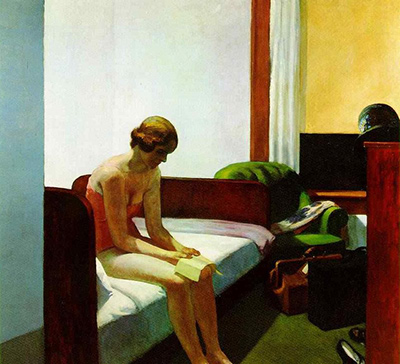
A woman sits on the edge of a bed, holding a pale sheet of paper. Her head inclines towards it; luggage and removed clothing occupy the room around her. The bed runs diagonally towards a dark window, while a broad, almost empty wall rises behind the figure. Edward Hopper's Hotel Room gives a traveller a substantial place on the canvas without telling us where her journey will lead.
The Museo Nacional Thyssen-Bornemisza dates the painting to 1931 and records an oil on canvas measuring 152.4 × 165.7 cm, inventory 594, accession 1977.110. Its account identifies the paper as a train timetable, drawing on Jo Hopper's detailed notes about the work. [1] That small practical object gives the scene a connection to travel beyond the room's walls.
At a Glance
- ArtistEdward Hopper [1]
- Date1931 [1]
- Mediumoil on canvas [1]
- Collection / recordMuseo Nacional Thyssen-Bornemisza [1]
- Accession1977.110 [1]
This work across Edward Hopper’s career
American Village
1912Soir Bleu
1914Automat
1927New York Movie
1939Nighthawks
1942Morning Sun
1952Two Comedians
1966Contents
- A bed that directs the eye
- A large canvas and a close body
- Reading a timetable
- A document that points beyond the evening
- Belongings in a temporary room
- Light from outside the picture
- The window at the back
- Shoulders, hands and the weight of sitting
- Jo posing in the studio
- The experiment of taking the room apart
A bed that directs the eye
The bed supplies the painting's strongest diagonal. Its near edge enters close to the spectator, then carries the eye towards the back of the interior. The room consequently feels deep even though much of its architecture is given through broad, simple planes.
The woman's seated position interrupts that movement. She belongs to the bed's edge, but her upright torso and lowered head make a separate concentration within it. The eye can follow the furniture towards the window or remain with the hands and paper nearer the centre.
The bedding brings a large pale area into the lower part of the image. It connects visually with the wall behind the figure, while folds, shadows and the bed's angle prevent the two surfaces from merging. Hopper makes the room's largest shapes light in colour without allowing them to become one undifferentiated field.
At the front, a cropped wall and the furniture at the right restrict our view. The interior is deep but not freely accessible. We look into a selected portion of it through a composition that presses objects close to the picture's edges.
A large canvas and a close body
The painting is only a little wider than it is high. That near-square format gives the room a different pressure from the long street fronts or broad landscapes in many of Hopper's best-known works. The bed projects into depth, but there is comparatively little lateral space in which to escape its direction. Furniture and figure take up a substantial portion of the view.
The woman's lower legs approach the bottom edge, where the frame interrupts the body. We encounter her at close range while the wall above preserves a large, unoccupied area. This unequal distribution is crucial: physical closeness does not make her dominate every part of the canvas. Architecture extends well beyond the scale of her immediate action.
The upright strip at the left introduces another body-sized presence. It rises through the entire height of the composition, catching a cooler light than the broad wall behind. Its lower edge brings the spectator close to an obstruction, making the view feel found around a corner rather than offered from the middle of an unrestricted floor.
This is an awkward position from which to imagine approaching the bed. We can see the woman clearly, but the painting has not furnished us with an obvious route towards her. The intimacy comes from the selected viewpoint and the size of the figure, while the room's overlapping planes maintain a distance that physical measurements alone cannot describe.
Reading a timetable
The paper is small beside the bed and wall, yet the woman's attention gives it weight. Her lowered face, bent arms and hands all lead towards it. A traveller's ordinary act of checking information becomes the scene's most concentrated action.
The timetable identification changes how we approach this gesture. It is a document for planning movement, rather than necessarily a personal letter or a page of fiction. The woman occupies a room while consulting something concerned with places and times beyond it.
A timetable can be read with confidence, uncertainty, fatigue or simple concentration. The posture alone cannot settle which response applies. The object narrows what she is doing while leaving open how she experiences it.
The museum's account imagines a recently arrived traveller who has removed her clothes and is considering a train to be taken the next day. [1] That is a coherent way to connect the visible belongings and timetable. The picture itself supplies no legible departure time, destination or date that would confirm the whole sequence.
A document that points beyond the evening
The timetable introduces a second system of time into a scene held at one instant. The woman's body rests in a particular room; the paper concerns departures, arrivals and connections that cannot be seen. Its practical purpose sets the still interior within a larger network of movement.
That relationship gives her more to do than simply embody a mood. Even a tired traveller may be making decisions, comparing possibilities or confirming an arrangement. A bowed head can accompany necessary work. Looking closely at the hands makes that activity more apparent than treating the face alone as the key to the painting.
The small sheet also changes the significance of the luggage. Cases can suggest arrival, departure or an interrupted stay. The timetable makes an onward journey especially plausible, but its unreadable surface keeps the next stage unavailable to us. We recognise a planning tool without acquiring the information it contains.
There is an important difference between this paper and a letter whose contents might explain a personal crisis. A timetable directs attention towards shared, public information. Hopper finds pictorial interest in the handling of an ordinary document, without making the spectator a reader of a private confession.
The scene consequently joins two scales of experience: the weight of a body sitting on bedding and an organised world of routes beyond the window. The first is given through visible forms; the second is suggested by a portable object. Their connection gives the room a purpose without requiring a train to appear.
Belongings in a temporary room
The luggage and green hat give the interior signs of an occupant who has brought things with her. They differ from the bed and larger furniture, which appear to belong to the room. Hopper creates a distinction between a furnished place and the possessions temporarily introduced into it.
That distinction is central to the hotel setting. A bed, window and dresser can serve successive people; a hat and travelling cases suggest a particular person's stay. The traveller has made the space usable without turning it into a fully described home.
The objects also complicate the relative emptiness of the wall. The room contains enough to suggest practical needs, yet the large pale surface offers little decoration to individualise the setting. Attention falls on the body, belongings and immediate tasks rather than on a history of domestic accumulation.
The woman's partially undressed state brings another contrast. The furnishings remain solid and impersonal while her body is exposed to the room's light. The painting gives her physical presence more specificity than it gives the place she occupies.
Light from outside the picture
The illumination makes strong differences between lit surfaces and shadow. Paloma Alarcó's museum essay identifies an artificial light source beyond the visible field. [1] We see its effects on the figure, wall and furniture without seeing the fitting that produces them.
This arrangement gives the interior a clarity that does not depend on a bright outdoor view. The window remains dark, and the room's light makes the woman's skin and the paper prominent against surrounding colours. Night exists beyond an opening that reveals little of the world outside.
The wall above the woman is especially important. Its scale makes the figure appear contained within a much larger plane. Her head and shoulders do not simply fill a portrait space; they sit below a stretch of architecture that draws attention to the room's height and comparative bareness.
The dark reddish-brown furniture introduces a different weight. It interrupts the pale areas with a solid block, while the green hat supplies a smaller colour accent among the traveller's things. Hopper builds the interior from a few large relationships, then lets selected objects make it particular.
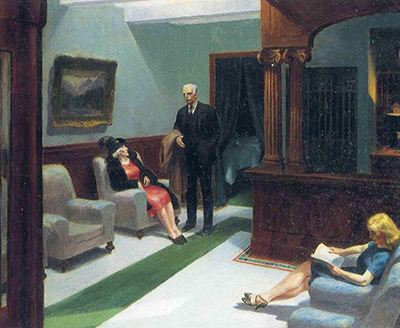
Compare: Hotel Lobby, 1943.
The window at the back
The bed's diagonal leads towards the window, but the opening does not reward the eye with a distant landscape. Its darkness brings the outward movement to a limit. The room offers a route for looking while withholding a clear destination.
The window and the timetable therefore connect the traveller to the outside in different ways. One is an architectural opening whose view remains obscure; the other contains information associated with an actual journey. The painting can suggest movement without showing a train, platform or street.
The curtain and window structure add vertical divisions to the bed's diagonal. These harder boundaries help hold the composition together. The eye moves across a room whose furniture and architecture repeatedly turn it towards the seated woman or the dark opening behind her.
This interplay makes the hotel more than a neutral backdrop. Its organisation determines how we approach the person and how far we can look beyond her. The setting contributes to the picture's sense of a pause between activities.
Shoulders, hands and the weight of sitting
The head casts much of the face into shade, while the shoulders and forearms remain exposed. This division allows the bodily pose to be more explicit than the expression. We can follow the downward direction through neck and arms even when the features offer little precise emotional information.
The arms do not make a forceful outward gesture. They bring the paper towards the lap and help close the figure into a compact arrangement. Below them, the knees and lower legs form a more extended pair of pale shapes. The body therefore contains both a gathering-in of attention and a downward continuation towards the frame.
The red-orange underclothing separates the torso from the wall and bedding, but the bare limbs share their lighter tones. Skin is made conspicuous through warmth, shadow and curvature rather than through isolation against an entirely dark background. The figure belongs to the room's colour structure even while her bent posture contrasts with its larger planes.
Tiziana Migliore's 2004 interpretation places particular emphasis on depleted energy and the strain of waiting. She compares the woman's bodily arrangement with more purposeful absorption elsewhere in Hopper's work. [2] This offers a language for one possible experience of the pose. It does not establish how long the traveller has waited or what has happened to her.
The painting's force survives that uncertainty. Sitting on a bed is a different bodily act from reclining to sleep, and consulting a sheet is different from putting it aside. Hopper holds the figure between activities through a pose that remains physically specific.
Jo posing in the studio
Alarcó draws on Jo Hopper's diary to record her posing for the picture in the Washington Square studio. She also describes the joint record book's combination of written notes and a sketch of the composition. [1] The evidence places the making of the figure within the Hoppers' working practice.
It also separates the painting's hotel from the circumstances in which the model posed. Jo could supply a seated body, the bend of the head and the action of holding a paper without the studio becoming the actual hotel depicted. The final figure belongs to a constructed setting.
The record book's identification of the timetable is particularly valuable because the painted sheet does not offer us a readable text. Written evidence can clarify an object whose role is otherwise visually ambiguous. It does not, by itself, supply the traveller's complete story.
The painting's substantial size gives this posed figure a different presence from a small illustrative vignette. The wall, bed and body occupy a canvas approaching a square, so that an ordinary private action becomes something the spectator encounters at a sustained scale.
Watch: Edward Hopper’s Life and Art
Explore Hopper’s paintings and the places behind them in these museum films. Choose a film below.
The experiment of taking the room apart
Richard Phelan returned to Hotel Room in his 2019 essay “Abstracting Hopper.” For a practical experiment made in 2017, he placed a version of the seated woman within a circle and surrounded it with large grey, yellow and black areas taken from the painting. Reconsidering the original, he found that supposedly abstract passages still described folds, shadows and the relation of curtain to wall. [3]
His experiment makes a useful distinction between an image's apparent simplicity and what sustains it. A large light area may look almost empty when attention rests on the person below it. Looking longer reveals differences of tone and small changes at its boundaries that help construct an actual room.
The wall is especially easy to overlook because it offers no elaborate ornament or readable message. Yet its lightness gives the darkened profile a clear setting, and its height determines the balance between person and architecture. Removing it would change more than the background colour.
The curtain likewise occupies an interval between a broad plane and a more articulated object. Its narrow folds make a transition beside the darker opening, while its vertical fall holds against the bed's oblique movement. Those relationships continue to matter when no particular story about the traveller is chosen.
Phelan's later painting is an act of interpretation, made by another artist decades afterwards. Its value here is the question it poses: how much of Hotel Room depends on the reader, and how much on the apparently uneventful surfaces around her? The original asks us to keep both in view.
Cropping and earlier images
Alarcó compares the cut-off feet and emphatic diagonals with compositions by Degas. [1] The comparison helps explain why the view feels selected from a larger space. The frame interrupts the body and furnishings, while the tilted bed gives the spectator a strongly directed approach.
Her essay also reports Gail Levin's proposed connection with an illustration by Jean-Louis Forain in Les Maîtres Humoristes. [1] That suggestion places the seated, partly undressed figure and diagonal bed within a history of modern interior imagery. It is a scholarly account of a possible source, rather than something the title or setting independently proves.
Visual relationships can survive substantial changes of meaning. A similar arrangement of a figure and bed need not carry the same narrative from one image into another. Hopper's timetable, luggage, large wall and dark window give this composition its particular concerns.
Alarcó also discusses the painting alongside the concise treatment of private life in contemporary literature. [1] The comparison describes the way a few selected details can encourage a larger imagined history. It does not identify a specific story that Hopper has illustrated.
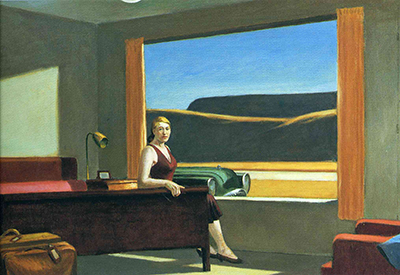
Compare: Western Motel, 1957.
A hotel without a named address
The title establishes a type of accommodation rather than a location. Nothing in the scene names a city, hotel chain or particular room. The painting's identity rests on its arrangement of a traveller and temporary furnishings, not on recognition of a landmark.
The timetable concerns precise movements within a setting whose own location remains general. The woman may know exactly where she is and where she intends to go; the spectator has only the visible pause.
That difference in knowledge helps explain the picture's capacity to generate stories. We are close enough to notice personal belongings and a partially undressed body, yet lack the ordinary information that would make this person's evening familiar. The intimate view and incomplete circumstances remain in tension.
A room of one's own, for a night
In her museum tour A Room of One's Own, Noelia Romero places Hotel Room within a discussion of gender and the occupation of interiors. She also brings it into dialogue with Sophie Calle's later work on the traces left by hotel guests. [4] This approach opens a different set of questions from asking only whether Hopper's traveller is lonely.
A hotel offers a private space that is also part of a public service. The furnishings are ready for someone whose possessions and habits the room's owners need not know. In the painting, we see neither a receptionist nor the work of preparing the bed; those conditions are implied by the accommodation and the traveller's use of it.
The room's relative bareness can therefore be considered practically as well as emotionally. It has enough furniture to support a stay, but little that visibly belongs to the woman. Her clothing, cases and hat establish temporary occupation against a setting that can continue after she leaves.
Romero's comparison reaches forward to Calle's L'Hôtel. The Centre Pompidou records the artist's employment as a chambermaid in Venice for three weeks in 1981. Her project combined photographs with written observations of the absent guests' rooms and belongings; the museum dates its version to 1981–83. [5]
The change of viewpoint is instructive. Hopper gives us a visible occupant whose thoughts remain private. Calle approached people indirectly through what they left behind. Both situations expose the gap between seeing intimate things and knowing the person associated with them, although their methods and circumstances are quite different.
This does not turn the 1931 painting into an anticipation of Calle's project or an illustration of Virginia Woolf. The comparison clarifies what is unusual about Hopper's view: the woman and her belongings are together before us, yet her temporary room still resists becoming a complete personal history.
Reading while travelling, reading before travelling
The woman in Compartment C, Car 293 offers a useful visual comparison. She also bends towards material held near her lap, with much of the room's larger wall left above her. Her hat, crossed legs and surrounding green upholstery give the body a markedly different setting from the exposed shoulders and bedding in Hotel Room.
The compartment includes an exterior view with warmer light, a bridge and landscape. The space outside the window is available as something she might look towards, even while her attention stays on the open publication. In Hotel Room, the dark window supplies much less competing visual information.
The difference between the documents matters too. The compartment reader appears occupied with a publication during a journey. The hotel traveller consults information that can help organise a journey beyond the room. The first scene places reading within transportation; the second lets a small sheet connect accommodation with movement still to come.
Hopper makes these distinctions through quite ordinary equipment. Upholstered seating supports one arrangement; the edge of a bed supports the other. Each setting contains a person for a time, and each is shaped by a purpose extending beyond that person's private thoughts.
The comparison also makes the hotel figure's underclothes more consequential. The train passenger is dressed for public travel, while the woman on the bed has changed her relation to that public world. Her planning continues during a private interval. A temporary room can interrupt the bodily routines of a journey without removing the need to think about its next stage.
Rooms occupied differently
Room in Brooklyn also places a seated woman and reading within an interior, but makes the surrounding city available through bright windows. In Hotel Room, the dark opening and luggage give the act a different relation to the world outside.
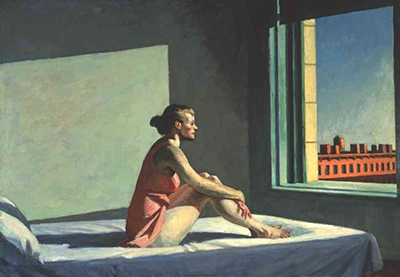
Morning Sun directs a seated figure towards the light and the window. Here, attention contracts towards the paper in the woman's hands, even as the bed leads our eye behind her.
Hotel by a Railroad introduces a second person and an exterior view beside transport infrastructure. The solitary reader in Hotel Room has no visible companion to share or interrupt her task.
Look from the timetable to the cases and then along the bed towards the window. The objects describe the conditions of travelling with unusual economy. Hopper makes a temporary room substantial, while the journey that gives it purpose continues beyond the canvas.
Artworks and studies directory
This researched directory includes finished works and separately identified studies. It is not a complete catalogue raisonné. Linked titles open the articles; unlinked studies are identified by their collection accessions. Watercolours retain their recorded media, and original prints remain distinct from reproductions.
| Name | Date | Medium |
|---|---|---|
| (Bridge and Embankment) (70.1298) | 1906 | Oil on wood |
| (Jo Sketching at Good Harbor Beach) (70.1129) | 1923–1924 | Watercolor and fabricated chalk on paper |
| (Manhattan Bridge) (70.1098) | 1925–1926 | Watercolor and graphite pencil on paper |
| (Rooftops) (70.1114) | 1926 | Watercolor and graphite pencil on paper |
| (Seated Male Model, Bent Over) (70.1277) | c. 1902–1903 | Oil on canvas |
| (Self-Portrait) (70.1254) | 1903–1906 | Oil on canvas |
| (Solitary Figure in a Theater) (70.1418) | c. 1902–1904 | Oil on board |
| 5 A.M. | 1937 | oil on canvas |
| Adam's House | 1928 | watercolour and charcoal on paper |
| American Village | 1912 | Oil on canvas |
| Apartment Houses | 1923 | oil on canvas |
| Approaching a City | 1946 | oil on canvas |
| August in the City | 1945 | oil on canvas |
| Automat | 1927 | oil on canvas |
| Barber Shop | 1931 | oil on canvas |
| Blackwell's Island | 1928 | oil on canvas |
| Bridge on the Seine | 1909 | Oil on canvas |
| Bridle Path | 1939 | oil on canvas |
| Burly Cobb's House South Truro | 1930–1933 | oil on canvas |
| Cape Cod Evening | 1939 | oil on canvas |
| Cape Cod Morning | 1950 | oil on canvas |
| Chair Car | 1965 | oil on canvas |
| Chop Suey | 1929 | oil on canvas |
| City Roofs | 1932 | Oil on canvas |
| Coast Guard Station | 1929 | oil on canvas |
| Compartment C, Car 293 | 1938 | oil on canvas |
| Conference at Night | 1949 | oil on canvas |
| Corn Hill | 1930 | oil on canvas |
| Dawn in Pennsylvania | 1942 | oil on canvas |
| Drug Store | 1927 | oil on canvas |
| Early Sunday Morning | 1930 | Oil on canvas |
| East Side Interior (70.1020) | 1922 | Etching |
| East Wind Over Weehawken | 1934 | oil on canvas |
| El Palacio | 1946 | Watercolor and graphite pencil on paper |
| Eleven A.M. | 1926 | oil on canvas |
| Evening Wind | 1921 | etching |
| Excursion into Philosophy | 1959 | oil on canvas |
| First Row Orchestra | 1951 | oil on canvas |
| Freight Car at Truro | 1931 | watercolour over graphite on paper |
| Gas | 1940 | oil on canvas |
| Girl at a Sewing Machine | c. 1921 | oil on canvas |
| Gloucester Harbor | 1912 | Oil on canvas |
| Ground Swell | 1939 | oil on canvas |
| Haskell's House | 1924 | watercolour over graphite on paperboard |
| High Noon | 1949 | oil on canvas |
| Hill and Houses Cape Elizabeth Maine | 1927 | watercolour over graphite pencil |
| Hills South Truro | 1930 | oil on canvas |
| Hotel by a Railroad | 1952 | oil on canvas |
| Hotel Lobby | 1943 | oil on canvas |
| Hotel Room | 1931 | oil on canvas |
| Hotel Window | 1955 | oil on canvas |
| House by the Railroad | 1925 | oil on canvas |
| House by the Squam River | 1926 | watercolour over graphite on paper |
| Le Bistro or The Wine Shop | 1909 | Oil on canvas |
| Le Pont des Arts | 1907 | Oil on canvas |
| Le Pont Royal | 1909 | Oil on canvas |
| Le Quai des Grands Augustins | 1909 | Oil on canvas |
| Lighthouse and Buildings Portland Head | 1927 | watercolour over graphite pencil on paper |
| Lighthouse Hill | 1927 | oil painting |
| Manhattan Bridge Loop | 1928 | oil on canvas |
| Model Sitting | c. 1902 | oil painting; support not asserted |
| Morning Sun | 1952 | oil on canvas |
| New York Movie | 1939 | oil on canvas |
| New York New Haven and Hartford | 1931 | oil on canvas |
| New York Office | 1962 | oil on canvas |
| New York Pavements | 1924–1925 | oil on canvas |
| New York Restaurant | c. 1922 | oil on canvas |
| Night Windows | 1928 | oil on canvas |
| Nighthawks | 1942 | oil on canvas |
| October on Cape Cod | 1946 | oil on canvas |
| Office at Night | 1940 | oil on canvas |
| Office in a Small City | 1953 | oil on canvas |
| Pennsylvania Coal Town | 1947 | oil on canvas |
| People in the Sun | 1960 | oil on canvas |
| Portrait of Orleans | 1950 | oil on canvas |
| Queensborough Bridge | 1913 | Oil on canvas |
| Railroad Sunset | 1929 | Oil on canvas |
| Railroad Train | 1908 | oil on canvas |
| Road in Maine | 1914 | oil on canvas |
| Room in Brooklyn | 1932 | oil on canvas |
| Room in New York | 1932 | oil on canvas |
| Rooms by the Sea | 1951 | oil on canvas |
| Rooms for Tourists | 1945 | oil on canvas |
| Route 6 Eastham | 1941 | oil on canvas |
| Second Story Sunlight | 1960 | Oil on canvas |
| Self-Portrait | 1925–1930 | Oil on canvas |
| Self-Portrait with Hat (70.1903) | c. 1918, posthumous print | Drypoint |
| Seven A.M. | 1948 | Oil on canvas |
| Soir Bleu | 1914 | oil on canvas |
| South Carolina Morning | 1955 | Oil on canvas |
| Stairway at 48 Rue de Lille Paris | 1906 | Oil on wood |
| Study for 5 A.M. (70.153) | 1937 | Fabricated chalk on paper |
| Study for 5 A.M. (70.429) | 1937 | Fabricated chalk and graphite pencil on paper |
| Study for Approaching a City (70.869) | 1946 | Fabricated chalk and charcoal on paper |
| Study for August in the City (70.158a-b) | 1945 | Fabricated chalk on paper |
| Study for August in the City (70.159) | 1945 | Fabricated chalk on paper |
| Study for Bridle Path (70.220) | 1939 | Fabricated chalk on paper |
| Study for Bridle Path (70.235) | 1939 | Fabricated chalk on paper |
| Study for Compartment C, Car 293 (70.430) | 1938 | Fabricated chalk on paper |
| Study for Compartment C, Car 293 (70.431a-b) | 1938 | Fabricated chalk and charcoal on paper |
| Study for Conference at Night (70.170) | 1949 | Fabricated chalk on paper (recto); Typewriter ink on paper (verso) |
| Study for Conference at Night (70.174) | 1949 | Fabricated chalk on paper ( recto); Typewriter ink on paper (verso) |
| Study for East Wind over Weehawken (70.249) | 1934 | Graphite pencil on paper |
| Study for East Wind over Weehawken (70.252) | 1934 | Fabricated chalk and charcoal on paper |
| Study for Evening Wind (70.343a-b) | 1921 | Fabricated chalk on paper |
| Study for First Row Orchestra (70.841) | 1951 | Fabricated chalk and charcoal on paper |
| Study for Gas (70.263) | 1940 | Fabricated chalk on paper |
| Study for Ground Swell (70.339) | 1939 | Fabricated chalk, charcoal and graphite pencil on paper |
| Study for Hotel by a Railroad (70.199) | 1952 | Fabricated chalk on paper |
| Study for Hotel by a Railroad (70.427) | 1952 | Fabricated chalk on paper |
| Study for Hotel by a Railroad (70.428) | 1952 | Fabricated chalk on paper |
| Study for Hotel Lobby (70.117) | 1942 | Fabricated chalk and graphite pencil on paper |
| Study for Hotel Lobby (70.839) | 1942 | Fabricated chalk and charcoal on paper |
| Study for Hotel Window (70.161) | 1955 | Fabricated chalk, graphite pencil and colored pencil on paper |
| Study for Morning Sun (70.243) | 1952 | Fabricated chalk on paper |
| Study for Morning Sun (70.244) | 1952 | Fabricated chalk on paper |
| Study for Morning Sun (70.290) | 1952 | Fabricated chalk on paper |
| Study for Morning Sun (70.291) | 1952 | Fabricated chalk and graphite pencil on paper |
| Study for New York Movie (70.273) | 1939 | Fabricated chalk on paper |
| Study for New York Movie (70.274a-b) | 1938 or 1939 | Fabricated chalk and charcoal on paper (recto); Fabricated chalk on paper (verso) |
| Study for New York Movie (70.455) | 1939 | Fabricated chalk and charcoal on paper |
| Study for New York Office (70.822) | 1962 | Fabricated chalk on paper |
| Study for Nighthawks (70.192) | 1941 or 1942 | Fabricated chalk on paper |
| Study for Nighthawks (70.193) | 1941 or 1942 | Fabricated chalk on paper |
| Study for Office at Night (70.340) | 1940 | Fabricated chalk and charcoal on paper |
| Study for Office at Night (70.341) | 1940 | Fabricated chalk and graphite pencil on paper |
| Study for Pennsylvania Coal Town (70.198) | 1947 | Fabricated chalk on paper |
| Study for Pennsylvania Coal Town (70.229) | 1947 | Fabricated chalk and charcoal on paper |
| Study for Rooms for Tourists (70.438) | 1945 | Fabricated chalk and charcoal on paper |
| Study for Rooms for Tourists (70.848) | 1945 | Fabricated chalk and charcoal on paper |
| Study for Route 6, Eastham (70.369) | 1941 | Fabricated chalk and graphite pencil on paper |
| Study for Route 6, Eastham (70.854) | 1941 | Fabricated chalk and graphite pencil on paper |
| Study for South Carolina Morning (70.162a-b) | 1955 | Fabricated chalk on paper (recto and verso) |
| Study for The Sheridan Theatre (70.969) | 1937 | Graphite pencil on paper |
| Study for Two on the Aisle (70.128) | 1927 | Fabricated chalk on paper |
| Study for Two on the Aisle (70.129) | 1927 | Fabricated chalk on paper |
| Study for Yawl Riding a Swell (70.439) | 1935 | Fabricated chalk and graphite pencil on paper |
| Summer Evening | 1947 | oil on canvas |
| Summer Interior | 1909 | Oil on canvas |
| Sun in an Empty Room | 1963 | oil on canvas |
| Sunlight in a Cafeteria | 1958 | oil on canvas |
| Sunlight on Brownstones | 1956 | oil on canvas |
| Tables for Ladies | 1930 | oil on canvas |
| The Bootleggers | 1925 | oil on canvas |
| The Camel's Hump | 1931 | oil on canvas |
| The Circle Theatre | 1936 | oil on canvas |
| The City | 1927 | oil on canvas |
| The Lighthouse at Two Lights | 1929 | oil on canvas |
| The Long Leg | 1935 | oil on canvas |
| The Mansard Roof | 1923 | watercolour over graphite on paper |
| The Sheridan Theatre | 1937 | oil on canvas |
| Tramp Steamer | 1908 | oil on canvas |
| Two Comedians | 1966 | oil on canvas |
| Two on the Aisle | 1927 | oil on canvas |
| Valley of the Seine | 1909 | Oil on canvas |
| Western Motel | 1957 | oil on canvas |
Frequently Asked Questions
Edward Hopper made Hotel Room in 1931. [1]
The recorded medium is oil on canvas. [1]
A woman sits on the edge of a bed, holding a pale sheet of paper. Her head inclines towards it; luggage and removed clothing occupy the room around her. The bed runs diagonally towards a dark window, while a broad, almost empty wall rises behind the figure. Edward Hopper's Hotel Room gives a traveller a substantial place on the canvas without telling us where her journey will lead.
Discussion
Look again at the images and ideas explored in Hotel Room. These editorial prompts invite your observations.
Reader Insights
Which boundary, gesture or change of light first holds your attention in Hotel Room?
Compare Hotel Lobby with Hotel Room. Which visual difference matters most to your reading?
Which detail would you look at again after reading “Belongings in a temporary room”?
Join the Conversation
Share a detail, comparison or question about Hotel Room below.
References
- Museo Nacional Thyssen-Bornemisza, Habitación de hotel (Hotel Room), 1931, inventory 594 (1977.110); collection metadata and essay by Paloma Alarcó, including transmitted diary and record-book evidence and her discussion of earlier images. View source.
- Tiziana Migliore, “Edward Hopper: le passioni dell’intervallo”, Ocula, no. 5, September 2004, section 2.1, pp. 8–10; an interpretation of posture and waiting, rather than biographical evidence about the painted traveller. View source.
- Richard Phelan, “Abstracting Hopper”, Textes et contextes, 14-2, 2019, section II, paragraphs 12–15; the author’s 2017 experiment and his subsequent observations of the original painting. DOI: 10.58335/textesetcontextes.2495. View source.
- Noelia Romero, A Room of One’s Own: A Gender Perspective on Inhabiting Interiors, Museo Nacional Thyssen-Bornemisza thematic tour, 2021, introduction and p. 11, Hotel Room; comparison with Sophie Calle. View source.
- Centre Pompidou, Sophie Calle, L’Hôtel, 1981–83, accession AM 2000-9 (1-8); collection record, artist’s introductory statement and Christine Macel’s account from Collection art contemporain, 2007. View source.
- Collection or catalogue record, American Village, 1912; medium and identity as discussed in the linked article. View source.
- Collection or catalogue record, Soir Bleu, 1914; medium and identity as discussed in the linked article. View source.
- Collection or catalogue record, House by the Railroad, 1925; medium and identity as discussed in the linked article. View source.
- Collection or catalogue record, Automat, 1927; medium and identity as discussed in the linked article. View source.
- Collection or catalogue record, Early Sunday Morning, 1930; medium and identity as discussed in the linked article. View source.
- Collection or catalogue record, New York Movie, 1939; medium and identity as discussed in the linked article. View source.
- Collection or catalogue record, Nighthawks, 1942; medium and identity as discussed in the linked article. View source.
- Collection or catalogue record, Morning Sun, 1952; medium and identity as discussed in the linked article. View source.
- Collection or catalogue record, Second Story Sunlight, 1960; medium and identity as discussed in the linked article. View source.
- Collection or catalogue record, Two Comedians, 1966; medium and identity as discussed in the linked article. View source.
- Whitney Museum of American Art, Study for Route 6, Eastham, 1941, accession 70.854; exact object record. View source.
- Whitney Museum of American Art, Study for Conference at Night, 1949, accession 70.170; exact object record. View source.
- Whitney Museum of American Art, Study for First Row Orchestra, 1951, accession 70.841; exact object record. View source.
- Whitney Museum of American Art, (Bridge and Embankment), 1906, accession 70.1298; exact object record. View source.
- Whitney Museum of American Art, (Seated Male Model, Bent Over), c. 1902–1903, accession 70.1277; exact object record. View source.
- Whitney Museum of American Art, Study for Morning Sun, 1952, accession 70.244; exact object record. View source.
- Whitney Museum of American Art, Study for Morning Sun, 1952, accession 70.243; exact object record. View source.
- Whitney Museum of American Art, Study for Two on the Aisle, 1927, accession 70.128; exact object record. View source.
- Whitney Museum of American Art, Study for New York Office, 1962, accession 70.822; exact object record. View source.
- Whitney Museum of American Art, Study for Two on the Aisle, 1927, accession 70.129; exact object record. View source.
- Whitney Museum of American Art, Study for Pennsylvania Coal Town, 1947, accession 70.229; exact object record. View source.
- Whitney Museum of American Art, (Rooftops), 1926, accession 70.1114; exact object record. View source.
- Whitney Museum of American Art, Study for South Carolina Morning, 1955, accession 70.162a-b; exact object record. View source.
- Whitney Museum of American Art, (Self-Portrait), 1903–1906, accession 70.1254; exact object record. View source.
- Whitney Museum of American Art, (Manhattan Bridge), 1925–1926, accession 70.1098; exact object record. View source.
- Whitney Museum of American Art, (Solitary Figure in a Theater), c. 1902–1904, accession 70.1418; exact object record. View source.
- Whitney Museum of American Art, Study for Approaching a City, 1946, accession 70.869; exact object record. View source.
- Whitney Museum of American Art, Study for August in the City, 1945, accession 70.159; exact object record. View source.
- Whitney Museum of American Art, Study for Compartment C, Car 293, 1938, accession 70.430; exact object record. View source.
- Whitney Museum of American Art, Study for Compartment C, Car 293, 1938, accession 70.431a-b; exact object record. View source.
- Whitney Museum of American Art, Study for East Wind over Weehawken, 1934, accession 70.252; exact object record. View source.
- Whitney Museum of American Art, Study for East Wind over Weehawken, 1934, accession 70.249; exact object record. View source.
- Whitney Museum of American Art, Study for Evening Wind, 1921, accession 70.343a-b; exact object record. View source.
- Whitney Museum of American Art, Study for The Sheridan Theatre, 1937, accession 70.969; exact object record. View source.
- Whitney Museum of American Art, Study for New York Movie, 1939, accession 70.455; exact object record. View source.
- Whitney Museum of American Art, Study for New York Movie, 1939, accession 70.273; exact object record. View source.
- Whitney Museum of American Art, Study for New York Movie, 1938 or 1939, accession 70.274a-b; exact object record. View source.
- Whitney Museum of American Art, Study for 5 A.M., 1937, accession 70.153; exact object record. View source.
- Whitney Museum of American Art, Study for 5 A.M., 1937, accession 70.429; exact object record. View source.
- Whitney Museum of American Art, (Jo Sketching at Good Harbor Beach), 1923–1924, accession 70.1129; exact object record. View source.
- Whitney Museum of American Art, Study for August in the City, 1945, accession 70.158a-b; exact object record. View source.
- Whitney Museum of American Art, Study for Morning Sun, 1952, accession 70.291; exact object record. View source.
- Whitney Museum of American Art, Study for Morning Sun, 1952, accession 70.290; exact object record. View source.
- Whitney Museum of American Art, Study for Office at Night, 1940, accession 70.340; exact object record. View source.
- Whitney Museum of American Art, Study for Office at Night, 1940, accession 70.341; exact object record. View source.
- Whitney Museum of American Art, Study for Hotel by a Railroad, 1952, accession 70.427; exact object record. View source.
- Whitney Museum of American Art, Study for Hotel by a Railroad, 1952, accession 70.199; exact object record. View source.
- Whitney Museum of American Art, Study for Hotel by a Railroad, 1952, accession 70.428; exact object record. View source.
- Whitney Museum of American Art, Study for Hotel Lobby, 1942, accession 70.117; exact object record. View source.
- Whitney Museum of American Art, Study for Hotel Lobby, 1942, accession 70.839; exact object record. View source.
- Whitney Museum of American Art, Study for Conference at Night, 1949, accession 70.174; exact object record. View source.
- Whitney Museum of American Art, Study for Hotel Window, 1955, accession 70.161; exact object record. View source.
- Whitney Museum of American Art, Study for Pennsylvania Coal Town, 1947, accession 70.198; exact object record. View source.
- Whitney Museum of American Art, Study for Route 6, Eastham, 1941, accession 70.369; exact object record. View source.
- Whitney Museum of American Art, Study for Bridle Path, 1939, accession 70.220; exact object record. View source.
- Whitney Museum of American Art, Study for Bridle Path, 1939, accession 70.235; exact object record. View source.
- Whitney Museum of American Art, Study for Ground Swell, 1939, accession 70.339; exact object record. View source.
- Whitney Museum of American Art, Study for Yawl Riding a Swell, 1935, accession 70.439; exact object record. View source.
- Whitney Museum of American Art, Study for Rooms for Tourists, 1945, accession 70.848; exact object record. View source.
- Whitney Museum of American Art, Study for Rooms for Tourists, 1945, accession 70.438; exact object record. View source.
- Whitney Museum of American Art, Study for Nighthawks, 1941 or 1942, accession 70.193; exact object record. View source.
- Whitney Museum of American Art, Study for Nighthawks, 1941 or 1942, accession 70.192; exact object record. View source.
- Whitney Museum of American Art, Study for Gas, 1940, accession 70.263; exact object record. View source.
- Whitney Museum of American Art, Self-Portrait with Hat, c. 1918, posthumous print, accession 70.1903; exact object record. View source.
- Whitney Museum of American Art, East Side Interior, 1922, accession 70.1020; exact object record. View source.
- Art Institute of Chicago, Selected Chronology for Edward Hopper; training, travels, exhibitions, New York and Truro chronology. View source.
- Emily C. Burns, Spectral figures: Edward Hopper’s empty Paris, chapter 5 in Empty Spaces: Confronting Emptiness in National, Cultural and Urban Histories, 2019; complete chapter and notes consulted. View source.
- Charles Brock, Regionalism and Folk Art, National Gallery of Art; complete essay and two notes consulted. View source.