 by Tom Gurney
Tom Gurney BSc (Hons) is an art history expert with over 20 years experience
Email: tomgurney1@gmail.com / Phone: +44 7429 011000
Lighthouse and Buildings, Portland Head: Introduction
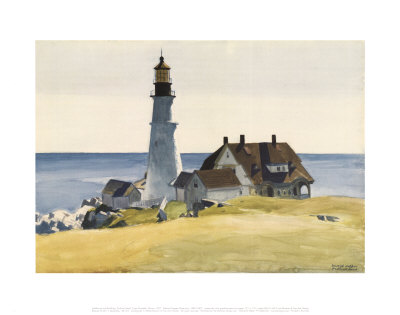
A white tower rises near the left of the picture, while a large house spreads across the ground to its right. Lower roofs join the two. Behind this compact group, a blue sea meets the sky along a steady horizon. Edward Hopper's Lighthouse and Buildings, Portland Head, Cape Elizabeth, Maine makes the lighthouse part of a working architectural ensemble, with the keepers' dwelling almost as consequential as the light itself.
Hopper painted the watercolour in 1927. The Museum of Fine Arts, Boston records watercolour over graphite pencil on paper, measuring 34.29 × 49.53 cm. It entered the collection through the bequest of John T. Spaulding and is identified by accession 48.723. The full title locates the view at Portland Head, distinguishing it from Hopper's paintings of Two Lights elsewhere in Cape Elizabeth. [1]
At a Glance
- ArtistEdward Hopper [1]
- Date1927 [1]
- Mediumwatercolour over graphite pencil on paper [1]
- Collection / recordMuseum of Fine Arts, Boston [1]
- Accession48.723 [1]
This work across Edward Hopper’s career
American Village
1912Soir Bleu
1914Automat
1927New York Movie
1939Nighthawks
1942Morning Sun
1952Two Comedians
1966Contents
- Tower and house
- The keepers' dwelling
- Water, rocks and open ground
- A pale sky above a dark lantern
- Portland Head and Hopper's Maine travels
- Comparing the coastal buildings
Tower and house
The tower is the tallest form, but its width changes as we follow it upwards. The lower white shaft narrows towards a darker gallery and lantern. Small projections interrupt its sides, making its construction more varied than a simple triangle or cylinder. At the top, dark metalwork gives the pale structure a precise ending against the sky.
Its upright movement is balanced by the broad roof of the house. The roof has several slopes, with a dormer projecting towards us and chimneys rising at different points. Lower down, the porch openings form a darker, more continuous passage across part of the building. These changes give the dwelling a depth and complexity that the taller tower does not possess.
The buildings between them are smaller. Their low roofs step towards the lighthouse, reducing the abruptness of the transition from a broad domestic structure to the tall shaft. We can look across the group as a sequence: house, connecting roofs, tower, lantern. Each part is distinct, but each also directs attention to the next.
The main house is set slightly further back than some of these lower structures. That overlap prevents the ensemble from looking like a row of cut-out shapes on one line. One roof partly hides another wall, and the foreground buildings conceal portions of the larger house. Hopper uses these ordinary obstructions to describe space.
The arrangement remains compact. There are gaps of sky above and between the upper forms, yet the lower parts gather into one settlement on the headland. It is easy to focus on the lighthouse first and discover the breadth of the house only afterwards. Looking in the opposite direction changes the emphasis: the house becomes the centre, and the tower its remarkable neighbour.
The keepers' dwelling
The house had a practical history before it became a subject for Hopper. Portland Head's keepers' quarters were built in 1891 as a duplex for the head keeper, assistant keeper and their families. The history published by the site museum distinguishes this building from earlier dwellings at the station. [2]
That information helps us understand its considerable scale. The broad structure accommodated more than one household. In the painting, the multiple roof slopes and openings give the dwelling the visual presence of a lived and organized place, although no resident appears at a window or on the ground.
A Historic American Buildings Survey made in the 1960s describes the wood-framed dwelling's clapboard and shingle surfaces, its arched porch openings and three chimneys. Those features provide an architectural vocabulary for forms visible in Hopper's view. The survey also distinguishes the masonry tower from the house: the lighthouse has stone and brick construction, with white-painted walls and dark ironwork above. [3]
The difference in materials matters visually even where the watercolour simplifies them. The house is broken into many parts; the tower remains more continuous. Roof, dormer, porch and chimney offer changes of scale that answer the lighthouse's long upward surface. We recognize two kinds of building working together.
Hopper does not need to show the interiors to make the dwelling significant. Its visible bulk and openings establish the human accommodation beside the navigational structure. A lighthouse requires more than a lamp raised above the sea; this view lets the surrounding buildings share its importance.
Water, rocks and open ground
The sea is a broad background presence. Its horizontal edge crosses behind the architecture, with open blue stretches on either side. Unlike a view taken from a boat, the painting allows a substantial area of dry land between us and the water. We stand on the headland looking towards its edge.
The foreground slopes and spreads across the lower part of the sheet. Warm yellow and ochre washes make this ground comparatively light, while small darker accents interrupt it. It supplies a broad resting area beneath the more intricate roofs.
At the left, angular rocks crowd nearer the tower. Their pale faces and darker crevices introduce a roughness that differs from both the open ground and the buildings. The lighthouse seems to rise from a rocky edge, while the larger house occupies a more generous patch of land.
The coastal setting is therefore divided into several textures. Water is relatively continuous; rocks are broken and angular; the foreground is broadly washed; the architecture is articulated by firm edges. These differences make the group legible without requiring a large amount of small descriptive detail.
The sea also gives the house and tower a shared background. Where a roof or wall interrupts the blue, its outline becomes clear. The level horizon offers a stable comparison for their sloping and upright edges. Even when attention remains on the buildings, the water helps organize the composition.
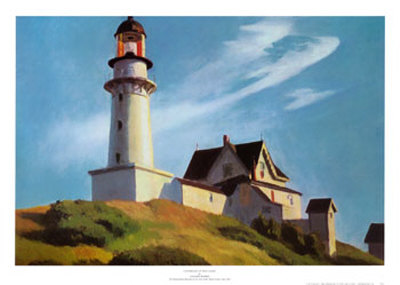
Compare: The Lighthouse at Two Lights, 1929.
Watch: Edward Hopper’s Life and Art
Explore Hopper’s paintings and the places behind them in these museum films. Choose a film below.
A pale sky above a dark lantern
The sky occupies a large part of the sheet. Its light washes leave considerable space around the tower's upper half. That openness is important: the lantern would have a different effect against a busy arrangement of clouds or distant architecture.
The dark top of the lighthouse is one of the most concentrated accents in the view. Its small size makes the contrast more striking. Below it, the long white shaft contains subdued changes of tone that suggest the turning of its surface. The tower has volume, though the details remain economical.
The house introduces darker areas at a lower level. Its roof, shaded sides and porch openings prevent the eye from remaining fixed at the lantern. Darkness appears in a descending sequence, carrying attention back towards the centre and lower right.
These dark passages are balanced by the warm foreground. The ground is not simply an empty area left over after the buildings have been placed. Its expanse gives the darker architectural shapes enough room to register individually and keeps the lower half from becoming crowded.
Watercolour is particularly effective in these transitions. A broad wash can establish a field of colour, while a smaller, more concentrated mark can define an opening or roof edge. The finished image combines breadth with a closely observed arrangement of parts. The museum's identification of graphite also establishes a drawing component, though the catalogue alone cannot reveal the sequence of every mark. [1]
Portland Head and Hopper's Maine travels
Portland Head was first lit in January 1791, long before Hopper's visit. The site museum's history traces changes to its tower and dwellings over the following century. The building he painted was therefore a layered historical place: an older lighthouse standing alongside the more recent keepers' house. [2]
The group has a harmonious outline, although its parts had different dates, materials and functions. Hopper brings those differences into a shared daylight.
The summer of 1927 marked an expansion in the Hoppers' travels. Bowdoin College Museum of Art's guide notes their purchase of a car and their stay in Cape Elizabeth until late September. The nearby coast supplied both oils and watercolours in that year and in 1929. [4] Lighthouse and Buildings belongs to this wider exploration, with a viewpoint that leaves room for the sea as well as the structures.
The work was also included in the MFA's account of its major 2007 Hopper retrospective. That exhibition brought together oil paintings, watercolours and prints, placing these different kinds of work within one career. [5] The Portland Head sheet demonstrates how much architectural complexity Hopper could accommodate within a relatively small work on paper.
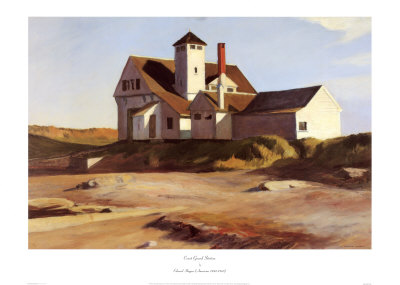
Compare: Coast Guard Station, 1929.
Comparing the coastal buildings
In Lighthouse Hill, the ground rises between the spectator and a more widely spaced house and tower. The ridge partially conceals their lower portions, and the sea is absent. Portland Head offers a different kind of access: we can follow the lower buildings across the headland and see water behind them.
The later Lighthouse at Two Lights makes the tower more imposing through its low viewpoint and the upward reach of the white shaft. Portland Head's lighthouse is also tall, but its companions claim a larger share of our attention. The broad house answers the tower with its own spread of roofs and openings.
The distinction is clearest around the roof of the dwelling. Several chimneys rise into the sky, a dormer breaks the roof slope, and arched openings create deep shadows below. Each feature has enough emphasis to reward a separate look. Beside this complexity, the tower offers a quieter long surface, ending in the compact dark lantern.
Following those parts back towards the sea gives the painting its particular character. Hopper has preserved the lighthouse's height while allowing a whole station to occupy the shore around it. The dwelling, low roofs, rocks and water keep the view open to repeated journeys across the sheet.
Artworks and studies directory
This researched directory includes finished works and separately identified studies. It is not a complete catalogue raisonné. Linked titles open the articles; unlinked studies are identified by their collection accessions. Watercolours retain their recorded media, and original prints remain distinct from reproductions.
| Name | Date | Medium |
|---|---|---|
| (Bridge and Embankment) (70.1298) | 1906 | Oil on wood |
| (Jo Sketching at Good Harbor Beach) (70.1129) | 1923–1924 | Watercolor and fabricated chalk on paper |
| (Manhattan Bridge) (70.1098) | 1925–1926 | Watercolor and graphite pencil on paper |
| (Rooftops) (70.1114) | 1926 | Watercolor and graphite pencil on paper |
| (Seated Male Model, Bent Over) (70.1277) | c. 1902–1903 | Oil on canvas |
| (Self-Portrait) (70.1254) | 1903–1906 | Oil on canvas |
| (Solitary Figure in a Theater) (70.1418) | c. 1902–1904 | Oil on board |
| 5 A.M. | 1937 | oil on canvas |
| Adam's House | 1928 | watercolour and charcoal on paper |
| American Village | 1912 | Oil on canvas |
| Apartment Houses | 1923 | oil on canvas |
| Approaching a City | 1946 | oil on canvas |
| August in the City | 1945 | oil on canvas |
| Automat | 1927 | oil on canvas |
| Barber Shop | 1931 | oil on canvas |
| Blackwell's Island | 1928 | oil on canvas |
| Bridge on the Seine | 1909 | Oil on canvas |
| Bridle Path | 1939 | oil on canvas |
| Burly Cobb's House South Truro | 1930–1933 | oil on canvas |
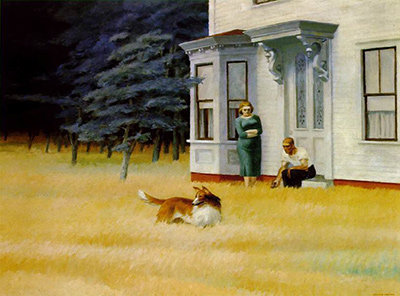
| Cape Cod Evening | 1939 | oil on canvas |
| Cape Cod Morning | 1950 | oil on canvas |
| Chair Car | 1965 | oil on canvas |
| Chop Suey | 1929 | oil on canvas |
| City Roofs | 1932 | Oil on canvas |
| Coast Guard Station | 1929 | oil on canvas |
| Compartment C, Car 293 | 1938 | oil on canvas |
| Conference at Night | 1949 | oil on canvas |
| Corn Hill | 1930 | oil on canvas |
| Dawn in Pennsylvania | 1942 | oil on canvas |
| Drug Store | 1927 | oil on canvas |
| Early Sunday Morning | 1930 | Oil on canvas |
| East Side Interior (70.1020) | 1922 | Etching |
| East Wind Over Weehawken | 1934 | oil on canvas |
| El Palacio | 1946 | Watercolor and graphite pencil on paper |
| Eleven A.M. | 1926 | oil on canvas |
| Evening Wind | 1921 | etching |
| Excursion into Philosophy | 1959 | oil on canvas |
| First Row Orchestra | 1951 | oil on canvas |
| Freight Car at Truro | 1931 | watercolour over graphite on paper |
| Gas | 1940 | oil on canvas |
| Girl at a Sewing Machine | c. 1921 | oil on canvas |
| Gloucester Harbor | 1912 | Oil on canvas |
| Ground Swell | 1939 | oil on canvas |
| Haskell's House | 1924 | watercolour over graphite on paperboard |
| High Noon | 1949 | oil on canvas |
| Hill and Houses Cape Elizabeth Maine | 1927 | watercolour over graphite pencil |
| Hills South Truro | 1930 | oil on canvas |
| Hotel by a Railroad | 1952 | oil on canvas |
| Hotel Lobby | 1943 | oil on canvas |
| Hotel Room | 1931 | oil on canvas |
| Hotel Window | 1955 | oil on canvas |
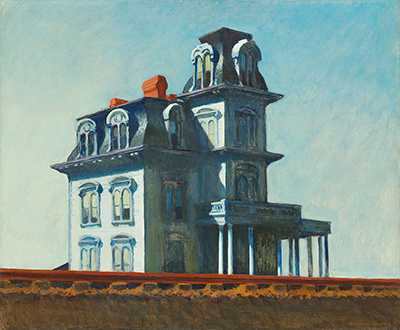
| House by the Railroad | 1925 | oil on canvas |
| House by the Squam River | 1926 | watercolour over graphite on paper |
| Le Bistro or The Wine Shop | 1909 | Oil on canvas |
| Le Pont des Arts | 1907 | Oil on canvas |
| Le Pont Royal | 1909 | Oil on canvas |
| Le Quai des Grands Augustins | 1909 | Oil on canvas |
| Lighthouse and Buildings Portland Head | 1927 | watercolour over graphite pencil on paper |
| Lighthouse Hill | 1927 | oil painting |
| Manhattan Bridge Loop | 1928 | oil on canvas |
| Model Sitting | c. 1902 | oil painting; support not asserted |
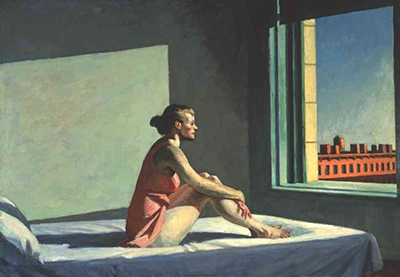
| Morning Sun | 1952 | oil on canvas |
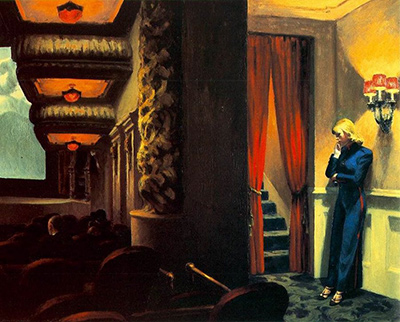
| New York Movie | 1939 | oil on canvas |
| New York New Haven and Hartford | 1931 | oil on canvas |
| New York Office | 1962 | oil on canvas |
| New York Pavements | 1924–1925 | oil on canvas |
| New York Restaurant | c. 1922 | oil on canvas |
| Night Windows | 1928 | oil on canvas |
| Nighthawks | 1942 | oil on canvas |
| October on Cape Cod | 1946 | oil on canvas |
| Office at Night | 1940 | oil on canvas |
| Office in a Small City | 1953 | oil on canvas |
| Pennsylvania Coal Town | 1947 | oil on canvas |
| People in the Sun | 1960 | oil on canvas |
| Portrait of Orleans | 1950 | oil on canvas |
| Queensborough Bridge | 1913 | Oil on canvas |
| Railroad Sunset | 1929 | Oil on canvas |
| Railroad Train | 1908 | oil on canvas |
| Road in Maine | 1914 | oil on canvas |
| Room in Brooklyn | 1932 | oil on canvas |
| Room in New York | 1932 | oil on canvas |
| Rooms by the Sea | 1951 | oil on canvas |
| Rooms for Tourists | 1945 | oil on canvas |
| Route 6 Eastham | 1941 | oil on canvas |
| Second Story Sunlight | 1960 | Oil on canvas |
| Self-Portrait | 1925–1930 | Oil on canvas |
| Self-Portrait with Hat (70.1903) | c. 1918, posthumous print | Drypoint |
| Seven A.M. | 1948 | Oil on canvas |
| Soir Bleu | 1914 | oil on canvas |
| South Carolina Morning | 1955 | Oil on canvas |
| Stairway at 48 Rue de Lille Paris | 1906 | Oil on wood |
| Study for 5 A.M. (70.153) | 1937 | Fabricated chalk on paper |
| Study for 5 A.M. (70.429) | 1937 | Fabricated chalk and graphite pencil on paper |
| Study for Approaching a City (70.869) | 1946 | Fabricated chalk and charcoal on paper |
| Study for August in the City (70.158a-b) | 1945 | Fabricated chalk on paper |
| Study for August in the City (70.159) | 1945 | Fabricated chalk on paper |
| Study for Bridle Path (70.220) | 1939 | Fabricated chalk on paper |
| Study for Bridle Path (70.235) | 1939 | Fabricated chalk on paper |
| Study for Compartment C, Car 293 (70.430) | 1938 | Fabricated chalk on paper |
| Study for Compartment C, Car 293 (70.431a-b) | 1938 | Fabricated chalk and charcoal on paper |
| Study for Conference at Night (70.170) | 1949 | Fabricated chalk on paper (recto); Typewriter ink on paper (verso) |
| Study for Conference at Night (70.174) | 1949 | Fabricated chalk on paper ( recto); Typewriter ink on paper (verso) |
| Study for East Wind over Weehawken (70.249) | 1934 | Graphite pencil on paper |
| Study for East Wind over Weehawken (70.252) | 1934 | Fabricated chalk and charcoal on paper |
| Study for Evening Wind (70.343a-b) | 1921 | Fabricated chalk on paper |
| Study for First Row Orchestra (70.841) | 1951 | Fabricated chalk and charcoal on paper |
| Study for Gas (70.263) | 1940 | Fabricated chalk on paper |
| Study for Ground Swell (70.339) | 1939 | Fabricated chalk, charcoal and graphite pencil on paper |
| Study for Hotel by a Railroad (70.199) | 1952 | Fabricated chalk on paper |
| Study for Hotel by a Railroad (70.427) | 1952 | Fabricated chalk on paper |
| Study for Hotel by a Railroad (70.428) | 1952 | Fabricated chalk on paper |
| Study for Hotel Lobby (70.117) | 1942 | Fabricated chalk and graphite pencil on paper |
| Study for Hotel Lobby (70.839) | 1942 | Fabricated chalk and charcoal on paper |
| Study for Hotel Window (70.161) | 1955 | Fabricated chalk, graphite pencil and colored pencil on paper |
| Study for Morning Sun (70.243) | 1952 | Fabricated chalk on paper |
| Study for Morning Sun (70.244) | 1952 | Fabricated chalk on paper |
| Study for Morning Sun (70.290) | 1952 | Fabricated chalk on paper |
| Study for Morning Sun (70.291) | 1952 | Fabricated chalk and graphite pencil on paper |
| Study for New York Movie (70.273) | 1939 | Fabricated chalk on paper |
| Study for New York Movie (70.274a-b) | 1938 or 1939 | Fabricated chalk and charcoal on paper (recto); Fabricated chalk on paper (verso) |
| Study for New York Movie (70.455) | 1939 | Fabricated chalk and charcoal on paper |
| Study for New York Office (70.822) | 1962 | Fabricated chalk on paper |
| Study for Nighthawks (70.192) | 1941 or 1942 | Fabricated chalk on paper |
| Study for Nighthawks (70.193) | 1941 or 1942 | Fabricated chalk on paper |
| Study for Office at Night (70.340) | 1940 | Fabricated chalk and charcoal on paper |
| Study for Office at Night (70.341) | 1940 | Fabricated chalk and graphite pencil on paper |
| Study for Pennsylvania Coal Town (70.198) | 1947 | Fabricated chalk on paper |
| Study for Pennsylvania Coal Town (70.229) | 1947 | Fabricated chalk and charcoal on paper |
| Study for Rooms for Tourists (70.438) | 1945 | Fabricated chalk and charcoal on paper |
| Study for Rooms for Tourists (70.848) | 1945 | Fabricated chalk and charcoal on paper |
| Study for Route 6, Eastham (70.369) | 1941 | Fabricated chalk and graphite pencil on paper |
| Study for Route 6, Eastham (70.854) | 1941 | Fabricated chalk and graphite pencil on paper |
| Study for South Carolina Morning (70.162a-b) | 1955 | Fabricated chalk on paper (recto and verso) |
| Study for The Sheridan Theatre (70.969) | 1937 | Graphite pencil on paper |
| Study for Two on the Aisle (70.128) | 1927 | Fabricated chalk on paper |
| Study for Two on the Aisle (70.129) | 1927 | Fabricated chalk on paper |
| Study for Yawl Riding a Swell (70.439) | 1935 | Fabricated chalk and graphite pencil on paper |
| Summer Evening | 1947 | oil on canvas |
| Summer Interior | 1909 | Oil on canvas |
| Sun in an Empty Room | 1963 | oil on canvas |
| Sunlight in a Cafeteria | 1958 | oil on canvas |
| Sunlight on Brownstones | 1956 | oil on canvas |
| Tables for Ladies | 1930 | oil on canvas |
| The Bootleggers | 1925 | oil on canvas |
| The Camel's Hump | 1931 | oil on canvas |
| The Circle Theatre | 1936 | oil on canvas |
| The City | 1927 | oil on canvas |
| The Lighthouse at Two Lights | 1929 | oil on canvas |
| The Long Leg | 1935 | oil on canvas |
| The Mansard Roof | 1923 | watercolour over graphite on paper |
| The Sheridan Theatre | 1937 | oil on canvas |
| Tramp Steamer | 1908 | oil on canvas |
| Two Comedians | 1966 | oil on canvas |
| Two on the Aisle | 1927 | oil on canvas |
| Valley of the Seine | 1909 | Oil on canvas |
| Western Motel | 1957 | oil on canvas |
Frequently Asked Questions
Edward Hopper made Lighthouse and Buildings Portland Head in 1927. [1]
The recorded medium is watercolour over graphite pencil on paper. [1]
A white tower rises near the left of the picture, while a large house spreads across the ground to its right. Lower roofs join the two. Behind this compact group, a blue sea meets the sky along a steady horizon. Edward Hopper's Lighthouse and Buildings, Portland Head, Cape Elizabeth, Maine makes the lighthouse part of a working architectural ensemble, with the keepers' dwelling almost as consequential as the light itself.
Discussion
Look again at the images and ideas explored in Lighthouse and Buildings, Portland Head. These editorial prompts invite your observations.
Reader Insights
Which boundary, gesture or change of light first holds your attention in Lighthouse and Buildings Portland Head?
Compare The Lighthouse at Two Lights with Lighthouse and Buildings Portland Head. Which visual difference matters most to your reading?
Which detail would you look at again after reading “Water, rocks and open ground”?
Join the Conversation
Share a detail, comparison or question about Lighthouse and Buildings, Portland Head below.
References
- Museum of Fine Arts, Boston, museum-contributed AMICA record, Lighthouse and Buildings, Portland Head, Cape Elizabeth, Maine, 1927, accession 48.723; title, medium, dimensions and Spaulding bequest. View source.
- Museum at Portland Head Light, About Us: History, excerpted from the museum guidebook compiled by Kathleen Rummler; first lighting and keepers' dwelling history. View source.
- Historic American Buildings Survey, Portland Head Light, HABS ME-123, written historical and descriptive data, National Park Service, 1965–67, especially architectural information, printed pp. 5–7. This is a later survey, not a record of Hopper's painting process. View source.
- Bowdoin College Museum of Art, A Guide to Hopper's Maine, 2011, Cape Elizabeth section. View source.
- Museum of Fine Arts, Boston, Edward Hopper exhibition overview, 2007. View source.
- Collection or catalogue record, American Village, 1912; medium and identity as discussed in the linked article. View source.
- Collection or catalogue record, Soir Bleu, 1914; medium and identity as discussed in the linked article. View source.
- Collection or catalogue record, House by the Railroad, 1925; medium and identity as discussed in the linked article. View source.
- Collection or catalogue record, Automat, 1927; medium and identity as discussed in the linked article. View source.
- Collection or catalogue record, Early Sunday Morning, 1930; medium and identity as discussed in the linked article. View source.
- Collection or catalogue record, New York Movie, 1939; medium and identity as discussed in the linked article. View source.
- Collection or catalogue record, Nighthawks, 1942; medium and identity as discussed in the linked article. View source.
- Collection or catalogue record, Morning Sun, 1952; medium and identity as discussed in the linked article. View source.
- Collection or catalogue record, Second Story Sunlight, 1960; medium and identity as discussed in the linked article. View source.
- Collection or catalogue record, Two Comedians, 1966; medium and identity as discussed in the linked article. View source.
- Whitney Museum of American Art, Study for Route 6, Eastham, 1941, accession 70.854; exact object record. View source.
- Whitney Museum of American Art, Study for Conference at Night, 1949, accession 70.170; exact object record. View source.
- Whitney Museum of American Art, Study for First Row Orchestra, 1951, accession 70.841; exact object record. View source.
- Whitney Museum of American Art, (Bridge and Embankment), 1906, accession 70.1298; exact object record. View source.
- Whitney Museum of American Art, (Seated Male Model, Bent Over), c. 1902–1903, accession 70.1277; exact object record. View source.
- Whitney Museum of American Art, Study for Morning Sun, 1952, accession 70.244; exact object record. View source.
- Whitney Museum of American Art, Study for Morning Sun, 1952, accession 70.243; exact object record. View source.
- Whitney Museum of American Art, Study for Two on the Aisle, 1927, accession 70.128; exact object record. View source.
- Whitney Museum of American Art, Study for New York Office, 1962, accession 70.822; exact object record. View source.
- Whitney Museum of American Art, Study for Two on the Aisle, 1927, accession 70.129; exact object record. View source.
- Whitney Museum of American Art, Study for Pennsylvania Coal Town, 1947, accession 70.229; exact object record. View source.
- Whitney Museum of American Art, (Rooftops), 1926, accession 70.1114; exact object record. View source.
- Whitney Museum of American Art, Study for South Carolina Morning, 1955, accession 70.162a-b; exact object record. View source.
- Whitney Museum of American Art, (Self-Portrait), 1903–1906, accession 70.1254; exact object record. View source.
- Whitney Museum of American Art, (Manhattan Bridge), 1925–1926, accession 70.1098; exact object record. View source.
- Whitney Museum of American Art, (Solitary Figure in a Theater), c. 1902–1904, accession 70.1418; exact object record. View source.
- Whitney Museum of American Art, Study for Approaching a City, 1946, accession 70.869; exact object record. View source.
- Whitney Museum of American Art, Study for August in the City, 1945, accession 70.159; exact object record. View source.
- Whitney Museum of American Art, Study for Compartment C, Car 293, 1938, accession 70.430; exact object record. View source.
- Whitney Museum of American Art, Study for Compartment C, Car 293, 1938, accession 70.431a-b; exact object record. View source.
- Whitney Museum of American Art, Study for East Wind over Weehawken, 1934, accession 70.252; exact object record. View source.
- Whitney Museum of American Art, Study for East Wind over Weehawken, 1934, accession 70.249; exact object record. View source.
- Whitney Museum of American Art, Study for Evening Wind, 1921, accession 70.343a-b; exact object record. View source.
- Whitney Museum of American Art, Study for The Sheridan Theatre, 1937, accession 70.969; exact object record. View source.
- Whitney Museum of American Art, Study for New York Movie, 1939, accession 70.455; exact object record. View source.
- Whitney Museum of American Art, Study for New York Movie, 1939, accession 70.273; exact object record. View source.
- Whitney Museum of American Art, Study for New York Movie, 1938 or 1939, accession 70.274a-b; exact object record. View source.
- Whitney Museum of American Art, Study for 5 A.M., 1937, accession 70.153; exact object record. View source.
- Whitney Museum of American Art, Study for 5 A.M., 1937, accession 70.429; exact object record. View source.
- Whitney Museum of American Art, (Jo Sketching at Good Harbor Beach), 1923–1924, accession 70.1129; exact object record. View source.
- Whitney Museum of American Art, Study for August in the City, 1945, accession 70.158a-b; exact object record. View source.
- Whitney Museum of American Art, Study for Morning Sun, 1952, accession 70.291; exact object record. View source.
- Whitney Museum of American Art, Study for Morning Sun, 1952, accession 70.290; exact object record. View source.
- Whitney Museum of American Art, Study for Office at Night, 1940, accession 70.340; exact object record. View source.
- Whitney Museum of American Art, Study for Office at Night, 1940, accession 70.341; exact object record. View source.
- Whitney Museum of American Art, Study for Hotel by a Railroad, 1952, accession 70.427; exact object record. View source.
- Whitney Museum of American Art, Study for Hotel by a Railroad, 1952, accession 70.199; exact object record. View source.
- Whitney Museum of American Art, Study for Hotel by a Railroad, 1952, accession 70.428; exact object record. View source.
- Whitney Museum of American Art, Study for Hotel Lobby, 1942, accession 70.117; exact object record. View source.
- Whitney Museum of American Art, Study for Hotel Lobby, 1942, accession 70.839; exact object record. View source.
- Whitney Museum of American Art, Study for Conference at Night, 1949, accession 70.174; exact object record. View source.
- Whitney Museum of American Art, Study for Hotel Window, 1955, accession 70.161; exact object record. View source.
- Whitney Museum of American Art, Study for Pennsylvania Coal Town, 1947, accession 70.198; exact object record. View source.
- Whitney Museum of American Art, Study for Route 6, Eastham, 1941, accession 70.369; exact object record. View source.
- Whitney Museum of American Art, Study for Bridle Path, 1939, accession 70.220; exact object record. View source.
- Whitney Museum of American Art, Study for Bridle Path, 1939, accession 70.235; exact object record. View source.
- Whitney Museum of American Art, Study for Ground Swell, 1939, accession 70.339; exact object record. View source.
- Whitney Museum of American Art, Study for Yawl Riding a Swell, 1935, accession 70.439; exact object record. View source.
- Whitney Museum of American Art, Study for Rooms for Tourists, 1945, accession 70.848; exact object record. View source.
- Whitney Museum of American Art, Study for Rooms for Tourists, 1945, accession 70.438; exact object record. View source.
- Whitney Museum of American Art, Study for Nighthawks, 1941 or 1942, accession 70.193; exact object record. View source.
- Whitney Museum of American Art, Study for Nighthawks, 1941 or 1942, accession 70.192; exact object record. View source.
- Whitney Museum of American Art, Study for Gas, 1940, accession 70.263; exact object record. View source.
- Whitney Museum of American Art, Self-Portrait with Hat, c. 1918, posthumous print, accession 70.1903; exact object record. View source.
- Whitney Museum of American Art, East Side Interior, 1922, accession 70.1020; exact object record. View source.
- Art Institute of Chicago, Selected Chronology for Edward Hopper; training, travels, exhibitions, New York and Truro chronology. View source.
- Emily C. Burns, Spectral figures: Edward Hopper’s empty Paris, chapter 5 in Empty Spaces: Confronting Emptiness in National, Cultural and Urban Histories, 2019; complete chapter and notes consulted. View source.
- Charles Brock, Regionalism and Folk Art, National Gallery of Art; complete essay and two notes consulted. View source.