



 by Tom Gurney
Tom Gurney BSc (Hons) is an art history expert with over 20 years experience
Published on June 19, 2020 / Updated on November 1, 2026
Email: tomgurney1@gmail.com / Phone: +44 7429 011000
The City: Introduction
A stairway rises through a crowd of coloured planes. Small grey figures occupy its lower reaches, while a huge mauve column cuts across their world. Around them, letters, railings and latticework flash into recognition, then become parts of an abstract arrangement again. Fernand Léger’s The City (La Ville), painted in 1919, makes urban life a problem of competing impressions: how much can the eye take in when everything seems to demand attention at once?
The painting belongs to the Philadelphia Museum of Art’s A. E. Gallatin Collection. An oil on canvas measuring 231.1 by 298.4 centimetres, it is large enough to confront a standing viewer almost as an environment. Its scale gives extraordinary force to a composition that refuses to settle into an ordinary view down a street. Léger brings the city towards us in pieces, making its signs and structures as assertive as the people who inhabit it. [1]
At a Glance
This work across Fernand Léger’s career
Nudes in the Forest
1909–1911 [2]Contrast of Forms
1913 [3]The Mechanic
1920 [4]Three Women
1921–22 [5]Contents
- Finding a way into the painting
- Colour, volume and interrupted depth
- Letters in the street
- Paris after the First World War
- A canvas with the force of a screen
- Studies and the mural idea
Finding a way into the painting
Begin near the bottom, just left of centre, where a dark rounded head appears above a grey torso. Behind it, another figure stands higher up beside the staircase. Their bodies have the segmented solidity of assembled parts. Highlights suggest rounded surfaces, but their faces offer little individual detail. These small inhabitants establish a human presence without becoming protagonists whose actions explain everything around them.
The black-and-white steps provide a momentary foothold. Their alternating bands are among the clearest signs of space in the painting: a stairway implies an ascent, a place to stand and a route between levels. Yet its destination disappears among upright panels and dark forms. Following the staircase does not lead us into a building that can be reconstructed in full. It leads back into the painted surface.
To its right, the mauve column extends through almost the entire height of the composition. Its shaded, cylindrical body is crossed by dark diagonal and red horizontal bands. It seems much nearer than the little figures, but the painting gives no dependable measure of the distance between them. The column acts as a powerful divider, concealing part of the urban assembly and making the remaining fragments feel like views caught on either side of an obstruction.
Other routes are equally tempting. At the lower left, a large white R stands against black. Above it, blue and red panels cut across pale architectural forms. Near the upper left corner, narrow crisscrossed structures suggest exposed metal supports. At the right, a framed panel contains a green figure-like shape, while pale curves and dark wedges continue beyond the edge. Each fragment supplies a clue; no single clue becomes a key to the whole.
This is why the picture rewards looking across it as well as into it. Follow a red patch from one area to another, or compare the thin latticework with the broad upright column. Such relationships remain clear even when the objects are uncertain. The composition can be navigated through differences of colour, width and direction before every motif has acquired a name.

Fernand Léger, Men in the City. Another urban composition makes the relation between people and their surroundings easier to compare.
Colour, volume and interrupted depth
Léger uses a shallow, crowded space, but he does not make every element equally flat. The grey bodies and mauve column have shaded surfaces that suggest weight and roundness. Broad red and blue areas, by contrast, appear as emphatic panels of colour. Between them lie white strips, black voids and small repeated markings. The tension between modelled volume and flat colour prevents the scene from becoming either a consistent architectural space or a purely abstract pattern.
The large pale yellow form left of the central figures is especially revealing. Its curved black edge gives it a distinct silhouette, while the neighbouring blue plane cuts across the forms behind it. We can register which shape covers another without being able to place all of them in a shared system of perspective. Overlap establishes local depth; abrupt changes of scale and direction interrupt any larger illusion of recession.
Black and white do much of the organising. The stair treads, the lettering, the dark upright near the centre and the narrow railings keep the brighter hues sharply separated. Colour does not melt into an atmosphere or describe a common light falling on a street. Red remains forcefully red beside blue, green, yellow and violet. The eye encounters successive boundaries rather than a smooth passage from foreground to distance.
The Tokyo Fuji Art Museum’s account of its preparatory watercolour reproduces a later statement in which Léger associated The City with a breakthrough in constructing depth and dynamism through flat colour. This is the artist looking back, transmitted through a museum interpretation, rather than a statement written beside the canvas in 1919. It nevertheless draws attention to the central achievement: spatial energy can come from the confrontation of coloured shapes as well as from conventional light and shade. [9]
Letters in the street
The white lettering introduces another kind of recognition. We are accustomed to reading letters rapidly, but here they are detached from a continuous message. The Philadelphia museum identifies the stencilled characters with advertising billboards; its teaching guide also notes Léger’s initials among them. [1] [10] Typography joins the structures and people as material to be cut apart and recombined.
The conspicuous R at the lower left is both readable and pictorial. Its upright repeats the many verticals elsewhere, while its curved bowl and diagonal leg complicate the surrounding rectangles. Once separated from a word, the character can function much like an architectural fragment. We recognise the kind of thing it is without receiving the information it would ordinarily deliver.
A sign in a street has to compete with other sights. Léger gives painted forms that same urgency. Large areas of colour press forward; fine bars and small marks make us move closer; letters promise a message but stop short of supplying it. The painting evokes the unstable attention of someone passing shopfronts, notices and construction work.
The Philadelphia guide compares the painting with Cassandre’s 1925 poster The Intransigent and reports Léger’s belief that advertising designers learned from The City. [10] A poster channels attention towards a product; here the lettering shares its force with every surrounding shape.
Paris after the First World War
After demobilisation in summer 1918, Léger returned to large urban subjects. The Centre Pompidou dossier quotes a wartime letter expressing his desire to see Paris again. [11]
The guide identifies Smoke over Rooftops (1911) with Léger’s studio view, including Notre-Dame. [10] Here, by contrast, fragments lack an enclosing site: urban recognition has become discontinuous.
The Philadelphia museum connects Léger’s military experience with his conviction that painting should answer a changed, dynamic mentality. [1] Here that response takes the form of an urban encounter.
The dossier also reproduces Cendrars’s 1954 recollection of Léger looking at scaffolding and posters in the Place Clichy. [11] This later testimony offers context, not proof that the canvas depicts the square. Its compressed structures and discontinuous spaces resist a literal topographical reading.
The dossier distinguishes the 1919 City from disc compositions of 1918 and Discs in the City of 1920. [11] In the Philadelphia painting, the balance is particularly suggestive: fragments of everyday surroundings remain recognisable, yet the picture’s rhythms are strong enough to organise them independently of any complete view.
The museums’ interpretations emphasise Léger’s fascination with urban vitality. Looking at the canvas, though, is more demanding than looking at an orderly panorama. Its pleasure involves interruption, density and repeated changes of attention. The viewer participates in the pressure of the city.
A canvas with the force of a screen
At almost three metres wide, The City changes the relationship between a painting and its spectator. The little figures can draw us close, but the major uprights and coloured expanses register from farther away. Moving between those distances alters the balance: a fragment becomes an object, then returns to the larger pattern. A small reproduction can convey the arrangement, but it cannot reproduce the way the canvas fills the viewer’s field of vision.
The museum compares the canvas with a theatre backdrop or cinema screen. [1] Several incidents appear together, but there is no fixed sequence of shots or prescribed order of looking.
Related experiments include the typographic illustrations for Cendrars’s La fin du monde (1919) and the rhythmic film Ballet mécanique, made with Dudley Murphy in 1923–24. [10] Neither supplies a narrative for this painting.
For Skating Rink (1921–22), Léger integrated dancers, costumes and scenery into a moving design. [10] Here, movement occurs through the spectator’s scanning eye.
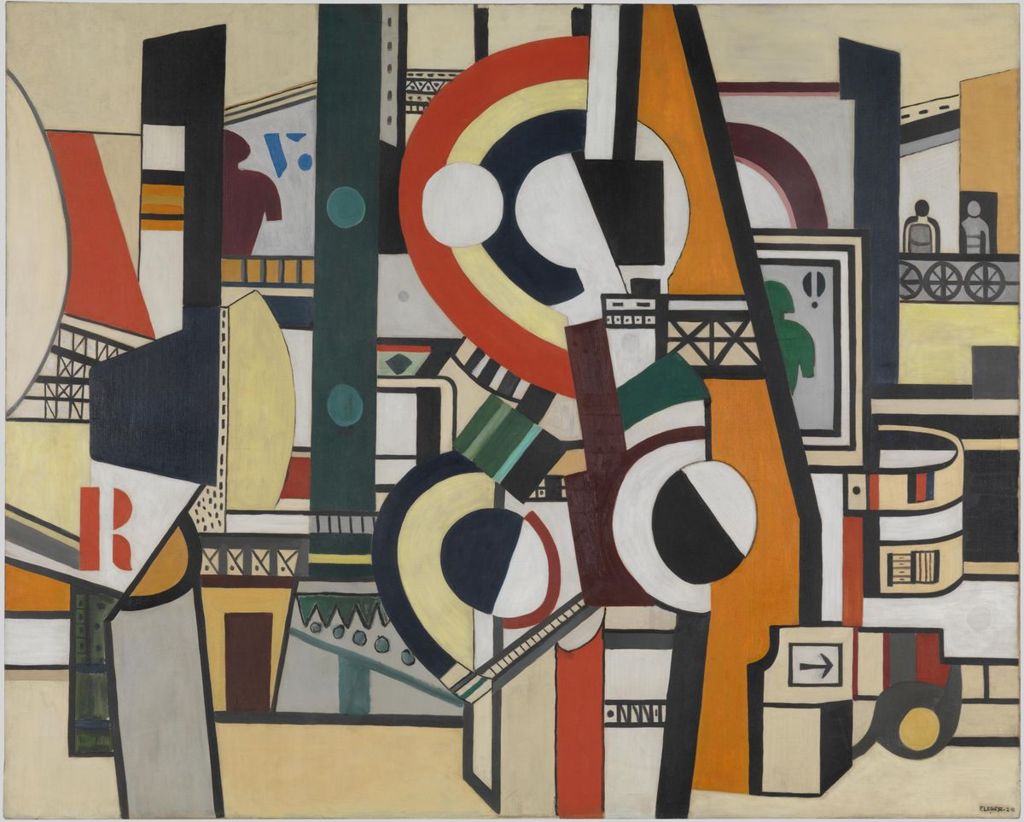
Fernand Léger, The Disks in the City, 1920. Oil on canvas. Disks and signs offer another solution to the movement of the eye across a city picture. Image source. Public domain.
Studies and the mural idea
The monumental canvas had smaller preparations. Tokyo Fuji Art Museum records a Study for the City of 1919 in watercolour on paper, measuring 38 by 32 centimetres. MoMA’s annotated 1960 Léger exhibition checklist lists a separate oil study of 1919, measuring 36¼ by 28¾ inches, and notes that several canvases and watercolours were made in preparation for the large Philadelphia work. [9] [12] These are distinct objects, not alternative measurements or media for the finished painting.
Both recorded studies are taller than they are wide; the Philadelphia canvas spreads horizontally. Their dimensions do not reproduce its final format. These records establish work across sizes and supports, without establishing the precise sequence of preparation.
MoMA’s checklist prints an edited extract from Léger’s letter of 20 November 1943 to Alfred H. Barr Jr. He describes a persistent tension between mural and easel painting, placing The City against the figure composition Three Women (1921). [12] This later testimony presents the latter painting as a counterweight to the urban canvas.
Calling The City mural-like describes its reach and visual ambition; the object itself remains an oil painting on canvas. Its relation to architecture is enacted before the viewer. Huge uprights divide the surface like structural members, flat panels assert themselves like walls or signs, and the painting’s width exceeds an intimate field of inspection. Léger makes a portable painting behave with the insistence of something encountered in public space.
The small grey figures bring that ambition back to a human scale. Surrounded by letters, girders, railings and coloured planes, they never possess the city as an orderly prospect. Neither do we. Our view is assembled through partial discoveries: a step, a body, a sign, a curved surface catching the light. The lasting force of The City lies in how precisely Léger organises that incomplete encounter, giving the fractured experience of urban looking a monumental painted form.
Léger in video
Explore abstraction, monumental painting and cinema through films from MoMA and the Centre Pompidou. These videos offer context for Léger’s wider work; the restoration film is in French.
Restaurer un… Fernand Léger
Follow conservation of Composition with Two Parrots, 1935–39, and look at painting on a monumental scale. French-language film.
Watch on YouTubeFernand Léger artworks directory
Works covered in these articles and further documented works. Studies and finished works have separate entries; alternate titles share an entry. This is not a catalogue raisonné.
| Name | Date | Medium |
|---|---|---|
| Acrobats and Clowns from Le Cirque | 1950 | |
| Adieu New York | 1946 | Painting |
| Ballet mécanique | 1924 | Film |
| Big Julie | 1945 | Painting |
| Builders with Aloe | 1951 | Painting |
| Charlot cubiste | 1924 | Sculpture |
| Chimneys on Rooftops | 1911 | Painting |
| Cirque (artist’s book) | 1950 | |
| Composition | 1929 | Painting |
| Composition (Study for Nude Model in the Studio) | 1912 | Drawing |
| Composition of Three Figures | 1932 | Painting |
| Composition with Two Parrots | 1935–39 | Painting |
| Construction Workers Final State | 1950 | Painting |
| Contrast of Forms | 1913 | Painting |
| Derrière le miroir, nos.121–122 (posthumous publication, includes a lithograph after Léger) | 1960 | |
| Drawing for The Card Game | 1917 | Drawing |
| Drawing for The Staircase | 1913 | Drawing |
| En attendant le départ | 1914 | Drawing |
| Grand Parade with Red Background | 1953 | Painting |
| J’ai tué (illustrated book) | 1918 | |
| La Cocarde, l’avion brisé | About 1916 | Drawing |
| La Couseuse | about1910 | Painting |
| La Fin du monde filmée par l’Ange N.-D. (illustrated book) | 1919 | |
| Les Femmes au bouquet (Women with a Bouquet) | 1921 | Painting |
| Man and Woman | 1921 | Painting |
| Man in Profile with Rope: Study for The Constructors | 1950/1 | Drawing |
| Man in the Blue Hat | 1937 | Painting |
| Matinée d’ivresse, from Les Illuminations | 1949 | |
| Mechanical Elements | 1918–23 | Painting |
| Mechanical Elements (Metropolitan Museum) | 1920 | Painting |
| Men in the City | 1919 | Painting |
| Mes voyages (posthumous illustrated book) | 1960 | |
| Mona Lisa with the Keys | 1930 | Painting |
| Nude Model in the Studio | 1912–13 | Painting |
| Nudes in the Forest | 1909–1911 | Painting |
| Propellers Second State | 1918 | Painting |
| Reading | 1924 | Painting |
| Soldier with a Pipe | 1916 | Painting |
| Soldiers Playing Cards | 1917 | Painting |
| Soldiers Playing Cards (front drawing) | 1916 | Drawing |
| Standing Nude, Rear View | 1911 | Drawing |
| Still Life with a Beer Mug | 1921–2 | Painting |
| Still Life with Tankard | 1921 | Drawing |
| Study for The Aviator | 1920 | Drawing |
| The Acrobat and his Partner | 1948 | Painting |
| The Acrobats in the Circus | 1918 | Painting |
| The Alarm Clock | 1914 | Painting |
| The Chalices and the Sponge, stained-glass model | 1950 | Drawing |
| The City | 1919 | Painting |
| The Disks in the City | 1920 | Painting |
| The Mechanic | 1920 | Painting |
| The Railway Crossing | 1919 | Painting |
| The Three Musicians | 1944, after a 1924–25 drawing | Painting |
| The Wheels | 1945 | Drawing |
| Three Women | 1921–22 | Painting |
| Two Women Holding Flowers | 1954 | Painting |
| Umbrella and Bowler | 1926 | Painting |
| Verdun, dessin du front | About 1915 | Drawing |
| Woman with a Book | 1923 | Painting |
| Woman: Costume Design for La Création du monde | c.1922–23 | Drawing |
Discussion
Look again at the images and ideas explored in The City. These editorial prompts invite your observations.
Reader Insights
What becomes easier to notice in The City when you compare it with Men in the City?
Where does the comparison with The Disks in the City reveal the clearest change in Léger’s approach?
Which detail would you follow first when returning to the work, and why?
Join the Conversation
Share a detail, comparison or question about The City below.
References
- Philadelphia Museum of Art, The City, 1919, collection record and interpretation; A. E. Gallatin Collection, 1952-61-58. View source.
- Kröller-Müller Museum, Nus dans la forêt / Nude Figures in a Forest, collection record KM 101.045. Current date, medium, identifier, curatorial sections “Distinctive cubist style”, “Geometric shapes” and “‘Battle of volumes’”, and museum reproduction. View source.
- Fondation Beyeler, Contraste de formes, Fernand Léger, current collection record, Inv.90.6: date, medium, dimensions, collection and signature on reverse. View source.
- National Gallery of Canada, The Mechanic, 1920, accession 14985, collection details and interpretive paragraph; French collection record, Le mécanicien. View source.
- The Museum of Modern Art, Fernand Léger. Three Women. 1921–22, collection record, object 189.1942: artwork image, metadata, 2021 gallery label, publication excerpt, installation history and provenance. View source.
- Musée national Fernand Léger, La Joconde aux clés, collection record and museum commentary (French): object data, owning museum image, artist recollection, sardine tin and symbolic interpretations. The artist’s recollection is consulted as reproduced by the museum; the page does not date it. View source.
- Musée national Fernand Léger, “Les années 50, les constructeurs”, complete Les Constructeurs (définitif) entry and accompanying museum image: title, 1950 date, oil on canvas, 300 × 228 cm, inventory MNFL 94001, 1969 donation and museum-mediated Renault-canteen recollection. View source.
- Musée national Fernand Léger, La Grande Parade sur fond rouge, complete object record and displayed reproduction: 1953, oil on canvas, 114.5 × 156.2 cm, inventory MNFL 96006; donation of Nadia Léger and Georges Bauquier. View source.
- Tokyo Fuji Art Museum, Study for the City, 1919, collection record and Japanese interpretation, including retrospective statements attributed to Léger. View source.
- James Stein, Léger: Modern Art and the Metropolis: A Guide for Students and Teachers, Philadelphia Museum of Art, 2013. Text reviewed for accuracy by exhibition curator Anna Vallye. Especially printed pp. 8, 10–14 and 16–20 (PDF pp. 10, 12–16 and 18–22); introduction and timeline, PDF pp. 4 and 6. View source.
- Centre Pompidou, Fernand Léger, teaching dossier, April 2008, introduction and “La vie moderne: La ville.” Includes Cendrars’s 1954 recollection and extracts from Léger’s correspondence. View source.
- Museum of Modern Art, Fernand Léger: exhibition announcement and annotated checklist, November 1960, notes by Alfred H. Barr Jr., PDF pp. 2–3. Includes the oil study and an edited extract from Léger’s letter to Barr under Three Women. View source.


