



 by Tom Gurney
Tom Gurney BSc (Hons) is an art history expert with over 20 years experience
Published on June 19, 2020 / Updated on November 1, 2026
Email: tomgurney1@gmail.com / Phone: +44 7429 011000
Chimneys on Rooftops: Introduction
Pale smoke swells between slate-grey roofs, rising in rounded segments through a city made of sharp edges. A broad roof slopes across the centre, while ochre walls and small dark windows hold their place among the drifting forms. In Fernand Léger’s Chimneys on Rooftops, the air seems almost as substantial as the buildings. Smoke has acquired a body, and the roofs appear to tilt and shift around it.
The Philadelphia Museum of Art’s 2013 guide lists this oil painting as Smoke over Rooftops, 1911, then in a private collection. [1] Its familiar alternative title draws attention to the chimneys; looking at the picture, however, it is the smoke that takes command. The small structures from which it rises become starting points for much larger movements across the surface.
At a Glance
- ArtistFernand Léger
- SubjectChimneys on Rooftops
- Date1911 [1]
- Recorded collectionPrivate collection (2013 catalogue) [1]
This work across Fernand Léger’s career
Nudes in the Forest
1909–1911 [2]Contrast of Forms
1913 [3]The Mechanic
1920 [5]Three Women
1921–22 [6]Contents
- Looking across the roofs
- Smoke with weight
- A restrained palette, an unsettled space
- A view from the studio
- Cézanne and the construction of a landscape
- The rooftop series and the next step
Looking across the roofs
The broad grey roof near the centre offers the clearest foothold. Its slope establishes a recognisable building, but its shape is irregular enough to resist a neat description as a rectangle seen in perspective. A dark edge drops towards the foreground, while pale adjoining planes pull in different directions. The roof seems solid locally, even as its position within the whole cityscape remains uncertain.
Above it, a narrow band of smaller architectural details crosses the picture. Short verticals and dark openings suggest windows, chimneys and adjoining walls. Their compressed scale encourages us to read them as more distant than the great roof below. Yet their outlines are almost as assertive as those in the foreground. Distance is suggested by size and overlap, then partly cancelled by the force of the painted marks.
At the right, a substantial warm wall forms a comparatively steady horizontal block. Its ochre colour answers the smaller yellow and brown planes scattered across the upper half. Below and beside it, dark window-like openings briefly restore the ordinary experience of a city building. These recognisable details matter because they keep the picture attached to a place, however freely Léger rearranges its visible structure.
The lower portion is harder to unravel. Angled bands, short parallel strokes and fragments of roofs are packed tightly together. They can suggest overlapping architectural surfaces, but the eye cannot easily follow a continuous route through them. The city becomes especially dense here: each small interval has been made to carry a change of direction, a contrast of tone or the edge of another form.
This gives the elevated viewpoint a peculiar intimacy. We look over buildings rather than along an open street, and their upper surfaces crowd towards us. The view contains little of the spacious sky that might ordinarily release the pressure of so many roofs. Even the upper corners are occupied by great pale curves. Architecture and atmosphere together fill the available field.
Smoke with weight
The most conspicuous smoke forms enter from the upper left and upper right, while narrower columns rise through the lower half. Their pale centres and grey margins suggest swelling, rounded volumes. Some edges carry faint warmer accents, further separating them from the cool roofs. The smoke is luminous without dissolving into a general haze.
On the left, a broad pale mass fills much of the corner, its lower curve crossing the small architecture behind it. Further down, a sequence of bulbous forms rises close to the edge. Near the centre-right, another pale column bends past a dark roofline. These passages establish several upward movements, each interrupted by a change in width or direction. The smoke looks capable of expansion even though its contours are held firmly in place.
Its scale is particularly striking. A puff can rival an entire roof, and a column can interrupt several buildings at once. The forms therefore have two roles: they represent something passing through the neighbourhood, and they organise the painting into large divisions. Follow the buildings and the eye tends to move sideways or diagonally; follow the smoke and it climbs, curls and returns towards the corners.
The Philadelphia guide quotes Léger on the expressive effect of opposing curved smoke to the hard surfaces of houses. [1] That account is useful here because the roofs’ rigidity becomes more apparent beside the smoke, while the smoke’s curves seem livelier beside the roofs. Neither half of the encounter would have the same force alone.
The pale forms can also look unexpectedly heavy. Their shading gives them the visual presence of objects, although their subject is something that cannot keep a fixed shape. The painting holds this contradiction in view. Smoke remains recognisable through its rising, swelling outline, while taking its place among the substantial masses of the city.
A restrained palette, an unsettled space
Grey dominates the image, but it is far from uniform. Bluish slate, charcoal edges and lighter silvery areas change its temperature and apparent weight. The warm walls bring ochre, muted yellow and brown into the same narrow colour range. Small reddish touches sharpen particular divisions without breaking the overall restraint.
Because the colours remain close, changes of contour become unusually important. A dark stroke can turn a pale area into a wall; an adjacent diagonal can make a grey patch read as a roof. The image asks the viewer to attend to relationships between shapes before any individual object has been completely identified. Recognition proceeds by adjustment: one building becomes clearer when the neighbouring plane falls into place.
The paint visible in the reproductions contributes to this effect. Surfaces appear mottled and worked rather than uniformly filled. A wall can carry several neighbouring tones, and the interior of a roof is less even than its strong boundary initially suggests. This variation keeps the geometry from feeling diagrammatic. Within the large shapes, the surface remains active.
Léger also allows modelling and flatness to coexist. The smoke swells through light and shade, while some architectural planes approach broad, nearly frontal patches. Elsewhere a sharp diagonal implies depth, only to meet a neighbouring surface whose orientation is difficult to reconcile with it. We can feel individual volumes without being able to assemble them into a single, dependable space.
The resulting movement comes from repeated changes in how we read the image. A grey shape first projects forward as a roof, then settles back into a pattern of dark-edged planes. A smoke column rises before the houses, then seems fastened to the same shallow surface as their walls. Looking becomes a process of moving between the represented city and the arrangement of paint that makes it visible.
A view from the studio
The Philadelphia Museum of Art identifies a view from Léger’s top-floor Paris studio, with Notre-Dame’s towers in the upper right. Its guide pairs the painting with Christopher Green’s 1972 photograph from 13, rue de l’Ancienne Comédie and dates the studio move to 1911. [1]
This account supplies a useful point of orientation. The small upright structures high on the right belong to a view extending beyond the nearby roofs. Once their possible landmark identity is supplied, the jumble acquires a longer reach. Yet the cathedral remains a small participant in the composition. Its forms share the greys, dark openings and vertical accents of the surrounding architecture.
That balance makes the studio viewpoint more than a convenient explanation of the subject. It helps us understand the unusual distribution of attention. Roof surfaces occupy the foreground, while a major monument is absorbed into the distance. The city is encountered through the ordinary architecture nearest the painter, with the famous landmark appearing among the less celebrated structures.
There is no clear human figure to organise this view. Windows imply occupied rooms, and the chimneys suggest activity within the buildings, but the painting gives its strongest presence to walls, roofs and moving air. The neighbourhood’s life reaches us indirectly, through things made and used by people. The smoke links those enclosed interiors to the open space above them.
Cézanne and the construction of a landscape
Léger’s early development involved a sustained engagement with Paul Cézanne. In his lecture Du village à la forêt – Cezanne et Léger, Jean Arrouye traces that relationship through simplified building volumes, departures from conventional perspective and the growing importance of relations between shapes. He argues that Léger increasingly gives the internal organisation of the picture priority over the appearance of the subject. [10]
This argument offers a way of approaching the rooftop painting without reducing it to an exercise in a borrowed style. Its houses are recognisable, but recognition does not settle their arrangement. Roofs provide large inclined surfaces, walls offer upright and horizontal divisions, and smoke introduces rounded volumes. The chosen subject supplies different kinds of form that can be made to work together.
The connection is especially helpful when considering the picture’s broken space. The buildings retain enough volume to feel constructed, yet their edges do not submit to one continuous recession. We move from a local pocket of depth back to the painted surface, then into another pocket elsewhere. What holds the image together is the recurrence of angled roofs, dark intervals and pale curves across those shifts.
Arrouye’s broader account also treats Cézanne’s influence as a continuing stimulus that Léger reworked, rather than a formula adopted once. [10] Here the most productive question is how an observed cityscape becomes an independently organised picture. The walls and smoke give Léger a subject through which the demands of description and the demands of composition can meet.

Fernand Léger, Nudes in the Forest. The contemporary treatment of the body and landscape gives a useful comparison for constructed roofs.
The rooftop series and the next step
The Philadelphia guide places this canvas within several smoke-and-rooftop paintings made between 1910 and 1912. [1] The Kröller-Müller Museum’s exhibition overview concentrates on the 1911–12 series, describing a movement from relatively realistic, restrained treatments towards greater abstraction and colour. It locates Léger among the Cubists who exhibited at the major Salons, alongside Robert Delaunay, Jean Metzinger and Henri Le Fauconnier. [11]
That setting helps explain why this quiet palette belongs to a period of vigorous experimentation. The subject offered repeatable relations—curves against angles, smoke against buildings—whose balance could be altered from canvas to canvas. The Kröller-Müller overview links the series to the later Contrasts of Forms paintings of 1913–14. [11] In the present work, the ingredients of that investigation are still anchored in a recognisable neighbourhood.
The Centre Pompidou’s teaching dossier explains the later contrasts through oppositions of volumes, lines and colours. It also transcribes part of Léger’s lecture of 5 May 1913, in which pictorial realism is located in the organisation of lines, forms and colours independently of imitation. [12] Read beside the rooftops, that later formulation clarifies how a convincing painting might emerge from relations that disrupt a convincing view.
Katharine Kuh’s 1953 Léger catalogue discusses a different Smoke over the Roofs, stressing how smoke acquires solid volume and helps articulate space. [13] The observation illuminates a recurring problem across the rooftop works: an ephemeral subject can become a powerful means of construction. In this canvas, the most changeable element in the view supplies some of its strongest masses.
The difference from Léger’s The City of 1919 is equally revealing. The Philadelphia guide presents that later work through vivid colour, urban signs and competing geometric fragments. [1] Here, the neighbourhood remains closer and more materially continuous. Warm walls answer cool roofs; rounded smoke interrupts their angles. The city already offers Léger an absorbing pictorial subject, with movement generated through the pressure of adjacent forms.
Return finally to the great grey roof at the centre. It still gives the eye somewhere to stand, but the surrounding smoke keeps that foothold provisional. A pale curve swells nearby, a dark edge changes direction, and a smaller roof draws attention across the surface. The painting’s energy lies in this continual exchange: a familiar view repeatedly made strange by the way its parts have been brought together.
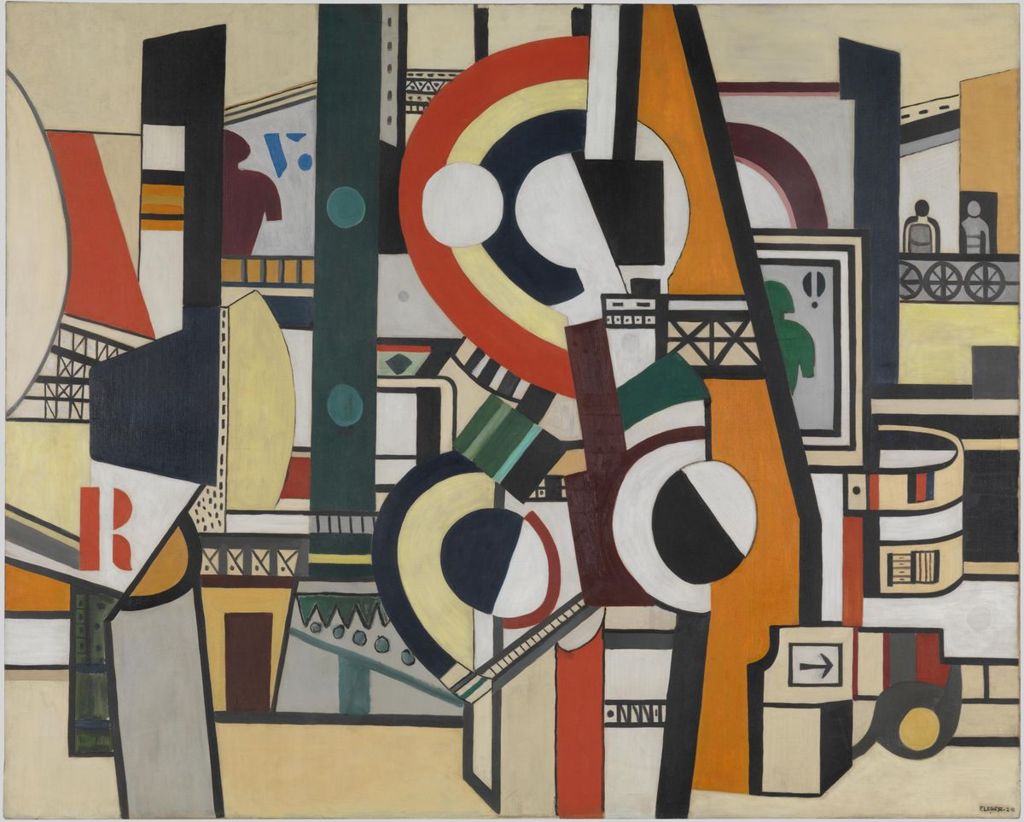
Fernand Léger, The Disks in the City, 1920. Oil on canvas. A later urban painting replaces the rooftop view with disks, signs and overlapping fragments. Image source. Public domain.
Léger in video
Explore abstraction, monumental painting and cinema through films from MoMA and the Centre Pompidou. These videos offer context for Léger’s wider work; the restoration film is in French.
1913 | “Contrast of Forms” by Fernand Léger
MoMA looks at its own 1913 Contrast of Forms, including the painting’s rough surface. This is a different canvas from the Beyeler work covered in this cluster. English.
Watch on YouTubeFernand Léger artworks directory
Works covered in these articles and further documented works. Studies and finished works have separate entries; alternate titles share an entry. This is not a catalogue raisonné.
| Name | Date | Medium |
|---|---|---|
| Acrobats and Clowns from Le Cirque | 1950 | |
| Adieu New York | 1946 | Painting |
| Ballet mécanique | 1924 | Film |
| Big Julie | 1945 | Painting |
| Builders with Aloe | 1951 | Painting |
| Charlot cubiste | 1924 | Sculpture |
| Chimneys on Rooftops | 1911 | Painting |
| Cirque (artist’s book) | 1950 | |
| Composition | 1929 | Painting |
| Composition (Study for Nude Model in the Studio) | 1912 | Drawing |
| Composition of Three Figures | 1932 | Painting |
| Composition with Two Parrots | 1935–39 | Painting |
| Construction Workers Final State | 1950 | Painting |
| Contrast of Forms | 1913 | Painting |
| Derrière le miroir, nos.121–122 (posthumous publication, includes a lithograph after Léger) | 1960 | |
| Drawing for The Card Game | 1917 | Drawing |
| Drawing for The Staircase | 1913 | Drawing |
| En attendant le départ | 1914 | Drawing |
| Grand Parade with Red Background | 1953 | Painting |
| J’ai tué (illustrated book) | 1918 | |
| La Cocarde, l’avion brisé | About 1916 | Drawing |
| La Couseuse | about1910 | Painting |
| La Fin du monde filmée par l’Ange N.-D. (illustrated book) | 1919 | |
| Les Femmes au bouquet (Women with a Bouquet) | 1921 | Painting |
| Man and Woman | 1921 | Painting |
| Man in Profile with Rope: Study for The Constructors | 1950/1 | Drawing |
| Man in the Blue Hat | 1937 | Painting |
| Matinée d’ivresse, from Les Illuminations | 1949 | |
| Mechanical Elements | 1918–23 | Painting |
| Mechanical Elements (Metropolitan Museum) | 1920 | Painting |
| Men in the City | 1919 | Painting |
| Mes voyages (posthumous illustrated book) | 1960 | |
| Mona Lisa with the Keys | 1930 | Painting |
| Nude Model in the Studio | 1912–13 | Painting |
| Nudes in the Forest | 1909–1911 | Painting |
| Propellers Second State | 1918 | Painting |
| Reading | 1924 | Painting |
| Soldier with a Pipe | 1916 | Painting |
| Soldiers Playing Cards | 1917 | Painting |
| Soldiers Playing Cards (front drawing) | 1916 | Drawing |
| Standing Nude, Rear View | 1911 | Drawing |
| Still Life with a Beer Mug | 1921–2 | Painting |
| Still Life with Tankard | 1921 | Drawing |
| Study for The Aviator | 1920 | Drawing |
| The Acrobat and his Partner | 1948 | Painting |
| The Acrobats in the Circus | 1918 | Painting |
| The Alarm Clock | 1914 | Painting |
| The Chalices and the Sponge, stained-glass model | 1950 | Drawing |
| The City | 1919 | Painting |
| The Disks in the City | 1920 | Painting |
| The Mechanic | 1920 | Painting |
| The Railway Crossing | 1919 | Painting |
| The Three Musicians | 1944, after a 1924–25 drawing | Painting |
| The Wheels | 1945 | Drawing |
| Three Women | 1921–22 | Painting |
| Two Women Holding Flowers | 1954 | Painting |
| Umbrella and Bowler | 1926 | Painting |
| Verdun, dessin du front | About 1915 | Drawing |
| Woman with a Book | 1923 | Painting |
| Woman: Costume Design for La Création du monde | c.1922–23 | Drawing |
Discussion
Look again at the images and ideas explored in Chimneys on Rooftops. These editorial prompts invite your observations.
Reader Insights
What becomes easier to notice in Chimneys on Rooftops when you compare it with Nudes in the Forest?
Where does the comparison with The Disks in the City reveal the clearest change in Léger’s approach?
Which detail would you follow first when returning to the work, and why?
Join the Conversation
Share a detail, comparison or question about Chimneys on Rooftops below.
References
- James Stein, Léger: Modern Art and the Metropolis: A Guide for Students and Teachers, Philadelphia Museum of Art, 2013, printed pp. 2, 4–6 and 8 (PDF pp. 4, 6–8 and 10). Object illustration and discussion of Smoke over Rooftops on printed p. 6; Christopher Green photograph on printed p. 5. Museum guide. View source.
- Kröller-Müller Museum, Nus dans la forêt / Nude Figures in a Forest, collection record KM 101.045. Current date, medium, identifier, curatorial sections “Distinctive cubist style”, “Geometric shapes” and “‘Battle of volumes’”, and museum reproduction. View source.
- Fondation Beyeler, Contraste de formes, Fernand Léger, current collection record, Inv.90.6: date, medium, dimensions, collection and signature on reverse. View source.
- Philadelphia Museum of Art, The City, 1919, collection record and interpretation; A. E. Gallatin Collection, 1952-61-58. View source.
- National Gallery of Canada, The Mechanic, 1920, accession 14985, collection details and interpretive paragraph; French collection record, Le mécanicien. View source.
- The Museum of Modern Art, Fernand Léger. Three Women. 1921–22, collection record, object 189.1942: artwork image, metadata, 2021 gallery label, publication excerpt, installation history and provenance. View source.
- Musée national Fernand Léger, La Joconde aux clés, collection record and museum commentary (French): object data, owning museum image, artist recollection, sardine tin and symbolic interpretations. The artist’s recollection is consulted as reproduced by the museum; the page does not date it. View source.
- Musée national Fernand Léger, “Les années 50, les constructeurs”, complete Les Constructeurs (définitif) entry and accompanying museum image: title, 1950 date, oil on canvas, 300 × 228 cm, inventory MNFL 94001, 1969 donation and museum-mediated Renault-canteen recollection. View source.
- Musée national Fernand Léger, La Grande Parade sur fond rouge, complete object record and displayed reproduction: 1953, oil on canvas, 114.5 × 156.2 cm, inventory MNFL 96006; donation of Nadia Léger and Georges Bauquier. View source.
- Jean Arrouye, Du village à la forêt – Cezanne et Léger, lecture given at the Université de Chicoutimi, Québec, 1995; published by Société Cezanne, 13 November 2017. Opening discussion and early landscape analyses through the discussion of smoke and constructive contrasts. Lecture text. View source.
- Kröller-Müller Museum, Fernand Léger en de daken van Parijs, exhibition overview, guest curator Sjraar van Heugten; sections “Schoorstenen en rookpluimen” and “Léger en de kubisten in Parijs”. Exhibition overview. View source.
- Centre Pompidou, Fernand Léger, teaching dossier, April 2008, introductory contrast discussion and “Les contrastes de formes”, including a transcribed excerpt from the lecture of 5 May 1913. Teaching dossier. View source.
- Katharine Kuh, Léger, Art Institute of Chicago, 1953, printed p. 16 (PDF p. 21), discussion of the separate canvas Smoke over the Roofs. Digitised catalogue. View source.


