



 by Tom Gurney
Tom Gurney BSc (Hons) is an art history expert with over 20 years experience
Published on June 19, 2020 / Updated on November 1, 2026
Email: tomgurney1@gmail.com / Phone: +44 7429 011000
Fernand Léger’s Drawings: Introduction
Fernand Léger’s drawings offer several ways into his art. A few lines can register the movement of a body; a carefully worked sheet can organise the forms of a future painting; a portrait made during military service can become the starting point for a different subject years later. Drawing also gave him a way to reconsider images already painted and to work out designs intended for reproduction. These purposes overlap. A sheet can be useful to another project and still reward attention as an image in its own right.
The materials matter as much as the title. Pencil and ink, watercolour and gouache produce different kinds of marks, while paper can carry oil paint as well as drawing. The word “study” describes a relationship or a working function, rather than a single technique. Following particular objects makes this range easier to understand than treating every work on paper as a preliminary sketch.
At a Glance
- ArtistFernand Léger
- SubjectDrawings
Contents
- Drawing from the figure
- The Staircase: a painted drawing and a changing canvas
- Paper during the First World War
- A portrait becomes another kind of image
- Ink, wash and the organisation of modern subjects
- Drawings with a life after painting
- Drawing for design and the printed page
Drawing from the figure
Standing Nude, Rear View of 1911, in the University of Michigan Museum of Art, is pen and ink on tan paper. Its spareness makes a useful beginning. A long curve establishes the back and hip; the arms cross the body; abbreviated marks give the hands and feet enough definition to suggest their positions. Much of the body remains the colour of the untouched sheet. There is little attempt to fill an enclosed silhouette with modelling, and the line carries almost all the information.[1]
The museum connects this manner with the gestural drawing practised by Rodin and other artists of the period: recording contour, movement and the passage of the hand. Looking at Léger’s sheet, the body remains easy to recognise even where its outline breaks off. This is a different economy from the crowded interlocking forms of his Cubist studies. Already, a drawings collection needs room for both. A rapid appearance also leaves open the question of purpose: brevity alone does not establish that a sheet was a plan for a painting.[1]
A much denser approach appears in the Metropolitan Museum of Art’s Composition (Study for “Nude Model in the Studio”), dated 1912. The medium is oil paint, opaque watercolour and ink over graphite on brown paper; the Met classifies the object under paintings. Its study function and paper support nevertheless make it important to an account of Léger’s drawing practice. The museum identifies it as one of the largest, most finished studies for the related Guggenheim canvas and records its exhibition at the Salon des Indépendants in spring 1913.[2]
Here white passages and dark strokes interrupt the warm paper, building a body out of rounded segments amid angular surroundings. The eye follows curves through the centre, then meets abrupt changes of direction elsewhere. By exhibiting the study, Léger gave it a public existence alongside its preparatory role. A work preceding a canvas could command attention on its own.[2]
Selected drawings

The Staircase: a painted drawing and a changing canvas
The Met’s Drawing for “The Staircase” is dated 1913 and catalogued as gouache and oil paint on paper, measuring 50.2 × 65.1 centimetres. The museum relates it to The Staircase (Second State), the 1914 painting in Madrid’s Museo Nacional Thyssen-Bornemisza. Keeping those dates and materials together distinguishes the sheet from the later canvas.[3]
The paper remains conspicuous between the painted forms. Bright white accents, black shapes and lighter strokes of shading give the clustered elements different weights. Central ovals suggest heads, while repeated diagonals towards the edges establish the surrounding structure. The composition is busy, yet its light and dark intervals prevent it from becoming a single undifferentiated mass. The Met interprets the subject as humanoid figures moving up and down stairs, linking the repeated steps and articulated limbs to Léger’s interest in motion. The drawing lets us study this organisation without the stronger colour contrasts of the related painting.[3]
Preparation did not make the subsequent canvas immune to revision. A Thyssen technical investigation found changes in the painting’s initial composition, including areas where a new preparation layer separates earlier paint from the visible surface. Its conclusions qualify an overly rigid picture of Léger executing a fully settled design directly and definitively. The evidence concerns this painting and its layers: it shows that planning and alteration could coexist. A preparatory sheet should therefore be approached as one stage in a developing work, rather than an instruction that the artist necessarily followed without change.[4]
Paper during the First World War
The Musée national Fernand Léger preserves contrasting wartime sheets. Sans titre, “En attendant le départ” (1914), ink on paper, brings Léger and Jeanne Lohy together in an intimate double portrait. Fine outlines and patches of hatching describe their faces and clothing, with generous empty space around them. The small sheet records a personal relationship at the moment of mobilisation.[5]
Sans titre, Verdun, dessin du front, dated about 1915, is catalogued as pencil on paper. Broken diagonals, fragments of lettering and short hatched passages disperse attention across its surface. The museum describes Léger drawing when circumstances allowed, sometimes on letter cards or the backs of military maps, and sending drawings with his correspondence. Paper sustained an artistic practice when painting was difficult.[5]
Colour was also possible. La Cocarde, l’avion brisé, about 1916, combines gouache and pencil on paper. Its red, white and blue aircraft marking stands out amid yellow, green and grey fragments. The museum identifies this polychrome sheet as exceptional for the period, when such materials were seldom available to him. The wartime drawings consequently encompass private portraiture, fragmented observation and occasional colour, rather than a uniform technique.[5]
The Met’s Drawing for “The Card Game” of 1917 gives a more specific connection with painting. Brush and ink and graphite on paper, subsequently mounted on board, establish a single large figure within a vertical sheet. Broad shaded passages turn its limbs into substantial volumes. Angular divisions around the body make the surrounding space feel compressed, while finer lines remain visible between the larger forms.[6]
The Met records that Léger sold the drawing, other studies and the final Card Game painting to Léonce Rosenberg on 5 December 1917. This is firm evidence of a study’s relationship with a canvas, and of the drawing’s place in a transaction encompassing the larger project. It is especially useful where titles recur: the Met sheet is accession 2016.237.19, and its date, medium and dimensions of 52.7 × 37.8 centimetres identify the particular sheet.[6]

Fernand Léger, Soldiers Playing Cards. The finished canvas offers a comparison for the wartime drawings discussed here.
A portrait becomes another kind of image
Portrait de Philippon bears an inscription dating it to 17 January 1917 at Le Godert. Reproduced in Christopher Green’s research for the Met, it is pencil, brush and watercolour on paper; its present location is unknown. Blue passages establish the shoulder, while the profile, ear and great curved form around the head remain embedded in a field of smaller coloured elements.[7]
Green relates this soldier portrait to Léger’s later Typographer paintings, tracing the transformation of features into mechanical elements. He leaves the curved head covering open to interpretation as a muffler or bandage. His argument gives drawing a role beyond immediate preparation: an observed companion supplied forms that could be reworked into a different, peacetime figure. The proposed connection should retain that distinction between a named wartime sitter and the later subject.[7]
Ink, wash and the organisation of modern subjects
The Met’s Study for “The Aviator” of 1920 combines brush and black ink and watercolour over graphite on paper. Its compact horizontal format differs markedly from the vertical Card Game drawing. A broad arch spans the upper part of the composition; dark uprights, smaller curves and pale rectangular forms meet beneath it. Changes between black, grey and untouched paper produce an ordered sequence of contrasts.[8]
Within this restrained tonal range, Léger creates considerable variety. Some shapes appear solid and modelled, others flat and open. The Met places the work within his postwar treatment of figures through mechanical and architectural forms. Its layered medium is revealing: a drawing can contain a graphite foundation, fluid brushwork and denser areas of colour, with each contributing to the final arrangement. “Drawing” here encompasses more than contour alone.[8]
Graphite offered another route. The Morgan Library & Museum catalogues Still Life with Tankard (1921) as graphite on tan wove paper, 37.9 × 25.9 centimetres, and identifies it as a study for a painting in the Tate collection. This documented relationship brings an ordinary tabletop subject into the same working practice as Léger’s figures and machinery.[9]
The sheet also provides a useful comparison with the mixed-media studies. A single drawing material can carry a composition towards painting without supplying its final colours. In comparing such objects, the productive questions concern what each stage establishes: the proportions of objects, their position within the sheet, and the relationships to be retained or reconsidered later. The existence of a study gives access to those decisions; it does not make the later painting simply a larger, coloured copy. The Morgan’s identification supplies a specific pair to investigate rather than a general claim about how every Léger still life was made.[9]
Drawings with a life after painting
The National Galleries of Scotland’s Man in Profile with Rope: Study for “The Constructors”, dated 1950/1, complicates the usual sequence. Its catalogue explicitly states that the drawing was made after the painting was complete. The title’s “study” therefore does not establish that it preceded the canvas. Ink and black chalk on paper give the worker an emphatic profile, a substantial cap and hands wrapped around a vertical rope.[10]
The close hatching within the figure differs from the open contours of the 1911 nude. Here the elaboration of a single figure sustains an image apart from the larger construction scene. The Scottish catalogue describes it as a highly finished drawing, one of several sheets concentrating on aspects of the completed painting. This is a concrete form of independence: the drawing returns to an existing subject and gives a selected element its own scale, surface and concentration.[10]
The interval could run in the other direction too. MoMA dates its oil painting The Three Musicians to 1944, while specifying that it follows a drawing of 1924–25; the canvas itself is dated 1924–44. A drawing could remain available for renewed work long after its first conception. The relationship between sheet and canvas sometimes stretches across decades.[11]
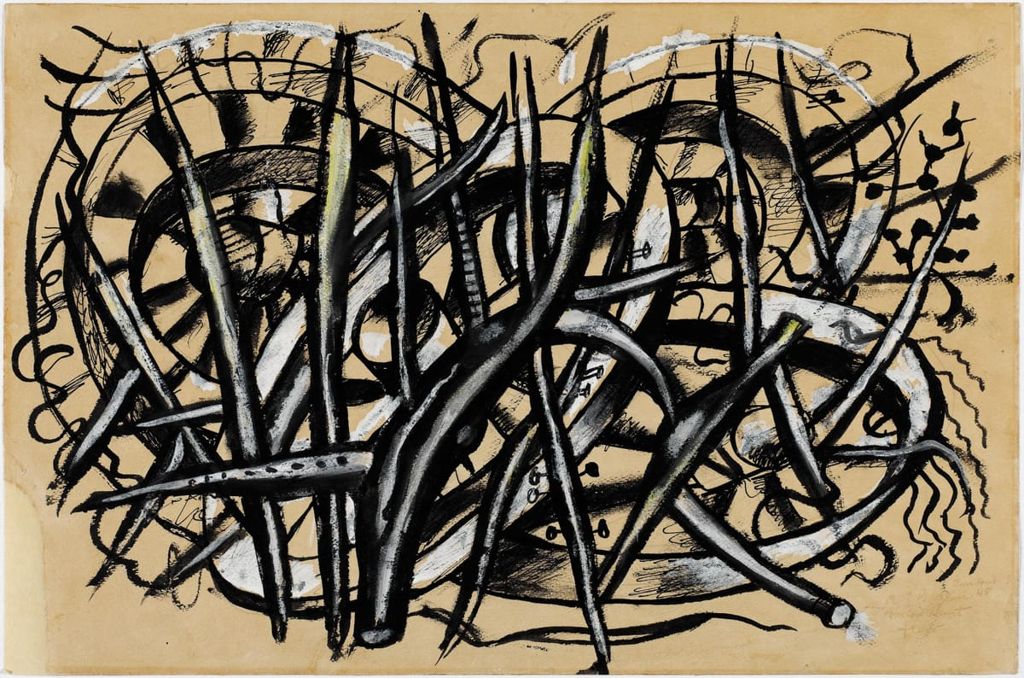
Fernand Léger, The Wheels, 1945. Gouache, India ink and graphite on paper. This autonomous sheet gives the drawn mark a density and energy of its own. Image source. Public domain.
Drawing for design and the printed page
The Musée national Fernand Léger places works on paper within the wider activity of his studio. Its graphic-art holdings include autonomous works, artists’ books and maquettes for monumental projects, alongside costume and scenery studies for Skating Rink (1922). Designs associated with stained glass and mosaic extend the field further. These purposes give drawing an audience beyond the artist at his easel: a sheet could help a collaborator understand an image that would take another material form. The museum also notes that the fragility of its paper holdings prevents permanent display, so temporary exhibitions reveal parts of this activity that a visit to the paintings alone may miss.[12]
Léger’s contribution to Blaise Cendrars’s La Fin du monde filmée par l’Ange N.-D. (1919) brings preparation into book design. The Met’s deluxe copy contains his original maquette, or mock-up, bound at the back. The museum’s research project makes this available alongside a separate copy and Cendrars’s working materials at the Bibliothèque nationale de France. These are distinct witnesses to the collaboration.[13]
In the New York maquette’s Scene 1 spread, black drawing, large lettering and red and yellow colour passages compete across the two pages. The enormous date “31 Décembre” occupies the right side, while forms and letters cross the central fold. A block of prose sits beneath the date. Looking across the spread makes the design problem tangible: image, display lettering and continuous reading all require space within the same opening.[14]
Green describes a sequence from drawing intended for printing in black to colour intended for pochoir, with changes still possible at the maquette stage. He also cautions that the precise division of typographic work is uncertain, attributing most detailed typographic decisions to Cendrars. The preparatory object records collaboration as well as Léger’s invention.[7]
A maquette and a published impression consequently answer different questions. The former helps us follow choices made while constructing a book; the latter presents the result through a reproductive process. Together with the figure studies, wartime sheets and finished worker drawing, it reveals paper as a place where Léger could observe, organise, revisit and communicate an image.
Léger in video
Explore abstraction, monumental painting and cinema through films from MoMA and the Centre Pompidou. These videos offer context for Léger’s wider work; the restoration film is in French.
1913 | “Contrast of Forms” by Fernand Léger
MoMA looks at its own 1913 Contrast of Forms, including the painting’s rough surface. This is a different canvas from the Beyeler work covered in this cluster. English.
Watch on YouTubeFernand Léger artworks directory
Works covered in these articles and further documented works. Studies and finished works have separate entries; alternate titles share an entry. This is not a catalogue raisonné.
| Name | Date | Medium |
|---|---|---|
| Acrobats and Clowns from Le Cirque | 1950 | |
| Adieu New York | 1946 | Painting |
| Ballet mécanique | 1924 | Film |
| Big Julie | 1945 | Painting |
| Builders with Aloe | 1951 | Painting |
| Charlot cubiste | 1924 | Sculpture |
| Chimneys on Rooftops | 1911 | Painting |
| Cirque (artist’s book) | 1950 | |
| Composition | 1929 | Painting |
| Composition (Study for Nude Model in the Studio) | 1912 | Drawing |
| Composition of Three Figures | 1932 | Painting |
| Composition with Two Parrots | 1935–39 | Painting |
| Construction Workers Final State | 1950 | Painting |
| Contrast of Forms | 1913 | Painting |
| Derrière le miroir, nos.121–122 (posthumous publication, includes a lithograph after Léger) | 1960 | |
| Drawing for The Card Game | 1917 | Drawing |
| Drawing for The Staircase | 1913 | Drawing |
| En attendant le départ | 1914 | Drawing |
| Grand Parade with Red Background | 1953 | Painting |
| J’ai tué (illustrated book) | 1918 | |
| La Cocarde, l’avion brisé | About 1916 | Drawing |
| La Couseuse | about1910 | Painting |
| La Fin du monde filmée par l’Ange N.-D. (illustrated book) | 1919 | |
| Les Femmes au bouquet (Women with a Bouquet) | 1921 | Painting |
| Man and Woman | 1921 | Painting |
| Man in Profile with Rope: Study for The Constructors | 1950/1 | Drawing |
| Man in the Blue Hat | 1937 | Painting |
| Matinée d’ivresse, from Les Illuminations | 1949 | |
| Mechanical Elements | 1918–23 | Painting |
| Mechanical Elements (Metropolitan Museum) | 1920 | Painting |
| Men in the City | 1919 | Painting |
| Mes voyages (posthumous illustrated book) | 1960 | |
| Mona Lisa with the Keys | 1930 | Painting |
| Nude Model in the Studio | 1912–13 | Painting |
| Nudes in the Forest | 1909–1911 | Painting |
| Propellers Second State | 1918 | Painting |
| Reading | 1924 | Painting |
| Soldier with a Pipe | 1916 | Painting |
| Soldiers Playing Cards | 1917 | Painting |
| Soldiers Playing Cards (front drawing) | 1916 | Drawing |
| Standing Nude, Rear View | 1911 | Drawing |
| Still Life with a Beer Mug | 1921–2 | Painting |
| Still Life with Tankard | 1921 | Drawing |
| Study for The Aviator | 1920 | Drawing |
| The Acrobat and his Partner | 1948 | Painting |
| The Acrobats in the Circus | 1918 | Painting |
| The Alarm Clock | 1914 | Painting |
| The Chalices and the Sponge, stained-glass model | 1950 | Drawing |
| The City | 1919 | Painting |
| The Disks in the City | 1920 | Painting |
| The Mechanic | 1920 | Painting |
| The Railway Crossing | 1919 | Painting |
| The Three Musicians | 1944, after a 1924–25 drawing | Painting |
| The Wheels | 1945 | Drawing |
| Three Women | 1921–22 | Painting |
| Two Women Holding Flowers | 1954 | Painting |
| Umbrella and Bowler | 1926 | Painting |
| Verdun, dessin du front | About 1915 | Drawing |
| Woman with a Book | 1923 | Painting |
| Woman: Costume Design for La Création du monde | c.1922–23 | Drawing |
Discussion
Look again at the images and ideas explored in Fernand Léger’s Drawings. These editorial prompts invite your observations.
Reader Insights
What becomes easier to notice in Drawings when you compare it with The Wheels?
Where does the comparison with Soldiers Playing Cards reveal the clearest change in Léger’s approach?
Which detail would you follow first when returning to the work, and why?
Join the Conversation
Share a detail, comparison or question about Fernand Léger’s Drawings below.
References
- University of Michigan Museum of Art, Standing Nude, Rear View, 1911, accession 1948/1.272; object details and description. View source.
- Metropolitan Museum of Art, Composition (Study for “Nude Model in the Studio”), 1912, accession 2016.237.17; object details and commentary. View source.
- Metropolitan Museum of Art, Drawing for “The Staircase”, 1913, accession 2016.237.18; object details and commentary. View source.
- Ubaldo Sedano Espín and colleagues, Apoyo analítico al estudio y proyecto de restauración de una obra de Fernand Léger de la colección Thyssen Bornemisza, presented at the II Congreso del GEIIC, Barcelona, 2005, especially PDF pp. 14, 18, 22, 24 and 28. View source.
- Musée national Fernand Léger, “La Première Guerre mondiale”, entries for En attendant le départ (MNFL 96097), Verdun, dessin du front (MNFL 96018) and La Cocarde, l’avion brisé (MNFL 96031). View source.
- Metropolitan Museum of Art, Drawing for “The Card Game”, 1917, accession 2016.237.19; object details and commentary. View source.
- Christopher Green, “La Fin du monde in Context”, Metropolitan Museum of Art, 3 June 2026; passages on Portrait de Philippon, typography and the New York maquette. View source.
- Metropolitan Museum of Art, Study for “The Aviator”, 1920, accession 2016.237.7; object details and commentary. View source.
- Morgan Library & Museum, Still Life with Tankard, 1921, L2021.30.57; object details and notes. View source.
- National Galleries of Scotland, Le Profil à la corde: étude pour “Les Constructeurs”, 1950/1, GMA 2955; object details and commentary. View source.
- Museum of Modern Art, The Three Musicians, 1944, after a drawing of 1924–25, accession 334.1955; object details. View source.
- Musée national Fernand Léger, “Collections”, section “La collection d’arts graphiques et le fonds d’ouvrages illustrés”. View source.
- Leonard A. Lauder Research Center for Modern Art, La Fin du monde: A Modernist Book, Metropolitan Museum of Art, updated June 2026; introduction and object descriptions. View source.
- Metropolitan Museum of Art, La Fin du monde and Léger’s Maquette, digitised primary source, viewer spread 41, “NY Maquette Scene 1”; also spread 40, “NY Maquette Chapter 1”. View source.


