


 by Tom Gurney
Tom Gurney BSc (Hons) is an art history expert with over 20 years experience
Published on June 19, 2020 / Updated on November 1, 2026
Email: tomgurney1@gmail.com / Phone: +44 7429 011000
Fernand Léger: Introduction
Fernand Léger made the human body look newly constructed. Arms swell into cylinders, fingers become emphatic linked shapes, and faces acquire the composure of masks. Around these people, signs, wheels, foliage and bright colour compete for attention. The French artist, who lived from 1881 to 1955, developed one of modern art’s most recognisable languages while continually changing what it could do. A crowded early Cubist painting and a spacious late scene of workers may look very different, yet both ask how separate parts can make a forceful, intelligible whole.[1]
That question gives Léger a place beyond the familiar category of the painter of machines. His subjects include soldiers, domestic interiors, everyday objects, swimmers, builders and circus performers. Their surroundings provide a changing vocabulary of relationships: between a person and a tool, a rounded body and a straight beam, an individual figure and a group. His art makes the act of joining things unusually visible. The eye travels through a painting by discovering connections rather than by following a single story.
Léger also wanted painting to participate in shared life. He worked in film, theatre, books, ceramics, stained glass and monumental decoration, carrying his interest in contrast into different materials and settings.[2] His career brings two ambitions into productive tension: to make pictures whose forms command attention, and to reach people beyond the established audience for advanced painting. Understanding that tension helps explain why he could be a demanding experimenter and an advocate of popular access at the same time.
At a Glance
- ArtistFernand Léger
- Lived1881–1955
- BornArgentan, Normandy
- Known forPainting, drawing, printmaking, film and public art
Léger’s collaborators and connections
Writing, film, theatre and architecture carried his work into shared settings.
- Blaise Cendrars: The poet belonged to Léger’s circle in Montparnasse. [3]
- Dudley Murphy: Murphy collaborated with Léger on Ballet mécanique. [3]
- Rolf de Maré: The Ballets suédois brought Léger’s work into the theatre. [3]
- Le Corbusier: They shared the architectural context of the 1933 CIAM congress. [3]
Fernand Léger in context
Cubism: founding dialogue
1907–1914 [4]Orphism: the simultaneity debate
1912–1914 [6]Pablo Picasso
1881–1973 [4]Georges Braque
1882–1963 [4]Three Women
1921–22 [8]The Mechanic
1920 [9]Nudes in the Forest
1909–1911 [11]Contents
- A modern artist learns to build a picture
- Contrast becomes the engine
- War changes the stakes
- The city enters painting
- Monumental bodies in everyday rooms
- Film and theatre test the same ideas
- Objects gain independence
- Painting for buildings and public audiences
- America and a more buoyant world
- Builders, leisure and the late public world
A modern artist learns to build a picture
Born in Argentan in Normandy, Léger trained in architectural work before moving to Paris in 1900. Cézanne’s treatment of solid form became an important point of departure. At La Ruche, the artists’ residence in Montparnasse, his circle included Robert Delaunay, Guillaume Apollinaire and Blaise Cendrars.[1]
Architecture offers a useful entry into Léger’s pictures without explaining them away as the work of a former draughtsman. His compositions often make their supporting structure conspicuous. Large divisions establish a framework; smaller shapes press against or interrupt it. A painted figure may possess the heft of a building, while an apparently stable room can become a restless arrangement of competing surfaces. Structure gives the picture resistance. It is something for movement to push against.
In Nudes in the Forest, made around 1909–11 and now in the Kröller-Müller Museum, bodies and landscape share a vocabulary of densely packed geometric forms.[1] Looking at the painting, one first encounters a closely interlocked mass. Figures emerge through elbows, heads and hands, then seem to sink back into their surroundings. The sharply changing light and dark planes make the whole surface feel worked and compressed. The forest provides no easy retreat into distance; looking means repeatedly extracting a body from the shapes around it.
This is already a distinctive problem within Cubism. The body remains substantial even where its outline is difficult to follow. Léger’s geometries can therefore suggest both instability and stubborn physical presence. His people are assembled, but they do not simply evaporate into an optical puzzle. The same capacity to make a figure belong to its setting while retaining its weight will recur in interiors and, much later, among the steelwork of his builders.
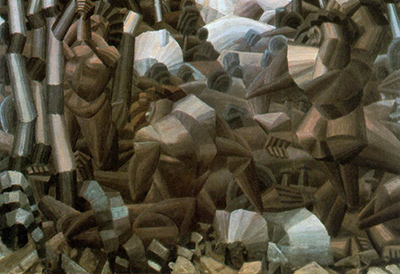
Fernand Léger, Nudes in the Forest. Early bodies and trees share the same constructed volumes.
Four stages of Fernand Léger’s career
These four periods group related changes; subjects and ways of working overlap their boundaries.
From constructed figures to abstraction
Paris and Cubism led towards paintings organised through contrasts of form and colour. [3]
Bodies, machines and the city
War drawings were followed by city paintings, monumental figures and experiments with film. [3]
A painting beyond the easel
Objects gained independence while architecture offered painting another scale and audience. [3]
Colour, leisure and shared labour
American experience preceded late builders, circus pictures and monumental decoration in France. [3]
Contrast becomes the engine
Léger’s early experimentation led towards the Contrasts of Forms of 1912–14. In the Centre Pompidou’s account, this group explores the opposition of lines, volumes and colours, sometimes approaching abstraction and sometimes admitting recognisable objects. His 1913 discussion of pictorial realism located a painting’s reality in its formal organisation.[3] This matters throughout his career: a painting can engage the world intensely while declining to reproduce its ordinary appearance.
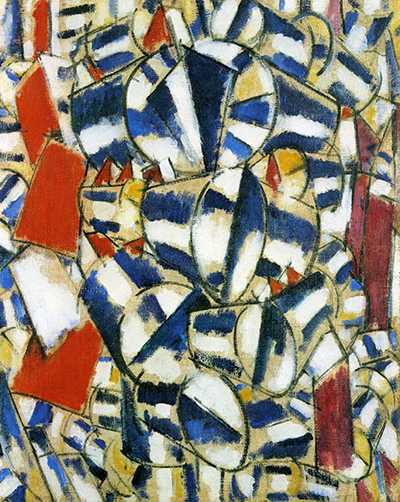
The Fondation Beyeler’s Contrast of Forms of 1913 offers a concentrated encounter with that freedom.[10] Blue, white and dark curved fragments tumble across a raw-looking field, interrupted by red planes. A rounded element seems to turn towards the light; beside it, a flat red shape abruptly stops the illusion of volume. The eye alternates between things that look solid and areas that insist upon the surface. No single object needs to be named for that exchange to hold attention.
The painting also rewards a slower look than its apparent velocity might suggest. Its repetitions never become exact duplicates. One white arc is narrow, another broad; a dark edge can support a form in one place and almost sever it in another. Léger creates energy through differences within recurrence. The picture feels constructed because the parts keep declaring their separate identities, even as they press together.
Contrast consequently means more than a bright palette or a pair of opposing colours. It can operate between round and angular, full and empty, crowded and open, heavy and buoyant. Once recognised, this principle helps connect periods that are often treated as separate styles. The quieter figures of the 1920s and the clearer outlines of the late paintings need not repeat the early canvases’ density to retain their force. They redistribute the differences on which that force depends.
War changes the stakes
During the First World War, Léger served as a sapper and stretcher-bearer. His encounters with fellow soldiers and mechanised destruction gave his later interest in workers a personal and historical foundation. The machine in his art carries knowledge of what technology can do to human beings as well as what it can make possible.[15]
The familiar image of Léger as an uncomplicated enthusiast for industrial progress becomes inadequate here. Christopher Green’s study of his wartime correspondence sets his admiration for the effectiveness of artillery beside his direct accounts of devastation at Verdun. Human attachment, technical efficiency and mass destruction occupy the same historical field.[15] That complexity is worth carrying into the bright postwar paintings rather than treating their energy as evidence that everything troubling had been forgotten.
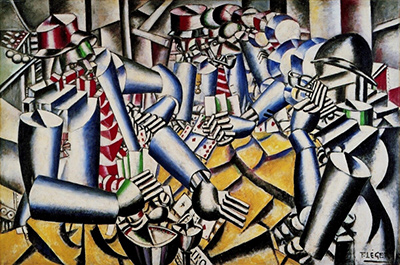
Drawing was one way of holding on to ordinary activity within extraordinary conditions. The Pompidou’s small Soldiers Playing Cards, executed near Verdun in 1916, belongs to the work that preceded the larger card-playing composition.[3] The subject turns attention towards bodies occupied with a shared task. Card play makes a temporary group: hands, objects and concentrated gestures establish a small working order. In Léger’s wider career, that concern with how people gather becomes as persistent as his fascination with modern equipment.
War thus altered the implications of a language that had already been developed. Geometric bodies were no longer only an adventurous answer to Cézanne or Cubism. The question of a person’s place within a larger structure had acquired a different urgency. Léger’s later scenes of collective life can be read with this in mind, while allowing each painting its own mood and purpose. Their breadth comes partly from the distance between the severity of his experience and the forms of ordinary life he continued to value.
The city enters painting
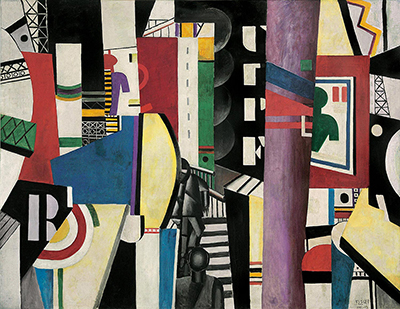
In The City of 1919, now in Philadelphia, Léger turned urban experience into a composition on an enveloping scale. The museum identifies letters associated with advertising, fragments of railings and metal girders among its signs of modern life. These elements do not add up to a topographical portrait of one street. They build a field of competing visual demands, with the breadth and immediacy of a screen or stage backdrop.[7]
The importance of this change extends beyond subject matter. A city is encountered in pieces: a sign above the head, a figure passing, a structure partly hidden by another structure. Léger gives such partial encounters compositional authority. The viewer no longer needs a single stable viewpoint from which everything falls into place. Recognition proceeds by interruption, much as attention moves between the separate claims of an urban street.
This also opens a different relationship between fine art and commercial images. The letter or coloured panel is useful because it already has a public existence. People encounter such forms before they enter a gallery. Léger can admit their directness and visibility into painting, then rearrange them according to a pictorial logic. Familiarity becomes the beginning of an experiment rather than a guarantee that the picture will be immediately easy.
With Cendrars, Léger made the 1919 book La Fin du monde filmée par l’Ange N.-D, joining writing and coloured imagery. Green places their collaboration within a dynamic alternative to more orderly developments of postwar Cubism.[15] The connection is valuable because it brings the city paintings into a conversation between media. Typography, narrative sequence and painting could all be ways of arranging modern attention.
Monumental bodies in everyday rooms
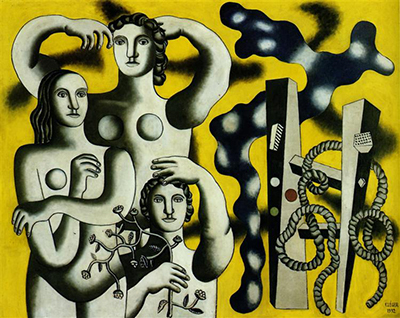
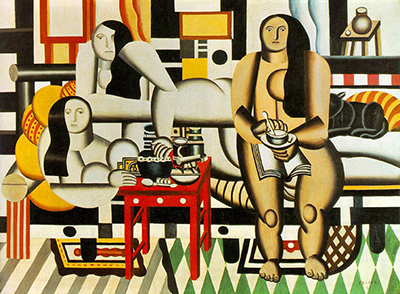
The speed of the city did not become Léger’s only register. In Three Women of 1921–22, at the Museum of Modern Art, the human figure gains an imposing stillness. MoMA’s current label places the women in a modern apartment and observes the relation between their metallic-looking bodies and the furniture around them.[8] The painting is an especially clear introduction to the strange coexistence of bodily mass and formal impersonality in his work.
Its red table, pale bodies, dark hair and patterned floor produce a series of distinct visual weights. Knees and shoulders are rounded almost to the point of becoming independent components. Straight furniture legs and rectangular background divisions keep those curves under pressure. The women’s presence is calm, yet the surrounding arrangement remains busy. A viewer can move from figure to furnishing without leaving the picture’s shared language of sharply defined parts.
The absence of expressive incident changes the way we meet these figures. They are not introduced through an unfolding drama or individual biography. Their scale, frontal presence and measured relation to one another do the work that a story might otherwise perform. A small action around the table can occupy the attention without determining the entire meaning of the scene. Monumentality becomes available to a domestic gathering.
Léger’s work of this period intersects with the search for order associated with Amédée Ozenfant and Le Corbusier, while continuing to develop its own treatment of objects and figures.[16] Looking across the career, the stillness of these interiors seems less an abandonment of modernity than a change of tempo. A body can be modern through its constructed clarity as well as its apparent motion. The room becomes a place where the human and manufactured worlds are made formally continuous.
Film and theatre test the same ideas
Léger’s curiosity about other media produced more than painted images of entertainment. He designed for the Ballets Suédois, first on Skating Rink in 1922, then on La Création du monde, premiered in Paris on 25 October 1923. The latter brought him together with Cendrars, composer Darius Milhaud and choreographer Jean Börlin in a project joining scenery, costume, music and movement.[17]
The theatre changes the relationship between a constructed figure and the world around it. A costume must be inhabited; a painted shape shares space with a moving person. The Biot museum’s account of La Création du monde describes Léger’s plans to conceal or neutralise the performers’ faces and to transform bodies through animal costumes. Its source imagery drew upon African art and a creation narrative mediated through Cendrars.[18] As Green observes, the ballet involved appropriation as well as recognition of African culture, a history that belongs alongside its formal inventiveness.[15]
Ballet mécanique, made in 1924 with Dudley Murphy, transferred a related interest in isolated elements to film.[1][3] MoMA describes how photographed kitchen utensils, repeated movement and a woman climbing stairs are transformed through editing.[19] A familiar object can become unfamiliar because it fills the frame or returns insistently. Sequence gives contrast a duration: the next image changes the force of the one just seen.
These projects clarify why Léger’s painted people can look almost puppet-like without being merely lifeless. Repetition, segmentation and unexpected scale offer ways of giving forms a new kind of activity. A face can become an image among images, while a utensil can command the attention normally reserved for a star. Film and theatre supplied different tests of an interest already present in the paintings: how to make separate elements act upon an audience.
Objects gain independence
Across the later 1920s and 1930s, Léger’s vocabulary expanded beyond the conspicuously mechanical. The Reina Sofía’s retrospective account traces the movement towards more organic forms, alongside the continuing simplification and monumentality of the figure.[16] Ropes, leaves and other everyday things could offer as much compositional energy as a wheel. Their usefulness lay in their contours, internal rhythms and relation to other shapes.
In his 1935 lecture on a new realism, excerpted by the Centre Pompidou, Léger argued for freeing the object from its subordinate place within an encompassing subject. He used the example of a tree: its bark, branches and leaves could each become material for pictorial investigation. He acknowledged the cinema close-up’s part in this change.[3] Enlarging or isolating something makes its shape newly available to a viewer who might normally pass it by.
This idea offers a helpful way to approach an unfamiliar Léger composition. Instead of solving it immediately as a scene, one can ask which forms demand inspection and how they are brought into relation. Does a curve return in another part of the picture? Does a broad field of colour hold something together or divide it? The work begins to open when the eye follows these decisions. A small object need not bear a hidden symbolic message to justify its prominence.
Nor does the organic vocabulary require a simple opposition between nature and industry. A branch can share a sweeping movement with a rope; a leaf may have the directness of a sign. Such relationships prevent his mechanical language from settling into a closed inventory. The world continues to supply new elements, and the picture tests what happens when they are detached from their habitual surroundings and given room to operate.
Painting for buildings and public audiences
Léger’s work with architects extended his concern with relationships into actual rooms and buildings. Museum Ludwig’s exhibition Painting in Space followed this activity through murals, private houses, churches, ships, exhibitions and unrealised schemes. It placed collaboration and the dialogue with built space at the centre of his achievement.[20] A painting in such a setting must act upon an environment that exists beyond its own edges.
The change of scale is therefore more than a matter of making a studio canvas larger. A wall has dimensions, interruptions, light and an audience moving past it. Colour can alter the experience of that wall; an assertive form can establish a rhythm across an architectural space. Léger’s preference for emphatic relationships becomes a practical resource here. The viewer may first encounter the work from a distance or while engaged in another activity.
For the 1937 Paris exposition, he made Le Transport des Forces for the Palais de la Découverte, working with pupils on a state commission concerned with the transformation of natural forces into electrical energy. The Biot museum’s dossier places this undertaking within the Popular Front context and his developing commitment to social art. The same exposition also involved photomontage collaborations with Charlotte Perriand and François Kollar.[21]
Teaching supplied another kind of shared space. Kuh describes his school in Paris, its international students and his work with Ozenfant, alongside lectures in Europe and the United States.[22] The studio could pass on habits of construction and observation without requiring a pupil to repeat the master’s subjects. His importance as a teacher belongs beside his importance as a collaborator: both roles made his ideas available through sustained work with other people.
His public ambitions cannot be measured solely by the recognisability of a depicted worker. They also concern where art appears, what it does to a room, and how long people have to live with it. A vivid arrangement might be encountered repeatedly before becoming familiar. This gives colour a social role without requiring every passage to deliver a verbal message. The formal experiment and the question of access meet in the conditions of looking.
America and a more buoyant world
Léger first visited the United States in 1931 and lived there during the Second World War, from 1940 to 1945.[1] The American years enlarged the geographical setting of his art without dissolving its established concerns. City spectacle, discarded machinery, landscape and bodies in motion offered fresh ways of thinking through contrast. His experience was broader than the image of New York as a perfect modern metropolis.
Katharine Kuh’s 1953 survey gives particular attention to his interest in abandoned farm machinery and the vegetation growing around it. It also follows the diver paintings from more modelled bodies towards flatter arrangements.[22] These strands belong together in a useful way. The machine is capable of becoming a relic, while a body can seem released from the weight that had made the earlier figures so imposing. Solidity ceases to be the only route to pictorial strength.
One can understand this as an expansion of the possibilities of a constructed body. A figure assembled from distinct shapes need not always stand upright on a floor. It can be carried through a composition by the connections between its parts and the surrounding intervals. In such a picture, open space becomes active. The viewer attends to the gaps between forms as well as to their boundaries.
The importance of America also reaches beyond the works Léger made there. The Fondation Beyeler’s 2008 exhibition examined his subsequent relevance to artists including Roy Lichtenstein, Robert Rauschenberg, Ellsworth Kelly and Al Held.[23] Those connections involve different responses to colour, assembly and the ordinary image. Léger’s contribution survives through questions that other artists could reopen, rather than through a single style that they all adopted.
Builders, leisure and the late public world
After the war, Léger’s public commitments continued alongside new work in monumental media. He joined the French Communist Party in 1945, a formal affiliation that followed his earlier Popular Front activity. Through Father Marie-Alain Couturier, he became involved in church decoration, including the mosaic at Assy and stained glass at Audincourt.[21] His artistic networks crossed the boundaries suggested by a simple political label.
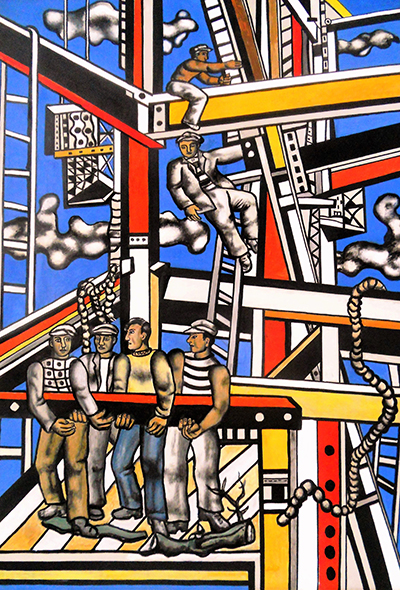
The Builders, in its final 1950 version at Biot, brings many of the career’s concerns into one striking encounter.[12] Straight beams divide the canvas, while bodies, clouds and a rope supply different kinds of curve. The lower figures form a compact group; above them, separate workers occupy the structure at different heights. The parts stay legible, yet the painting offers no neutral background against which the people can be considered alone. Their world is made of relations.
The figure seated high in the structure gives an especially vivid sense of the difference between the flexibility of a body and the hard geometry supporting it. Looking down through the picture, one encounters variations on that relation rather than a single repeated pose. Léger’s worker possesses a pictorial weight comparable to the manufactured environment. Labour becomes a subject for a large, carefully organised painting without being turned into a detailed account of a particular building operation.
The museum records Léger’s recollection of showing builder paintings in a Renault factory canteen: initial mockery gave way to a more sustained, everyday acquaintance with their colour.[12] The anecdote is valuable precisely because the encounter was uneven. Wanting a popular audience did not make understanding automatic. The paintings had to occupy the workers’ shared space and endure their scrutiny. Access was a relationship to be developed, with time as one of its materials.
Leisure, circus and outdoor gathering provide other forms of shared life in the late work. The Biot collection preserves the 1950 artist’s book Cirque, alongside drawings and studies for works in several media.[2] Circus offers an illuminating counterpart to construction: bodies coordinate, balance and perform within an organised setting. Across these themes, strength can be joined to ease, and an emphatic outline can describe pleasure as readily as work.
Fernand Léger, Construction Workers Final State. The late builders bring monumental figures into a shared task.
A career that exceeds the easel
Léger’s late experiments in ceramics at Biot, made with Roland Brice and his workshop, brought colour and form into material relief. After his death in 1955, Nadia Léger and Georges Bauquier developed the museum that opened there in 1960; their subsequent donation established its national collection.[2] Its range helps preserve a view of his career in which a drawing, a book, a ceramic and a monumental project belong to the same field of enquiry.
Series and variations are essential to that breadth. Kuh observed the difficulty of treating every group as a simple progression towards one largest, final painting.[22] Repetition can allow a new balance of colour, scale or spacing to be discovered. A familiar subject remains available for another trial. This working habit explains why an overview needs to leave room for differences within the apparently familiar Léger image.
The large retrospective organised across Paris, Madrid and New York in 1997–98 brought successive phases of his painting back into view; MoMA’s presentation included about eighty paintings and forty drawings.[16][24] Architecture, performance and the graphic arts broaden that picture further. His achievement is especially clear when the bold late figures are held in mind beside the compressed early abstractions. The visual language remained recognisable because he kept finding different tasks for it.
Léger makes modernity available as an experience of looking: divided, insistent, material, sometimes exhilarating and sometimes difficult to resolve. His forms give people and things a conspicuous presence, then ask how they can coexist. The result is an art in which a red table, a steel beam, a swimmer’s limb or a bright interval can help organise an entire world. Its lasting force lies in that capacity to turn the arrangement of a picture into a proposal about shared space.
Essential Fernand Léger works
Three Women
1921–22 · Three monumental figures turn a domestic room into a structure of bodies and things.[8]
The Mechanic
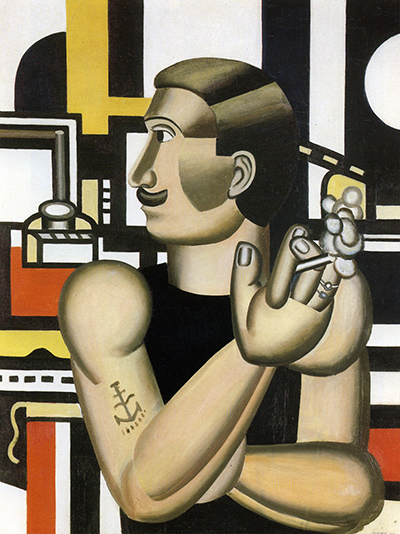
1920 · The worker at rest joins rounded bodily weight to a manufactured setting.[9]
Contrast of Forms
1913 · Volume, stripe and colour become the moving parts of an abstract picture.[10]
Nudes in the Forest
1909–1911 · Nudes and trees share the same heavy, interlocking construction.[11]
Construction Workers Final State
1950 · Four builders organise a common task within a steel framework.[12]
Mona Lisa with the Keys
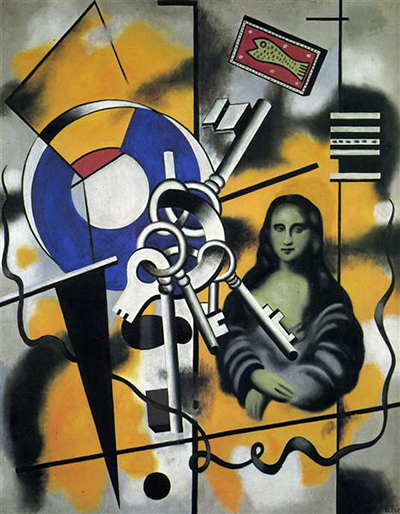
1930 · Oversized keys meet a reproduced portrait in an unexpected contrast.[13]
Grand Parade with Red Background
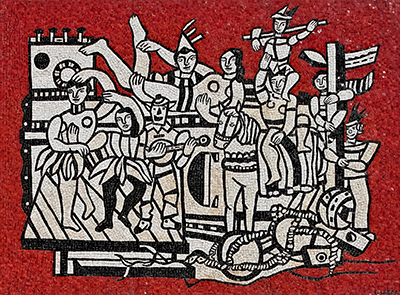
1953 · A circus company gathers around a horse, rope and emphatic red field.[14]
Léger in video
Explore abstraction, monumental painting and cinema through films from MoMA and the Centre Pompidou. These videos offer context for Léger’s wider work; the restoration film is in French.
Restaurer un… Fernand Léger
Follow conservation of Composition with Two Parrots, 1935–39, and look at painting on a monumental scale. French-language film.
Watch on YouTubeFernand Léger artworks directory
Works covered in these articles and further documented works. Studies and finished works have separate entries; alternate titles share an entry. This is not a catalogue raisonné.
| Name | Date | Medium |
|---|---|---|
| Acrobats and Clowns from Le Cirque | 1950 | |
| Adieu New York | 1946 | Painting |
| Ballet mécanique | 1924 | Film |
| Big Julie | 1945 | Painting |
| Builders with Aloe | 1951 | Painting |
| Charlot cubiste | 1924 | Sculpture |
| Chimneys on Rooftops | 1911 | Painting |
| Cirque (artist’s book) | 1950 | |
| Composition | 1929 | Painting |
| Composition (Study for Nude Model in the Studio) | 1912 | Drawing |
| Composition of Three Figures | 1932 | Painting |
| Composition with Two Parrots | 1935–39 | Painting |
| Construction Workers Final State | 1950 | Painting |
| Contrast of Forms | 1913 | Painting |
| Derrière le miroir, nos.121–122 (posthumous publication, includes a lithograph after Léger) | 1960 | |
| Drawing for The Card Game | 1917 | Drawing |
| Drawing for The Staircase | 1913 | Drawing |
| En attendant le départ | 1914 | Drawing |
| Grand Parade with Red Background | 1953 | Painting |
| J’ai tué (illustrated book) | 1918 | |
| La Cocarde, l’avion brisé | About 1916 | Drawing |
| La Couseuse | about1910 | Painting |
| La Fin du monde filmée par l’Ange N.-D. (illustrated book) | 1919 | |
| Les Femmes au bouquet (Women with a Bouquet) | 1921 | Painting |
| Man and Woman | 1921 | Painting |
| Man in Profile with Rope: Study for The Constructors | 1950/1 | Drawing |
| Man in the Blue Hat | 1937 | Painting |
| Matinée d’ivresse, from Les Illuminations | 1949 | |
| Mechanical Elements | 1918–23 | Painting |
| Mechanical Elements (Metropolitan Museum) | 1920 | Painting |
| Men in the City | 1919 | Painting |
| Mes voyages (posthumous illustrated book) | 1960 | |
| Mona Lisa with the Keys | 1930 | Painting |
| Nude Model in the Studio | 1912–13 | Painting |
| Nudes in the Forest | 1909–1911 | Painting |
| Propellers Second State | 1918 | Painting |
| Reading | 1924 | Painting |
| Soldier with a Pipe | 1916 | Painting |
| Soldiers Playing Cards | 1917 | Painting |
| Soldiers Playing Cards (front drawing) | 1916 | Drawing |
| Standing Nude, Rear View | 1911 | Drawing |
| Still Life with a Beer Mug | 1921–2 | Painting |
| Still Life with Tankard | 1921 | Drawing |
| Study for The Aviator | 1920 | Drawing |
| The Acrobat and his Partner | 1948 | Painting |
| The Acrobats in the Circus | 1918 | Painting |
| The Alarm Clock | 1914 | Painting |
| The Chalices and the Sponge, stained-glass model | 1950 | Drawing |
| The City | 1919 | Painting |
| The Disks in the City | 1920 | Painting |
| The Mechanic | 1920 | Painting |
| The Railway Crossing | 1919 | Painting |
| The Three Musicians | 1944, after a 1924–25 drawing | Painting |
| The Wheels | 1945 | Drawing |
| Three Women | 1921–22 | Painting |
| Two Women Holding Flowers | 1954 | Painting |
| Umbrella and Bowler | 1926 | Painting |
| Verdun, dessin du front | About 1915 | Drawing |
| Woman with a Book | 1923 | Painting |
| Woman: Costume Design for La Création du monde | c.1922–23 | Drawing |
Discussion
Look again at the images and ideas explored in Fernand Léger. These editorial prompts invite your observations.
Reader Insights
Which changes become clearest when you compare Nudes in the Forest with The Builders?
Where do Léger’s figures remain weighty even as their surroundings change?
Which medium most changes how you encounter his forms: painting, film or print?
Join the Conversation
Share a detail, comparison or question about Fernand Léger below.
References
- Rachel Boate, “Fernand Léger (1881–1955)”, Metropolitan Museum of Art, May 2018. View source.
- Musée national Fernand Léger, “La collection du musée national Fernand Léger”. View source.
- Centre Pompidou, “Fernand Léger” teaching dossier, especially “Les contrastes de formes,” “Soldats jouant aux cartes,” “Le cinéma,” and the excerpt from “Un nouveau réalisme, la couleur pure et l’objet.” View source.
- Metropolitan Museum of Art, Sabine Rewald, Cubism. View source.
- Museum of Modern Art, Words in Freedom: Futurism at100. View source.
- Centre Pompidou, Marie-José Rodriguez, L’orphisme. View source.
- Philadelphia Museum of Art, The City, 1919, object and interpretive record. View source.
- Museum of Modern Art, Three Women, 1921–22, object record and 2021 gallery label. View source.
- National Gallery of Canada, The Mechanic, 1920, accession 14985, collection details and interpretive paragraph; French collection record, Le mécanicien. View source.
- Fondation Beyeler, Contraste de formes, 1913, Inv.90.6. View source.
- Kröller-Müller Museum, Nus dans la forêt / Nude Figures in a Forest, collection record KM 101.045. Current date, medium, identifier, curatorial sections “Distinctive cubist style”, “Geometric shapes” and “‘Battle of volumes’”, and museum reproduction. View source.
- Musée national Fernand Léger, “Les années 50, les constructeurs”, including Les Constructeurs (définitif), 1950, MNFL 94001. View source.
- Musée national Fernand Léger, La Joconde aux clés, collection record and museum commentary (French): object data, owning museum image, artist recollection, sardine tin and symbolic interpretations. The artist’s recollection is consulted as reproduced by the museum; the page does not date it. View source.
- Musée national Fernand Léger, La Grande Parade sur fond rouge, complete object record and displayed reproduction: 1953, oil on canvas, 114.5 × 156.2 cm, inventory MNFL 96006; donation of Nadia Léger and Georges Bauquier. View source.
- Christopher Green, “La Fin du monde in Context”, Metropolitan Museum of Art, 3 June 2026, especially “Léger as combatant,” “Alternative modernisms,” and “La Fin du monde and avant-garde populism.” View source.
- Museo Nacional Centro de Arte Reina Sofía, “Fernand Léger,” 1997–98 retrospective. View source.
- Musée national Fernand Léger, “Léger et La Création du monde. Un ballet d’avant garde”, 2026 exhibition account. View source.
- Musée national Fernand Léger, Étude d’un costume pour le ballet La Création du monde, MNFL 95004. View source.
- Museum of Modern Art, Ballet mécanique, 1924, including excerpt from Circulating Film Library Catalogue (1984), p.167. View source.
- Museum Ludwig, “Fernand Léger: Malerei im Raum”, 2016 exhibition account. View source.
- Musée national Fernand Léger, Le Transport des Forces, exhibition press dossier, 2021, printed pp.4, 19, 22–23. View source.
- Katharine Kuh, Léger, Art Institute of Chicago in collaboration with MoMA and the San Francisco Museum of Art, 1953, especially printed pp.7, 54–55, 60–61. Selected sections consulted. View source.
- Fondation Beyeler, Fernand Léger: Paris–New York, gallery guide, 2008, introduction and entries 1–7. View source.
- Museum of Modern Art, “Fernand Léger,” retrospective exhibition record, 15 February–12 May 1998. Exhibition record consulted; full Carolyn Lanchner catalogue not consulted. View source.