 by Tom Gurney
Tom Gurney BSc (Hons) is an art history expert with over 20 years experience
Published on June 19, 2020 / Updated on November 1, 2026
Email: tomgurney1@gmail.com / Phone: +44 7429 011000
The Railway Crossing (Sketch): Introduction
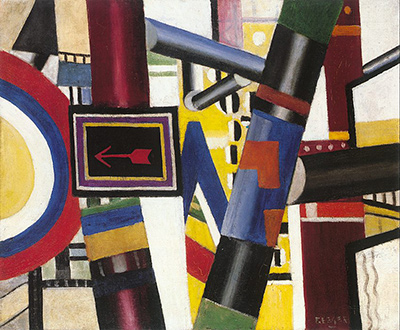
A small red arrow points left through a crowded assembly of bars, tubes and coloured panels. Its instruction is wonderfully clear; the space around it is much harder to navigate. In Fernand Léger’s The Railway Crossing (Sketch), a thick diagonal cylinder cuts across the centre, a circular form pushes in from the left edge, and narrow strips of brightness appear between dark uprights. Each part seems firmly shaped, yet together they keep the eye moving. Painted in 1919, this oil on canvas belongs to the Art Institute of Chicago and measures 54.1 by 65.7 centimetres. [1]
The title suggests a place where routes meet. Léger gives that encounter a life inside the painting. Directions compete. A horizontal beam crosses a sloping tube; straight edges confront broad curves; a flat sign interrupts the suggestion of rounded metal. The railway crossing becomes an experience of visual rhythm, built from changes in direction, colour and apparent weight.
At a Glance
This work across Fernand Léger’s career
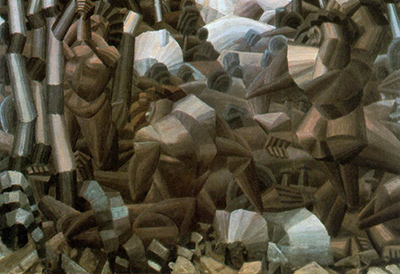
Nudes in the Forest
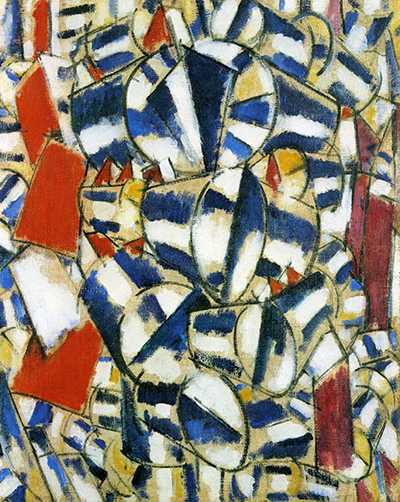
1909–1911 [2]Contrast of Forms
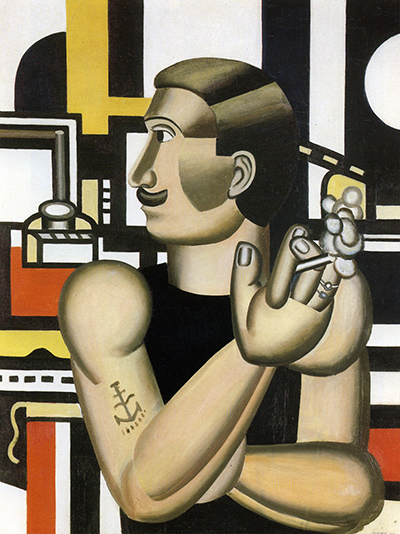
1913 [3]The Mechanic
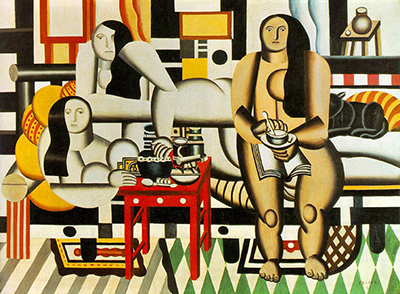
1920 [5]Three Women
1921–22 [6]Contents
- Follow the arrow
- Bars, bands and curved metal
- A shallow space full of interruptions
- An oil study with a deliberate structure
- A picture with several names
- Modern signs and the language of contrast
Follow the arrow
The sign just left of centre offers the most immediate point of entry. Against its black ground, a red shaft, arrowhead and shaped tail form a compact horizontal emblem. Thin coloured borders enclose it, with yellow providing a particularly sharp light against the darkness. The surrounding frame makes the sign appear self-contained, like a small picture set into the larger one.
Follow its direction and the eye reaches the great concentric bands cut off at the left edge. Red, blue, pale white and yellow bend around a centre that lies partly beyond the picture. Their smooth curves answer the arrow’s pointed angles. The sign can send us towards this circular shape, but the shape turns our attention back into the surrounding pattern. Looking becomes a circuit rather than a single journey to a destination.
The arrow also changes the character of the forms nearby. Before noticing it, we might read the whole canvas as an arrangement of coloured geometry. Once a familiar public sign appears, the adjacent bars acquire possible practical associations. They begin to suggest structures through which someone might pass or equipment encountered beside a route. Recognition spreads out from this small, legible detail, even though the rest of the painting retains its ambiguity.
Its position matters as much as its meaning. The sign sits about halfway down the picture, a little left of centre. It neither dominates the entire canvas nor disappears among the other fragments. The darkness behind the arrow gives it a moment of visual quiet. Around that pause, the larger forms can appear still more insistent.
Bars, bands and curved metal
The central diagonal is one of the painting’s strongest organising features. It rises from the lower middle towards the upper right, widening into a substantial dark and green mass near the top. Blue sections, red-orange patches and black passages divide its length. Pale highlights make parts of it look curved and solid, while its coloured bands keep drawing attention to the painted surface.
A different cylinder drops almost vertically behind the sign. Its deep red surface carries a lighter streak that gives it a rounded appearance. These two large forms establish distinct rhythms: the steady upright on the left and the energetic slant across the centre. Smaller bars cross between them, multiplying the possible directions through the image.
Near the top, a blue-grey beam runs diagonally down towards the right. Beneath it is a shorter, dark rounded form with a pale edge. Lower down, a broad black horizontal pushes in from the right. None of these elements needs to be assigned a precise engineering function for their relationship to be felt. Their overlap supplies the pressure of an assembled structure, with each new piece bracing, crossing or interrupting another.
Repeated bands help bind this apparent variety together. Red appears on the circular form, the central cylinder and the tall panels towards the right. Yellow occurs in the sign’s border, in bright background passages and in small sections between darker shapes. Blue moves from a curved ring at the left into larger sloping forms nearer the middle. Colour travels across gaps where a continuous object cannot be followed.
Small details give the large masses a scale of their own. Along the right-hand red structure runs a short row of pale circular marks. Elsewhere, thin black divisions create miniature grids and stripes. These measured repetitions make the broad cylinders seem heavier and more forceful. A tiny interval between two marks can answer the much larger interval between two beams.
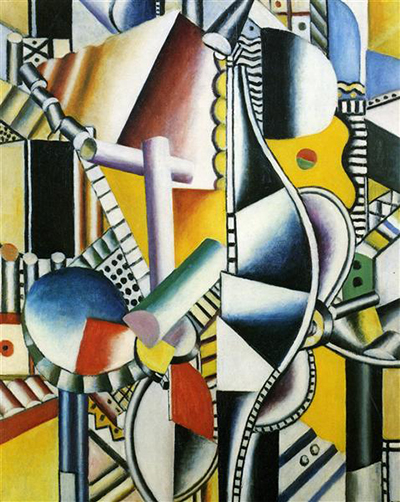
Fernand Léger, Propellers Second State. The propeller picture offers a comparison of curved metal and crowded edges.
A shallow space full of interruptions
The painting provides plenty of overlap, but little room to stand back. The large left-hand curve continues beyond the frame. At the top, the diagonal mass is cut short; at the right, bars enter from outside the visible field. Léger makes the composition feel like a selected portion of a larger activity, while ensuring that every cropped form also presses against the boundaries of the canvas.
White and yellow passages between the objects might initially seem to open a way through. The tall pale strip beside the sign, for example, offers a sudden change from the dense red and black around it. Yet these bright areas have their own sharp contours and strong shapes. Instead of dissolving into a distant atmosphere, they often meet the darker elements with equal force.
That produces an absorbing uncertainty between depth and flatness. A shaded cylinder seems to project towards us, but a clean red or blue patch laid across it can bring it back into the surface pattern. A dark beam suggests weight; the rectangular colour beside it asserts a flat division of the picture. The eye moves repeatedly between handling an imaginary solid and registering a painted shape.
There is a similar tension in the relationships between individual parts. The sign appears in front of the red upright, while other crossings imply further layers. These local clues remain persuasive without joining into a continuous, easily measured space. We can follow one overlap at a time. Attempting to reconstruct the whole arrangement sends us back to another edge, another colour, another interruption.
The sense of motion comes from this changing attention. No blurred train needs to rush across the canvas. The long diagonal carries the gaze upwards, the left-pointing arrow sends it sideways, and the circular bands bend it around. The painting remains physically still while its parts generate competing impulses to move.
An oil study with a deliberate structure
Chicago identifies this work as an oil study for The Level Crossing (1919). Léger explored the subject through drawings and painted sketches. The reverse bears the words Le Passage à niveau and Esquisse, French for sketch. [1]
Here, “sketch” describes the painting’s place in that development. It is still a substantial arrangement in oil on canvas, with definite contours, repeated colour relationships and a strongly balanced distribution of forms. Looking at it as a study invites attention to the decisions a composition requires: where to place its clearest sign, how much weight to give a diagonal, and how to sustain movement around a small rectangular field.
The arrow provides a useful example. Its isolated black panel could easily become the picture’s sole centre of interest. Léger counters that concentration with the large curved fragment at the left and the massive sloping form towards the right. Smaller strips and marks keep those major elements connected. The whole canvas becomes a testing ground for the balance between a readable motif and a more widely distributed rhythm.
The modest horizontal format also makes the congestion unusually concentrated. The eye can take in the main forms together, then discover how many changes of direction occur within them. The study has its own density and pace, while giving us an arrangement Léger could develop on a larger scale.
A picture with several names
Chicago’s record lists the work as Abstraction in exhibitions of 1929 and 1931, and as Follow the Arrow in later publications. Rue Winterbotham Carpenter owned it from the late 1920s; her daughter gave it to the Art Institute in 1953. [1]
Those alternative titles offer revealing ways into the same arrangement. Abstraction encourages attention to the forms before the setting. Follow the Arrow singles out a recognisable motif and turns looking into an action. The Railway Crossing supplies a wider subject within which the fragments might belong. The image can sustain all three approaches because its most legible detail remains embedded in a structure that exceeds its simple instruction.
Modern signs and the language of contrast
The year 1919 places the sketch alongside Léger’s renewed engagement with the modern city after the First World War. The Centre Pompidou’s account of this period describes bright colours, letters and signs drawn from posters and traffic panels entering his urban paintings. [10] That context makes the little arrow especially telling. A public mark intended to direct attention becomes one of the means by which the painter directs ours.
James Stein’s Philadelphia Museum of Art teaching guide discusses the competing patterns, overlapping forms and bold graphics of Léger’s separate painting The City, also made in 1919. It relates these to the fragmented experience of urban life. [11] In the railway sketch, that wider concern takes a concentrated form: a few forceful motifs bring together the clarity of a sign and the difficulty of grasping a crowded environment at once.
The differences within this picture are as important as the modern associations of its subject. Black intensifies yellow. A broad curve gives a straight edge greater severity. A smoothly shaded passage makes an adjacent flat patch look flatter. The Centre Pompidou traces Léger’s systematic exploration of opposing lines, colours and volumes to his pre-war Contrasts of Forms, and reproduces his 1913 account of pictorial realism as an ordering of these elements. [10] This earlier thinking helps explain why the crossing can remain compelling even where its objects resist identification.
There is a longer continuity behind that independence of pictorial structure. In his study of Cézanne and Léger, the scholar Jean Arrouye examines how Léger developed relationships between geometric form, colour and depth. His discussion of a Level Crossing concerns a different painting, dated 1912, whose landscape still includes recognisable houses and trees. [12] The comparison offers a useful measure of the later sketch’s concentration. Here the close encounter of bars, sign and curves takes up the field, bringing the problem of how forms meet to the front of our attention.
The Chicago catalogue likens the interplay of volumes and flat shapes to moving pistons. [1] The analogy is most productive as a way of looking: one part appears to push against another, and repeated shapes suggest coordinated energy. The visible relationships carry the effect. A viewer can feel the rhythm without turning the composition into a diagram of a particular machine.
Return finally to the red arrow. Its instruction remains simple, but its place in the picture becomes richer with looking. It is an everyday sign, a sharply coloured shape, an interruption in a vertical mass and a link to the circular bands beside it. Léger makes these roles coexist. The crossing’s energy lies in the constant exchange between a detail we recognise and a larger arrangement that asks us to keep finding our way.
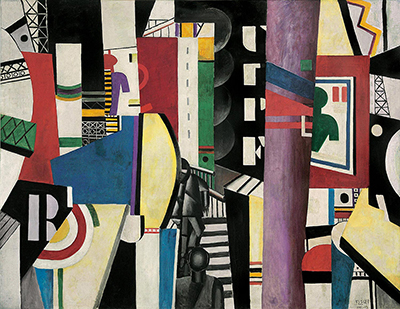
Fernand Léger, The City. The larger urban canvas broadens the encounter between lettering, architecture and the moving eye.
Léger in video
Explore abstraction, monumental painting and cinema through films from MoMA and the Centre Pompidou. These videos offer context for Léger’s wider work; the restoration film is in French.
Restaurer un… Fernand Léger
Follow conservation of Composition with Two Parrots, 1935–39, and look at painting on a monumental scale. French-language film.
Watch on YouTubeFernand Léger artworks directory
Works covered in these articles and further documented works. Studies and finished works have separate entries; alternate titles share an entry. This is not a catalogue raisonné.
| Name | Date | Medium |
|---|---|---|
| Acrobats and Clowns from Le Cirque | 1950 | |
| Adieu New York | 1946 | Painting |
| Ballet mécanique | 1924 | Film |
| Big Julie | 1945 | Painting |
| Builders with Aloe | 1951 | Painting |
| Charlot cubiste | 1924 | Sculpture |
| Chimneys on Rooftops | 1911 | Painting |
| Cirque (artist’s book) | 1950 | |
| Composition | 1929 | Painting |
| Composition (Study for Nude Model in the Studio) | 1912 | Drawing |
| Composition of Three Figures | 1932 | Painting |
| Composition with Two Parrots | 1935–39 | Painting |
| Construction Workers Final State | 1950 | Painting |
| Contrast of Forms | 1913 | Painting |
| Derrière le miroir, nos.121–122 (posthumous publication, includes a lithograph after Léger) | 1960 | |
| Drawing for The Card Game | 1917 | Drawing |
| Drawing for The Staircase | 1913 | Drawing |
| En attendant le départ | 1914 | Drawing |
| Grand Parade with Red Background | 1953 | Painting |
| J’ai tué (illustrated book) | 1918 | |
| La Cocarde, l’avion brisé | About 1916 | Drawing |
| La Couseuse | about1910 | Painting |
| La Fin du monde filmée par l’Ange N.-D. (illustrated book) | 1919 | |
| Les Femmes au bouquet (Women with a Bouquet) | 1921 | Painting |
| Man and Woman | 1921 | Painting |
| Man in Profile with Rope: Study for The Constructors | 1950/1 | Drawing |
| Man in the Blue Hat | 1937 | Painting |
| Matinée d’ivresse, from Les Illuminations | 1949 | |
| Mechanical Elements | 1918–23 | Painting |
| Mechanical Elements (Metropolitan Museum) | 1920 | Painting |
| Men in the City | 1919 | Painting |
| Mes voyages (posthumous illustrated book) | 1960 | |
| Mona Lisa with the Keys | 1930 | Painting |
| Nude Model in the Studio | 1912–13 | Painting |
| Nudes in the Forest | 1909–1911 | Painting |
| Propellers Second State | 1918 | Painting |
| Reading | 1924 | Painting |
| Soldier with a Pipe | 1916 | Painting |
| Soldiers Playing Cards | 1917 | Painting |
| Soldiers Playing Cards (front drawing) | 1916 | Drawing |
| Standing Nude, Rear View | 1911 | Drawing |
| Still Life with a Beer Mug | 1921–2 | Painting |
| Still Life with Tankard | 1921 | Drawing |
| Study for The Aviator | 1920 | Drawing |
| The Acrobat and his Partner | 1948 | Painting |
| The Acrobats in the Circus | 1918 | Painting |
| The Alarm Clock | 1914 | Painting |
| The Chalices and the Sponge, stained-glass model | 1950 | Drawing |
| The City | 1919 | Painting |
| The Disks in the City | 1920 | Painting |
| The Mechanic | 1920 | Painting |
| The Railway Crossing | 1919 | Painting |
| The Three Musicians | 1944, after a 1924–25 drawing | Painting |
| The Wheels | 1945 | Drawing |
| Three Women | 1921–22 | Painting |
| Two Women Holding Flowers | 1954 | Painting |
| Umbrella and Bowler | 1926 | Painting |
| Verdun, dessin du front | About 1915 | Drawing |
| Woman with a Book | 1923 | Painting |
| Woman: Costume Design for La Création du monde | c.1922–23 | Drawing |
Discussion
Look again at the images and ideas explored in The Railway Crossing (Sketch). These editorial prompts invite your observations.
Reader Insights
What becomes easier to notice in The Railway Crossing when you compare it with The City?
Where does the comparison with Propellers Second State reveal the clearest change in Léger’s approach?
Which detail would you follow first when returning to the work, and why?
Join the Conversation
Share a detail, comparison or question about The Railway Crossing (Sketch) below.
References
- Art Institute of Chicago, The Railway Crossing (Sketch), 1919, reference 1953.341. Collection details, inscriptions and the reproduced entry from Master Paintings in the Art Institute of Chicago (2013), p. 118. Consulted in the saved institutional page capture, 31 October 2026; the live page returned an access error during this session. View source.
- Kröller-Müller Museum, Nus dans la forêt / Nude Figures in a Forest, collection record KM 101.045. Current date, medium, identifier, curatorial sections “Distinctive cubist style”, “Geometric shapes” and “‘Battle of volumes’”, and museum reproduction. View source.
- Fondation Beyeler, Contraste de formes, Fernand Léger, current collection record, Inv.90.6: date, medium, dimensions, collection and signature on reverse. View source.
- Philadelphia Museum of Art, The City, 1919, collection record and interpretation; A. E. Gallatin Collection, 1952-61-58. View source.
- National Gallery of Canada, The Mechanic, 1920, accession 14985, collection details and interpretive paragraph; French collection record, Le mécanicien. View source.
- The Museum of Modern Art, Fernand Léger. Three Women. 1921–22, collection record, object 189.1942: artwork image, metadata, 2021 gallery label, publication excerpt, installation history and provenance. View source.
- Musée national Fernand Léger, La Joconde aux clés, collection record and museum commentary (French): object data, owning museum image, artist recollection, sardine tin and symbolic interpretations. The artist’s recollection is consulted as reproduced by the museum; the page does not date it. View source.
- Musée national Fernand Léger, “Les années 50, les constructeurs”, complete Les Constructeurs (définitif) entry and accompanying museum image: title, 1950 date, oil on canvas, 300 × 228 cm, inventory MNFL 94001, 1969 donation and museum-mediated Renault-canteen recollection. View source.
- Musée national Fernand Léger, La Grande Parade sur fond rouge, complete object record and displayed reproduction: 1953, oil on canvas, 114.5 × 156.2 cm, inventory MNFL 96006; donation of Nadia Léger and Georges Bauquier. View source.
- Centre Pompidou, Fernand Léger, educational dossier, 2008, introductory discussion of modernity, “Les contrastes de formes” and “La ville.” Consulted in the saved text capture, 31 October 2026; in French. View source.
- James Stein, Léger: Modern Art and the Metropolis: A Guide for Students and Teachers, Philadelphia Museum of Art, 2013, pp. 2, 4 and 8. Consulted in the saved PDF text capture, 31 October 2026. View source.
- Jean Arrouye, “Du village à la forêt – Cezanne et Léger”, lecture given in 1995, published by Société Cézanne, 13 November 2017. Passages on constructive contrasts, the 1912 Le passage à niveau and Contrastes de formes. Consulted in the saved text capture, 31 October 2026; in French. View source.