 by Tom Gurney
Tom Gurney BSc (Hons) is an art history expert with over 20 years experience
Published on June 19, 2020 / Updated on November 1, 2026
Email: tomgurney1@gmail.com / Phone: +44 7429 011000
Big Julie: Introduction
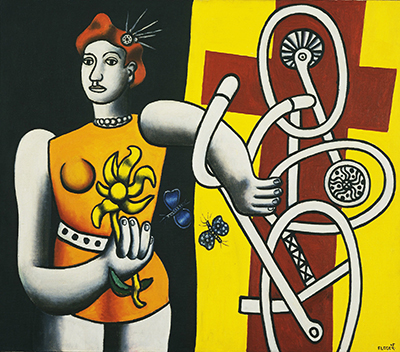
A woman in a brilliant orange top holds a yellow flower while her other arm reaches into a tangle of bicycle parts. Her pale limbs have the weight of sculpture; the bicycle wheels stretch into white loops against a yellow ground. Two blue butterflies occupy the narrow interval between them. Fernand Léger brings these very different things into a single, emphatic encounter in Big Julie, an oil painting of 1945 now in the Museum of Modern Art, New York. [1]
We recognise a woman with a bicycle immediately, yet following the individual parts unsettles that first impression. The machine seems turned and opened out; the woman is assembled from powerful rounded sections. A red cross and broad areas of black and yellow establish a clear design before every object has been identified.
At a Glance
This work across Fernand Léger’s career
Nudes in the Forest
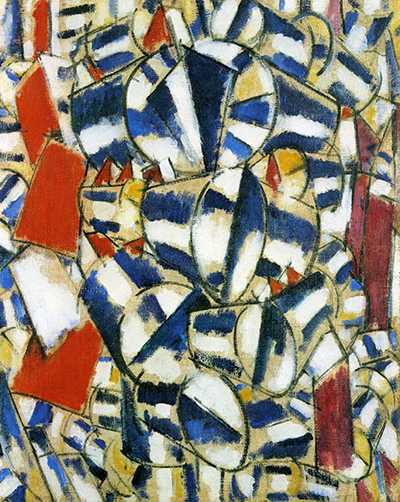
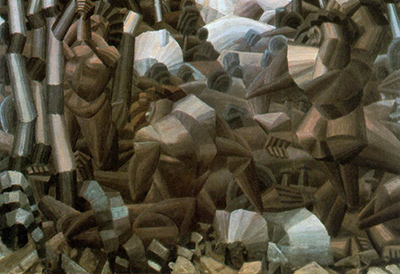
1909–1911 [2]Contrast of Forms
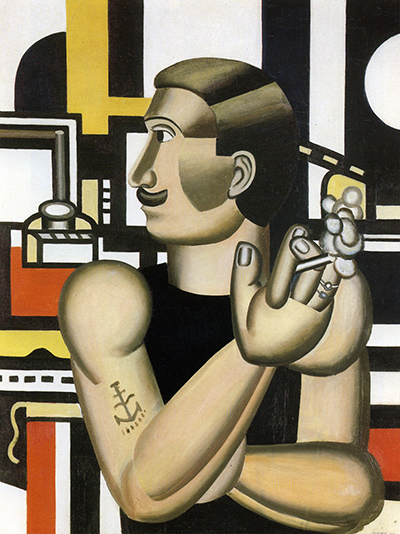
1913 [3]The Mechanic
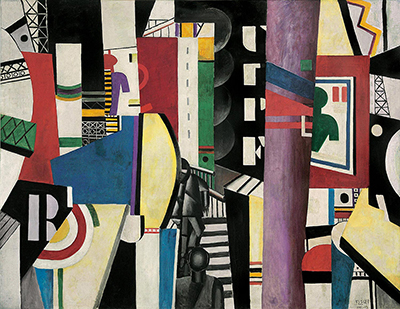
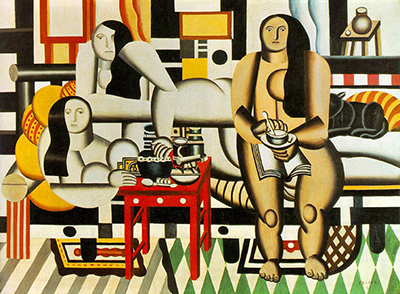
1920 [5]Three Women
1921–22 [6]Contents
- Meeting Julie
- A bicycle opened into shapes
- Orange, yellow, black and red
- The flower and the butterflies
- An American painting of 1945
- Stillness with energy inside it
Meeting Julie
Julie fills the left side of the canvas, from her red-orange headwear near the upper edge to the pale forms cut off at the bottom. The cropping brings her close. We have no stretch of path or surrounding scenery through which to approach her, and little room in which to imagine her taking a step. Her presence depends on the breadth of her shoulders, the sweep of her arms and the frontal exposure of her face.
The face is surprisingly composed amid the busy curves around it. Dark outlines describe the eyebrows, eyes, long nose and small mouth with almost diagrammatic economy. Subtle grey shading gives the head volume, especially around the cheek and neck, while the eyes turn slightly towards our left. This small shift prevents the frontal figure from becoming entirely rigid. Her attention seems to extend beyond the rectangle even as her body commands its surface.
Small details establish their own rhythms. A close necklace repeats a row of pale beads, while black dots punctuate a white belt. On her headwear, a circular ornament sends out a spray of thin lines. The dots and radiating strokes make a lively contrast with the broad, mostly uninterrupted orange of her torso. They also anticipate the circular details inside the bicycle forms across the picture.
Léger's title gives the figure the familiarity of a first name. The current MoMA record calls the work Big Julie, while La grande Julie appears in the Fondation Beyeler's exhibition guide. That guide distinguishes it from a smaller version called Julie, la belle cycliste. [1] [10] Here the encounter is with a painted presence: a distinctive figure whose individuality lies in her gaze, clothes and gestures rather than an accompanying life story.
A bicycle opened into shapes
The bicycle occupies almost as much attention as Julie. Its three conspicuous ovals turn in different directions: one rises near the upper edge, one stretches across the middle right, and another extends beyond the bottom. Thick pale bands, bounded by black, give them a firm identity even where their connections become difficult to follow. Smaller radial patterns make the upper and middle loops read as wheels, while a long diagonal bar cuts across the lower assembly.
Trying to reconstruct a rideable machine is less rewarding than tracing its visual connections. A curve passes behind a limb, meets a straight section and emerges as another loop. The eye keeps changing direction. Concentrated vertical, horizontal and diagonal movements give the bicycle an energy independent of any rider.
The Fondation Beyeler guide reads this arrangement as a largely dismantled bicycle, paired with a body constructed limb by limb. It identifies Julie's outstretched arm as the link joining the human and mechanical elements into an assemblage. [10] That interpretation is particularly persuasive at the centre of the picture. The hand is visible, with individually marked fingers and nails, but its grip sits among so many intersecting contours that flesh and apparatus become difficult to disentangle at a glance.
Look back along that arm towards the shoulder. The upper part projects almost horizontally, then the forearm drops towards the hand. Shading makes the broad sections swell, but their abrupt joins give the arm the character of something fitted together. The body shares the bicycle's logic of connected pieces while retaining the softness of a rounded surface.
The contrast between these two kinds of construction remains important. Julie's arms acquire weight through transitions from white to grey and near-black. Many bicycle bands stay comparatively flat and white. The hand at their meeting point negotiates between the two: a substantial human form curls around an arrangement of crisp linear shapes.
Orange, yellow, black and red
The broadest division in the painting is between the near-black field around Julie and the intense yellow surrounding the bicycle. This places each group against a ground that makes it strongly visible. The pale figure stands out against darkness, while the black edges of the machine bite into yellow. Orange holds the left side together; red gives the right side an underlying structure.
The red cross behind the bicycle is especially effective because it can be read so quickly. Its broad arms supply a stable pattern beneath the overlapping ovals. Straight edges remain visible between the curves, allowing the eye to recover a simple framework whenever the machine becomes confusing. Katharine Kuh, writing about this painting in her 1953 Léger catalogue, treats the cross as a visual device without symbolic significance. She also draws attention to the way he turns an everyday bicycle into interwoven ovals. [11]
The yellow presses forward between the white bands, making small openings seem almost as bright and active as the forms enclosing them. On the left, black creates a different effect. It lets the thin stalk of a butterfly and the outline of a shoulder remain legible without supplying a measurable distance behind them.
These grounds do not establish a single outdoor setting. There is no horizon to place the woman on a road, and the red cross provides no convincing architectural location. Instead, the background colours regulate how we see the things in front of them. The scene feels complete as a relationship between surfaces, contours and volumes, even while its physical location remains open.
Colour also crosses the apparent division of subjects. The orange of Julie's clothing has an affinity with the red behind the bicycle. Pale arms answer pale loops. Black outlines bind both sides. These repetitions give coherence to a composition whose objects otherwise seem to obey different rules of space and movement.
The flower and the butterflies
The flower provides another kind of turning form. Its thick yellow petals bend around a round centre, some lifting upwards, others curling down. Its green leaves and stem continue below the raised hand. Set against orange, it remains emphatic without needing the large expanse given to the bicycle. The folded petals produce a compact movement that answers the far larger loops on the right.
Julie holds the flower with a peculiar mixture of delicacy and strength. Her fingertips rise beside its stem, but the arm supporting them sweeps across her body in a broad, heavy curve. The hand seems almost oversized for the task. This imbalance makes the gesture memorable: a massive body has paused to attend to something small.
The two butterflies sharpen that sense of a pause. One lies chiefly against the dark field, with blue wings edged in a lighter colour. The other, over yellow, has spotted wings. Their small bodies and fine appendages introduce a scale of mark that would be easy to overlook among the larger forms. Once noticed, they make the space between woman and bicycle feel inhabited.
The butterflies also prevent the composition from dividing neatly into a human half and a mechanical half. They hover across the interval, encouraging the eye to pass between orange, black and yellow. Their irregular wing shapes contrast with the circular wheel centres, yet both kinds of detail have a decorative intricacy. Nature and machinery become neighbours through the way Léger paints them.
The Beyeler guide associates the flower, butterflies and cycling subject with recreation outside the city, and connects that leisure theme with Léger's later work in France. It also notes the striking absence of an actual landscape behind Julie. [10] This helps explain the painting's particular atmosphere: a suggestion of time outdoors survives within an arrangement of abstract colour fields.
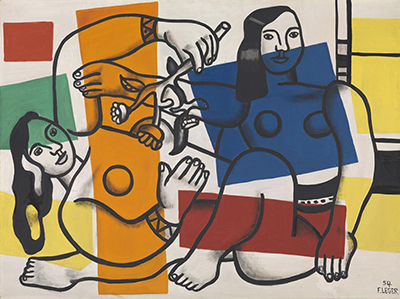
Fernand Léger, Two Women Holding Flowers. The flower becomes part of a different arrangement of linked bodies and mobile colour.
An American painting of 1945
Léger lived in the United States from 1940 to 1945, during the Second World War. Rachel Boate's Metropolitan Museum essay places those years within his continuing exploration of bold, outlined forms and everyday subjects. [12] MoMA's 1960 exhibition material is more specific about this canvas, grouping Big Julie with paintings made in New York during the war. [13]
The archival checklist also reproduces Léger's comments from a 1946 interview with James Johnson Sweeney. He connected his cyclist paintings with the striking colours and unconventional clothing of American women, contrasting their appearance with the restraints of fashionable French taste. He described La Grande Julie as the culmination of the series. [13]
His pleasure in what he called “bad taste” helps us look again at the orange garment, ornamented headwear and assertive colour clashes. [13] Nothing here is subdued to make the ensemble discreet. Each element has sufficient strength to announce itself, yet all must work together. The picture makes visual organisation the answer to an abundance of competing attractions.
Kuh connects the enlarged bicycle and circus figures of this period with the scale and arrested action of cinematic close-ups. [11] Her comparison offers a useful way to understand Julie's proximity. The painting crops a large figure into a compact field, making a gesture and its surrounding objects occupy nearly everything we see. An ordinary recreational subject acquires a public, almost monumental presence through that concentration.
Stillness with energy inside it
For all the bicycle's promise of movement, Julie seems to have stopped. Her face is calm, her flower is lifted and the machine is held in a strange vertical arrangement. Yet the painting never feels inert. Its energy passes through curved arms, turning petals, rotated wheels and the repeated interruptions of black against white.
One can follow a route from her head ornament to the wheel at the top, down through the outstretched hand and around the great lower oval. Another route runs from the flower to the butterflies and across into the smaller patterned wheel. These pathways connect objects of very different sizes. Looking becomes a succession of discoveries within an image whose broad design remains unusually clear.
That balance gives Big Julie its lasting appeal. The woman has enough solidity to dominate the scene, while the flower, insects and machine each retain their own claims on our attention. Léger gives a moment of leisure the density of a constructed object, holding its disparate pleasures together through the pressure of colour and the rhythm of a line.
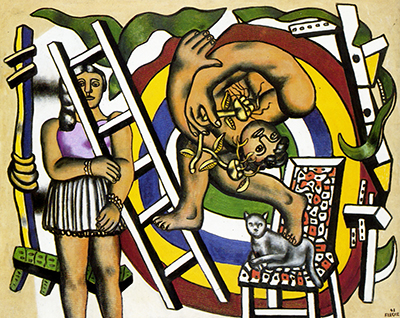
Fernand Léger, The Acrobat and his Partner. A later composition of performers and everyday objects develops another balance of weight and movement.
Léger in video
Explore abstraction, monumental painting and cinema through films from MoMA and the Centre Pompidou. These videos offer context for Léger’s wider work; the restoration film is in French.
Restaurer un… Fernand Léger
Follow conservation of Composition with Two Parrots, 1935–39, and look at painting on a monumental scale. French-language film.
Watch on YouTubeFernand Léger artworks directory
Works covered in these articles and further documented works. Studies and finished works have separate entries; alternate titles share an entry. This is not a catalogue raisonné.
| Name | Date | Medium |
|---|---|---|
| Acrobats and Clowns from Le Cirque | 1950 | |
| Adieu New York | 1946 | Painting |
| Ballet mécanique | 1924 | Film |
| Big Julie | 1945 | Painting |
| Builders with Aloe | 1951 | Painting |
| Charlot cubiste | 1924 | Sculpture |
| Chimneys on Rooftops | 1911 | Painting |
| Cirque (artist’s book) | 1950 | |
| Composition | 1929 | Painting |
| Composition (Study for Nude Model in the Studio) | 1912 | Drawing |
| Composition of Three Figures | 1932 | Painting |
| Composition with Two Parrots | 1935–39 | Painting |
| Construction Workers Final State | 1950 | Painting |
| Contrast of Forms | 1913 | Painting |
| Derrière le miroir, nos.121–122 (posthumous publication, includes a lithograph after Léger) | 1960 | |
| Drawing for The Card Game | 1917 | Drawing |
| Drawing for The Staircase | 1913 | Drawing |
| En attendant le départ | 1914 | Drawing |
| Grand Parade with Red Background | 1953 | Painting |
| J’ai tué (illustrated book) | 1918 | |
| La Cocarde, l’avion brisé | About 1916 | Drawing |
| La Couseuse | about1910 | Painting |
| La Fin du monde filmée par l’Ange N.-D. (illustrated book) | 1919 | |
| Les Femmes au bouquet (Women with a Bouquet) | 1921 | Painting |
| Man and Woman | 1921 | Painting |
| Man in Profile with Rope: Study for The Constructors | 1950/1 | Drawing |
| Man in the Blue Hat | 1937 | Painting |
| Matinée d’ivresse, from Les Illuminations | 1949 | |
| Mechanical Elements | 1918–23 | Painting |
| Mechanical Elements (Metropolitan Museum) | 1920 | Painting |
| Men in the City | 1919 | Painting |
| Mes voyages (posthumous illustrated book) | 1960 | |
| Mona Lisa with the Keys | 1930 | Painting |
| Nude Model in the Studio | 1912–13 | Painting |
| Nudes in the Forest | 1909–1911 | Painting |
| Propellers Second State | 1918 | Painting |
| Reading | 1924 | Painting |
| Soldier with a Pipe | 1916 | Painting |
| Soldiers Playing Cards | 1917 | Painting |
| Soldiers Playing Cards (front drawing) | 1916 | Drawing |
| Standing Nude, Rear View | 1911 | Drawing |
| Still Life with a Beer Mug | 1921–2 | Painting |
| Still Life with Tankard | 1921 | Drawing |
| Study for The Aviator | 1920 | Drawing |
| The Acrobat and his Partner | 1948 | Painting |
| The Acrobats in the Circus | 1918 | Painting |
| The Alarm Clock | 1914 | Painting |
| The Chalices and the Sponge, stained-glass model | 1950 | Drawing |
| The City | 1919 | Painting |
| The Disks in the City | 1920 | Painting |
| The Mechanic | 1920 | Painting |
| The Railway Crossing | 1919 | Painting |
| The Three Musicians | 1944, after a 1924–25 drawing | Painting |
| The Wheels | 1945 | Drawing |
| Three Women | 1921–22 | Painting |
| Two Women Holding Flowers | 1954 | Painting |
| Umbrella and Bowler | 1926 | Painting |
| Verdun, dessin du front | About 1915 | Drawing |
| Woman with a Book | 1923 | Painting |
| Woman: Costume Design for La Création du monde | c.1922–23 | Drawing |
Discussion
Look again at the images and ideas explored in Big Julie. These editorial prompts invite your observations.
Where does your eye linger longest: on Julie's flower, her outstretched hand, or the bicycle's turning forms?
Reader Insights
What becomes easier to notice in Big Julie when you compare it with The Acrobat and his Partner?
Where does the comparison with Two Women Holding Flowers reveal the clearest change in Léger’s approach?
Which detail would you follow first when returning to the work, and why?
Join the Conversation
Share a detail, comparison or question about Big Julie below.
References
- The Museum of Modern Art, Fernand Léger. Big Julie. 1945, collection record, object 141.1945: current title, date, medium, dimensions, credit and collection image. Record and image consulted 31 October 2026. View source.
- Kröller-Müller Museum, Nus dans la forêt / Nude Figures in a Forest, collection record KM 101.045. Current date, medium, identifier, curatorial sections “Distinctive cubist style”, “Geometric shapes” and “‘Battle of volumes’”, and museum reproduction. View source.
- Fondation Beyeler, Contraste de formes, Fernand Léger, current collection record, Inv.90.6: date, medium, dimensions, collection and signature on reverse. View source.
- Philadelphia Museum of Art, The City, 1919, collection record and interpretation; A. E. Gallatin Collection, 1952-61-58. View source.
- National Gallery of Canada, The Mechanic, 1920, accession 14985, collection details and interpretive paragraph; French collection record, Le mécanicien. View source.
- The Museum of Modern Art, Fernand Léger. Three Women. 1921–22, collection record, object 189.1942: artwork image, metadata, 2021 gallery label, publication excerpt, installation history and provenance. View source.
- Musée national Fernand Léger, La Joconde aux clés, collection record and museum commentary (French): object data, owning museum image, artist recollection, sardine tin and symbolic interpretations. The artist’s recollection is consulted as reproduced by the museum; the page does not date it. View source.
- Musée national Fernand Léger, “Les années 50, les constructeurs”, complete Les Constructeurs (définitif) entry and accompanying museum image: title, 1950 date, oil on canvas, 300 × 228 cm, inventory MNFL 94001, 1969 donation and museum-mediated Renault-canteen recollection. View source.
- Musée national Fernand Léger, La Grande Parade sur fond rouge, complete object record and displayed reproduction: 1953, oil on canvas, 114.5 × 156.2 cm, inventory MNFL 96006; donation of Nadia Léger and Georges Bauquier. View source.
- Fondation Beyeler, Fernand Léger. Paris–New York, German gallery guide, 2008, PDF p. 2, room 19B, entry 13, “La grande Julie, 1945”. Guide texts credited to Philippe Büttner, Raphaël Bouvier and Daniel Kramer. Entry consulted in the saved four-page guide, 31 October 2026. View source.
- Katharine Kuh, Léger (Chicago: Art Institute of Chicago, 1953), printed pp. 66–67 (PDF pp. 71–72), discussion of bicycle and circus figures and The Great Julie; printed p. 8 (PDF p. 13), explanation of the catalogue's use of quotations. Consulted in the saved catalogue text, 31 October 2026. View source.
- Rachel Boate, “Fernand Léger (1881–1955)”, Heilbrunn Timeline of Art History, Metropolitan Museum of Art, May 2018, paragraphs on the American years and late career. Consulted 31 October 2026. View source.
- The Museum of Modern Art, Léger exhibition press release and annotated checklist, 16 November 1960, PDF p. 1 and p. 3, Big Julie entry, quoting the artist's interview with James Johnson Sweeney in “Eleven Europeans in America”, The Museum of Modern Art Bulletin 13, nos. 4–5 (1946). Consulted in the saved document text, 31 October 2026. View source.