 by Tom Gurney
Tom Gurney BSc (Hons) is an art history expert with over 20 years experience
Published on June 19, 2020 / Updated on November 5, 2026
Email: tomgurney1@gmail.com / Phone: +44 7429 011000
Composition of Three Figures
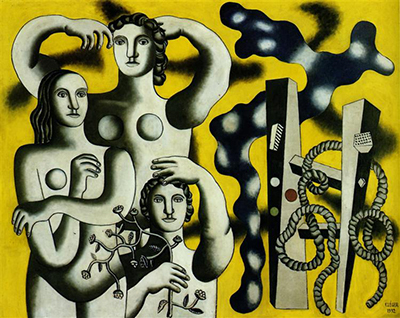
Three grey figures crowd one side of a brilliant yellow painting. A ladder and a looping rope occupy the other, while an irregular blue form moves between them. In Fernand Léger's Composition of Three Figures, bodies, everyday objects and shapes that resist naming share the same emphatic presence. The people are recognisable, but their arrangement is as carefully constructed as the objects beside them.
Painted in oil on canvas in 1932, Composition aux trois figures belongs to the Centre Pompidou's Musée national d'art moderne collection, inventory AM 2284 P. [1] Its attraction lies in an unusual balance: rounded bodies seem solid enough to touch, yet the surrounding space never becomes an ordinary room. Looking from the figures to the rope, and from the rope to the blue shape, reveals how Léger gives very different things a common pictorial language.
At a Glance
Two moments in Léger’s career
Contents
A group assembled from bodies
The largest figure raises both arms above her head. Their pale outer edges form a broad arch, enclosing the face and a patch of yellow. Dark shading gives the arms the weight of cylinders, but the long fingers introduce smaller, more flexible curves. The pose fills the upper left of the canvas without breaking its firm rectangular boundary.
Below and beside her, two smaller heads establish a descending rhythm. The left figure has long, dark hair, while the foreground figure's hair forms compact curls. Their faces share narrow noses, sharply outlined eyes and restrained mouths. These similarities hold the group together; differences in hair and position allow each face to remain distinct. They do not supply the kind of expressive exchange that would explain a conversation or event.
Hands connect the bodies more directly than glances do. One rests above the smallest figure's head; another crosses the foreground beside the flowering branch. Arms overlap torsos and return towards neighbouring forms. It can take a moment to follow where a limb begins and ends. That slight delay makes the grouping feel assembled through a sequence of interlocking shapes, even while its human subject remains clear.
The branch adds a finer scale of movement. Its slender stem, paired leaves and small flowers spread across the lower group. Although it suggests a living plant, it shares the figures' subdued grey colouring. The difference between a body and a branch therefore depends less on colour than on contour, size and the way each shape divides the surrounding space.
The ladder and the rope
At the right, the ladder offers a second kind of structure. Its thick uprights rise almost vertically, their rectangular faces meeting along crisp edges. Dark sides give them volume; small circular and patterned marks interrupt their broad surfaces. Compared with the figures' continuous curves, these straight boundaries feel abrupt and resistant.
The rope changes that impression. It winds around and between the uprights, forming loops that turn back towards themselves. Repeated light and dark divisions make its twisted construction visible. A length of rope can be followed through the painting as a succession of bends, crossings and hanging ends, much as an arm can be followed through the group on the left.
This correspondence is more useful than assigning a hidden meaning to either object. The ladder brings straight lines into contact with the rope's curves; the figures already contain a comparable contrast between firm outlines and rounded volumes. Léger makes the difference between flesh and equipment visible, then gives the eye reasons to move between them. The ladder is recognisable without needing a wall to lean against, and the rope remains convincing without an identifiable task to perform.
Blue, yellow and uncertain space
The blue shape prevents the two halves from settling into separate pictures. It stretches across the upper centre and descends between the people and the ladder. Rounded projections and narrowing passages give its contour an uneven pulse. Pale highlights swell inside it, suggesting volume, although they never turn it into a clearly identifiable object.
Its blue is particularly forceful against the yellow. The figures and ladder occupy a quieter range of whites, greys and blacks, so colour draws attention towards the least easily named element. We can recognise a face almost instantly, yet the blue form repeatedly calls the eye away from it. The painting makes visual prominence and descriptive certainty pull in different directions.
Dark patches spread across the yellow behind the figures and objects. Some resemble shadows, but together they do not establish a consistently measurable space. The yellow continues around the forms without resolving into a wall, sky or floor. We are given modelling, overlap and intervals, rather than a complete setting into which everything can be securely placed.
Neither a room nor an anecdote
This uncertain setting allows the painting to move between a figure group and a still life. The people occupy more space than the objects, but no story makes them the ladder's users or the rope's owners. Their proximity is a compositional fact before it becomes a narrative possibility. The blue form strengthens that openness: it belongs to the arrangement while refusing a familiar category.
A Centre Pompidou teaching text places the painting within Léger's dialogue between organic bodies and a mechanical environment. It stresses his treatment of people and objects as pictorial equivalents, organised through contrasts of curved and straight lines, flat passages and modelled forms. [2] This helps explain why the ladder can receive such sustained attention. Its edges and surfaces take part in the painting's construction as actively as the arms and faces.
Equivalence does not erase difference. A hand still suggests touch, a flower growth, and a rope flexibility. Those associations remain available while their outlines produce further relationships. The painting holds together because these two kinds of recognition operate at once: we identify things, then notice the formal exchanges that make them newly unfamiliar.
From manufactured objects to living forms
Léger was already exploring such exchanges before 1932. In the Musée national Fernand Léger's Nature morte of 1930, objects appear in fragments and familiar perspective gives way to an arrangement of contrasting forms. The museum describes keys passing across an orange shape with feminine curves, alongside forms suggesting a bust and a pipe case. It also notes the softening effect of sinuous bands within the composition. [3]
That comparison makes the 1932 painting's changes easier to see. Here the human figures are unmistakable and dominant, while a branch introduces a recognisable natural element. Yet the rope, ladder and ambiguous blue form preserve the freedom to combine unlike things. The shift towards bodies does not require a return to a self-contained scene or an illusionistic interior.
Nor does the picture simply exchange an interest in machines for an interest in nature. Its most supple shapes are set beside unusually insistent straight edges. The pleasure of the image comes from their coexistence: rounded flesh, twisted rope, rectangular supports and a wandering coloured contour each keep their character while sharing the canvas.
Surrealism without a dream story
Isabelle Monod-Fontaine, writing about the painting for the Centre Pompidou, connects its unexpected correspondences with the atmosphere of Surrealism. Her account presents this as an affinity within Léger's work, rather than a complete conversion to another movement. [1] The association is suggestive because the objects are individually legible while their encounter remains difficult to explain.
It does not make the painting a dream that can be decoded detail by detail. Nothing in its title identifies a myth, a specific episode or named sitters. The blue form can invite comparisons with living matter without becoming a documented symbol. Its ambiguity is something to experience through looking, rather than a gap that needs an invented explanation.
Curator Carolyn Lanchner's introduction to MoMA's 1998 Léger retrospective offers a broader caution. She challenged the lasting stereotype of Léger as principally a machine painter, emphasising his ability to bring abstraction and representation, flatness and depth into the same work. [4] Composition of Three Figures makes that breadth visible without sacrificing the clarity of its large shapes.
Keeping the versions distinct
The title does not identify every painting bearing these words as the same canvas. Christie's has catalogued a separate, smaller Composition aux trois figures, also dated 1932, with a provenance beginning in Marie Cuttoli's collection. [6] That ownership history belongs to the auctioned work; it should not be attached to the Pompidou painting.
The distinction also discourages an easy assumption about sequence. A related composition need not be a preparatory study merely because it is smaller. The existence of two canvases does not, by itself, establish which came first or explain the purpose of their repetition. Here the secure subject is the work identified by the Pompidou's inventory number.
MoMA's 1998 exhibition checklist includes Composition aux trois figures as a 1932 oil painting. [5] Read alongside the owning museum's record, it places the work within an extensive retrospective presentation. Its importance for a viewer remains more immediate: the pictured group, ladder, rope and blue form belong to a particular composition, rather than a generic image of Léger's style.
A painting bought for the public collection
The French state bought this canvas directly from Léger on 25 July 1936. Monod-Fontaine relates the acquisition to the opening towards modern art associated with the Popular Front government. [1] The purchase came four years after the painting's date, so that later political setting should not be mistaken for proof of an original government commission.
Public ownership gives the work another setting, but the image retains its resistance to a single message. Return to the smallest figure and the flowering branch, then follow the rope upwards. Each passage offers a different rhythm, yet the same contrasts recur across them. What first appeared to be a curious gathering becomes a sustained exercise in seeing relationships: between a person and an object, a line and a volume, something recognisable and something still open to interpretation.
Artworks directory
A selection of paintings and works on paper documented in collection records and catalogues. Similar titles identify different objects: the Basel and Met Mechanical Elements, the two Mechanic paintings and the Indianapolis painting and Städel drawing have separate entries. This is not a complete catalogue of Léger’s work. Additional entries labelled “Tate” come from the museum’s October 2014 catalogue. They retain its historical titles, dates and attributions; newer collection records are used where available. The list brings together selected records from these sources. [8]
| Name | Date | Medium |
|---|---|---|
| La Couseuse (The Sewing Woman) | about 1910 | Painting |
| Nude Figures in a Forest | 1909–11 | Painting |
| The Acrobats in the Circus (Basel) | 1918 | Painting |
| Sketch for The Acrobats in the Circus | 1918 | Painting |
| Two Acrobats | 1918 | Painting |
| Le Cirque Médrano | 1918 | Painting |
| Mechanical Elements (Basel) | 1918–23 | Painting |
| The Mechanic (LaM) | 1918 | Painting |
| The Mechanic (Ottawa) | 1920 | Painting |
| Mechanical Elements (Met) | 1920 | Painting |
| Man and Woman (Newfields) | 1921 | Painting |
| Woman with a Cat | 1921 | Painting |
| The Fishermen | 1921 | Painting |
| Homme et femme (Städel drawing) | 1921 | Drawing |
| Three Women | 1921–22 | Painting |
| Two Women | 1922 | Painting |
| Leaves and Shell (Tate N05907) | 1927 | Painting |
| Keys (Composition) (Tate N05990) | 1928 | Painting |
| Playing Card and Pipe (Tate N05991) | 1928 | Painting |
| The King of Hearts (Tate P01711) | 1949 | |
| Les Objets à Réaction Poetique (Tate P80180) | 1931–6 | Photograph |
| Two Women Holding Flowers (Tate T00246) | 1954 | Painting |
| Still Life with a Beer Mug (Tate T02035) | 1921–2 | Painting |
| The Acrobat and his Partner (Tate T03118) | 1948 | Painting |
| Mechanical Elements (Tate T06798) | 1926 | Drawing |
| ABC (Tate T06799) | 1927 | Drawing |
| Three Bottles (Tate T06800) | 1954 | Painting |
| Trees (Tate T06801) | 1923 | Drawing |
| Acrobats and Clowns — Le Cirque design | 1950 | Colour lithograph |
| Composition aux trois figures (Pompidou) | 1932 | Painting |
Frequently Asked Questions
- The Pompidou collection records the canvas as AM 2284 P. [1]
The Centre Pompidou's Musée national d'art moderne collection, following a French state purchase in 1936. [1]
Its identity is open. Follow its curves between the figures and the rope: its visual relationships are clearer than any single object it might represent.
Yes. Christie's has recorded a separate, smaller 1932 canvas with the same French title and a different provenance. Its ownership history should not be transferred to the Pompidou painting. [6]
Discussion
Compare the rounded bodies, looped rope, straight ladder edges and wandering blue form.
Which connection do you notice first: the curve of an arm and a loop of rope, the grey modelling shared by the people and ladder, or the blue shape moving between them? Describe the passage that changes how you read the rest of the painting.
Reader Insights
Which shape leads your eye between the two sides?
Do the grey figures feel more solid than the ladder?
Where does the picture stop resembling an ordinary room?
Join the Conversation
Share a detail, comparison or question about Composition of Three Figures below.
References
- Centre Pompidou, Composition aux trois figures, Fernand Léger, 1932, AM 2284 P; object fields and Isabelle Monod-Fontaine's analysis, reproduced from Collection art moderne – La collection du Centre Pompidou, Musée national d'art moderne, Brigitte Leal, ed., 2007, as credited on the collection record. French analysis and English/French object information consulted 28 October 2026. View source.Splash image: Composition aux trois figures, 1932, oil on canvas. Centre Pompidou, Musée national d’art moderne, AM 2284 P.
- Centre Pompidou, Fernand Léger : la beauté plastique du monde moderne, collection teaching sheet, salle 17, niveau 5, undated; PDF page 100 in the compiled institutional educational document. Relevant page consulted and visually checked 28 October 2026. View source.
- Musée national Fernand Léger, Nature morte, 1930, AM 2650 P, collection record and interpretation. French text consulted 28 October 2026. View source.
- Carolyn Lanchner, Fernand Léger, exhibition introduction, The Museum of Modern Art, 1998. English text consulted 28 October 2026. View source.
- The Museum of Modern Art, Fernand Léger, 1998 exhibition checklist, PDF page 1, entry for Composition aux trois figures, 1932. Consulted 28 October 2026. View source.
- Christie's, Fernand Léger (1881–1955), Composition aux trois figures, lot 6610432, object details and provenance of the separate 1932 canvas formerly in the Marie Cuttoli collection. Consulted 28 October 2026. View source.
- Centre Pompidou, La Couseuse, about 1910, AM 1984-578. Collection record and interpretation; accessed 28 October 2026. View source.
- Tate, Tate Collection metadata, artwork_data.csv, October 2014 snapshot, released under CC0. Repository readme states that this dataset is no longer maintained. Downloaded and artist rows inspected 28 October 2026. View source.