 by Tom Gurney
Tom Gurney BSc (Hons) is an art history expert with over 20 years experience
Published on June 19, 2020 / Updated on November 1, 2026
Email: tomgurney1@gmail.com / Phone: +44 7429 011000
Man in the Blue Hat: Introduction
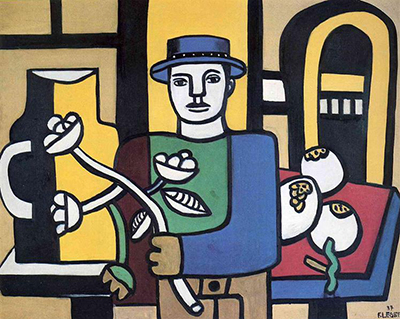
A man faces us beneath a blue hat while a long, pale stem curves across his body. Flowers spread towards the edges of the canvas, and a large vase rises beside him. In Fernand Léger’s Man in the Blue Hat, these familiar things acquire an unusual authority: a leaf can hold our attention as firmly as an eye, and a sleeve can feel as substantial as a wall. Painted in 1937, the work is an oil on canvas measuring 73 by 92 centimetres, now in the Musée national Fernand Léger in Biot. Its French title is L’Homme au chapeau bleu. [1]
The scene has the directness of a person presenting himself and the intricacy of an arrangement assembled piece by piece. Its strongest movement comes from the plant crossing the figure, while its stability comes from the upright head and broad body. We recognise the man almost immediately, then spend longer following the lines that bind him to his surroundings.
At a Glance
- ArtistFernand Léger
- SubjectMan in the Blue Hat
- Date1937 [1]
- CollectionMusée national Fernand Léger, Biot [1]
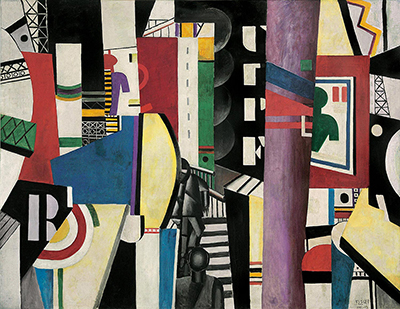
This work across Fernand Léger’s career
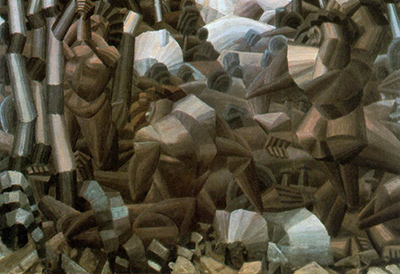
Nudes in the Forest
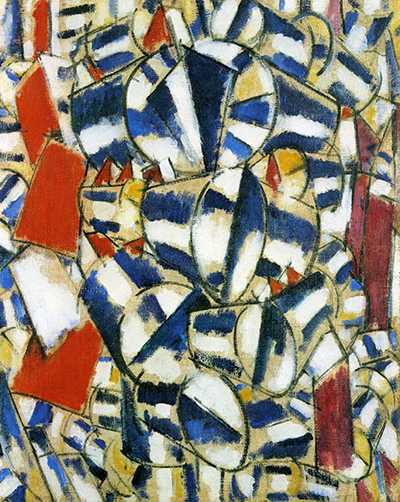
1909–1911 [2]Contrast of Forms
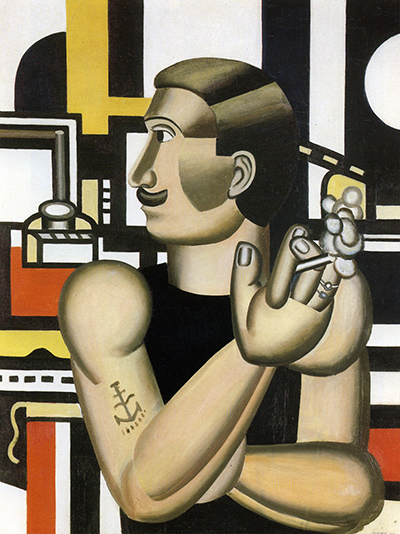
1913 [3]The Mechanic
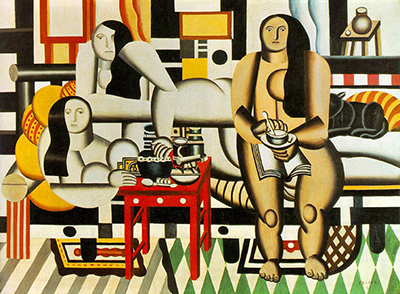
1920 [5]Three Women
1921–22 [6]Contents
- The hat and the face
- A hand, a stem and several kinds of flower
- A room made of edges
- Colour as construction
- The figure as an object in the 1930s
- A later view of the face
The hat and the face
The hat supplies the title and one of the picture’s clearest horizontal accents. Its oval brim extends beyond the head, giving the pale face a firm cap. The darker crown and band make the blue seem solid, while the little pale marks around the band introduce a finer rhythm. Above the large, simplified body, this small piece of clothing becomes surprisingly precise.
Under it, the face looks straight out. Dark eyebrows, two eyes, a strongly drawn nose and short horizontal marks around the mouth establish an expression with very few elements. The nose’s angular construction lends relief to the otherwise pale surface. The dark lower contour rounds off the chin, and the neck widens into a clean white band. These compressed details make the head readable at a distance while rewarding closer attention.
There is a quiet tension between the man's gaze and his gesture. His face addresses the viewer, while his hand attends to the plant below. The eyes do not follow the stem. This separation gives the action a suspended quality: we see someone holding something, but the picture does not hurry us towards the next stage of the task. The figure stands available to inspection, composed rather than caught in passing.
The dark curves enclosing the head also answer the much larger arched shape at the upper right. One belongs unmistakably to the man; the other suggests an architectural opening. Each places a pale or yellow zone inside a dark surround. Such echoes encourage us to move between face and setting, noticing how similar devices can make very different things visible.
A hand, a stem and several kinds of flower
The gripping hand near the lower centre is the hinge of the composition. Rounded fingers close around the pale stem, bringing a small, definite human action into the broad colour fields. From that point, the stem rises diagonally towards the left, passing in front of the torso and across the area occupied by the vase. Its curve pulls the eye out of the body's upright structure.
The flowers are emphatically constructed. Their white forms open like shallow cups, divided and bounded by black. Leaves project at intervals, some with a central line and repeated interior strokes. Léger makes the difference between leaf and flower clear through a small vocabulary of shape and marking. Their edges remain as assertive as the outlines of the man’s face and clothes.
At the right, several pale flower heads crowd against a red plane. Their roundness contrasts with its straight edges, while the dark divisions around them prevent their whites from merging. A green stem and leaves descend towards the lower border. These flowers form a separate cluster, answering the plant held by the man across the breadth of the canvas.
The exchange of scale is striking. The leaves and flower heads are large enough to compete with the face. The hand, in turn, is treated with the same economy as the leaves: each consists of a bounded shape with just enough internal marks to specify its character. Looking travels between the living body and the plant through these formal similarities. The flowers remain recognisable, yet their curves have as much compositional work to do as their botanical identity.
A room made of edges
The setting offers fragments of a furnished, architectural space. At the left, the broad vase rests above a white horizontal surface. A thick dark line underneath gives this support a firm edge. Behind the vase, black uprights and crossbars divide the yellow and muted brown background into unequal compartments. At the right, the arch and red surface suggest further objects or furnishings without resolving into a fully measurable room.
The setting presses close to the figure. There is little interval of open space between the man and the things around him, and few soft transitions to carry us gradually into depth. Instead, one contour meets another, and one colour stops where the next begins. The image feels fitted together, its objects claiming adjacent portions of the surface.
The vase is especially forceful. Its narrow neck, broad shoulders and curved side occupy much of the left-hand zone. Yellow and black divide its body, while white accents at the opening and along its side sharpen its silhouette. It has a physical presence comparable to the man's torso. The plant crosses it, linking the vessel to the hand through a line that cuts across their otherwise separate shapes.
The large arch on the right balances that tall vessel. Between these two upright presences, the man seems held in place. Yet the curving plant breaks through the enclosure they suggest. This balance between a firm framework and a mobile diagonal gives the composition much of its poise: the scene is crowded, but the eye always has a route through it.
Colour as construction
The shirt gathers blue, green and a reddish brown into a single body. Blue occupies the broad right-hand portion and sleeve; green forms a central area beneath the neck; the warmer colour runs down the opposite side. The divisions give the torso an internal structure as legible as the surrounding rectangles. They also tie it to the setting, where yellow, red and dark outlines organise the available space.
Blue returns in the hat and in the sloping edge beneath the red plane at the right. Green links the shirt to the leaves. These recurrences carry attention across the canvas instead of allowing it to settle permanently on the head. White makes another, more dispersed sequence: face, neck, flowers, stem, vase accents and supporting surface. Each pale passage catches the eye, but each has a different shape and direction.
The painting suggests volume through rounded contours, overlaps and small tonal shifts, particularly in the hat. At the same time, its larger colour areas remain insistently flat. The blue sleeve can read as a bent arm and as a broad shape wrapping around the green panel. The vase can feel bulky while its contrasting halves remain almost like cut pieces. This double reading gives familiar objects their peculiar solidity: they occupy the imagined scene while keeping a strong hold on the canvas surface.
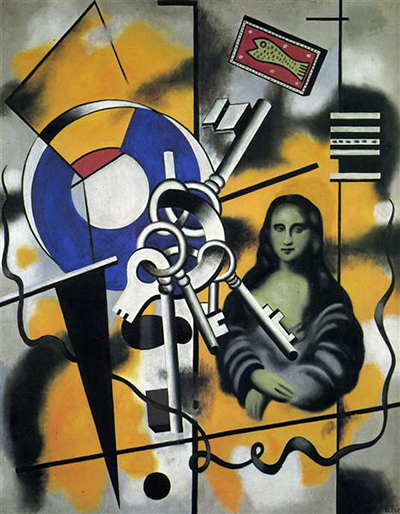
Fernand Léger, Mona Lisa with the Keys. The contrast between a face and enlarged objects takes a different form in this composition.
The figure as an object in the 1930s
Léger had been exploring the relationship between human beings and objects long before this painting. The Centre Pompidou’s account of his work describes the “figure-object” in relation to La Lecture of 1924: bodies and faces become material for pictorial construction alongside other forms. Its discussion of his 1929 Composition traces a related interest in objects valued for their shapes, colours and relationships. [10]
The idea helps explain the equal force of head, hand, vase and flowers here. Each is given a bold outline and a clearly articulated shape. The man remains the organising presence, but nearby objects receive comparable visual emphasis. Even the little repeated marks within a leaf can rival those describing his features.
A statement close to the painting’s date gives this approach further substance. In his 1935 lecture at the Museum of Modern Art, reproduced in the Pompidou dossier, Léger argued for the freedom gained when the object and pure colour became central to composition. He used the example of a tree studied for the visual possibilities of its bark, branches and leaves. [10] In Man in the Blue Hat, the plant’s patterned leaves and branching movement offer a particularly clear way to see such possibilities at work.
These formal concerns developed alongside a widening interest in the public for modern art. Rachel Boate’s Metropolitan Museum essay connects Léger’s work of the 1930s with an effort to make modern painting accessible and with his involvement in the French Popular Front. She also notes his teaching of workers in the middle of that decade. [11] The immediately identifiable hat, face and flowers make this canvas approachable, while their unusual arrangement keeps the act of recognition lively.
In the same year, 1937, Léger undertook major public-art commissions for the Paris International Exposition, including Le Transport des Forces. The Biot museum’s exhibition dossier places those projects within his ambition to bring painting into public space and into dialogue with architecture. [1] This smaller canvas offers a more intimate encounter with forceful colour and familiar forms. Its dimensions allow us to take in the whole arrangement at once, then return to individual contours.
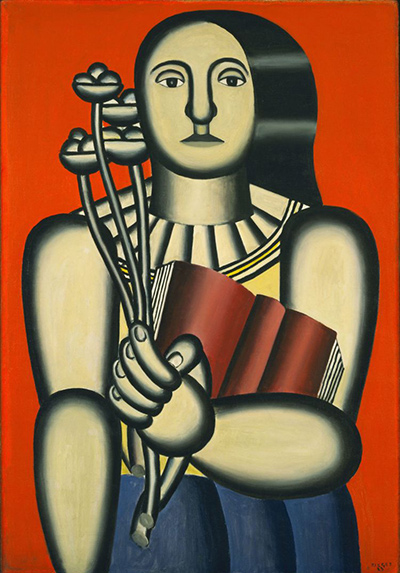
Fernand Léger, Woman with a Book. An earlier frontal figure makes a useful comparison for the face, hands and accompanying objects.
A later view of the face
In the museum’s 2024 exhibition Léger et les Nouveaux Réalismes, it appeared in the section “Des visages-objets”, alongside Daniel Spoerri’s Agg i Hatten of 1965. The accompanying gallery argument considered the growing prominence of objects and the treatment of faces as objects or machines, while distinguishing Léger’s painted representations from later artists’ use of actual things. [12]
That later curatorial setting brings a useful feature of this canvas into focus. The man's face is both a human address and an arrangement of components. Eyes, brows and nose are sufficiently distinct to be read individually, yet together they produce a calm, unmistakable presence. The same process makes the vase a vessel and the small patterned shapes leaves. Across the painting, recognition emerges from the fitting of parts.
The enduring pleasure lies in following those parts without losing the scene. The blue hat keeps its familiar character; the hand continues to grip; the flowers open towards us. At the same time, their colours and contours keep drawing us sideways, from person to plant to vessel to surrounding frame. Léger makes an ordinary encounter hold together with the deliberateness of a carefully built object.
Léger in video
Explore abstraction, monumental painting and cinema through films from MoMA and the Centre Pompidou. These videos offer context for Léger’s wider work; the restoration film is in French.
Restaurer un… Fernand Léger
Follow conservation of Composition with Two Parrots, 1935–39, and look at painting on a monumental scale. French-language film.
Watch on YouTubeFernand Léger artworks directory
Works covered in these articles and further documented works. Studies and finished works have separate entries; alternate titles share an entry. This is not a catalogue raisonné.
| Name | Date | Medium |
|---|---|---|
| Acrobats and Clowns from Le Cirque | 1950 | |
| Adieu New York | 1946 | Painting |
| Ballet mécanique | 1924 | Film |
| Big Julie | 1945 | Painting |
| Builders with Aloe | 1951 | Painting |
| Charlot cubiste | 1924 | Sculpture |
| Chimneys on Rooftops | 1911 | Painting |
| Cirque (artist’s book) | 1950 | |
| Composition | 1929 | Painting |
| Composition (Study for Nude Model in the Studio) | 1912 | Drawing |
| Composition of Three Figures | 1932 | Painting |
| Composition with Two Parrots | 1935–39 | Painting |
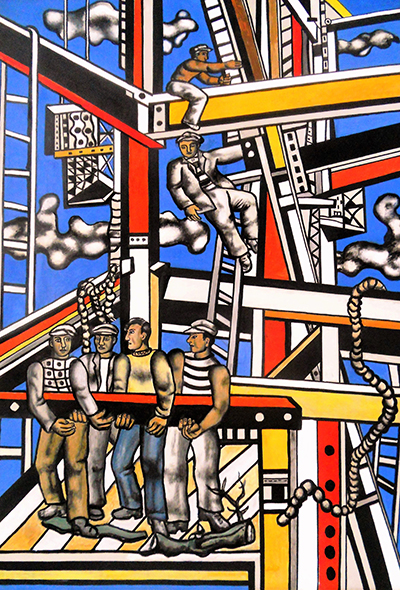
| Construction Workers Final State | 1950 | Painting |
| Contrast of Forms | 1913 | Painting |
| Derrière le miroir, nos.121–122 (posthumous publication, includes a lithograph after Léger) | 1960 | |
| Drawing for The Card Game | 1917 | Drawing |
| Drawing for The Staircase | 1913 | Drawing |
| En attendant le départ | 1914 | Drawing |
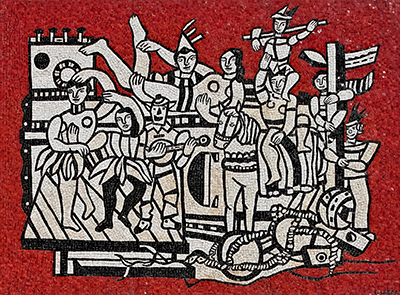
| Grand Parade with Red Background | 1953 | Painting |
| J’ai tué (illustrated book) | 1918 | |
| La Cocarde, l’avion brisé | About 1916 | Drawing |
| La Couseuse | about1910 | Painting |
| La Fin du monde filmée par l’Ange N.-D. (illustrated book) | 1919 | |
| Les Femmes au bouquet (Women with a Bouquet) | 1921 | Painting |
| Man and Woman | 1921 | Painting |
| Man in Profile with Rope: Study for The Constructors | 1950/1 | Drawing |
| Man in the Blue Hat | 1937 | Painting |
| Matinée d’ivresse, from Les Illuminations | 1949 | |
| Mechanical Elements | 1918–23 | Painting |
| Mechanical Elements (Metropolitan Museum) | 1920 | Painting |
| Men in the City | 1919 | Painting |
| Mes voyages (posthumous illustrated book) | 1960 | |
| Mona Lisa with the Keys | 1930 | Painting |
| Nude Model in the Studio | 1912–13 | Painting |
| Nudes in the Forest | 1909–1911 | Painting |
| Propellers Second State | 1918 | Painting |
| Reading | 1924 | Painting |
| Soldier with a Pipe | 1916 | Painting |
| Soldiers Playing Cards | 1917 | Painting |
| Soldiers Playing Cards (front drawing) | 1916 | Drawing |
| Standing Nude, Rear View | 1911 | Drawing |
| Still Life with a Beer Mug | 1921–2 | Painting |
| Still Life with Tankard | 1921 | Drawing |
| Study for The Aviator | 1920 | Drawing |
| The Acrobat and his Partner | 1948 | Painting |
| The Acrobats in the Circus | 1918 | Painting |
| The Alarm Clock | 1914 | Painting |
| The Chalices and the Sponge, stained-glass model | 1950 | Drawing |
| The City | 1919 | Painting |
| The Disks in the City | 1920 | Painting |
| The Mechanic | 1920 | Painting |
| The Railway Crossing | 1919 | Painting |
| The Three Musicians | 1944, after a 1924–25 drawing | Painting |
| The Wheels | 1945 | Drawing |
| Three Women | 1921–22 | Painting |
| Two Women Holding Flowers | 1954 | Painting |
| Umbrella and Bowler | 1926 | Painting |
| Verdun, dessin du front | About 1915 | Drawing |
| Woman with a Book | 1923 | Painting |
| Woman: Costume Design for La Création du monde | c.1922–23 | Drawing |
Discussion
Look again at the images and ideas explored in Man in the Blue Hat. These editorial prompts invite your observations.
Reader Insights
What becomes easier to notice in Man in the Blue Hat when you compare it with Woman with a Book?
Where does the comparison with Mona Lisa with the Keys reveal the clearest change in Léger’s approach?
Which detail would you follow first when returning to the work, and why?
Join the Conversation
Share a detail, comparison or question about Man in the Blue Hat below.
References
- Musée national Fernand Léger, Le Transport des Forces, exhibition press dossier, PDF p. 20 (printed p. 19), checklist entry for L’Homme au chapeau bleu, inventory MNFL 95021; PDF pp. 12 and 15 (printed pp. 11 and 14), exhibition texts on the 1937 commissions. Consulted 31 October 2026. View source.
- Kröller-Müller Museum, Nus dans la forêt / Nude Figures in a Forest, collection record KM 101.045. Current date, medium, identifier, curatorial sections “Distinctive cubist style”, “Geometric shapes” and “‘Battle of volumes’”, and museum reproduction. View source.
- Fondation Beyeler, Contraste de formes, Fernand Léger, current collection record, Inv.90.6: date, medium, dimensions, collection and signature on reverse. View source.
- Philadelphia Museum of Art, The City, 1919, collection record and interpretation; A. E. Gallatin Collection, 1952-61-58. View source.
- National Gallery of Canada, The Mechanic, 1920, accession 14985, collection details and interpretive paragraph; French collection record, Le mécanicien. View source.
- The Museum of Modern Art, Fernand Léger. Three Women. 1921–22, collection record, object 189.1942: artwork image, metadata, 2021 gallery label, publication excerpt, installation history and provenance. View source.
- Musée national Fernand Léger, La Joconde aux clés, collection record and museum commentary (French): object data, owning museum image, artist recollection, sardine tin and symbolic interpretations. The artist’s recollection is consulted as reproduced by the museum; the page does not date it. View source.
- Musée national Fernand Léger, “Les années 50, les constructeurs”, complete Les Constructeurs (définitif) entry and accompanying museum image: title, 1950 date, oil on canvas, 300 × 228 cm, inventory MNFL 94001, 1969 donation and museum-mediated Renault-canteen recollection. View source.
- Musée national Fernand Léger, La Grande Parade sur fond rouge, complete object record and displayed reproduction: 1953, oil on canvas, 114.5 × 156.2 cm, inventory MNFL 96006; donation of Nadia Léger and Georges Bauquier. View source.
- Centre Pompidou, Fernand Léger, educational dossier, 2008, “Figures et objets” and the excerpt from Léger’s 1935 lecture “Un nouveau réalisme, la couleur pure et l’objet”. Consulted 31 October 2026. View source.
- Rachel Boate, “Fernand Léger (1881–1955)”, Metropolitan Museum of Art, May 2018, especially the paragraphs on the 1930s, democratic accessibility and teaching. Consulted 31 October 2026. View source.
- Musée national Fernand Léger, Léger et les Nouveaux Réalismes, press dossier, 2024, p. 10, gallery text “La vie des objets”, and p. 24, “Des visages-objets” checklist. Consulted 31 October 2026. View source.